
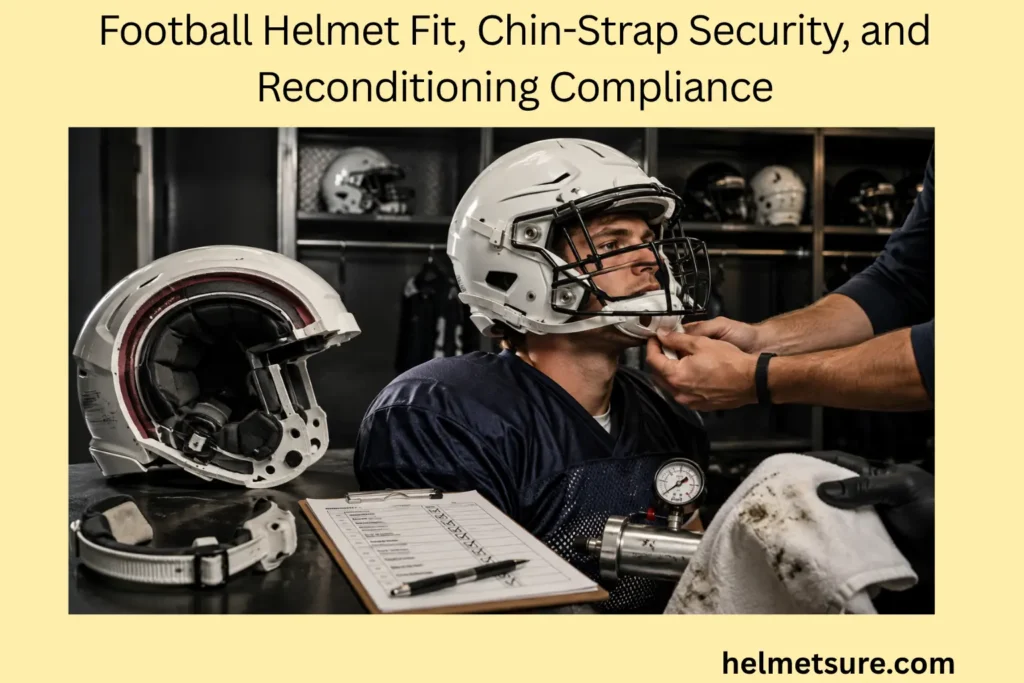
Football Helmet Fit, Chin-Strap Security, and Reconditioning Compliance
Football helmet readiness depends on correct size and position, consistent internal contact, secure chin-strap retention, serviceable components, and current manufacturer-compliant certification or recertification status; no size label, tight strap, or reconditioning sticker proves complete suitability.
Fit, retention, condition, reconditioning, and certification answer different questions. A size chart identifies a candidate helmet. A fitting process determines whether that helmet works with one player’s head. The chin strap helps retain an already correct fit. Inspection addresses present condition. Reconditioning restores eligible equipment through a controlled service process, while recertification retests previously certified equipment against the applicable performance requirements. Readiness exists only when every required layer can be verified.
This guide does not replace the exact helmet manufacturer’s fitting, component, care, and reconditioning instructions. Questions involving structural condition, certification status, or service eligibility should be routed to the manufacturer, a qualified football equipment manager, a licensed reconditioner, or another competent protective-equipment professional.
Football Helmet Safety Depends on Stable Position and Equipment Condition, Not Size Alone
Football helmet size identifies a candidate shell, while functional readiness additionally depends on helmet position, internal contact, retention, component condition, and applicable certification status.
Treat readiness as a sequence of gates. First identify the exact model and candidate size. Then establish shell position, internal contact, and player-specific stability before securing the chin strap. Next verify retention, inspect the shell and every functional component, and confirm the required certification or recertification documentation. Success in one area cannot compensate for failure in another.
Helmet size as a starting measurement rather than proof of correct fit
Football helmet size is a starting measurement that narrows candidate shells but does not by itself establish correct player-specific fit.
Manufacturers assign sizes using their own shell geometry, padding system, and measurement ranges. The same circumference can fall into different labeled sizes across brands or even across models from one brand. Two players with the same circumference can also have different head length, width, crown shape, facial geometry, hair conditions, and pressure patterns.
Measure exactly as the manufacturer directs, select the candidate size from that model’s current chart, and then perform the complete fitting procedure. The final decision must consider shell position, crown and interior contact, jaw interface where applicable, pressure distribution, and movement before the chin strap is used as a retention check.
Do not size up merely to eliminate all firm contact, and do not size down to create a feeling of tightness. The correct size is the candidate that supports a stable, properly positioned, serviceable configuration within the manufacturer’s adjustment range.
Why shell position, internal contact, and retention must function together
Football helmet shell position, internal contact, and retention must function together because each controls a different part of how the helmet remains aligned on the player’s head.
Shell position determines where the helmet sits relative to the forehead, crown, ears, and face. Internal pads or liners establish contact between the head and shell system, distribute pressure, and help limit independent shell movement. The chin strap then helps preserve that established position during normal movement.
Evaluate in order: position the shell, configure approved internal components, verify baseline contact and movement, secure the complete chin strap, and repeat the stability check. If a later step moves the helmet away from the earlier correct position, the setup remains unresolved.
How damaged or degraded components can undermine an otherwise correct fit
Damaged or degraded pads, liners, jaw components, straps, buckles, snaps, or hardware can undermine a football helmet fit that was previously correct.
Internal padding can compress, tear, detach, harden, leak, or move from its intended location. Chin-strap webbing can fray or twist; snaps, buckles, ratchets, and attachment points can loosen or fail; screws and related hardware can corrode, strip, or back out. Each change can alter contact, retention geometry, or the helmet’s ability to hold an adjustment.
A helmet that fitted last season should not be assumed to fit now. Player assignment, growth, hairstyle, component wear, part replacement, cleaning history, and service work can all change the relationship between head and helmet. Recheck after any meaningful change and before normal use resumes.
Use only manufacturer-authorized parts and procedures for the exact model. A component that physically fits is not necessarily equivalent in material, dimensions, attachment, or function.
What fit checks cannot establish about a helmet’s structural condition
Football helmet fit checks cannot establish whether the shell, internal protective structure, hardware, or certification status remains acceptable for continued use.
A structurally questionable helmet can still feel snug. A shell crack, deformation, chemical exposure, altered hole, damaged liner, or incompatible part may not cause obvious movement during a quick fit check. Conversely, an intact-looking shell can have expired or unverifiable certification status. Fit is therefore evidence about player compatibility, not structural proof.
Inspect condition independently. Check the shell, interior system, attachment points, labels, hardware, retention, and service history using the exact manufacturer and reconditioning criteria. Do not cover damage with paint, decals, adhesive, or improvised repair and then rely on fit as evidence of acceptability.
When structural condition or certification cannot be verified, stop normal use pending qualified evaluation. A successful fit test should never override an unresolved condition or compliance concern.
How Correct Helmet Position Creates the Foundation for Functional Fit
Correct football helmet position aligns the shell and interior fit system with the player’s head so later pressure, movement, jaw-pad, and retention checks evaluate the intended configuration.
How the helmet should sit relative to the forehead and crown
A football helmet should sit at the forehead and crown position specified by its manufacturer before internal fit or chin-strap adjustments are judged.
The correct front-edge location, helmet height, and ear relationship can vary by model. Use the current fitting instructions supplied with the exact helmet rather than applying one familiar measurement to every design. Align the shell first, then check that the crown and internal fit system support that position.
General educational guidance often uses the ears as a visual reference, but the manufacturer remains authoritative. The discussion of ear-centered helmet position can help explain why an offset shell may indicate improper height or tilt; it does not replace model-specific landmarks.
After positioning, confirm clear vision, correct faceguard relationship, even contact, and an undistorted chin-strap path. If the helmet immediately slides away from the intended position before retention is secured, investigate size, padding, and head-shape compatibility.
Why excessive forward, backward, or elevated positioning signals a fit problem
Persistent forward, rearward, low, or elevated helmet position signals that football helmet sizing or internal adjustment requires correction.
A forward-sliding helmet can change the player’s view and forehead relationship. Rearward position can expose more of the front of the head and alter jaw or strap geometry. A helmet that sits too high may lack crown contact or have an incompatible pad arrangement; one that sits too low can interfere with vision, faceguard clearance, or facial position.
Do not correct an orientation problem by pulling one strap harder. Return to the baseline: verify shell size, confirm all required internal components, follow the approved adjustment sequence, and reset the helmet. Make one authorized change at a time so the cause remains identifiable.
If the intended position cannot be maintained without excessive compression, gaps, unauthorized padding, or extreme strap tension, select another authorized size or model rather than accepting the displaced shell.
How internal padding should maintain consistent contact around the head
Football helmet internal padding should maintain the manufacturer-intended contact pattern around the player’s head without large unsupported gaps or inappropriate localized loading.
The exact pattern depends on the design. Some helmets use inflatable liners, others use fixed or removable pad systems, and some combine multiple fit components. Do not assume a procedure for one system applies to another. Required crown, side, rear, forehead, and jaw contacts must be checked using the model guide.
Consistent contact helps the shell move with the head instead of sliding independently. Large gaps can permit motion; a concentrated hard spot can indicate incorrect size, pad arrangement, or adjustment. A snug feeling at one location is not proof of complete internal fit.
Do not add generic foam, cut approved pads, substitute a liner, or inflate beyond the manufacturer’s instructions. If the authorized system cannot provide the intended contact pattern, the helmet-player combination does not pass.
Why hair, head coverings, and padding changes can alter effective fit
Hair, approved head coverings, and changes to football helmet padding can alter the effective shell-to-head interface and therefore require fit to be rechecked.
Long hair, braids, locs, a major haircut, or an approved skull cap can change circumference, contact, shell height, and pressure distribution. The player should be fitted in the hairstyle and permitted head covering expected during practices and games. A change later in the season can invalidate the earlier adjustment.
Pad or liner replacement also changes the interface. Even an authorized part can restore thickness or contact that had gradually been lost, which means the old shell position and strap settings may no longer be correct. Treat replacement as a new fitting event.
Never use compressible hair or an unauthorized covering as a fit component. Verify that the shell remains positioned, evenly supported, and stable under the real use condition.
How to Verify Football Helmet Fit Before Securing the Chin Strap
Football helmet fit should be verified through size, crown contact, pressure distribution, interior contact, and shell movement before chin-strap tension is allowed to influence the result.
This pre-retention stage isolates shell-to-head compatibility. If the helmet is only stable after aggressive chin-strap tension, the fitter cannot tell whether the shell and internal system actually fit. Establish the baseline first, then use retention to preserve it.
Checking circumference and shell-size selection before fine adjustment
Check head circumference and the exact manufacturer’s shell-size chart before using pads, inflation, or retention adjustments to fine-tune football helmet fit.
Measure at the location and with the technique specified by the manufacturer. Keep the tape level, use the stated units, and record the result. If the player is near a boundary, follow the model’s tie-break instructions or evaluate both permitted candidates rather than guessing.
Confirm the shell label and model, not just a loose pad kit or storage-bin marking. A mislabeled assignment can send the rest of the fitting process in the wrong direction. Then install or configure only the approved interior components for that shell and player.
Inflation, jaw-pad selection, or pad thickness can fine-tune an appropriate candidate within authorized limits. These adjustments should not be used to force a clearly oversized, undersized, or incompatible shell to work.
Confirming crown contact without excessive vertical space
Crown contact should match the helmet manufacturer’s fitting instructions so the shell does not remain improperly suspended above the player’s head or load the wrong area.
Check whether the player’s head reaches the intended crown interface and whether the helmet maintains its specified height. Excess vertical space can allow the shell to sit high or move downward after the chin strap is tightened. Excessive crown pressure can indicate an undersized shell, wrong pad arrangement, or incorrect adjustment.
Do not invent a universal crown-gap measurement. Helmet interiors vary, and visual access can be limited. Use the fitting method for the exact model, together with player feedback and shell-position checks.
If correct crown contact cannot be established without moving the shell away from the required forehead and ear relationship, return to size and internal configuration. All positional checks must agree.
Checking side-to-side and front-to-back pressure distribution
Side-to-side and front-to-back football helmet contact should be evaluated for stable, distributed support rather than obvious gaps or concentrated compression.
Check the front, sides, rear, crown, and jaw interface as the model permits. The shell should not rock around one tight point or float over a large unsupported region. Compare left and right contact, ask about pressure, and observe whether controlled shell movement transfers to the head.
Visible or felt head and jaw gaps can help identify incomplete contact, but jaw fit must not be used as a shortcut for the upper shell. Diagnose whether the issue comes from shell size, head geometry, pad selection, inflation, placement, or worn components.
Make only manufacturer-approved adjustments. If distributed support cannot be created without painful compression elsewhere, choose another candidate.
Identifying painful pressure points versus firm uniform contact
Firm football helmet contact should be distinguished from persistent painful pressure because excessive localized compression can indicate a poor fit rather than superior security.
A new fitting may feel snug, but sharp pain, numbness, headache, skin pinching, one-sided jaw pressure, or a single intense hotspot is not evidence that the helmet is safer. These symptoms can indicate an undersized shell, incompatible head geometry, incorrect padding, overinflation, or asymmetric adjustment.
Ask the player directly and recheck after several minutes in the correctly positioned helmet. Inspect the contact pattern rather than loosening or tightening one part at random. Correct the cause through the authorized fitting range.
Comfort alone does not prove fit, but pain can reveal a failure. If firm, distributed contact and stable position cannot coexist without persistent pain, the player needs another approved size, internal configuration, or helmet model.
Testing whether the shell shifts independently of the player’s head
Before relying on the chin strap, test whether the football helmet shell moves excessively relative to the player’s head under the manufacturer’s fit-check procedure.
Use the exact method supplied for the model. The fitter may apply controlled side-to-side or front-to-back pressure and observe whether the forehead skin and head move with the shell or whether the helmet slides independently. Do not invent a universal movement distance.
Record the direction and location of movement. Rocking may indicate a shape mismatch; vertical travel may indicate poor crown contact; lateral movement can involve shell size or jaw/internal fit; a slipping pad may reveal a condition problem.
If the baseline helmet moves excessively, correct size and approved internal fit before fastening the chin strap. Retention is the next gate—not a mechanism for hiding the failed one.
How Jaw Pads and Internal Fit Components Control Side-to-Side Helmet Movement
Jaw pads and other football helmet fit components help control lower-shell contact and lateral stability but cannot compensate indefinitely for an incorrectly sized shell.
Jaw systems vary. Some helmets use removable pads of different authorized thicknesses; others use inflatable or integrated components. Fitters must identify the exact model and component system before making any change. The goal is proper contact within a shell that already fits through the crown and upper interior.
How jaw-pad contact helps stabilize the lower portion of the helmet
Football helmet jaw-pad contact helps stabilize the lower shell by maintaining the manufacturer-intended interface with the player’s face and jaw area.
Correct contact can reduce lateral shell movement and help keep the faceguard and chin cup centered. It should be evaluated with the helmet at its intended height and with the approved components installed. A jaw pad that is misplaced, folded, detached, or wrong for the model can create misleading pressure.
Jaw contact is only one fit attribute. The shell must also be correct at the crown, forehead, sides, and rear. A helmet that clamps the cheeks while rocking above them remains a failed fit.
Follow the model’s jaw-pad selection, inflation, or adjustment process. Recheck the entire helmet after a jaw component changes because lower-shell adjustment can affect overall position and strap geometry.
Why undersized pads can allow excessive lateral movement
Undersized or insufficiently adjusted jaw components can leave excess space and permit unwanted lateral football helmet movement.
The player may feel the shell shift across the face, the chin cup may move off center, or the ear and faceguard relationship may change when the helmet is pushed. This does not automatically mean the shell size is wrong, but the cause must be separated from upper-shell fit and component condition.
Confirm that the pad belongs to the exact model, is installed correctly, and remains serviceable. Use only the manufacturer’s authorized thickness or adjustment range. If an approved change restores lower contact while the crown and upper shell remain correct, repeat the full movement and retention checks.
If progressively larger jaw components are required to control a shell that remains loose elsewhere, the shell may be oversized or geometrically incompatible. Do not continue compensating indefinitely.
Why oversized pads can create pressure without producing correct overall fit
Oversized football helmet jaw pads can create excessive facial pressure without correcting a shell that is otherwise too large or geometrically incompatible.
Thicker or overadjusted jaw components can squeeze the cheeks, distort the chin cup, make the helmet difficult to put on, or hold the lower shell while the crown still rocks. The player may report tightness even though the helmet’s primary shell-to-head relationship has not improved.
Evaluate pressure and movement together. If reducing the jaw component relieves pain but reveals an oversized shell, select the correct shell rather than restoring discomfort. If the shell fits and only the lower interface needs adjustment, stay within the exact manufacturer’s permitted options.
“Tighter” is not the goal. The goal is stable, distributed contact across the complete fitting system without persistent painful compression.
How worn or compressed padding can change helmet stability over time
Worn, compressed, damaged, or displaced football helmet padding can change fit and stability over time even when the shell itself has not changed size.
Repeated use, sweat, cleaning, storage, and normal material aging can affect thickness, attachment, elasticity, inflation, and shape. A player may gradually tighten straps or add air to compensate without recognizing that a component no longer performs as intended.
Compare the current system with the model’s service criteria. Look for permanent compression, tears, detachment, leaks, hardening, contamination, or recurring displacement. Do not establish universal wear thresholds by eye; route uncertain components to the manufacturer or qualified service process.
Replace only with authorized parts, then treat the helmet as newly fitted. Restored components can change shell height, contact, and retention, so previous settings cannot be assumed correct.
How Chin-Strap Security Keeps a Correctly Fitted Helmet in Position
A football helmet chin strap is a retention system that helps preserve an already correct helmet fit rather than creating correct fit from an oversized or poorly positioned shell.
How chin-strap attachment points resist helmet displacement
Football helmet chin-strap attachment points create the retention geometry that helps limit helmet displacement after the shell and interior fit have been established.
Front and rear connections can resist different directions of movement. The chin cup provides a centered interface, while the strap paths and hardware keep tension distributed. Exact geometry varies across traditional snap systems, ratcheting systems, and manufacturer-specific designs.
Inspect every anchor and connection for compatibility, damage, secure engagement, and correct routing. A strap that is twisted or attached to the wrong point can feel tight while applying tension in the wrong direction. A missing or unreliable connection changes the complete retention system.
Do not substitute a generic strap or hardware because it appears to attach. Confirm that the component is approved for the exact helmet and faceguard configuration.
Why all required attachment points must remain engaged during use
Every chin-strap attachment point required by the football helmet manufacturer should remain correctly engaged because the retention system is designed to function as a complete configuration.
Leaving one snap open or one ratchet partially engaged changes the load path and can permit the helmet to rotate or lift. The remaining points may feel tight but are not proof that the intended system is intact. Repeated detachment can signal worn webbing, incompatible hardware, a damaged snap, or an incorrect adjustment.
The consequences of an unsecured chin strap should be understood as a retention failure, not merely a uniform issue. Stop and correct the complete system before use. Do not tie, tape, or improvise around unreliable hardware.
Confirm each required point visually and by the manufacturer’s engagement check, then perform the final movement test.
How strap tension affects retention without correcting an oversized shell
Football helmet chin-strap tension affects how well the retention system limits displacement but cannot correct an oversized shell or incompatible internal fit.
Under-tension can allow the chin cup to move, a connection to disengage, or the shell to lift and rotate. Excess tension can pull the helmet downward or backward, distort the chin cup, create pain, and mask the movement caused by poor shell fit.
Set tension only after the helmet passes baseline fit. Balance the approved attachment points so the chin cup remains centered and the shell retains its intended position. Ask the player about jaw movement, breathing, and painful pressure without treating comfort alone as proof.
If reasonable authorized tension does not stabilize the helmet, return to shell size, internal components, hardware condition, and strap compatibility. Do not keep tightening.
Why twisting, damaged webbing, or compromised hardware changes retention security
Twisted football helmet straps, damaged webbing, unreliable snaps, broken buckles, or compromised attachment hardware can prevent the retention system from maintaining its intended configuration.
Twisting changes how load is distributed and may prevent a strap from lying correctly. Fraying, cuts, stretching, chemical damage, cracked hardware, failed ratchets, loose anchors, or repeated snap release can cause the setting to change during use.
Inspect the complete strap at every fitting and routine check. Straighten routing only as the manufacturer directs, and replace damaged components through the approved part and service path. Do not stitch, melt, tape, knot, or glue retention parts.
After an authorized replacement, start the fit process again. A new strap or buckle can change adjustment range and chin-cup position even when the shell and pads are unchanged.
How to Test Chin-Strap Fit and Helmet Retention as One System
Final football helmet retention should be tested only after shell size, position, interior contact, and chin-strap configuration have been established.
The final test asks whether the complete fitted and secured helmet maintains its intended relationship with the player’s head. A tight-feeling strap is not the outcome; stable shell position through the prescribed movement check is the outcome.
Checking chin-cup position and centered contact
The football helmet chin cup should sit in the manufacturer-intended centered position before strap tension and complete retention are evaluated.
The cup should not ride on the throat, slide to one side, or force the jaw into an unnatural position. A visibly offset cup can result from unequal strap length, twisted routing, wrong attachment points, incompatible hardware, or a helmet that is already displaced.
Center the shell first, then the cup, and adjust the prescribed straps in the stated sequence. Check the relationship again while the player opens and closes the mouth and turns the head as permitted by the fitting instructions.
If the cup cannot remain centered without pulling the helmet away from its correct position, the retention configuration or underlying fit is unresolved. Do not approve the setup because the buckle closes.
Verifying balanced strap tension across attachment points
Football helmet strap tension should be adjusted across the manufacturer’s required attachment points so the chin cup and shell remain centered rather than being pulled asymmetrically.
Unequal front or rear settings can tilt the shell, lift one side, rotate the chin cup, or concentrate pressure. The exact sequence and amount are model-specific, so avoid universal strap measurements. Use the current helmet and chin-strap instructions.
After each adjustment, recheck forehead and crown position, ear relationship, chin-cup centering, attachment engagement, and player feedback. All required hardware should hold its setting without slipping.
Balanced does not mean every visible strap segment must have identical length. It means the complete approved system preserves the intended centered position and passes the manufacturer’s stability test.
Testing upward, forward, rearward, and rotational helmet movement
Test the secured football helmet for upward, forward, rearward, and rotational movement using the helmet manufacturer’s prescribed stability procedure.
Apply only the controlled movements specified for the model. Observe whether the shell lifts, slides over the forehead, rotates around the head, or moves independently while the chin cup and attachments remain engaged. Do not invent a universal acceptable distance.
The guide to movement after buckling explains why fastening is not the end of the test. A closed buckle confirms engagement; it does not prove that shell size, internal contact, strap balance, and hardware condition work together.
If movement exceeds the manufacturer’s criterion, identify the direction and return to the relevant fit or retention step. Repeat until the exact cause is corrected or the helmet is removed from normal use.
Identifying a helmet that shifts even though the chin strap feels tight
A football helmet that continues to shift after the chin strap is correctly secured has an unresolved fit, internal-component, retention-hardware, or sizing problem.
Possible causes include an oversized shell, uneven or worn padding, inadequate crown contact, jaw gaps, a head-shape mismatch, slipping hardware, an incompatible chin strap, or asymmetric routing. Tightness at the chin alone cannot identify which one is responsible.
Release the strap and verify the baseline shell fit again. Inspect the internal system and attachment points, then rebuild the retention setting. If authorized adjustment does not restore stable position, try another suitable component, size, or model as the manufacturer allows.
Do not accept continued movement, add improvised padding, or apply painful strap tension. Classify the helmet as unresolved until it passes the complete check.
Repeating the stability test after fit components are adjusted or replaced
Repeat the complete football helmet stability test whenever pads, jaw components, liners, chin straps, buckles, snaps, or other fit/retention parts are adjusted or replaced.
Every component participates in geometry. A thicker pad can raise the shell, a restored air bladder can change contact, a new jaw pad can affect lateral stability, and a replacement strap can alter chin-cup position or adjustment range. Even approved service changes invalidate the previous fitting result until retested.
Document the work when the equipment program requires traceability. Confirm part identity and authorization, install it correctly, refit the player from shell position onward, secure all attachment points, and repeat the full movement check.
Only return to normal use when the modified configuration passes fit, retention, condition, and compliance gates together.
Which Helmet Conditions Require Adjustment, Repair Evaluation, or Removal From Use?
Football helmet problems should be separated into approved fit adjustments, component-condition concerns, structural warning signs, altered configurations, and unresolved conditions that require removal from normal use pending evaluation.
Fit problems that can be corrected through approved adjustment
Some football helmet fit problems can be corrected through manufacturer-approved pad, liner, inflation, jaw-pad, or strap adjustment when the underlying shell size and equipment condition remain appropriate.
Examples may include an authorized liner setting, pad thickness, jaw component, or strap balance that has not yet been configured for the player. The specific option exists only if the exact model instructions permit it. Do not assume every helmet has inflatable areas, removable pads, or the same range.
Before adjusting, confirm the shell is the correct candidate size and has no unresolved damage or compliance issue. Make one change, reset shell position, and repeat the full fit and retention sequence.
If adjustment reaches its authorized limit without producing stable, non-painful fit, the problem belongs to sizing, head compatibility, component service, or another helmet—not endless adjustment.
Worn pads, loose hardware, and retention components that require inspection
Worn pads, loose or unreliable hardware, and degraded football helmet retention components require inspection before normal use continues.
Look for detached or compressed pads, liner leaks, failed hook-and-loop attachment, frayed straps, broken buckles, unreliable snaps, loosened fasteners, damaged valve parts, stripped threads, cracked clips, or recurring loss of adjustment. A component that repeatedly needs correction should be recorded and escalated.
Do not automatically tighten, glue, tape, or substitute. Determine whether the part is user-adjustable, replaceable by authorized equipment staff, or reserved for a manufacturer or licensed reconditioner. Use only approved components.
After service, refit and retest the helmet. A repaired function is not complete until the player-specific configuration is verified again.
Shell cracks, deformation, or other structural warning signs
Football helmet shell cracks, deformation, or other manufacturer-defined structural warning signs should trigger removal from routine use pending qualified evaluation.
Structural concerns can include cracking, a changed shell shape, damaged edges or holes, severe gouging, chemical attack, unauthorized drilling, heat damage, or another sign identified by the manufacturer. This article does not invent size thresholds for cracks or dents.
Do not cover the area, continue using the helmet because it still fits, or attempt a field structural repair. Remove it from assignment, identify the exact shell, document the observation and known event history, and route it to the appropriate manufacturer or qualified reconditioning process.
Only an authorized decision should determine serviceability, repair eligibility, or retirement. Visual inspection can identify a concern; it does not replace qualified structural evaluation.
Missing, altered, or incompatible components that change the helmet system
Missing, altered, substituted, or incompatible football helmet components can change the system that was originally certified and should be evaluated against manufacturer and certification requirements.
Relevant parts include liners, pads, jaw components, chin straps, buckles, snaps, faceguard hardware, screws, clips, valves, and attachments. A replacement part that fits the hole or shell is not necessarily equivalent to the original configuration.
Compare the assembled helmet with the manufacturer’s authorized parts information and any reconditioning requirements. Remove unauthorized additions, but do not assume that reversal automatically restores certification or condition; drilling, chemical exposure, or structural alteration may remain.
When the configuration cannot be verified, stop use and seek authoritative guidance. Compatibility is documented, not inferred from physical attachment.
When uncertainty about helmet condition should stop normal use pending evaluation
When football helmet structural condition, component integrity, fit stability, or certification status cannot be verified, normal use should stop until the uncertainty is resolved by the appropriate qualified source.
Uncertainty is a legitimate decision state. Examples include an unreadable model label, unknown service history, questionable crack, repeated retention failure, missing recertification record, incompatible component, or a fit result that changes between checks. Guessing converts missing evidence into false assurance.
Quarantine the helmet from routine assignment, record why, and route the question correctly: fitting issue to a qualified fitter or manufacturer; component or shell condition to authorized service; certification or recertification status to records, the manufacturer, or licensed reconditioner; injury concern to medical personnel.
Return the helmet only after the uncertainty is resolved and every affected readiness gate is rechecked.
What Football Helmet Reconditioning Actually Covers
Football helmet reconditioning is a controlled service process involving inspection, cleaning/sanitizing, component evaluation, authorized repair or restoration, and related recertification activity rather than ordinary team cleaning.
Inspection as the entry point to the reconditioning process
Formal football helmet reconditioning begins with qualified inspection to determine whether the shell and components are eligible for continued servicing.
The helmet is identified, disassembled through the service process, and examined for damage, wear, alteration, missing parts, and model-specific disqualifying conditions. Inspection decides whether the item can proceed, needs eligible component work, or must be rejected from recertification.
This entry decision requires expertise and controlled criteria. A team’s pre-use look is valuable for finding concerns, but it is not the same as the formal inspection performed within a licensed recertification process.
Known impacts, chemical exposure, unauthorized changes, and recurring fit or retention problems should accompany the helmet’s service record where possible. History helps the evaluator interpret what appearance alone may not reveal.
Cleaning and component evaluation as separate maintenance functions
Cleaning and sanitizing are parts of football helmet reconditioning, while component evaluation separately determines whether pads, hardware, retention parts, and other eligible components remain serviceable.
Cleaning removes soil and prepares equipment for inspection and return. Sanitizing addresses hygiene. Neither action determines structural integrity or component function. A bright, repainted shell can still fail inspection or testing, while a visually worn finish may be cosmetic if the qualified process accepts it.
Component evaluation checks eligibility, condition, compatibility, and performance within the original system. Some parts may be replaced through authorized procedures; other findings can disqualify the helmet.
Do not treat cosmetic restoration as evidence of recertification. Look for the required labels and documentation from the completed process.
Repair or replacement of eligible components within approved procedures
Football helmet reconditioning can include authorized repair or replacement of eligible components when the work preserves the system required for continued certification.
The reconditioner follows the applicable standard, license requirements, manufacturer instructions, and approved parts criteria. Eligible work may involve permitted liners, pads, hardware, retention components, finishes, or other items, but the scope is helmet- and process-specific.
Structural alteration and component substitution cannot be assumed acceptable merely because the helmet can be reassembled. The finished system must function as required and proceed through the applicable testing and documentation stages.
If a part is replaced, player fit is still not established. The returned helmet must be assigned, fitted, secured, and inspected for the actual player before use.
Testing and documentation as distinct from cosmetic restoration
Football helmet testing, recertification labeling, and service documentation perform compliance functions that cosmetic restoration alone cannot provide.
Under the NOCSAE framework, recertification involves testing samples in the licensed process before and after reconditioning, together with updated labeling. A paint job, cleaning receipt, retailer repair ticket, or old sticker does not establish that the current process was completed.
Verify the exact shell identity, service provider, recertification date, applicable label, and records required by the equipment program. Labels should be legible and consistent with the service history. An unexplained or mismatched mark is a reason to verify, not to assume.
Successful recertification establishes compliance status at that time. It does not guarantee correct fit for a new player or eliminate later inspection after damage or component change.
Why routine team maintenance should not be conflated with formal reconditioning
Routine football-team cleaning, hardware checks, pad adjustments, and basic maintenance should not be conflated with formal reconditioning and recertification performed within the NOCSAE licensed framework.
Teams can perform manufacturer-permitted tasks such as routine cleaning, fit checks, and defined component adjustments. Those actions help preserve equipment and reveal problems between service cycles. They do not provide the inspection controls, test equipment, sampling, licensing, labeling, or documentation of formal recertification.
The question of formal helmet reconditioning turns on qualification and process, not whether a retailer or staff member is generally skilled with sports gear. A service provider must operate within the relevant framework for the claimed work.
When a task exceeds routine manufacturer-authorized maintenance, stop and route the helmet to the manufacturer or appropriate licensed reconditioner.
How Reconditioning Compliance Connects Helmet Condition to Continued Use
Football helmet reconditioning compliance depends on the exact model’s manufacturer instructions, applicable NOCSAE performance/recertification standards, required testing, current labeling, and documented certification status.
Identifying the manufacturer instructions that apply to the specific helmet model
Begin football helmet reconditioning compliance by identifying the manufacturer, exact helmet model, manufacture date, and model-specific fitting, care, component, and recertification instructions.
Record the size, serial or shell identifier where present, original certification information, and known service history. Model identification matters because reconditioning eligibility, approved components, fitting systems, and intervals can differ even within one brand.
Use current manufacturer materials rather than remembered team practice. Confirm whether the helmet is re-certifiable, which interval applies, which parts are authorized, who may perform service, and what conditions disqualify it.
If labels are missing or identification cannot be established, do not reconstruct the history from appearance. Mark the helmet for verification and contact the manufacturer or qualified service provider.
Determining which applicable certification or reconditioning requirements govern the equipment
Determine the football helmet’s applicable certification and recertification requirements from current NOCSAE standards, manufacturer instructions, equipment age/status, and any verified governing-body rules.
NOCSAE develops performance standards; SEI provides third-party certification of new equipment to those standards. Recertification of eligible used equipment occurs through the licensed reconditioning framework. NOCSAE states that manufacturer requirements determine the interval, not one universal annual or two-year NOCSAE rule.
A missed recertification interval can cause the existing certification to expire under NOCSAE guidance until successful recertification renews it. Separately, NAERA’s refusal to recondition or recertify helmets ten years old or older is a NAERA policy, not a NOCSAE ten-year requirement.
Youth status is also time-sensitive: ND006-26 for newly manufactured youth football helmets becomes effective September 1, 2027, while ND007-26 addresses recertified youth helmets. Verify applicability at publication and service time.
Verifying required inspection, testing, labeling, or documentation
Verify football helmet compliance through the inspection, testing, labeling, certification marks, recertification labels, and records required by the applicable process rather than relying on verbal assurance.
For new equipment, confirm the exact model’s certification through the SEI framework and inspect the required permanent labels. For recertified equipment, confirm the current dated label, reconditioning facility identification, service record, and manufacturer interval. Match every record to the exact shell.
An old sticker proves only that a previous event may have occurred. It does not establish that the current interval remains valid, the shell was not damaged later, components remain approved, or the helmet fits its present player.
When documentation conflicts, preserve the helmet’s identity, stop assignment, and verify with the certifier, manufacturer, licensed reconditioner, or equipment program.
Distinguishing a completed reconditioning process from unrestricted future serviceability
Successful football helmet reconditioning and recertification establish status at the time of the completed process, not unrestricted future serviceability regardless of later damage, fit changes, or component deterioration.
After return, the helmet can be dropped, exposed, altered, reassigned, fitted incorrectly, or affected by worn parts. A current label does not cancel the need for pre-use fit, retention checks, routine condition monitoring, and event-based inspection.
The player-specific fit must be established anew. Check shell position, pads, jaw contact, chin cup, all attachment points, movement, hardware, and labels before use. Repeat whenever parts or assignments change.
Recertification is a compliance milestone, not a protective guarantee through the next calendar date. Present condition always remains a separate gate.
Why teams should verify current requirements instead of relying on remembered policies
Football programs should verify current NOCSAE, manufacturer, reconditioner, league, and governing-body requirements rather than rely on recertification policies remembered from prior seasons.
Standards revisions, effective dates, manufacturer product updates, service-provider policies, and league rules can change. A statement that was accurate for an older model or prior season may be wrong for the current helmet inventory. Youth-standard transitions make date checks especially important.
Maintain a source register for each helmet family: current fitting guide, component list, care instructions, recertification interval, service eligibility, applicable standard, and verified organizational rule. Date the verification and assign responsibility for updates.
Do not invent or repeat school, state, NFHS, NCAA, or youth-league requirements without checking the authoritative current source for that exact organization.
How Coaches and Equipment Staff Can Track Helmet Condition Between Reconditioning Cycles
Football helmet condition should be monitored between formal reconditioning cycles because fit, retention, hardware, padding, and player assignment can change before the next scheduled service event.
An effective monitoring system links the exact shell to the player, service history, observations, and corrective actions. It does not ask routine staff to make unsupported structural conclusions; it helps them identify, document, remove, and route concerns early.
Running pre-use fit and retention checks after equipment assignments change
Repeat football helmet fit and retention checks whenever a helmet is newly assigned or reassigned to another player.
The new player may have a different circumference, head shape, hairstyle, crown profile, jaw geometry, and pressure tolerance. A helmet that passed for the previous player has no inherited fit status. Begin with the model’s size chart and complete the full fitting sequence.
Verify shell position and internal contact before securing the chin strap. Then check chin-cup centering, every required attachment, balanced tension, and movement. Inspect condition and documentation separately.
Record the assignment and fitting date where the program requires traceability. If fit cannot be achieved within the authorized system, assign another appropriate helmet rather than modifying the equipment.
Recording damaged or repeatedly loosening components for follow-up
Record football helmet components that repeatedly loosen, fail adjustment, show damage, or require repeated intervention so recurring problems are not reset and forgotten.
A log should identify the shell, player, date, component, observation, temporary removal status, action taken, part used, person performing the work, and final verification. Repeated screw loosening, snap release, strap slippage, pad movement, or liner pressure loss can reveal a functional problem that one quick adjustment hides.
Use a clear quarantine status so another staff member cannot return unresolved equipment to circulation. Escalate recurrence according to manufacturer and equipment-program procedures.
The record supports better service decisions and gives the reconditioner relevant history. It is not a substitute for inspection or recertification.
Rechecking fit after padding or retention components are replaced
Recheck complete football helmet fit after any approved padding, jaw-pad, liner, chin-strap, buckle, snap, or retention-component replacement.
Verify that the replacement is authorized and installed correctly. Then reset the helmet on the player, confirm crown and interior contact, assess pressure and gaps, check jaw interface, center the chin cup, engage all required attachment points, and repeat the complete movement test.
Do not copy the previous inflation, pad, or strap setting automatically. A new component may restore original dimensions and change the geometry that the old worn part created.
Update the maintenance record with the exact part and verification outcome. If stable fit cannot be re-established, stop use and route the helmet for further evaluation or select another candidate.
Separating routine cleaning observations from structural-condition decisions
Routine football helmet cleaning can reveal visible concerns, but equipment staff should distinguish an observation from a qualified structural-condition decision.
Cleaning may expose a crack, deformation, loose edge, damaged hole, chemical change, missing label, hardware corrosion, or detached padding. Staff should document what they see, remove the helmet from normal use when required, and route it to the correct authority.
Avoid unsupported statements such as “only cosmetic” or “structurally failed” unless the person is qualified and applying the relevant criteria. Do not polish, repaint, cover, or repair the evidence before evaluation.
Use only manufacturer-approved cleaners and methods. Some substances can damage materials in ways that may not be visible, so cleaning itself must remain within the helmet instructions.
Maintaining traceable helmet identification and service records where required
Traceable football helmet identification and service records help connect the exact shell to its manufacture, assignment, inspection, repair, reconditioning, and recertification history.
Use a stable identifier linked to manufacturer, model, size, manufacture date, certification information, player assignments, component work, observed events, reconditioning dates, labels, and disposition. Preserve label legibility and do not obscure required warnings or marks.
Traceability prevents a serviced record from being attached to the wrong shell and helps staff identify missed intervals, recurring defects, or incompatible parts. It also supports orderly quarantine and return-to-use decisions.
Follow applicable privacy and organizational record rules. The objective is equipment accountability, not collection of unnecessary player medical information.
How to Decide Whether a Football Helmet Is Ready for Use
A football helmet is ready for normal use only when player-specific fit, chin-strap retention, equipment condition, approved configuration, and applicable certification or recertification status can all be verified.
The final decision is a gate sequence rather than a weighted score. One strong attribute cannot cancel a failed requirement. Use the action labels consistently:
Football helmet readiness decision labels
| Decision | Meaning |
|---|---|
| USE | Every required fit, retention, condition, configuration, and compliance gate is verified for the assigned player. |
| VERIFY | Evidence or documentation is missing or ambiguous; hold the helmet from normal use until confirmed. |
| SERVICE | A manufacturer-authorized adjustment, component action, reconditioning, or recertification process is required. |
| REPLACE | Replace an authorized component or the complete helmet when the controlling instructions require it, then refit and retest. |
| REJECT | The helmet is ineligible, incompatible, structurally disqualified, or cannot meet the applicable requirement. |
| CHOOSE A DIFFERENT TYPE | The item is not an appropriate certified football helmet for the required activity or protection framework. |
Football helmet readiness checklist
Confirm the helmet size and internal fit before evaluating retention
Confirm football helmet shell size, position, crown/interface contact, pressure distribution, and approved internal fit before using chin-strap retention as a final stability check.
Measure with the model chart, establish the intended forehead, crown, and ear position, inspect the required liner and pads, assess distributed contact, and test baseline shell movement. Confirm jaw components without treating cheek pressure as proof of upper-shell fit.
If the authorized fitting system cannot produce stable, non-painful contact, choose another candidate. Do not proceed to retention in the hope that the strap will solve the failure.
This gate produces USE only provisionally; condition and compliance still remain. A missing fitting guide or uncertain component identity produces VERIFY, while an authorized adjustment need produces SERVICE.
Verify stable position with the chin strap fully secured
Verify that the football helmet maintains its intended position after the complete chin-strap system is secured according to manufacturer instructions.
Center the chin cup, route straps correctly, engage every required attachment, balance tension, and repeat the prescribed upward, forward, rearward, and rotational movement checks. Confirm that tightening did not change shell height, tilt, pressure, or vision.
Repeated slipping, release, or inability to hold an adjustment requires SERVICE or REPLACE through the authorized process. Persistent movement after correct setup requires another size, internal configuration, or model—not greater tension.
A secure chin strap completes retention; it does not complete the readiness decision by itself.
Inspect shell, padding, hardware, and retention components for condition concerns
Inspect the football helmet shell, internal components, hardware, and retention system for condition concerns before allowing fit success to determine readiness.
Check cracks, deformation, edges, holes, chemical changes, required labels, liners, pads, jaw parts, webbing, snaps, buckles, ratchets, anchors, screws, clips, valves, and faceguard hardware according to current instructions. Review known impact, cleaning, and alteration history.
An authorized correctable component problem may be SERVICE or REPLACE. A structural disqualifier is REJECT. A mark or history that cannot be interpreted is VERIFY and requires qualified evaluation. Do not assign USE from appearance or fit alone.
After any service, repeat the full player-specific fit and retention process.
Confirm applicable reconditioning and documentation requirements have been satisfied
Confirm the football helmet’s applicable manufacturer reconditioning interval, certification or recertification status, required labels, and service documentation before final acceptance.
Verify the exact shell against current records. Confirm the SEI certification framework for the model, manufacturer interval and eligibility, recertification label and provider when applicable, current NOCSAE standard transition, and any directly sourced organizational rule. Keep NAERA policy distinct from NOCSAE requirements.
Missing, expired, mismatched, or ambiguous documentation is VERIFY or SERVICE, not USE. Equipment that cannot regain required status becomes REJECT. A current label still requires present fit and condition checks.
Date-sensitive standards, especially youth ND006 and ND007, should be checked again at the time of procurement, reconditioning, and assignment.
Remove the helmet from normal use when fit, condition, or compliance cannot be verified
Remove a football helmet from normal use when player fit, retention stability, structural condition, approved configuration, or required compliance status cannot be verified.
Quarantine the exact shell, record the reason, and select the correct route. Use VERIFY for missing evidence, SERVICE for authorized adjustment or formal reconditioning, REPLACE when the controlling instruction requires a part or helmet change, and REJECT when the equipment cannot qualify. Use CHOOSE A DIFFERENT TYPE when the item is not an appropriate football helmet for the activity.
Frequently Asked Questions About Football Helmet Fit and Reconditioning
These answers summarize the article’s fit, position, retention, condition, service, and compliance boundaries.
Does the football helmet size label prove correct fit?
No. Size identifies a candidate shell. Final fit depends on model-specific position, crown and interior contact, pressure distribution, movement, approved components, and player geometry.
Can a tight chin strap correct an oversized helmet?
No. The chin strap retains an already correct fit. Excess tension can displace the shell, create pain, and hide an unresolved size or internal-fit problem.
Must every required chin-strap attachment remain engaged?
Yes. An open, partially engaged, damaged, or unreliable attachment changes the intended retention geometry and requires correction before use.
Does successful fit prove that the helmet is structurally serviceable?
No. Fit evaluates player compatibility and position; shell, liner, hardware, modification history, labels, and certification status require separate inspection and verification.
Is routine team maintenance the same as formal reconditioning?
No. Routine permitted cleaning and adjustment do not reproduce the controlled inspection, eligible service, testing, licensing, labeling, and documentation used in formal reconditioning and recertification.
Does NOCSAE require one universal recertification interval?
No. Manufacturer requirements determine the applicable interval, while service-provider and organizational policies must be kept distinct from NOCSAE requirements.
Does a current recertification label guarantee future serviceability?
No. Later damage, reassignment, fit changes, component wear, alteration, or documentation problems can make the helmet unsuitable before the next calendar date.
When should a football helmet be removed from normal use?
Remove it whenever fit, retention, structural condition, component approval, or required compliance cannot be verified, then route it to the appropriate verification, service, replacement, or rejection process.