
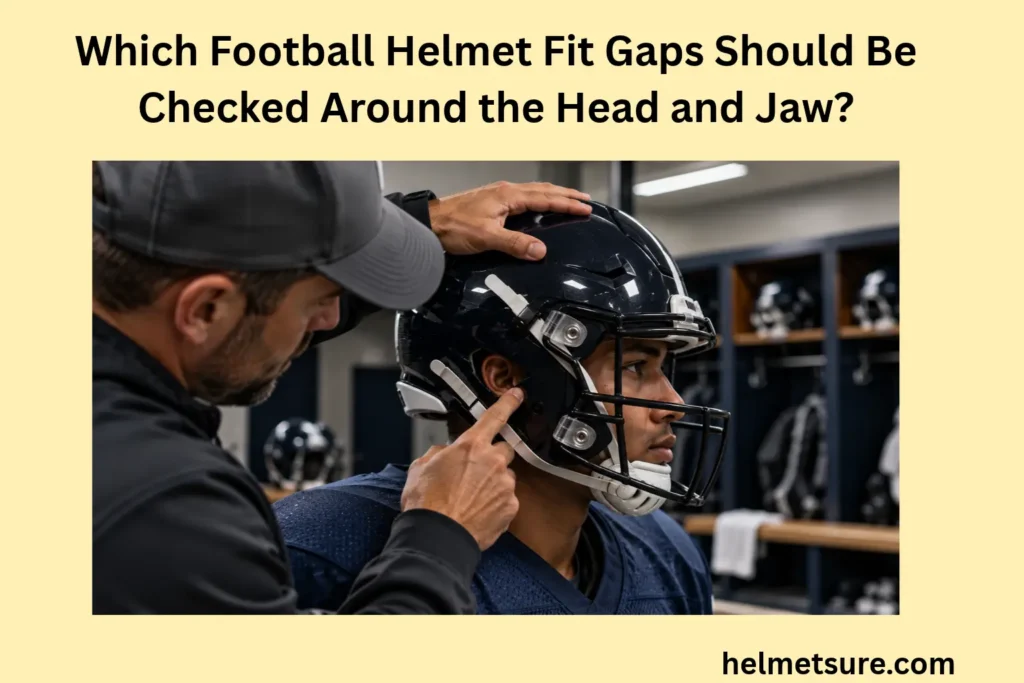
Which Football Helmet Fit Gaps Should Be Checked Around the Head and Jaw?
Football helmet fit gaps are localized breaks in intended head or jaw contact. Their location helps evaluate seating and support, but a gap does not independently prove incorrect shell size or complete fit.
The main regions to examine are the temples and sides of the head, the crown and rear of the head, both cheek and jaw-pad areas, and any contact zone that opens, closes, or shifts during the applicable movement check. Each region supplies a different piece of fit evidence.
Helmet Fit Gaps as Breaks in Intended Contact Rather Than a Universal “No Space Anywhere” Rule
A football helmet fit gap is a localized break in the contact expected from the applicable fit system. The useful question is not whether every internal surface touches the athlete, but whether contact is missing where that helmet’s approved fitting system is intended to support the head or jaw.
How a fit gap differs from normal clearance created by helmet shell and liner design
A fit gap reflects missing intended contact, while normal clearance can result from the helmet's designed shell and liner geometry. Football helmets do not present one continuous interior surface: shells, liner modules, suspension structures, pad edges, ear openings, vents, and hardware create equipment-specific spaces.
Visible clearance is therefore not automatically a fit defect. It becomes relevant when an intended liner, sizing pad, comfort pad, jaw guard, or other approved fit component is not making the contact described for the helmet being evaluated.
CDC’s broad consumer guidance says a football helmet should feel snug without spaces between the pads and the athlete’s head, while also emphasizing that helmet systems and fitting instructions vary. The general principle is supported contact; the exact surfaces expected to touch must come from the current instructions for the model. Riddell publishes platform-specific fitting guides, and Xenith’s Epic guidance identifies its own suspension, sizing-pad, comfort-pad, and jaw-guard system.
No universal millimeter, finger-width, or percentage threshold defines a gap across all football helmets. A space beside a structural opening can be normal design clearance, whereas missing contact at an intended support zone is a fit signal that requires evaluation.
Why gap location matters more than treating all visible space as equivalent
Gap location determines which part of the football helmet fit system requires evaluation. A temple or side-head gap raises a lateral-support question. Missing crown or rear-head contact raises a seating or upper-support question. A cheek or jawline gap concerns the lower fit system. A gap that moves raises a stability question.
Two spaces that look similar in size can therefore carry different meanings. One may sit beside a designed opening where contact is not expected. Another may interrupt an intended support region. The location connects the observation to the relevant component and determines which neighboring checks are useful.
Record the anatomical zone, the side of the helmet, and whether the pattern is isolated or distributed. Gap size alone is less informative than the combination of location, intended fit-system role, and behavior after correct reseating.
Why one localized gap cannot establish overall helmet size or fit by itself
One localized gap cannot establish overall helmet size or complete fit by itself. Shell size is only one possible contributor. Helmet seating, athlete head shape, liner or padding configuration, jaw-pad selection, component condition, and stability can create overlapping contact patterns.
A single localized loss of contact carries different diagnostic weight from unresolved contact across the sides, crown, rear, and jaw. The first pattern may respond to correct seating or an approved local configuration change. The second gives more reason to evaluate broader shell-to-head compatibility.
CDC also notes that helmet sizes and fit vary among brands and models, which is why the manufacturer’s sizing chart and fitting instructions remain essential. For the complete context around position, retention, component condition, and fit, review complete helmet fit.
A gap should therefore trigger corroborating checks, not the shortcut conclusion that the helmet is too large. Certification does not change this boundary: NOCSAE’s football standard establishes product performance requirements, not whether one helmet fits one athlete.
How Helmet Seating and Padding Create Contact Around the Head and Jaw
Helmet seating and approved fit components determine where the helmet contacts the head and jaw. Before a gap can be interpreted, the helmet must be placed in the fitted position specified for that system.
How full helmet seating determines where the internal liner contacts the head
Full helmet seating establishes the baseline relationship between the head and the internal fit system. If the shell sits high, low, forward, backward, or tilted, the liner meets different regions of the head and may create or remove an apparent gap.
This is why the first reliable comparison starts after the helmet has been put on according to its current instructions. USA Football’s fitting sequence separates putting on the helmet, adjusting helmet height, checking front-to-back and side-to-side fit, adjusting face pads, checking the fit, and setting the chin strap. The sequence treats position as a condition that must be established before the final result is judged.
A gap observed while the shell is only partly seated cannot reliably identify a size or component problem. First standardize the helmet’s position; then record what contact remains missing.
How liner thickness and configuration change contact across the sides, crown, and rear of the head
Liner thickness and configuration change how support is distributed across the sides, crown, and rear of the head. Different football helmets use different combinations of liners, pads, bladders, and suspension structures, so the internal contact pattern is platform-specific.
An approved change within a fitting system can redistribute support without changing the outer shell size. It can close one localized gap, alter shell height, or change how the helmet returns to position. The reverse can also occur: an unsuitable setting can reduce contact in a neighboring zone or concentrate pressure.
Greater thickness or inflation is not automatically an improvement. The applicable manufacturer specifies which components are adjustable, which tools or methods are approved, and what fitting sequence should follow. Riddell directs users to guides for its individual platforms, while Xenith identifies system-specific sizing and comfort pads for its Epic platform.
The fitter should distinguish supported contact from excessive pressure. A painful or concentrated point is not evidence that the surrounding contact pattern is correct, and an adjustment that merely forces contact can leave the broader fit unresolved.
How jaw-pad position changes the contact relationship along the cheeks and jawline
Jaw-pad position and approved sizing determine how the lower helmet contacts the cheeks and jawline. The applicable jaw or face-pad system forms a distinct lower-helmet relationship that should be assessed separately from crown and side-head contact.
Approved pad position, thickness, inflation, or system tension can change bilateral cheek contact and the way the lower helmet is supported. Xenith’s Epic instructions, for example, identify jaw guards as a platform-specific fitting accessory and integrate the lower straps and chin cup with its internal suspension system. Those features describe Xenith equipment and should not be applied as universal instructions for other helmets.
Firm or snug contact does not mean maximum compression. Thicker jaw pads are not automatically the correct response to a visible space. The pad must be an approved option for the helmet, and its effect must be evaluated with the entire head-and-jaw contact pattern.
Why reseating the same helmet can change an apparent gap without changing shell size
Reseating the same helmet can change a fit gap while the shell size remains unchanged. A more complete or level seating changes the shell-to-head relationship and can restore contact in one or more regions.
For example, a shell that initially stops high can leave an upper or rear contact pattern different from the pattern created after it is fully seated. A tilted shell can reduce contact on one side while compressing the opposite side. Correct reseating can change both observations without any change to the size label.
If a gap disappears after consistent reseating, the result supports a positioning explanation. It does not prove complete fit. The remaining head and jaw zones must agree, and the corrected position must stay stable during the recognized movement check.
How Head and Jaw Fit Zones Work Together When Interpreting Gaps
Head and jaw fit zones provide related but distinct evidence about how the helmet is supported. Each region should be interpreted in context, yet a passing region cannot erase a persistent problem elsewhere.
How temple and side-head contact helps contextualize lateral fit gaps
Temple and side-head contact helps show how evenly the helmet is supported laterally. Reduced contact on one side can occur beside greater compression on the other, so the two sides should be compared under the same seating condition.
A persistent temple gap directs attention to the helmet’s lateral support system. Depending on the model, that support may come from padding, a liner, a bladder, or a suspension structure. The gap’s existence does not tell the fitter which of those variables is responsible.
Check whether the shell is level, whether the same pattern returns after reseating, and whether the opposite side contains excessive pressure. Only then can head shape, configuration, or broader compatibility be considered with appropriate caution.
How crown and rear-head contact helps determine whether a gap reflects incomplete helmet seating
Crown and rear-head contact help determine whether the helmet is seated fully and consistently. These regions provide context for whether the shell has reached its intended vertical and rear support position.
Missing expected crown contact can accompany a helmet that is perched rather than fully seated. Reduced rear contact can accompany a forward or tilted position. Yet contact in one region does not automatically validate the other, and concentrated pressure at the crown is not the same as distributed support.
USA Football includes helmet height and front-to-back fit as separate steps, while Riddell’s fitting resources divide helmet position, liner adjustment, and the final fit check by platform. Those sequences support a combined interpretation: establish seating, then judge whether crown and rear contact agree with it.
How jaw-pad contact helps stabilize the lower helmet around the cheeks and jawline
Jaw-pad contact supports the lower helmet around the cheeks and jawline. Comparable contact on both sides helps the lower fit system maintain its relationship to the athlete rather than leaving one side unsupported.
“Comparable” does not require mathematically identical pressure. Facial anatomy can be asymmetric, and different helmet platforms create lower support in different ways. The correct comparison follows the intended jaw or face-pad system and checks whether either side has a persistent gap or excessive compression.
Increased compression is not automatically stronger support. The useful result is an approved contact pattern that works with helmet seating and remains stable, not the highest pressure the athlete can tolerate.
Why apparently good contact in one fit zone cannot compensate for a persistent gap elsewhere
Good contact in one fit zone does not cancel a persistent gap in another zone. Temple, side, crown, rear, cheek, and jaw observations test related but distinct parts of the fitted relationship.
A helmet can press firmly at the crown while lacking intended lateral contact. It can feel snug at one cheek while leaving the opposite jaw area unsupported. It can also achieve a static contact pattern that shifts after the retention system is secured and the applicable movement check begins.
Do not average these conditions into an overall pass. The goal is coherent support across the zones specified for the helmet—not maximum pressure everywhere and not one strong-contact zone compensating for another unresolved area.
Which Gaps Should Be Checked During the Initial Head-and-Jaw Fit Evaluation?
Initial head-and-jaw evaluation should record where intended contact is present, reduced, asymmetric, or changing. This stage describes the pattern without deciding its cause.
Whether localized gaps appear between the liner and the temples or sides of the head
Check whether localized loss of intended contact appears at the temples or sides of the head. Inspect the fit zones identified for the helmet after it has been fully seated.
Record the side, exact region, and whether the gap is isolated or accompanies broader contact loss. Compare the opposite side for similar contact, reduced contact, or concentrated pressure. These observations establish the lateral pattern for later interpretation.
Do not call the shell too large during this check. Seating, anatomy, liner configuration, and other variables have not yet been classified.
Whether crown or rear-head areas lose expected contact when the helmet is fully seated
Check whether expected crown or rear-head contact is missing after the helmet is fully seated. Evaluate the actual upper and rear structures used by the helmet rather than assuming every interior surface is intended to touch.
Record whether the contact loss is localized, widespread, or associated with a high, low, forward, backward, or tilted shell position. Note pressure points separately; pressure is not a substitute for supported contact.
At this observation stage, missing crown or rear contact does not prove incorrect size. It becomes a signal for the seating and configuration checks that follow.
Whether jaw pads maintain comparable contact along both sides of the jaw and cheek area
Check whether the jaw-pad system maintains comparable contact on both sides of the cheeks and jawline. Observe each side independently and then compare them under the same helmet position.
Record a gap, reduced contact, or excessive compression without assigning the reason. Natural facial asymmetry means the two sides do not need to look or feel mathematically identical, but a clear and persistent difference deserves further evaluation.
Do not replace or resize a pad solely from this first observation. The approved component options and the complete lower-helmet relationship still need to be checked.
Whether normal head movement causes an observed head or jaw gap to open, close, or shift location
Check whether an observed gap changes location or size during the applicable movement check. Compare the contact pattern before and during the procedure specified by the recognized fitting authority or helmet manufacturer.
A fixed static gap and a movement-dependent gap do not supply the same evidence. If a space opens, closes, or shifts as the shell moves relative to the head or jaw, record that behavior as a stability signal.
Do not invent a shake test, force level, or movement tolerance. CDC and Xenith both describe checks performed after the retention system is secured, but the exact procedure must match the helmet being fitted.
Regional Gap Evaluation Checklist
Head-and-Jaw Fit Check
What Different Head and Jaw Gap Patterns May Indicate About Helmet Fit
Different gap patterns point to different fit variables that require corroborating checks. The purpose of interpretation is to identify what should be examined next, not to convert appearance into a final diagnosis.
What a persistent side-head or temple gap may suggest about lateral contact
A persistent temple or side-head gap indicates that lateral contact requires further evaluation. The first task is to determine whether side support is incomplete or uneven after the helmet has been seated consistently.
Compare the opposite side and note whether it carries excessive pressure. Recheck shell level, side-liner or pad configuration, and whether the same pattern returns. Head shape and shell compatibility become relevant only after these closer explanations have been evaluated.
The gap points to a lateral fit problem, but it does not show whether the source is size, shape, seating, or configuration. No universal temple-gap measurement can supply that missing classification.
What reduced crown or rear-head contact may suggest about helmet seating
Reduced crown or rear-head contact is a signal to recheck helmet seating and upper-rear support. Normalize shell position before changing the liner or assuming a size problem.
A high, forward, or tilted shell can reduce expected contact in these regions. Reseat the helmet through the applicable procedure and compare the crown, rear, brow, and side relationships again. If contact returns, positioning gains support as the explanation.
If the gap persists, examine the approved fit-system configuration and broader compatibility. Do not jump directly to thicker components; any change must follow current model-specific instructions and must not create concentrated pressure elsewhere.
What unequal left-to-right jaw-pad gaps may suggest about lower-helmet contact or positioning
Unequal jaw-pad gaps indicate that lower-helmet contact or position should be rechecked. The pattern can reflect uneven seating, facial anatomy, pad configuration, or a lower shell position that differs from side to side.
First confirm that the helmet is level and seated consistently. Then compare the approved jaw or face-pad components and the contact they create. A difference that disappears after reseating carries different meaning from one that returns under the same conditions.
Do not declare one pad defective or the shell incorrectly sized from asymmetry alone. The observation needs manufacturer-specific component information and corroborating fit evidence.
What repeatedly shifting gaps during movement may indicate about fit stability
A gap that repeatedly shifts during movement indicates that the contact pattern is not remaining stable. The shell is changing its relationship to the head or jaw instead of maintaining the supported position achieved at rest.
Evaluate full seating, overall contact distribution, approved liner and jaw-pad configuration, and the retention procedure. Do not assume the chin strap is the sole cause. A helmet can move because of unresolved size, seating, padding, liner, jaw-pad, or retention relationships.
CDC says the helmet should not slide on the head with the chin strap in place, and Xenith’s Epic instructions include a movement check with all four buckles secured. These sources support the need for stability evaluation, while the procedure and any adjustment remain system-specific.
| Observed gap pattern | Primary fit relationship to investigate | Supporting checks | Do not conclude automatically |
|---|---|---|---|
| Persistent temple or side-head gap | Lateral contact and support | Opposite-side contact, seating, liner configuration | Helmet is definitely too large |
| Reduced crown or rear-head contact | Seating and upper or rear support | Helmet position, neighboring contact zones | Thicker padding is automatically required |
| Unequal left-right jaw-pad gaps | Lower-helmet contact and position | Seating, facial asymmetry, approved jaw-pad configuration | Shell size or one pad is definitely wrong |
| Gap repeatedly shifts during movement | Fit stability | Overall contact, approved configuration, retention | Chin-strap tension is the sole cause |
When Persistent Gaps Point to Seating Versus Size, Padding, or Configuration
Persistent gaps should be classified only after correct seating and regional contact have been rechecked. The most useful differentiators are how the gap responds to repeatable reseating and whether it changes within the helmet’s approved adjustment system.
How a gap that disappears after full reseating differs from one that remains in the same location
A gap that disappears after full reseating behaves differently from a gap that remains in the same location. The disappearing pattern is more consistent with a seating-state problem because shell position changed while size remained constant.
A gap that remains after the same repeatable seating procedure requires a broader review of regional contact, approved configuration, shell-to-head compatibility, and stability. The persistence carries more diagnostic weight than the original appearance alone.
Even a gap that disappears must pass the remaining checks. Contact should remain coherent across neighboring zones and stable during the applicable movement procedure.
How a one-time positioning gap differs from a gap that repeatedly returns after the helmet is reseated
A recurring gap returns after the helmet has been reseated consistently. One incomplete or uneven fitting attempt does not establish recurrence.
When the same region repeatedly loses contact under comparable conditions, an underlying fit variable is returning the helmet to that pattern. The cause may involve configuration, size or head compatibility, contact distribution, component condition, or stability.
Use the same manufacturer-directed setup for each comparison. Recurrence establishes that the pattern is unresolved; it still does not identify a single cause.
How padding or jaw-pad configuration can create persistent gaps without proving the shell size is incorrect
Padding or jaw-pad configuration can alter contact without changing the helmet shell size. Approved pads, jaw pads, liners, suspension accessories, or other documented settings can change regional support inside the same shell.
If a localized cheek or jaw gap changes after an approved component is correctly adjusted or exchanged, configuration becomes a stronger explanation. The response does not independently prove that the shell size is correct; it shows only that the original gap was not a standalone size test.
When approved face-fit components are the relevant variable, consult the exact helmet instructions alongside HelmetSure’s guide to removable pads. Xenith, for example, identifies sizing pads, comfort pads, and jaw guards for its Epic system, while Riddell directs users to platform-specific guides.
Do not use improvised fillers, aftermarket substitutes, or unapproved pads. A persistent gap that does not respond within the documented configuration range requires a broader fit review rather than continued material addition.
How a broader size-related contact pattern differs from an isolated padding or jaw-pad mismatch
A broader size-related fit problem affects the contact pattern beyond one isolated adjustable zone. Several regions may remain inconsistent even after the helmet is seated correctly and the approved fit options are evaluated.
An isolated configuration mismatch is more localized and responds coherently to an approved adjustment: the target contact improves without disturbing the sides, crown, rear, or opposite jaw area. A broader compatibility pattern persists across several relationships or across the supported adjustment range.
CDC’s warning that fit and size differ among brands and models supports treating shell-to-head compatibility as equipment-specific. A multi-zone pattern increases the reason to review size or another helmet model, but one local gap still cannot establish that conclusion by itself.
| Gap behavior | Supporting observations | Primary category to investigate |
|---|---|---|
| Gap disappears after correct reseating and stays corrected | Other contact zones normalize | Positioning or seating |
| Gap disappears but repeatedly returns | Position changes again or movement reopens the gap | Stability or broader fit |
| Gap remains localized and changes with an approved pad or jaw-pad adjustment | Other zones remain coherent | Padding, jaw-pad, or fit-system configuration |
| Gap persists with multiple unresolved head-contact zones | Seating and approved configuration do not normalize contact | Size or head-compatibility review |
| Correcting one gap creates another contact loss | Contact distribution shifts elsewhere | Broader fit-system review |
How to Verify Head and Jaw Contact After Fit Adjustments
Head and jaw contact must be rechecked after every approved fit adjustment. Verification asks whether the target contact improves under repeatable conditions without creating a new problem elsewhere.
Reseat the helmet before comparing the adjusted head-and-jaw contact pattern
Reseat the helmet consistently before comparing the adjusted contact pattern. The before-and-after conditions must match if the comparison is to show what the adjustment actually changed.
Inconsistent seating can make an ineffective adjustment appear successful or make a suitable adjustment appear to fail. Manually holding or tilting the shell until the target gap disappears is not a valid correction because it does not test the position the fitted system maintains.
Use the current procedure for the exact helmet each time, then recheck the recorded contact pattern from the same baseline.
Recheck the specific gap zone after liner, padding, or jaw-pad adjustments
Recheck the original gap zone after every approved liner, padding, or jaw-pad adjustment. Return to the exact temple, side, crown, rear, cheek, or jaw region recorded during the initial evaluation.
Compare contact under the same seating condition. Determine whether the intended support has returned, whether the gap remains, or whether the adjustment has created concentrated pressure. Closing the space by over-compression is not a successful result.
Do not automatically add more inflation or a thicker pad when a gap persists. Stop at the manufacturer’s documented adjustment range and broaden the fit evaluation when the target zone cannot be corrected coherently.
Confirm that correcting one gap has not created a new loss of contact in another fit zone
Confirm that correcting one gap has not disrupted contact elsewhere in the helmet. Recheck both side-head zones, the crown and rear, and both cheek and jaw areas after the target adjustment.
An adjustment can redistribute shell support. The original gap may close while another zone loses contact, develops concentrated pressure, or changes the shell’s position. That transferred problem means the fit remains unresolved.
After static cross-zone contact has been rechecked and the applicable retention system is secured, evaluate helmet movement. The corrected pattern should remain stable during the manufacturer-directed check; disappearance of the original gap is not enough.
Escalate to a broader fit review when repeated adjustments fail to produce stable, consistent head-and-jaw contact
Repeated failure to produce stable head-and-jaw contact requires a broader fit review. Recurring gaps, redistributed contact loss, or instability after correct seating and approved adjustment indicate that a simple local correction has not resolved the fit.
Reassess the exact helmet’s size range, shell-to-head compatibility, component completeness and condition, approved configuration, and current fitting instructions. A different size, model, or documented configuration can be evaluated through its own fitting process; it should not be assumed from one remaining gap.
Do not keep tightening, inflating, or adding material to conceal the symptom. A football equipment professional, certified athletic trainer, equipment manager, or another practitioner with documented experience fitting that helmet system should complete the broader evaluation before the helmet is used.
Post-Adjustment Recheck Checklist
Head-and-Jaw Fit Check
Head-and-Jaw Gap Checks as One Part of Complete Football Helmet Fit
Head-and-jaw gap checks provide one part of the complete football helmet fit assessment. They identify where the contact pattern deserves closer evaluation without turning visible space into an automatic size verdict.
Gap location as a practical clue to how the helmet contacts the head and jaw
Gap location identifies which head or jaw contact relationship needs closer evaluation. Temple and side gaps direct attention to lateral support; crown and rear gaps raise seating and upper-support questions; cheek and jaw gaps focus the lower fit system.
The location is a clue, not a diagnosis. Designed clearance must remain separate from missing intended contact, and the contact architecture comes from the exact helmet system.
Why gap meaning becomes clearer when seating, contact distribution, and stability agree
Gap meaning becomes clearer when seating, contact distribution, and stability point to the same fit conclusion. A persistent location, repeatable shell position, neighboring contact pattern, response to approved adjustment, and movement behavior provide independent evidence.
When those signals agree, the likely fit category becomes clearer. When they conflict, the fit remains unresolved. One passing check cannot establish complete fit, and stronger contact in one region cannot cancel contact loss or instability elsewhere.
The final fit model: identify the gap, interpret its location, distinguish its likely source, then verify that corrected contact holds
Identify the gap, interpret its location, classify its likely source, and verify that corrected contact remains stable. Start by distinguishing missing intended contact from normal design clearance. Localize the pattern, compare neighboring and opposing zones, and observe whether it changes after correct reseating.
Classify the likely source only after the evidence agrees. A gap that resolves with seating supports a positioning explanation. A localized pattern that responds to an approved component change supports a configuration explanation. A persistent multi-zone pattern gives more reason for a size or head-compatibility review. Movement-dependent change keeps stability unresolved.
After any approved correction, recheck the target zone, the rest of the contact pattern, and stability. A disappearing gap does not compensate for new pressure, lost contact elsewhere, or shell movement.
If the pattern remains unresolved, use the current manufacturer-directed fitting process and seek review from a football equipment professional, certified athletic trainer, equipment manager, or another practitioner with documented experience fitting that system. Head-and-jaw gap checks inform the fit assessment; they do not prove shell size, protection level, or injury outcome by themselves.
Frequently Asked Questions About Football Helmet Head-and-Jaw Gaps
Short answers covering contact zones, gap behavior, approved adjustments, and safety boundaries.
Which football helmet fit gaps should be checked?
Check localized loss of intended contact at the temples and sides, crown and rear, and both jaw or cheek areas.
Does every visible space inside a helmet count as a fit gap?
No. Normal clearance can result from the shell and liner design; compare the observed space with the intended contact pattern.
Does one temple gap prove the helmet is too large?
No. Reseat the helmet and check opposite-side contact, liner configuration, and stability before classifying the cause.
What can unequal jaw-pad gaps indicate?
They can signal uneven lower-helmet contact or positioning, but they do not independently prove shell size or one pad is wrong.
Why check whether a gap moves?
A gap that opens, closes, or shifts during approved movement can reveal unresolved fit stability.
Can extra material be added to fill a gap?
No improvised fillers or unapproved pads should be used. Follow the exact manufacturer’s approved fitting system.
When should a broader fit review happen?
Escalate when gaps persist, recur, redistribute contact, or remain unstable after correct seating and approved adjustment.
Does a gap-free appearance guarantee protection?
No. Fit appearance cannot guarantee protection, prevent concussion, or replace certification and condition checks.