
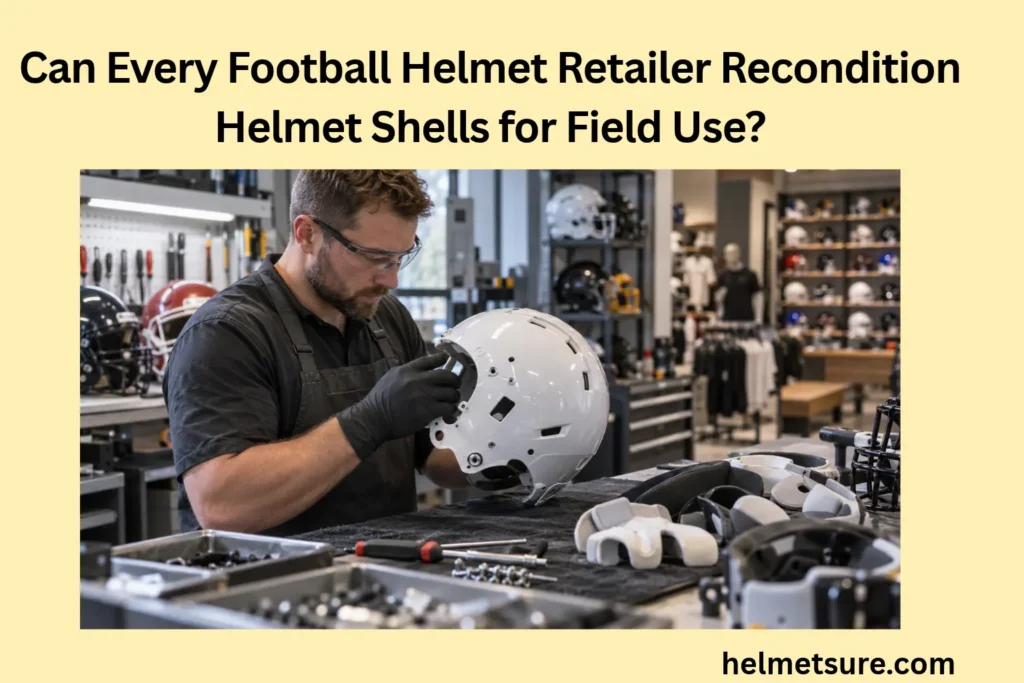
Can Every Football Helmet Retailer Recondition Helmet Shells for Field Use?
Football helmet retailer status does not establish return-to-field reconditioning or recertification qualification; the actual facility’s qualification, applicable recertification authority, helmet eligibility, and service documentation must collectively support the helmet’s return-to-use pathway.
Reconditioning and recertification do not guarantee injury prevention or athlete-specific fit. Field use also requires correct fit, inspection, permitted configuration, and compliance with current manufacturer and program requirements.
A retailer may sell helmets, fit players, replace permitted accessories, accept equipment for shipment, or coordinate work with another business. None of those activities proves that the retailer itself performs formal reconditioning or recertification.
NOCSAE defines reconditioning and recertification as separate activities and requires recertification work to be performed under the applicable NOCSAE license agreement. Therefore, the important questions are who performs the technical work, whether that facility has the appropriate qualification, whether the individual helmet is eligible, and what documented result the process produces.
Selling Football Helmets Is Different From Being Qualified to Recondition and Recertify Them
Selling football helmets does not by itself qualify a retailer to perform reconditioning and applicable recertification.
Retail activity and technical reconditioning represent different service roles. A retailer may have extensive product knowledge and still lack the equipment, processes, license relationship, or quality controls needed to perform formal recertification.
Why retail authorization does not automatically establish reconditioning or recertification capability
Retail authorization establishes a commercial relationship, not formal reconditioning or recertification capability.
A manufacturer-authorized dealer may be permitted to sell products, fit customers, provide warranty support, or replace certain components. Those permissions do not automatically show that the retailer can disassemble, inspect, recondition, test, label, and document previously certified helmets through the applicable NOCSAE pathway.
NOCSAE also states that it does not certify companies as reconditioners or recertifiers. Instead, facilities performing recertification activities must operate pursuant to a NOCSAE license agreement and comply with the applicable recertification standard. That distinction matters: calling a business “NOCSAE-certified” may inaccurately describe the relationship.
Retail authorization, dealer status, NAERA membership, manufacturer permission, and a NOCSAE license agreement must each be understood within their own scope.
How a reconditioning facility differs from a retailer that only sells, fits, or performs limited service
A reconditioning facility performs equipment-level inspection and service that goes beyond ordinary retail work.
Retail fitting focuses on the relationship between the helmet and the wearer. Limited service might include adjusting permitted components, replacing an accessory, processing a warranty claim, or preparing a helmet for shipment. Formal reconditioning addresses the condition of the helmet system through inspection, cleaning, sanitizing, and permitted repair or restoration.
Where applicable, the broader process also includes recertification testing and updated documentation. These activities require technical procedures, specialized equipment, controlled component decisions, and an appropriate facility-level qualification.
A retailer can legitimately coordinate this work without performing it. In that arrangement, the retailer is the intake provider while a separate facility is responsible for the technical outcome.
Why return-to-field work requires more than cosmetic shell restoration
Return-to-field work requires evaluation of the complete helmet system rather than improvement of the shell’s appearance alone.
Cleaning, repainting, refinishing, or replacing decals may change how a shell looks. These actions do not establish the condition of the liner, attachment hardware, retention components, faceguard connections, or other functional relationships within the helmet.
Cosmetic work may form part of an allowed reconditioning process, but appearance cannot prove serviceability or recertification status. A helmet can look restored while still having an unresolved model restriction, unacceptable component configuration, failed inspection, or missing recertification evidence.
| Provider activity | What it can establish | What it cannot establish by itself |
|---|---|---|
| Sell a helmet | Completion of a retail transaction | Reconditioning or recertification qualification |
| Fit a wearer | Completion of a wearer-facing fitting service | Equipment recertification status |
| Accept a helmet | Retailer intake or service coordination | Identity or qualification of the technical facility |
| Perform cosmetic work | A surface or appearance result | Complete helmet-system serviceability |
| Recondition a helmet | Completion of permitted inspection and service | Successful recertification from the term alone |
| Recertify a helmet | Applicable status result when successfully completed | Athlete-specific fit or guaranteed injury prevention |
How Reconditioning and Recertification Work Together for Previously Certified Football Helmets
Reconditioning and recertification are separate processes that may operate together for eligible, previously certified football helmets.
According to NOCSAE, reconditioning concerns inspection and equipment service, while recertification concerns retesting and continued compliance with the original applicable NOCSAE requirements. They are commonly performed together because the recertification framework includes testing associated with the reconditioning process.
How reconditioning covers inspection, cleaning, sanitizing, and repair or restoration
Reconditioning covers inspection, cleaning, sanitizing, and permitted repair or restoration of athletic equipment.
The process evaluates more than the exterior shell. The facility may need to examine the shell, liner system, hardware, retention components, attachment points, and other relevant parts according to the helmet design and applicable service instructions.
If a condition can be corrected within the permitted process, the facility may repair or replace an appropriate component. If damage or another restriction makes the helmet unserviceable, the correct outcome may be rejection rather than restoration.
Before sending equipment, owners should also determine what must be removed, retained, or documented by reviewing guidance on shipment accessories. Shipment preparation does not establish eligibility, but it can prevent accessories or personal items from complicating intake.
How recertification retests previously certified equipment against its original NOCSAE requirements
Recertification retests previously certified equipment to determine whether it continues to meet the original applicable NOCSAE requirements.
It is a formal status process, not another term for cleaning or repair. The applicable performance specification for recertified football helmets is identified by NOCSAE as ND004. The process supplies evidence for a recertification determination after eligible equipment passes through the required pathway.
This does not mean that every individual helmet necessarily receives an impact test. NOCSAE describes a sampling system in which helmets representing relevant categories are tested before and after reconditioning. Each helmet must still undergo the applicable inspection and processing required by the facility’s program.
A helmet that receives service but does not successfully complete an applicable recertification pathway should not be described as recertified.
Why recertification testing occurs as part of the reconditioning process
Recertification testing occurs within the broader reconditioning operation because equipment condition and performance status must be evaluated through connected but distinct stages.
Pre-reconditioning testing of the applicable sample helps evaluate equipment before service. Reconditioning then addresses inspection, cleaning, sanitizing, and permitted restoration. Post-reconditioning testing supplies evidence for the recertification determination.
This relationship explains why the two terms are often used together. It does not make them synonyms:
- Reconditioning changes or restores equipment condition within a permitted scope.
- Recertification determines the applicable status through testing and documentation.
A repair may be completed without proving that recertification succeeded. Conversely, applicable testing cannot correct physical problems that should have been identified and addressed during reconditioning.
How manufacturer instructions constrain the reconditioning and recertification pathway
Manufacturer instructions can restrict whether and how a helmet enters the reconditioning and recertification pathway.
NOCSAE provides the general standards framework, but the manufacturer controls model-specific information such as service instructions, permitted configurations, recertification frequency, repair restrictions, or eligibility limitations. A facility’s NOCSAE license relationship does not override those instructions.
The exact manufacturer and model must therefore be identified. A rule applying to one model, product family, or brand should not be generalized to another helmet.
| Process stage | Primary function | What it can establish | What it cannot establish |
|---|---|---|---|
| Inspect | Evaluate condition and ability to proceed | Whether additional service may be possible | Successful recertification |
| Recondition | Clean, sanitize, inspect, and restore within permitted limits | Serviced equipment condition | Recertification status |
| Test | Conduct applicable recertification testing | Evidence for a recertification determination | Athlete-specific fit |
| Document | Apply applicable labeling and maintain records | Traceable service and status information | Guaranteed injury prevention |
What Capabilities a Football Helmet Reconditioning Facility Needs Beyond Ordinary Retail Service
A football helmet reconditioning facility needs complete-system inspection, controlled service procedures, specialized testing, appropriate component management, and the applicable recertification license relationship.
These are facility-level capabilities. A retailer’s reputation, sales volume, product inventory, or fitting expertise does not independently demonstrate them.
How complete helmet disassembly and component inspection support the reconditioning process
Complete-system inspection allows the facility to evaluate conditions that cannot be established from the shell’s exterior.
The applicable process may require the helmet to be disassembled sufficiently for inspection of its relevant components and connections. This helps distinguish damage, wear, contamination, incompatible parts, or other conditions from purely cosmetic marks.
The precise disassembly sequence depends on the helmet system and current service instructions. Consumers should not assume that every football helmet has the same internal construction or can be taken apart and rebuilt using a universal procedure.
A legitimate provider must be able to explain whether it performs the complete technical process or merely forwards the helmet to another facility.
Why specialized pre- and post-reconditioning testing separates recertification from ordinary repair
Specialized testing separates formal recertification from ordinary repair because it evaluates an applicable performance-status question.
A repair shop may be capable of correcting a damaged attachment or replacing an allowed component. That does not mean it has the equipment, sampling system, quality controls, or license relationship required for recertification.
NOCSAE describes testing of selected helmets before and after reconditioning using specialized equipment. The applicable football-helmet framework is governed by ND004. This testing belongs to a controlled recertification program rather than an informal pass/fail assessment performed at a retail counter.
Consumers should not ask only whether a business “tests helmets.” They should ask what testing is performed, who performs it, under which applicable pathway, and what documented result follows.
How replacement components must preserve the helmet’s originally certified functional relationship
Replacement components must preserve the functional relationships under which the helmet was originally certified.
NOCSAE’s standards are not written around one required brand, material, or design. However, NOCSAE states that all components must function as originally certified and that replacement parts must be of equivalent quality to the manufacturer’s original parts.
This does not create permission to install any part that physically fits. Component compatibility can involve geometry, attachment method, material, performance, and interaction with the rest of the helmet system. Manufacturer-specific restrictions may also apply.
Installing an inappropriate component can leave the helmet outside its permitted configuration even if the individual part appears new and undamaged.
Why NOCSAE licensing and quality-control obligations matter when a facility performs recertification
The applicable NOCSAE license agreement connects a recertifying facility to formal standards and quality-control obligations.
NOCSAE does not describe this relationship as company certification. It requires facilities performing recertification activities to do so pursuant to a license agreement that carries responsibilities such as compliance with the applicable standard.
NAERA is a professional association rather than the standards organization. Its current directory can help identify member reconditioners, while the NOCSAE license relationship establishes the separate recertification-framework requirement. NOCSAE currently states that NAERA-member reconditioning facilities are subject to third-party quality-control and quality-assurance inspections.
| Facility capability | Why it matters | Evidence to verify |
|---|---|---|
| Inspect the complete helmet system | Identifies conditions beyond surface appearance | Current NOCSAE and applicable manufacturer guidance |
| Perform specialized testing | Supports the applicable recertification determination | Current NOCSAE requirements |
| Control replacement components | Preserves approved functional relationships | NOCSAE plus applicable manufacturer instructions |
| Operate under the applicable license agreement | Establishes the formal recertification relationship | Current NOCSAE information |
| Maintain quality controls | Supports consistent execution | Current institutional evidence |
| Document the completed outcome | Provides traceability | Applicable label and service records |
How to Check Whether a Retailer Is Actually Qualified to Handle Return-to-Field Reconditioning
Checking a retailer requires identifying the complete service chain and verifying the facility responsible for the technical work.
Do not stop at the retailer’s name, marketing statement, or promise that a helmet will be “refurbished.” Determine what the service includes and which facility performs it.
Whether the retailer performs the work itself or sends helmets to a separate reconditioning facility
First determine whether the retailer performs the work or serves as an intake and coordination point.
Outsourcing is not automatically a problem. A retailer may legitimately receive helmets, prepare paperwork, collect payment, and send the equipment to a separate qualified facility. The important issue is whether this arrangement is transparent and traceable.
Ask for the legal or operating name of the facility that will inspect, recondition, test, recertify, and label the helmet. If different stages are divided between facilities, ask which operation is responsible for the applicable recertification result.
The retailer’s address on a receipt may identify the customer-facing business without identifying the technical performer.
Whether the facility performing recertification operates under the required NOCSAE license agreement
The facility performing recertification should be verified against the current applicable NOCSAE licensing framework.
Ask directly whether the facility performs recertification pursuant to a NOCSAE license agreement. Verify the answer through current institutional information rather than relying solely on advertising, an old certificate, a logo, or a statement that the business is “approved.”
Facility status can change. Historical membership, past licensing, or an undated web page should not automatically be treated as proof of current qualification.
If the provider refers to NAERA membership, that can be checked against the current NAERA directory. Association membership and the NOCSAE license relationship should still be understood as separate facts owned by different organizations.
Whether the provider can identify the facility responsible for testing and recertification
A provider should be able to identify the facility responsible for testing and the applicable recertification determination.
Useful service-chain information includes:
- The actual facility name.
- The location to which the helmet will be sent.
- The service being performed.
- Whether recertification applies.
- The party responsible for testing.
- The records or labeling supplied after completion.
- The process followed when a helmet is rejected.
A provider that cannot identify the technical facility leaves the central qualification question unresolved. A quotation or estimated completion date describes a transaction; it does not establish facility authority.
Whether completed helmets receive the required dated recertification labeling when recertification applies
When recertification applies and is successfully completed, the helmet should receive the applicable updated labeling.
NOCSAE describes a dated recertification label containing the recertifying facility’s name and the year of recertification. The label should correspond to the helmet and the process just completed—not an earlier service event or a different piece of equipment.
Ask how the facility documents helmets that pass, require further correction, or are rejected. A receipt stating “helmet service” or “reconditioning” is not automatically evidence of successful recertification.
Provider evaluation should establish the following:
- Identify the actual technical facility.
- Verify the applicable current license relationship.
- Confirm the scope of the promised service.
- Determine whether recertification applies.
- Check how testing is performed within the qualified pathway.
- Verify the applicable labeling and service documentation.
- Separate provider qualification from helmet eligibility.
How Retail Service, Shell Repair, Reconditioning, and Recertification Differ
Retail service, shell repair, reconditioning, and recertification perform different jobs and produce different kinds of evidence.
Understanding these categories prevents a narrow service result from being mistaken for complete return-to-field verification.
How ordinary retail fitting or accessory service differs from helmet reconditioning
Ordinary retail fitting addresses wearer fit or a limited equipment need, while reconditioning addresses equipment condition.
A trained retailer may help select a size, adjust permitted fit components, attach an accessory, or replace an allowed part. Those services can be useful, but they do not show that the complete helmet has been inspected and processed through formal reconditioning.
The reverse distinction also matters. A reconditioned and recertified helmet is not automatically fitted to its next wearer. Athlete-specific positioning, stability, retention, and fit must still be evaluated separately.
Expertise in fitting does not establish recertification authority, and recertification status does not establish correct individual fit.
How cosmetic shell work differs from inspection and restoration of the complete helmet system
Cosmetic shell work changes appearance, while complete reconditioning evaluates and services the helmet system.
Surface cleaning, polishing, painting, refinishing, or decal replacement may produce an attractive shell. None of these outcomes establishes the condition of concealed components or confirms that shell treatment was permitted for the exact model.
Permitted cosmetic restoration can occur within a complete reconditioning process. The distinction lies in scope: appearance work has a cosmetic outcome, while reconditioning involves inspection and permitted service of the functional helmet system.
A refinished shell should not be called field-ready based on appearance alone.
How component repair or replacement differs from recertification testing
Component repair or replacement changes helmet condition, while recertification testing evaluates the applicable recertification status.
Corrective service may resolve an allowed component problem. It does not independently answer whether the helmet satisfies the applicable recertification requirements.
Approved replacement work can be part of reconditioning. After that work, the helmet must still follow the applicable pathway before a recertification result can be claimed.
The same boundary applies to new components: a new chin strap, liner element, fastener, or other part does not erase unrelated shell damage, model restrictions, age considerations, inspection findings, or documentation requirements.
How reconditioning without an applicable recertification pathway differs from restoring a helmet’s certification status
Reconditioning without an applicable recertification pathway does not by itself restore recertification status.
The word “reconditioned” describes equipment service. The word “recertified” describes the result of the applicable retesting and status process.
An item may be cleaned, inspected, or repaired without receiving a successful recertification result. This could occur because recertification was not included, the helmet was ineligible, the relevant pathway was unavailable, or the equipment did not complete the required process.
Service descriptions should therefore be read literally. If a document says only “cleaned,” “repaired,” “refinished,” or “reconditioned,” do not infer recertification unless the corresponding outcome is independently established.
| Service category | Primary job | What it can establish | What it cannot establish by itself |
|---|---|---|---|
| Retail fitting or accessory service | Fit or limited equipment support | Completion of that service | Reconditioning or recertification authority |
| Cosmetic shell work | Appearance restoration | Cosmetic result | Complete-system serviceability |
| Component repair or replacement | Correct permitted component condition | Component-service outcome | Recertification status |
| Reconditioning | Inspect and service within permitted scope | Reconditioned equipment condition | Successful recertification from the term alone |
| Recertification | Complete applicable retesting and status process | Recertification result when successfully completed | Athlete-specific fit or injury outcome |
Which Football Helmets Are Eligible for Reconditioning and Recertification?
A qualified facility cannot complete an applicable recertification pathway for a helmet that is not eligible for that pathway.
Provider qualification and helmet eligibility are independent conditions. A properly qualified facility may still have to reject a helmet because of manufacturer restrictions, age or timing requirements, configuration problems, physical condition, or an unsuccessful inspection or testing outcome.
How manufacturer instructions determine whether a particular helmet model may be recertified
Manufacturer instructions can determine whether a particular helmet model remains eligible for recertification.
The brand name alone may be insufficient. Eligibility can depend on the exact model, model generation, configuration, manufacturing information, or other identifiers required by current manufacturer documentation.
NOCSAE’s general framework does not override a manufacturer’s model-specific limitation. Likewise, evidence that one model can be recertified does not establish eligibility for every helmet made by that manufacturer.
Before making a model-level decision, match the helmet’s identifying information to current manufacturer documentation and the facility’s applicable pathway. If the exact model cannot be confirmed, eligibility remains unresolved.
Why helmet age can affect whether a reconditioning facility will accept it for recertification
Helmet age can affect acceptance for recertification, but every age rule must be attributed to the organization or policy that establishes it.
Chronological helmet age and time since the last recertification are different measurements. A manufacturer may impose a model-specific age or service rule. An association or facility may have its own acceptance policy. A governing program may also impose equipment requirements.
NOCSAE explains that recertification frequency can vary according to manufacturer requirements and distinguishes its requirements from separate NAERA policies. Therefore, one age cutoff should not be presented as a universal rule for every football helmet.
When evaluating time-based status, identify both the helmet’s age and its applicable recertification interval. Then identify which authority owns each rule.
How condition or failed inspection can prevent an otherwise eligible helmet from being recertified
Helmet condition or a failed inspection can prevent an otherwise eligible helmet from completing recertification.
Model eligibility establishes only that an applicable pathway may exist. The individual helmet must still meet the relevant inspection, serviceability, configuration, and testing requirements.
Damage, wear, incompatible components, altered construction, or other conditions may affect the outcome, but model-specific rejection limits should come from current authoritative documentation. A casual visual inspection cannot reliably predict every condition a qualified facility may discover.
A helmet that passes the age and model checks can still be rejected. Likewise, a helmet that looks undamaged is not automatically eligible or serviceable.
Why retailer willingness to work on a shell does not establish the helmet’s recertification eligibility
Retailer willingness to service a shell does not establish that the helmet remains eligible for recertification.
Retail acceptance usually means that a transaction or intake process has begun. The technical facility may not evaluate the helmet’s model, age, configuration, condition, and applicable pathway until later.
A price quote, work order, receipt, or verbal promise is therefore not a final eligibility result. The helmet can still be restricted by manufacturer instructions, rejected during inspection, require permitted correction, or fail to complete the applicable recertification process.
A responsible retailer may explain the facility’s acceptance criteria, but it cannot replace unresolved authoritative evidence with commercial reassurance.
| Eligibility axis | Required action | Appropriate evidence | Possible meaning |
|---|---|---|---|
| Manufacturer and model | Confirm the exact model and permitted pathway | Current manufacturer documentation | Eligible, restricted, ineligible, or unresolved |
| Helmet age | Attribute the applicable rule to its owner | Manufacturer, association, facility, or program evidence | Relevant rule identified |
| Recertification timing | Check the applicable current interval | Current institutional or manufacturer evidence | Current, due, overdue, or unresolved |
| Physical condition | Verify the qualified inspection outcome | Facility inspection plus applicable requirements | Proceed, correct, or reject |
| Component configuration | Confirm permitted functional relationships | Manufacturer and applicable NOCSAE information | Acceptable, correction required, or unresolved |
| Applicable testing | Verify the completed outcome | NOCSAE-governed pathway and documentation | Recertified, not recertified, or unresolved |
What Should Be Verified Before a Reconditioned Helmet Returns to Field Use?
Before field return, verify helmet eligibility, the actual facility, and the applicable recertification result and documentation.
“Reconditioned” alone is not a complete return-to-use conclusion. Verification must connect the exact helmet to an eligible pathway, a qualified technical facility, the applicable completed process, and matching documentary evidence.
Confirm that the helmet model was eligible for the reconditioning and recertification performed
Confirm that the specific helmet model was eligible for the service and recertification pathway actually performed.
Match the helmet’s manufacturer, model, and any other relevant identifier to current manufacturer instructions. Do not rely on guidance for a similar-looking helmet or another model in the same product family.
Then confirm that the completed service remained within the permitted pathway. A facility’s qualification cannot override model ineligibility, and a successful outcome for one model does not establish eligibility for another.
If current manufacturer documentation cannot resolve the question, obtain clarification from the manufacturer before relying on the helmet’s return-to-use status.
Confirm which facility actually completed the reconditioning and applicable recertification
Confirm the identity of the facility that actually completed the reconditioning and applicable recertification.
Match the facility named in the service records to the facility whose current qualification was verified. If a retailer accepted the helmet but outsourced the work, preserve both identities: one is the customer-facing intake provider, and the other is responsible for the technical process.
The facility connected to the applicable recertification result must be traceable. Retailer paperwork that does not identify the technical performer may establish payment or intake without establishing who performed the formal work.
Verify the applicable recertification labeling and service documentation before return to use
Verify that applicable recertification labeling and service documentation correspond to the helmet, facility, and completed recertification outcome.
Check that the label is current for the relevant service event and identifies the information required by the applicable NOCSAE framework. Compare it with the facility name and service records. An old, unrelated, unreadable, or ambiguous label should not be treated as proof of a new recertification result.
After matching the documentation to the helmet and facility, determine whether it supports current-season status for the relevant program and use period.
Documented recertification still does not establish athlete-specific fit or guarantee prevention of concussion or another injury.
Refer unresolved eligibility or certification questions to the manufacturer or qualified reconditioning facility rather than assuming retail service is sufficient
Unresolved model eligibility or recertification-status questions require confirmation from the authority responsible for that issue.
Direct manufacturer- and model-specific questions to current manufacturer documentation or the manufacturer. Direct questions about the performed process, inspection result, testing, label, or recertification status to the facility responsible for the work. Consult current NOCSAE information when the uncertainty concerns the standards or licensing framework.
A retailer may help obtain these answers, but appearance, receipt language, or unsupported verbal assurance cannot replace them. Until the material facts are confirmed, the relevant return-to-use status remains unresolved.
Before relying on the helmet for field use:
Retailer Status Alone Does Not Determine Whether a Football Helmet Can Be Reconditioned for Field Use
Retailer status alone does not determine whether a football helmet can legitimately complete a return-to-field reconditioning and applicable recertification pathway.
The final decision depends on the actual technical facility, the individual helmet’s eligibility, completion of the applicable process, and documentary evidence supporting the resulting status.
Reconditioning capability as a facility qualification rather than a general retailer privilege
Reconditioning and recertification capability depend on the actual facility rather than retailer status in general.
A retailer may sell, fit, accept, or coordinate helmet service. Those functions do not automatically establish the capabilities or license relationship needed for recertification.
Retailers can still play a legitimate role by sending eligible helmets to appropriately qualified facilities. In that case, the facility’s qualification—not the retailer’s commercial identity—supports the technical pathway.
Why provider qualification and helmet eligibility must both be established
Legitimate return-to-field reconditioning requires both an appropriately qualified provider pathway and an eligible helmet.
A qualified facility cannot override manufacturer restrictions, unacceptable helmet condition, an incompatible configuration, or another eligibility barrier. An eligible helmet cannot establish that the provider performing the work is qualified.
Both conditions must be satisfied independently:
- The actual provider must possess the applicable facility-level qualification.
- The individual helmet must remain eligible for the process.
Even then, the final status depends on successful completion and matching documentation.
The final decision model: identify the actual reconditioner, confirm helmet eligibility, and verify the applicable recertification pathway
The final decision follows three connected verification stages.
First, identify the actual facility performing the technical work and verify its current qualification. Second, confirm that the exact helmet is eligible under current manufacturer instructions, applicable policies, its configuration, and its physical condition. Third, verify completion of the applicable reconditioning and recertification pathway through corresponding labeling and service documentation.
If any stage remains unresolved, retailer status cannot fill the evidence gap. Model-specific uncertainty belongs with the manufacturer; process or status uncertainty belongs with the facility that performed the work and the relevant institutional authority.
A football helmet should not be treated as ready for field use merely because a retailer accepted, cleaned, repaired, or returned it.
A retailer can coordinate service, but field-use confidence depends on the actual facility, the helmet’s eligibility, successful completion of the applicable pathway, and matching documentation.
Frequently Asked Questions
Short answers to the most important retailer and recertification questions.
Can any football helmet retailer recondition a helmet?
No. Retail status alone does not establish facility-level reconditioning or recertification qualification.
Is repainting a helmet shell the same as reconditioning?
No. Cosmetic work changes appearance; formal reconditioning evaluates and services the complete helmet system within permitted limits.
Are reconditioning and recertification the same process?
No. Reconditioning addresses equipment condition, while recertification determines applicable status through testing and documentation.
What should I ask a retailer before sending a helmet?
Ask which facility performs the work, whether recertification applies, how the facility is qualified, and what label or records you will receive.
Does a recertified helmet automatically fit the athlete?
No. Athlete-specific fit, positioning, stability, and retention must be checked separately.
Sources
Primary standards and directory references used for this article.