
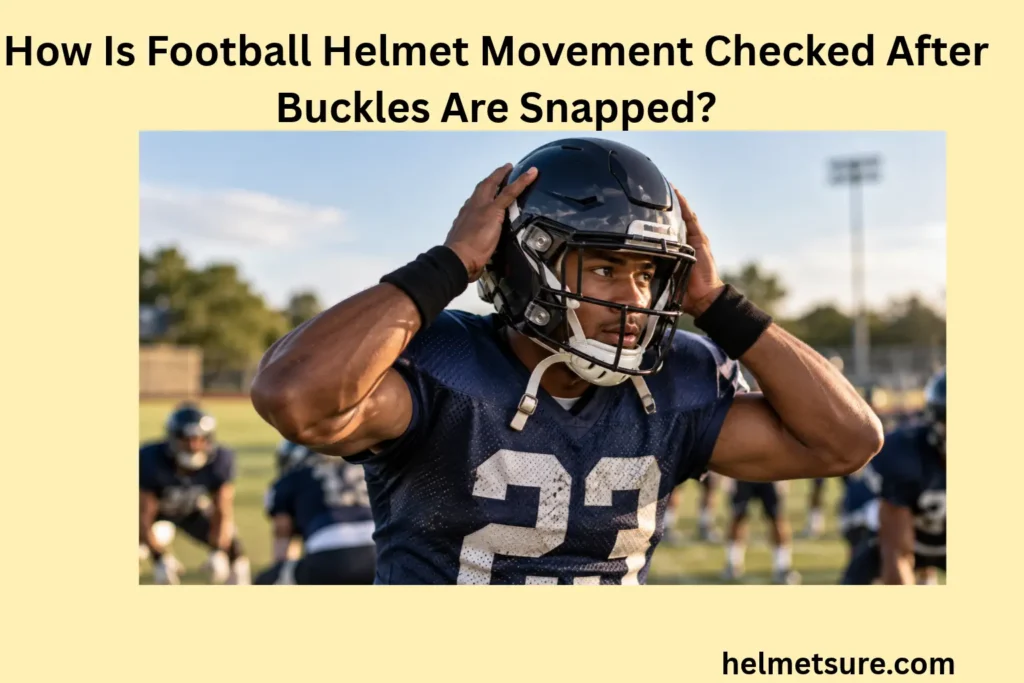
How Is Football Helmet Movement Checked After Buckles Are Snapped?
After the chin-strap buckles are secured, check whether the helmet moves with the head rather than shifting independently. The result verifies retention stability but does not independently prove correct size, complete fit, or the cause of abnormal movement.
Begin with the helmet seated and configured according to the current instructions for the exact model. Confirm the required buckles, chin-cup position, liner contact, and starting brow and ear relationships. Then apply only the movement method specified by the manufacturer and compare shell motion with head motion. CDC guidance supports checking front-to-back and side-to-side movement after the chin strap is fastened, while also directing users to the helmet manufacturer's fitting instructions.
The Post-Buckle Movement Check as a Retention Test Rather Than a Complete Fit Verdict
The post-buckle movement check evaluates whether a secured helmet maintains its seated relationship to the head. It is a retention and stability check performed after the required fastening points have been secured—not a shortcut for measuring the head, selecting shell size, positioning the helmet, or evaluating all internal contacts.
The distinction is reflected in authoritative fitting sequences. USA Football lists head-size measurement, helmet placement, height adjustment, front-to-back and side-to-side adjustment, face-pad adjustment, and a general fit check before chin-strap adjustment. Riddell's Speed-platform guide similarly separates head measurement, liner and face-contact checks, and chin-strap adjustment. Movement after buckle closure must therefore be interpreted within a complete fitting process.
How the movement check tests whether the helmet maintains its seated relationship to the head
The movement check compares helmet motion with head motion after the retention system is secured. The helmet begins in the fitted position established by the applicable manufacturer's instructions. During the prescribed movement, the observer watches whether the shell and head behave as a coupled system or whether the shell slides, rotates, or shifts around the head.
That comparison answers a narrow question: did the helmet maintain the relationship being tested? When the head follows the helmet and the starting positional references remain consistent, the result supports retained contact. When the shell moves independently or finishes in a different position, stability remains unresolved. Neither pattern identifies the cause by itself.
Do not replace the manufacturer's procedure with a generic “shake test,” forceful pull, or invented movement distance. Xenith, for example, directs users of the Epic/Epic+ system to secure all four buckles and then apply mild force to the facemask in multiple directions. That method belongs to the named Xenith architecture; another helmet may specify a different check.
Why helmet stability after buckle closure is different from helmet sizing by itself
Post-buckle stability and helmet sizing evaluate different fit relationships. Sizing concerns compatibility between the athlete's head measurements and shape and the shell or size range specified for a helmet model. The post-buckle check concerns whether the already seated and secured helmet maintains its position during the applicable movement.
The same shell size can behave differently when seating, liner configuration, jaw-area contact, chin-cup position, or strap setup changes. Conversely, securing a strap can reduce movement without establishing that the original shell size was correct. CDC notes that sizes and fit differ among brands and models and tells users to consult the manufacturer's sizing chart and fitting instructions.
Persistent whole-helmet looseness after correct retention makes a broader sizing and compatibility review more relevant, but it still does not make movement a direct size test. Retention, internal contact, approved configuration, and component condition must be compared before assigning a likely source.
Why passing one movement check does not establish complete football helmet fit
Passing one movement check does not establish complete football helmet fit. A favorable movement response is one verification signal. Complete fitting also depends on correct size selection, intended seating, brow and ear relationships, liner and jaw-area contact, chin-cup position, approved configuration, component condition, and any other checks specified for the model.
Agreement across those independent references strengthens the fit conclusion. Disagreement keeps it open. For example, a helmet may move with the head while sitting outside its intended brow position, or a centered chin cup may coexist with inadequate liner contact. The movement result cannot clear a separate failed reference.
No universal composite score should be created from these observations because the authorities do not publish one cross-brand weighting system. Follow the full, current procedure for the exact helmet. A passing equipment-fit check also is not a guarantee of protection and should never be used to predict concussion or another medical outcome. CDC states that no helmet is concussion-proof.
How Buckle Security, Chin-Cup Position, and Internal Fit Affect the Movement Check
Buckle security, chin-cup position, and internal contact establish the relationships evaluated during the movement check. Buckles create the required fastening state, the chin cup provides a lower-retention reference, and the liner or fit system supports the head inside the shell. If one of these conditions is unknown, the movement result becomes harder to interpret.
These relationships should be established before testing, not inferred from the result afterward. A helmet that shifts with an open buckle was not tested under its intended retention condition. A helmet that remains still while being held in place manually was not allowed to demonstrate what its fitted system can maintain.
How snapped buckles allow the chin strap to maintain its retention relationship
Snapped buckles secure the chin-strap system so it can maintain its intended retention relationship. Engaging every attachment required by the helmet and strap system connects the chin cup and straps to the shell in the configuration the manufacturer expects during fitting.
A visible or audible snap confirms engagement, but it does not confirm the entire setup. Strap routing, buckle position, slack removal, chin-cup location, hardware compatibility, and any separate locking step may still matter. CDC says that all four straps must be snapped and tightened when fitting a helmet with a four-point chin-strap system and immediately directs users to the manufacturer's instructions.
The details vary. Riddell's Speed-platform guide describes top and bottom strap paths and snap locations for the named helmets, while Xenith's Epic/Epic+ guide separates low- and high-buckle adjustment and includes a later buckle-locking step. These instructions are platform-specific and should not be transferred across brands.
How chin-cup position supports consistent lower-helmet retention during the movement check
Chin-cup position helps maintain a consistent lower-retention relationship during movement. When the cup is placed as the helmet and strap manufacturer directs, its relationship to the jaw allows the connected straps to oppose lower-shell displacement from a defined position.
CDC's general guidance calls for the chin strap to be centered under the athlete's chin and fitted snugly. Riddell directs users of the covered Speed systems to hold the cup centered on the chin while adjusting the straps, whereas Xenith's Epic/Epic+ procedure describes the cup moving up to meet the chin as the lower straps and internal suspension are engaged. The wording and mechanism differ, so the exact OEM instructions govern.
Do not use maximum pressure as the target. Correct placement and manufacturer-directed security are not the same as excessive compression. Also, a cup that stays centered does not prove that the liner, jaw-area components, or shell size are correct; it establishes one lower-retention prerequisite for a meaningful movement check.
How liner contact creates the internal helmet-head relationship evaluated during the movement check
Liner contact establishes the internal helmet-head relationship evaluated during movement. Supported, distributed contact helps the shell and head behave more coherently, while loss of contact can allow the shell to move independently even when the external retention hardware is closed.
“Contact” does not mean maximum pressure or the absence of every design space. The expected pattern depends on the helmet's architecture. Riddell's Speed-platform guide requires the applicable liners to contact the player's head and uses forehead-skin movement with the front pad during side-to-side movement as one model-specific fit reference. Xenith describes an internal suspension relationship influenced by its lower straps. Neither criterion should be generalized to helmets with a different system.
Keep liner evidence separate from chin-strap evidence. Liner contact describes internal support; buckles and the cup describe retention. Both can contribute to coupled helmet-head movement, but one cannot substitute for the other.
Why correctly snapped buckles cannot compensate for poor internal helmet fit
Correctly snapped buckles cannot compensate for poor internal helmet fit. External retention can help preserve an established position, but it cannot create missing liner support, correct an incompatible shell/head relationship, or place approved fit components into the configuration required by the manufacturer.
A helmet may therefore have every buckle closed and still shift because the head moves inside the shell. Pulling the straps tighter can change cup pressure without correcting distributed internal looseness. USA Football's sequence places the fit check before chin-strap adjustment, supporting the boundary between internal fit and retention.
The reverse is also true: sound internal contact does not replace an unsecured retention system. Both conditions must be present before movement is evaluated. Use only approved liners, pads, straps, buckles, snaps, and adjustment methods; improvised fillers or mixed hardware change the system and invalidate a straightforward comparison.
What Should Be Confirmed Before Testing Helmet Movement?
Confirm helmet seating, buckle security, chin-cup position, and positional references before testing movement. This preparation establishes the baseline against which the post-test helmet position will be compared. It should also include the applicable liner or internal-contact reference so that later shell movement is not interpreted without its supporting fit context.
Do not begin moving the helmet while these conditions are still being adjusted. Record the starting state first. Preparation answers “What condition is being tested?”; the later procedure answers “What happened when movement was applied?” Keeping those questions separate makes the result repeatable.
Confirm that the helmet is fully seated before judging movement
Confirm the helmet's intended seated position before judging movement. Put the helmet on and establish its height, level, and fore-aft position under the current instructions for that exact model. A shell that starts too high, low, tilted, forward, or rearward can produce an apparent movement problem that began as a seating problem.
Use the athlete's actual fitted condition rather than holding the helmet in place to obtain a favorable result. The chin strap and fit system—not the fitter's hands—must maintain the starting position once preparation is complete. CDC describes general coverage and ear-alignment references, while USA Football includes helmet height and directional adjustment in its sequence. Exact measurements or landmarks from an OEM remain limited to the named model.
Record the initial seat so it can be restored during any later retest. Correct seating establishes a valid baseline; it does not yet show whether that position will remain stable.
Confirm that the required chin-strap buckles are securely fastened
Confirm that every buckle required by the helmet's retention system is securely fastened. Follow the current manufacturer procedure for attachment points, strap routing, buckle setting, snap engagement, cup position, and any required lock. Inspect for damaged, incompatible, or missing parts before continuing.
For systems with a distinct setting or locking step, buckle fit is part of establishing the test condition; simply hearing the hardware snap does not prove the strap is correctly secured. Xenith's Epic/Epic+ instructions, for example, place low- and high-buckle adjustment before the fit check and specify feeding the strap through a second buckle slot to lock the fit. That sequence applies to that Xenith system only.
Do not assume every football helmet uses four buckles, identical snap locations, the same strap path, or the same locking method. Correct fastening creates a known retention baseline. It does not prove shell size or internal fit.
Confirm that the chin cup remains centered in its intended jaw position
Confirm the chin cup's intended position before testing helmet movement. Check the cup after all required buckles are secured because fastening can pull it away from the position established earlier. Compare its location with the exact instructions for the approved helmet-and-strap combination.
The goal is a maintained lower-retention reference, not maximum pressure. A cup that is displaced, tilted, or pinching cannot provide a clean baseline merely because the hardware is closed. Riddell's Speed guide calls for the cup to be centered firmly on the chin; Xenith's Epic/Epic+ guide describes the cup sitting comfortably under the chin after the high straps are secured. Apply each statement only within its documented system.
Record the cup's starting relationship so it can be observed during and after movement. Even when the cup remains correctly placed, the shell and internal fit still require separate evaluation.
Confirm the starting brow and ear-position references before moving the helmet
Record the starting brow and ear-position references before applying movement. These landmarks provide a visible before-state for determining whether the shell returns to, or departs from, its seated position after the check.
The ear-to-opening relationship is especially useful as a repeatable position reference, which is why ear positioning should be understood before comparing pre-test and post-test alignment. CDC advises checking that helmet ear holes line up with the athlete's ears and that the helmet does not sit too high or low. That general reference does not establish one universal distance or ratio for every helmet.
Likewise, record the applicable brow relationship without importing a value from another platform. Riddell publishes a brow-position value for the covered Speed helmets, and USA Football includes a general helmet-height value, but model-specific instructions remain controlling. Brow or ear alignment can reveal positional change; neither landmark, by itself, proves the shell size.
Pre-Test Setup Checklist
Post-Buckle Movement Check
How to Check Whether the Helmet Moves With the Head After the Buckles Are Snapped
Apply the applicable controlled movement and observe whether the helmet follows the head or shifts independently. Use the exact movement location, direction, and degree described by the manufacturer. The purpose is to compare relative motion, not to find the greatest force the helmet can withstand.
Complete the initial observation sequence before diagnosing a cause or changing the fit. Watch the primary helmet-head response, check distinct movement directions if the procedure calls for them, and then compare brow and ear references with the recorded baseline. Write down what happened in objective terms.
Apply controlled movement to the helmet while observing whether the head follows with it
Apply manufacturer-directed controlled movement and observe whether the head follows the helmet. Stabilize the athlete as the fitting procedure requires, use the contact point named by the OEM, and apply only the prescribed movement. Watch the head and shell together rather than relying on a vague impression of strap tightness.
For the Xenith Epic/Epic+ system, the published instruction calls for all four buckles to be snapped before mild force is applied to the facemask in multiple directions. That is a useful example of a defined OEM procedure, not a universal method. If the current manual for another model specifies a different check—or does not authorize a user-performed movement at that location—do not substitute the Xenith instruction.
Record one of two broad observations: the helmet moves and the head visibly follows, or the shell shifts relative to the head. Also record mixed or unclear results. Do not label the cause during the procedure; the same independent shift can arise from retention, seating, internal contact, approved configuration, shell compatibility, or combined factors.
Check side-to-side movement for shell shifting independently of the head
Check whether side-to-side shell movement occurs independently of the head. During the applicable lateral portion of the manufacturer's procedure, watch whether the athlete's head follows the shell or whether the shell slides around it. Note the direction, the locations where contact appears to remain or change, and whether the cup stays in its starting relationship.
CDC says a fastened helmet should not easily move side to side, while Riddell uses forehead-skin movement with the front pad during side-to-side turning as one Speed-platform fit reference. The CDC statement supplies general context; the Riddell observation is limited to the covered Riddell systems. Neither source establishes a cross-brand displacement value.
At this stage, lateral shell independence is only an observation. Do not call it a sizing failure, loose strap, or liner problem until the later comparison considers correction response, movement distribution, and internal-contact integrity.
Check front-to-back movement for changes in the helmet’s seated position
Check whether front-to-back movement changes the helmet's seated position. Apply only the longitudinal movement included in the relevant fitting procedure, and compare the shell's position relative to the head during and after that motion.
Watch for the shell rotating forward or backward, the brow relationship changing, the chin cup leaving its intended position, or the helmet settling somewhere different. Record the direction and whether the change is repeatable. CDC's general guidance says the fastened helmet should not easily move back to front, but the precise execution and interpretation remain manufacturer-directed.
Do not infer incorrect size from front-to-back shift alone. A change in strap security, initial seating, chin-cup position, liner contact, or fit-system configuration can produce a similar positional observation.
Recheck whether the starting brow and ear relationships remain consistent after the movement test
Recheck whether the starting brow and ear relationships remain consistent after movement. Without repositioning the helmet first, compare the same landmarks recorded during preparation. This shows whether the shell returned to and maintained its original seat or finished in a different relationship.
Unchanged references support position maintenance; changed references document displacement. Neither result completes the entire fit assessment. The helmet could retain these two landmarks while another fit reference remains unacceptable, and a changed landmark does not identify why the shell moved.
Record the observation before touching the straps, liners, or helmet position. If adjustment is appropriate, it belongs to the later verification stage and must follow the exact manufacturer's instructions.
Post-Buckle Movement-Check Sequence
- Establish the fully seated baseline.
- Confirm the required retention hardware and chin-cup position.
- Record starting brow and ear references.
- Apply the applicable manufacturer-directed movement.
- Observe whether the head follows with the helmet.
- Observe side-to-side independent shell shift.
- Observe front-to-back position change.
- Recheck the starting brow and ear references.
- Record the result before assigning a cause.
What Different Movement Patterns May Indicate About Helmet Stability
Different movement patterns provide different evidence about whether the helmet maintains a stable relationship to the head. Head-following motion supports retained contact, while independent shell shift, changed positional references, or repeated settling indicate that stability remains unresolved.
This stage interprets what an observed pattern means; it does not identify the component or fit variable that caused it. That distinction prevents a visible movement sign from becoming an unsupported strap, liner, or sizing diagnosis. Compare all findings with the original baseline before drawing a stability conclusion.
What movement that carries the head with the helmet may indicate about retained helmet-head contact
Movement that carries the head with the helmet supports a more stable helmet-head relationship. When the shell is moved under the applicable check and the head follows rather than allowing the shell to slide around it, the observation is consistent with retained internal contact and effective restraint.
This is supporting evidence, not a complete-fit pass. The helmet must still satisfy its seating, chin-cup, brow, ear, liner, jaw-area, sizing, and configuration references. A coupled response can coexist with excessive pressure, an incorrect starting position, or another condition not measured by the movement check.
Record whether coupled motion occurs in every direction included in the manufacturer's procedure and whether the starting landmarks remain consistent. No universal percentage of head-following motion should be calculated; the cited authorities do not establish such a cross-system threshold.
What shell movement that occurs independently of the head may indicate about helmet stability
Shell movement independent of the head indicates unresolved helmet stability. The shell has shifted while the head has not followed to the same degree, so the fitted relationship being tested was not maintained as a coupled system.
The finding is important, but its source is still open. Incomplete strap setup, displaced chin cup, incorrect seating, poor liner contact, fit-system configuration, shell/head incompatibility, or several interacting conditions can produce independent motion. CDC's observation that a fastened helmet should not easily move in any direction supports treating such movement as a fit concern, while its direction to follow the manufacturer preserves the model-specific boundary.
Do not label the helmet oversized or the strap loose from this one observation. Carry the result forward to the classification axes: response to correct retention, movement location, liner-contact integrity, and broader configuration.
What a changed brow or ear relationship after the test may suggest about loss of helmet position
A changed brow or ear relationship after movement indicates that the helmet did not maintain its starting position. The shell has finished higher, lower, farther forward or back, or otherwise differently aligned relative to the recorded landmarks.
This before-and-after comparison is valuable because it captures positional loss that may not be obvious while force is being applied. The helmet can look still after movement yet have settled into a new seat. CDC uses helmet height and ear-hole alignment as general fit references, and Riddell provides platform-specific brow guidance for the covered Speed helmets.
The changed relationship remains an effect, not a cause. Retention, seating, internal support, configuration, and sizing can all influence it. Do not convert an ear or brow change directly into a shell-size diagnosis.
What repeated settling into a different seated position may indicate about retention stability
Repeated settling into a different seated position indicates that helmet position is not remaining stable. When the same valid baseline and prescribed movement produce a changed end position more than once, the recurrence strengthens the conclusion that the fitted relationship is inconsistent.
Repeatability matters more than an invented attempt count. One poorly controlled trial may be ambiguous, but the solution is not to keep increasing force or to repeat the test arbitrarily. Re-establish the correct baseline, apply the same authorized procedure, and document whether the position is maintained.
Even a repeated pattern does not identify one source. It can reflect the retention setup, internal fit, approved padding or suspension configuration, shell compatibility, or interacting issues. Classification comes next; correction waits until the evidence has been compared.
Movement Pattern → Interpretation Table
| Movement pattern | Stability meaning | Supporting reference | What it does not prove |
|---|---|---|---|
| Helmet movement carries the head | The helmet-head relationship appears more retained | Liner contact and positional references remain consistent | Complete fit is proven |
| Shell shifts independently | Stability is unresolved | Compare retention, liner contact, and movement distribution | The chin strap is definitely the sole cause |
| Brow or ear relationship changes | Starting helmet position was not maintained | Compare pre-test and post-test references | Shell size is definitely wrong |
| Helmet repeatedly settles differently | Positional stability is inconsistent | Repeatable baseline and test conditions | One specific fit-system source |
When Excessive Movement Points to Strap Retention Versus a Broader Helmet-Fit Problem
Excessive movement requires comparison of retention response, movement location, liner-contact integrity, and broader fit configuration. These four axes help determine which category deserves priority without treating any one sign as a final diagnosis.
Classification asks what the evidence is more consistent with. It does not authorize an adjustment. First compare the pattern; then, in the verification section, apply only the correction permitted by the current manufacturer documentation and repeat the same movement check.
How response to correct strap adjustment separates strap-retention instability from movement that persists beyond strap correction
Movement that resolves after correct strap adjustment is more consistent with retention-related instability. If an incorrect strap state is documented, the approved setup is restored, and the same test no longer produces independent shell movement, the evidence that retention contributed becomes stronger.
Improvement is not single-cause proof. Correcting the strap can change its interaction with the cup, lower shell, or—on some architectures—the internal fit system. A second unresolved problem may remain even though the dominant movement is reduced. Continue to check all supporting references.
“Correct adjustment” means the procedure for the exact approved strap and helmet system. Riddell and Xenith publish different routing and adjustment instructions for the systems cited here. No universal amount of tightening or required improvement should be invented. If movement persists under a verified retention setup, broader fit variables gain priority.
How movement centered around the chin cup or lower retention system differs from whole-helmet looseness
Lower-retention movement differs from looseness distributed through the whole helmet. A localized pattern may show the cup shifting, lower straps changing relationship, or motion concentrated near the jaw while other internal contacts remain comparatively coherent. That pattern gives more weight to retention geometry.
Whole-helmet looseness is distributed: the head appears to move within the shell, multiple contact regions change, or the entire helmet shifts despite a correctly positioned cup and secured hardware. This broadens attention to seating, internal support, fit-system configuration, and shell/head compatibility.
Location alone still does not establish the source. A lower pattern can coexist with broader looseness, and a retention problem can affect more than one region. Use movement distribution as one axis alongside correction response and liner-contact integrity, not as a standalone verdict.
How movement with maintained liner contact differs from movement accompanied by widespread liner-contact loss
Movement with maintained liner contact differs from movement accompanied by widespread loss of internal contact. If the manufacturer-defined liner relationships remain coherent while instability centers on the cup or straps, retention or another localized issue becomes more plausible. If contact is lost across multiple head or jaw regions as the shell shifts, the concern expands to the broader fit system.
Widespread loss naturally raises the question of where fit gaps appear and whether those locations match the current model's intended contact pattern. A single visible space is not automatically a sizing failure; seating, head shape, approved padding, liner configuration, and shell size can all influence contact.
Evaluate gaps only under current OEM guidance. Riddell's covered Speed systems use inflatable liners and S-pads with platform-specific contact instructions, while Xenith's Epic/Epic+ architecture uses a suspension system and approved fit accessories. Do not transfer a pad, inflation method, pressure expectation, or gap rule from one system to the other.
How persistent movement can reflect padding or fit configuration without automatically proving incorrect shell size
Persistent movement can reflect padding or fit-system configuration without proving incorrect shell size. Within some helmet families, manufacturer-approved liner, pad, air, jaw-area, or suspension settings change internal support without changing the shell label. Those options must be evaluated under the exact platform instructions.
Riddell's Speed-platform guide, for example, describes specific inflatable liner and S-pad adjustments for the named models, while Xenith lists system-specific sizing or comfort components for Epic/Epic+. These examples show why configuration and shell size are separate categories. They do not authorize the use of those parts or methods on other helmets.
If an approved configuration change materially improves stability, configuration likely contributed. That improvement does not independently prove that shell size is correct. If distributed looseness and contact loss persist across the approved setup, size or head-to-shell compatibility becomes more relevant—but still requires the manufacturer's fitting process. Never add improvised padding, fillers, substitute liners, or unauthorized hardware.
Retention vs. Broader Fit Matrix
| Classification axis | More consistent with retention/local issue | More consistent with broader fit issue | What remains unproven |
|---|---|---|---|
| Response to correct strap setup | Movement substantially normalizes | Movement persists | The strap was the sole cause |
| Movement location | Instability centers around the chin cup or lower retention | The whole helmet remains loose | The exact underlying component |
| Liner-contact integrity | Internal contact largely remains coherent | Widespread contact loss accompanies movement | Incorrect shell size by itself |
| Fit-system category | Approved configuration materially changes stability | Instability persists across approved setup | One universal size diagnosis |
How to Recheck Helmet Movement After a Fit or Strap Adjustment
Recreate the original baseline before repeating the movement check after an approved adjustment. A valid retest uses the same seating, retention condition, positional references, and manufacturer-directed movement sequence as the initial check. Otherwise, a different result may reflect different test conditions rather than an effective correction.
This is the only stage in the process that owns correction and corrective verification. Adjust only the element identified for review, stay within the applicable manufacturer's approved system, restore the full baseline, and record the new result. If instability remains, escalate rather than repeatedly intensifying the adjustment.
Return the helmet to its fully seated starting position before repeating the movement check
Return the helmet to the same fully seated starting position before retesting. Reseat it under the same current OEM procedure and reconfirm the same brow, ear, level, and fore-aft references recorded for the original check.
Do not compare a first test that began from one seat with a second test that began higher, lower, or differently rotated. Seating can change both shell movement and the apparent contact pattern, making the effect of the adjustment impossible to isolate. CDC, USA Football, and Riddell all treat positioning as part of fit, while exact criteria remain system-specific.
The starting position must be maintained by the fitted helmet itself, not manually held. Once the baseline is restored, proceed to the retention reset before applying movement.
Resecure the buckles and confirm chin-cup position after the adjustment
Resecure the retention system and reconfirm chin-cup position before retesting. An adjustment to a liner, pad, seating reference, or other approved fit element can change how the strap reaches its buckles or where the cup rests. Reapply the full OEM procedure rather than assuming the earlier buckle state remains valid.
Confirm every required attachment, strap path, buckle setting, snap, cup position, and model-specific locking step. Riddell's Speed and Xenith's Epic/Epic+ instructions illustrate different platform sequences, so use only the document for the helmet being tested.
The objective is the same correct retention baseline—not a tighter baseline designed to produce less movement. Over-tightening changes the test condition and can conceal the original source while creating discomfort. Use approved hardware only and record the reset before retesting.
Repeat the same movement sequence and compare the helmet-head relationship with the initial result
Repeat the same movement sequence and compare the helmet-head relationship with the initial result. Use the same authorized contact point, directions, order, and qualitative force language contained in the current OEM procedure. Observe head-following motion, independent shell shift, chin-cup behavior, liner contact, and the same post-test positional references.
Compare like with like. A changed method or stronger force prevents a defensible before-and-after conclusion. Improvement in one direction should not end the check if another prescribed direction now shows independent movement or the helmet settles differently.
Classify the result as improved, unchanged, or newly different without inventing a numeric improvement threshold. A resolved primary movement pattern supports the effectiveness of the approved correction, but complete fit still requires agreement among the other references.
Escalate to a broader fit review when correct securing and adjustment do not restore stable helmet positioning
Persistent instability after correct securing and approved adjustment requires broader football helmet fit review. The escalation trigger is a valid baseline, a manufacturer-approved correction, a comparable retest, and continued independent movement or loss of position—not an arbitrary number of attempts.
Broaden the review to seating, shell/head compatibility, liner contact, jaw-area contact, approved padding or suspension configuration, retention components, and equipment condition. A different size, approved configuration, replacement component, or helmet system may need evaluation, but the movement result cannot choose among them by itself.
Stop repeated tightening, over-inflation, or improvised padding. Refer the case to current manufacturer documentation and a football equipment professional, certified athletic trainer, equipment manager, or another practitioner with documented experience fitting the applicable system. If the athlete has symptoms or a suspected injury, stop participation and follow the organization's medical and emergency protocol; equipment fitting is not a medical diagnosis.
Post-Adjustment Retest Checklist
Post-Buckle Movement Check
Helmet Movement After Buckle Closure as One Part of Complete Fit Verification
Post-buckle movement testing is one component of complete football helmet fit verification. It determines whether the secured helmet maintains its seated relationship during a controlled, system-specific check. It does not independently establish correct size, complete fit, certification status, protective performance, or medical outcome.
The defensible conclusion comes from sequence and corroboration: build a valid baseline, perform the authorized movement, record relative shell and head behavior, interpret stability, compare likely source categories, correct only within the approved system, and retest under comparable conditions.
The movement check as confirmation that the secured helmet maintains its seated relationship to the head
The movement check confirms whether the secured helmet maintains its seated relationship to the head. From a fully seated and correctly fastened baseline, coupled helmet-head motion supports retention stability; independent shell motion or changed landmarks shows that the relationship remains unresolved.
That confirmation is deliberately limited. CDC includes movement after chin-strap fastening within a broader set of football helmet fit checks, and OEM manuals define how their own systems should be seated, secured, and evaluated. The result belongs inside that complete process rather than replacing it.
Why movement results become more meaningful when brow, ear, liner, and retention references remain consistent
Movement results become stronger evidence when independent positioning, contact, and retention references remain consistent. A stable motion pattern is more informative when the brow relationship, ear relationship, liner contact, chin-cup position, and buckle condition also remain at their established baselines.
Agreement reduces reliance on one ambiguous observation. Conflict does the opposite: if the helmet appears to move with the head but finishes at a changed brow reference, or if the cup stays positioned while widespread liner contact is lost, complete fit remains unresolved. No universal composite score can turn those signals into certainty.
NOCSAE's football standards address product performance and certification requirements, not whether one athlete's specific helmet passes this fit check. Even multi-reference fit agreement is an equipment finding, not a protection guarantee or a prediction of concussion outcome.
The final verification model: establish the baseline, test movement, interpret independent shifting, classify its likely source, and confirm that correction holds
Establish the baseline, test movement, classify persistent instability, and verify that approved correction holds. Seat and secure the helmet, record its positioning and contact references, apply the current manufacturer's movement procedure, and document head-following behavior or independent shell shift before interpreting the result.
Next, compare correction response, movement location, liner-contact integrity, and fit-system configuration. Apply only the adjustment authorized for the exact helmet and repeat the same check from the same baseline. This sequence keeps observation, stability meaning, source classification, and correction from being collapsed into one assumption.
If correct manufacturer-directed securing and approved adjustment still leave persistent instability, the helmet requires broader fit evaluation under current manufacturer instructions and direct review by a qualified football equipment professional, certified athletic trainer, equipment manager, or similarly experienced practitioner. Do not return an unresolved helmet to activity.
Frequently Asked Questions About Post-Buckle Football Helmet Movement
Short answers covering preparation, movement testing, interpretation, corrective retesting, and safety boundaries.
What does the post-buckle movement check evaluate?
It checks whether the secured helmet maintains its seated relationship to the head during the applicable controlled movement procedure.
What must be confirmed before testing movement?
Confirm seating, required buckles and locking steps, chin-cup position, liner contact, and starting brow and ear references.
How should helmet movement be tested?
Use only the movement method specified for the exact helmet, observing side-to-side and front-to-back shell motion relative to the head.
What does movement that carries the head suggest?
It supports a more retained helmet-head relationship when liner and positional references also remain consistent.
What does independent shell movement suggest?
It signals unresolved stability and requires comparison of retention, contact, configuration, and movement distribution.
Does excessive movement automatically mean the helmet is the wrong size?
No. Correct strap setup, contact, configuration, component condition, and compatibility must be compared first.
How should movement be rechecked after adjustment?
Restore the same baseline, repeat the same sequence, and compare the new helmet-head relationship with the initial result.
Does passing the check prove complete fit or protection?
No. It is one fit-verification result and cannot guarantee protection or make a helmet concussion-proof.