
What Does Ear-Centered Positioning Mean for Football Helmet Fit?
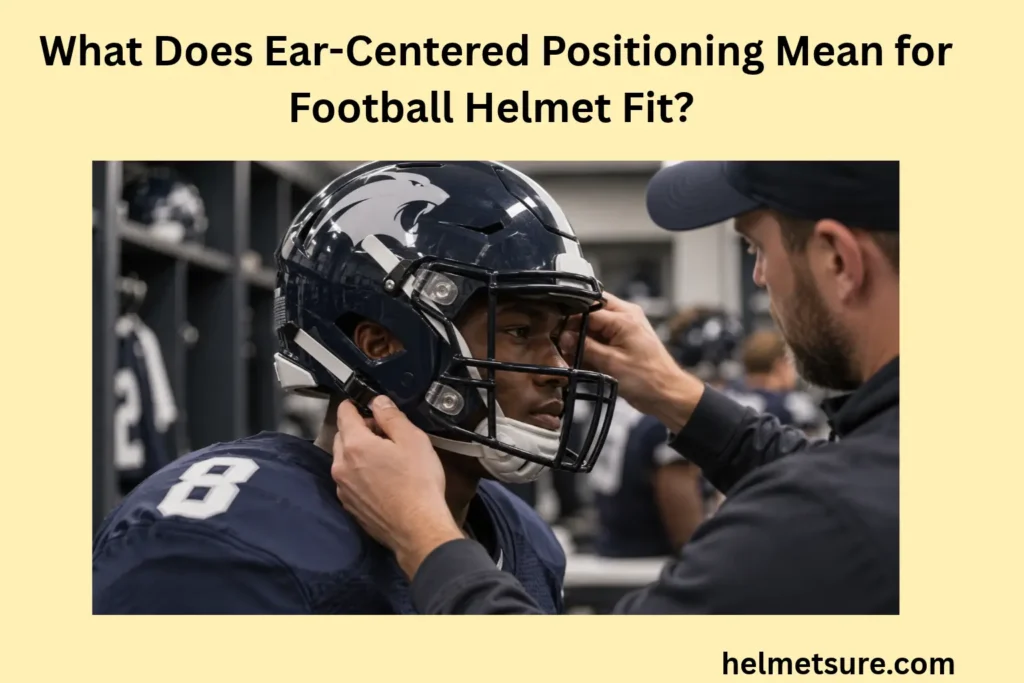
Ear-centered positioning aligns the athlete's ears with the helmet's ear openings when the helmet is seated at its intended height. It reflects shell position but does not independently prove correct size, complete fit, protection level, or retention security.
The ear openings are useful because they provide a visible reference between the helmet shell and the athlete’s head. However, that reference must be interpreted with brow position, crown contact, side contact, helmet stability, and the fitting instructions for the exact helmet. CDC guidance similarly treats ear-hole alignment as one part of a broader football helmet fit check, not as a complete verdict by itself.
Ear-Centered Positioning as a Helmet-Height Reference Rather Than a Complete Fit Standard
Ear-centered positioning functions as a helmet-height and seating reference. It helps the fitter judge where the shell is sitting vertically, but it does not replace the rest of the fitting process.
How the ear-to-opening relationship functions as a reference for helmet position
The ear-to-opening relationship indicates where the helmet shell sits relative to the athlete's ears. When the helmet is fully seated, each ear should occupy the position intended by the applicable fitting guidance. CDC HEADS UP expresses the practical version of this check by instructing fitters to make sure the helmet’s ear holes line up with the athlete’s ears.
This relationship changes when the shell moves. If the shell shifts upward, downward, or to one side, the ear appears in a different part of the opening even though the athlete’s anatomy has not changed. That makes ear alignment a useful observation of shell position.
“Centered” should not be read as a universal mathematical midpoint. Ear-opening shapes and internal fit systems differ across helmet designs, and no single gap, distance, or percentage applies to every football helmet. The relevant comparison is the intended relationship described for the helmet being fitted.
Ear position also does not measure crown support, lateral contact, chin-strap security, or movement stability. It answers a narrow question—where the shell sits relative to the ears—while those other checks answer different fit questions.
Why ear-centered positioning describes helmet seating rather than helmet size by itself
Ear-centered positioning describes where the helmet is seated on the athlete's head. Helmet size, by contrast, is the shell or fit-system range selected from the manufacturer’s sizing information.
The same nominal size can appear at different heights if the helmet is not pulled fully into position, sits unevenly, or is supported differently by its internal components. Conversely, a helmet can be placed so that the ears look aligned even when other fit relationships remain unresolved.
This is why ear misalignment does not prove that the shell size is wrong. CDC notes that sizes and fit vary by brand and model and directs users to the applicable manufacturer’s sizing chart and fit instructions. Seating, head shape, side contact, padding configuration, liner configuration, and stability all need to be checked before a broader compatibility conclusion is reached.
Why acceptable ear alignment must be interpreted alongside other fit references
Ear alignment gains meaning when other football helmet fit references support the same shell position. Brow position offers a front reference for helmet height. Crown contact helps show whether the helmet is fully seated. Side contact reveals whether the shell has balanced support. A recognized movement check determines whether the position can be maintained.
Agreement among these observations strengthens the interpretation that the helmet is seated as intended. Disagreement keeps the fit unresolved. For example, ears that appear aligned do not cancel a helmet that is perched at the crown, sits unevenly at the sides, or shifts relative to the head.
The broader relationship among positioning, contact, retention, equipment condition, and manufacturer instructions is covered in complete helmet fit. Ear alignment belongs inside that complete fit context; it is not a substitute for it.
The same distinction applies to standards. NOCSAE standards establish laboratory performance requirements for new or recertified football helmets, whereas wearer-specific fit must be evaluated on the individual athlete. A standards label therefore does not prove that a particular helmet fits a particular player.
How Vertical Helmet Seating Changes the Ear-to-Opening Relationship
Vertical helmet seating changes the visible relationship between each ear and its helmet opening. Understanding that movement first prevents the fitter from assigning a cause before the actual pattern has been observed.
How upward or downward shell movement shifts the ear's position within the helmet opening
Upward or downward shell movement changes where the ear appears within the helmet opening. When the shell moves upward relative to the head, the opening also moves upward relative to the ear. When the shell moves downward, the opening moves downward relative to the ear.
This is a relationship between a moving shell and a stable anatomical reference. It describes what changed, not why the change occurred. A high or low relationship can result from incomplete seating, internal support, an unresolved size relationship, a configuration issue, or another fit variable.
For that reason, the visible shift should be recorded before it is interpreted. Do not use the ear opening alone to prescribe a different size, pad, liner setting, or chin-strap adjustment.
How uneven helmet seating creates different ear-to-opening relationships on each side
Uneven helmet seating changes the left and right ear-to-opening relationships differently. A shell that tilts or receives unequal support can sit higher on one side and lower on the other, creating visibly different alignments.
That observation must be separated from natural anatomy. Human ears and head shapes are not always perfectly symmetrical, and helmet openings are not a photographic-symmetry test. The relevant question is whether the shell appears level and whether its supported position is repeatable.
If the asymmetry persists after the helmet is reseated consistently, compare the ear observations with brow level, crown seating, and side-contact patterns. Those checks help determine whether the difference belongs to the shell’s position rather than to ordinary anatomical variation.
Why reseating the helmet can change apparent ear alignment without changing the player's head size
Reseating the helmet can change ear alignment without changing the athlete's head size. The head remains the same; the shell returns to a different position.
An incompletely seated helmet can perch above its intended location. An inconsistently seated helmet can stop at different heights or angles on repeated attempts. Pulling it on and seating it according to the manufacturer’s current procedure can therefore change the visible ear relationship without any change to the selected size. CDC and USA Football both place putting on and positioning the helmet within a sequence that precedes the final fit and retention checks.
If alignment normalizes after correct reseating, positioning remains the first explanation to investigate. That result is not yet proof of complete fit: the brow, crown, sides, retention system, and movement stability still require verification.
How Brow, Crown, Side Contact, and Stability Help Interpret Ear-Centered Positioning
Brow position, crown contact, side contact, and stability provide independent references for interpreting ear alignment. Each one tests a different part of the fitted relationship, so no single reference should be used to excuse a problem found by another.
How brow position helps corroborate the helmet height suggested by ear alignment
Brow position provides a second reference for judging helmet height. Because shell height influences both the front edge or frontal pad relationship and the ear openings, the two observations should point toward the same vertical position.
If the ear alignment and brow position both agree with the applicable fitting instructions, confidence in the seating interpretation increases. If the ears appear aligned but the helmet is visibly too high or low at the brow, the fit remains unresolved and should be reseated and reviewed.
USA Football includes helmet-height adjustment as a distinct step before front-to-back, side-to-side, face-pad, overall-fit, and chin-strap checks. Riddell’s fitting guide also uses a brow-position reference, but its exact measurement and procedures apply to the helmet families covered by that guide and should not be generalized to every model.
How crown contact helps confirm whether the observed ear position comes from a fully seated helmet
Crown contact helps determine whether the helmet is seated fully on the head. The shell can appear close to the desired ear position while still being perched or supported incorrectly at the top.
Supported crown contact means the helmet is seated into its intended internal support system rather than merely touching at one concentrated pressure point. Ear alignment without appropriate crown support remains an incomplete result. Likewise, pressure or discomfort at one point should not be interpreted as stronger proof of fit.
Riddell’s guide for the helmet systems it covers distinguishes crown pressure from brow pressure during its fit check. The transferable principle is not a universal pressure rule; it is that the helmet’s documented crown-support relationship must be checked alongside its ear and brow position.
How side contact helps show whether the ear-to-opening relationship is supported evenly on both sides
Side contact shows whether the shell receives balanced support around the head. Supported contact at the applicable side and jaw areas helps the shell return to a repeatable position instead of leaning toward an unsupported gap.
Unequal gaps or compression can challenge the ear-position signal. A helmet may look centered from one angle while receiving uneven support internally. At the same time, greater tightness is not automatically better: excessive or concentrated pressure can coexist with poor seating or an incompatible fit relationship.
When the ear relationships differ from side to side, examine the contact pattern addressed in head and jaw gaps. Use only pads, liners, inflation zones, or other fit components approved for the exact helmet system, and follow its current instructions. CDC specifically warns against altering or replacing internal parts unless the work is supervised by a trained equipment manager.
How helmet stability helps confirm whether ear-centered positioning can be maintained rather than only achieved momentarily
Helmet stability shows whether the observed ear alignment remains in place during the approved fit check. A shell that can be manually arranged around the ears but immediately moves away from that position has not produced a stable seating result.
Observe the shell relative to the head while following the recognized or manufacturer-directed procedure. The purpose is to see whether the ear-to-opening relationship, brow position, and supported contact remain coherent—not to invent a forceful shake test or an unsupported movement threshold.
CDC states that a fitted helmet should not slide on the head with the chin strap in place and should not move easily back-to-front or side-to-side after the strap is fastened. The exact check still needs to follow the current instructions for the helmet and retention system being fitted.
What Proper Ear-Centered Positioning Should Look Like During an Initial Fit Check
Proper initial ear-centered positioning shows each ear in the intended relationship to its opening while the helmet is seated level. At this stage, record what is visible and defer causal diagnosis until the supporting checks have been compared.
Whether each ear sits within the helmet opening's intended fit zone
Each ear should occupy the helmet opening position specified by the applicable fitting guidance. Seat the helmet fully, then inspect the left and right sides separately rather than judging the relationship from only one side.
Record whether each ear appears aligned with its opening, high relative to it, low relative to it, or displaced toward one edge. This is an observed fit signal. Do not label the cause as size, padding, tilt, or head-shape incompatibility during the observation stage.
No universal centering percentage or edge distance should be applied. The intended position follows the current instructions for the exact model, while the CDC’s general criterion is that the ear holes line up with the athlete’s ears.
Whether left-to-right ear alignment appears reasonably consistent when the helmet is seated level
Left-to-right ear alignment should appear reasonably consistent when the helmet is seated level. Compare both sides under the same seating condition and look for an obvious difference in the shell’s height or angle.
“Reasonably consistent” does not mean visually identical. Natural differences between the athlete’s ears and the helmet’s contours can affect appearance. The goal is to identify whether the shell itself is sitting unevenly and whether the same relationship returns when the helmet is reseated correctly.
An apparent difference should be flagged for corroboration, not immediately called a fit failure. Brow level, crown contact, and side support determine whether the visual asymmetry reflects the helmet’s position.
Whether the observed ear position agrees with the previously established brow and crown references
The observed ear position should agree with the brow and crown references from the same fit check. All three observations should support one coherent shell height.
If the ears appear properly related to the openings but the brow reference indicates a different height, reseat and reassess. If the brow and ears look plausible but the crown is not properly supported, the helmet may not be fully seated. A passing observation does not average out a conflicting one.
This cross-check reflects the fitting sequence used by institutional and manufacturer guidance: put on and position the helmet, adjust the applicable fit system, and then check the complete result.
Whether the ear-to-opening relationship remains visually consistent during the initial movement check
The ear-to-opening relationship should remain visually consistent during the recognized initial movement check. Watch the shell relative to the head rather than looking only at whether the helmet remains on the athlete.
If the ear moves toward a different part of the opening as the shell shifts, record an instability signal. At this point, do not decide whether the cause is shell size, internal configuration, side contact, or retention adjustment. The movement observation establishes that the fitted relationship did not remain consistent; the later diagnostic checks determine what deserves investigation.
Use the procedure specified by the applicable helmet manufacturer or recognized fitting authority. Do not create a homemade shake test, force requirement, or universal movement limit.
Initial Ear-Position Checklist
Football Helmet Fit Check
What Incorrect Ear Alignment May Indicate About Helmet Position
Incorrect ear alignment identifies a helmet-position pattern that requires further fit checks. The pattern directs the next observation; it does not prove a single cause.
What an ear opening sitting noticeably above the ear may suggest about helmet position
An ear opening sitting noticeably above the ear is a signal to recheck whether the helmet is seated too high. The opening has moved upward relative to the anatomical ear, which makes vertical seating the first relationship to revisit.
Reseat the helmet using the applicable procedure, then compare brow position, crown contact, and side support. A helmet that is not fully seated at the crown or is held high by its contact pattern can produce the same visible cue as other fit problems.
Do not conclude from this pattern alone that the shell is too small. “Noticeably above” is an observational description, not a universal measurement, and the opening’s geometry differs among helmet systems.
What an ear opening sitting noticeably below the ear may suggest about helmet position
An ear opening sitting noticeably below the ear is a signal to recheck whether the helmet is seated too low. Compare the relationship with the brow, field of vision, crown support, and side contact before classifying why the shell occupies that position.
A low relationship can reflect more than one fit variable. It does not, by itself, justify removing padding, changing liner settings, or choosing a different shell size. Any correction must follow the current instructions for the exact helmet.
CDC advises checking that a football helmet does not sit too high or too low and pairs ear-hole alignment with frontal coverage and vision checks. That combined approach is more informative than treating the ear opening as an isolated gauge.
What persistent left-to-right ear asymmetry may suggest about tilted or uneven helmet seating
Persistent left-to-right ear asymmetry is a signal to investigate tilted or uneven helmet seating. “Persistent” means the same pattern remains after the helmet has been put on and seated consistently according to the applicable instructions.
Compare the shell’s level position, crown seating, and side-contact distribution. Unequal support can maintain a tilt, but it remains a hypothesis until the internal fit system is checked. Natural anatomical asymmetry also needs to be distinguished from a shell that is actually sitting unevenly.
Ear appearance alone cannot diagnose head-shape incompatibility, the wrong shell size, or a particular pad problem. Those classifications require repeatable seating and agreement among several fit references.
What repeated loss of ear alignment during movement may indicate about helmet-seating stability
Repeated loss of ear alignment during movement indicates that helmet-seating stability requires further evaluation. The helmet may reach the intended position at rest yet fail to maintain the same relationship during the approved check.
That pattern confirms an unresolved stability issue, not its cause. Reassess side contact, crown support, shell/head compatibility, approved fit-system configuration, and the retention procedure. Do not default to greater chin-strap tension; a retention change cannot correct every shell-position or internal-support problem.
CDC’s fit guidance links a secured chin strap with resistance to easy front-to-back and side-to-side helmet movement. Manufacturer instructions determine how that check is performed for the applicable system.
| Observed pattern | Primary fit condition to investigate | Supporting checks | Conclusion not to jump to |
|---|---|---|---|
| Ear opening appears high relative to ear | High or incomplete seating | Brow, crown, contact | Wrong shell size |
| Ear opening appears low relative to ear | Low vertical seating | Brow, vision, crown | Padding is automatically the cause |
| Left-right relationship remains different after reseating | Tilt or uneven support | Side contact, seating repeatability | Head shape or shell size is definitely wrong |
| Alignment repeatedly changes during movement | Unresolved stability | Contact, configuration, retention | Chin-strap tension is the sole cause |
When Ear Misalignment Points to Positioning Versus a Broader Sizing or Configuration Problem
Persistent ear misalignment requires classification beyond the initial positioning check. Classification begins only after the helmet has been reseated consistently and the other fit references have been compared.
How ear alignment that normalizes after reseating differs from misalignment that persists
Ear alignment that normalizes after consistent reseating differs from alignment that remains incorrect after the same seating procedure. A relationship restored by reseating supports a temporary positioning explanation. A relationship that stays incorrect signals the need for a broader fit review.
The distinction depends on repeatable conditions. Before and after observations are not comparable if the helmet was seated differently, the retention system was handled differently, or the fit configuration changed between checks.
Even when reseating restores alignment, verify crown contact, side support, brow position, and movement stability. A temporary visual correction is useful evidence, but it is not proof of complete fit.
How a one-time seating error differs from an alignment pattern that repeatedly returns after the helmet is reseated
A recurring alignment pattern returns after the helmet has been reseated consistently. One incomplete or awkward attempt does not establish recurrence; the same problem must reappear under the same applicable fitting procedure.
Recurrence increases the reason to investigate a broader fit relationship because something is repeatedly guiding the shell back to the same high, low, tilted, or unstable position. That factor may involve contact distribution, fit-system configuration, size compatibility, head shape, or component condition.
Do not label the helmet incompatible after one failed attempt. Standardize the fitting method first, observe whether the pattern returns, and then use corroborating checks to narrow the category.
How padding or fit-system configuration can produce persistent ear misalignment without proving the helmet shell size is wrong
Padding or fit-system configuration can change the shell's seated position on the head. Approved side pads, jaw pads, liners, or inflation systems can redistribute support and alter shell height, tilt, or stability.
That does not mean every persistent alignment problem is a configuration problem. It means shell size cannot be inferred from the ear opening alone. If an approved adjustment changes the contact pattern and the ear relationship, configuration becomes a stronger explanation; the complete fit still requires rechecking.
Adjustment architecture differs by manufacturer and model. Riddell’s guide, for example, describes specific liner and jaw-pad procedures for the systems named in that document. Those directions should not be applied to a different helmet, and improvised foam, unauthorized pads, or unapproved liner changes should not be used.
How a size-related fit pattern differs from one driven primarily by padding or fit-system configuration
A size-related fit problem persists across the helmet's approved adjustment range. It remains unresolved even when the helmet is correctly seated and its approved internal fit components are configured according to current manufacturer instructions.
A configuration-responsive pattern changes when the approved system is adjusted: support becomes more balanced, the shell position becomes repeatable, and the ear, brow, crown, side-contact, and stability observations move toward agreement. A broader compatibility problem remains inconsistent despite those permitted changes.
This classification is still based on the complete fit, not ear appearance alone. CDC emphasizes that helmet fit and sizing vary across brands and models. If the supported fitting range cannot produce stable, coherent contact without gaps or excessive pressure, review shell size, head compatibility, and another appropriate helmet system with a qualified fitter. Do not increase compression simply to force visual alignment.
| Pattern after correct reseating | Supporting observations | Primary category to investigate |
|---|---|---|
| Alignment becomes correct and remains stable | Brow, crown, and contact references also normalize | Positioning |
| Alignment becomes correct but repeatedly shifts | Movement instability remains | Stability or broader fit |
| Alignment remains wrong and contact distribution is unresolved | Gaps or pressure pattern persists | Size or head-compatibility review |
| Alignment changes with approved internal adjustment | Shell position responds to configuration | Padding, liner, or fit-system configuration |
| Alignment remains unresolved throughout the approved fitting range | Multiple references remain inconsistent | Broader size or compatibility review |
How to Verify Ear-Centered Positioning After Helmet Adjustments
Ear-centered positioning must be rechecked after every approved fit adjustment. Verification asks whether the intended relationship can be restored under repeatable conditions and maintained when the complete fit system is reassembled.
Reseat the helmet fully before comparing the adjusted ear-to-opening relationship
Reseat the helmet fully before evaluating the effect of an adjustment. A partial or inconsistent starting position can make an ineffective change appear successful—or make an appropriate change appear to fail.
Use the same manufacturer-directed putting-on and seating procedure for each comparison. Do not manually hold the shell until the ears look centered. Verification concerns the position the fitted system produces and maintains, not a temporary arrangement created by the fitter’s hands.
Two observations made under different seating conditions cannot support a reliable before-and-after conclusion. Standardize the baseline first, then compare the adjusted ear relationship.
Recheck both sides after padding or fit-system changes to confirm the resulting ear position
Recheck both ear-to-opening relationships after every approved padding or fit-system adjustment. Internal changes can redistribute support, alter shell height, or reduce one tilt while creating another.
Inspect each side separately and then compare them. Improvement on one side with a new gap, pressure concentration, or alignment problem on the other does not resolve the fit. Return to the applicable manufacturer procedure rather than compensating with an improvised part or generic setting.
Do not borrow inflation values, pad thicknesses, or liner instructions from another model. If the current documentation for the exact helmet cannot be confirmed, have the system assessed by a qualified equipment professional rather than guessing.
Confirm that the adjusted ear alignment remains consistent with brow, crown, side-contact, and stability references
Adjusted ear alignment must remain consistent with the helmet's other fit references. Recheck brow position, supported crown contact, balanced side contact, and the retention system before moving from a static inspection to the approved movement check.
The ears can appear aligned while another part of the fit remains unresolved. One improved observation cannot cancel a poor crown relationship, an unsupported gap, excessive compression, or repeatable shell movement.
Once the helmet is secured according to its instructions, assess helmet movement as the next stability question. CDC states that all snaps in a four-point system should be fastened and adjusted as part of fitting and that the helmet should not move easily after the chin strap is secured.
Escalate to a broader fit review when repeated adjustments fail to restore stable, consistent ear-centered positioning
Repeated failure to restore stable ear-centered positioning requires a broader fit review. When correct seating and approved adjustments still leave the ears high, low, asymmetric, or unstable—and other fit references remain inconsistent—the issue has moved beyond a simple one-time positioning correction.
Review the exact helmet’s size range, head compatibility, fit-system configuration, component completeness and condition, and current manufacturer requirements. Further changes must remain within the approved components and settings for that model.
Do not continue tightening, inflating, or adding material in an attempt to hide the symptom. A football equipment professional, certified athletic trainer, equipment manager, or another practitioner with documented experience fitting that helmet system should evaluate the unresolved fit before the helmet is used.
Post-Adjustment Verification Checklist
Football Helmet Fit Check
Ear-Centered Positioning as One Signal Within a Complete Football Helmet Fit
Ear-centered positioning remains one fit signal within the complete football helmet fitting process. Its value is practical but deliberately limited: it helps locate the shell relative to the athlete’s head.
Ear alignment as a practical reference for judging helmet seating
Ear alignment provides a practical reference for judging where the helmet sits on the head. The shell’s ear opening creates an observable relationship with the athlete’s ear, so changes in shell height or tilt change what the fitter sees.
Use that relationship to identify a seating question, not to declare the size correct or the fit complete. Ear alignment does not independently establish crown support, lateral contact, retention security, stability, certification status, impact performance, or injury outcome.
Why the ear-position signal becomes more meaningful when supporting fit references agree
The ear-position signal becomes stronger when independent fit references support the same helmet position. Agreement at the brow, crown, and sides, followed by maintained position during the approved movement check, produces a more coherent fit interpretation.
Conflicting references keep the fit unresolved. Centered ears cannot compensate for a perched crown, uneven contact, excessive pressure, an improperly configured retention system, or a shell that repeatedly moves relative to the head. Agreement increases confidence in the equipment-fit assessment; it does not guarantee protection or a medical outcome.
The final fit model: use ear position to assess seating, then validate that signal against the broader fit context
Use ear position to assess helmet seating, then validate that observation against the broader fit context. Observe both ear relationships, compare the brow, crown, and side-contact references, secure the approved retention system, and verify that the position remains stable during the applicable check.
If the signals agree, ear alignment supports the conclusion that the shell is seated consistently within the evaluated fit context. If they conflict—or if the same misalignment returns after correct reseating and approved adjustment—the fit remains unresolved.
The correct next step is a complete manufacturer-directed fitting review by a football equipment professional, certified athletic trainer, equipment manager, or another practitioner with documented experience fitting the helmet system. Ear position informs that assessment; it never becomes a standalone test of size, complete fit, protection, or injury prevention.
Frequently Asked Questions About Ear-Centered Football Helmet Fit
Short answers covering helmet seating, supporting fit checks, adjustment, and safety boundaries.
What does ear-centered positioning mean?
It means each ear aligns with the helmet opening as intended when the shell is seated at the correct height.
Does centered ear alignment prove the helmet size is correct?
No. It is a positioning cue and must be interpreted with the manufacturer’s sizing range and other fit references.
What can make an ear look high or low in the opening?
High, low, tilted, or incomplete shell seating can change the visible ear-to-opening relationship.
Why check brow and crown position too?
They independently corroborate whether the helmet is seated at the intended height and fully supported.
Does ear asymmetry prove a head-shape mismatch?
No. First reseat the helmet and check side contact, configuration, and repeatability before classifying the cause.
Can padding be changed to center the ears?
Only use components and procedures approved by the manufacturer for that exact helmet system.
When is a broader fit review needed?
Seek qualified review when misalignment or instability persists after correct reseating and approved adjustment.
Does correct football helmet fit prevent concussion?
No. Correct fitting is important, but no football helmet is concussion-proof or guarantees injury prevention.