
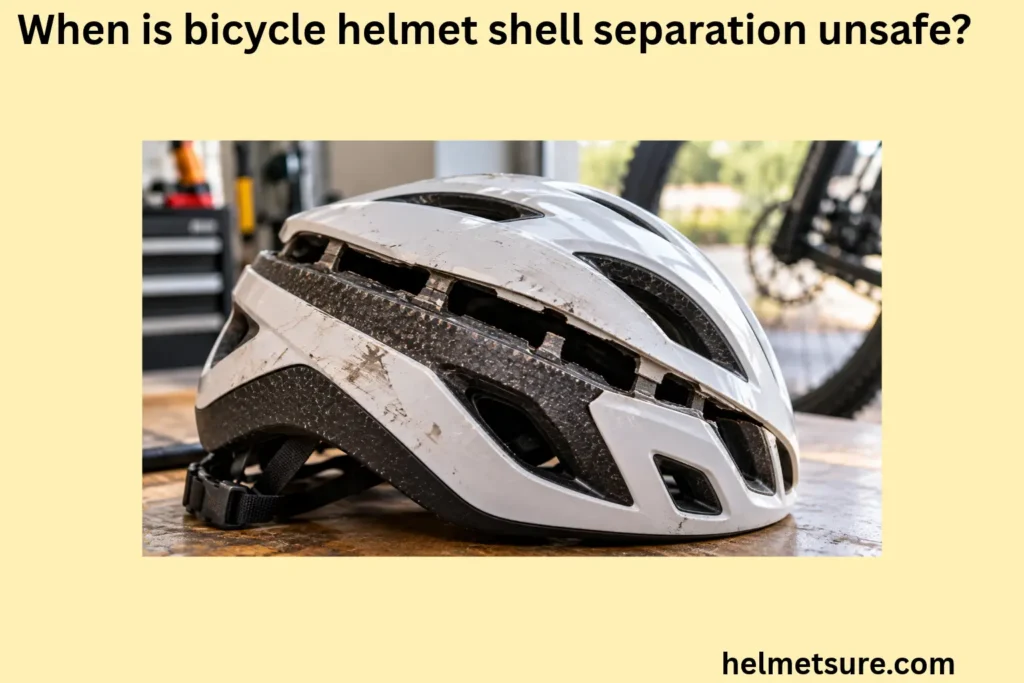
When Is Bicycle Helmet Shell Separation Unsafe?
Bicycle helmet shell separation is a stop-use concern when protective components are unintentionally loose or damaged. Construction-dependent movement requires model-specific interpretation, while structural damage or significant impact calls for replacement rather than visual reassurance.
If you notice a new gap or a shell edge lifting away from the foam, remove that helmet from use before investigating. The question is whether a protective attachment has changed—not simply whether two visible parts can move.
Home inspection cannot certify remaining impact protection. Record what you see, identify the exact model, and follow its manufacturer’s instructions. If unintended protective-shell detachment remains unresolved, replace the helmet.
How Does Actual Bicycle Helmet Shell Separation Differ From Normal Construction Features?
Actual bicycle helmet shell separation differs from normal construction features because it involves unintended loss of protective-shell attachment rather than designed component movement or superficial surface damage.
Start by identifying the component involved and its intended attachment. An exterior shell, a removable visor, and an internal moving liner belong to different interfaces. A photograph of a gap cannot establish which interface has failed.
Actual Shell-to-EPS Separation Involves Loss of an Intended Attachment
Actual shell-to-EPS separation occurs when the helmet’s protective outer shell loses an attachment that its original construction was intended to maintain.
The protective shell is the outer covering; expanded polystyrene, or EPS, is the impact-absorbing foam beneath it. Separation concerns their intended connection. An exposed foam edge or an original construction seam is a different observation from a shell that has newly detached.
Describe an uncertain finding as suspected separation. Do not label it confirmed bonding failure until the original attachment arrangement and the observed change are established.
In-Mold Construction Bonds the Outer Shell to EPS During Molding
In-mold bicycle helmet construction integrates the outer shell with EPS during foam molding, creating a bonded shell-and-liner assembly.
The shell is placed in a mold with polystyrene beads. Steam expands the beads into the liner shape and brings the shell and foam together during manufacturing. This differs from attaching a finished shell afterward.
Shell thinness alone does not identify the construction method. Check the exact model documentation before interpreting flexibility or a visible edge.
Separately Attached Microshells May Behave Differently
Glued or taped bicycle helmet microshells use separately attached construction, so their attachment characteristics may differ from those of an in-mold bonded assembly.
The original assembly may have different edge geometry or limited flexibility. Neither characteristic gives blanket permission to ride with new lifting, peeling, or looseness.
Cosmetic Surface Damage Does Not Automatically Establish Separation
A finish scuff concerns the surface. A protective-shell crack concerns the shell material, while detachment concerns the shell’s attachment to the liner. Keep those descriptions separate when documenting the problem.
A superficial-looking mark can coexist with damage elsewhere. Calling a mark cosmetic does not clear a helmet that has a relevant impact history or suspected attachment failure.
Accessory Movement Is Different From Shell-to-Liner Separation
Movement at a removable visor’s mounting points is not, by itself, evidence that the exterior shell has detached from EPS. Identify what moves before deciding what the observation means.
Accessory condition still deserves attention under the manufacturer’s instructions. Distinguishing an accessory from the shell does not authorize use with a broken accessory or damaged mounting area.
Designed Internal Movement Is Different From Exterior Detachment
Some documented internal protection systems permit relative movement between internal layers. That engineered movement does not establish that unexpected exterior-shell lifting is normal.
Confirm that the exact helmet contains the identified system. Do not remove, reposition, or manipulate internal layers to investigate shell attachment.
| Observation | Component or Interface | Interpretation |
|---|---|---|
| New protective-shell lifting | Exterior shell to EPS | Suspected unintended separation |
| Documented flexibility | Construction-specific exterior assembly | Interpret using exact-model instructions |
| Superficial finish mark | Surface finish | Does not alone establish separation |
| Movable removable visor | Accessory mounting points | Separate from shell-to-EPS attachment |
| Documented internal movement | Engineered internal layers | Different from exterior detachment |
Which Signs of Shell Separation Indicate an Unsafe Condition?
Shell separation presents an unsafe-use concern when protective-shell attachment is unexpectedly loose, structural components are damaged, or relevant impact history creates unresolved protection uncertainty.
Unexpected Exterior-Shell Looseness Is a Stop-Use Warning
Unexpected exterior-shell looseness is a stop-use warning when the helmet’s intended construction does not explain the observed movement.
If you cannot explain a new movement through the exact model’s documentation, keep the helmet out of use. Do not perform a short ride to test whether the shell remains attached.
Cracks or Splits Indicate Structural Damage
Cracks or splits in a bicycle helmet’s protective shell indicate structural component damage rather than ordinary cosmetic finish wear.
A line that breaks through the shell material belongs in the structural-damage category. Do not downgrade it to finish wear because it is short or close to an edge.
Crushed or Permanently Deformed EPS Is Liner Damage
Cracked, crushed, or permanently deformed EPS represents damage to the impact-absorbing liner. Confirm that the material is structural EPS rather than removable comfort padding.
Record visible damage without squeezing, digging into, or removing the foam. The amount of visible damage cannot establish the condition of hidden regions.
A Significant Impact Can Require Replacement Despite an Intact Appearance
Impact history creates an independent decision route. You do not need to find shell lifting before following applicable post-impact replacement instructions.
Do not invent a riding-speed or collision-force threshold to decide whether hidden damage exists. Use the exact manufacturer’s guidance.
An Increasing Gap Cannot Be Cleared Using a Universal Measurement
No universal shell-to-foam gap measurement applies to every bicycle helmet. Construction methods, shell geometry, edge design, and intended interfaces vary between models.
Stop using the helmet when its shell is unexpectedly loose, peeling, cracked, progressively separating, or associated with damaged EPS or a significant impact. Do not continue riding while waiting for clarification.
| Finding | What It Establishes | Required Response |
|---|---|---|
| Unexpected loose shell | Attachment uncertainty | Stop use and verify the exact construction |
| Cracked or split shell | Structural shell damage | Replace the helmet |
| Crushed, cracked, or deformed EPS | Structural liner damage | Replace the helmet |
| Significant helmeted-head impact | Relevant impact history | Follow post-impact replacement guidance |
| Unexplained or increasing gap | Unresolved attachment condition | Keep out of use until resolved |
How Might In-Mold Shell Separation Affect the Protective Structure?
Loss of intended in-mold bonding may remove structural reinforcement supplied by the integrated shell-and-EPS assembly, but a home inspection cannot quantify the remaining protection.
In an in-mold helmet, the shell and EPS are formed as an integrated assembly. If the shell unintentionally separates, the helmet no longer matches the original structure described by that construction method.
The observation does not support a numerical estimate of lost performance. It establishes that an intended protective-component relationship may have changed and that continued use requires an authoritative resolution.
Do not convert a visible separated area into a percentage of lost protection. No home formula can translate gap size into retained impact performance.
How Can Riders Inspect Suspected Separation Without Damaging the Helmet?
Inspect suspected separation by identifying the exact model, visually documenting accessible surfaces, recording impact and exposure history, and avoiding any action that peels, bends, probes, or stresses the helmet.
Identify Visible Lifting at Edges and Ventilation Openings
Look for a new gap, a lifted edge, cracking, or a change that differs from matching areas. Do not assume that every exposed foam edge indicates damage; compare the condition with the exact model’s documented construction.
Observe Movement Without Prying or Stressing Components
Do not insert tools beneath the shell, deliberately bend an edge, peel material back, or repeatedly press the area. Such actions may enlarge the condition and destroy evidence of how it originally appeared.
Inspect Accessible EPS Surfaces
Look for cracks, compressed regions, missing material, or permanent deformation on visible liner surfaces. Do not remove bonded shell material or internal protection layers to expose hidden foam.
Record Impact and Exposure History
Note whether the helmet experienced a crash, hard drop, excessive heat, unsuitable washing, solvent, adhesive, paint, fuel, or another chemical exposure. History helps frame the manufacturer enquiry but does not prove the exact failure mechanism.
A normal visual examination cannot certify retained impact protection or rule out hidden damage. Record inaccessible areas as unknown rather than intact.
Which Events and Exposures Can Cause Unwanted Shell Separation?
Unwanted shell separation may follow mechanical impacts, excessive heat, or incompatible chemicals, although the exact attachment damage depends on the helmet’s construction and the event involved.
Mechanical Impacts
Mechanical loading can affect the shell, its attachment, or the supporting EPS liner. Separation is one possible finding; other impact damage may occur without visible detachment.
If lifting appeared after an event, report the sequence. Timing alone does not establish which material or connection failed, and no universal force threshold applies.
Excessive Heat
Excessive heat can distort certain outer shells and contribute to lifting in some separately attached microshell constructions. This supports a heat-related concern but does not establish one universal temperature cutoff.
Record where the helmet was stored or washed and what changed afterward. Do not apply heat to reshape the shell or test its attachment.
Incompatible Chemical Exposure
Petroleum products, unsuitable cleaning agents, paints, adhesives, solvents, and some insect repellents may damage helmet materials. The precise effect depends on the chemical, material, concentration, exposure, and construction.
Record the product name and circumstances. Do not apply another chemical to clean, neutralize, or rebond the suspected interface without exact-model instructions.
| Possible Cause | Relevant History | Possible Effect | Interpretation Limit |
|---|---|---|---|
| Mechanical impact | Collision or loading involving the helmet | Shell, liner, or attachment damage | Depends on construction and event |
| Excessive heat | Hot storage or unsuitable washing | Distortion or lifting in some constructions | No universal temperature cutoff |
| Incompatible chemical | Contact with an unsuitable substance | Material or attachment deterioration | No precise diagnosis without matching evidence |
Impact, heat, or chemical exposure can raise concern, but exposure history alone does not prove the exact failure mechanism. The observed condition and model-specific instructions control the decision.
Can Bicycle Helmet Shell Separation Be Repaired?
Shell separation requires replacement when structural components are damaged or acceptable attachment integrity cannot be established. Limited problems in separately attached microshells require exact-model manufacturer confirmation before any repair is considered.
Cracked Shells or Damaged EPS Require Replacement
Closing a crack or making a shell look attached again does not establish restored protective performance. Ordinary adhesive repair is not an appropriate consumer response to confirmed structural shell or liner damage.
Replace the helmet rather than attempting to rebuild its protective assembly. Limited microshell-repair discussions do not override this structural-damage rule.
A Helmet Involved in a Significant Impact Must Follow Replacement Guidance
Remove the helmet from service and apply the applicable post-impact instructions. Do not wait for a gap to develop or treat an intact exterior as permission to continue riding.
Limited Microshell Problems Need Construction-Specific Confirmation
A limited problem in a separately applied microshell is not equivalent to lost in-mold bonding. Before considering service, obtain manufacturer confirmation covering the exact model, observed condition, permitted procedure, and suitability for continued use afterward.
Unresolved Protective-Shell Detachment Favors Replacement
If documentation or manufacturer assessment cannot resolve the attachment concern, replace the helmet. An unanswered support request, uncertain response, or successful-looking home repair does not establish acceptable continued use.
| Condition | Corrective Decision | Basis for Resuming Use |
|---|---|---|
| Cracked shell or damaged EPS | Replace | Use a suitable replacement helmet |
| Significant impact requiring replacement | Follow replacement instructions | Use a suitable replacement helmet |
| Limited attached-microshell problem | Request exact-model manufacturer assessment | Explicit authorized resolution |
| Detachment remains unresolved | Replace | Use a suitable replacement helmet |
Do not use household glue, tape, filler, heat, clamps, or improvised pressure to restore a separated shell. A repair that looks secure does not prove that the original protective assembly has been restored.
What Is the Final Stop-Ride Decision?
Stop using the helmet when protective attachment is unexpectedly loose, structural components are damaged, or a significant impact triggers applicable replacement guidance.
Stop using a helmet with unexplained protective-shell looseness, confirmed structural damage, or an impact history requiring replacement. Designed movement requires exact-model interpretation. If the concern cannot be resolved, replace the helmet before riding again.
The practical endpoint is a clear decision: documented acceptable construction, manufacturer-authorized resolution, or replacement. A normal-looking shell alone cannot supply that decision.
- Structural shell or EPS damage: replace the helmet.
- Replacement-triggering impact: follow the applicable replacement instructions.
- Unexpected exterior-shell looseness: stop use while obtaining exact-model confirmation.
- Confirmed intended construction behavior: follow the model’s instructions.
- Attachment integrity remains unresolved: replace the helmet.
Frequently Asked Questions
Is every visible shell gap unsafe?
No. Some seams and edges are part of the intended construction. However, a new, unexplained, mobile, or increasing gap is a stop-use concern until the exact model’s construction is confirmed.
Can I push or glue a lifted shell back down?
Do not assume a consumer adhesive repair is safe. Reattachment does not prove that the original structure or impact performance has been restored.
Does a movable visor mean the shell has separated?
No. A removable visor uses a different component interface. Identify what is moving before interpreting the condition.
Can engineered internal movement be mistaken for shell separation?
Yes. Some documented internal protection systems permit relative movement, but that does not make unexpected exterior-shell lifting normal.
How large can a safe shell-to-foam gap be?
There is no universal safe gap measurement across bicycle helmet models. Use exact-model documentation or manufacturer confirmation.
Can heat cause a bicycle helmet shell to lift?
Excessive heat can distort or separate some constructions, but no single temperature threshold applies to every helmet.
Can a normal visual inspection clear the helmet for use?
No. Inspection can identify warning signs, but it cannot certify retained impact protection or exclude hidden damage.
When should a helmet with suspected separation be replaced?
Replace it when structural damage exists, post-impact instructions require replacement, or acceptable attachment integrity cannot be confirmed.
Sources
-
CPSC — Which Helmet for Which Activity?
Loose-shell, damage, inspection, and post-impact replacement guidance.
-
BHSI — In-Molded Helmets
In-mold construction and integrated shell-and-foam support.
-
Mips — Spherical
Designed movement between documented internal liner layers.
-
BHSI — Bicycle Helmet Inspection
Visible shell, attachment, and EPS damage observations.
-
BHSI — Dishwashers Damage Bike Helmets
Documented heat-related helmet damage and test observations.
-
Trek — Helmet Washing and Care
Heat, chemical, cleaning, and material-compatibility warnings.
-
BHSI — Bicycle Helmet Repairs
Structural-damage replacement and limited microshell-repair distinctions.