
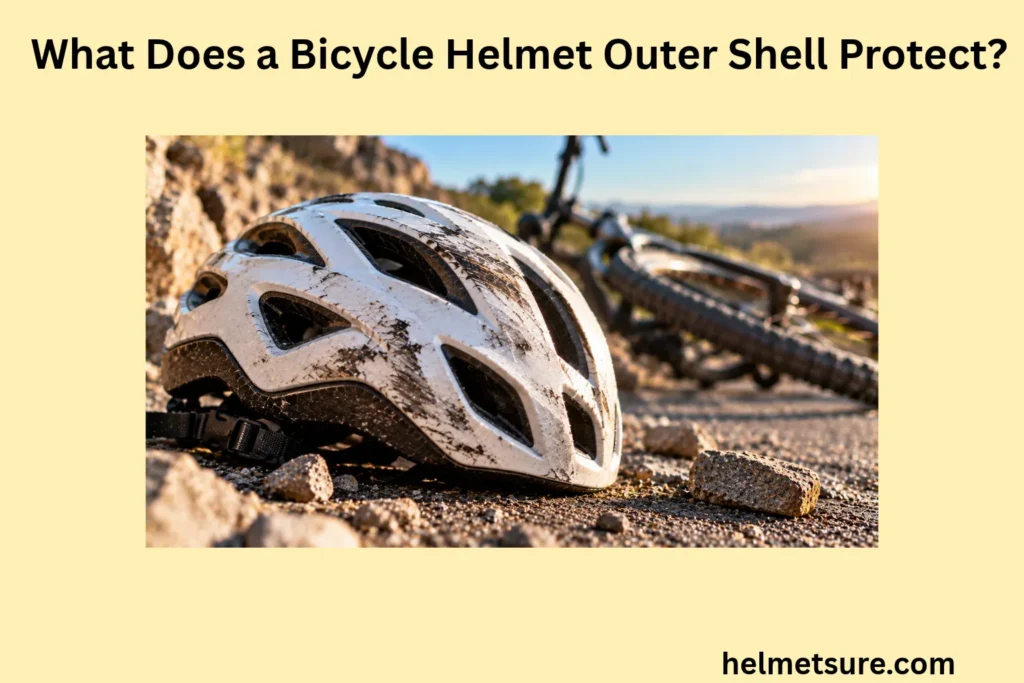
A bicycle helmet’s outer shell shields the impact-absorbing foam liner from abrasion and external contact. Its surface helps manage contact and sliding, while the liner absorbs impact energy; neither component guarantees injury prevention.
An intact shell or properly worn helmet cannot guarantee prevention of concussion, brain injury, skull fracture, or every harmful outcome. After a significant impact or with concerning symptoms, stop riding and seek appropriate medical evaluation.
A bicycle helmet’s outer shell shields the impact-absorbing foam liner from abrasion and external contact. Its surface helps manage contact and sliding, while the liner absorbs impact energy; neither component guarantees injury prevention.
The shell is the exterior protective covering; the liner is the thicker protective material beneath it. Their different responsibilities explain why a durable-looking exterior alone cannot establish how well a helmet will protect your head.
Safety boundary: A bicycle helmet cannot prevent every concussion, skull fracture, or serious injury. Impact damage can remain hidden beneath an apparently intact shell.
The Outer Shell as a Protective Barrier for the Helmet’s Foam Liner
The bicycle helmet outer shell serves as an exterior protective barrier that covers and shields the underlying impact-absorbing foam liner.
Evaluate the complete helmet system. The shell contributes to protection but cannot establish the condition or performance of the liner by itself.
Its direct role is liner protection. Its contribution to protecting the rider’s head comes through the complete helmet assembly.
How the bicycle helmet outer shell covers the impact-absorbing foam liner
The bicycle helmet outer shell covers the outward-facing surface of the impact-absorbing foam liner, with the extent of coverage determined by the helmet’s construction.
Shell coverage places an exterior material between the foam and external surfaces. Vents, exposed lower edges, and different shell designs mean that coverage is not identical across helmets. A shell is a protective covering, not an impenetrable enclosure.
The impact-absorbing liner is also different from the soft, removable comfort pads. Those pads help fit and comfort; they do not substitute for the protective foam.
Why shielding the underlying liner contributes indirectly to head protection
Shielding the underlying foam liner contributes indirectly to head protection by reducing the liner’s direct exposure to surface contact and supporting the helmet’s protective structure.
The shell can help hold the foam assembly together during a collision. The liner remains responsible for the principal impact-energy absorption. Protecting and supporting that component matters because the helmet relies on its structure to manage head-impact loading.
This relationship has a limit: the shell may remain intact while the liner beneath it is damaged. Liner shielding does not guarantee that the liner survives a crash in its original condition.
How the Bicycle Helmet Outer Shell Manages Surface Contact During Impact
The bicycle helmet outer shell manages external surface contact through design-dependent contact-load distribution, sliding behavior, and resistance to surface abrasion.
Surface contact, sliding, abrasion shielding, and load distribution are design-dependent contributions—not guarantees for every collision or surface.
These are separate functions. Contact shape, impact direction, friction, and helmet construction affect how each operates.
How the outer shell can distribute concentrated contact loads across the foam liner
The bicycle helmet outer shell can distribute a concentrated contact load across a broader portion of the foam liner when its stiffness, geometry, and construction support that response.
A narrow object initially loads a smaller area than a broad surface. The shell’s response influences how that contact transfers into the foam. A flexible, thin covering should not be assumed to spread a load like a stiffer shell.
Oblique-impact research has identified shell thickness, vent configuration, and curvature as influences on effective helmet stiffness at tested locations. Those findings concern particular helmets and conditions rather than establishing an identical response for every shell.
How a smooth shell exterior can promote sliding during oblique impacts
A smooth bicycle helmet outer shell can promote sliding against an impact surface during oblique contact, depending on surface friction, geometry, and impact conditions.
An oblique impact includes motion into the surface and along it. Testing has found that some hard-shell and micro-shell helmets tend to slide rather than hang up under specified conditions. This does not guarantee the same response in every collision.
Exterior sliding occurs between the shell and the ground. It is different from movement within an internal rotational-impact system. Sliding does not eliminate rotational head motion or guarantee concussion prevention.
How abrasion resistance helps shield the foam liner from surface scraping
Abrasion resistance helps the bicycle helmet outer shell shield the underlying foam liner from direct scraping against pavement and other abrasive surfaces.
Where the shell covers the foam, it takes the initial surface scraping instead of leaving the foam directly exposed. The shell itself can become scratched, worn, or damaged during that contact. This protective covering function does not prove that the underlying liner is undamaged.
Abrasion is surface wear. Penetration is intrusion by a concentrated object. Resisting scraping does not establish resistance to every pointed object.
| Mechanism | What happens | Relevant limitation |
|---|---|---|
| Contact-load distribution | Localized contact loads the shell, which transfers loading into the foam. | Depends on stiffness, shape, construction, and contact geometry. |
| Surface sliding | Angled contact produces shell-to-surface friction and possible sliding. | Sliding is not guaranteed. |
| Abrasion resistance | The exterior covering takes surface scraping before covered foam is directly exposed. | The shell and liner can still sustain damage. |
Outer Shell vs Foam Liner: How Their Protective Roles Differ
The bicycle helmet outer shell and foam liner perform different protective functions: the shell manages exterior contact and shields the liner, while the liner absorbs impact energy through deformation.
The shell faces exterior contact; the liner deforms to manage impact energy. Neither component should be credited with the other component’s complete function.
Why the outer shell serves as the helmet’s contact-facing protective layer
The outer shell serves as the bicycle helmet’s contact-facing protective layer because it forms the exterior surface that first encounters external objects during shell-covered impacts.
That position allows it to influence sliding and support the foam assembly. It does not make the shell the main shock absorber. At uncovered edges or vent openings, the same exterior coverage may not be present.
How the foam liner absorbs impact energy through controlled deformation
The bicycle helmet’s foam liner absorbs impact energy by deforming under load, reducing the severity of force transfer to the rider’s head within the helmet’s designed protective limits.
EPS means expanded polystyrene, a common helmet-liner material. Its crushing response uses deformation to manage energy and extends the stopping process compared with an unprotected impact. This helps reduce peak head acceleration under relevant test conditions.
Crushed EPS does not reliably recover its original protective capacity. A helmet whose shell looks normal can therefore have less capacity for a later impact.
Why shell-liner integration matters to the complete helmet’s protective function
Shell-liner integration matters because the bicycle helmet’s exterior shell and impact-absorbing liner must function together as a protective assembly during external contact and impact loading.
Their arrangement determines how the shell covers and supports the foam. Some helmets use a polycarbonate shell permanently fused to an EPS liner through in-mold construction. That is a construction example, not proof that bonded helmets are universally safer.
| Protective attribute | Outer shell | Foam liner |
|---|---|---|
| Primary responsibility | Shields the liner and manages exterior contact. | Absorbs impact energy. |
| Position | Exterior covering. | Beneath the shell. |
| Impact response | Depends on stiffness, shape, and construction. | Deforms or crushes under loading. |
| Damage concern | Cracks, distortion, or abnormal separation. | Crushing, cracking, or concealed compression. |
| Protection limit | Cannot replace the liner. | Cannot guarantee an injury-free impact. |
How Shell Materials and Construction Influence Helmet Performance
Bicycle helmet outer-shell materials and construction methods influence shell stiffness, shell durability, liner integration, and external-contact behavior.
Material names and construction labels describe parts of the design. They do not establish a universal safety ranking or whole-helmet superiority.
Material, manufacturing method, and structural category describe different attributes. They should not be used interchangeably.
How polycarbonate functions as a bicycle helmet outer-shell material
Polycarbonate shells function as bicycle helmet outer-shell materials by providing a durable thermoplastic exterior that covers the impact-absorbing liner and participates in the helmet’s response to external contact.
Polycarbonate is used in different shell constructions, including shells designed to tolerate the heat of in-mold manufacturing. This supports a material and construction explanation rather than a universal safety ranking.
Material grade, thickness, shape, processing, and integration matter. The word “polycarbonate” alone does not establish the complete helmet’s performance.
How in-mold construction integrates the exterior shell with the foam liner
In-mold bicycle helmet construction integrates the exterior shell with the foam liner by expanding the liner material inside a pre-positioned shell during manufacturing.
In a conventional EPS process, the shell is placed in the mold and polystyrene beads expand against it under heat and pressure. The resulting assembly joins the exterior covering and foam during molding. This differs from attaching a separately manufactured shell afterward.
In-mold describes the production method. It does not specify one universal shell thickness or establish that every in-mold helmet outperforms every alternative.
How hard-shell construction differs from in-mold shell integration
Hard-shell bicycle helmet construction generally uses a comparatively rigid exterior shell, while in-mold construction describes a manufacturing process that integrates the shell with the foam liner.
Conventional hard-shell designs often have a separately formed exterior attached to the liner. Thin-shell in-mold designs use a different arrangement. However, rigidity and manufacturing method remain different classifications.
A hard shell can use polycarbonate or another material. Neither “hard shell” nor “in-mold” independently establishes comparative protection.
| Term | Classification | What it tells you | What it does not establish |
|---|---|---|---|
| Polycarbonate | Material | The exterior uses a particular thermoplastic. | Whole-helmet safety performance. |
| In-mold | Manufacturing method | Foam expands within and integrates with the shell. | Superiority over every other construction. |
| Hard shell | Structural category | The exterior is comparatively rigid. | One material, attachment method, or safety ranking. |
What Protection Can a Bicycle Helmet Outer Shell Not Provide on Its Own?
A bicycle helmet outer shell cannot independently provide the foam liner’s impact-energy absorption or guarantee protection against concussion, skull fracture, uncovered-area injuries, and sharp-object penetration.
An intact shell cannot guarantee concussion prevention, replace liner absorption, protect uncovered anatomy, or guarantee resistance to sharp-object penetration.
These limits describe the scope of shell protection. They do not negate the documented injury-reduction benefits of bicycle helmets.
Why the outer shell cannot replace the foam liner’s impact-energy absorption
The bicycle helmet outer shell cannot replace the foam liner’s impact-energy absorption because the liner is designed to deform under loading and manage the impact energy transmitted through the helmet.
Shell bending or deformation can influence impact response, so its mechanical contribution is not zero. Nevertheless, distributing an external load is different from absorbing energy through foam crushing. An intact shell cannot compensate for a damaged liner.
Why an intact outer shell cannot guarantee prevention of concussion or brain injury
An intact bicycle helmet outer shell cannot guarantee prevention of concussion or brain injury because brain-injury risk depends on the complete helmet’s performance and the forces generated during the impact.
Linear acceleration and rotational head motion are relevant to impact biomechanics. Shell appearance does not measure either. Oblique-impact testing assesses complete helmets under defined conditions; it cannot promise an individual rider an injury-free crash.
Research associating helmet use with reduced odds of head and serious head injury provides helmet-level evidence rather than a measured concussion-prevention effect of the shell alone.
Why severe impacts can still cause skull fractures despite helmet protection
Severe impacts can still cause skull fractures despite bicycle helmet protection when the collision exceeds the complete helmet’s capacity to reduce impact loading sufficiently.
Research supports protective benefits for skull-injury outcomes, but a reduction in risk is not guaranteed prevention. Contact location, severity, and the complete protective assembly remain relevant.
The CPSC standard requires a warning that no helmet protects against all possible impacts. A fracture also cannot be attributed to visible shell failure alone because external appearance does not reveal the full loading experienced by the head.
Why the outer shell cannot protect head and facial areas outside its coverage
The bicycle helmet outer shell cannot directly shield head or facial areas outside its physical coverage because those areas remain exposed to external contact.
An open-face helmet leaves much of the face uncovered. Coverage varies by design, and positioning affects which head areas remain covered. Correct fit and attachment are part of protection.
This physical limit is separate from population-level findings that helmet use is associated with reduced facial-injury odds. Such findings do not mean an open-face shell directly covers the face.
Why bicycle helmet outer shells are not guaranteed to resist sharp-object penetration
Bicycle helmet outer shells are not guaranteed to resist sharp-object penetration because puncture resistance depends on shell construction, object geometry, impact conditions, and the testing requirements that apply to the helmet.
A pointed contact concentrates loading. Research evaluating hard-shell and foam helmets under defined penetration-test conditions does not establish how every current helmet handles every sharp object.
The U.S. CPSC bicycle-helmet standard specifies impact attenuation, retention, stability, and other requirements; it does not establish universal protection against every pointed object.
| Protective function or outcome | Shell contribution | What it cannot guarantee |
|---|---|---|
| Impact-energy management | Influences exterior contact and loading. | Replacement of the foam’s primary absorption. |
| Concussion and brain injury | Contributes to complete-helmet protection. | Prevention of every brain injury. |
| Skull fracture | Supports the helmet’s impact response. | Prevention in every severe collision. |
| Anatomical coverage | Directly covers specified areas. | Shielding outside its coverage. |
| Sharp-object penetration | Provides construction-dependent resistance. | Resistance to every pointed object. |
How Can You Identify Damage to a Bicycle Helmet Outer Shell?
Bicycle helmet outer-shell damage can be identified through visible cracking, deformation, and shell-liner separation, but internal impact damage may remain concealed beneath an intact-looking exterior.
Use non-destructive observation and review impact history. A clean or intact-looking shell cannot certify the hidden condition of the liner.
Inspection identifies warning signs. It does not certify remaining protective capacity.
How cracks, splits, and deformation indicate possible outer-shell damage
Cracks, splits, and deformation in a bicycle helmet outer shell indicate possible structural damage that requires safety evaluation rather than an assumption that the helmet remains protective.
Look for broken shell material, newly flattened areas, dents, or changes from the original shape. A mark in a surface finish is different from a crack through the plastic, but visual uncertainty should not be resolved by assuming it is harmless.
How shell separation or delamination can signal compromised liner integration
Shell separation or delamination can signal compromised bicycle helmet shell-liner integration when the protective covering detaches or separates abnormally from the underlying foam.
Delamination means separation between layers or bonded components. A newly lifting bonded shell is different from a normal edge on a separately attached covering. Attachment methods vary, so compare a suspicious change with the model’s documented construction. Avoid peeling or forcing the shell to investigate it.
Why impact-related foam damage may remain hidden beneath an intact-looking shell
Impact-related foam damage may remain hidden beneath an intact-looking bicycle helmet outer shell because the liner can compress or crack without producing equally visible changes on the exterior.
Laboratory research on particular helmets has found that consumers may have difficulty distinguishing some impacted helmets from new ones. This supports the limitation of appearance-based judgments without establishing a universal damage threshold.
Manufacturer guidance also warns that damage after a severe blow may be invisible. Even partial recovery of foam shape does not demonstrate recovery of protective performance.
Why superficial scuffs alone cannot establish whether a helmet remains safe
Superficial scuffs on a bicycle helmet outer shell cannot independently establish whether the helmet remains safe because cosmetic surface marks do not reveal the complete impact history or internal liner condition.
A mark from ordinary handling and a scrape from a crash can look superficially similar. The event matters: a faint crash mark does not clear the helmet for further use, while a surface mark alone does not quantify structural damage. Interpret appearance alongside known impacts and manufacturer instructions.
Damage inspection checklist
Keep inspection to accessible parts and follow the helmet’s instructions. Do not disassemble or deliberately impact the helmet to test it.
When Should a Bicycle Helmet Be Replaced After Shell Damage or Impact?
A bicycle helmet should be replaced after a significant impact or when structural damage compromises its protective assembly, even when the outer shell does not display obvious damage.
A significant impact or confirmed structural damage overrides cosmetic appearance. Tape, glue, or reshaping cannot verify restored protection.
Impact history and structural condition determine the next action; appearance alone cannot clear a potentially damaged helmet.
When a significant impact warrants replacement despite no visible shell damage
A significant impact involving a bicycle helmet warrants replacement even without visible outer-shell damage because the protective liner may have been permanently compressed or otherwise damaged.
A crash in which the helmet strikes the road or another object warrants following post-impact replacement instructions. Do not wait for a visible crack. Manufacturer instructions commonly direct replacement after a severe blow even when the helmet appears undamaged.
CPSC-required labeling recognizes concealed damage and directs return to the manufacturer for inspection or destruction and replacement. Incidental handling contact is not automatically equivalent to a crash; no universal drop-height or impact-force cutoff establishes safety for every model.
Why cracks, deformation, or shell-liner separation warrant helmet replacement
Cracks, deformation, or abnormal shell-liner separation warrant bicycle helmet replacement because these conditions indicate possible damage to the helmet’s protective structure.
Replace a helmet with a confirmed structural shell crack, damage-related distortion, cracked or crushed foam, or abnormal separation of its protective assembly. These conditions cannot be cleared by a cosmetic improvement.
Tape, glue, or reshaping cannot verify restoration of original impact performance. Superficial wear requires contextual evaluation; confirmed structural damage requires replacement.
When uncertain shell damage requires manufacturer guidance rather than visual assumptions
Uncertain bicycle helmet outer-shell damage requires manufacturer guidance when the rider cannot reliably determine whether observed changes involve structural damage or concealed liner deterioration.
Stop using the questionable helmet while seeking model-specific advice. Provide the model, photographs of the change, and the known impact history. Manufacturer guidance can clarify construction or replacement requirements; it is not permission to keep riding while uncertainty remains.
A known significant impact or confirmed structural damage already supports replacement. Contacting the manufacturer should not dilute that decision.
| Helmet condition | Recommended action | Reason |
|---|---|---|
| Significant impact with no visible damage | Replace under applicable post-impact guidance. | Concealed liner damage may exist. |
| Structural shell crack or split | Replace. | The protective structure may be compromised. |
| Damage-related deformation | Replace. | The shell and underlying foam may be affected. |
| Abnormal shell-liner separation | Replace. | The original assembly integrity is uncertain. |
| Superficial scuff with no known impact | Evaluate history and instructions. | Surface appearance alone does not establish safety. |
| Suspected or unclear damage | Pause use and obtain manufacturer guidance. | The condition remains unresolved. |
Why the Outer Shell Matters as Part of a Complete Bicycle Helmet
The bicycle helmet outer shell matters because it shields the impact-absorbing liner and supports the complete helmet’s protection through exterior contact management, while the liner provides the principal impact-energy absorption.
Evaluate the complete helmet: shell, liner, integration, retention, fit, condition, and impact history. No single component guarantees prevention of injury.
The shell protects the foam from direct exterior exposure where it provides coverage. It influences surface contact, possible sliding, abrasion exposure, and design-dependent load transfer.
The liner manages impact energy through deformation. The retention system helps keep the helmet positioned, and proper fit supports the complete assembly’s intended operation.
Together, these parts contribute to protection without guaranteeing that every concussion, skull fracture, facial injury, or other harmful outcome will be prevented.
Check the complete helmet’s condition and impact history—not just its shell. The shell shields the liner and manages exterior contact, while the liner provides principal energy absorption. Replace the helmet after a significant impact or confirmed structural damage.
Frequently Asked Questions
These answers preserve the distinction between the outer shell, foam liner, complete helmet system, and injury-prevention limits.
The shell contributes to protection but cannot independently certify whole-helmet condition, crash suitability, or injury prevention.
What does a bicycle helmet outer shell protect?
It covers and shields the impact-absorbing foam liner, faces exterior contact, and can support sliding, abrasion resistance, and design-dependent load distribution.
Does the outer shell absorb most impact energy?
No. The foam liner provides the principal impact-energy absorption through deformation, while the shell manages exterior contact and protects the liner.
Can a smooth shell reduce snagging during an oblique impact?
A smooth exterior can promote sliding under some conditions, but the result depends on the shell, surface, angle, speed, and complete collision.
Is polycarbonate automatically the safest shell material?
No. Material grade, thickness, geometry, processing, integration, and whole-helmet performance matter. A material name alone does not create a universal safety ranking.
Does an intact shell prove the helmet is safe after a crash?
No. Impact-related foam damage can remain hidden beneath an intact-looking shell, so applicable post-impact replacement guidance still applies.
Can a shell prevent every concussion or skull fracture?
No. A helmet can reduce certain injury risks without guaranteeing prevention of concussion, brain injury, skull fracture, or every harmful outcome.
Which shell damage signs require attention?
Cracks, splits, deformation, abnormal shell-to-liner separation, crushed foam, and relevant impact history require replacement or model-specific manufacturer guidance.
Can glue, tape, or reshaping repair a damaged shell?
No cosmetic action can verify restoration of the helmet’s original impact performance or clear confirmed structural damage.