
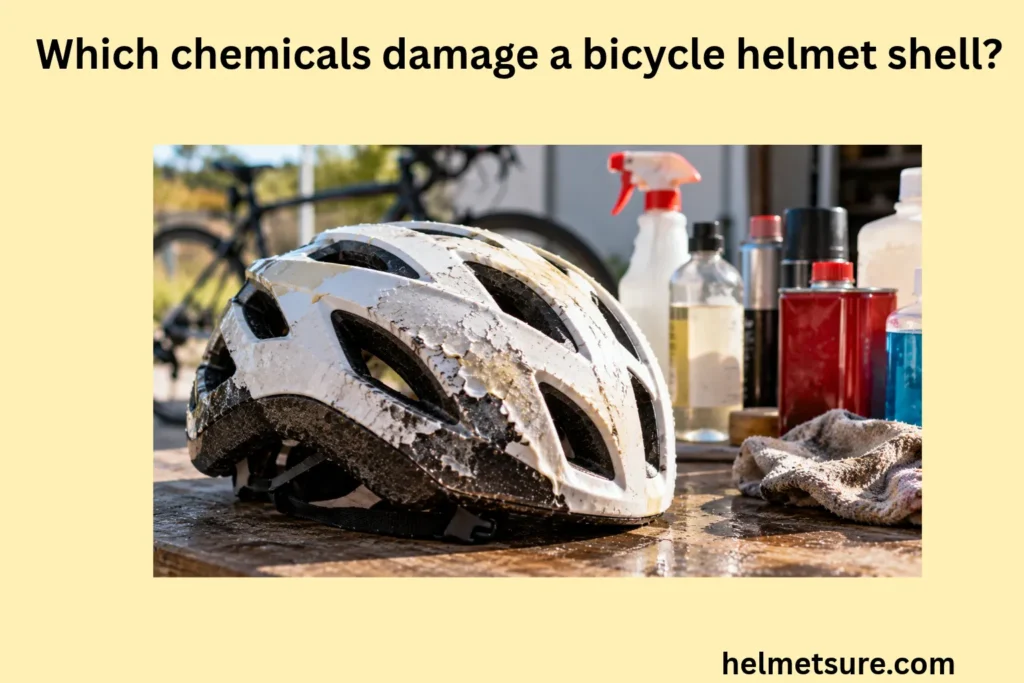
Which Chemicals Damage a Bicycle Helmet Shell?
Petroleum fuels, strong solvents, incompatible paints and thinners, some adhesives, aerosol carriers, degreasers, and workshop chemicals can damage certain bicycle helmet shell plastics. Exact risk depends on formulation, shell material, concentration, contact time, temperature, stress, and manufacturer guidance.
A visually normal or chemically cleaned helmet cannot guarantee prevention of concussion or another head injury. After a crash or with concerning symptoms, stop riding and seek appropriate medical evaluation.
Solvents, fuels, cleaners, paints, adhesives, aerosols, and other formulations damage bicycle helmet shells when their chemistry is incompatible with the shell material; actual risk depends on formulation, exposure conditions, and manufacturer guidance.
For polycarbonate specifically, documented concerning examples include acetone, methyl ethyl ketone (MEK), xylene, and certain chlorinated solvents. These findings cannot establish the response of an ABS, composite, coated, or unidentified shell. Commercial products also require evaluation of their complete formulation.
The practical assessment follows this order: identify the helmet and shell material, identify the contacting product, document the exposure, inspect without damaging the shell, and apply the helmet manufacturer’s instructions.
Important safety boundary: Chemical damage can be non-visible. Do not resume using a helmet after known incompatible exposure while its condition remains unresolved. Visible material deterioration warrants stopping use and replacement; unclear cases require manufacturer guidance. [1–3]
Helmet-Safe Cleaning as the Boundary Between Routine Care and Chemical Exposure
Helmet-safe cleaning begins with the manufacturer’s permitted care method; mild soap and water are a common baseline, while unverified stronger formulations require compatibility confirmation.
Use only the exact helmet manufacturer’s permitted cleaning method. A product described as mild, natural, or household-safe is not automatically shell-compatible.
Why mild soap and water form the default cleaning baseline for many bicycle helmet shells
Mild soap and water form a common cleaning baseline because helmet manufacturers recommend them for ordinary care. Bell also specifies a soft cloth or sponge; Trek recommends gentle washing. Follow the instructions for your actual helmet.
Routine care addresses dirt and sweat. A fuel spill, unknown cleaner, or solvent contact creates a different task: deciding whether the exposure affected helmet materials. Washing afterward does not answer that question.
Understanding outer-shell protection helps explain why preserving shell condition belongs in helmet care.
Why stronger cleaners require manufacturer compatibility confirmation
Stronger cleaners require compatibility confirmation because their ingredients may damage helmet materials without obvious visible evidence. CPSC guidance specifically identifies ammonia and bleach among common cleaners that may cause this problem.
A household cleaner, disinfectant, or workshop product should therefore not replace the permitted cleaning method simply because it removes a stubborn mark. Identify the product and check the helmet maker’s guidance first. The words “mild,” “gentle,” and “sports equipment” do not establish approval for your model.
How shell-cleaning guidance differs from liner-specific compatibility guidance
Shell-cleaning guidance differs from liner guidance because the outer shell, structural impact liner, comfort pads, adhesives, and finishes can use different materials.
Approval for one component cannot automatically establish compatibility with another. If contamination reached—or may have reached—the structural liner, assess that separately using guidance on liner chemicals. Removable comfort padding is a separate component from the impact liner.
| Situation | What is known | Appropriate pathway |
|---|---|---|
| Ordinary dirt or sweat | No known incompatible chemical contact | Manufacturer-permitted routine cleaning |
| Unknown household or workshop cleaner | Formulation is uncertain | Identify the product and verify compatibility |
| Known manufacturer-prohibited substance | A relevant exposure occurred | Document contact and assess the helmet |
| Chemical reached the impact liner | Shell assessment alone is insufficient | Check liner-specific and manufacturer guidance |
Petroleum Fuels and Fuel Residues That Can Contaminate Bicycle Helmet Shell Plastics
Gasoline, petrol, and related petroleum contamination belong in shell assessment because helmet manufacturers warn against petroleum-product contact with helmet materials.
Gasoline, petrol, and their residues create a compatibility concern. Wiping away visible residue does not prove that the shell was unaffected.
How gasoline or petrol contact creates a compatibility concern for helmet shell plastics
Gasoline or petrol contact creates a compatibility concern under helmet-manufacturer petroleum warnings. Bell’s manual identifies petroleum products among substances that can damage a helmet and impair its effectiveness.
After a spill, record the helmet model, fuel involved, contact area, and circumstances. Check the applicable instructions before deciding on continued use. A resistance result for a raw plastic cannot override a warning for the finished helmet, which includes other materials and interfaces.
How fuel residues transfer from hands, containers, vehicles, or storage surfaces
Fuel residues can transfer to the shell through contaminated hands, gloves, containers, vehicle surfaces, rags, or storage areas.
For example, handling a helmet after touching a leaking fuel container creates a plausible indirect contact pathway. Placing it on a surface with known fuel residue creates another. Record these events even when no obvious spill occurred. Transfer establishes an exposure history; it does not, by itself, prove deterioration.
Why removing visible fuel residue does not confirm that the shell was unaffected
Removing visible fuel residue does not establish that the shell was unaffected because surface cleanliness and material condition are different findings.
A stain disappearing, an odor fading, or the surface becoming dry cannot establish compatibility. Keep the original contact history available for the manufacturer. The recognized possibility of non-visible chemical damage remains relevant after cleanup.
Which Solvent Classes Are Concerning for Polycarbonate Bicycle Helmet Shells?
For verified polycarbonate shells, ketone, aromatic, and selected chlorinated solvents require close scrutiny because technical polymer data document adverse interactions for representative chemicals.
Solvent examples apply only after confirming the shell material. Laboratory resistance data does not authorize a product for a finished helmet.
Why acetone and methyl ethyl ketone are high-concern solvent examples for polycarbonate
Acetone and methyl ethyl ketone are high-concern examples because Covestro’s Makrolon polycarbonate table records swelling for both substances. These are material-test findings, not measured outcomes for every bicycle helmet.
First confirm the shell material from the manufacturer’s specifications. The explanation of polycarbonate shells provides context for this material distinction.
If a product containing either solvent contacted a verified polycarbonate shell, preserve its label and ask the helmet manufacturer how to proceed. The table supplies no universal safe contact time for helmets.
How xylene, aromatic solvents, and chlorinated solvents fit into compatibility risk
Xylene and selected chlorinated solvents have documented adverse interactions with the tested polycarbonate. Covestro records swelling for xylene and trichloroethylene, and dissolution for methylene chloride and chloroform.
These examples explain why solvent identity matters. They do not establish identical behavior across every aromatic or chlorinated chemical. A mixed cleaner or coating must be assessed as the actual product involved, with the correct shell material and manufacturer instructions.
Why contact time, concentration, temperature, and molded stress affect solvent compatibility
Solvent compatibility depends on chemical identity, concentration, contact duration, temperature, and stress within the molded part. Substance name alone leaves important exposure details unresolved.
Record whether contact was brief or prolonged, whether the product was diluted, and whether the helmet was in a hot environment. Mark unknown details as unknown. None of these observations establishes a consumer pass/fail threshold, and laboratory exposure conditions should not become a “safe number of seconds” for a helmet.
How Incompatible Chemicals Physically Damage a Bicycle Helmet Shell
Incompatible chemicals can alter susceptible shell polymers through swelling, dissolution, environmental stress cracking, or chemical degradation. Which mechanism occurs depends on the material and exposure.
Crazing, cracking, swelling, softening, clouding, or deformation are condition findings—not home measurements of remaining shell strength.
How chemical exposure can cause stress cracking, crazing, swelling, or softening
Incompatible contact can produce cracking, fine crazing, swelling, softening, tackiness, or dissolution in a susceptible polymer. Covestro describes swelling/dissolution and stress cracking as distinct damage mechanisms.
Swelling changes the material’s dimensions; dissolution breaks down the material into the contacting solvent. Stress cracking involves chemical interaction together with stresses in the part. Fine crack patterns can appear as crazing.
These descriptions explain possible damage. A crack alone does not prove chemical causation: impacts, mechanical stress, and other deterioration pathways also need consideration.
Why clouding, discoloration, deformation, or surface changes can signal deterioration
Clouding, discoloration, deformation, tackiness, or altered texture can signal deterioration, especially when the change appeared in a known contact area.
Compare the affected area with photographs taken before exposure, if available. Record new changes rather than trying to polish them away. Dirt, abrasion, pigments, and unrelated aging can also change appearance, so a color change alone cannot identify the cause or establish the shell’s condition.
How hidden or repeated chemical exposure can weaken shell plastic without dramatic visible damage
Chemical damage may occur without dramatic visible change, so normal appearance cannot clear known incompatible exposure. Both institutional guidance and helmet manufacturers recognize this limitation. [1–3]
Record repeated contacts as separate events—for example, repeated cleaning with the same unapproved product. Do not invent a cumulative exposure limit or assume the last wash erased earlier exposure. The manufacturer needs the relevant history, including what was used and how often when those facts are known.
Paints, Paint Thinners, and Coatings That Can Attack Bicycle Helmet Shell Plastics
Solvent-based paints, thinners, and unverified coatings create compatibility concerns because their formulations can interact with helmet materials. Helmet makers’ paint restrictions govern the finished product.
Do not infer compatibility from color, finish, marketing, or intended use on another plastic. Obtain helmet-model approval before application.
Why solvent-based paint and spray paint can create shell-compatibility problems
Solvent-based paint and spray paint create compatibility problems when their contacting ingredients are incompatible with the shell or other helmet components.
Brush application does not establish safety, and spray application does not identify the chemistry. The relevant question is whether the exact coating system is permitted for the helmet. Polymer-compatible coatings can exist, but that does not provide blanket permission to repaint a finished helmet.
How paint thinner and turpentine increase solvent exposure risk
Paint thinner and turpentine introduce direct solvent contact, creating a separate concern from the appearance of a cured coating. Covestro specifically identifies turpentine as incompatible with Makrolon polycarbonate.
“Paint thinner” describes a product category with varying formulations. Record the exact thinner rather than assuming its ingredients. Do not use it to remove paint from a helmet unless the helmet maker explicitly permits that procedure; attempted removal may add another exposure to the original coating contact.
Why coating compatibility should be confirmed before decorating or refinishing a helmet shell
Coating compatibility needs confirmation before decoration because primers, paints, clear coats, and curing systems involve product-specific chemistry.
Ask about the complete proposed system, including preparation and removal products. Approval for one coating does not establish approval for another. An inconspicuous spot test on the helmet cannot validate its protective condition, so leave an unverified system unapplied.
Adhesives, Stickers, and Glue Residues That Can Affect Bicycle Helmet Shell Plastics
Adhesives, stickers, and glue residues require compatibility confirmation because adhesive formulations differ. Bell includes adhesives in its chemical-damage warning.
A manufacturer-approved decal does not make every sticker, glue, remover, or adhesive system safe for the shell.
Why some glues and sticker adhesives contain chemicals that may affect shell plastic
Some adhesive formulations contain solvents, plasticizers, or other ingredients that create compatibility concerns. The word “adhesive” does not identify the contacting chemistry.
For a sticker, the decorative face and adhesive backing present different material questions. For a glue, curing does not establish that the earlier wet contact was permitted. Check the exact product before application, and include any residue-removal product in the compatibility enquiry.
How plasticizers or adhesive ingredients can interact with stressed polycarbonate
Certain migrating ingredients can interact with stressed polycarbonate, making ingredient-specific compatibility important. Covestro documents plasticizer-related stress cracking in a particular plasticized-PVC contact example.
That example supports checking the ingredients and conditions; it does not classify every plasticizer or sticker as damaging. A consumer generally cannot determine the complete adhesive formulation by examining the backing. Where documentation is insufficient, ask the helmet manufacturer rather than extrapolating from an unrelated adhesive.
Why manufacturer-approved decals do not make every generic adhesive helmet-safe
Manufacturer approval applies to the specific decal or adhesive system and the stated helmet use. It does not extend automatically to generic alternatives.
Before replacing an approved decal with another product, verify the new backing, adhesive, and application instructions. Do not infer approval from similar appearance. Also check removal guidance: a sticker that was permitted for application does not make any solvent acceptable for stripping its residue.
Non-Paint Aerosol Sprays That Can Reach a Bicycle Helmet Shell Indirectly
Non-paint sprays can reach a shell through overspray; the contacting formulation determines compatibility. “Aerosol” identifies a delivery format rather than one chemical.
The aerosol format alone does not determine risk. Ingredients, carriers, propellants, overspray path, and shell compatibility remain decisive.
How insect-repellent and other non-paint aerosol mist can settle on the helmet shell
Spray applied near a helmet can deposit mist on its surface even when the product is intended for the rider. Trek explicitly includes DEET-containing insect repellents in its chemical warning.
Apply such products with the helmet away from the application area. If overspray occurs, record the repellent name and where it landed. Trek’s warning provides no universal safe DEET percentage, and it does not establish the compatibility of every other repellent formulation.
Why carrier solvents and propellants matter more than the aerosol format itself
Carrier solvents, active ingredients, additives, and other contacting components matter more than the package format because different sprays contain different formulations.
Neither “water-based” nor “aerosol” is enough for approval. Identify the actual product and use the applicable helmet guidance. Propellant presence alone does not prove damage, and the absence of an obvious solvent smell does not establish compatibility.
How vents, edges, and exposed shell areas can collect accidental overspray
Vents, edges, and exposed surfaces provide locations where accidental mist can settle. Include those areas when documenting contact.
Record what you observed without assuming the product reached every component. Deposition near a vent does not prove liner contamination; observed entry into the helmet requires separate component assessment. Keep photographs of the contact area if they help show the exposure path.
Bicycle Degreasers, Lubricants, Oils, and Workshop Chemicals That Can Transfer to the Helmet Shell
Bicycle-care chemicals become shell concerns when maintenance residues transfer to the helmet. Their suitability for a bicycle component does not establish helmet compatibility.
Indirect transfer from hands, gloves, rags, tools, shelves, or benches is still chemical contact and requires the same compatibility check.
How degreasers, chain lubricants, and oils transfer from hands, gloves, or tools
Maintenance products can transfer through hands, gloves, tools, or work surfaces. Handling the helmet immediately after drivetrain work is a practical example.
Keep the helmet away from maintenance and clean your hands before handling it. If transfer occurred, identify the exact lubricant, oil, or degreaser. Do not classify all oils together or assume “bike-specific” provides helmet approval.
Why brake and component cleaners create a separate shell-exposure pathway
Brake and component cleaners create a separate exposure pathway because they are intended for mechanical components, without that purpose establishing shell compatibility.
If contact occurred, retain the product label and safety data sheet (SDS), where available. These help identify ingredients but do not themselves certify the product for helmet use. Cleaner formulations vary; do not assume a particular solvent from the category name or use a component cleaner for routine helmet care.
How benches, rags, shelves, and storage areas become secondary contamination sources
Benches, rags, shelves, and storage areas become secondary sources when residues on them contact the shell.
Store the helmet on a clean, dedicated surface and use a separate cloth for permitted helmet cleaning. A workbench is not automatically contaminated, but known spills or maintenance residues should be kept out of the helmet’s storage area. Record contact with a contaminated surface as an exposure event.
Why Labels Such as “Alcohol,” “Cleaner,” and “Oil” Do Not Establish Shell Compatibility
These labels do not establish compatibility because products within each category can differ in ingredients, concentrations, additives, and carriers.
Category names hide concentration, additives, fragrances, plasticizers, and carrier solvents. Never approve a formulation from its generic label alone.
Why products in the same chemical or cleaning category can have different compatibility profiles
Products sharing a category name can have different compatibility profiles. Covestro’s table, for example, gives different resistance results for ethanol and methanol under its listed test conditions.
This demonstrates why “alcohol” is insufficiently specific; it does not authorize an alcohol-containing cleaner for a helmet. Identify the actual formulation and check the helmet maker’s care instructions. Apply the same reasoning to products labeled only as cleaners or oils.
How concentration, additives, fragrances, plasticizers, and carrier solvents change material response
The complete formulation and exposure conditions determine compatibility; the headline ingredient leaves other contacting ingredients unresolved.
A front label may identify an active ingredient without describing every carrier or additive. Do not treat an ingredient you cannot identify—including a fragrance—as automatically harmful or harmless. Give the manufacturer the exact product information and leave unavailable concentrations explicitly unknown.
Why manufacturer-specific guidance should resolve uncertain formulations
The helmet maker’s guidance should resolve uncertain cases because it addresses the finished product’s materials, finishes, interfaces, and permitted care.
Identify the helmet brand and model, check the current manual, and compare its restrictions with the actual exposure. If the documents do not answer the question, contact support with the product information and photographs. A raw-polymer resistance table can support that enquiry; it cannot independently clear the entire helmet.
| Chemical or product | Typical contact source | Compatibility concern | Potential effect or evidence limit | Evidence needed | Response |
|---|---|---|---|---|---|
| Gasoline/petrol | Spill or fuel-residue transfer | Helmet-OEM petroleum warnings | Damage may be non-visible | Applicable helmet instructions | Document and follow OEM guidance |
| Acetone | Solvent or product ingredient | Tested polycarbonate incompatibility | Swelling in Makrolon data | Shell identity and material data | Treat verified polycarbonate contact as high concern |
| MEK | Workshop solvent | Tested polycarbonate incompatibility | Swelling in Makrolon data | Shell identity and material data | Seek model-specific guidance |
| Xylene | Solvent-containing formulation | Tested polycarbonate incompatibility | Swelling in Makrolon data | Actual product and shell identity | Document and evaluate contact |
| Selected chlorinated solvents | Specialty solvent or cleaner | Chemical-specific polycarbonate findings | Swelling or dissolution for named examples | Exact chemical and material evidence | Follow OEM exposure guidance |
| Solvent-based paint/spray paint | Decoration | Formulation and helmet restrictions | Material interaction depends on coating system | OEM approval; supporting material data | Leave unapproved systems unapplied |
| Paint thinner/turpentine | Refinishing | Solvent exposure | Turpentine is incompatible with Makrolon | Exact formulation and shell identity | Obtain OEM guidance after contact |
| Adhesive/sticker glue | Decoration or attempted repair | Formulation-specific | Appearance cannot establish compatibility | Exact-product approval | Verify before application |
| Insect-repellent spray | Overspray | Applicable OEM restriction | Trek specifically warns about DEET | Repellent identity and helmet instructions | Prevent contact; assess exposure |
| Degreaser | Maintenance | Formulation-dependent | Category alone cannot predict effect | Product information/SDS and OEM guidance | Identify before deciding |
| Chain lubricant/oil | Hand or surface transfer | Formulation-dependent | Bike-component suitability is insufficient | Product information and OEM guidance | Prevent transfer; document contact |
| Brake/component cleaner | Workshop spill or overspray | Formulation-dependent | No universal category-wide outcome | Exact product/SDS and OEM guidance | Do not use as a routine helmet cleaner |
The named Makrolon findings above describe technical material tests, not consumer exposure limits or finished-helmet approval.
How to Assess a Bicycle Helmet Shell After Suspected Chemical Exposure
Assess suspected exposure by observing material changes, collecting the contact history, and checking manufacturer guidance. Normal appearance supplies only part of the evidence.
Use non-destructive observation only. Do not bend, scrape, sand, probe, heat, or apply another chemical to test the shell.
Check for crazing, cracking, swelling, softening, clouding, warping, or discoloration
Inspect the exposed area and adjacent shell for fine crack patterns, larger cracks, swelling, altered shape, unusual tackiness, clouding, discoloration, or surface breakdown.
Use non-destructive observation. Do not bend, scrape, probe, sand, or apply another chemical to reveal damage. Compare new marks with known older ones; guidance on shell scratches helps address a superficial-mark-versus-damage question without assigning chemical causation.
Identify the chemical involved and document concentration, contact time, and cleanup
Document the actual product and the circumstances before deciding on compatibility. Collect:
- Helmet brand, model, and shell material if known.
- Product name, manufacturer, label, and available SDS.
- Concentration or dilution, when known.
- Approximate contact duration and whether exposure was repeated.
- Affected area and whether other components were contacted.
- Temperature context, cleanup method, and photographs.
Separate facts from estimates. “Unknown concentration” is more useful than an invented value that could mislead the assessment.
Why a visually normal shell cannot confirm that incompatible exposure caused no damage
A visually normal shell cannot establish that incompatible contact caused no damage because chemical deterioration may be non-visible. [1–3]
Describe your finding as “no visible change observed.” Combine it with the exposure history and applicable instructions before deciding on use. Do not substitute an undamaged-looking surface for manufacturer resolution of known incompatible contact.
Damage-signs checklist
An absence of visible signs does not establish an absence of chemical damage.
When Chemical Exposure Makes Helmet Replacement Safer Than Continued Use
Replacement becomes the appropriate response when shell material is visibly deteriorated. Known incompatible exposure without visible changes requires the applicable manufacturer’s replacement or escalation guidance.
Visible deterioration or unresolved high-concern exposure must not be downgraded by cleaning, a normal fit check, or a reassuring surface appearance.
Why cracking, crazing, softening, deformation, or flaking crosses a clear replacement threshold
Cracking, crazing, softening, permanent deformation, or breakdown of the shell material warrants stopping use and replacement. Distinguish altered shell material from removable residue or damage limited to a decorative coating; ask the manufacturer if that distinction is unclear.
Do not try to restore a deteriorated shell by sanding, polishing, heating, repainting, solvent cleaning, or gluing. A cosmetic improvement does not demonstrate restored protective performance, and the cited care guidance does not establish these as structural repair procedures.
When confirmed or unidentified chemical exposure creates too much uncertainty for continued use
Known incompatible contact, or credible unidentified chemical contact, can leave too much uncertainty for routine continued use even without visible damage.
Keep the helmet out of use while a relevant high-concern case remains unresolved. An unexplained cosmetic stain alone does not prove destructive exposure. If the contact also coincides with actual shell or interface separation, consider shell separation as a separate condition question.
When manufacturer guidance is needed before deciding the shell remains serviceable
Manufacturer guidance is needed when the product formulation, shell material, exposure circumstances, or observed condition remains unresolved.
Send the collected information and ask whether the helmet should be replaced or whether the documented exposure falls within permitted care. Follow a specific replacement instruction when provided. If an unresolved high-concern case cannot be cleared, replacement is the conservative choice; “probably fine” is not evidence of serviceability.
| Evidence state | Meaning | Action |
|---|---|---|
| Cracking, crazing, softening, or permanent deformation of shell material | Visible material deterioration | Stop use and replace |
| Flaking or surface change of uncertain origin | Residue, coating damage, and shell damage need distinguishing | Stop use if material damage is suspected; ask the manufacturer |
| Known incompatible exposure; normal appearance | Non-visible condition remains unresolved | Apply OEM replacement or escalation instructions before use |
| Unidentified chemical with a credible concerning contact history | Compatibility is unresolved | Document and seek manufacturer guidance |
| Applicable OEM guidance permits the documented exposure; no deterioration | No chemical-replacement trigger established from these facts | Follow the stated care instructions |
| Cosmetic mark without credible chemical-contact evidence | Chemical cause is unproven | Assess under ordinary shell-condition guidance |
How to Prevent Chemical Damage to a Bicycle Helmet Shell
Prevent chemical damage by following permitted care, separating the helmet from chemical work, and confirming approval before applying any product.
Prevention means approved care, chemical separation, clean handling, and compatibility verification before any cleaner, coating, decal, or treatment touches the shell.
Use only cleaning products permitted by the helmet manufacturer
Use the manufacturer’s permitted cleaning method, with mild soap and water as the common baseline where recommended.
Keep the instructions accessible so routine cleaning does not become improvisation. Stubborn chemical contamination belongs in exposure assessment, rather than prompting progressively stronger cleaners. Check instructions for separate components before washing them.
Keep fuels, solvents, paints, adhesives, aerosols, and workshop chemicals away from helmet storage
Separate helmet storage from chemical use and contaminated surfaces to interrupt both spills and residue transfer.
Use a clean storage location, keep maintenance rags separate, and move the helmet before spraying or refinishing nearby. Clean your hands after chemical work before handling it. Prevention depends on avoiding contact; there is no universal storage-distance number that establishes compatibility.
Verify compatibility before applying any cleaner, coating, decal, or treatment to the shell
Verify the exact product against the helmet manufacturer’s guidance before applying a cleaner, coating, decal, adhesive, polish, aerosol, or other treatment.
| Care item or product | Before use | Boundary |
|---|---|---|
| Water | Follow the helmet instructions | Cleaning method remains model-specific |
| Mild soap | Use where recommended | “Mild” marketing alone does not establish approval |
| Soft cloth or sponge | Follow the permitted method | Avoid abrasive treatment |
| Alcohol-containing product | Confirm exact-product permission | Identity, concentration, and formulation matter |
| Disinfectant | Confirm exact-product permission | Category name is insufficient |
| Specialty helmet cleaner | Check approval for your helmet | Marketing is not model-specific evidence |
| Sticker or decal | Verify the adhesive system | One approved decal does not approve all stickers |
| Paint or coating | Verify the complete system | Raw-polymer compatibility is insufficient |
| Fuel or petroleum product | Prevent contact | Apply OEM guidance after exposure |
| Strong solvent | Leave unapplied without explicit permission | Material tests do not authorize helmet use |
| Degreaser or component cleaner | Keep away from helmet care | Component suitability does not establish shell compatibility |
| Repellent or other spray | Prevent overspray; check restrictions | Active ingredients and carriers matter |
Identify the shell material and exact product, use only manufacturer-permitted care, and prevent unapproved contact. After exposure, document and inspect non-destructively; replace visible deterioration and resolve high-concern uncertainty before use. If cracking is present, follow the guidance on shell cracks.
Frequently Asked Questions
These answers preserve the shell-versus-liner boundary and avoid universal chemical thresholds.
Compatibility must be confirmed for the exact product, shell material, helmet model, and exposed component; a generic chemical name is not enough.
What is the safest default way to clean a bicycle helmet shell?
Use the method permitted by the exact helmet manufacturer. Many instructions use mild soap and water, but the model’s directions control.
Can gasoline damage a bicycle helmet shell?
Gasoline or petrol and their residues create a compatibility concern. Remove the helmet from use and follow manufacturer guidance; visible cleanup does not prove no effect.
Is acetone safe on a polycarbonate helmet shell?
Acetone is a high-concern solvent for polycarbonate. Do not apply it unless the finished-helmet manufacturer explicitly authorizes that exact use.
Are alcohol-based cleaners always unsafe?
The word “alcohol” is not enough to determine compatibility. Concentration, formulation, additives, contact time, shell material, and manufacturer approval matter.
Can spray paint be used on a bicycle helmet?
Only when the helmet manufacturer approves the exact coating system and application. Solvents in paints and thinners can create shell-compatibility problems.
Are stickers safe on every helmet shell?
No. Manufacturer-approved decals do not establish that every adhesive, sticker, glue, or remover is compatible with the shell.
Does a normal-looking shell prove a chemical caused no damage?
No. Visual inspection can identify warning signs but cannot certify hidden integrity or prove that an incompatible exposure had no effect.
When should a chemically exposed helmet be replaced?
Replace when visible deterioration or applicable manufacturer guidance requires it. Keep the helmet out of use while a high-concern or unidentified exposure remains unresolved.