
Why Does Bicycle Helmet In-Mold Construction Matter?
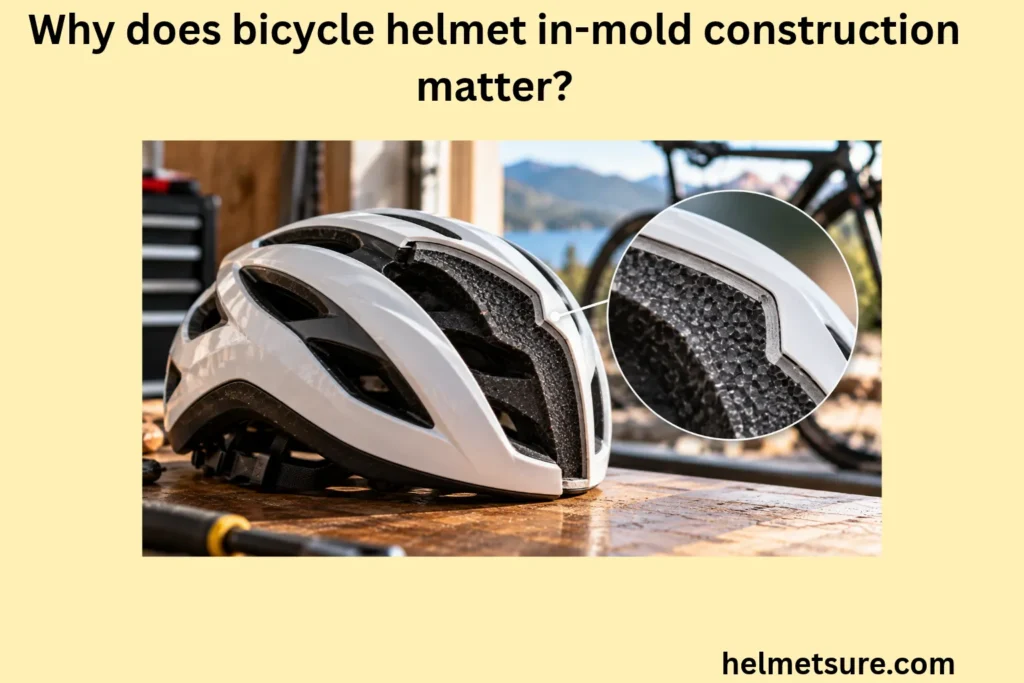
Bicycle helmet in-mold construction bonds the outer plastic shell to the EPS liner during manufacturing. This integration supports structural and design possibilities, including ventilation and weight choices, but does not independently guarantee superior impact protection.
The important change is how two distinct protective components become one integrated assembly. That connection can help designers support the foam structure and choose particular helmet shapes. What those choices deliver must be evaluated in the finished product.
In-mold construction is not itself a safety rating. Consider applicable safety compliance, proper fit and retention, appropriate coverage, and credible model-specific testing before assigning protective value to the manufacturing label.
How Does In-Mold Shell Attachment Differ From Separately Applied Bicycle Helmet Shells?
In-mold bicycle helmet shell attachment differs from separately applied shells because the outer microshell bonds to the EPS liner during foam molding rather than being attached to a previously formed liner.
The distinction concerns the stage at which attachment forms. It does not classify helmets by how expensive they look or how rigid their exterior feels. First identify the components; then identify the documented method used to join them.
Why the Outer Microshell and EPS Foam Liner Are Distinct Bicycle Helmet Components
The outer microshell and EPS foam liner are distinct bicycle helmet components because the microshell forms the exterior plastic covering while the EPS serves as the impact-absorbing foam structure.
The microshell is the thin exterior plastic covering. EPS—expanded polystyrene is the structural foam beneath it. Integration does not make these materials interchangeable: the shell contributes to the assembly, while the EPS provides the impact-absorbing liner.
Removable comfort pads are another component. They help with fit and comfort but are not the molded EPS structure. When reading a specification, distinguish references to the shell, structural liner, and soft interior padding.
How In-Mold Shell Attachment Differs From Glued or Taped Microshell Construction
In-mold shell attachment differs from glued or taped microshell construction because in-mold bonding forms during EPS molding, while separately attached shells are joined to a previously manufactured foam liner.
In the separately applied approach, the liner is formed before the shell is attached through the specified assembly method. In-mold production brings the shell into the foam-molding operation itself.
Glued or taped construction is an intentional manufacturing category, not a failed attempt at in-mold bonding. When comparing bicycle helmet construction types, use the attachment method to describe the category and reserve performance judgments for evidence about the complete helmet.
Why a Hard Plastic Outer Shell Does Not Automatically Identify an In-Mold Helmet
A hard plastic outer shell does not automatically identify an in-mold bicycle helmet because shell rigidity and thickness do not establish how the shell was attached to the EPS liner.
Rigidity is a material and geometry characteristic; in-mold is an attachment-process description. A smooth or hard exterior does not reveal the production sequence.
Check the exact model’s manufacturer specifications. Terms describing shell material or outer coverage may appear beside the construction label, but they answer different questions. Do not classify a helmet as in-mold from a photograph, shell thickness, or a pressure test performed by hand.
| Component or category | Defining characteristic | What it does not establish |
|---|---|---|
| Outer microshell | Exterior plastic covering | EPS liner identity |
| EPS liner | Structural impact-absorbing foam | Removable comfort padding |
| In-mold construction | Shell attachment forms during EPS molding | Comparative protection |
| Glued or taped microshell | Separate attachment after liner formation | Automatic inferiority |
| Hard plastic exterior | A physical shell characteristic | Manufacturing method |
How Does the In-Mold Manufacturing Process Bond the Outer Shell to EPS Foam?
The bicycle helmet in-mold manufacturing process bonds the outer plastic shell to EPS foam by positioning a preformed shell inside a mold and forming the expanding foam liner against it.
The documented sequence starts with shell placement, continues through EPS formation, and establishes attachment during that molding operation. Shell-material compatibility is a requirement for carrying out the process. These stages explain how the assembly forms, rather than how it ranks against other helmets.
How a Preformed Plastic Shell Is Positioned Inside the Helmet Mold
A preformed plastic shell is positioned inside the bicycle helmet mold before EPS expansion so the foam liner can form against the shell’s intended inner surface.
At this stage, the outer shell already has its intended form. Its position establishes the surface against which the liner will be molded. The setup is therefore different from placing a finished shell over an already completed foam liner.
This is a general account of the documented process. It does not specify the tooling arrangement or placement tolerances used by every factory.
How Steam and Pressure Expand EPS Beads Inside the Mold
Steam and controlled molding conditions expand EPS beads inside the bicycle helmet mold, forming the foam liner in the required helmet geometry.
BHSI describes polystyrene beads being expanded with steam and pressure within the mold. The mold defines the liner’s geometry as the bead material forms the foam structure.
The relevant point is the transformation from bead material to molded liner. There is no universal steam temperature, pressure, or cycle duration established here; those values would require documentation for a defined production process.
How Expanding EPS Bonds to the Shell Without a Separate Shell-Gluing Operation
Expanding EPS bonds to the positioned outer shell during bicycle helmet in-mold manufacturing, creating an integrated shell-and-foam assembly without a separate post-molding shell-gluing operation.
Attachment develops while the foam forms against the positioned shell. The result is the intended shell-to-EPS connection created within that operation, rather than a separate shell-gluing step afterward.
That process description does not establish a molecular bonding mechanism or prove a higher bond strength than every adhesive assembly. Either stronger claim would require directly relevant materials or mechanical test evidence.
Why In-Mold Manufacturing Requires Shell Plastics That Tolerate the Molding Process
In-mold bicycle helmet manufacturing requires shell plastics that tolerate the molding process because the positioned outer shell must maintain its intended characteristics during EPS foam formation.
The shell is present during foam formation, so its material must suit that environment. Polycarbonate is a commonly documented example; it is not an assertion that every in-mold helmet uses an identical plastic formulation.
Material suitability must be evaluated against the relevant process conditions. A polymer name alone does not specify its grade, manufacturing settings, or finished-helmet performance.
Manufacturing process chain
- Prepare the preformed shell using a material suitable for the process.
- Position that shell inside the helmet mold.
- Introduce the prepared EPS bead material.
- Use steam-assisted molding to form the liner geometry.
- Establish shell-to-EPS attachment within that molding operation.
How Does In-Mold Bonding Contribute to a Bicycle Helmet’s Structural Integrity?
In-mold bonding contributes to bicycle helmet structural integrity by integrating the outer plastic shell with the EPS liner, potentially reinforcing narrow foam sections against cracking or breakup.
The structural significance is the connection between the two components. To interpret it correctly, distinguish support against cracking or breakup from measurements of how much impact loading a complete helmet transmits.
How Bonded Shell-to-EPS Integration Helps Resist Cracking of Narrow Foam Sections
Bonded shell-to-EPS integration helps support relatively narrow bicycle helmet foam sections by providing structural continuity between the outer plastic shell and the EPS liner.
BHSI identifies resistance to cracking as a potential benefit of integrated shell-and-foam construction. The bonded shell can contribute to supporting foam regions as part of the assembly, rather than functioning as an unrelated outer covering.
The effect remains design-dependent. Foam-section thickness and shape, shell properties, EPS characteristics, and additional reinforcement all influence structural behavior. An in-mold label does not specify those variables.
Structural support also answers a narrower question than comparative impact attenuation. Helping an assembly resist breakup does not, by itself, demonstrate lower head acceleration or reduced injury risk. Those conclusions require appropriate completed-helmet test evidence.
For example, two helmets may both use in-mold bonding but have different foam geometry and reinforcement. The shared process name is insufficient to predict which would perform better under a particular impact.
- Bonded condition: shell and EPS form an integrated assembly.
- Structural role: the connection contributes to support and continuity.
- Potential effect: support against cracking or breakup of narrow foam regions.
- Dependencies: geometry, shell properties, EPS properties, and other reinforcement.
- Evidence boundary: structural support alone does not establish superior impact attenuation.
What Design Trade-Offs Does In-Mold Construction Create for Ventilation, Weight, Cooling, and Cost?
In-mold bicycle helmet construction creates design opportunities involving ventilation openings and lightweight configurations, while actual cooling, finished weight, and production cost depend on additional engineering and manufacturing choices.
This is where a manufacturing capability becomes a product-design choice. A manufacturer decides which opportunities to use, and the completed helmet determines whether the intended benefits are achieved.
How In-Mold Construction Can Enable Larger Bicycle Helmet Ventilation Openings
In-mold construction can enable larger bicycle helmet ventilation openings by supporting design geometries that incorporate wider or differently arranged spaces between EPS foam sections.
The support described above can give designers options for opening up or rearranging spaces between foam sections. Vent layout remains a chosen geometry: in-mold construction does not require a particular opening size or number.
A helmet may use the construction method while retaining a relatively closed layout. Another may prioritize larger openings. Identify the actual configuration rather than assuming that the manufacturing label describes it. Cooling effectiveness is a separate question.
How In-Mold Construction Can Support Lightweight Bicycle Helmet Designs
In-mold construction can support lightweight bicycle helmet designs by allowing manufacturers to combine the integrated shell-and-EPS assembly with particular geometry and material choices.
A lightweight configuration is a possibility, not a measured result. Total mass includes the shell, EPS geometry, reinforcement, retention system, and other fitted components. Additional features can offset any mass savings elsewhere.
The label also does not tell you how much EPS the helmet contains. Bonding method alone cannot establish liner volume or total material quantity.
When comparing weight, use figures for the actual models, sizes, and configurations being considered. A mass listed for one size should not silently be applied to another. Without matched information, a claim that an in-mold helmet is lighter remains unverified.
Why Larger Helmet Vents Do Not Automatically Produce Better Cooling
Larger bicycle helmet vents do not automatically produce better cooling because airflow depends on opening placement, internal channel design, and the conditions under which the helmet is used.
Cooling depends on how air moves through the entire arrangement. Inlet and outlet placement, connecting internal channels, and head orientation can change the airflow reaching the head. More visible opening area does not describe that complete path.
For bicycle helmet ventilation and cooling, separate appearance from measured thermal performance. A meaningful comparison identifies the tested helmets and conditions, rather than ranking them by vent count.
If comparable cooling data are unavailable, describe the layout as a design feature. Do not convert a photograph of large vents into a quantified cooling advantage.
How Established In-Mold Manufacturing Requirements Can Affect Production Cost
Established in-mold manufacturing requirements can affect bicycle helmet production cost through tooling, equipment, process complexity, and production-efficiency considerations.
Relevant expenses can include tooling, suitable materials, equipment, production steps, and how efficiently those resources are used. Scale and product complexity influence how such costs are distributed across production.
BHSI’s manufacturing-cost page explicitly identifies its figures as estimates and says manufacturers have not supplied proprietary cost data. Those numbers should not be treated as verified contemporary factory costs.
Production expense is also different from retail price. A construction method does not establish a fixed consumer price premium, and the price tag does not reveal how much of it represents manufacturing. Without matched production data, no universal in-mold cost comparison is justified.
| Attribute | Potential design opportunity | Evidence needed for a comparison | Unsupported shortcut |
|---|---|---|---|
| Vent layout | Larger or differently arranged openings | Actual model geometry | Every in-mold helmet has larger vents |
| Finished weight | Lightweight configurations | Matched model, size, and configuration masses | In-mold always weighs less |
| Cooling | Vent and channel arrangements | Relevant comparative airflow or thermal evidence | Larger vents always cool better |
| Production cost | Different tooling and process requirements | Defined production and scale data | A fixed factory or retail premium |
Does In-Mold Construction Establish That a Bicycle Helmet Offers Better Protection?
In-mold construction does not, by itself, establish that a bicycle helmet offers better protection because safety compliance and comparative impact performance depend on the complete helmet rather than its shell-attachment method alone.
The evidence question changes here: instead of asking how a helmet was made, ask what has been demonstrated about the completed model. Compliance, independent testing, and rider fit supply different kinds of information.
Why In-Mold and Separately Assembled Helmets Must Meet the Same Applicable U.S. Safety Standard
In-mold and separately assembled bicycle helmets must meet the same applicable U.S. bicycle helmet safety requirements because the relevant standard evaluates completed-helmet performance rather than granting exemptions based on shell-attachment method.
For helmets within the applicable U.S. bicycle-helmet rule, shell attachment does not create a separate regulatory category. CPSC guidance describes requirements involving impact attenuation, retention, positional stability, peripheral vision, labeling, and other specified provisions.
An in-mold label does not replace the required compliance evidence. Equally, separately applied construction does not automatically prevent a helmet from meeting the standard.
Compliance answers whether applicable requirements are met. It does not rank compliant helmets by comparative performance, and it should not be described as proof that every compliant model performs identically.
Why Structural Integration Alone Does Not Prove Superior Impact Protection
Structural integration alone does not prove superior bicycle helmet impact protection because actual performance depends on the complete shell, EPS liner, geometry, reinforcement, and other design characteristics.
The integrated connection is one feature within a larger design. It does not disclose the full liner geometry, material properties, reinforcement, or measured impact response.
To claim that one helmet offers better impact protection than another, identify the compared models, the testing method, and the supported outcome. A construction explanation cannot substitute for that comparison.
This also limits injury claims. Neither a bonded shell nor a claim of greater structural strength establishes that a rider cannot sustain a concussion. The manufacturing attribute and demonstrated protective performance must remain separate.
How Independent Impact Ratings Evaluate More Than a Helmet’s Manufacturing Label
Independent bicycle helmet impact ratings evaluate laboratory measurements from completed helmet models, providing performance information that a manufacturing label such as in-mold construction cannot establish by itself.
Virginia Tech’s Bicycle Helmet Ratings use its STAR system to evaluate complete models under defined impact scenarios. Its current description identifies measurements of linear acceleration and rotational velocity. These are laboratory performance observations, not classifications based solely on shell attachment.
Use the listing for the exact model being considered. Read the methodology and limitations before interpreting a rating as evidence for a particular comparison.
The result cannot guarantee an individual crash outcome. A laboratory rating adds information under its test conditions; it does not turn a helmet into universal protection or replace applicable compliance and correct use.
Why Proper Helmet Fit and Protective Coverage Remain Necessary Regardless of In-Mold Construction
Proper bicycle helmet fit and protective coverage remain necessary regardless of in-mold construction because the manufacturing method does not determine whether the helmet is correctly sized, positioned, or secured on a rider’s head.
A construction label does not determine whether a helmet matches your head or stays in its intended position. Those requirements must be checked on the individual rider.
CPSC consumer guidance calls for a comfortable, snug helmet worn level and securely fastened. Follow the model’s sizing and adjustment instructions, and evaluate its intended coverage while it is correctly positioned.
Understanding how to choose a properly fitting bicycle helmet therefore remains necessary even after its construction is known. A model with attractive engineering features is unsuitable for you if it cannot be fitted and secured correctly.
| Evidence type | What it establishes | What it does not establish |
|---|---|---|
| Manufacturer construction specification | How the identified helmet is assembled | Independent impact superiority |
| Applicable compliance evidence | Meeting defined regulatory requirements | A comparative protection ranking |
| Model-specific laboratory rating | Performance under the stated test method | Every real-world crash outcome |
| Individual fit and adjustment check | Suitability of positioning and retention for that rider | Laboratory impact performance |
When Should In-Mold Construction Influence Your Choice of Bicycle Helmet?
In-mold construction should influence bicycle helmet selection when its structural and design characteristics meet the rider’s needs, but the decision must also account for safety compliance, fit, coverage, and credible complete-helmet performance evidence.
Give the attribute weight when its integration or design characteristics are useful in a helmet that already meets your safety and fit requirements. Compare the actual product, not the expected advantages of its label.
For instance, if low mass or cooling matters to your riding, evaluate those attributes using relevant model information. If comparative impact performance matters, consult credible testing for the complete model. In each case, the evidence should answer the question you are actually asking.
In-mold construction matters because it bonds the outer shell to the EPS liner during manufacturing and can support structural and design choices. Consider those characteristics, while prioritizing applicable safety compliance, proper fit, protective coverage, and credible complete-helmet performance evidence.
Frequently Asked Questions
Is in-mold construction a bicycle helmet safety rating?
No. It describes how the outer shell is joined to the EPS liner. Compliance, model-specific test evidence, fit, retention, and coverage must be evaluated separately.
Does in-mold construction always provide better impact protection?
No. Comparative impact performance depends on the complete helmet design and relevant testing, not the attachment method alone.
Are separately attached microshell helmets automatically inferior?
No. Separately attached shells are an intentional construction category. The complete helmet must be evaluated using applicable compliance and performance evidence.
Does a hard outer shell prove that a helmet is in-mold?
No. Shell rigidity and thickness do not establish when or how the shell was attached. Check the exact manufacturer specification.
Does in-mold construction always make a helmet lighter?
No. Finished mass also depends on shell material, EPS geometry, reinforcement, retention parts, size, and other components.
Do larger vents always provide better cooling?
No. Cooling also depends on vent placement, internal channels, outlet design, speed, head position, and test conditions.
Can in-mold construction prevent concussion?
No helmet construction can guarantee prevention of concussion or every head injury. Avoid converting a manufacturing attribute into an injury-prevention guarantee.
When should in-mold construction influence helmet selection?
Use it as one engineering attribute after confirming applicable compliance, correct fit and retention, appropriate coverage, and credible evidence for the complete model.
Sources
- BHSI: Inmolded Helmets and How Bicycle Helmets Are Made — construction, manufacturing, and structural explanations.
- BHSI: Ventilation and Cooling and Manufacturing Costs — airflow dependencies and explicitly estimated production costs.
- CPSC: Bicycle Helmet Business Guidance and Consumer Helmet Guidance — U.S. requirements and practical fit guidance.
- Virginia Tech — Bicycle Helmet Ratings — model-specific STAR laboratory ratings.