
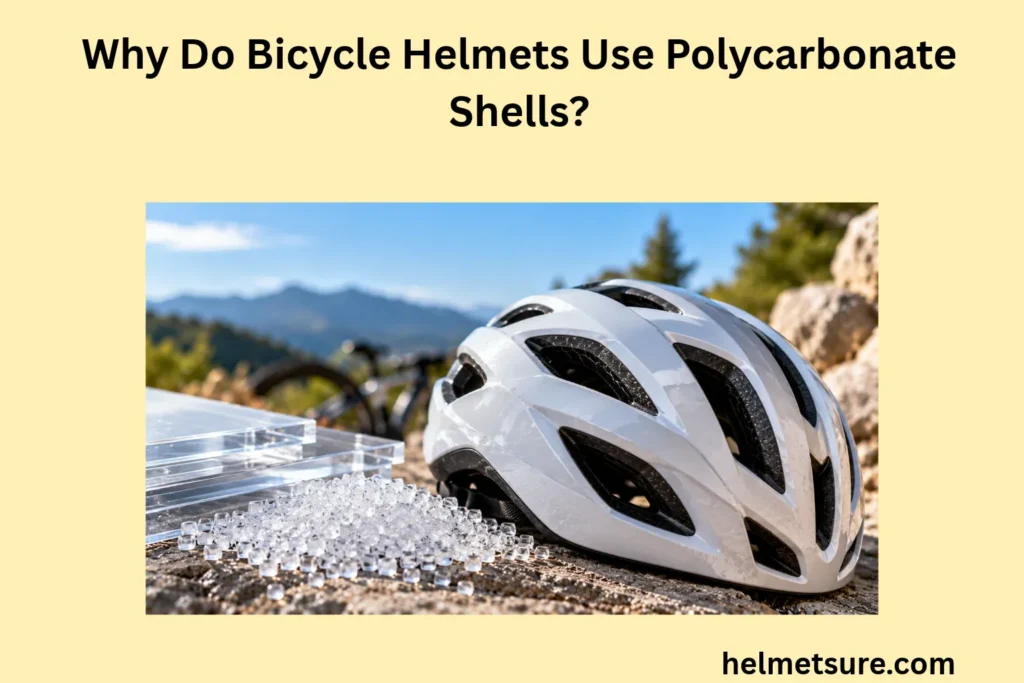
Bicycle helmets use polycarbonate shells because the material combines impact toughness, thin-sheet formability, and compatibility with common in-mold manufacturing. The shell protects the foam exterior, while the EPS liner provides primary impact-energy absorption.
A polycarbonate shell does not determine complete-helmet protection. Actual performance depends on the assembled shell, EPS liner, retention system, coverage, fit, condition, and compliance testing.
Polycarbonate, abbreviated PC, is an engineering thermoplastic that manufacturers can form into a lightweight exterior covering. Its properties support curved shapes, ventilation openings, and close integration with EPS foam.
These advantages explain why manufacturers select the material. They do not establish that every polycarbonate-shell helmet provides the same performance or that the shell absorbs most impact energy.
Polycarbonate as a Protective Exterior Rather Than an Impact-Absorbing Liner
Polycarbonate serves as the protective exterior shell, while the underlying EPS liner provides the principal impact-energy absorption.
Why polycarbonate is classified as a tough thermoplastic shell material
Polycarbonate is a tough engineering thermoplastic because suitable grades can be shaped through controlled heat processing and resist fracture under specified mechanical conditions.
“Thermoplastic” describes processing behavior; “tough” describes mechanical behavior. Neither term means that a finished shell is unbreakable. Grade, thickness, stabilization, and manufacturing history all matter.
How a polycarbonate outer shell covers and supports the underlying EPS foam liner
The shell covers the EPS liner, protects its exposed surface from direct contact, and contributes to continuity of the completed assembly. EPS foam is the thick structural material beneath the shell—not the soft comfort padding touching the rider’s head.
Exterior coverage, surface protection, and assembly support.
Primary impact-energy management through deformation and crushing.
Helps keep the helmet correctly positioned on the head.
Combines all components into one tested protective system.
How Polycarbonate’s Mechanical Properties Support Bicycle Helmet Shell Protection
Polycarbonate contributes impact toughness, controlled deformation behavior, and a smooth exterior surface, but these properties are not a complete helmet safety rating.
How polycarbonate’s impact toughness helps a shell withstand localized mechanical stress
Impact toughness helps the shell resist fracture during some localized loading by allowing suitable material grades to absorb energy before breaking. Shell thickness, grade, forming history, temperature, and loading conditions affect the response.
Why polycarbonate can tolerate deformation before fracture under suitable conditions
Some polycarbonate grades can exhibit ductile behavior. Elastic deformation recovers after unloading, plastic deformation remains, and fracture separates or cracks the material. These outcomes should not be treated as interchangeable.
How the polycarbonate shell’s exterior can assist surface sliding during angled contact
A smooth shell can assist sliding during angled contact by reducing the tendency to catch against some surfaces. Sliding also depends on shape, finish, projections, friction, and the contacted surface; it is not guaranteed by the polymer name.
Why Polycarbonate Can Be Formed Into Thin, Lightweight, and Ventilated Helmet Shells
Suitable polycarbonate sheets can be heated, formed into curved geometry, cooled, and trimmed before integration with the foam liner.
How thermoforming shapes polycarbonate sheets into curved bicycle helmet shells
Thermoforming heats the specified sheet and draws it against shaped tooling. Vacuum may provide the pressure difference, cooling fixes the geometry, and trimming creates the perimeter and openings.
Why thin polycarbonate shell construction can help reduce overall helmet weight
A thin covering can reduce exterior-shell mass by limiting material volume. Total helmet weight still includes foam, straps, adjustment hardware, comfort padding, and other components.
How polycarbonate formability supports complex shell contours and ventilation openings
Formability supports curved contours and openings that correspond with liner vents and airflow channels. More openings alone do not prove better cooling or stronger construction.
Select the specified sheet and compatible graphics.
Draw the sheet against controlled tooling.
Set the geometry and create intended openings.
Check shape, edges, consistency, and mold fit.
Why Polycarbonate Is Commonly Used in In-Mold Bicycle Helmet Construction
Suitable polycarbonate constructions can retain their intended shape during conventional EPS molding and integrate closely with the expanding foam liner.
Why polycarbonate’s thermal properties suit conventional EPS in-mold processing
The prepared shell must tolerate the controlled steam, heat, and pressure cycle used to expand EPS beads without unacceptable distortion. This is process compatibility—not unlimited resistance to heat during storage or use.
How expanding EPS foam integrates with the preformed polycarbonate shell
The preformed shell is positioned inside the mold. EPS beads expand and fuse against its inner surface, forming an integrated shell-and-liner assembly.
Why shell-liner integration can improve structural continuity without guaranteeing higher impact protection
Close integration can reduce gaps and support coordinated geometry. It cannot prove that every in-mold helmet provides greater impact protection than every alternative construction.
Why Manufacturers Choose Polycarbonate Instead of PET or ABS for Certain Bicycle Helmet Shells
Manufacturers choose materials according to formability, toughness, thermal compatibility, thickness, geometry, and the intended production method—not strength alone.
Why polycarbonate is often favored over conventional PET for in-mold shell processing
Suitable polycarbonate grades can tolerate conventional EPS molding conditions more effectively than PET grades historically used as thin coverings on separately molded liners. Specialized formulations and alternative processes may differ.
How polycarbonate and ABS differ in shell applications and processing options
Polycarbonate is widely used for thin formed and in-mold shells. ABS shells are often associated with comparatively rigid molded hard-shell construction, although specialized ABS in-mold construction has also been documented.
Why manufacturers select shell materials according to processing requirements rather than material strength alone
A material must work with the forming cycle, tooling, thickness, trimming, graphics, downstream molding, and final helmet geometry. Performance in one material test does not prove manufacturing suitability.
What Limitations and Trade-Offs Come With Polycarbonate Bicycle Helmet Shells?
Polycarbonate offers toughness and manufacturing flexibility, but surface scratching, UV exposure, elevated temperatures, and incompatible chemicals remain relevant concerns.
Why polycarbonate’s impact toughness does not make its surface scratch-resistant
Fracture toughness and resistance to localized surface marking are different properties. Abrasive contact can mark the surface without creating the same event as bulk fracture.
How ultraviolet exposure and elevated temperatures can affect polycarbonate properties
UV exposure can contribute to weathering and appearance changes. Elevated temperatures can affect the shell, foam, adhesives, or their interface. Results depend on formulation, stabilization, exposure severity, and the complete assembly.
Why certain solvents and chemicals may cause polycarbonate stress cracking
Environmental stress cracking can occur when chemical exposure interacts with residual or applied mechanical stress. Substance identity, concentration, temperature, duration, coatings, and material formulation all matter.
Use only manufacturer-approved cleaning and care methods. A compatibility table for one resin does not authorize applying a cleaner, paint, adhesive, or solvent to a finished helmet.
Why a Polycarbonate Shell Alone Does Not Determine Bicycle Helmet Safety
Impact attenuation, retention, stability, vision, coverage, and other protective requirements depend on the complete assembled helmet.
Why the EPS liner remains responsible for most impact-energy absorption
The EPS liner deforms and crushes under impact loading to provide the principal energy-management mechanism. Shell toughness cannot substitute for an appropriately designed liner.
Why bicycle helmet safety testing evaluates the assembled helmet rather than polycarbonate alone
Helmet testing evaluates the finished shell, impact-absorbing liner, retention system, stability, peripheral vision, and complete design. A resin datasheet or “polycarbonate shell” description cannot establish product compliance.
Why polycarbonate shell thickness and design must be evaluated alongside the complete helmet structure
Shell thickness works with geometry, vents, foam depth, reinforcement, coverage, and attachments. There is no basis for assuming that the thinnest, thickest, hardest, or most flexible PC shell is automatically safest.
Complete-helmet validation checklist
Why Polycarbonate Remains a Practical Choice for Bicycle Helmet Outer Shells
Polycarbonate remains practical because suitable grades combine toughness, thin-sheet formability, and compatibility with conventional EPS in-mold production.
The engineering rationale is connected: mechanical behavior supports an exterior covering, formability supports curved and ventilated geometry, and process compatibility allows the prepared shell to integrate with EPS foam.
Every advantage remains conditional on the specific material grade, shell design, manufacturing controls, complete helmet construction, condition, and tested performance.
Bicycle helmets use polycarbonate because it supports tough, lightweight, formable exterior shells and conventional in-mold integration. The EPS liner still provides primary impact-energy absorption, and protection must be evaluated through the complete helmet—not the shell material alone.
Frequently Asked Questions
Why is polycarbonate used for bicycle helmet shells?
It combines useful impact toughness, thin-sheet formability, and compatibility with common EPS in-mold manufacturing.
Does the polycarbonate shell absorb most impact energy?
No. In conventional designs, the EPS liner provides the principal energy absorption through deformation and crushing.
Is a polycarbonate shell unbreakable?
No. Its response depends on grade, thickness, forming history, temperature, geometry, loading, and condition.
Does polycarbonate make a helmet lightweight?
A thin PC covering can reduce shell mass, but total weight also includes foam, straps, hardware, padding, and other components.
Why is polycarbonate suitable for in-mold construction?
Suitable grades and shell constructions can retain their intended geometry during controlled EPS molding and integrate closely with the expanding foam.
Is polycarbonate better than ABS or PET?
Not universally. Material selection depends on the intended construction, forming process, thermal cycle, geometry, and performance requirements.
Can chemicals or heat damage a polycarbonate shell?
Yes. Excessive heat and incompatible substances can affect the shell or complete assembly. Follow the manufacturer’s care instructions.
Does a polycarbonate shell prove that a helmet is safe?
No. Safety validation applies to the complete helmet, including its shell, EPS liner, retention system, coverage, fit, condition, and applicable testing.