
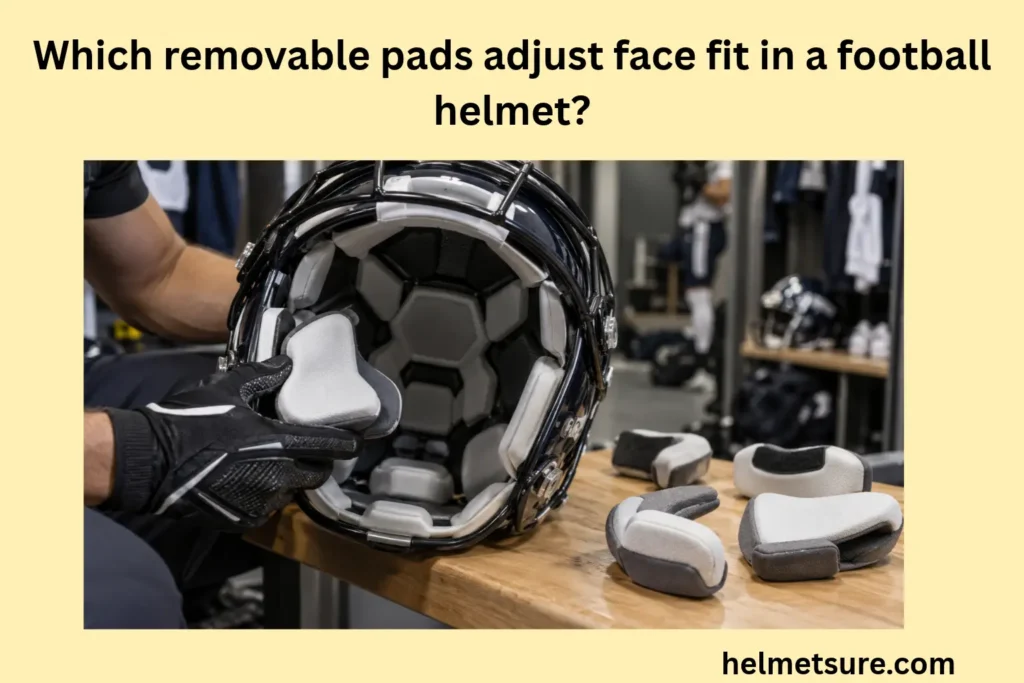
Which Removable Pads Adjust Face Fit in a Football Helmet?
In helmets that use replaceable face-contact padding, removable jaw or manufacturer-specific cheek pads adjust local face fit; the correct pad type and thickness depend on the exact helmet platform, current cheek/jaw contact, and documented compatibility.
Use only components and configurations documented for the exact helmet platform. Do not trim, stack, glue, reshape, or substitute padding unless the manufacturer expressly supports that configuration. A local face-pad change does not by itself confirm correct overall helmet size or fit.
The key is to identify the pad by its documented location and function—not merely because it can be removed. A face-fit pad changes contact at the cheeks or jaw. Crown, forehead, occipital, comfort, and general sizing components usually serve different regions, while inflatable face systems use a different adjustment method.
In Replaceable-Pad Systems, Jaw or Model-Specific Face Pads Change Cheek and Jaw Contact
In replaceable-pad helmet systems, the removable components intended to change cheek and jaw contact are the platform’s documented jaw pads or other model-specific face-contact pads.
Some current football helmet platforms provide replaceable jaw pads in multiple supported sizes or thicknesses. Other platforms use different component names, shapes, attachment systems, or adjustment mechanisms. The correct answer therefore starts with the exact helmet model and its current manufacturer documentation.
How removable jaw pads can change cheek and jaw contact where the helmet platform supports them
Removable jaw pads can change local cheek and jaw contact when the helmet platform provides compatible replacement thicknesses or variants.
The pad occupies the local space between the helmet’s supported face-contact structure and the wearer’s cheek or jaw. Changing to another manufacturer-approved thickness or variant changes that relationship: a supported thicker option can add local contact, while a supported thinner option can reduce excessive local compression.
VICIS, for example, currently directs ZERO2 fitters to select from its jaw-pad thickness options so the pads feel snug against the face and sit flush with the jaw without pressing too forcefully into the cheeks. That guidance belongs to the ZERO2 platform; it is not a universal thickness rule for other helmets.
How model-specific face-contact pads can serve the same local fit job under different manufacturer terminology
Different manufacturers can use different component names for pads that influence local cheek or jaw contact.
“Jaw pad” is a common term, but a manufacturer may use another name for a component positioned in the same general fit region. Identify the component by three facts: where it contacts the wearer, what fit function the manufacturer assigns to it, and which helmet platform supports it.
Similar function does not make differently named parts interchangeable. A removable jaw pad, an inflatable face-frame pad, a fit pod, and a comfort pad can belong to different architectures even when each affects how the helmet feels somewhere inside.
Why a manufacturer label does not automatically make two face-contact pad designs equivalent
Similar manufacturer labels do not establish that two face-contact pad designs share the same geometry, thickness options, attachment system, or compatibility.
Two products described as “jaw pads” can differ in contour, mounting method, location, materials, supported sizes, and interaction with the rest of the fit system. Even parts sold by the same manufacturer may belong to separate helmet platforms.
Schutt’s current F7 AiR HSS jaw-pad documentation limits compatibility to Schutt helmets that use the HSS jaw-pad architecture and identifies the pads as having a platform-specific shape. That is why a matching label or similar appearance cannot replace an exact compatibility check.
Why the exact helmet model must define which removable face-fit pad category applies
The exact helmet model or platform determines which removable face-fit component, if any, is valid.
Identify the manufacturer, exact model, platform generation when applicable, and current face-fit architecture before looking for a replacement. Then match that identity to the manufacturer’s current fitting guide or replacement-parts listing.
If the model uses replaceable jaw pads, continue with supported pad selection. If it uses an inflatable face system, use the manufacturer’s air-adjustment procedure instead. If the documentation does not identify a removable cheek/jaw component, do not create one by treating an unrelated interior pad as a face-fit pad.
Face-fit pad identification box
| Identification question | Direction |
|---|---|
| Does the component contact the cheek or jaw zone? | Continue face-fit classification |
| Is it removable or replaceable on this exact platform? | Verify current manufacturer instructions |
| Does the manufacturer offer supported sizes, thicknesses, or variants? | Treat it as a potential local face-fit adjustment |
| Is it actually a crown, forehead, occipital, comfort, or general sizing pad? | Exclude it from the removable face-fit category |
| Does the platform change face contact through air inflation? | Follow the inflatable-system pathway instead |
Removable Face-Fit Pads Serve a Different Role From Crown, Forehead, Comfort, and Occipital Pads
Removable face-fit pads act at the cheek and jaw, while crown, forehead, occipital, comfort, and general sizing components primarily affect other fit regions or functions.
Removability is a physical property, not a complete component classification. The manufacturer’s documented fit job and contact region determine whether an interior component belongs to the removable face-fit pad category.
How removable face-fit pads act at the cheek and jaw contact zone
Removable face-fit pads alter contact specifically where the helmet interfaces with the cheeks and jaw.
Where a platform supports interchangeable jaw or cheek-contact pads, changing the approved pad variant alters local contact in that facial region. This can help address a localized gap or excessive compression without directly changing crown height, forehead contact, or rear-head stabilization.
The adjustment remains local. Better cheek contact does not prove that the shell size, helmet position, crown contact, or entire fit is correct. Those variables must be evaluated separately.
How crown and forehead pads affect other head-contact regions rather than local cheek fit
Crown and forehead pads govern upper or frontal head contact rather than the cheek/jaw face-contact zone.
A crown component influences contact at the top of the head or helmet height according to the platform. A forehead or front pad influences the frontal contact region. Changing either may alter overall fit, but neither should be the default response to a localized cheek gap.
Multiple fit issues can exist together. A helmet may need attention at both the cheeks and crown, but each signal should be assigned to the component system responsible for that region rather than solved through one generic “padding” change.
How occipital pads act at the rear of the head rather than the face-contact zone
Occipital padding supports fit at the rear/base of the head rather than controlling cheek and jaw contact.
Its position and adjustment influence rear-head contact or stabilization within the helmet architecture. Rear looseness, lift, or movement is therefore not automatic evidence that thicker jaw pads are required.
A face-pad adjustment may improve local cheek contact while leaving an occipital issue unchanged. Diagnose the location of the fit signal before selecting a component, then confirm the overall helmet fit after any local change.
Why comfort liners and general sizing pads should not be classified as face-fit pads by removability alone
Comfort or general sizing pads are not face-fit pads merely because they can be removed or replaced.
Some removable components tune comfort, broader head-size accommodation, or contact in another region. Xenith’s current Epic documentation, for example, describes jaw-pad options separately from snug comfort-pad options, showing that both can be replaceable while serving different fitting roles.
Classify each part using its manufacturer-defined purpose. A removable component becomes part of this article’s central category only when its documented job is to influence cheek or jaw contact on the applicable platform.
Why inflatable face-fit systems are a different adjustment architecture rather than removable-pad thickness options
Inflatable face-fit systems change local contact through air adjustment rather than by selecting a removable pad thickness.
Riddell’s SpeedFlex fitting guide identifies inflatable Face Frame Pads and directs fitters to adjust them through the specified inflation procedure until they are snug against the face. That architecture can affect the same general face-contact region, but its adjustment variable is air—not a thicker or thinner removable pad.
Do not apply removable-pad selection logic to an air-adjusted system. The guide to air-liner fit zones covers the correct alternate pathway when the platform uses inflatable fit components.
Face pads versus other interior pads matrix
| Component category | Primary fit region or job | Part of the removable face-fit pad category? |
|---|---|---|
| Removable jaw or cheek-contact pad | Cheek and jaw contact | Yes, when the manufacturer documents compatible variants |
| Crown pad | Top or crown contact | No |
| Forehead or front pad | Frontal head contact | No |
| Occipital or rear pad | Rear or base-of-head fit | No |
| Comfort liner or pad | Comfort or secondary contact | Not unless the manufacturer specifically assigns a cheek/jaw role |
| General sizing pad or pod | Broader sizing or customization | No by default |
| Inflatable face-frame or jaw pad | Face contact through air adjustment | Architecture contrast only |
Where Removable Face-Fit Pads Should Act Around the Cheeks and Jaw
Removable face-fit pads should influence the local cheek and jaw contact zone defined by the helmet’s manufacturer.
The anatomical region is general, but actual pad shape, attachment, and placement are platform-specific. Locate the documented component before interpreting gaps or pressure so that a signal from the forehead, crown, or rear of the head is not mistaken for a face-pad issue.
How removable face-fit pads contact the cheek and jaw region
Removable face-fit pads are positioned to create local contact along the cheek and jaw area of the wearer.
Their supported thickness and geometry determine how fully they meet that region. VICIS describes the intended ZERO2 relationship as snug face contact with the jaw pad flush to the jaw and without excessive cheek pressure. Other manufacturers may express the criterion differently, so retain the exact platform boundary.
There is no universal millimeter boundary for the contact zone. Use the helmet model’s current pad location and fit instructions, then evaluate the wearer at the actual points where those pads are designed to contact.
How cheek/jaw contact differs from crown or forehead contact
Cheek and jaw contact is a separate fit region from crown and forehead contact.
A gap beside the cheek is not the same signal as space over the crown, and cheek pressure is not the same as forehead pressure. The location of the signal determines which component family should be investigated.
Problems can coexist across regions, but a jaw-pad change should not be expected to correct upper-head contact by default. After solving the local face issue, recheck the other regions rather than assuming the whole helmet is now properly fitted.
Why left and right face-contact areas should be assessed as separate local positions when the system uses separate pads
When the platform uses separate left and right face pads, evaluate each side’s contact rather than assuming both sides have the same local fit state.
Compare the left and right cheek/jaw zones for gaps, excessive compression, pad seating, and contact consistency. Schutt’s current F7 AiR HSS jaw pads are sold as a pair and marked for left/right placement, which makes positional identification part of compatibility and installation.
Observation of asymmetry does not authorize an asymmetric pad combination. Do not select different left/right sizes unless the current manufacturer documentation expressly supports that configuration for the platform.
Why the helmet model determines the exact placement of its removable face-contact components
The helmet model determines the shape, attachment, and exact placement of its removable face-contact components.
The shell, liner, mounting points, and internal fit architecture determine where each compatible pad seats. A general cheek/jaw label helps identify the anatomical region, but it cannot supply the exact geometry or attachment position for every football helmet.
Use the current model diagram or replacement instructions when identifying the pad seat. Never copy one manufacturer’s component map onto another helmet or infer compatibility from a similar-looking location.
Face-fit pad location diagram
| Fit region | Typical location | Classification for this article |
|---|---|---|
| Left cheek/jaw zone | Local face contact on the wearer’s left side | Removable face-fit pad only if the platform documents a separate compatible pad |
| Right cheek/jaw zone | Local face contact on the wearer’s right side | Removable face-fit pad only if the platform documents a separate compatible pad |
| Crown zone | Top of the head | Separate fit region |
| Forehead/front zone | Frontal head contact | Separate fit region |
| Occipital/rear zone | Rear or base of the head | Separate fit region |
| Inflatable face-frame zone | Manufacturer-defined facial contact area | Separate adjustment architecture |
This is a regional map, not a universal component drawing. The exact pad contour, seat, attachment, and orientation must come from the helmet platform’s current instructions.
What the Current Face-Contact Condition Means Before Changing a Pad
Diagnose the current cheek/jaw contact as insufficient, excessive, asymmetric, or appropriate before selecting a different removable pad.
The observed local condition determines which adjustment direction—if any—should be investigated. It does not prove that a compatible replacement exists or that the rest of the helmet fits correctly.
A visible or persistent gap → insufficient local cheek/jaw contact
A persistent gap between the documented face-fit pad and the cheek/jaw area indicates insufficient local face contact.
Evaluate the gap at the actual face-pad zone, not at an unrelated part of the helmet interior. If the pad does not contact the intended cheek or jaw region, a manufacturer-supported thicker pad or other approved face-fit option may be worth evaluating.
Do not immediately assume the shell size is correct or that pad thickness is the only cause. The broader guide to head-and-jaw gaps helps separate local cheek contact from other gap locations. No universal gap width should be invented; current OEM criteria are qualitative and platform-specific.
Excessive local compression → overly tight face contact at the pad zone
Excessive pressure or compression localized at the cheek/jaw pad zone indicates that local face contact may be too tight.
Distinguish ordinary snug contact from pressure that is clearly excessive, uncomfortable, or inconsistent with the manufacturer’s intended fit. VICIS, for example, asks for snug, flush jaw contact without the pads pressing too forcefully into the cheeks.
A thinner supported option may reduce local compression, but the component and entire fit must be reassessed first. The guide to uncomfortable padding addresses the adjacent question of padding discomfort. Do not use an invented pressure number or treat discomfort elsewhere as proof of a jaw-pad problem.
Uneven left-to-right contact → asymmetric local fit that requires model-specific evaluation
Uneven cheek contact between the two sides indicates an asymmetric local fit state that should be evaluated within the helmet model’s supported adjustment options.
Check whether each pad is the correct component, seated in the intended position, and oriented properly. Also consider whether helmet positioning, broader fit, or the wearer’s facial geometry is contributing to the observed difference.
Do not automatically mix pad sizes to force symmetry. A left/right combination is valid only when the manufacturer documents that configuration. If current instructions do not authorize it, refer the asymmetry to the manufacturer or a qualified helmet fitter.
Stable, appropriate cheek/jaw contact → no removable-pad change solely to increase or reduce local pressure
Appropriate stable cheek/jaw contact does not require a pad-thickness change merely for the sake of changing local pressure.
When the supported pads contact the cheeks and jaw as intended, remain comfortable, and show no relevant gap or excessive compression, keeping the current configuration is a valid decision. More pressure is not automatically better fit.
Another fit problem may still exist at the crown, forehead, rear, shell size, or helmet position. Investigate that region directly rather than changing an already-correct face pad to make the entire helmet feel tighter.
Fit-state checklist
- Check for persistent gaps at the documented cheek/jaw pad zones.
- Check for excessive local pressure or compression.
- Compare left and right contact when the platform uses separate pads.
- Confirm whether contact is already snug, stable, and appropriate.
- Separate local face-pad signals from crown, forehead, rear, size, and whole-helmet issues.
- Delay pad selection until the local face-contact state is classified.
Which Removable-Pad Adjustment Matches the Face-Fit Condition?
Choose a thicker, thinner, unchanged, or other supported removable face-pad option only after matching the local fit condition to the exact helmet platform’s documented choices.
This step identifies a supported adjustment direction, not a final replacement. The actual component must still pass model, location, size or variant, and position-specific compatibility checks before it is used.
How a thicker compatible removable face pad can increase cheek contact where that thickness option is supported
A thicker compatible face pad can increase local cheek/jaw contact when the helmet manufacturer supports that thicker option for the platform.
Increasing the approved pad thickness reduces local space between the pad and the wearer, which can improve contact where a genuine cheek or jaw gap exists. VICIS ZERO2 and Schutt HSS platforms are current examples of systems offering multiple jaw-pad options, but their parts and choices are platform-specific.
Do not stack loose padding or substitute an unrelated component to imitate a thicker pad. After any supported change, verify that the original gap improved without creating excessive pressure or masking a broader sizing problem.
How a thinner compatible removable face pad can reduce excessive local compression where supported
A thinner compatible face pad can reduce excessive cheek/jaw compression when the helmet platform supports a thinner option.
Reducing the approved pad thickness can create more local space and lower excessive contact at the cheek/jaw zone. The goal is appropriate snug contact—not the least possible pressure or the thinnest available component.
Confirm that a thinner option exists for the exact platform before selecting it. Recheck the fit afterward so the reduction in compression does not create a new gap, reduce required local contact, or leave the pad incorrectly seated.
Why correct face contact does not require changing removable-pad thickness
When cheek/jaw contact is already appropriate, changing pad thickness can create a new fit problem rather than improve the local fit.
A thicker pad can overcompress the face; a thinner pad can introduce a gap. If the current approved component produces stable, comfortable contact at the intended region, retain it and investigate any remaining complaint elsewhere in the helmet.
Do not change pads solely to create a stronger sensation of pressure. The correct endpoint is the manufacturer-described fitted relationship, not maximum facial compression.
Why model-specific removable pad options determine which thickness or variant changes are valid
The manufacturer’s current pad options for the exact helmet platform determine which thickness or variant changes are valid.
A theoretical need for “more contact” or “less pressure” does not prove that a suitable component exists. Match the desired adjustment direction to the manufacturer’s current compatible replacement list, including platform generation, attachment system, and supported variants.
If no compatible option is documented, do not cut, trim, glue, reshape, stack, or substitute padding. Direct the unresolved fit problem to current manufacturer guidance or a qualified football-helmet fitter.
Why an inflatable jaw system falls outside removable-pad thickness selection
An inflatable jaw or face-frame system must be adjusted through its manufacturer-specified air-fit procedure rather than removable-pad thickness selection.
Air volume—not an interchangeable thickness—is the fitting control in an inflatable architecture. Follow the exact OEM sequence, tools, valve locations, and limits for that platform rather than transferring instructions from a removable-pad system.
Both architectures may change local face contact, but they are not interchangeable. Once inflation is identified as the supported method, stop the thicker/thinner removable-pad decision path.
Loose versus tight face-contact decision table
| Local face-contact state | Interpretation | Supported direction |
|---|---|---|
| Persistent cheek/jaw gap | Insufficient local contact | Evaluate a thicker compatible face pad where supported |
| Excessive cheek compression | Local contact may be too tight | Evaluate a thinner compatible face pad where supported |
| Uneven left/right contact | Asymmetric local fit | Verify cause and OEM-supported options before changing pads |
| Stable, appropriate contact | Local fit is acceptable | Retain the current supported pad |
| Inflatable face-fit system | Different adjustment architecture | Use the manufacturer’s air-adjustment procedure |
How to Confirm a Replacement Face Pad Is Compatible With the Helmet Model
Confirm compatibility by matching the candidate face pad to the exact helmet model, cheek/jaw location, supported size or variant, and any documented position-specific requirement.
A correct adjustment direction is only the beginning. A pad can be thicker or thinner in theory and still be invalid because it belongs to another model, fit architecture, contact location, or side.
Match the replacement pad to the exact helmet model or platform
Match the replacement face pad to the exact helmet model or platform before evaluating any other compatibility detail.
Record the manufacturer, model, and platform generation where the manufacturer distinguishes them. Then verify the candidate against the current OEM product or replacement-parts listing. A shared brand name does not prove compatibility across helmet families.
Schutt’s current HSS jaw-pad page illustrates this boundary by listing the helmet platforms that use that specific HSS system. If the helmet is not within the documented architecture, the pad should not be treated as a valid replacement.
Confirm that the pad is intended for the cheek/jaw face-contact location
Confirm that the replacement component is specifically intended for the cheek/jaw face-contact location.
A component may be valid for the helmet yet serve the crown, forehead, rear, comfort, or general sizing system. Match the pad’s manufacturer-described function and seat to the local face zone being corrected.
Platform compatibility and role compatibility must both be true. Do not use a compatible comfort or sizing component as a jaw pad unless the manufacturer explicitly assigns it that face-contact function.
Confirm the supported thickness, size, or variant options for that helmet system
Confirm that the selected thickness, size, or variant appears among the manufacturer-supported options for the exact helmet system.
Use the current option list rather than a generic size chart or a listing for another platform. Availability only proves that an option exists; it does not prove that it matches the wearer’s diagnosed condition.
Choose among valid options only after evaluating local contact. If the desired theoretical size is not supported, do not combine unrelated pads or create a custom intermediate thickness.
Verify left/right or position-specific requirements when the manufacturer documents them
Verify any left/right or position-specific requirement before installing or selecting a replacement face pad.
Check the manufacturer’s markings, images, and instructions for the intended side or attachment position. A pad can appear symmetrical while its contour or mounting relationship is designed for one side.
Schutt identifies its current F7 AiR HSS jaw pads as left/right marked. Preserve those positions. If a manufacturer does not distinguish sides, do not invent a left/right rule or assume that an unrelated platform’s rule applies.
Why visual similarity does not establish pad compatibility
A visually similar face pad is not compatible unless the manufacturer documents it for the helmet platform and location.
Hidden differences can include contour, dimensions, mounting surfaces, attachment hardware, material structure, and interaction with the rest of the fit system. A product description such as “universal” cannot override an explicit platform limitation.
Use current OEM documentation as the compatibility evidence. Reject unsupported aftermarket substitution, cutting, stacking, or modification even when the candidate seems to fit physically.
Model compatibility checklist
- Identify the exact helmet manufacturer, model, and platform generation when relevant.
- Confirm that the replacement belongs to that platform.
- Confirm that it is intended for the cheek/jaw contact location.
- Check the current supported thickness, size, or variant options.
- Verify left/right or position-specific requirements when documented.
- Reject compatibility based only on visual similarity.
- Reject unsupported stacking, trimming, reshaping, or substitution.
- Verify the current OEM replacement documentation before use.
How to Verify Face Fit After Changing a Removable Face-Fit Pad
After changing a removable face-fit pad, recheck cheek/jaw contact, local compression, pad position, and overall helmet fit before accepting the adjustment.
Installation is not proof of improvement. Reassess the same local signal that prompted the change, then confirm that the replacement did not create an opposite problem or disguise a broader fit issue.
Confirm that unwanted cheek/jaw gaps are corrected where appropriate
Confirm that the replacement corrected the targeted cheek/jaw gap without creating excessive compression.
Compare the pad-to-face contact with the state observed before replacement. The local adjustment has succeeded only when the unwanted gap is corrected and the resulting contact remains appropriate for the platform and wearer.
If the gap persists, check pad compatibility, seating, orientation, and helmet position. Do not declare success merely because a thicker component was installed.
Confirm that the new pad does not create excessive local facial compression
Confirm that the new face pad remains snug without creating excessive cheek or jaw compression.
Ask whether the new contact is stable and comfortable within the manufacturer’s fit criteria. More pressure is not automatically an improvement. A gap correction that creates excessive compression is an overcorrection, not a successful outcome.
If pressure becomes excessive, reassess the selected variant and the broader helmet fit. Do not draw medical conclusions from discomfort; stop the adjustment and use current manufacturer or qualified fitting guidance when the cause remains unclear.
Confirm that the removable face-fit pad remains in its intended cheek/jaw position
Confirm that the replacement pad is seated in the helmet’s intended cheek/jaw position and orientation.
Inspect the attachment, contour, side marking where applicable, and contact location against the current OEM instructions. A compatible component in the wrong seat or orientation cannot provide a valid fit result.
Do not accept a displaced pad simply because local contact seems fuller. Correct installation and appropriate contact must coexist.
Confirm that the local pad change did not simply mask a broader helmet-size or overall-fit problem
Recheck the whole helmet to ensure the local face-pad change did not merely hide a broader size, positioning, or fit problem.
Reassess the crown, forehead, rear fit, helmet position, and whole-helmet stability using the exact model’s fitting procedure. Correct cheek contact can coexist with the wrong shell size or another unresolved regional fit issue.
Accept the face-pad adjustment only when the local result and the broader fitted state are both appropriate. Do not use thicker jaw pads indefinitely to compensate for an incorrect helmet size or positioning problem.
Post-adjustment verification checklist
- Recheck the original cheek/jaw gap, compression, or asymmetry signal.
- Confirm appropriate local contact.
- Check that no excessive facial compression was introduced.
- Verify correct pad seating, attachment, side, and orientation.
- Compare left and right contact where relevant.
- Reassess crown, forehead, rear, size, positioning, and whole-helmet stability.
- Reject a local correction that merely hides an unresolved overall-fit problem.
Identify the Face Pad → Evaluate the Fit → Confirm Compatibility → Choose the Supported Adjustment → Verify Face Contact
Identify the model’s removable cheek/jaw component, evaluate local contact, confirm exact compatibility, choose only a supported adjustment, and verify the resulting face fit.
This sequence keeps component identity, local diagnosis, compatibility, selection, and outcome verification separate. It also prevents a theoretically sensible thicker or thinner direction from becoming an unsupported replacement recommendation.
Identify the removable cheek/jaw face-contact component used by the helmet model
Identify the exact removable cheek/jaw face-contact component documented for the helmet model.
Start with the precise platform and determine whether it uses replaceable jaw or cheek pads, an inflatable face system, or another manufacturer-defined architecture. Continue removable-pad selection only when that is the supported system.
Evaluate whether local face contact is loose, correct, tight, or uneven
Evaluate the cheek/jaw contact state as insufficient, appropriate, excessive, or asymmetric before changing the pad.
Use the observed face-pad zone—not a general impression of helmet looseness or tightness—to classify the condition. That local state determines the adjustment direction worth investigating.
Confirm that the candidate replacement belongs to the exact helmet platform and location
Confirm that the candidate replacement is documented for the exact helmet platform and cheek/jaw location.
Verify the current manufacturer listing, compatible platform, face-contact role, supported variant, and any positional requirement. Appearance or a shared brand name is not sufficient.
Choose only the supported removable-pad thickness or variant that matches the evaluated condition
Choose only an OEM-supported removable-pad thickness or variant that addresses the evaluated local face-contact condition.
Consider a thicker supported option for insufficient contact, a thinner supported option for excessive compression, or no change when contact is already appropriate. For asymmetry, use only a configuration the manufacturer expressly permits.
Recheck cheek and jaw contact after the adjustment
Recheck local cheek and jaw contact after the change and confirm that overall helmet fit remains appropriate.
Verify that the original condition improved, the pad remains correctly installed, no opposite local problem appeared, and the broader helmet fit still passes the current model’s requirements. If the result fails, reassess the diagnosis, compatibility, or whole-helmet fit rather than improvising another component change.
Final sequence strip
Identify → Evaluate → Confirm Compatibility → Choose → Verify
- Identify: Find the exact removable cheek/jaw component used by the helmet platform.
- Evaluate: Classify local contact as insufficient, appropriate, excessive, or asymmetric.
- Confirm Compatibility: Match the candidate to the exact platform, location, variant, and position requirements.
- Choose: Use only the supported option that matches the diagnosed condition.
- Verify: Recheck local cheek/jaw contact and the broader helmet fit.
Use only the exact removable cheek or jaw pad documented for the helmet platform. Match a supported variant to the local fit condition, then verify cheek contact, pad position, comfort, and the helmet’s complete fit.
Frequently Asked Questions
Short answers about removable football helmet face-fit pads.
Which removable pads adjust face fit?
On compatible systems, manufacturer-documented jaw pads or model-specific cheek-contact pads adjust local cheek and jaw contact.
Can any removable interior pad be used for cheek fit?
No. Crown, forehead, occipital, comfort, and general sizing pads usually serve different regions or functions.
Does a thicker jaw pad always improve fit?
No. Use a thicker option only when the exact helmet platform supports it and the evaluated local condition requires more cheek or jaw contact.
Are inflatable face pads adjusted the same way?
No. Inflatable systems use the manufacturer’s specified air-adjustment procedure rather than removable-pad thickness selection.
What must be checked after replacing a face pad?
Recheck local contact, excessive compression, pad position, compatibility, and the helmet’s overall fit under the current model instructions.
Sources
Manufacturer documentation used for component classification and fit guidance.