
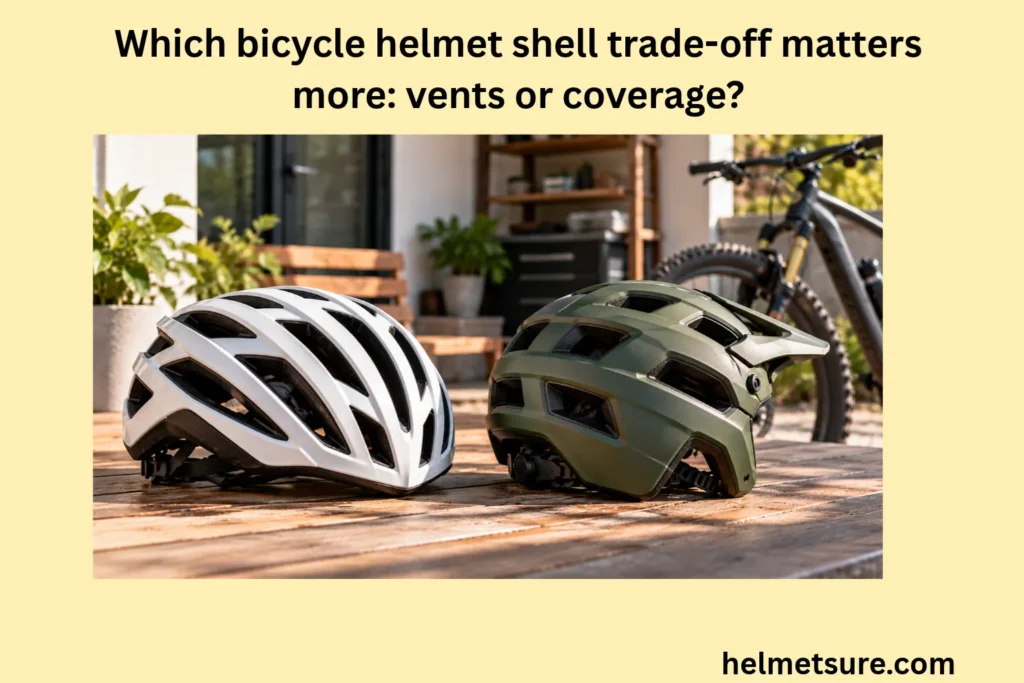
Bicycle helmet shells affect coverage and airflow, but protection depends on the complete helmet. Prioritize suitable coverage, correct fit, and applicable certification; then compare independent impact evidence and effective ventilation to choose between eligible designs.
Coverage generally deserves priority when a helmet would otherwise leave intended head regions inadequately covered. Ventilation becomes an important deciding factor once the helmets being compared meet essential safety, fit, and intended-use requirements.
Neither feature should be judged by appearance alone. A helmet with a larger external shell does not necessarily provide greater impact attenuation, and one with more visible vents does not necessarily keep the rider cooler.
The reason is that the bicycle helmet shell is only one component of a larger protective system. Its geometry and openings interact with the underlying impact-absorbing liner, retention system, and overall helmet construction. Safety testing evaluates the assembled helmet, while ventilation performance depends on airflow pathways and heat transfer rather than opening count alone.
Four Questions Before Comparing Vents and Coverage
- 01
Does the helmet meet the requirements for the intended cycling activity?
- 02
Do the shell and protective liner provide suitable physical coverage when correctly fitted?
- 03
What independent impact and ventilation evidence is available for the actual helmet?
- 04
Which remaining design characteristics best suit the rider’s environment and preferences?
These questions matter differently for hot-weather road riding, stop-start commuting, technical mountain biking, and certain legally classified electric cycles.
Why the Bicycle Helmet Outer Shell Cannot Establish Protection on Its Own
The bicycle helmet outer shell cannot establish protection on its own because the assembled helmet's impact response depends on interactions between the external structure, protective liner, and other components.
A bicycle helmet typically includes an external shell, an energy-absorbing liner, fitting components, and a retention system. Each contributes differently to the helmet's intended function.
The shell helps manage the initial contact and distribute loading. The liner deforms to manage impact energy. The assembled helmet's performance depends on how these structures interact under specific loading conditions.
How the outer shell contributes to structural integrity and impact-load distribution
The bicycle helmet outer shell contributes to structural integrity and impact-load distribution through its material properties and mechanical interaction with the underlying protective liner.
The shell provides an external contact surface and can help distribute localized impact loading across a wider portion of the supporting structure. Its effectiveness depends on material stiffness, deformation behavior, thickness, shape, and attachment to the liner.
For example, a polycarbonate shell responds differently to loading than expanded polystyrene foam. These differences are relevant because the materials perform different mechanical functions.
Bocciarelli and colleagues (2020) investigated this interaction through laboratory tensile testing of polycarbonate, compression testing of expanded polystyrene, and finite-element modeling of helmet impacts. Their approach illustrates how measured component properties can be incorporated into simulations of assembled-helmet response. It does not establish a universal ranking of commercial helmets by shell material.
To understand how incoming energy is managed, the protective liner must be considered separately.
How an EPS or comparable impact-absorbing liner manages impact energy through deformation
An EPS or comparable bicycle helmet liner manages impact energy through material deformation, contributing to the assembled helmet's attenuation of impact loading.
Expanded polystyrene, commonly called EPS, contains a cellular structure designed to compress and crush under sufficiently severe loading.
As the liner deforms, work is done on the material. This process absorbs part of the incoming impact energy and changes how loading is transmitted through the helmet.
The amount and pattern of deformation depend on several factors, including foam density, thickness, shape, loading rate, and available deformation space.
An EPS liner also has a finite energy-management capacity. Significant crushing can permanently change its structure, which is one reason a helmet that has experienced a substantial impact may require replacement even when the outer shell appears intact.
Alternative impact-management materials may deform differently. Their performance cannot be assumed to match EPS without relevant evidence.
The material testing reported by Bocciarelli and colleagues supports the importance of studying the liner's behavior separately from the shell. However, the compression response of one foam sample is not an independent safety rating for every helmet using that material.
Why assembled-helmet performance depends on interactions between structural components
Assembled bicycle helmet performance depends on interactions between structural components because the outer shell, protective liner, and associated structures respond together during impact.
An impact begins with contact between the helmet and another surface. Loading then interacts with the shell, underlying liner, component interfaces, and the geometry of the assembled helmet.
The resulting response depends on the combination of those properties and the impact conditions.
For example, changing the shell geometry might alter where loading enters the structure. Changing the liner configuration might alter deformation. The combined result cannot be established by examining either feature independently.
Engineering simulations help researchers investigate these interactions. However, a finite-element model remains dependent on its material assumptions, boundary conditions, geometry, and validation.
It should not be treated as equivalent to an independent laboratory measurement of an unidentified commercial helmet.
Component roles in bicycle helmet protection
| Component | Primary mechanical contribution | What it does not establish alone |
|---|---|---|
| Outer shell | External structural response and interaction with the liner | Complete-helmet protection |
| Protective liner | Deformation and impact-energy management | A comparative safety rating |
| Complete helmet | Combined response of the assembled structure under loading | Guaranteed protection in every crash |
The practical conclusion is that shell construction matters, but measured protection belongs to the complete helmet.
The next question is geometric rather than mechanical: where do the external shell and protective liner physically extend around the rider's head?
How Bicycle Helmet Shell and Liner Geometry Change Head Coverage
Bicycle helmet shell and liner geometry change head coverage by determining which anatomical regions lie beneath the external shell and which are also covered by impact-absorbing material.
Physical coverage describes the location and extent of helmet material relative to the head.
It does not automatically describe how effectively that material attenuates an impact.
A helmet's external shell may extend beyond the edge of its underlying liner. Similarly, decorative contours, projections, and visors can change its appearance without providing equivalent impact-absorbing material.
Coverage should therefore be examined region by region, with the helmet worn in its intended position.
How lower rear-shell and protective-liner boundaries change occipital coverage
Lower rear-shell and protective-liner boundaries change occipital coverage by determining how far each bicycle helmet component extends over the back of the head.
The occipital region is the rear portion of the head.
Some bicycle helmets have outer shells that extend relatively far downward around this region. However, the lowest visible shell edge and the lowest boundary of the impact-absorbing liner may not coincide.
For an accurate comparison, examine two separate boundaries: the external rear shell edge and the underlying protective-foam endpoint.
A helmet with a lower rear shell and correspondingly extended protective liner provides more physical material coverage over the affected region than a model whose components terminate higher, assuming both are compared in their correct fitted positions.
That geometric observation alone cannot establish stronger rear-impact attenuation.
The actual response also depends on the liner's construction, the loading direction, and the location of contact.
How lateral shell contours and liner extent determine temporal-region coverage
Bicycle helmet side coverage and liner extent determine temporal-region coverage by establishing how far the external and impact-absorbing materials extend around the sides of the head.
The temporal regions occupy the sides of the head, broadly above and around the ears.
Helmet designs vary in how far their lateral structures extend downward and around these regions.
Two helmets may appear similar from the front but have substantially different side contours. Conversely, two helmets with noticeably different exterior shapes may contain impact-absorbing liners with less obvious differences.
To assess side coverage, examine where each component terminates while the helmet is worn level and securely fitted.
The inspection should distinguish:
- The visible lateral shell edge.
- The actual protective-liner boundary.
- The anatomical region beneath each component.
Greater lateral coverage may be a useful geometric feature, particularly when evaluating helmets designed for particular riding disciplines. But it cannot be translated into a quantified side-impact advantage without relevant testing.
How front shell and liner boundaries affect forehead coverage relative to the brow line
Front bicycle helmet shell and liner boundaries affect forehead coverage by determining where external material and protective foam terminate relative to the brow line.
The brow line provides a useful anatomical reference when evaluating the helmet's position over the forehead.
A helmet worn too far backward can leave more of the forehead exposed than intended. A helmet positioned excessively low may interfere with vision or depart from the manufacturer's fitting instructions.
The correct evaluation therefore combines helmet placement with an examination of the actual protective material.
Pay particular attention to the difference between the front liner edge and any projecting visor or shell feature.
A visor may provide shade or serve another intended function without extending the impact-absorbing liner beneath it.
Do not treat the lowest visible frontal projection as the helmet's protective-foam boundary.
Anatomical coverage inspection
| Head region | External shell feature | Protective-liner feature | What to verify |
|---|---|---|---|
| Occipital / rear | Lower rear contour | Rear foam endpoint | Actual extent over the back of the head |
| Temporal / sides | Lateral shell contours | Side liner boundaries | Physical material extent around the temples |
| Frontal / forehead | Front edge relative to the brow | Frontal foam endpoint | Correct position and intended forehead coverage |
These observations establish physical geometry, not measured impact attenuation.
Once the shell and liner boundaries are understood, the other side of the trade-off becomes clearer: how shell openings and internal passages affect airflow and cooling.
How Vent Openings and Internal Air Channels Influence Bicycle Helmet Cooling
Bicycle helmet vent openings and internal air channels influence cooling by affecting effective air entry, local fresh-air distribution, and convective and evaporative heat loss.
A well-ventilated helmet does more than expose parts of the head through openings.
Its design influences how outside air enters, moves through available passages, exchanges with warmer air beneath the helmet, and leaves through rear or alternative outlets.
The relevant sequence is:
Air entry → internal distribution → air exchange → heat transfer → perceived comfort.
Each stage depends on different factors. Consequently, counting visible vents is not enough to establish cooling performance.
How front vent inlet geometry influences airflow entering the helmet
Front bicycle helmet vent inlet geometry influences airflow entry through the size, shape, projected area, and orientation of openings exposed to incoming air.
A helmet may have numerous small openings, fewer larger openings, or a combination of inlet shapes.
These configurations can behave differently because effective air entry depends on more than the total number of openings.
Projected inlet area is particularly important. It describes the apparent area of an opening relative to approaching airflow.
An opening that appears large from above may present a smaller effective area to airflow approaching from the front.
The relationship also changes with the orientation of the helmet and the surrounding flow field.
De Bruyne and colleagues (2012) investigated local ventilation beneath five bicycle helmets using tracer-gas measurements at 13 positions between a manikin head and the helmets.
Their findings showed substantial differences in local fresh-air exchange. The researchers suggested that optimizing projected inlet area could be more useful than simply increasing inlet count.
Why internal channel continuity affects fresh-air distribution toward rear outlets
Internal channel continuity affects bicycle helmet fresh-air distribution by influencing whether entering air can travel through connected passages toward rear or other available outlets.
After air enters a helmet, its movement depends on the geometry of the available space between the helmet and head.
Some helmets contain continuous channels intended to guide air from frontal inlets toward rear exhaust openings. Other constructions use shorter passages, interconnected openings, or less continuous internal spaces.
An uninterrupted passage can provide a potential airflow route, but its presence does not guarantee that fresh air reaches every location equally.
Air may escape through lateral openings or follow a route different from the intended front-to-rear path.
De Bruyne and colleagues reported substantial spatial variation in their five tested helmets. Local ventilation values ranged from zero to approximately 16–20 × 10⁻³ s⁻¹, depending on the tested configuration and measurement position.
Their results showed relatively well-ventilated frontal zones and less-ventilated rear zones within the studied designs. These were local fresh-air exchange measurements, not direct measurements of heat loss or rider comfort.
The practical lesson is to examine internal passage continuity and available exits alongside the external openings.
A helmet with connected channels may have a more credible ventilation architecture than one whose large openings lead into poorly connected spaces. Actual performance, however, still requires suitable measurements.
How riding speed and head orientation alter local ventilation effectiveness
Riding speed and head orientation alter bicycle helmet ventilation effectiveness by changing the airflow conditions around the shell's inlets and internal passages.
Airflow approaching the helmet changes with the rider's movement, environmental wind, and head position.
For example, leaning forward may change how particular openings face the approaching flow compared with riding in an upright position.
Changes in airflow can also alter the pressure differences that influence air entry and exit.
This means that a helmet may not ventilate identically during a fast road descent, a slow climb, and a stationary traffic stop.
Laboratory studies control some of these variables to produce reproducible measurements.
Mukunthan and colleagues (2019), for example, evaluated helmet thermal performance at controlled air velocities of 3 m/s and 6 m/s. These velocities represent experimental airflow conditions, not universal thresholds separating effective from ineffective ventilation.
Different helmets can respond differently to changed airflow conditions, so a cooling improvement measured for one configuration should not be applied automatically to another.
Why visible vent count alone cannot reliably predict convective and evaporative cooling performance
Visible bicycle helmet vent count alone cannot reliably predict convective and evaporative cooling because thermal outcomes depend on air distribution, heat transfer, evaporation conditions, and helmet-specific design.
Ventilation, heat loss, and comfort describe related but different outcomes.
Local ventilation concerns the exchange of fresh air in a particular region beneath the helmet.
Convective cooling concerns heat transfer between surfaces and surrounding air.
Evaporative cooling concerns heat loss associated with moisture evaporation. Experimental measurements of apparent evaporative performance depend on the method and conditions used.
Thermal comfort concerns how the rider experiences the resulting conditions, including temperature, moisture, pressure, and personal preferences.
A 2019 study by Mukunthan and colleagues compared five helmet configurations using a nine-zone thermal manikin.
The researchers tested convective and evaporative heat transfer at air velocities of 3 m/s and 6 m/s.
Their open helmet configuration A1 achieved reported convective cooling efficiencies of 100.9% and 101.6% at the respective velocities, relative to the nude-head reference used in the experiment.
These values do not mean the wearer experienced more than 100% comfort. They describe a laboratory heat-transfer ratio under specified conditions.
The study also reported different relative performances for apparent evaporative cooling. Its abstract gives A1 an apparent evaporative cooling efficiency of 97.8% at 3 m/s, whereas the tabulated value identified in the research record is 97.3%. That discrepancy requires confirmation against the original table before using the figure for a precise comparison.
At 6 m/s, the researchers reported 96.7% apparent evaporative efficiency for configuration A4.
The results demonstrate why thermal performance must be examined by test mode and operating condition rather than vent count alone.
Importantly, the study involved four commercial configurations and one experimental configuration. Its results cannot establish a universal ranking of modern helmets.
For a more focused evaluation of bicycle helmet ventilation, consider inlet geometry, channel continuity, measured airflow, heat-transfer evidence, and intended riding conditions together.
How Bicycle Helmet Ventilation Becomes Cooling
Inlet area, orientation, and approaching airflow influence how fresh air enters.
Channel shape and continuity influence the movement of incoming air.
Fresh air exchanges with existing air and escapes through available outlets.
Convective and evaporative processes determine measured heat-transfer effects.
Physiology, riding conditions, fit, and preference shape the final experience.
The central distinction remains: more openings do not necessarily produce greater local ventilation, and greater local ventilation does not automatically establish proportionally better cooling.
The next consideration is independent of thermal performance: what testing establishes about the complete helmet's protective performance.
What Safety Standards and Independent Tests Reveal About Bicycle Helmet Shell Protection
Bicycle helmet safety standards and independent tests establish different aspects of complete-helmet performance under defined conditions, but they do not establish the protective capability of the external shell alone.
Certification and comparative testing answer different questions.
Applicable certification establishes conformity with specified requirements. Independent laboratory testing may provide additional information about how particular helmets compare under a defined test methodology.
Neither category should be interpreted as a guarantee of injury prevention.
What CPSC 16 CFR Part 1203 and EN 1078:2012+A1:2012 require of complete bicycle helmets
CPSC certification under 16 CFR Part 1203 and EN 1078:2012+A1:2012 establish specified requirements and test methods for complete bicycle helmets within their respective regulatory and technical-standard contexts.
In the United States, the Consumer Product Safety Commission administers the mandatory bicycle helmet requirements in 16 CFR Part 1203.
The regulation addresses several functions, including impact attenuation, positional stability, retention-system strength, peripheral vision, and product labeling.
EN 1078:2012+A1:2012 is a European technical standard for helmets intended for pedal cyclists and users of skateboards and roller skates.
Its authorized NEN description identifies requirements covering construction, field of vision, shock absorption, retention systems, marking, and user information.
The two systems should not be treated as identical merely because both address bicycle helmets. Their procedures, specifications, and legal applicability must be evaluated in their respective contexts.
For a broader explanation of requirements and jurisdictional differences, consult HelmetSure's guide to bicycle helmet safety standards.
Compliance establishes a defined baseline. It does not independently establish that one compliant helmet performs better than another.
Why the CPSC impact test line limits conclusions about attenuation at lower helmet locations
The CPSC impact test line limits conclusions about lower bicycle helmet locations because prescribed impact tests do not establish equivalent attenuation below the required testing boundary.
The CPSC defines an impact test line on the helmet according to prescribed positioning and geometry.
In the specified impact testing, contact locations are selected on or above that line. Positions below the line are outside the required impact-test region.
This creates an important distinction between physical material coverage and demonstrated attenuation.
DeMarco and colleagues (2020) experimentally investigated this issue using 12 bicycle helmet models.
The researchers tested impacts at 6.2 m/s below, on, and above the CPSC test line.
Their abstract reports that:
- One model remained below the study's 300 g criterion at every tested location.
- Five models met the criterion on or above the test line but exceeded it below the line.
- Six models exceeded the criterion at one or more tested locations on or above the line.
These findings reveal performance differences across the particular helmets and locations studied. They do not establish the failure rate of all commercially available helmets.
The study also should not be used as evidence of the precise shell or liner geometry of an unrelated helmet.
Its main relevance is that impact location matters and compliance at specified locations does not prove equivalent attenuation everywhere else.
How Virginia Tech STAR ratings use peak linear acceleration and rotational velocity to compare tested helmets
Virginia Tech Bicycle Helmet STAR ratings use measured peak linear acceleration and rotational velocity within a defined risk model to compare helmets tested under the laboratory's bicycle impact methodology.
Virginia Tech Helmet Lab evaluates helmets using a standardized set of impact scenarios intended to represent relevant bicycle crash loading conditions.
Its published bicycle methodology uses 24 impact tests across six locations at medium and high impact energies.
The laboratory measures peak linear acceleration and peak rotational velocity. These results contribute to modeled concussion-risk estimates, which are weighted according to the test scenarios.
The resulting numerical STAR score supports comparisons among helmets evaluated using the compatible bicycle methodology.
A lower numerical STAR score indicates better modeled performance within that testing system.
The numerical score is distinct from the displayed star category. A helmet receiving five stars belongs to the laboratory's higher-performing rating category, but that designation is not a guarantee of protection in an individual crash.
Rotational velocity also should not be confused with rotational acceleration. They are different physical measurements.
Virginia Tech explicitly warns that numerical scores from its different sports-rating systems are not directly comparable because the impact methods and risk calculations differ.
When comparing bicycle helmets, the exact model and applicable rating methodology therefore matter more than a generic claim that a product is independently tested.
Why certification compliance and independent laboratory ratings cannot guarantee individual crash outcomes
Bicycle helmet certification and independent laboratory ratings cannot guarantee individual crash outcomes because actual collisions involve impact conditions and wearer-specific factors that differ from standardized tests.
Laboratory methods control variables such as impact location, direction, speed, test surface, and headform configuration.
Real crashes introduce additional uncertainty.
The rider may experience a different contact location, multiple impacts, an unusual collision angle, or a loading condition outside the tested scenarios.
Helmet fit, retention, and the interaction between the wearer and helmet can also influence the circumstances of an impact.
That uncertainty does not make certification or independent testing meaningless.
It means the evidence must be interpreted according to the conditions under which it was obtained.
A compliant helmet has met its applicable requirements. A favorable compatible independent rating provides additional comparative evidence.
What different forms of bicycle helmet evidence establish
| Evidence | What it establishes | What it cannot establish alone |
|---|---|---|
| CPSC 16 CFR Part 1203 | Defined U.S. compliance requirements | Superior performance over every other helmet |
| EN 1078:2012+A1:2012 | European technical requirements within its scope | Identical performance to CPSC-tested helmets |
| Manufacturer conformity information | The documented or declared conformity status of a product | Independent cross-model ranking |
| CPSC impact test line | Boundary relevant to prescribed impact locations | Attenuation at every lower region |
| Virginia Tech Bicycle STAR | Comparative modeled performance under its methodology | Guaranteed individual crash outcome |
| Actual crash outcome | Result of one particular incident | Universal performance across other incidents |
These evidence categories should guide helmet comparisons rather than be compressed into a single unsupported safety label.
How Ventilation-Focused and Extended-Coverage Bicycle Helmet Shells Compare
Ventilation-focused and extended-coverage bicycle helmet shells differ in design emphasis, but meaningful comparisons require model-specific evidence about geometry, liner extent, cooling, mass, fit, and complete-helmet impact performance.
A ventilation-focused helmet may use prominent inlets and continuous internal passages.
An extended-coverage design may emphasize lower rear or lateral contours.
However, these categories are not mutually exclusive. A single helmet can incorporate substantial physical coverage and a developed ventilation system.
How ventilation-focused and extended-coverage designs differ in observable shell and liner characteristics
Ventilation-focused and extended-coverage bicycle helmet designs differ in vent arrangement and external contours, while the actual protective-liner extent must be established independently for each model.
A practical comparison begins by identifying the exact product and documenting observable features rather than assuming how a design category must perform.
Two manufacturer-described examples illustrate different emphases.
Specialized S-Works Prevail 3
Specialized emphasizes ventilation and describes an AirCage construction with large through-air channels. Its published comparison reports greater ventilation surface area than the earlier Prevail II Vent. This is a manufacturer design comparison, not an independent thermal ranking.
Smith Forefront 3 Mips
Smith describes extended rear coverage, complete Koroyd construction, an internal roll cage, and 20 fixed vents. This provides an example of a design intended to combine extended coverage with airflow features. Its actual cooling and impact performance require separate evidence.
For either helmet, a complete comparison would require the relevant model variant, size, external shell boundary, actual liner extent, and compatible performance results.
Manufacturer descriptions can establish intended design features. They do not automatically establish comparative laboratory superiority.
How comparable performance measurements reveal meaningful differences between shell designs
Comparable performance measurements reveal meaningful differences between bicycle helmet shell designs when product identity, test methods, configurations, and operating conditions are sufficiently consistent.
Before interpreting a number, determine exactly what was measured.
A helmet's mass, impact response, ventilation rate, and thermal efficiency describe different physical quantities.
Even measurements of the same quantity can be misleading when their methods differ.
For example, a manufacturer-reported mass for a small helmet cannot be compared directly with a medium-size product and presented as a controlled design comparison.
Similarly, heat-transfer values from tests conducted at different airflow velocities, temperatures, or reference baselines may not establish a valid cooling ranking.
For impact performance, measurements must be interpreted using comparable test methods, headforms, impact locations, and loading conditions.
A reliable comparison should record:
- Exact manufacturer, model, variant, and relevant size.
- Measured property and unit.
- Test method and configuration.
- Operating conditions.
- Source of the measurement.
- Important limitations or missing information.
If compatible measurements are unavailable, the correct conclusion is that relative performance remains uncertain.
Missing evidence should not be converted into an assumed disadvantage.
How integrated shell designs can combine extended anatomical coverage with effective ventilation
Integrated bicycle helmet shell designs can combine extended anatomical coverage with effective ventilation when verified construction and airflow performance support both attributes.
There is no engineering requirement that a helmet offering additional rear coverage must eliminate its ventilation pathways.
Designers can incorporate openings, supporting structures, internal channels, and protective material within a larger helmet geometry.
The resulting arrangement may be intended to satisfy multiple objectives simultaneously.
However, successful integration must be evaluated rather than assumed.
A helmet that combines a visibly extended shell with numerous air passages has demonstrated two observable design features. It has not automatically demonstrated superior impact attenuation or cooling.
The distinction is particularly important when manufacturers describe innovative structural materials or airflow systems.
Those systems may provide credible design mechanisms, but comparative performance claims still require suitable measurements.
Nine-dimension bicycle helmet shell comparison
| Dimension | Ventilation-focused design | Extended-coverage design |
|---|---|---|
| Vent geometry | Often emphasizes larger openings or developed airflow pathways | Varies with model |
| Anatomical coverage | Rear, side, and frontal boundaries vary | May emphasize lower rear or lateral contours |
| Protective-liner extent | Must be verified independently | Must be verified independently |
| Measured ventilation | Requires suitable airflow or thermal testing | Requires suitable airflow or thermal testing |
| Helmet mass | Depends on exact model and size | Depends on exact model and size |
| Fit and comfort | Individual suitability varies | Individual suitability varies |
| Impact evidence | Requires complete-helmet testing | Requires complete-helmet testing |
| Potential compromises | Openings interact with structural and liner design | Additional coverage may interact with mass, fit, and airflow |
| Integrated capability | Can also provide substantial coverage | Can also provide effective ventilation |
No broad design category wins every dimension.
The next question is therefore not which category is universally better, but which verified attributes matter most in a particular riding environment.
Which Riding Conditions Make Ventilation or Extended Coverage More Relevant?
Riding conditions change the relative importance of bicycle helmet ventilation and extended coverage because thermal demands, intended activities, and sometimes legal approval requirements differ.
A rider climbing a long road in warm weather may reasonably place significant weight on cooling performance.
A mountain biker may prefer a model with verified extended rear and lateral coverage for the intended discipline.
A commuter may want a balanced helmet that remains suitable across variable speeds and weather.
All of these preferences remain secondary to applicable certification, correct fit, suitable coverage, and serviceable condition.
Why prolonged hot-weather road cycling increases the importance of effective helmet ventilation
Prolonged hot-weather road cycling increases the importance of effective bicycle helmet ventilation because sustained riding in warm conditions makes thermal comfort a significant selection factor.
Road cycling can involve extended periods of physical exertion, particularly during climbing or long-distance riding.
Under warm conditions, riders may place greater value on helmets that provide acceptable ventilation without requiring changes to correct wearing position.
Laboratory studies such as Mukunthan and colleagues' work support evaluating heat-transfer performance rather than relying solely on external vent appearance.
However, those experimental findings do not provide a universal rule for the best helmet at every outdoor temperature or riding duration.
For prolonged hot-weather road riding, compare helmets that already meet essential requirements, then use credible thermal evidence and personal fit comfort to distinguish among them.
A well-ventilated helmet that fits poorly should not be preferred over a correctly fitted alternative simply because it appears cooler.
How stop-start urban commuting changes the balance between cooling comfort and coverage preferences
Stop-start urban commuting changes the balance between bicycle helmet cooling comfort and coverage preferences because travel speed and airflow conditions vary throughout the ride.
Urban cyclists may alternate between moving traffic, intersections, slow sections, and stationary periods.
These changes affect the airflow available around the helmet.
A ventilation arrangement that performs well during sustained movement may feel different when the rider stops.
At the same time, commuters may reasonably prefer certain shell contours, comfort characteristics, and coverage arrangements.
Neither preference supplies an independent protection ranking.
The appropriate choice is a helmet that meets the applicable requirements, fits securely, offers suitable physical coverage, and remains comfortable through the rider's actual commuting conditions.
If the rider regularly encounters warm weather and frequent stops, practical comfort testing can help identify a suitable option.
If the route involves different riding environments, the helmet's intended use and relevant certification should also be confirmed.
When technical mountain biking makes extended rear and lateral coverage a relevant selection criterion
Technical mountain biking makes extended rear and lateral bicycle helmet coverage a relevant selection criterion when the rider's intended discipline favors designs with additional physical coverage.
Some mountain bike helmets are designed with lower rear contours or broader lateral structures than particular road-oriented models.
These features may be relevant when selecting equipment for trail riding, technical descents, or other mountain biking disciplines.
However, the relevant construction must be verified on the exact helmet.
An extended shell without a correspondingly documented protective liner does not necessarily provide equivalent extended impact-absorbing coverage.
A rider should therefore examine actual rear and side liner boundaries, intended-use documentation, fit, and available independent impact evidence.
Effective ventilation remains relevant, particularly during sustained climbs or riding in warm environments.
For disciplines involving more specialized protective requirements, verify whether the activity calls for a different helmet category or additional applicable performance requirements.
Extended visible coverage alone cannot establish a quantified reduction in injury risk.
When speed-pedelec classification changes the applicable helmet approval requirements
Speed-pedelec classification changes applicable bicycle helmet approval requirements when the governing jurisdiction requires head protection approved for that vehicle category.
The Netherlands provides a useful example.
According to the Government of the Netherlands, relevant speed-pedelec operation requires an approved helmet.
Accepted categories include qualifying speed-pedelec helmets marked NTA 8776:2016 and approved moped helmets meeting the applicable ECE 22.05 or ECE 22.06 requirements.
This is an eligibility requirement, not simply a preference for more shell coverage.
An ordinary bicycle helmet cannot be assumed suitable for a Dutch speed-pedelec merely because it looks substantial or carries a general bicycle standard.
The correct approval must be established before comparing ventilation, mass, comfort, or external shell features.
Riding-condition decision matrix
| Riding condition | Attribute deserving attention | Selection principle |
|---|---|---|
| Prolonged hot-weather road cycling | Effective cooling | Favor credible cooling evidence among otherwise suitable helmets |
| Stop-start urban commuting | Comfort and coverage balance | Select a suitable helmet that remains secure and comfortable |
| Technical mountain biking | Rear and lateral physical coverage | Verify liner extent and consider available impact evidence |
| Speed-pedelec operation | Applicable legal approval | Establish eligible helmet category before comparing preferences |
These are conditional priorities, not universal safety rankings.
How to Assess Bicycle Helmet Shell Coverage and Ventilation Before Purchase
Bicycle helmet shell coverage and ventilation should be assessed before purchase through verification of the complete helmet's approval, fit, physical coverage, impact evidence, condition, and cooling suitability.
The evaluation should proceed in a deliberate order.
First establish whether a candidate is eligible for the intended activity. Then examine the evidence for its measured performance, fit, physical coverage, and practical comfort.
Optional features should not override essential suitability.
Verify that the helmet's certification applies to the intended cycling activity
Bicycle helmet certification must be verified against the intended cycling activity because approval for one category does not necessarily establish suitability for another.
Begin by identifying the type of riding and the jurisdiction in which the helmet will be used.
Then examine the exact manufacturer's product information and conformity documentation.
Where applicable, verify the required certification marking, relevant standard, product identity, and intended-use instructions.
For example, a bicycle helmet offered in the United States should have the conformity evidence required for its regulated bicycle-helmet use.
A helmet marketed for a different activity should not automatically be accepted as equivalent.
Be cautious about general advertising statements such as "safety tested" or "professional protection."
Such descriptions do not establish compliance with a particular applicable standard.
If required conformity cannot be verified, defer the purchase or exclude the candidate until the issue is resolved.
Compare independent impact results for exact helmet models when compatible ratings are available
Independent bicycle helmet impact results should be compared for exact models when the available ratings follow sufficiently compatible laboratory methods.
After confirming essential eligibility, determine whether a recognized independent laboratory has evaluated the helmet.
For Virginia Tech STAR results, identify the exact model and ensure the rating belongs to the bicycle methodology.
Check whether the product name, generation, and configuration match the helmet under consideration.
When compatible results exist for multiple eligible helmets, they provide a useful additional basis for comparison.
However, a laboratory rating should not override individual fit or intended-use suitability.
Also distinguish between an unavailable rating and an unfavorable result.
A helmet that does not appear in a particular independent database has not necessarily failed a test.
Its comparative performance is simply not established by that source.
Record the missing information honestly rather than assigning an assumed score.
Check whether fitted shell and liner boundaries provide suitable anatomical coverage
Fitted bicycle helmet shell and liner boundaries provide suitable anatomical coverage when the helmet remains correctly positioned and its external and impact-absorbing structures cover the intended head regions.
Begin with the manufacturer's size chart and fitting instructions.
Select a size appropriate to the rider's measured head dimensions, then verify that the helmet's interior shape is compatible with the actual head.
A suitable initial size does not guarantee secure fit.
The helmet should remain properly positioned without obvious sliding, unstable movement, or persistent painful pressure.
Once correctly fitted, examine three physical coverage regions.
At the rear, identify the lower shell boundary and the actual protective-liner endpoint.
At the sides, inspect how far the shell and liner extend around the temporal regions.
At the front, examine the shell and liner boundaries relative to the brow line while preserving the intended wearing position.
Do not mistake visors, decorative edges, or exposed trim for additional impact-absorbing material.
When foam boundaries are hidden, consult documented construction information rather than removing structural components or making assumptions.
For additional guidance on bicycle helmet fit and sizing, review HelmetSure's explanation of head-size compatibility, correct positioning, retention, and fit stability.
A coverage comparison is meaningful only when both helmets remain in their correct fitted positions.
Evaluate ventilation comfort without loosening or incorrectly repositioning the helmet
Bicycle helmet ventilation comfort must be evaluated while the helmet remains securely fitted and correctly positioned, because cooling preferences must not compromise intended helmet use.
Once size, fit, and coverage are acceptable, inspect the airflow features.
Look at the arrangement of front inlets, available internal passages, and rear or alternative outlets.
Manufacturer descriptions may help identify intended airflow routes.
Compatible independent thermal measurements offer stronger evidence when available.
However, laboratory cooling data cannot determine exactly how comfortable every rider will feel.
When practical, evaluate the helmet's comfort while wearing it correctly and with the retention system properly secured.
Pay attention to whether warmth, pressure, moisture, or discomfort makes the helmet difficult to wear consistently.
Do not loosen the chin strap, tilt the shell backward, or otherwise alter the intended position to obtain more airflow.
If comfortable use requires improper positioning, reconsider the size, shape, adjustment, or model.
Bicycle Helmet Pre-Purchase Checklist
0 of 18 checked
Completion records your review of each step; it does not certify the helmet or guarantee safety.
After these checks, each candidate should fall into one of four categories.
| Evaluation result | Meaning | Next action |
|---|---|---|
| Suitable for comparison | Essential approval, fit, condition, and use requirements are established | Compare optional attributes |
| Requires verification | Essential suitability information remains unresolved | Defer selection |
| Comparative evidence unavailable | Optional ratings or thermal data are missing | Record uncertainty |
| Unsuitable | A required condition cannot be satisfied | Reject or replace |
The checklist establishes which candidates deserve further consideration. The next section identifies the conditions that should override desirable shell characteristics.
When Poor Fit, Damage, or Unsuitable Shell Design Should Disqualify a Helmet
Poor fit, damage, missing applicable compliance, or shell-related discomfort that prevents correct use can make a bicycle helmet unsuitable regardless of its visible coverage or ventilation.
A helmet should not remain under consideration merely because one attractive feature performs well.
Problems affecting essential suitability must be corrected, verified, or treated as reasons to choose another model.
When unstable helmet positioning prevents intended coverage from remaining correctly aligned
Unstable bicycle helmet positioning makes a helmet unsuitable when it cannot maintain its intended protective alignment during normal use.
A helmet that slides excessively, tilts unintentionally, or repeatedly changes position may leave intended head regions improperly covered.
This problem should first be evaluated as a potential adjustment, size, or head-shape issue.
If proper adjustment restores stable positioning without excessive pressure, the helmet may remain a suitable candidate.
If instability persists despite correct fitting, a different size or model may be necessary.
Additional external shell coverage does not compensate for a helmet that cannot maintain its intended position.
The correct decision is to resolve the fit problem rather than relying on the amount of visible material.
When impact damage or suspected structural compromise requires replacement
Bicycle helmet impact damage or suspected structural compromise requires replacement when the helmet has sustained a potentially damaging impact or meets the manufacturer's replacement criteria.
A bicycle helmet can experience structural damage that is not immediately visible from the outside.
An apparently intact outer shell does not establish that the protective liner remains capable of performing as originally intended.
Significant impact can produce permanent liner deformation, hidden cracking, or other changes in the assembled structure.
Follow the helmet manufacturer's instructions after an impact.
Do not continue using a helmet solely because its exterior appears undamaged.
Similarly, do not assume that replacing removable comfort pads restores structural integrity after a damaging event.
When missing or inapplicable safety compliance makes the helmet unsuitable for its intended use
Missing or inapplicable bicycle helmet safety compliance makes a candidate unsuitable when the approval required for its intended activity cannot be established.
A helmet may look well constructed yet lack verified conformity with the requirements applicable to its market and intended use.
Another helmet may be approved for a different activity without satisfying the requirements of the rider's actual cycling category.
In these situations, appearance is not an adequate substitute for documentation.
Confirm the relevant marking and conformity evidence using authoritative information.
Where required approval is absent, reject the candidate.
Where essential documentation is unresolved, defer the decision until the manufacturer or another appropriate authority can establish its status.
This requirement should not be confused with optional independent ratings.
A correctly certified helmet without a Virginia Tech STAR result may still be eligible for consideration.
The absence of an optional score is not evidence of failed certification.
When ventilation discomfort causes unsafe adjustment or inconsistent helmet use
Bicycle helmet ventilation discomfort warrants reconsideration when it causes the rider to loosen, tilt, remove, or inconsistently wear the helmet.
Thermal comfort matters partly because a helmet must be practical to wear correctly.
A design that becomes intolerably uncomfortable during intended riding conditions may encourage improper adjustment or inconsistent use.
For example, shifting a helmet backward to expose more of the forehead changes its intended coverage.
Loosening the retention system to feel less constrained can also compromise secure positioning.
These are not acceptable solutions to poor ventilation.
First check whether the discomfort results from an incorrect size, poor head-shape compatibility, or improper adjustment.
If correct fitting does not resolve the problem, consider another appropriately certified helmet with more suitable comfort characteristics.
Helmet rejection and replacement thresholds
| Condition | Appropriate action | Reason |
|---|---|---|
| Persistent unstable positioning | Adjust correctly or reject the model | Intended alignment cannot be maintained |
| Potentially damaging impact | Follow manufacturer replacement guidance | Hidden structural damage may exist |
| Required approval absent or unverifiable | Reject or defer | Essential eligibility is unresolved |
| Necessary peripheral vision obstructed | Correct positioning or reject | Vision must remain appropriate |
| Cooling discomfort encourages improper wearing | Reassess fit or change model | Comfort cannot depend on unsafe adjustment |
These are practical decision criteria, not a universal numerical fit or cooling standard.
No arbitrary movement distance, temperature threshold, liner-extension measurement, or replacement age should be applied to every bicycle helmet.
Which Bicycle Helmet Shell Design Should You Ultimately Choose?
The preferred bicycle helmet shell design is determined by its coverage and ventilation within a complete helmet that meets applicable approval, fit, condition, and intended-use requirements.
Neither maximum shell coverage nor maximum vent count should be the universal buying objective.
Instead, establish essential suitability, use valid independent evidence where available, and then choose the coverage-and-ventilation balance that best meets the intended riding conditions.
The decision falls into three cases.
When comparable independent ratings exist, use tested performance before selecting the preferred coverage-and-ventilation balance
Comparable independent bicycle helmet impact ratings provide a tested-performance basis for choosing between suitable complete helmets before selecting the preferred shell coverage-and-ventilation balance.
When two or more helmets meet the required approval, fit, condition, and intended-use criteria, relevant independent impact results can help distinguish them.
For example, exact-model ratings from Virginia Tech may identify meaningful differences in modeled impact performance under its bicycle testing methodology.
Such results deserve consideration because they measure complete-helmet responses rather than inferring protection from external appearance.
However, a favorable score does not correct an unsuitable fit, establish every untested impact location, or guarantee an individual crash outcome.
After considering compatible impact evidence, examine the physical coverage and credible ventilation information.
If the remaining suitable helmets have comparable relevant impact evidence and appropriate coverage, effective ventilation may reasonably determine the preferred model, especially for warm-weather riding.
When only applicable certification is available, choose by suitable coverage, fit, and cooling while acknowledging comparative uncertainty
When only applicable bicycle helmet certification is available, riders should choose through verified coverage, secure fit, acceptable cooling, and manufacturer documentation while acknowledging comparative impact uncertainty.
Not every compliant bicycle helmet has an independently published comparative impact rating.
This does not automatically make an unrated model unsafe.
Applicable certification remains meaningful evidence that the product has satisfied defined requirements.
For such candidates, assess the factors that can be verified:
- Correct intended-use approval.
- Compatible size and stable fit.
- Suitable rear, lateral, and frontal coverage.
- Documented construction characteristics.
- Serviceable condition.
- Acceptable ventilation and comfort.
Choose a helmet that satisfies these requirements and suits the riding environment.
However, do not claim that two certified helmets offer identical impact attenuation merely because neither has an independent score.
Their relative protective performance remains uncertain without suitable comparative evidence.
When essential compliance or suitability cannot be established, exclude the candidate regardless of visible shell features
A bicycle helmet candidate should be excluded or deferred when essential compliance, condition, fit, or intended-use suitability cannot be established, regardless of its visible shell coverage or ventilation.
This final case overrides the other comparisons.
A helmet lacking required approval cannot be made eligible by having more protective-looking material.
An unstable helmet cannot become suitable simply because it has fewer vents.
A potentially damaged helmet cannot be approved for continued use because it previously received a favorable laboratory rating.
Where essential information is missing, seek verification before selecting the candidate.
Where a requirement cannot be satisfied, choose another appropriate helmet.
Final three-case selection framework
| Evidence case | Condition | Decision |
|---|---|---|
| A — Comparable independent ratings | Eligible helmets have compatible exact-model impact results | Consider tested performance, then coverage and cooling |
| B — Applicable certification only | Essential suitability is established but compatible independent ratings are unavailable | Compare fit, physical coverage, manufacturer documentation, and comfort while acknowledging uncertainty |
| C — Essential suitability failure | Required approval, fit, condition, or intended-use suitability fails or remains unresolved | Reject or defer regardless of shell features |
The final recommendation is to choose a properly fitting, appropriately certified bicycle helmet with suitable anatomical coverage. Use compatible independent impact evidence where available, then select the shell coverage-and-ventilation balance appropriate to the intended ride.
Greater visible shell coverage does not automatically establish superior protection, and more vents do not automatically provide better cooling.
The most defensible choice is the complete helmet that satisfies essential requirements and offers the best-supported combination of measured performance, suitable coverage, and practical comfort for the individual rider.
Quick Knowledge Check
Check the article’s central decision rule before choosing between coverage and ventilation.
Which choice is best supported?
Frequently Asked Questions
Concise answers to common questions about bicycle helmet vents, coverage, and evidence.
Is a bicycle helmet with more vents automatically cooler?
No. Cooling depends on inlet geometry, internal channel continuity, outlets, airflow conditions, and heat transfer—not opening count alone.
Does greater shell coverage automatically mean better protection?
No. Physical coverage and measured impact attenuation are different. The underlying liner, complete construction, test location, and fit also matter.
Should coverage or ventilation come first?
Suitable coverage is an essential requirement. Ventilation becomes a deciding factor among helmets that already meet approval, fit, condition, and intended-use needs.
Can certification identify the best-performing helmet?
Certification establishes compliance with defined requirements. Compatible independent ratings can add comparative information, but neither guarantees an individual outcome.
Can I loosen or tilt a helmet to improve airflow?
No. If acceptable comfort requires improper adjustment or positioning, reconsider the size, head-shape compatibility, or model.