
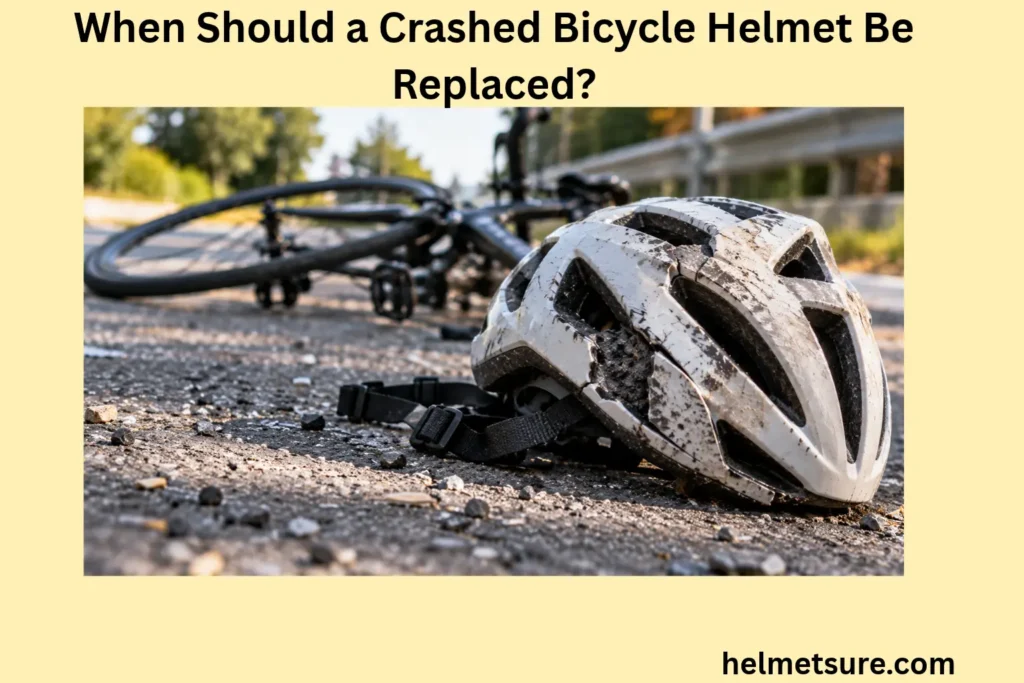
When Should a Crashed Bicycle Helmet Be Replaced?
Replace the helmet after a known significant helmet impact, even if it looks undamaged. When helmet contact is uncertain, resolve that uncertainty conservatively. When contact is confidently ruled out, assess condition, retention, fit, and manufacturer instructions before reuse.
A crash and a helmet impact are different facts. The replacement decision starts with what happened to the helmet, then considers its condition and the instructions for that product.
Here, significant impact means a crash-related blow involving the helmet’s protective function, such as striking pavement while worn. It does not mean that the rider must measure impact force or find visible damage. Manufacturer instructions may require replacement after impact without using that qualifier.
This guide addresses equipment replacement. Seek appropriate medical assessment for possible injury after a crash, regardless of the helmet’s appearance. Helmet damage cannot diagnose an injury, and replacing equipment does not establish readiness to ride again.
Helmet Impact—Not an Intact-Looking Shell—Is the Primary Replacement Trigger
A known significant bicycle-helmet impact creates the primary post-crash replacement trigger even when the exterior appears intact. CPSC’s current consumer guidance treats bicycle helmets as single-impact equipment and requires replacement after the relevant impact event.
Why a known significant helmet impact creates a replacement trigger even when the exterior still looks normal
A known significant helmet impact creates a replacement trigger because impact-managing structures can change without obvious exterior damage. The decisive fact is the established impact, rather than the presence of a crack.
A helmet that struck the road while protecting the rider belongs in this replacement path. A crash in which helmet contact is confidently ruled out belongs in a separate assessment path. Uncertain contact belongs in neither category until it is addressed.
Why normal appearance after a known impact does not prove that protective capability is unchanged
Normal exterior appearance after a known helmet impact does not prove that protective capability is unchanged. The shell can conceal liner damage. BHSI warns that the foam may have been altered even when the helmet still appears intact.
Visible damage adds replacement evidence. Its absence does not cancel the established impact. This does not mean that every impacted helmet has an identifiable hidden crack; it means appearance cannot provide the required reassurance.
What the rider should do once significant helmet impact is established
Remove the helmet from use once significant impact is established, and follow the applicable replacement or manufacturer-return instructions. CPSC’s required warning directs users toward manufacturer return or destruction and replacement after such an impact.
Contact the manufacturer before disposing of the helmet if you need its return instructions. An intact-looking shell does not justify wearing it while arranging replacement.
Known significant impact → replacement
- Remove the helmet from use.
- Apply the impact replacement rule even when damage is invisible.
- Follow official instructions for replacement or return.
- Reject appearance as clearance for another ride.
How a Crash Can Damage the Helmet Beneath the Outer Shell
A crash can damage the structure beneath a bicycle helmet’s outer shell when its impact liner deforms while absorbing energy. The shell and liner therefore need separate consideration.
Visual inspection can identify some damage, but it cannot prove that a known significant impact left the liner unchanged.
How the impact-absorbing liner deforms while managing crash energy
The impact-absorbing liner manages energy by deforming as the helmet slows the rider’s head. Expanded polystyrene, or EPS, is a common crushable liner material. Its compression helps make the stop less abrupt.
EPS is a common example, rather than the only bicycle-helmet construction. Soft comfort pads serve a different purpose from the main impact structure. For more detail on that material, see EPS liner.
Why bicycle helmets are generally designed around energy absorption that may permanently alter the liner during a significant impact
Bicycle helmets generally absorb significant impact energy through structures that may undergo permanent change. CPSC describes bicycle helmets as single-impact helmets, distinguishing them from equipment designed for repeated impacts in other sports.
That distinction concerns the protective event. It does not establish that every ordinary handling bump produces the same damage, or that every helmet material behaves identically.
Why liner crushing or deformation can reduce remaining impact-management capability
Liner crushing can reduce the structure available to manage a later impact. Once crushable material has been compressed, its original capacity cannot be assumed to remain available.
Material recovery varies. A liner recovering some thickness does not establish restored performance or override replacement instructions. No universal percentage of protection loss can be assigned from a consumer inspection.
How an intact outer shell can conceal damage to the energy-absorbing structure underneath
An intact outer shell can conceal impact-related changes in the underlying liner. BHSI explains that thin shells may hide dents in the foam.
Look only at accessible components using the manufacturer’s inspection instructions. Do not peel away the shell or cut the liner to seek clearance: destructive examination would change the assembly being assessed.
Hidden impact-damage sequence
| Stage | What it means for the decision |
|---|---|
| Helmet strikes a surface | Impact load enters the helmet |
| Liner manages energy | Impact material deforms |
| Deformation remains | Original structural condition may have changed |
| Shell looks normal | Exterior appearance may conceal that change |
| Significant impact is known | Replacement remains the appropriate path |
Which Visible Signs Mean a Crashed Bicycle Helmet Should Be Replaced?
Visible structural damage supports replacement independently of the crash account. Retention damage also prevents continued use until appropriately resolved. These findings are useful, but they are not prerequisites for replacing a helmet after known significant impact.
Why cracks, dents, or permanent shell deformation support replacement
Cracks, significant dents, and permanent shell deformation support replacement because they indicate damage or alteration. CPSC identifies shell cracking among helmet replacement indicators.
A superficial cosmetic mark is not automatically a structural crack. However, a new mark can help establish crash contact. Distinguish what the mark shows from what it cannot establish about internal condition. See shell cracks for the related damage question.
How crushed, cracked, or permanently compressed liner foam indicates structural impact damage
Crushed, cracked, or permanently compressed impact foam indicates damage to the energy-management structure. BHSI directs replacement when cracked or crushed liner foam is found.
Distinguish damage from the liner’s original molded shape. A designed channel or recess is not automatically evidence of impact. If the difference remains unresolved, ask the manufacturer before further use.
Why shell-to-liner separation or displaced structural components matter after a crash
New shell-to-liner separation or displaced structural components matter because the assembly has changed. CPSC includes a loose shell among replacement indicators.
A deliberately removable comfort pad is a different component category. Do not interpret an unexpectedly detached structural layer as routine pad removal, or improvise a regluing procedure to return it to service.
When damaged straps, buckles, retention systems, or missing parts make continued use unsuitable
Damaged straps, failed buckles, or missing required parts make continued use unsuitable when the helmet cannot remain secured as designed. BHSI identifies strap wear, failing stitching, and broken buckle parts as inspection concerns.
An undamaged shell does not compensate for failed retention. A replacement part is an option only when official instructions authorize it for that helmet. For the adjacent inspection task, see strap safety.
Post-crash visible-damage check
What If You Cannot Tell Whether the Helmet Hit Anything During the Crash?
Helmet-impact status remains unresolved when available evidence cannot establish whether the helmet struck a surface. Keep that uncertainty explicit. A normal exterior cannot settle it, given the documented limits of visual inspection.
Why incomplete or disorienting crash memory can leave helmet contact genuinely uncertain
Incomplete crash memory can leave helmet contact uncertain because part of the event cannot be reconstructed. Remembering the start and end of a fall does not necessarily account for what happened between them.
Record what you actually know. “I cannot remember helmet contact” differs from “I can reliably account for the helmet remaining clear of the ground.” BHSI cautions that riders may fail to recognize a helmet impact.
This equipment distinction does not diagnose the reason for incomplete memory.
Why no visible damage does not prove that helmet impact never occurred
No visible damage does not prove that helmet impact never occurred. CPSC warns about invisible impact damage, and BHSI explains why inspection may miss liner changes.
The practical inference is limited: appearance alone cannot reconstruct contact history. A fresh impact mark may support contact, but a clean-looking shell cannot establish its absence.
What crash evidence can help narrow an uncertain helmet impact history without making appearance the deciding test
Crash evidence can narrow uncertainty when it helps reconstruct the helmet’s path and contact. Relevant information might include a witness account, clear footage, new helmet marks, or a reliable account of the rider’s position.
For example, footage showing the helmet strike pavement establishes contact. Footage that loses sight of the rider at the decisive moment leaves a gap. These are examples of evidence assessment, rather than a validated scoring method.
Consider the evidence together. Do not require an arbitrary number of clues or convert an incomplete account into a numerical confidence score. BHSI’s replacement guidance emphasizes impact history and manufacturer consultation when doubt remains.
When unresolved uncertainty supports conservative replacement rather than continued use
Unresolved uncertainty supports conservative replacement when potentially damaging helmet contact cannot be confidently ruled out. This is a precautionary decision based on the limits of the available evidence, rather than proof that damage occurred.
Snell recommends replacement when compromise is suspected. Applied here, that advice supports keeping the helmet out of use while significant possible contact remains unresolved. Choosing replacement does not change the recorded impact status from uncertain to confirmed.
When model-specific manufacturer guidance can help resolve a genuinely uncertain case
Manufacturer guidance can help when uncertainty involves the model’s construction, permitted service, or official replacement process. Identify the exact helmet and explain both what happened and what remains unknown.
As an OEM example, Trek’s published safety guidance directs replacement of impacted helmets even when they appear undamaged. That instruction illustrates an official manufacturer position; it does not establish another brand’s inspection service or replacement policy.
Ask whether the manufacturer offers an applicable assessment or return process. Do not assume that a photograph or generic retailer reassurance provides structural clearance.
Uncertain-impact decision sequence
- Identify the missing contact-history information.
- Review available accounts, footage, and new marks.
- Classify contact as established, confidently ruled out, or unresolved.
- Reject normal appearance as proof of absent contact.
- Keep the helmet out of use while potentially damaging contact remains unresolved.
- Choose conservative replacement when that uncertainty cannot be adequately resolved.
Does Every Bicycle Crash Automatically Mean the Helmet Must Be Replaced?
A bicycle crash does not automatically activate the helmet-impact replacement rule when helmet contact is confidently ruled out. This is a narrow inference from the impact-based rule, not a CPSC procedure for certifying a particular helmet fit for reuse.
Use this pathway only when helmet contact has been reasonably and confidently ruled out—not merely forgotten or unseen.
Why crash involvement alone is different from confirmed helmet impact when helmet contact can reasonably be ruled out
Crash involvement differs from confirmed helmet impact when reliable evidence rules out helmet contact. A rider falling onto a knee while the helmet remains clear of surrounding surfaces illustrates that distinction.
The example applies only when the helmet’s lack of contact can be reasonably established. If the rider cannot account for it, use the uncertainty pathway.
What structural components should still be checked after a clearly non-helmet-impact crash
Check the shell, liner, attachments, and required hardware even after helmet contact has been ruled out. The absence of this crash trigger does not establish acceptable overall condition.
Use the damage categories already described. This check assesses present condition; it does not clear an unresolved impact history.
Why the retention system and fit should still remain sound before continued use
Retention and fit must remain sound because the helmet must stay secured and correctly positioned. CPSC’s required warnings separately address correct fit, wearing position, and fastening according to manufacturer instructions.
Good fit cannot compensate for structural damage. Likewise, acceptable structure cannot compensate for a buckle that fails to secure the helmet.
When continued use may remain possible after helmet impact has been confidently ruled out
Continued use may remain possible when helmet contact is confidently ruled out and condition, retention, fit, and manufacturer requirements remain satisfactory. This is a conditional equipment decision, not a guarantee against injury.
Any newly discovered damage or gap in the contact account ends that pathway. Address the failed condition or return to the uncertainty assessment.
When unusual model-specific manufacturer instructions can override the general no-impact boundary
Model-specific instructions govern additional replacement or service requirements for the product they cover. Follow a stated requirement rather than treating absent crash contact as exemption from all replacement guidance.
For example, Trek publishes non-impact replacement guidance alongside its impact instructions. Those are separate requirements within that manufacturer’s guidance. Do not apply an unrelated brand’s policy to your helmet or invent an exception that its manual does not provide.
Conditions for the no-impact pathway
| Decision factor | Required finding |
|---|---|
| Helmet contact during the crash | Reasonably and confidently ruled out |
| Structural condition | No identified structural damage or unresolved concern |
| Retention | Functional and correctly secured |
| Fit | Appropriate for the rider |
| Manufacturer requirements | Followed, with no unresolved conflict |
| Possible outcome | Continued use may remain possible |
Can a Crashed Bicycle Helmet Be Repaired Instead of Replaced?
Structural impact damage belongs in the helmet replacement category. Manufacturer-approved serviceable components belong in a separate maintenance category. Replacing one serviceable part does not reverse a known-impact replacement decision.
Approved serviceable parts and structural impact damage are different categories. Replacing a pad or buckle cannot reverse a crash-replacement trigger.
Why cracked or crushed impact-absorbing foam should not be treated as a repairable protection system
Cracked or crushed impact foam requires helmet replacement, rather than a home repair intended to restore protection. BHSI’s inspection guidance directs replacement for those liner conditions.
Gluing a crack or filling a depression does not provide verification of restored impact performance. Removable comfort padding is a different service question.
Why structural shell damage belongs in the replacement category rather than the maintenance category
Structural shell damage belongs in the replacement category because the shell forms part of the helmet assembly. Trek describes its shell as helping hold the foam together during impact.
A cosmetic blemish and a structural crack have different meanings. Patching a crack or securing a detached shell does not cancel either structural damage or the established impact history.
How replaceable comfort pads differ from impact-managing helmet components
Comfort pads mainly support fit and comfort; the impact liner performs the principal crushable energy-management role. A replaceable comfort pad therefore does not make damaged structural foam serviceable.
Trek’s buying guide describes removable and replacement pads, while advising readers to consult manufacturer instructions. Verify the correct pad set for your helmet. For the related maintenance task, see replacement pads.
Why replacement straps or other serviceable parts should follow the helmet manufacturer’s instructions
Replacement straps and other serviceable parts should follow manufacturer instructions because compatibility and attachment depend on the helmet. CPSC advises against adding parts or making adjustments outside those instructions.
Do not assume that your strap assembly is replaceable. Obtain authorization for the exact part and procedure. Even an approved replacement buckle cannot resolve crash damage elsewhere in the helmet.
Serviceable parts and structural damage
| Finding | Appropriate response |
|---|---|
| Cracked or crushed impact liner | Replace the helmet |
| Structural shell cracking or deformation | Replace the helmet |
| Worn, officially replaceable comfort pads | Follow the approved pad instructions |
| Damaged, officially serviceable retention component | Follow the exact approved procedure before use |
| Unknown part compatibility | Resolve with the manufacturer before use |
| Known significant helmet impact | Keep the helmet replacement decision regardless of serviceable parts |
How Is Crash Replacement Different From Replacing a Helmet Because of Age?
Crash replacement is triggered by impact history. Non-crash replacement considers service time, condition, care, and manufacturer guidance. Keep those decisions separate.
Why a significant impact can create an immediate replacement trigger regardless of helmet age
A significant impact can require immediate replacement regardless of whether the helmet is new or old. Being recently purchased does not cancel the impact finding.
Age becomes a separate question only after the crash-related replacement issue has been resolved.
Why an uncrashed helmet’s replacement timing depends on different factors
An uncrashed helmet’s replacement timing depends on condition, use, care, storage, fit, and applicable manufacturer guidance. Those considerations address a different history from an impact event.
No universal lifespan is needed to decide this crash question. For the separate non-crash question, see helmet age.
Why manufacturer lifespan guidance does not negate a replacement trigger created by crash damage
Manufacturer lifespan guidance does not negate an earlier replacement trigger from impact or structural damage. Trek’s guidance addresses both impact replacement and non-impact service life separately.
A future replacement date is not permission to use a helmet that has already met its impact replacement condition. Apply whichever relevant replacement trigger has occurred.
Remove the helmet from use and replace it.
Keep it out of use while resolving the uncertainty; replace conservatively if it remains unresolved.
Check condition, retention, fit, and manufacturer requirements before reuse.
How to Decide Whether Your Bicycle Helmet Should Be Used Again After a Crash
The use-or-replace decision starts with helmet-impact status. Apply condition, retention, fit, and manufacturer instructions afterward, without using one successful check to cancel a failed requirement.
Apply the known-impact finding first when significant helmet impact has already been established
Apply the known-impact finding first: significant helmet impact directs the helmet into the replacement path. Normal appearance and recent purchase do not reverse that finding.
There is no need to reopen uncertainty analysis after the relevant contact has already been established.
Apply the uncertainty finding when helmet contact cannot be confidently reconstructed
Apply the uncertainty pathway when contact cannot be confidently reconstructed. Review the available evidence and seek applicable manufacturer guidance. Keep the helmet out of use while potentially damaging contact remains unresolved.
Conservative replacement remains a precautionary decision. It does not require pretending that the unknown impact is confirmed.
Use the no-impact boundary only when helmet contact has been reasonably ruled out
Use the no-impact boundary only when available evidence reasonably and confidently rules out helmet contact. Then assess the remaining condition and use requirements.
“I do not remember hitting my head” does not establish that finding. A gap in recollection remains a gap, rather than affirmative evidence of absent contact.
Check structural condition, retention system, and fit before any continued-use decision
Structural condition, functioning retention, and appropriate fit must all support use before a no-impact helmet returns to service. CPSC treats proper fit and fastening as independent requirements.
After impact status, structure, and retention are resolved, check helmet position. Apply that positioning step to a replacement helmet too. Correct fit does not establish unchanged post-impact structure.
Follow model-specific manufacturer guidance whenever the helmet’s design or impact history leaves the final decision unresolved
Follow official manufacturer guidance when construction, serviceability, or impact history leaves the final decision unresolved. Provide the model details, crash account, and relevant photographs if requested.
Use an inspection or return process only when the manufacturer actually offers it. An unrelated brand’s policy cannot supply that process. Trek’s published impact instructions illustrate why consulting the applicable official guidance matters.
Do not invent clearance when adequate guidance is unavailable. Keep the unresolved helmet out of use, and choose replacement when potentially damaging contact cannot be ruled out.
Use again or replace?
Replace a bicycle helmet after a known significant helmet impact even when it looks normal. If helmet contact remains uncertain, keep it out of use and choose conservative replacement when the uncertainty cannot be resolved.
Frequently Asked Questions
Should a bicycle helmet be replaced after a crash if it looks undamaged?
Yes, when a significant helmet impact is known. An intact-looking shell cannot establish that the impact liner remains unchanged.
Does every bicycle crash require helmet replacement?
Not automatically. The impact-replacement rule applies when helmet contact occurred. If contact is confidently ruled out, assess condition, retention, fit, and manufacturer instructions before reuse.
What if I cannot remember whether the helmet hit the ground?
Treat helmet contact as unresolved. Review reliable evidence and applicable manufacturer guidance, keep the helmet out of use, and replace it conservatively if potentially damaging contact cannot be ruled out.
Can a crashed bicycle helmet be repaired?
Structural shell or impact-liner damage belongs in the replacement category. Only manufacturer-approved serviceable parts should be replaced, and they do not cancel a known-impact replacement decision.
Can correct fit make an impacted helmet safe to reuse?
No. Correct fit is necessary, but it cannot prove unchanged post-impact structure or override a replacement instruction.
Sources
Primary and established helmet-safety guidance used for this decision framework.
- CPSC: Which Helmet for Which Activity? and Bicycle helmet labeling
- Bicycle Helmet Safety Institute: When to replace and Inspection guidance
- Snell Foundation: Impact-liner guidance
- Trek: Bike helmet safety