
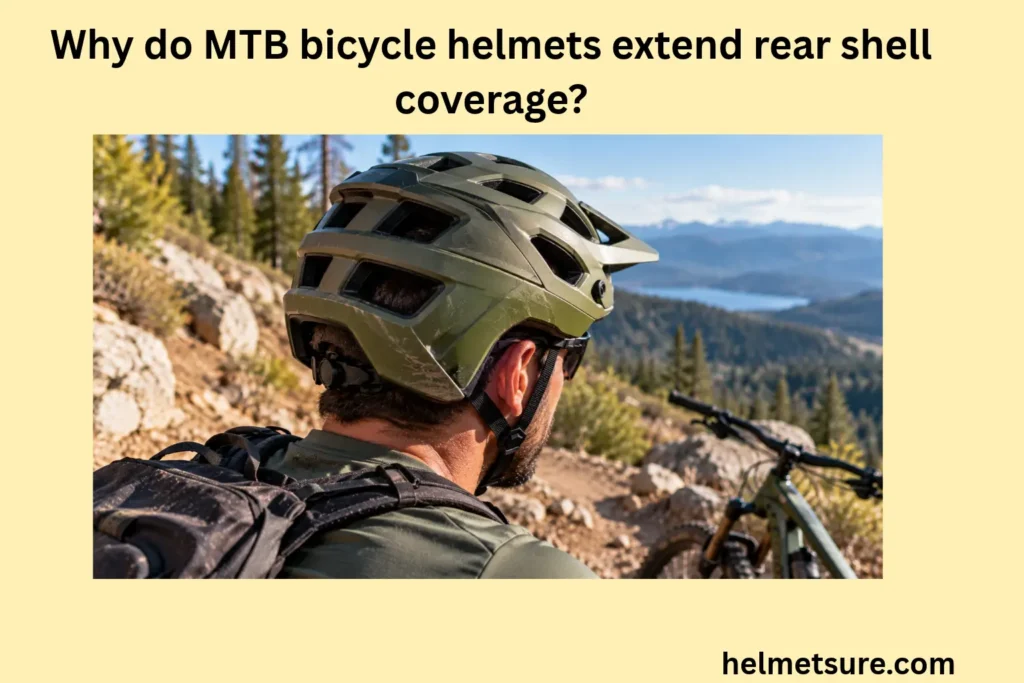
MTB helmets extend rear shell coverage to place additional protective construction over the lower rear skull, which may contact the ground during off-road falls. This design intention does not independently establish superior measured protection or guaranteed injury prevention.
Extended rear coverage is a construction feature: additional helmet material occupies a lower portion of the posterior skull. Its protective intention must be distinguished from measured impact attenuation and demonstrated injury prevention. Understanding that distinction helps explain both why the extension exists and how much weight to give it when choosing a helmet.
Where Extended MTB Helmet Coverage Sits Relative to the Occipital Region and Neck
Extended MTB helmet coverage occupies the lower posterior helmet region, where the outer shell and underlying materials are positioned relative to the occipital portion of the skull.
The relevant boundaries are the skull beneath the helmet, the visible exterior edge, and the impact-absorbing construction inside it. These boundaries describe different things and need separate inspection.
How the Lower Rear Shell Edge Extends Over the Occipital Region
The lower rear edge of an MTB helmet extends over part of the posterior skull near the occipital region, with its exact position determined by the helmet's construction and intended wearing angle.
The occipital bone forms the back and part of the base of the skull. In helmet discussions, the occipital region identifies this posterior anatomical area; it is not a performance rating or a fixed helmet measurement. [ANATOMY]
The lower rear shell edge is the physical boundary of the helmet exterior above this area. A lower-reaching edge can place helmet construction over a portion of the skull that a higher-cut profile leaves uncovered. How much additional area a particular helmet covers requires a defined position and model-specific evidence. The edge alone does not reveal what lies beneath it.
How Outer Shell Coverage Differs From Underlying Impact-Absorbing Liner Coverage
Outer shell coverage describes the visible exterior extent of an MTB helmet, while impact-absorbing liner coverage describes the energy-absorbing structure beneath or within that exterior.
For example, Fox documents in-molded expanded polystyrene, or EPS, in the Mainframe Mips. Smith identifies KOROYD impact-absorbing construction and an internal roll cage in the Forefront 3 Mips. These descriptions establish declared construction features, but they do not provide a sectional map of every lower-rear surface. [OEM-TRAIL-A; OEM-TRAIL-B]
Why Extended Rear Helmet Coverage Does Not Constitute Neck Protection
Extended rear MTB helmet coverage is intended to cover part of the lower posterior skull, not to function as dedicated cervical-spine protection.
The occipital skull region sits next to the upper cervical region, but the skull and cervical spine are distinct anatomical structures. A helmet edge reaching closer to the neck does not, by that proximity, demonstrate a cervical protective function. [ANATOMY]
Rear Coverage Anatomy and Construction Checklist
Which Off-Road Fall Conditions Make Extended Rear-Head Coverage Relevant?
Extended rear-head coverage is relevant during off-road riding because backward and oblique falls can create potential contact involving posterior or rear-side head regions.
These are conditional contact pathways. The rider's movement, the surface encountered, and the orientation at contact determine which helmet region is involved.
How Backward Falls on Off-Road Terrain Can Expose the Lower Rear Skull to Ground Contact
A backward fall on off-road terrain can expose the lower rear skull to ground contact when the rider's posterior head region moves toward the surface behind them.
Backward falls appear among the orientations reported in Bonte and colleagues' analysis of selected mountain-biking crash videos. That establishes their presence in the analyzed sample; it does not establish how frequently they occur across all MTB riding. [FALL-RESEARCH-B]
Mechanically, backward movement provides a possible route toward posterior contact. However, the head can change orientation before reaching the ground. The surface may also be encountered by another helmet region or another part of the body first. Backward fall orientation therefore cannot identify the eventual anatomical contact location by itself.
The specific relevance of lower-rear coverage arises when the actual contact involves that covered region. This remains a conditional explanation rather than a claim that backward falls necessarily strike the lower occipital skull.
How Uneven Terrain and Trail Obstacles Can Affect Rear-Side Contact During Oblique Falls
Uneven terrain and protruding obstacles can influence rear-side contact during an oblique fall by changing the shape or orientation of the surface encountered.
Consider a rider already moving sideways and backward during a fall. A sloping patch of ground or a protruding obstacle may present a different contact surface from flat ground. If encountered, that geometry can change where and how the helmet contacts the environment. This example illustrates a possible mechanism, not an observed frequency.
Three terms need separation. Trajectory describes motion before contact. Surface contact describes the interaction between the helmet and the encountered surface. Impact loading describes the resulting mechanical loading, which can include normal and tangential components. Laboratory bicycle-impact reconstructions inform this distinction. [IMPACT-RECONSTRUCTION]
Off-Road Rear-Head Contact Pathways
| Off-road condition | Fall orientation | Environmental contact geometry | Potential anatomical contact | Evidence boundary |
|---|---|---|---|---|
| Backward loss of balance | Backward fall | Ground behind the rider | Lower posterior skull | Contact location remains conditional |
| Oblique fall on uneven ground | Oblique trajectory | Irregular surface orientation | Rear-side head region | Trajectory alone does not establish loading direction |
| Oblique fall involving an obstacle | Oblique trajectory | Protruding contact surface | Posterior or rear-side helmet region | Encountering an obstacle need not be the cause of the fall |
Once contact occurs, the relevant question changes from exposure to the response of the helmet construction at that location.
How the Extended Rear Shell and Impact Liner Respond to Contact Forces
The extended rear shell and impact liner respond to contact forces through localized loading and deformation of the relevant helmet materials.
The mechanical sequence begins at the contacted structure and continues through the materials supporting it. Its details depend on which components are actually present.
How Localized Rear Contact Loads the Outer Shell and Underlying Liner
Localized rear contact loads the outer shell and underlying liner where those components are present at the helmet's point of contact.
An external surface applies force to the contacted helmet region. The exterior and its supporting structure participate in transmitting and resisting that load. Where impact-absorbing material supports the shell, it can become loaded as part of this interaction. Oblique contact can introduce tangential as well as normal loading. [IMPACT-RECONSTRUCTION]
This describes how an impact initiates a structural response. It does not establish identical load distribution in different helmets. Shell construction, support, and liner arrangement influence the response, while material deformation determines how the loaded liner contributes to energy management.
How Impact-Absorbing Foam Deforms During Applicable Rear-Head Impacts
Impact-absorbing foam, including EPS where used, deforms under suitable loading and contributes to the helmet's management of impact energy.
Controlled compression tests of bicycle-helmet EPS characterize its deformation and energy-absorption behavior. During compression, work is done deforming the foam structure. That material response is part of the mechanism through which an EPS liner manages impact energy. [LINER-RESEARCH-A]
The response depends on the material and loading conditions. Research on selected traditional and BMX helmets found EPS density variation within and between samples and examined its influence on impact performance. Those findings do not establish a single density rule for every MTB design. [LINER-RESEARCH-B]
EPS presence alone cannot establish attenuation at every rear location. Local construction and the applied impact matter, and EPS findings should not automatically be transferred to alternative materials such as KOROYD. Material behavior also does not independently demonstrate injury prevention.
Shell-and-Liner Impact-Response Sequence
These component distinctions provide a basis for comparing actual road and MTB products.
How Rear Shell Coverage Differs Across Road, Trail, and Downhill Helmet Designs
Road, trail, enduro, and downhill helmets can differ in rear-shell profile and liner construction, but exact coverage requires individual model documentation.
The following examples illustrate declared construction. They are not a dimensional ranking or a comparison of measured rear-impact protection.
How Road and Trail Helmet Designs Typically Differ in Lower-Rear Coverage
Representative trail helmets often feature lower-reaching rear-shell profiles than higher-cut road designs, although exact differences must be established from comparable model evidence.
Giro's Aries Spherical provides a road example with dual-density EPS Progressive Layering and Spherical Technology. Smith's Forefront 3 Mips provides a trail example whose documentation expressly identifies extended back coverage, KOROYD construction, and an internal roll cage. [OEM-ROAD; OEM-TRAIL-A]
This establishes a declared rear-coverage feature for the Smith model and documented construction for both products. It does not establish how many millimeters lower one rear edge sits than the other, or which helmet performs better in a matched rear-impact test.
Broader comparison of road vs mountain bike helmets should likewise distinguish intended use, construction, and measured performance rather than treating category names as safety rankings.
How Trail/Enduro and Downhill Helmets Differ in Rear-Coverage Construction
Trail/enduro and downhill helmets can differ in rear-shell construction and liner materials because their product configurations and intended riding applications are not identical.
The open-face Fox Mainframe Mips has manufacturer-declared extended side and rear coverage with in-molded EPS. Troy Lee Designs describes the Stage as a full-face enduro helmet using EPS and EPP, with a fiber-reinforced Polylite shell. Its D4 Composite supplies a downhill full-face example; the D4 documentation identifies an EPS head structure and an EPP collarbone-related component. [OEM-TRAIL-B; OEM-ENDURO; OEM-DOWNHILL]
Those are distinct material and configuration descriptions. The D4's collarbone-related component must not be relabeled as evidence of continuous lower-rear EPP head coverage. Likewise, a chin bar establishes a full-face configuration, not a measured rear-depth advantage.
The examples do not establish that every downhill helmet extends farther down the rear skull than every enduro helmet.
Why Rear-Coverage Dimensions Must Be Checked at the Individual Model Level
Rear-coverage dimensions must be checked for individual helmet models because category names do not define a universal rear-edge position or impact-liner boundary.
A defensible comparison needs identified product revisions, comparable helmet sizes, consistent positioning, and a common anatomical or headform reference. Exterior measurements and internal liner boundaries must also be recorded separately.
The manufacturer sources used here do not establish comparable rear-edge measurements for all five models. These dimensions therefore remain unverified. Photographs cannot reliably fill the gap: perspective, helmet tilt, and reference-head size can alter apparent depth. [OEM-ROAD; OEM-TRAIL-A; OEM-TRAIL-B; OEM-ENDURO; OEM-DOWNHILL]
Road, Trail, Enduro, and Downhill Rear-Coverage Comparison
| Category | Representative model | Manufacturer-declared coverage | Documented construction | Measured rear geometry | Evidence boundary |
|---|---|---|---|---|---|
| Road | Giro Aries Spherical | No quantified rear extension established for this comparison | Dual-density EPS; Spherical Technology | Not verified | Appearance supplies no local impact rating |
| Trail | Smith Forefront 3 Mips | Extended back coverage declared | KOROYD; internal roll cage | Not verified | Declared coverage is not comparative attenuation evidence |
| Trail | Fox Mainframe Mips | Extended rear and side coverage declared | In-molded EPS | Not verified | Local liner continuity requires further documentation |
| Enduro | Troy Lee Designs Stage | Comparative rear depth unresolved | Full-face; EPS and EPP; reinforced Polylite shell | Not verified | Full-face configuration does not quantify rear depth |
| Downhill | Troy Lee Designs D4 Composite | Comparative rear depth unresolved | Composite full-face construction; EPS head structure; EPP collarbone-related component | Not verified | Model and standard edition require separate verification |
Construction documentation answers what a helmet contains. Standards documentation answers a different question: which requirements govern its evaluation.
How Helmet Standards and Certification Requirements Relate to Extended Rear Coverage
Helmet standards relate to extended rear coverage by defining applicable test regions, testing procedures, and compliance requirements rather than evaluating helmets solely by visible rear-shell depth.
CPSC requirements, ASTM specifications, and product conformity evidence each contribute different information.
How the CPSC Bicycle Helmet Standard Defines Impact-Test Locations Relative to the Test Line
The CPSC bicycle helmet standard establishes an impact-test line through prescribed helmet and headform positioning, with eligible impact-site centers selected on or above that line.
Under §1203.11, the helmet is positioned on the appropriate headform using the manufacturer's helmet positioning index. The line is marked using the prescribed headform reference planes. Figure 4 applies to helmets intended only for persons five and older; Figure 5 applies to helmets intended for persons one and older. [CPSC-LINE]
Virginia Tech's July 2025 memorandum changed star-rating thresholds. A resulting category change does not, by itself, mean the helmet changed physically or underwent new testing. The memorandum concerns classification thresholds rather than a replacement bicycle impact protocol. [VT-THRESHOLDS-2025]
No current model score or star category is assigned to the five examples in this article.
Why Helmet Certification Cannot Guarantee Protection in Every Real-World Crash
Helmet certification cannot guarantee protection in every real-world crash because compliance demonstrates performance against specified requirements rather than every possible collision condition.
A crash can differ from prescribed testing in contact location, direction, severity, surface geometry, and the sequence of contacts. Compliance remains important evidence, but its meaning is bounded by the requirements and procedures it addresses. [CPSC-IMPACT; ASTM-DOWNHILL]
Independent risk-based ratings add information from defined laboratory conditions; they cannot determine an individual rider's outcome in an unobserved crash. Neither certification nor a strong aggregate rating guarantees prevention of concussion, skull fracture, neck injury, or other harm. [VT-RESEARCH-2020; VT-RATINGS-CURRENT]
Rear-Coverage Protective-Performance Limitation Matrix
| Feature or evidence | Supported interpretation | Unsupported inference |
|---|---|---|
| Extended rear shell | Additional documented physical coverage | Greater depth always means better attenuation |
| Impact-absorbing liner | Material contributes to energy management | Material presence guarantees injury prevention |
| Location-specific test | Response under identified conditions | Identical response at every other location |
| Aggregate STAR score | Combined result across defined impacts | Isolated effectiveness of rear-shell extension |
| Star category | Classification under applicable thresholds | A changed category proves physical modification |
| Standards conformity | Compliance with applicable requirements | Guaranteed protection in every crash |
Evidence has limits, but riders can directly assess whether the helmet occupies and maintains its intended position.
How Riders Can Evaluate Extended Rear Coverage When an MTB Helmet Is Worn
Riders can evaluate extended MTB rear coverage by checking the intended wearing position, retention stability, and clearance during ordinary head and neck movement.
Use general fitting guidance together with the instructions for the actual helmet. These checks assess practical suitability rather than laboratory impact performance.
How to Check Rear Shell Position at the Helmet's Intended Wearing Angle
Rear shell position should be checked with the MTB helmet worn at its intended angle so the lower rear edge occupies the manufacturer's intended position relative to the skull.
Begin with the manufacturer's sizing and positioning instructions. NHTSA's general bicycle-helmet guidance calls for a level helmet positioned low on the forehead. Check the rear extension only after establishing the intended overall position. [FIT-NHTSA]
Rotating the helmet changes both front and rear coverage. Do not tilt it backward merely to make the rear edge appear lower: that can move it away from its intended forehead position. There is no universal rear-edge distance or angle established for all five models.
How to Check Whether the Retention System Maintains Stable Rear Coverage
A properly adjusted MTB helmet retention system helps maintain stable rear coverage by limiting unwanted helmet movement during ordinary use.
Adjust the chin strap and applicable fit components according to the manual, then perform the recommended position and stability checks. The helmet should remain appropriately seated rather than readily shifting out of position. [FIT-NHTSA]
Mechanisms differ. Smith identifies a BOA 360 system on the Forefront 3. Fox documents a dial and an adjustable rear cradle on the Mainframe. Giro lists Roc Loc 5+ Air on the Aries. Use the actual mechanism's instructions instead of transferring adjustment steps between models. [OEM-TRAIL-A; OEM-TRAIL-B; OEM-ROAD]
Seek secure fit without excessive pressure. Maximum dial tension is not a substitute for a suitable helmet size and shape.
How to Identify Rear-Edge Interference During Normal Head and Neck Movement
Rear-edge interference occurs when an MTB helmet's lower rear edge obstructs or uncomfortably contacts adjacent areas during normal head movement or riding posture.
With the helmet correctly positioned and secured, move your head through ordinary comfortable movements and adopt your usual riding posture. Notice whether the rear edge presses uncomfortably, restricts movement, or pushes the helmet out of position.
This is a practical editorial fit check. NHTSA supports general positioning and stability assessment, but its guidance does not establish a universal rear-edge movement test or clearance measurement. Any specific manufacturer instruction takes precedence for that model. [FIT-NHTSA]
If correct position, stable retention, and comfortable clearance cannot be achieved together, consider another appropriate size or design. Passing this check does not establish certified impact performance.
Three-Criterion Rear-Coverage Fit Checklist
These three checks complete the practical part of the selection decision.
How Should Mountain Bikers Prioritize Extended Rear Coverage When Choosing a Helmet?
Mountain bikers should evaluate extended rear coverage by prioritizing intended riding use, applicable standards, protective construction, available testing evidence, and secure fit.
Use exactly three priorities to combine these considerations:
- Intended Riding Use and Applicable Standards. Choose a helmet suited to the intended MTB discipline. Verify relevant certification or conformity documentation for the actual product and claimed standard edition.
- Protective Construction and Available Testing Evidence. Evaluate the complete shell-and-liner system. Consider relevant independent results within their documented test conditions, distinguishing local measurements from aggregate ratings.
- Rear Coverage and Secure Fit. Confirm that the extension occupies the intended posterior skull region while maintaining correct wearing position, stable retention, and comfortable movement clearance.
A mountain bike helmet buying guide can help organize these same criteria when comparing suitable models.
MTB helmets often extend rear shell coverage to place additional protective construction over the lower rear skull, which may experience contact during off-road falls. The value of that extension depends on the complete helmet system, appropriate evidence, and correct fit—not visible shell depth alone.
Quick Knowledge Check
Test the key distinction between visible rear coverage and verified helmet performance.
Which statement is best supported?
Frequently Asked Questions
Short answers to the most common questions about extended MTB helmet rear coverage.
Does more rear coverage always mean a safer MTB helmet?
No. It establishes additional physical coverage, not automatically better attenuation or injury prevention. Construction, testing, fit, and the applicable crash conditions still matter.
Does an extended rear shell protect the neck?
No. It covers part of the posterior skull; ordinary helmet extension is not dedicated cervical-spine protection.
Is every visible part of the rear shell impact tested?
Not necessarily. Test locations are governed by the applicable standard and its test line. Visible material below a line does not prove that every point received a separate impact.
Can a star rating prove the benefit of rear coverage?
An aggregate rating summarizes defined tests. It does not isolate the effect of the rear extension at every possible location.
How should a rider check extended rear coverage?
Set the intended wearing angle, secure the retention system, and check ordinary head and neck movement for uncomfortable interference.