
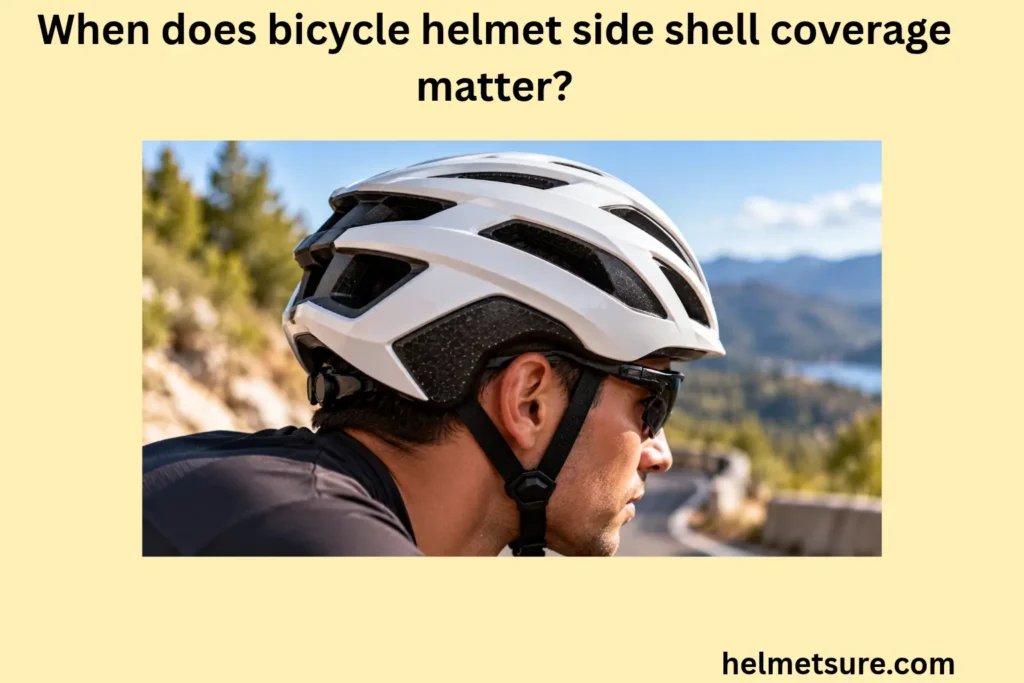
When Does Bicycle Helmet Side Shell Coverage Matter?
A helmet that reaches farther down the side of the head presents an observable structural difference. Understanding that difference requires three separate questions: where does the external shell end, where does the impact-absorbing liner extend, and what has testing demonstrated at the relevant location?
This distinction matters around the temples, above the ears, and near the lower lateral edge. Those regions may encounter a surface during a fall or collision, but appearance cannot tell you how a particular helmet will respond. The sections below explain the mechanics, testing boundaries, design differences, and practical checks that help make side coverage a useful selection consideration.
Bicycle Helmet Side Shell Coverage as a Structural Feature Rather Than a Complete Protection Measure
Bicycle helmet side shell coverage describes the external shell’s lateral extent, but this structural feature is separate from the underlying impact-absorbing liner and the helmet’s measured protective performance.
How the outer shell and EPS foam liner serve different functions within a bicycle helmet
The outer shell and EPS foam liner serve different functions in a bicycle helmet: the shell forms the external covering, while the EPS liner manages impact energy through controlled deformation.
EPS means expanded polystyrene. In a conventional EPS-based helmet, this relatively firm foam is part of the protective structure. It differs from the soft, often removable comfort pads that contact your head. Squeezing a comfort pad does not assess the impact-absorbing liner.
Giro’s Syntax Mips documentation, for example, identifies a polycarbonate exterior bonded to an EPS liner. That establishes the documented construction of the model; it does not provide a lower-side attenuation result. Understanding bicycle helmet construction and safety features begins with identifying these components separately. [BH1/BH8]
Where side shell and liner coverage extend around the temple and above-ear regions
Bicycle helmet side shell and liner coverage extend across model-dependent portions of the temple and above-ear regions, and their physical boundaries do not necessarily coincide.
The temple lies toward the front side of the head, while the above-ear region sits higher than the ear itself. The lower lateral helmet edge is a construction boundary, not an anatomical landmark shared by every wearer.
Size, head shape, shell geometry, liner geometry, and worn position all affect the relationship. A visible shell wrap may conceal the foam boundary. Where the underlying structure is hidden, an exterior photograph cannot establish its extent; consult the manufacturer’s documentation rather than assuming it is present or absent.
Why visible helmet coverage and demonstrated protective performance are separate attributes
Visible bicycle helmet coverage and demonstrated protective performance are separate attributes because physical shell extension does not establish measured impact attenuation at the covered location.
A construction description answers where material exists. An impact report answers how an identified helmet responded at an identified site under defined loading. Neither automatically establishes the outcome of an individual crash.
The U.S. CPSC procedure also limits permissible certification impact-test centers, so visible material and the prescribed testing region are different things. [BH3] When comparable lower-side results are unavailable, the additional shell coverage is observable, but stronger measured lower-side impact attenuation remains unverified.
| Attribute | What it establishes | What it cannot establish independently |
|---|---|---|
| Visible outer-shell coverage | The external shell’s physical extent | How much impact energy the helmet manages there |
| Impact-absorbing liner coverage | Where identifiable protective material exists | Its measured response under a particular impact |
| Demonstrated impact performance | Results from documented testing | Equivalent results at untested sites or a precise personal injury-risk reduction |
How Bicycle Helmet Side Coverage Interacts With Lateral and Oblique Impacts
Bicycle helmet side coverage interacts with lateral and oblique impacts through the location of contact, the liner’s response to loading, tangential forces, and the helmet’s position relative to the head.
How lateral head contact determines which region of the bicycle helmet receives an impact
Lateral head contact determines which bicycle helmet region receives an impact through the position and orientation of the head relative to the contacted surface.
A broad surface and a projecting edge can encounter different parts of the same helmet. Contact may involve the lateral structure, its lower boundary, or an area beyond that boundary. A sideways fall therefore does not identify one inevitable temple-impact site.
How impact-absorbing liner material manages energy at the helmet’s contact location
Impact-absorbing liner material manages energy at a bicycle helmet’s contact location through deformation that influences the loading transmitted to the head.
In EPS construction, compression and crushing of the foam contribute to energy management as the head decelerates. Energy absorption describes the material response; peak headform acceleration is a measured consequence recorded during a test.
Density, geometry, available deformation, and loading conditions affect the response. Simply seeing more foam, or a deeper foam edge, does not establish a better result. Quantifying attenuation requires testing the actual construction under a defined protocol. [BH1]
How oblique impacts introduce tangential forces and rotational head motion alongside direct loading
Oblique impacts introduce tangential forces alongside direct loading, creating conditions in which the head can experience rotational motion as well as linear acceleration.
The normal loading component acts perpendicular to the contacted surface; the tangential component acts along it. Tangential forces can generate moments that influence head rotation. Mills and Gilchrist’s oblique-impact research measured both linear and rotational headform acceleration. [BH2]
These quantities must stay distinct. Linear acceleration describes changes in translational velocity. Rotational velocity describes angular speed, while rotational acceleration describes how quickly that angular velocity changes. Greater side-shell depth alone cannot establish improvement in any of these measurements.
How helmet displacement during impact can change the alignment between side coverage and the head
Helmet displacement during impact can change the alignment between the helmet’s side coverage and the head by moving protective material away from its intended position.
Initial positioning and retention therefore matter to coverage alignment. The CPSC standard includes a positional-stability requirement under which the helmet must remain on the test headform. That requirement does not demonstrate zero movement in every real collision. [BH4]
A normal-wear fit check can reveal rocking or slipping before riding. It cannot measure crash-time displacement, and no specific displacement amount is assumed here.
The mechanical sequence is to identify the contact site, distinguish direct and tangential loading, consider the liner response, measure the relevant head motion, and account for possible changes in alignment. A performance conclusion must remain tied to the conditions actually tested.
Which Bicycle Crash Scenarios Make Side Shell Coverage More Relevant?
Bicycle crash scenarios make side shell coverage more relevant when sideways falls, roadside obstacles, irregular terrain, or collisions create plausible contact near the temple, above-ear region, or lower helmet edge.
The following situations illustrate possible contact configurations. They are not a statistical ranking of cycling crashes.
Sideways falls onto pavement that expose the temple or above-ear regions
Sideways falls onto pavement can expose the temple and above-ear regions to ground contact, making the position of bicycle helmet side coverage relevant.
If the head approaches pavement with its side facing the surface, lateral helmet material may be contacted. A different head orientation can shift contact toward the front, rear, or upper helmet.
The practical question is which shell and liner material would occupy the relevant region when the helmet is correctly worn. The scenario itself supplies no measured attenuation advantage for a deeper design.
Falls near curbs or roadside objects that create localized lower-side contact
Falls near curbs or roadside objects can create localized lower-side contact when an exposed edge or projecting surface encounters the helmet or head.
Unlike a broad flat surface, an edge may contact a small region near the helmet’s lower boundary. Its position and shape influence where contact occurs.
This makes lower-side construction worth examining, but it does not establish a numerical severity or guarantee that extended material will manage the impact adequately. The relevant performance depends on the actual helmet and loading configuration.
Mountain biking falls where rocks, roots, or uneven terrain may contact the helmet’s lateral edge
Mountain biking falls on rocky or uneven terrain can expose the helmet’s lateral edge to irregular contact surfaces, making lower-side coverage relevant to the equipment evaluation.
A protruding rock or root offers a different potential contact geometry from level pavement. This is a reason to inspect the shell and liner boundaries of a candidate helmet carefully.
It is not evidence that every mountain bike helmet outperforms every road helmet. Both riding environments can involve lateral contact, and category labels do not substitute for model-specific results.
Collisions involving side-of-head contact with another object or surface
Collisions involving side-of-head contact make bicycle helmet lateral coverage relevant when another object or surface contacts the temple, above-ear area, or lower helmet edge.
The direction of the overall collision does not necessarily identify the direction of loading at the head. Head orientation and the contacted surface still determine the actual site.
| Crash scenario | Potential contact region | Why examine side-shell coverage? | Limitation |
|---|---|---|---|
| Sideways pavement fall | Temple or above-ear region | A lateral helmet surface may meet the ground | Head orientation changes the site |
| Curb or roadside-object contact | Lower lateral boundary | An edge may contact near the perimeter | Shell depth does not establish attenuation |
| Fall on uneven trail terrain | Lateral edge and adjacent regions | Projections create varied contact possibilities | Evaluate the actual model |
| Side-of-head collision | Temple, above-ear area, or lower side | Another object may contact the lateral head region | Exposure does not predict injury outcome |
What Do Bicycle Helmet Safety Standards Actually Verify About Side Coverage?
Bicycle helmet safety standards verify performance under prescribed testing conditions, but the CPSC impact test line restricts where certification impact-test centers may be placed.
How the CPSC impact test line defines the permitted locations of certification impact-test centers
The CPSC impact test line defines the lower boundary for permissible certification impact-test centers, which must be selected on or above the marked line.
Under 16 CFR § 1203.11, the helmet is placed on the appropriate headform using the manufacturer’s helmet positioning index. The prescribed procedure then establishes the line on the helmet exterior. [BH3]
This line is not the physical shell edge or the liner boundary. An impact-test center is also distinct from the surrounding contact area: a requirement about the center should not be read as a claim that contact occurs only at a mathematical point.
Why the CPSC standard does not require impact-test centers below the prescribed test line
The CPSC standard does not require impact-test centers below the prescribed test line because its impact-site provisions specify locations on or above that boundary.
Absence of a required below-line test is not a failed test. It establishes neither successful nor unsuccessful performance there. Without relevant model-specific results, relative lower-side protective superiority remains unverified.
What published helmet testing reports about impact attenuation below, on, and above the test line
Published testing by DeMarco and colleagues found differences in impact attenuation below, on, and above the CPSC test line among the 12 bicycle helmet models examined.
The 2020 study used a drop-test speed of 6.2 m/s and assessed results against a 300 g peak-acceleration criterion. Its abstract reports these groups:
- One model met the criterion at every investigated location below, on, and above the line.
- Five models met it at investigated locations on or above the line but not below.
- Six models exceeded it at one or more investigated locations on or above the line. [BH7]
How impact-test documentation identifies the helmet locations and conditions evaluated
Bicycle helmet impact-test documentation identifies evaluated locations and conditions through the recorded helmet model, impact site, test protocol, loading configuration, and measured response.
Useful documentation identifies the exact model, size, configuration, headform, conditioning, location, orientation, impact surface, velocity, and outcome. A generic statement that a helmet was “tested” leaves most of those questions unanswered.
For the CPSC impact procedure, the specified velocities are 6.2 m/s ±3% against the flat anvil and 4.8 m/s ±3% against the hemispherical and curbstone anvils. The instrumented headform’s acceleration supplies the attenuation measurement. [BH5] Sharing an acceleration unit does not make results from different methods interchangeable.
| Testing question | Requirement or finding | What it does not establish |
|---|---|---|
| Where may CPSC impact-test centers be selected? | On or above the prescribed line [BH3] | Results at every below-line site |
| What is the CPSC peak-acceleration limit? | No more than 300 g under the prescribed test [BH4] | A personal injury-risk percentage |
| What other characteristics are required? | Peripheral vision, positional stability, and retention strength [BH4] | Identical performance among compliant helmets |
| How are impacts applied? | Prescribed equipment, conditioning, surfaces, velocities, and sites [BH5] | Response in every crash |
| What did below-line research find? | Variation within the investigated sample [BH7] | Universal outcomes for untested products |
| What can a supplemental test establish? | A result for its documented site and conditions | Equivalent results elsewhere |
CPSC also specifies at least 105° of unobstructed vision to each side of the midsagittal plane and retention-system integrity without more than 30 mm elongation in the prescribed dynamic-strength test. These are laboratory requirements, not home inspection thresholds. [BH4]
How Does Side Shell Coverage Vary Across Road, Commuter, Mountain Bike, and Full-Face Helmets?
Bicycle helmet side shell coverage varies across road, commuter, mountain bike, and full-face designs through differences in shell shape, liner extension, and the anatomical regions covered.
Manufacturer descriptions below identify structural examples. They do not establish a comparative protection ranking.
How road bicycle helmets vary in side-shell depth and lower-side liner extension
Road bicycle helmets vary in side-shell depth and lower-side liner extension, so lateral coverage cannot be assumed identical across road helmet models.
Giro describes the Syntax Mips as having a deeper profile and documents a polycarbonate shell bonded to EPS foam. [BH8] This illustrates why a road label cannot define one universal side-coverage geometry.
The description supplies no exact side-depth measurement or comparative lower-side impact result. It should therefore remain a construction example, rather than evidence that a particular road design protects better.
How commuter helmets differ in temple-area coverage and shell geometry
Commuter bicycle helmets differ in temple-area coverage and shell geometry, with individual designs using distinct shell profiles and fit constructions.
The Specialized Mode has an urban-oriented exterior with concealed ventilation. Specialized documents an integrated adjustment system and Classic and Round Fit configurations. [BH8] These details show how exterior form and fit architecture can differ within the commuter market.
Neither a smooth exterior nor fewer visible vents establishes stronger measured lower-side impact attenuation. Exact temple coverage and concealed liner boundaries require direct confirmation for the specific model and size.
How trail and mountain bike helmets may extend protective material toward the lower sides and rear
Some trail and mountain bike helmets extend shell and liner material toward the lower sides and rear, although the actual protective structure varies by model.
Giro’s current Merit Spherical page describes a deep profile, EPS liner construction, and a polycarbonate lower shell fused to the liner. [BH8] Those documented features support discussion of lower-perimeter construction.
They do not provide a complete map of hidden liner boundaries or measured lower-side attenuation. Nor should a lower-shell wrap be treated as equivalent to a thicker protective liner. Inspect the actual structure and documentation rather than making a category-wide assumption.
How full-face mountain bike helmets add facial and jaw coverage beyond conventional open-face designs
Full-face mountain bike helmets add facial and jaw coverage through a chin-bar structure that conventional open-face bicycle helmets do not provide.
Bell’s Super Air R Spherical illustrates this physical distinction through its removable chin bar. [BH8] Facial and jaw coverage is a separate design dimension from how far an open-face shell extends above the ears.
ASTM F1952-26 addresses downhill mountain bicycle helmet performance and includes chin-bar criteria for full-face designs; it does not require every helmet covered by the standard to be full-face. [BH11] Chin-bar presence alone establishes no particular compliance claim. Check the actual model, market version, configuration, and documented standard edition.
| Category | Structural attributes to compare | Documented example | Evidence limitation |
|---|---|---|---|
| Road | Side profile, shell-to-liner construction, lower boundary | Giro Syntax Mips | A deeper profile is not an attenuation result |
| Commuter | Temple geometry, shell profile, fit configuration | Specialized Mode | Exterior styling cannot establish lower-side performance |
| Trail / mountain bike | Lower shell wrap, liner distribution, rear extent | Giro Merit Spherical | Wrap construction is not a complete tested-performance map |
| Full-face mountain bike | Lateral structure, chin bar, facial coverage | Bell Super Air R Spherical | Chin-bar presence does not establish downhill compliance |
Comparable lower-side impact-test results have not been verified here for these examples. Their relative protective performance at that location remains unverified; no category or model winner follows from the table.
Which Protective-Performance Claims Cannot Be Established From Extended Side Coverage Alone?
Extended bicycle helmet side coverage alone cannot establish stronger lower-side impact attenuation, equivalent performance at untested locations, better rotational response, or a measurable reduction in injury risk.
Each proposed conclusion needs evidence suited to its particular question.
Why a deeper side shell cannot establish improved lower-side impact attenuation without comparative performance data
A deeper bicycle helmet side shell cannot establish improved lower-side impact attenuation without comparable testing of the relevant helmet models and impact locations.
Shell depth is a geometric attribute; peak acceleration is a measured response. Comparing them as if one predicts the other skips the actual performance measurement.
To support a superiority claim, reports must identify the helmets and relevant sites and use sufficiently comparable loading and measurement methods. Without those reports, stronger measured lower-side impact attenuation remains unverified. This does not establish that the extra structure is ineffective.
Why favorable impact results at tested locations cannot automatically establish equivalent attenuation at other lower-side locations
Favorable bicycle helmet impact results at tested locations cannot automatically establish equivalent attenuation at other lower-side locations that were not evaluated.
Local geometry and construction may differ across the helmet. Loading at an adjacent edge may also differ from loading farther inward. A result belongs to its documented location and conditions.
The location-dependent findings in DeMarco and colleagues’ sample reinforce the need to check the actual tested sites. [BH7] An untested location is an evidence gap, not a demonstrated failure or a demonstrated equivalent result.
Why linear impact results cannot independently establish rotational-impact performance at untested side regions
Linear impact results cannot independently establish rotational-impact performance at untested bicycle helmet side regions because they do not provide the relevant rotational measurements.
A report of peak linear acceleration does not by itself establish angular velocity or angular acceleration. Relevant rotational claims require a method that measures or appropriately derives the stated rotational quantity.
Mills and Gilchrist investigated linear and rotational acceleration; Virginia Tech’s bicycle ratings use linear acceleration and rotational velocity. [BH2/BH6] These methods must be described accurately rather than combined into one generic “rotation” result.
Why increased side-shell depth alone cannot establish a measurable reduction in head injury risk
Increased bicycle helmet side-shell depth alone cannot establish a measurable reduction in head injury risk because external coverage provides no direct clinical outcome evidence.
Material geometry, laboratory response, modeled injury risk, and observed injuries are different evidence categories. A useful laboratory result does not establish how many injuries an individual rider will avoid.
Any numerical clinical claim needs appropriate outcome-specific evidence and a defined population and exposure. No percentage reduction in concussion or head injury is assigned to additional side-shell depth here.
| Available evidence | Conclusion it cannot establish alone | Additional evidence needed |
|---|---|---|
| Visibly deeper shell | Superior lower-side attenuation | Comparable relevant model-specific tests |
| Favorable result at one site | Equivalent response at other sites | Appropriate additional location tests |
| Favorable linear acceleration | Better rotational response | Relevant rotational measurements |
| Greater visible coverage | A quantified clinical injury reduction | Validated outcome-specific research |
An unsupported conclusion may eventually prove true or false. The point is that the evidence currently described does not demonstrate it.
How Can Cyclists Inspect Bicycle Helmet Side Coverage and Fit?
Cyclists can inspect bicycle helmet side coverage and fit by checking shell position, visible liner extension, retention stability, and interference with normal vision or eyewear.
Use nondestructive observation and the model’s instructions. These checks establish observable construction and wear, not laboratory protective performance.
How to check bicycle helmet positioning relative to the forehead, temples, and ears
Bicycle helmet positioning should keep the helmet level on the head, correctly located above the forehead, and appropriately aligned around the temples and ears.
Follow the manufacturer’s fit instructions. NHTSA’s fitting guide uses approximately two finger-widths above the eyebrows as a forehead reference and shows straps forming a V around each ear. [BH9]
Check the front rim and side alignment before comparing apparent depth. Tilting a helmet backward or sideways changes its relationship to the temples and can make an unsuitable position look like a coverage difference. Learning how to fit a bicycle helmet correctly is therefore part of evaluating its side profile.
How to identify visible impact-absorbing liner extension beneath the lower side shell
Visible impact-absorbing liner extension can be identified by examining whether protective foam continues beneath the bicycle helmet’s lower side shell.
With the helmet removed, look along its accessible lower perimeter and inside surfaces. Identify firm protective liner material separately from thin comfort pads, straps, and the exterior shell.
Do not peel bonded material, cut the foam, or dismantle the helmet. If a wrap or internal component conceals the liner, consult manufacturer documentation. Hidden material cannot be assumed absent, and visible foam does not establish measured attenuation.
How to assess retention stability during normal head movement without excessive helmet shifting
Bicycle helmet retention stability can be assessed during normal head movement by checking whether the correctly adjusted helmet remains securely positioned without excessive shifting.
Select the correct size and adjust the fit system and chin strap as directed. NHTSA’s current guide describes a snug chin strap with room for two fingers. [BH9]
Use gentle ordinary head movements and check for obvious rocking or slipping. If the helmet cannot stay correctly positioned after proper adjustment, try another size or shape. This is a fitting check, not a crash simulation; the CPSC retention elongation limit cannot be applied to movement observed at home.
How to identify side-shell interference with peripheral vision, eyewear, or comfortable positioning
Bicycle helmet side-shell interference can be identified by checking whether the worn helmet obstructs peripheral vision, conflicts with eyewear, or prevents comfortable and stable positioning.
Try the helmet with your usual glasses or goggles. Look ahead and to either side, and check whether the eyewear or shell edge creates pressure or pushes the helmet out of position.
A casual visibility check does not verify the formal CPSC vision requirement. [BH4] It can still reveal an obvious compatibility problem. Do not tilt the helmet incorrectly to relieve interference or accept persistent pressure solely to obtain a deeper-looking profile.
Which Safety Evidence Should Cyclists Prioritize When Comparing Bicycle Helmets With Different Side Coverage?
Cyclists comparing bicycle helmets with different side coverage should prioritize applicable certification, comparable location-specific test results, independent performance ratings, and proper fit over unsupported assumptions based on shell depth.
Certification and individual fit are necessary conditions. Test evidence then helps answer the particular performance question.
Why applicable bicycle helmet certification is a baseline requirement before comparing additional side coverage
Applicable bicycle helmet certification is a baseline selection requirement because it establishes compliance with defined safety requirements before additional side-shell coverage is evaluated.
Check the actual helmet’s labeling and documentation against its intended market and activity. For U.S. bicycle helmets, CPSC compliance is the relevant baseline discussed in this article. It is not a comparative star rating.
A broader shell cannot replace documented compliance. Equally, compliance should not be interpreted as identical performance at all helmet locations.
Why comparable location-specific impact results deserve priority when evaluating lower-side protective performance
Comparable location-specific impact results deserve priority when evaluating lower-side bicycle helmet performance because they directly measure the impact response of the relevant helmet region.
For that specific question, examine the model, size, location, loading, and measured outcome. Lower peak acceleration can support stronger measured attenuation in an otherwise appropriate comparison, but differences in protocol may prevent that interpretation.
How independent overall helmet ratings contribute broader impact-performance evidence to a comparison
Independent overall bicycle helmet ratings contribute broader impact-performance evidence by summarizing laboratory results across the impact locations and conditions included in their methodology.
Virginia Tech’s bicycle STAR system uses 24 impacts across six locations and records linear acceleration and rotational velocity. Weighted results feed a modeled concussion-risk calculation. Lower STAR scores indicate better performance within the system; more stars indicate better rating categories. [BH6]
This makes independent ratings useful when learning how to compare bicycle helmet safety ratings. However, an overall score does not independently establish response at a particular untested lower-side site, and modeled risk is not observed concussion incidence among individual wearers.
How matching test locations, impact conditions, and measured outcomes improves evidence comparability
Matching bicycle helmet impact-test locations, loading conditions, and measured outcomes improves comparability by reducing differences attributable to the testing method rather than the helmet.
Before comparing numbers, examine orientation, velocity, surface or anvil, headform, conditioning, size, configuration, and measurement type. Check whether the method and reported variability support a meaningful distinction.
Two values expressed in g are not automatically comparable. If material procedural differences remain, describe each result within its own scope rather than declaring a numerical winner.
Why proper fit and retention remain mandatory selection requirements regardless of available test results
Proper bicycle helmet fit and retention remain mandatory selection requirements because favorable laboratory results do not establish correct positioning on an individual wearer’s head.
A tested headform does not verify your sizing, head-shape compatibility, or strap adjustment. A strong overall rating therefore cannot resolve a helmet that rocks, slips, or requires incorrect positioning.
Use the fit procedure above to identify suitable candidates, then assess their available performance evidence.
| Criterion | Role | What to examine | Limit |
|---|---|---|---|
| Applicable certification | Baseline requirement | Exact model, market, activity, and documentation | Does not rank every location |
| Relevant lower-side data | Direct evidence for the specific comparison | Site, model, conditions, outcome | Applies to the tested configuration |
| Independent overall ratings | Broader performance comparison | Exact rated model and methodology | Cannot replace missing site-specific results |
| Method comparability | Supports valid numerical comparison | Equivalent sites, loading, headforms, measurements | Different protocols can prevent ranking |
| Fit and retention | Personal suitability requirement | Size, shape, position, adjustment, stability | Laboratory ratings do not establish your fit |
When Should Cyclists Prioritize Extended Side Shell Coverage Over Other Helmet Features?
Cyclists should give extended bicycle helmet side-shell coverage greater consideration when lateral head exposure is relevant and the helmet also satisfies applicable certification, fit, and evidence requirements.
Greater consideration means examining the feature more carefully. It does not mean assigning an automatic protective advantage.
When anticipated riding conditions make lateral head exposure an important helmet-selection consideration
Anticipated riding conditions make bicycle helmet side coverage an important selection consideration when plausible falls or collisions involve lateral contact near the temple or lower helmet edge.
Pavement, roadside edges, irregular trails, and lateral collisions provide reasons to examine the relevant regions. Start with appropriately certified candidates that fit, then look at their shell boundaries, documented liner coverage, and available test results.
The riding environment identifies what deserves attention. It cannot determine which candidate has stronger attenuation.
When model-specific lower-side impact results provide sufficient comparative evidence to influence helmet selection
Model-specific lower-side impact results can influence bicycle helmet selection when the tested impact locations, methods, and measured outcomes support a meaningful comparison.
A credible advantage in relevant measured attenuation can reasonably influence a preference when the reports match the actual models and configurations being considered. Read the original reports, including conditions and uncertainty, before relying on the difference.
This article identifies no named lower-side performance winner because suitable comparative reports have not been verified. That evidence gap leaves relative superiority unresolved; it does not establish equal performance or failure.
When unverified shell extension, poor fit, or unstable positioning prevents additional coverage from becoming the deciding factor
Unverified bicycle helmet side-shell extension, poor fit, or unstable positioning prevents additional visible coverage from becoming the deciding selection factor.
Give substantial weight to credible broader test evidence while retaining that distinction. A stronger overall rating can inform the overall choice without answering every lower-side question.
When stronger lower-side impact attenuation under comparable test conditions serves as a tie-breaker between otherwise comparable helmets
Stronger measured lower-side impact attenuation can serve as a final tie-breaker between bicycle helmets with comparable certification, proper fit, overall performance, and relevant testing conditions.
Apply the rule only where a defensible measured difference exists. If the tests are missing or incompatible, that tie-breaker is unavailable. Do not substitute shell appearance for the absent result.
| Situation | Selection response | Necessary limitation |
|---|---|---|
| Plausible lateral contact is relevant to your riding | Examine side-shell and liner coverage more closely | Exposure does not prove a particular helmet advantage |
| Comparable relevant tests support stronger attenuation | Give weight to the measured difference | The result remains specific to its test conditions |
| Deeper shell is visible but supporting tests are unavailable | Treat extension as a secondary structural attribute | Relative lower-side superiority is unverified |
| Coverage conflicts with fit or positioning | Choose a suitably fitting alternative | More visible material cannot correct poor fit |
| Stronger overall independent evidence favors another suitable helmet | Give that broader evidence substantial weight | It does not settle every lower-side location |
| Otherwise comparable candidates have valid lower-side results | Use stronger relevant measured attenuation as a tie-breaker | No precise personal injury reduction follows |
Compare the actual candidates’ applicable certification, personal fit, independent overall ratings, and any documented lower-side measurements. When comparable model-specific lower-side results are unavailable, relative protective superiority remains unverified. Examine manufacturer documentation and original test reports rather than choosing a helmet solely because its side shell looks deeper.
What Does Deeper Side Coverage Prove?
Choose the most accurate statement.
Frequently Asked Questions
Does deeper bicycle helmet side coverage guarantee better protection?
No. Visible depth does not independently establish liner extent, lower-side impact attenuation, rotational response, or injury-risk reduction.
Does CPSC certification test every lower-side helmet location?
No. CPSC impact-test centers are selected on or above its prescribed test line. Separate documentation is needed for additional lower-side sites.
How can I inspect side coverage without damaging the helmet?
Check level positioning, temple and ear alignment, accessible liner material, retention stability, vision, and eyewear compatibility. Do not cut, peel, or dismantle the helmet.
Can a mountain bike helmet be assumed better than a road helmet?
No. Category and appearance do not create a universal performance ranking. Compare the exact models, fit, applicable requirements, and relevant test evidence.
When should extended side coverage influence a choice?
Give it greater consideration when lateral contact is plausible and the candidate also provides appropriate certification, proper fit, stable positioning, and relevant documented performance.
Sources
- [BH1/BH8] Manufacturer construction documentation: Giro Syntax Mips, Specialized Mode, Giro Merit Spherical, and Bell Super Air R Spherical.
- [BH1] A Novel Rotation-Mitigation Technology for Cycling Helmets. Journal of Biomechanical Engineering.
- [BH2] Mills, N. J., and Gilchrist, A. (2008). Oblique Impact Testing of Bicycle Helmets.
- [BH3–BH5] U.S. CPSC requirements: 16 CFR §1203.11, §1203.12, and §1203.17.
- [BH6] Virginia Tech Helmet Lab. Bicycle Helmet Ratings and Methodology.
- [BH7] DeMarco, A. L., et al. (2020). Impact Performance Below, On and Above the Test Line; institutional research summary.
- [BH9] National Highway Traffic Safety Administration. Bicycle Safety: Fitting a Bicycle Helmet.
- [BH11] ASTM International. ASTM F1952-26.