
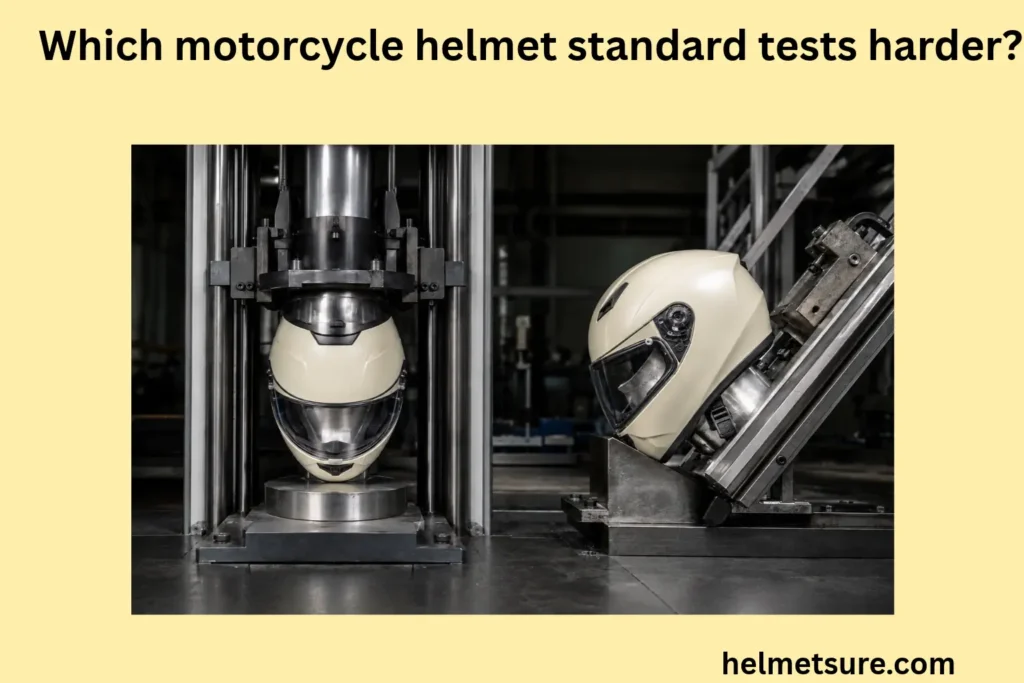
Which Motorcycle Helmet Standard Tests Harder?
Motorcycle helmet standards test hardest in different ways: impact inputs, response limits, rotational criteria, test coverage, and certification controls differ, so no single standard is toughest across every dimension without defining the comparison criterion.
That conclusion applies to the comparison set used here: U.S. DOT FMVSS 218, UN ECE 22.06, Snell M2025D, Snell M2025R, and FIM FRHPhe-02. Each evaluates a helmet through a different combination of test inputs and acceptance rules. Understanding motorcycle helmet safety therefore requires looking beyond one speed, one acceleration limit, or one certification label to the complete tested response.
A standard can be more demanding in one dimension and less expansive in another. It may prescribe a high direct-impact velocity, impose a restrictive response limit, test oblique impacts, select more locations, repeat strikes, add component tests, or maintain stronger production controls. Those are related questions, but they are not interchangeable.
Passing any of these systems shows conformity under specified laboratory and administrative conditions. It does not guarantee prevention of concussion, skull fracture, brain injury, or death in every crash. This comparison uses the current source documents cited below; riders, manufacturers, and race entrants should confirm the exact version required in their jurisdiction or competition.
Test Severity as a Multi-Criteria Question Rather Than a Single Pass/Fail Number
Motorcycle helmet test severity cannot be reduced to one pass/fail number because impact input, anvil geometry, response limits, programme breadth, and certification controls measure different forms of demand.
Test Severity as a Multi-Criteria Question Rather Than a Single Pass/Fail Number
| Severity Criterion | Core Question | Why It Cannot Stand Alone |
|---|---|---|
| Impact input | How fast and with what effective mass does the headform strike? | Velocity alone omits anvil shape and acceptance limits. |
| Anvil geometry | How concentrated or distributed is the contact? | A severe contact shape does not reveal the permitted response. |
| Response limits | How much linear or rotational response is allowed? | A limit matters only with its test input, instrumentation, and calculation method. |
| Program breadth | How many locations, orientations, conditions, and repeat events are tested? | Breadth does not prove that every individual test is harsher. |
| Secondary tests | Which non-impact or component failure modes are evaluated? | Penetration, retention, visor, and removal tests assess different hazards. |
| Certification controls | Who approves, audits, samples, and enforces conformity? | Governance rigor is not the physical severity of a laboratory impact. |
Why higher prescribed impact speed does not by itself establish that one motorcycle helmet standard tests harder
Higher prescribed impact speed increases one component of impact demand, but it does not by itself establish that a motorcycle helmet standard is harder overall. The kinetic-energy input rises when effective mass and the rest of the setup are held constant, but standards do not necessarily hold those variables constant. They use different headforms, masses, anvils, locations, conditioning states, strike sequences, and pass criteria. A velocity comparison is therefore an input comparison, not a complete difficulty ranking.
For example, Snell M2025R and FIM FRHPhe-02 each prescribe an 8.2 m/s flat-anvil condition in parts of their programs. That shared velocity does not make the tests mechanically identical. The standards differ in headform configurations, site selection, response metrics, and program structure.
The same caution applies when a standard uses a lower speed. A more concentrated anvil, a second strike, or a tighter allowable response can change the passing challenge. A defensible comparison keeps the entire protocol attached to the headline number.
How acceleration limits, duration limits, and injury criteria can change laboratory test severity even when impact conditions appear similar
Acceleration limits, pulse-duration limits, and injury criteria can make similar impact inputs produce materially different passing requirements. A peak linear-acceleration limit constrains the highest measured translational acceleration. Duration limits constrain how long acceleration may remain above specified levels. Criteria such as HIC and BrIC integrate parts of the response history rather than judging only one instantaneous maximum.
FMVSS 218 illustrates why peak acceleration alone is incomplete. It permits no more than 400 g at the peak, while also limiting cumulative exposure above 200 g to 2.0 milliseconds and above 150 g to 4.0 milliseconds. UN ECE 22.06 uses a 275 g peak linear limit and a Head Injury Criterion limit of 2,400 in its prescribed direct-impact tests. Snell M2025R combines headform-dependent peak limits with HIC no greater than 2,880.
These numbers cannot be ranked in isolation because they operate within different impact protocols and calculation rules. Laboratory headform measurements are useful performance outcomes under controlled conditions. They are not deterministic predictions of an individual rider’s injury.
How anvil geometry changes the loading challenge independently of headline impact speed
Anvil geometry changes how impact load is applied to a helmet, so flat, hemispherical, edge or kerbstone, and oblique tests cannot be ranked from impact speed alone. A flat anvil tends to engage a broader area than a rounded or edged surface. A hemispherical or kerbstone-type anvil can produce a more localized loading pattern. An oblique anvil adds tangential interaction and rotational motion to the challenge.
FMVSS 218 uses flat and hemispherical anvils. Snell M2025D and M2025R add an edge anvil to their direct-impact programs. UN ECE 22.06 uses flat and kerbstone anvils for direct impact and a separate inclined abrasive anvil for oblique impact. FIM FRHPhe-02 specifies flat, hemispherical, and oblique conditions in its additional racing program.
An anvil name still does not supply a complete severity verdict. Radius, face width, surface specification, velocity, headform, and pass criteria must remain connected to the result.
Why laboratory severity, test-program breadth, and certification rigor require separate verdicts
Laboratory severity, test-programme breadth, and certification rigor require separate verdicts because each describes a different source of difficulty. Laboratory severity concerns the demand of a particular test event. Test-programme breadth concerns how many impact modes, locations, environmental states, repetitions, and component functions are examined. Certification rigor concerns how approval, production conformity, market surveillance, and enforcement are administered.
A standard can set a demanding isolated impact without testing the widest range of components. Another can cover many components without prescribing the greatest direct-impact velocity. A third can add extensive approval controls without changing the physical severity of a specific drop test.
The accurate method is to report at least three verdicts: which protocol is most demanding for the selected impact criterion, which program covers the broadest relevant conditions, and which certification system applies the strongest form of oversight. Combining those into one score hides more than it reveals.
Which Helmet Standards Are Directly Comparable, and Which Operate as Additional Certification Layers?
DOT FMVSS 218 and UN ECE 22.06 are road-compliance systems, Snell M2025D/M2025R are voluntary certifications, and FIM FRHPhe-02 is an additional racing homologation layer requiring eligible baseline certification.
DOT and ECE are road-compliance systems, Snell M2025D/M2025R are voluntary certifications, and FIM FRHPhe-02 is an additional racing homologation layer. Their roles must be separated before ranking their tests.
Which Helmet Standards Are Directly Comparable, and Which Operate as Additional Certification Layers?
| Standard or System | Primary Role | Approval Path | Appropriate Comparison Use |
|---|---|---|---|
| DOT FMVSS 218 | Mandatory U.S. road-performance standard | Manufacturer self-certification with NHTSA enforcement | Compare its physical tests and U.S. compliance model separately. |
| UN ECE 22.06 | Road type approval used by contracting parties | Approval by a designated authority or technical service, with production conformity | Compare the 06-series tests and type-approval controls. |
| Snell M2025D | Independent voluntary motorcycle certification | Snell certification and ongoing sample testing | Compare its D-oriented direct and oblique protocols without treating it as road law. |
| Snell M2025R | Independent voluntary motorcycle certification | Snell certification and ongoing sample testing | Compare its ECE-compatible design pathway and distinct impact protocol. |
| FIM FRHPhe-02 | Additional competition homologation | FIM program after an eligible baseline certificate | Evaluate the combined racing layer, not as a substitute road standard. |
How DOT FMVSS 218 functions as a U.S. road-compliance standard within the comparison
DOT FMVSS 218 functions as the U.S. federal minimum-performance standard for motorcycle helmets, with manufacturers certifying compliance and NHTSA enforcing the standard. Manufacturers apply the required DOT marking. NHTSA does not pre-approve each helmet model; it conducts compliance testing and can pursue recalls or enforcement when products fail.
Within this comparison, FMVSS 218 contributes direct-impact attenuation, penetration, retention, peripheral-vision, projection, and labeling requirements. Its impact program includes two successive blows at each of four selected sites, using flat or hemispherical anvils as prescribed.
That role matters. DOT is neither a voluntary premium rating nor an FIM racing homologation. Its physical tests can be compared criterion by criterion, while its self-certification structure belongs in a separate governance comparison.
How UN ECE 22.06 functions as a road type-approval standard rather than an additional racing layer
UN ECE 22.06 functions as a road type-approval regime for protective helmets and visors rather than as an additional competition-only homologation layer. A helmet type must demonstrate conformity through the applicable approval system before approval markings are granted, and production must continue to conform to the approved type.
The 06-series adds direct impacts at prescribed and supplementary locations, lower- and higher-energy conditions, oblique-impact evaluation, retention and roll-off testing, lower-face requirements where applicable, and visor requirements. It therefore combines impact attenuation with a broad road-helmet construction and component program.
ECE 22.06 should be compared directly with DOT when the question concerns alternative road-compliance systems. It should not be described as an extra racing layer; FIM homologation occupies that different role.
How Snell M2025D and M2025R function as voluntary motorcycle helmet certification standards alongside road requirements
Snell M2025D and M2025R function as separate voluntary motorcycle helmet certifications designed to coexist with mandatory road requirements, while retaining distinct linear-impact protocols. They do not replace the road certification required where a helmet is sold or used. Instead, manufacturers may seek Snell certification in addition to applicable legal compliance.
The Snell Memorial Foundation describes M2025D and M2025R as distinct standards. M2025D follows the test philosophy associated with DOT- and JIS-oriented helmets, while M2025R was structured to permit compatibility with UN ECE 22.06 designs. Both add the same Snell oblique-impact evaluation, but their direct-impact schedules differ materially.
It is therefore incorrect to speak of “Snell 2025” as one undifferentiated impact test. A valid comparison identifies D or R, the headform, the anvil, the first or second strike, and the relevant response limits.
How FIM FRHPhe-02 functions as an additional racing homologation layer rather than a directly equivalent road standard
FIM FRHPhe-02 functions as an additional competition homologation layer whose eligible helmets must first satisfy an accepted baseline certification requirement. A qualifying helmet must then satisfy the FIM programme’s competition-specific construction, impact, penetration, and quick-removal requirements.
The August 2025 homologation manual lists eligible baseline routes that include UN ECE 22.06 type-P approval and specified Snell and JIS certifications. It then requires features such as a one-piece, non-modular shell, a non-detachable lower-face cover, double-D retention, and emergency cheek-pad removal. Eligibility lists can change, so a racer must check the current manual rather than assume that any newer voluntary certificate automatically qualifies.
FIM announced FRHPhe-02 as mandatory for covered FIM championships in 2026, subject to discipline-specific rules and stated exceptions. Calling it “harder than ECE” without acknowledging the baseline layer would compare an add-on competition system with a standalone road approval.
Why these different system roles require criterion-level comparison rather than one undifferentiated ranking
Different road, voluntary, and racing roles make criterion-level comparison more defensible than one undifferentiated ranking. DOT asks whether a road helmet meets a U.S. federal minimum through manufacturer certification and enforcement. ECE asks whether a helmet type and its production conform to a road type-approval regulation. Snell offers an independent voluntary certificate. FIM adds a race-specific homologation to a qualifying baseline.
Physical test results remain comparable only after the relevant conditions are aligned. Governance remains comparable only after the legal or voluntary role is identified. The final ranking must therefore say “hardest for what?” before naming a standard.
Which Standard Places the Greatest Demands on Linear Impact Attenuation?
Linear-impact severity must be compared through prescribed velocity or verified energy, anvil geometry, repeat-impact pattern, and acceptance limits together rather than through one headline value.
Impact velocity is only one input. Anvil geometry, headform, repeat strikes, peak limits, duration limits, HIC, SFC, and other acceptance criteria determine the full passing challenge.
Which Standard Places the Greatest Demands on Linear Impact Attenuation?
| Standard | Representative Direct-Impact Inputs | Principal Linear Acceptance Features | Key Qualification |
|---|---|---|---|
| DOT FMVSS 218 | Flat at 5.8–6.2 m/s; hemispherical at 5.0–5.4 m/s; two strikes per site | Peak ≤400 g; cumulative duration above 200 g ≤2.0 ms and above 150 g ≤4.0 ms | Every selected site receives a second strike, but velocities are below the maxima in the other programs. |
| UN ECE 22.06 | High-energy direct impacts at 7.5 m/s on flat and kerbstone anvils, plus prescribed lower-energy impacts | Peak ≤275 g and HIC ≤2,400 | Location and conditioning rules are part of the result. |
| Snell M2025D | First impact at 7.75 m/s; lower headform-dependent second impacts on flat and hemispherical anvils; edge struck once | Headform-dependent peak limits from 275 g down to 243 g | Particularly demanding repeat structure, but second-impact speed varies with headform. |
| Snell M2025R | Flat once at 8.20 m/s; edge once at 7.75 m/s; hemispherical at 7.70 m/s plus a lower-speed second strike | Headform-dependent peak limits and HIC ≤2,880 | Highest listed single flat velocity, but no flat second strike. |
| FIM FRHPhe-02 | Four flat impacts at 8.2 m/s; four hemispherical impacts at 7.5 m/s; lower-face impact at 6.0 m/s | Peak, SFC, BrIC, and rotational-acceleration limits apply to flat/hemi tests; separate lower-face peak limit | It is an added racing layer and evaluates more than linear response in these nominally direct impacts. |
The values above are protocol conditions, not universal crash thresholds. “g” denotes acceleration relative to gravity, and laboratory headform results do not directly predict an individual injury outcome.
How differences in prescribed impact velocity change linear-impact demand across the standards
Prescribed impact velocities differ across motorcycle helmet standards, but each value is meaningful only within its matching headform, anvil, test mode, and impact sequence. Because kinetic energy varies with the square of velocity when mass is fixed, even a modest velocity difference can matter. Yet the relevant mass is not identical across every headform or standard, so converting velocity alone into a universal energy leaderboard would be misleading.
FMVSS 218 prescribes 5.8–6.2 m/s for its flat anvil and 5.0–5.4 m/s for its hemispherical anvil. Snell M2025D uses a 7.75 m/s first impact across its direct anvils, followed by headform-dependent second impacts on flat and hemispherical anvils. M2025R specifies an 8.20 m/s single flat impact, a 7.75 m/s single edge impact, and a 7.70 m/s first hemispherical impact followed by a lower-speed second strike. FIM FRHPhe-02 specifies 8.2 m/s flat and 7.5 m/s hemispherical conditions in its additional program.
By maximum listed flat-anvil velocity, M2025R and FRHPhe-02 reach 8.2 m/s. That is a narrow input verdict. It is not proof that either complete program is hardest in every linear-impact dimension.
How each standard’s required anvil geometries change the concentration and distribution of impact loading
Required anvil geometries change how the impact load enters the helmet, creating different challenges even where test velocities are similar. A flat surface challenges broad-area attenuation. A rounded or kerbstone-like surface recruits a smaller region. Snell’s edge anvil introduces a narrow contact face intended to probe localized response.
DOT’s flat and 48 mm-radius hemispherical anvils are used at different velocity ranges. ECE’s flat and kerbstone anvils form part of its direct-impact schedule. Snell D and R include flat, 48 mm-radius hemispherical, and 6.3 mm-face edge anvils. FIM uses flat and hemispherical direct impacts and separates those from its inclined oblique test.
No geometry is universally “hardest” outside its complete condition. An edge impact at one velocity and pass limit cannot be ranked from shape alone against a flat or hemispherical test with different energy and acceptance rules.
How differences in peak-acceleration limits change the permitted headform response across the standards
Peak-acceleration limits change how much translational headform response each standard permits, but those limits must be interpreted with the associated test input and headform. A lower number appears more restrictive, but it remains meaningful only with the relevant impact input and headform.
DOT caps peak acceleration at 400 g and supplements that limit with duration requirements. ECE 22.06 applies a 275 g peak limit in its direct-impact evaluation. Snell M2025D allows 275 g for its smaller through J headforms, 264 g for M, and 243 g for O. M2025R generally uses 275 g, with 257 g for its O headform. FIM applies a 275 g peak limit to its 8.2 m/s flat and 7.5 m/s hemispherical tests, while also constraining other response measures.
M2025D has the lowest stated peak limit for the largest listed headform in this set. That does not make M2025D categorically hardest, because the headform-specific input and its absence of a linear HIC limit differ from the other systems.
How duration limits and other linear acceptance criteria change passing difficulty beyond peak acceleration alone
Duration limits and calculated linear-response criteria can make passing more demanding even when two standards permit similar peak acceleration. They constrain the shape of the acceleration-time pulse. A helmet can stay below a peak limit while still sustaining elevated acceleration long enough to fail a duration or integral criterion.
FMVSS 218 limits cumulative time above 200 g and 150 g in addition to its 400 g cap. ECE 22.06 combines its peak limit with HIC no greater than 2,400. Snell M2025R includes HIC no greater than 2,880, whereas M2025D relies on its headform-dependent peak requirements for direct impact. FIM adds the Severity Function Criterion, limited to 212 g in flat and hemispherical tests, alongside peak linear, BrIC, and peak rotational-acceleration requirements.
These criteria are not interchangeable scales. Each uses its own definition and threshold. The correct question is whether a helmet passes the full acceptance envelope under that standard’s test condition.
Why linear-impact severity must be judged from impact energy, anvil geometry, and acceptance limits together
Linear-impact severity is defensibly judged only by combining verified impact input, anvil geometry, repeat-impact demand, and acceptance limits. Input velocity and effective mass establish the available kinetic energy. The anvil influences contact and load distribution. Peak, duration, HIC, or SFC limits determine which resulting headform response is acceptable.
This combined view is the useful basis for understanding impact control: a demanding input can be paired with a relatively permissive limit, while a lower input can be paired with a restrictive response envelope or repeated strike.
There is therefore no single unqualified linear winner. M2025R and FIM share the highest listed flat velocity at 8.2 m/s. M2025D imposes a strong two-hit schedule on flat and hemispherical anvils and tighter peak limits for larger headforms. ECE combines direct impacts with a 275 g peak and 2,400 HIC limit. DOT uses lower velocities but applies two blows at every selected site and explicit high-acceleration duration limits. The “hardest” answer changes with the isolated criterion.
How Oblique and Rotational-Impact Tests Separate Modern Helmet Standards
Oblique and rotational-impact requirements separate the standards by testing tangential loading and angular headform motion that direct linear acceleration criteria do not fully describe.
Oblique and rotational test breadth must be judged separately from direct linear-impact harshness. A standard can lead one comparison without leading the other.
How Oblique and Rotational-Impact Tests Separate Modern Helmet Standards
| Standard | Formal Instrumented Oblique Test | Rotational Criteria | Interpretation |
|---|---|---|---|
| DOT FMVSS 218 | No | None in the current impact-attenuation procedure | It cannot be ranked on a test it does not conduct. |
| UN ECE 22.06 | Yes; 8.0 m/s onto a 45° abrasive anvil | BrIC ≤0.78; peak rotational acceleration ≤10,400 rad/s² | Evaluates tangential response within a road type-approval program. |
| Snell M2025D | Yes; 8.00±0.12 m/s onto a 45° abrasive anvil | BrIC ≤0.78; peak rotational acceleration ≤10,000 rad/s² | Uses multiple technician-selected orientations across at least two samples. |
| Snell M2025R | Same Snell oblique protocol | BrIC ≤0.78; peak rotational acceleration ≤10,000 rad/s² | Rotational requirements are shared with M2025D despite different direct tests. |
| FIM FRHPhe-02 | Yes; three orientations at 8.0 m/s and one at 5.0 m/s | BrIC ≤0.78; peak rotational acceleration ≤10,000 rad/s², plus linear and SFC limits | Also applies rotational criteria during flat and hemispherical impacts in the additional racing layer. |
How the presence or absence of oblique-impact testing changes the protective response each standard evaluates
A standard with an oblique-impact test evaluates tangential loading and rotational headform motion that a purely guided linear drop test does not directly measure. Such a test produces coupled linear and rotational motion. A direct vertical drop onto a flat or rounded anvil does not reproduce the same sliding and rotational interaction.
ECE 22.06, Snell M2025D, Snell M2025R, and FIM FRHPhe-02 include instrumented oblique-impact tests. FMVSS 218 does not include an equivalent formal oblique test in its current impact-attenuation requirements.
Absence of that test means the standard does not directly set an oblique-response threshold; it does not prove that every compliant helmet has poor rotational performance. Presence means a helmet was evaluated under the specified oblique protocol; it does not guarantee protection in every angled crash.
How differences in rotational-acceleration limits change the allowable headform response during oblique impacts
Lower allowable peak rotational acceleration can impose a stricter response limit when the underlying oblique-impact conditions are sufficiently comparable. Snell M2025D, Snell M2025R, and FIM FRHPhe-02 specify a peak rotational-acceleration limit of 10,000 rad/s². ECE 22.06 specifies 10,400 rad/s².
The lower Snell and FIM number is slightly more restrictive as an isolated threshold. It does not settle the entire comparison because the programs differ in impact orientations, sampling, linear-response constraints, site selection, and approval role.
Rotational acceleration is also distinct from rotational velocity and BrIC. A helmet must satisfy every applicable metric rather than trade failure on one for success on another.
How BrIC or related rotational injury criteria add requirements that linear acceleration limits cannot capture
BrIC and related rotational criteria constrain angular headform motion separately from the translational acceleration limits used in direct linear-impact testing. BrIC is based on the headform’s rotational-velocity response. ECE 22.06, both Snell M2025 standards, and FIM FRHPhe-02 use a BrIC limit of 0.78 in their prescribed rotational evaluations.
The criterion should be described as a laboratory response measure, not an injury forecast for a particular rider. BrIC is informed by biomechanical research, but passing a threshold does not guarantee avoidance of concussion or other brain injury in an uncontrolled crash.
Requiring both BrIC and peak rotational acceleration narrows the acceptable response in two distinct ways. A test program can become broader again when it also limits linear acceleration or another criterion during the same event.
How FIM FRHPhe-02 extends rotational and oblique evaluation through its additional impact requirements, including hemispherical-anvil testing where applicable
FIM FRHPhe-02 extends rotational and oblique evaluation through additional impact locations, oblique configurations, and hemispherical-anvil testing under its racing-homologation programme. It applies BrIC and peak rotational-acceleration limits not only to its oblique impacts but also to its high-speed flat and hemispherical tests. Those direct-anvil events also carry peak linear and SFC limits.
Its oblique sequence uses rear, front, and left-lateral orientations at 8.0 m/s and a right-lateral orientation at 5.0 m/s. The oblique acceptance envelope includes peak linear acceleration no greater than 170 g, SFC no greater than 140 g, BrIC no greater than 0.78, and peak rotational acceleration no greater than 10,000 rad/s².
This gives FIM the broadest layered rotational measurement package in the comparison. The conclusion applies to its additional racing homologation and the cited protocol. It should not be restated as proof that every FIM-homologated helmet will produce the lowest rotational response in every real crash.
Why rotational-impact severity must be judged separately from direct linear-impact harshness
Rotational-impact severity requires its own verdict because oblique input and angular-response criteria measure a different challenge from direct linear attenuation. Oblique tests use a different contact geometry, motion state, measurement set, and pass logic from direct attenuation tests. A standard may lead the comparison in single flat-anvil velocity while another applies a broader rotational acceptance envelope.
For rotational coverage, DOT cannot be the winner because it lacks a formal instrumented oblique test. ECE and both Snell M2025 standards impose BrIC and rotational-acceleration limits. FIM adds multiple prescribed oblique orientations and applies rotational criteria to flat and hemispherical events as well.
The qualified rotational verdict therefore favors FIM FRHPhe-02 for breadth of measured rotational requirements. The strictest isolated peak rotational-acceleration threshold is shared by FIM and the two Snell standards. Neither verdict answers which protocol has the harshest direct linear impact.
How Impact Locations, Conditioning, and Test Repetition Change the Difficulty of Passing
Impact-location breadth, environmental conditioning, and test repetition increase the range of conditions a helmet must satisfy without necessarily making any single impact harsher.
How Impact Locations, Conditioning, and Test Repetition Change the Difficulty of Passing
| Standard | Impact-Location Approach | Conditioning Scope | Repeated-Impact Feature |
|---|---|---|---|
| DOT FMVSS 218 | Four selected sites within the permitted test area | Ambient, hot, cold, and water immersion | Two successive impacts at every site |
| UN ECE 22.06 | Prescribed points plus laboratory-selected supplementary points | Defined environmental and conditioning sequences | Uses varied energy and location conditions rather than DOT’s same-site two-hit rule |
| Snell M2025D | Technician discretion within valid test regions and around suspected weaknesses | Ambient, hot, cold, wet, and specified solvent exposure | Second impact at or close to the first site on flat and hemispherical anvils |
| Snell M2025R | Similar discretionary site selection | Ambient, hot, cold, wet, and specified solvent exposure | Second impact on the hemispherical anvil; flat and edge are single impacts |
| FIM FRHPhe-02 | Random selection across a large predefined location set | Solvent treatment followed by controlled laboratory conditioning in the additional layer | Broad set of separate impacts, but not a same-site repeated-strike sequence |
How testing a broader set of helmet locations reduces the ability to optimize protection around a narrow fixed test zone
Testing more helmet locations broadens the areas that must demonstrate acceptable performance and reduces reliance on protection concentrated around a narrow set of test sites. Shell curvature, liner thickness, vents, ridges, interfaces, and local construction can vary around a helmet. A broader spatial programme asks more of the design as a whole.
ECE 22.06 combines prescribed points with supplementary test locations selected under its protocol. Snell allows technicians to choose valid sites and to investigate apparent weaknesses. FIM selects multiple impact locations at random from a predefined map in its additional program.
Breadth of location is not identical to severity at one location. A program may test many areas at moderate demand, while another subjects fewer areas to repeated or higher-energy strikes. Both features should be reported.
How examiner-selected or variable impact locations increase demands across more of the helmet shell
Examiner-selected or variable impact locations can increase programme robustness by allowing testing to target different regions or potential structural weaknesses. The tester can recruit different shell and liner regions, including areas affected by local geometry or nearby features, provided the sites comply with the standard’s validity rules.
Under Snell M2025D and M2025R, technicians choose impact sites and anvil assignments within the permitted region and may target construction features or suspected weaknesses. FIM uses randomized selection across its defined impact-location set; its current manual describes linear impacts at 9 to 13 of 22 locations across the program, depending on the test plan.
Variable selection does not mean arbitrary testing outside the written procedure. Nor does one difficult location represent every helmet region. It means the passing helmet must tolerate less predictable spatial deployment of the specified tests.
How heat, cold, moisture, and other conditioning procedures test whether protective performance survives environmental changes
Environmental conditioning tests whether a helmet continues to satisfy prescribed performance requirements after defined hot, cold, wet, or other exposure states. Heat can alter polymer behavior and bonding. Cold can change deformation response. Water or moisture can affect comfort materials, retention components, and interfaces. Solvent or ultraviolet exposure probes other durability concerns.
FMVSS 218 divides helmets among ambient, hot, cold, and water-immersed conditions before testing. Snell M2025D and M2025R use ambient, hot, cold, and wet samples and prescribe a solvent-wipe procedure in the applicable sequence. ECE 22.06 contains its own defined environmental and preconditioning program. The FIM layer uses a specified solvent mixture followed by laboratory conditioning rather than repeating the complete environmental matrix of its eligible baseline approval.
Conditioning temperatures, exposure times, and transfer windows differ, so the labels “hot,” “cold,” and “wet” are not automatically equivalent. A valid comparison preserves each standard’s actual procedure.
How repeated strikes test whether sufficient protective capacity remains after an initial impact
Repeated strikes test whether a helmet can still satisfy the prescribed response limits when another impact is applied under the standard’s defined sequence. The second response depends on the first strike’s velocity, anvil, location tolerance, elapsed procedure, and the permanent or recoverable deformation already produced.
DOT requires two successive impacts at each of four sites, with the second contact within 19 mm of the first. Snell M2025D requires a second strike at or within 10 mm of the first site for flat and hemispherical anvils, using lower, headform-dependent second velocities. M2025R repeats the hemispherical condition but uses single flat and edge impacts.
DOT’s second hit remains in the prescribed DOT velocity range, while Snell D’s first strike is substantially faster and its second strike varies by headform. Neither fact yields an unqualified winner. Repeated laboratory testing also does not mean a real helmet is suitable for reuse after a crash; serviceability is a separate question governed by manufacturer guidance and inspection limits.
Why impact-location, conditioning, and repetition breadth must be evaluated separately from single-strike severity
Location, conditioning, and repetition breadth describe how widely a programme probes helmet robustness, not how harsh one isolated strike is. Location breadth probes spatial robustness. Conditioning probes environmental robustness. Repetition probes residual capacity. Single-strike severity probes the response to one defined input.
By same-site repetition, DOT is unusually comprehensive because every selected site is struck twice. Snell M2025D combines a higher first-strike velocity with second impacts on two anvil types. ECE emphasizes a wide combination of locations, energies, and oblique conditions. FIM’s added layer spreads numerous direct and oblique tests across randomized locations but does not reproduce DOT’s same-site repeat pattern.
The broadest answer therefore depends on the axis. No responsible summary should turn “more locations,” “more conditioning states,” or “two strikes” into a complete safety ranking.
Which Standards Add the Broadest Secondary Helmet and Component Tests?
Secondary-test breadth depends on how many distinct non-primary-impact functions a standard evaluates, not on whether one supplementary test appears severe.
Which Standards Add the Broadest Secondary Helmet and Component Tests?
| Test Area | DOT FMVSS 218 | UN ECE 22.06 | Snell M2025D / M2025R | FIM FRHPhe-02 Additional Layer |
|---|---|---|---|---|
| Shell penetration | Yes | No equivalent pointed-striker shell test | Yes | Yes |
| Retention / positional stability | Dynamic retention requirement | Retention and roll-off requirements | Dynamic retention and positional-stability tests | Requires eligible baseline and double-D system; checks defined FIM construction functions |
| Chin bar / lower face | No dedicated chin-bar impact test | Requirements for protective lower-face structures where applicable | Dedicated chin-bar impact test | Lower-face direct impact and full-face construction rules |
| Visor / face shield | No comparable visor performance program | Extensive visor requirements | High-speed face-shield penetration test when supplied | Relies substantially on baseline approval and checks prescribed race configuration |
| Quick removal / emergency access | No | Not equivalent to FIM cheek-pad removal check | Helmet-removability evaluation | Mandatory quick-removal cheek pads and helmet-removal test |
How penetration testing expands secondary coverage by evaluating shell resistance through a distinct failure mode
Penetration testing expands programme coverage by evaluating resistance to a concentrated striker rather than repeating the blunt-impact attenuation test. It is a separate failure mode with a separate pass condition.
FMVSS 218 drops an approximately 3 kg pointed striker through 3 m at two sites and prohibits contact with the headform. Snell M2025D and M2025R use a 3 kg striker at a specified impact velocity and likewise prohibit penetration to the tell-tale surface. FIM FRHPhe-02 uses a 3 kg striker dropped 2 m at at least two points and prohibits contact with the support. ECE 22.06 does not contain an equivalent pointed-striker shell-penetration test.
The different heights, velocities, supports, sites, and conditioning rules prevent a one-number penetration ranking here. Presence of the test establishes additional coverage; absence does not by itself characterize performance in every real sharp-object impact.
How retention-system testing expands coverage to whether the helmet remains secured under prescribed loading
Retention-system testing expands coverage from impact attenuation to whether the helmet’s fastening system satisfies prescribed strength, displacement, or stability requirements. Impact attenuation cannot help as intended if a helmet does not remain properly secured during the test scenario.
FMVSS applies a static preload and a larger sustained load, limits displacement, and prohibits separation. ECE 22.06 includes retention-system strength, dynamic displacement, and roll-off or positional-stability requirements. Snell M2025D and M2025R evaluate both positional stability and dynamic retention, including a displacement limit and post-test unfastening requirement.
FIM requires a double-D retention system as part of its competition-specific construction and rests on a qualifying baseline certification that already includes retention evaluation. These approaches differ in apparatus and pass logic, so retention breadth should not be collapsed into the direct-impact verdict.
How chin-bar requirements extend secondary testing to structural areas beyond crown-impact attenuation
Chin-bar requirements extend testing to the lower-front structure of applicable full-face or modular helmets rather than limiting evaluation to principal shell impact zones. A helmet may control crown impacts yet respond differently at the chin bar because the geometry, openings, shell structure, and load path are different.
Snell M2025D and M2025R apply a dedicated chin-bar impact using a 5 kg striker at 3.5 m/s and limit maximum deflection to 60 mm. ECE 22.06 includes lower-face coverage and impact requirements for full-face configurations under its type-approval scheme. FIM requires a non-detachable lower-face cover and applies a 6.0 m/s impact at its specified lower-face point with a 275 g peak limit. FMVSS 218 does not prescribe a comparable chin-bar impact test.
These are not interchangeable procedures. The accurate conclusion is that ECE, Snell, and FIM evaluate the lower-face region in different ways, while DOT’s federal minimum does not add that dedicated test.
How visor requirements extend secondary coverage to face and eye-protection components
Visor requirements extend programme coverage beyond the helmet shell and liner by evaluating applicable face or eye-protection components. The criteria can address optical quality, field of vision, mechanical integrity, surface behavior, or impact resistance, depending on the standard.
ECE 22.06 contains the broadest road-type-approval visor program in this comparison, including specified optical and mechanical requirements. Snell M2025D and M2025R require a high-speed face-shield penetration test when a full-face helmet is supplied with a shield; a soft lead pellet is fired at three sites. FIM’s racing layer controls the homologated helmet configuration and relies on the qualifying baseline for much of the visor’s underlying approval.
FMVSS 218 has field-of-view and projection requirements but no comparable full visor-performance suite. A broad visor program should be credited as component coverage, not treated as evidence that its crown-impact drop is physically harsher.
How quick-removal or emergency-access requirements extend testing to functions outside primary impact attenuation
Quick-removal or emergency-access requirements extend testing into post-crash helmet-handling functions that primary impact attenuation does not evaluate. Such requirements assess whether responders can remove a helmet through the intended process without excessive resistance.
FIM FRHPhe-02 requires cheek pads that can be removed quickly and checks that the helmet can then be taken off without resistance under the prescribed procedure. Snell M2025D and M2025R include a helmet-removability evaluation, though their method and certification purpose differ from FIM’s mandatory quick-release cheek-pad architecture.
DOT and ECE do not use the same FIM racing-removal procedure. That difference does not make their impact attenuation less severe; it means the FIM layer and Snell programs include additional functional questions.
Why broader secondary-test coverage does not establish that each individual secondary test is harder
A standard with more secondary-test categories has broader coverage, but that fact does not establish that each individual component test is more severe. A broader programme evaluates more failure modes or components, yet every test retains its own load, limit, and configuration.
Among the standalone systems in this comparison, Snell M2025D and M2025R cover the widest combined set of the specifically reviewed categories: penetration, retention, positional stability, chin bar, face shield, and removability. ECE 22.06 provides particularly extensive visor and road-helmet component coverage but omits a pointed-striker shell-penetration test. DOT includes penetration and retention but not the dedicated chin-bar, visor, or quick-removal programs described above.
The widest combined requirement stack is FIM FRHPhe-02 plus its qualifying baseline, because the racing layer adds penetration, lower-face impact, quick-removal, and configuration controls to an already certified helmet. That is a layered-system verdict, not proof that each FIM secondary test is the hardest isolated procedure.
How Certification and Production Controls Change Rigor Beyond the Laboratory Test
Certification and production controls change how compliance is demonstrated and maintained, but those governance mechanisms do not make a physical impact test intrinsically harsher.
Type approval, self-certification, voluntary certification, production conformity, surveillance, and racing homologation describe compliance control—not the physical severity of one impact test.
How Certification and Production Controls Change Rigor Beyond the Laboratory Test
| System | Initial Compliance Route | Ongoing Control | Governance Interpretation |
|---|---|---|---|
| DOT FMVSS 218 | Manufacturer self-certification | NHTSA compliance testing, defect investigations, enforcement, and recalls | Strong public enforcement structure without model-by-model pre-approval by NHTSA |
| UN ECE 22.06 | Third-party type approval through the applicable authority and technical service | Conformity-of-production requirements and authority oversight | Approval and continued production are linked within the regulatory system |
| Snell M2025D / M2025R | Independent voluntary certification | Follow-up purchase and testing of certified samples under Snell’s program | Additional private certification alongside mandatory road compliance |
| FIM FRHPhe-02 | FIM homologation after an eligible baseline certificate | Homologation labels and post-homologation controls at production, distribution, or events | Competition-specific control layered over baseline certification |
How manufacturer self-certification assigns compliance responsibility differently from third-party approval
Manufacturer self-certification places initial compliance responsibility on the manufacturer, while third-party approval uses an external approval pathway before the relevant approval is granted. That first model applies to DOT compliance under FMVSS 218.
NHTSA publishes the standard and test procedure, purchases or selects helmets for compliance testing, investigates potential defects or noncompliance, and can require corrective action. The DOT label therefore means the manufacturer certifies compliance; it is not evidence that NHTSA pre-tested and approved that exact model.
Self-certification is a governance structure, not a laboratory shortcut. A physical FMVSS test remains whatever the regulation prescribes. The distinction concerns who bears the initial certification responsibility and how compliance is enforced.
How third-party type approval changes the pathway through which an initial helmet design demonstrates compliance
Third-party type approval changes who verifies the design before approval, creating a different compliance pathway from manufacturer self-certification. UN ECE 22.06 defines the information, samples, tests, markings, and administrative steps used for that decision.
This differs from DOT self-certification because an approval authority and technical service participate in the pre-market type-approval process. It does not automatically make every ECE laboratory test more severe than every DOT, Snell, or FIM test. It makes the initial compliance pathway more externally administered.
The approval applies to a defined helmet type and its documented configurations. Subsequent changes and extensions remain subject to the regulation’s administrative controls.
How conformity-of-production controls extend scrutiny from approval samples to continued manufacturing consistency
Conformity-of-production controls extend compliance scrutiny beyond the original approval sample by requiring continued production to remain consistent with the approved type. They require the manufacturer to maintain processes and product characteristics so later units remain consistent with the approved construction.
This matters because a demanding prototype test does not by itself ensure that mass-produced helmets match the approved construction. Production checks, quality arrangements, records, and authority powers address that gap.
Conformity of production still should not be scored as extra impact velocity or a lower acceleration threshold. It strengthens confidence in continued compliance through a different mechanism.
How independent voluntary certification adds a separate compliance pathway alongside mandatory road requirements
Independent voluntary certification adds another compliance pathway that a manufacturer can pursue alongside the mandatory road requirements applicable to the helmet’s market. Snell M2025D or M2025R certification is optional from the standpoint of road law unless another body separately requires it.
The Snell Foundation evaluates submitted helmet models against the selected standard and operates follow-up testing of certified products. Its standards also allow technician discretion in selecting impact sites and investigating apparent weaknesses.
This can add useful scrutiny, but “voluntary” does not mean universally harder and “independent” does not replace legal certification. A buyer should identify both the required road mark and any separate voluntary mark rather than assuming one subsumes the other.
How racing homologation applies competition-specific approval controls after qualifying baseline certification
Racing homologation applies competition-specific approval and traceability controls after the helmet satisfies an eligible baseline certification requirement. FIM FRHPhe-02 then reviews the model and size through its own submission, laboratory, construction, impact, penetration, and removal requirements.
Approved helmets receive an FIM homologation label associated with the model and size. The FIM program also provides for post-homologation controls involving production, distribution channels, or competition events and can withdraw homologation for nonconformity.
This layered structure is rigorous for the intended racing environment. It does not make FRHPhe-02 the road law for ordinary use, and the rider must still verify the certification and homologation required by the relevant jurisdiction and sporting regulations.
Why certification rigor is not laboratory test severity and therefore requires a separate conclusion
Certification rigor requires a separate conclusion because approval, surveillance, and production controls govern compliance processes rather than the physical harshness of an individual helmet impact test. One cannot be converted into the other.
A clearer discussion of certification and safety keeps those layers visible: DOT uses manufacturer self-certification with federal enforcement; ECE uses type approval and conformity of production; Snell uses independent voluntary certification and follow-up testing; FIM uses additional race homologation and post-approval controls.
The separate governance conclusion is therefore descriptive, not ordinal. ECE provides an integrated third-party road approval and production-conformity system. Snell adds independent voluntary scrutiny. FIM adds a centralized competition layer with traceable labels and post-homologation controls. DOT assigns initial certification to the manufacturer and backs it with NHTSA surveillance and enforcement. Calling any one “hardest” without first defining the desired governance attribute would be imprecise.
Which Motorcycle Helmet Standard Tests Hardest Once the Criteria Are Separated?
No motorcycle helmet standard is hardest across every dimension; the defensible answer assigns separate leaders for linear severity, rotational testing, programme breadth, secondary coverage, and certification control.
Which Motorcycle Helmet Standard Tests Hardest Once the Criteria Are Separated?
| Criterion | Most Accurate Verdict | Essential Qualification |
|---|---|---|
| Highest listed single flat-anvil velocity | Tie: Snell M2025R and FIM FRHPhe-02 at 8.2 m/s | Headform, site selection, metrics, and system role differ. |
| Repeated direct-impact challenge | Snell M2025D for its high first strike plus second strikes on flat and hemispherical anvils; DOT stands out for two strikes at every selected site | Second-strike velocities and headforms differ, so there is no universal repeat winner. |
| Lowest isolated peak linear limit | Snell M2025D reaches 243 g for its O headform | Other standards add HIC, duration, SFC, or rotational limits. |
| Rotational / oblique breadth | FIM FRHPhe-02 | It is an additional racing layer; Snell shares the 10,000 rad/s² and 0.78 BrIC limits in its oblique test. |
| Spatial, conditioning, and repetition breadth | No single winner | ECE is spatially and conditionally broad; Snell uses discretionary sites and four environmental states; DOT repeats every site; FIM randomizes many sites in an added layer. |
| Standalone secondary-test breadth | Snell M2025D and M2025R among the categories examined here | ECE has broader visor-specific road requirements; category selection matters. |
| Broadest combined requirement stack | FIM FRHPhe-02 plus an eligible baseline certificate | A layered racing system cannot be treated as a directly equivalent standalone road standard. |
| Certification-control rigor | Report separately | Self-certification, type approval, voluntary certification, and racing homologation are different models. |
Why no motorcycle helmet standard is hardest across every testing dimension without qualification
No motorcycle helmet standard is defensibly hardest across every testing dimension because the programmes differ in test inputs, response limits, rotational requirements, breadth, and certification role. Maximum velocity, repeat impacts, spatial coverage, conditioning, component tests, and production control are separate variables.
Even within linear impact, the winner changes with the chosen measure. M2025R and FIM reach the highest flat velocity. M2025D sets lower peak limits for larger headforms and repeats flat and hemispherical strikes. ECE adds HIC and a broad set of direct and oblique locations. DOT uses lower velocities but repeats every selected impact and limits acceleration duration.
The defensible answer is a criterion matrix, not a podium. Any claim that one label guarantees the safest helmet or the best outcome exceeds what the standards establish.
Which standard is most demanding when linear-impact severity is isolated
Linear-impact severity does not produce a defensible single winner until maximum single-impact demand, repeat-impact loading, anvil geometry, and response limits are evaluated under an explicit criterion. Snell M2025R and FIM FRHPhe-02 share the highest listed flat-anvil velocity at 8.2 m/s. M2025D imposes the more demanding high-velocity repeat structure because it follows a 7.75 m/s first strike with a second strike on both flat and hemispherical anvils, although the second velocity declines with headform size.
For the tightest isolated peak limit, M2025D reaches 243 g on its O headform. For a combined peak-plus-HIC envelope, ECE and M2025R must be judged within their different inputs and HIC limits. For sustained high acceleration, DOT’s duration limits add a constraint not visible in its 400 g peak number.
Accordingly, there is no honest single linear winner. The closest concise verdict is: M2025R and FIM lead maximum flat velocity; M2025D stands out for repeated high-energy direct impacts and large-headform peak limits; ECE, M2025R, FIM, and DOT each add distinct response criteria that prevent a universal ordering.
Which standard imposes the strongest rotational or oblique-impact requirements
The strongest rotational or oblique package should be identified from test input, PRA and BrIC limits, tested orientations, and additional rotationally instrumented configurations rather than from oblique-test presence alone. FIM FRHPhe-02 imposes the broadest such package in this comparison. It tests multiple prescribed oblique orientations and also applies rotational criteria during its high-speed flat and hemispherical impacts, alongside linear and SFC limits.
Snell M2025D and M2025R match FIM’s isolated thresholds of BrIC no greater than 0.78 and peak rotational acceleration no greater than 10,000 rad/s² in the Snell oblique protocol. ECE uses the same BrIC limit and a slightly higher 10,400 rad/s² peak rotational-acceleration limit within a comprehensive road type-approval test.
FIM therefore leads on rotational test breadth, while Snell and FIM share the strictest isolated rotational-acceleration threshold. DOT has no formal instrumented oblique criterion, so it cannot receive a rotational-test ranking.
Which standard provides the broadest impact-location, conditioning, and repeated-impact coverage
The broadest test programme is the one that subjects helmets to the widest verified combination of impact locations, conditioning states, and repetition rules—not necessarily the harshest single strike. No single standard provides the broadest coverage across all three simultaneously. ECE 22.06 combines prescribed and supplementary locations, direct and oblique impacts, and defined environmental conditioning within a road type-approval programme. Snell D and R allow discretionary site selection and use ambient, hot, cold, and wet samples.
DOT has the clearest same-site repetition breadth because all four selected sites receive two impacts, and the sample set covers ambient, hot, cold, and water-conditioned helmets. M2025D combines hotter first-impact demand with second strikes on flat and hemispherical anvils. FIM distributes numerous direct and oblique tests across randomized predefined locations but uses a narrower conditioning sequence in the added racing layer.
The accurate verdict must name the desired attribute: DOT for universal two-hit treatment of its selected sites; Snell D for its particular high-energy repeat schedule; ECE for broad road-program spatial and condition variation; FIM for extensive randomized-location coverage in a supplemental racing program.
Which system provides the broadest secondary helmet and component test coverage
The broadest secondary-test system is the one covering the greatest verified range of distinct helmet and component functions, not the one with the most severe primary impact. Among the standalone standards and certifications reviewed here, Snell M2025D and M2025R provide the broadest combined coverage of the selected secondary categories. They include shell penetration, retention and positional stability, chin-bar impact, face-shield penetration when applicable, and helmet-removability testing.
ECE 22.06 is broader in visor-specific road approval and includes retention, roll-off, and lower-face requirements, but it does not add a pointed-striker shell-penetration test. DOT includes penetration and retention but lacks equivalent chin-bar and visor suites.
If the unit of comparison is the complete requirement stack rather than one standalone standard, FIM FRHPhe-02 plus its eligible baseline is broadest. The FIM layer adds penetration, lower-face, quick-removal, construction, and racing-specific impact controls to the baseline system.
Why certification-control rigor should be reported separately from the “tests hardest” verdict
Certification-control rigor should be reported beside, not inside, the tests hardest verdict because compliance governance does not alter the physical severity of a prescribed impact. Administrative oversight cannot be expressed as impact velocity, acceleration, HIC, BrIC, or strike count. It affects confidence that the submitted design and production helmets remain conforming, not the physical input of a particular test.
ECE offers third-party type approval and conformity-of-production controls. Snell provides independent voluntary certification and follow-up product testing. FIM adds competition homologation, labels, and post-homologation controls. DOT relies on manufacturer self-certification backed by NHTSA testing and enforcement.
These systems assign responsibility differently. Their relative rigor depends on the chosen governance measure, such as pre-market approval, production surveillance, independent sampling, enforcement authority, or event-level control. None can be honestly folded into a single laboratory-harshness score.
Why FIM racing homologation requires a different final interpretation from road and voluntary certification systems
FIM FRHPhe-02 requires a different final interpretation because it adds competition-specific testing and homologation to an eligible baseline certification rather than serving as a directly equivalent road standard. The helmet must first hold that baseline certificate, then satisfy additional FRHPhe-02 construction and performance requirements for covered competition use.
That makes FIM the broadest combined racing requirement stack in this comparison and the leader in layered rotational evaluation. It does not make FRHPhe-02 a replacement for road approval or a directly equivalent competitor to DOT, ECE, or Snell considered alone. The actual helmet must carry the correct label for its model and size, and the current championship regulations determine whether the homologation is required.
Motorcycle helmet standard decision checklist
The practical conclusion is to evaluate in sequence. First, identify the road standard legally applicable where the helmet will be used. Second, identify any racing homologation required by the organizer. Third, decide whether an additional voluntary certification matters for the intended use. Finally, compare the complete impact-management design, coverage, fit, and verified whole-helmet test results rather than shopping by one headline standard, one velocity, or one pass label.
Frequently Asked Questions About Motorcycle Helmet Test Standards
These answers summarize the article’s criterion-based comparison of DOT FMVSS 218, UN ECE 22.06, Snell M2025D, Snell M2025R, and FIM FRHPhe-02.
Which motorcycle helmet standard tests hardest overall?
No single standard is hardest across every dimension. The answer changes depending on whether you compare maximum impact input, repeat strikes, response limits, rotational testing, programme breadth, secondary tests, or certification controls.
Which standards have the highest listed flat-anvil impact velocity here?
Snell M2025R and FIM FRHPhe-02 both reach a listed flat-anvil condition of 8.2 m/s in the cited programs. That is an input verdict, not a complete hardness ranking.
Which standard stands out for repeated direct-impact testing?
Snell M2025D stands out for a high first strike followed by second strikes on flat and hemispherical anvils. DOT is also distinctive because every selected impact site receives two successive impacts.
Which system has the broadest rotational or oblique package?
FIM FRHPhe-02 has the broadest layered rotational package in this comparison because it uses multiple oblique orientations and also applies rotational criteria during additional flat and hemispherical impacts.
Does DOT FMVSS 218 include a formal instrumented oblique-impact test?
No. Current FMVSS 218 does not include an equivalent formal instrumented oblique-response criterion, so it cannot be ranked as a leader on that specific dimension.
Which standalone system covers the broadest secondary helmet tests here?
Among the standalone systems reviewed, Snell M2025D and M2025R cover the broadest combined set of the selected secondary categories, including penetration, retention, stability, chin-bar, face-shield, and removability tests.
Why should FIM FRHPhe-02 be interpreted differently from DOT or ECE?
FIM FRHPhe-02 is an additional racing homologation layer that requires an eligible baseline certification. It is not a directly equivalent standalone road standard.
Does passing a harder laboratory standard guarantee better protection in every crash?
No. Passing shows conformity under the standard’s defined tests and controls. It does not guarantee prevention of concussion, skull fracture, brain injury, serious injury, or death in every real crash.