
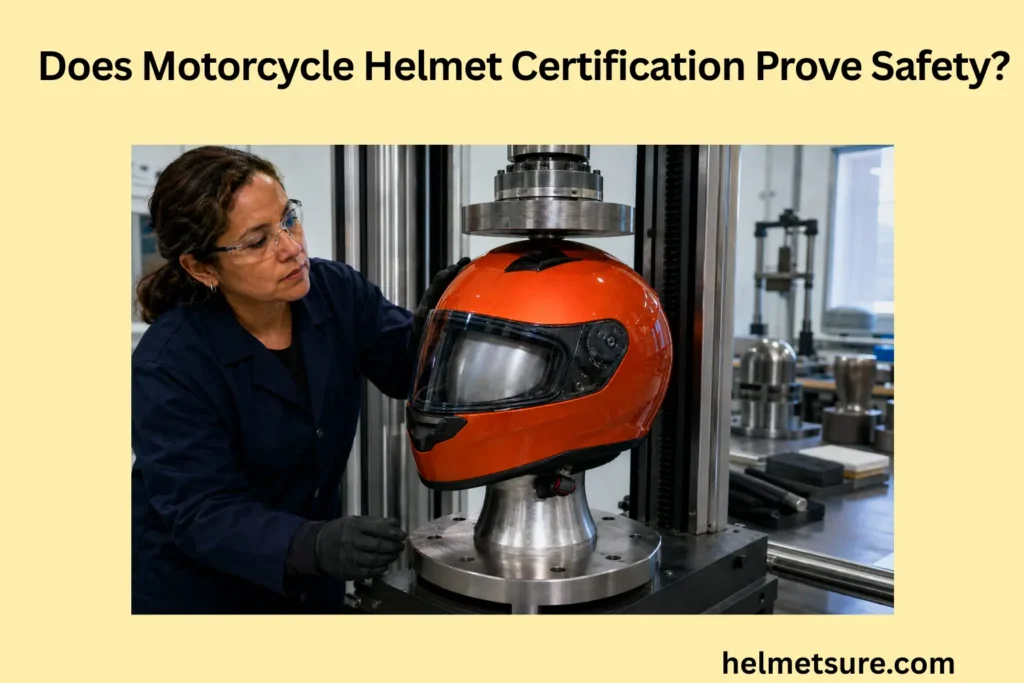
Does Motorcycle Helmet Certification Prove Safety?
Motorcycle helmet certification proves compliance with defined requirements under prescribed conditions; it does not guarantee protection in every crash, freedom from injury, or that a damaged or modified helmet still matches its originally certified condition.
That distinction matters because certification is one evidence layer within motorcycle helmet safety, while actual impact response also depends on the crash, the helmet design, fit, and the helmet’s present physical state. In the United States, for example, manufacturers self-certify compliance with Federal Motor Vehicle Safety Standard (FMVSS) No. 218. The National Highway Traffic Safety Administration (NHTSA) tests selected helmets for compliance and can investigate or enforce against noncompliance; it does not preapprove every helmet bearing a DOT label.
Certification is therefore meaningful, but bounded. It can establish that a defined compliance process applies to a represented helmet model or type. It cannot turn a laboratory result into a promise about every collision or an individual rider’s injury outcome.
Certification as Evidence of Compliance Rather Than a Universal Safety Guarantee
Motorcycle helmet certification establishes compliance with the requirements of a defined standard, not a universal prediction of how the helmet will perform in every possible crash.
Certification is strongest when four limits remain explicit: the standard boundary, test boundary, product boundary, and time-and-condition boundary.
The standard identifies the product scope, test methods, measured attributes, and acceptance criteria behind the claim. A compliant helmet has supplied the evidence that its certification system requires. That evidence may be highly relevant to impact attenuation, retention, penetration resistance, field of vision, projections, or other regulated attributes, depending on the standard. Its meaning stops at the boundary of those requirements and the product state they represent.
How certification establishes compliance with defined requirements rather than predicting every crash outcome
Certification establishes that the applicable compliance pathway has determined the helmet satisfies defined requirements; it does not predict the outcome of every crash.
A standard deliberately reduces a complicated problem to repeatable procedures. It defines such matters as test-headform use, conditioning, impact surfaces, locations, velocities, measurements, and pass criteria. A passing result answers a precise question: did the represented helmet meet those requirements in that programme?
A real crash asks a different and much larger question. The rider may strike an irregular object, experience several contacts, encounter oblique loading, or receive loads to regions and in sequences that a particular protocol does not reproduce. Injury outcome also depends on the rider and the event, not solely on the helmet. A certification decision consequently provides bounded compliance evidence, not a forecast for a specific collision.
Why compliance with a helmet standard cannot guarantee freedom from injury
Compliance with a motorcycle helmet standard cannot guarantee freedom from injury because injury outcome depends on crash conditions and human loading beyond a certification pass/fail result.
Helmets manage only part of the energy and loading in a crash. Their physical deformation capacity is finite, and no standard can represent every impact speed, object, direction, sequence, or anatomical response. Even within the conditions a standard evaluates, a limit on a laboratory measurement is not a boundary between injury and no injury for every person.
This is why headform measurements must remain laboratory outcomes. They help compare performance against a defined criterion, but they do not determine what will happen to an individual brain, skull, neck, or body. Real-world studies of fatal helmeted crashes also show diverse mechanisms, including facial, tangential, edge, occipital, and runover contacts. That fatal-case evidence illustrates crash diversity; it is not a population-wide estimate of how often each mechanism occurs.
Why certification evidence must remain bounded by the conditions and requirements represented by the certification
Certification evidence is strongest when the writer limits each conclusion to the conditions, measurements, criteria, and product scope actually represented by the underlying standard.
Four boundaries keep the interpretation accurate. The standard boundary identifies what was required. The test boundary identifies how those requirements were evaluated. The product boundary identifies the model, type, size, configuration, or component set to which the evidence applies. The time-and-condition boundary distinguishes the originally compliant product from a helmet that may later be damaged, altered, or counterfeited.
Crossing any of these boundaries needs additional evidence. A pass under one standard does not automatically prove compliance with another. A result for one approved configuration does not automatically cover a visually similar product. An intact certification label does not prove that the shell, energy-absorbing liner, or retention system remains in its original condition.
Why certification evidence must remain bounded by the conditions and requirements represented by the certification
| Question | What certification can establish | What it cannot establish alone |
|---|---|---|
| Did the represented product satisfy a defined standard? | Compliance under the applicable pathway and prescribed conditions | Compliance with every other standard |
| Does the helmet have impact-performance evidence? | Results against the named standard’s tests and criteria | Performance in every real crash |
| Will the rider avoid injury? | No individualized conclusion | Freedom from injury or a guaranteed outcome |
| Is the helmet still in certified condition? | The product state originally represented | Its current condition after impact, wear, or modification |
What Motorcycle Helmet Certification Positively Demonstrates
Motorcycle helmet certification positively demonstrates a compliance chain in which defined requirements are evaluated through prescribed tests, measured results are compared with pass criteria, and a certification decision follows.
That chain is the positive value of certification. It replaces an unsupported marketing assertion with a structured claim tied to rules, procedures, and accountability. The exact pathway differs: FMVSS No. 218 uses manufacturer self-certification backed by NHTSA compliance testing and enforcement, UN Regulation No. 22 uses a type-approval framework, and Snell operates a voluntary certification programme with its own standards and certified-product tracking.
How a certification standard converts defined performance requirements into prescribed laboratory tests
A motorcycle helmet certification standard turns defined performance requirements into repeatable laboratory procedures that specify what is tested and under which prescribed conditions.
“Impact attenuation” becomes a procedure only after the standard defines the headform, preparation, impact sites, anvils, strikes, velocities or energies, instrumentation, and data treatment. “Retention-system strength” similarly needs a defined loading method and an allowable response. Other requirements may address penetration, field of vision, projections, visors, or helmet components.
Prescribing those details allows different laboratories or compliance programmes to ask substantially the same test question. It also creates an evidence boundary: a procedure supplies direct evidence for the condition it represents, while claims about untested speeds, surfaces, directions, or configurations require other support.
How those tests produce measurable results for the helmet attributes being evaluated
Prescribed certification tests produce measured or directly evaluated results for the specific helmet attributes that the standard requires to be assessed.
Depending on the requirement, the output may be an acceleration-time history, penetration result, retention-system displacement, visual assessment, dimensional measurement, or another explicitly defined observation. The output is not simply “safe” or “unsafe.” It is a measured or evaluated result associated with a named helmet attribute and a particular test condition.
That distinction prevents two common errors. First, a passing impact-attenuation test does not silently become evidence for an unrelated attribute. Second, one measured value does not describe the entire helmet across all sites, sizes, configurations, or loading directions. The standard determines which samples and conditions make up the compliance evidence.
How pass criteria convert measured results into a compliance decision under the specific standard being applied
Pass criteria convert test results into a compliance decision by defining the limits or conditions a helmet must satisfy under the specific standard being applied.
The criterion may impose a maximum, a duration limit, a no-contact or no-failure condition, a minimum field, or another rule. The compliance decision follows only after the test result is evaluated against the relevant requirement. A helmet that passes has satisfied that rule within the applicable programme; the result does not mean that every measured value was zero, that the helmet cannot be damaged, or that injury is impossible.
Criteria are also standard-specific. Passing FMVSS No. 218, UN Regulation No. 22.06, or a Snell M2025 standard means meeting the requirements of that particular system. Because their procedures and criteria are not identical, their labels are not interchangeable shorthand for a single universal test.
How pass criteria convert measured results into a compliance decision under the specific standard being applied
| Evidence-chain stage | What happens | What the result means |
|---|---|---|
| Requirement | The standard defines an attribute or condition to be satisfied | The safety claim is bounded to that requirement |
| Prescribed test | A repeatable procedure represents the required condition | The evidence applies to the stated setup and samples |
| Measurement or evaluation | The laboratory records the specified output | The output describes the tested attribute, not universal safety |
| Pass criterion | The output is compared with the standard’s limit or rule | Pass/fail is determined under that standard |
| Certification or compliance claim | The applicable pathway recognizes the represented product | The claim remains tied to its product and programme scope |
Which Real-World Crash Conditions Remain Outside What Certification Can Prove?
Motorcycle helmet certification cannot prove performance across every real-world crash because standardized tests represent selected speeds, impact locations, orientations, surfaces, and loading combinations rather than the full crash envelope.
Laboratory certification samples selected speeds, locations, surfaces, orientations, and loading combinations. Unrepresented real-world conditions remain outside what the certification claim alone can establish.
Repeatability requires selection. A test programme must choose reproducible conditions from an effectively unlimited set of crash possibilities. Those choices make compliance evaluation possible, but they also establish the limit of the direct evidence.
How selected impact speeds represent defined laboratory conditions rather than every possible crash severity
Prescribed impact speeds represent defined laboratory test conditions, not the complete range of impact severities a motorcycle helmet may encounter in real crashes.
The speed specified for a drop or guided impact belongs to a full setup that includes headform mass, impact surface, helmet location, orientation, conditioning, and measurement rules. It should not be read as a universal crash-speed threshold. Motorcycle speed before a collision is also not necessarily the same as the helmet’s normal velocity at contact.
Experimental helmet research across multiple impact severities shows why the distinction matters: the same helmet can be driven through different response regimes as demand increases. Those study conditions help characterize severity dependence, but they cannot be converted into a simple statement that all crashes below one speed are manageable or all crashes above it are not.
How prescribed impact locations and orientations cover only part of the possible real-world impact envelope
Prescribed impact locations and orientations sample defined helmet regions and loading directions rather than every location and angle that can occur during a real motorcycle crash.
Standards specify allowable test areas or particular impact points so coverage can be evaluated consistently. This sampling may include several regions and repeated impacts, depending on the standard. It still cannot place every possible part of every helmet against every possible surface at every possible angle.
Local architecture matters. Shell curvature, liner thickness, apertures, shields, chin bars, edges, and retention geometry vary around a helmet. A result from one site therefore should not be represented as a measurement of every other site. Real-world fatal-case research has documented contacts involving different anatomical and helmet regions, reinforcing the need to separate prescribed test coverage from the wider crash envelope.
How standardized anvils and test surfaces simplify the range of objects and surfaces encountered in actual crashes
Standardized anvils and impact surfaces create repeatable loading conditions, but they simplify the much wider range of objects, edges, shapes, and surfaces encountered in real crashes.
Flat, hemispherical, kerbstone-like, edge, or other prescribed surfaces represent controlled loading geometries. Their material, shape, mounting, and orientation can be reproduced and compared. Roads, curbs, vehicles, guardrails, posts, debris, and terrain are far more variable. They may also deform, move, catch, abrade, or present compound shapes.
A standard surface is not intended to imitate every object literally. It is a controlled challenge chosen for the requirement. The proper conclusion is that the helmet met the applicable criterion on the prescribed surface—not that its response is known for every object a rider could strike.
How combined, irregular, or unrepresented loading conditions can fall outside the certification test protocol
Combined or irregular real-world loading can fall outside a certification protocol when the event mixes impact directions, contacts, rotations, secondary strikes, or other conditions not represented together in the prescribed test.
A real crash may begin with an oblique contact, continue through sliding, and include another strike at a different location. The shell, liner, retention system, face shield, and rider’s neck may be loaded together in a changing sequence. A standard may examine several of those attributes, yet do so in separate tests or in specifically prescribed combinations.
Biomechanical research using oblique-impact rigs demonstrates that radial and tangential loading components can be measured as distinct parts of a helmeted-head response. That historical research supports the mechanics of the distinction; it does not, by itself, define the coverage of a current certification standard. The current standard text must be checked to see which combined conditions it actually represents.
Why performance outside represented test conditions remains beyond what the certification claim can establish
Performance outside the conditions represented by a certification programme remains uncertain unless separate evidence directly evaluates those additional conditions.
“Uncertain” does not mean that a compliant helmet provides no benefit outside the laboratory. It means the certification claim alone does not prove a specified result there. Additional standardized tests, independent comparative research, validated modelling, or well-designed crash investigation may add evidence, but each has its own methods and limits.
This boundary protects certification from both exaggeration and dismissal. Certification is not useless because it is incomplete, and it is not universal because it is valuable. It is a defined body of evidence that should be combined with the actual standard scope, model authenticity, correct configuration, fit, and present condition.
Why performance outside represented test conditions remains beyond what the certification claim can establish
| Dimension | What a certification protocol represents | What may remain outside the claim |
|---|---|---|
| Severity | Selected laboratory velocities, energies, and loading setups | The full range and sequence of real crash demands |
| Location and orientation | Prescribed sites, zones, and directions | Every possible point, angle, and local structure |
| Surface | Reproducible anvils or test fixtures | Variable roads, vehicles, edges, debris, and terrain |
| Loading combination | Conditions combined as the protocol specifies | Irregular mixtures of impact, rotation, sliding, and repeated contact |
| Outcome | Compliance measurements under the protocol | A guaranteed injury outcome for an individual rider |
Why Different Motorcycle Helmet Standards Provide Different Safety Evidence
Different motorcycle helmet standards provide different safety evidence because they prescribe different conditions, acceptance criteria, test categories, product scopes, and compliance pathways.
The label is the visible endpoint of that system, not a self-explanatory safety grade. To interpret it, identify the standard and version, then examine what that document requires. FMVSS No. 218, UN Regulation No. 22.06, and Snell M2025 standards all evaluate motorcycle helmets, but they do not use one common procedure or administrative pathway.
How differences in prescribed impact conditions change the performance evidence supplied by each standard
Differences in prescribed impact conditions change what each motorcycle helmet certification can demonstrate because the evidence is tied to the specific loading conditions the standard requires.
Standards can differ in impact speed, energy, anvil geometry, site selection, number and sequence of strikes, conditioning, headforms, instrumentation, and sample allocation. A standard may also vary conditions by helmet size or configuration. These choices determine which parts of the helmet’s response are directly challenged.
That does not make one condition a universal proxy for “more safety.” A higher demand in one test dimension may be paired with different criteria, sampling rules, surfaces, or test categories elsewhere. Comparisons should therefore be made requirement by requirement, using the current standard text rather than isolated numbers or label reputation.
How differences in acceptance criteria change what successful compliance demonstrates
Different acceptance criteria change what a passing result demonstrates because compliance is defined by the limits and conditions imposed by the specific standard.
Two protocols could produce the same kind of measurement but apply different thresholds, duration rules, calculations, or sample-failure provisions. Conversely, similarly worded criteria may come from tests whose setup differs. A pass is meaningful only as the combined statement: this result met this criterion under this procedure.
This is why certification labels should not be arranged into a simple ordinal scale without a clearly defined comparison. “Stricter” can refer to one limit while overlooking broader or narrower test coverage elsewhere. A defensible evaluation identifies the performance attribute, test condition, criterion, and product scope being compared.
How rotational, penetration, retention, or component requirements broaden the evidence supplied by some standards
Rotational, penetration, retention, and component requirements can broaden a certification’s evidence when the underlying standard explicitly evaluates those additional attributes or failure modes.
Impact attenuation is not the only possible test category. Standards may evaluate retention-system strength and stability, penetration resistance, peripheral vision, shell projections, visors, chin bars, accessories, or oblique-impact response. Each included requirement adds evidence about that attribute under its prescribed conditions.
The categories cannot be assumed from the mere existence of a label. The current text and applicable helmet class must show whether a requirement applies, how it is tested, and what constitutes a pass. UN Regulation No. 22.06, for example, is a type-approval regulation with detailed helmet-and-visor provisions. FMVSS No. 218 and Snell M2025 define their own test sets and criteria.
How broader test coverage increases evidence breadth without proving protection in every crash
Broader test coverage increases the range of conditions or attributes for which compliance evidence exists, but it still cannot represent every possible motorcycle crash.
Adding a surface, impact direction, conditioning state, component test, or loading category can close a particular evidence gap. It cannot close the unlimited set of gaps created by different crash severities, contact sequences, objects, rider anatomies, helmet fits, and product histories. Each addition is another defined sample of the problem rather than a universal simulation.
Breadth should thus be described precisely: a standard provides evidence across the tests it includes. If an independent study evaluates a further condition, that evidence can be discussed separately. Neither source should be expanded beyond its protocol, and neither converts laboratory headform response into certainty about an individual injury.
Why certification labels should be interpreted through the requirements of the underlying standard rather than as interchangeable safety grades
A certification label should be interpreted through the requirements of its underlying standard because different labels can represent different tests, criteria, scopes, and compliance pathways.
Start with the exact identifier and version. Then review the standard tests that sit behind it, including impact conditions, acceptance criteria, other test categories, sampling, and administrative controls. This reveals what the label positively demonstrates and which questions remain unanswered.
For U.S. road helmets, “DOT” signals manufacturer certification to FMVSS No. 218; it is not an NHTSA preapproval seal. A UN ECE approval marking belongs to a type-approval system under the applicable regulation. A Snell mark represents voluntary certification to the named Snell standard, which may be M2025D or M2025R rather than a generic, timeless “Snell” grade. These are distinct evidence frameworks, not medals on one universal scale.
Why certification labels should be interpreted through the requirements of the underlying standard rather than as interchangeable safety grades
| Evidence dimension | FMVSS No. 218 / DOT | UN Regulation No. 22.06 | Snell M2025 |
|---|---|---|---|
| Compliance pathway | Manufacturer self-certification with NHTSA testing and enforcement | Type approval through an approval authority and technical service | Voluntary Snell certification and programme controls |
| Technical evidence | Requirements and tests defined by FMVSS No. 218 | Requirements and tests defined by the 06-series regulation | Requirements and tests defined by the applicable M2025D or M2025R standard |
| Label interpretation | Compliance claim, not NHTSA preapproval | Approval marking tied to an approved type | Certification tied to the named Snell standard and certified product |
| Comparison rule | Read procedure, criteria, and scope | Read procedure, criteria, and scope | Distinguish the current standard variant and scope |
| Universal claim | Does not prove every crash outcome | Does not prove every crash outcome | Does not prove every crash outcome |
What Model, Configuration, and Production Condition Does Certification Actually Cover?
Motorcycle helmet certification applies to a defined approved or certified product scope—such as a model, type, size/configuration, required components, and production state—not every helmet that looks similar.
A certification claim applies to the defined genuine model, type, size or configuration, required components, and represented production state—not every visually similar helmet or label.
Product scope is the bridge between a successful test programme and the helmet in a rider’s hands. The bridge depends on identity, configuration, and manufacturing conformity. If any of those links is missing, the visible label alone may not establish that the physical helmet matches the product for which compliance evidence exists.
How certification attaches to an approved helmet model or configuration rather than every visually similar helmet
Certification attaches to the model, type, or configuration recognized by the applicable certification system rather than automatically extending to every helmet with similar appearance.
Names, graphics, shell shapes, and external styling can be copied or shared across variants. The compliance scope is defined by the programme’s product identity and technical documentation, not by a consumer’s visual comparison. Size, shell, liner, retention, visor, chin-bar, or component differences may be relevant to how a system defines a type or certified model.
NHTSA advises buyers to check the full label information, including manufacturer or brand, model designation, DOT symbol, the relevant FMVSS reference, and certification statement. It also warns that unsafe helmets may carry misleading or counterfeit labels. The correct inference is therefore “this identified product claims the named compliance,” followed by authenticity and scope checks—not “anything that looks like it is certified.”
How required components and approved configurations define the condition represented by certification
Required components and approved configurations help define the helmet state represented by certification, so component substitutions or removals can change the scope that the original compliance evidence describes.
A face shield, visor, chin curtain, peak, spoiler, retention component, comfort liner, or accessory may be included in a type, required for a test, optional within an approved set, or irrelevant to a particular requirement. The answer is architecture- and programme-specific. Removing or replacing a part cannot be judged from appearance alone.
The sound approach is to follow the helmet manufacturer’s instructions and the applicable approval documentation. A change using a specified, approved component may remain within the represented configuration. An unapproved modification or substitute may not. Certification should never be used to validate a configuration that the certification evidence did not cover.
How production-conformity controls connect manufactured helmets back to the approved design
Production-conformity or continuing-compliance controls can connect manufactured helmets back to the approved or certified design by checking whether production continues to match the represented specification.
Type testing alone concerns samples. Conformity of production addresses the continuing relationship between approved type and manufactured output. Under the UN regulatory framework, manufacturers must have arrangements that support consistent production conformity, while approval authorities retain oversight functions. Other programmes use their own sampling, documentation, audit, surveillance, or enforcement mechanisms.
These controls strengthen the evidence chain but do not mean that every unit is destructively tested. They provide a system for connecting production to the represented design. A production defect, unauthorized change, or false marking remains possible and is handled through the programme’s conformity, recall, enforcement, or certification procedures.
Why altered, counterfeit, or nonconforming helmets cannot be assumed to match the certified specification
Altered, counterfeit, or nonconforming helmets cannot be assumed to match the certified specification because a label or visual resemblance does not establish conformity to the genuine approved product state.
A counterfeit can imitate graphics and certification markings without sharing the shell, liner, retention system, materials, or manufacturing controls of the genuine product. A nonconforming production helmet may carry a legitimate-looking label yet fail an applicable requirement. An altered genuine helmet may have started within scope but no longer match the represented configuration.
NHTSA’s consumer guidance specifically warns about misleading DOT labeling and identifies features that can help detect unsafe helmets. Manufacturer channels, approval databases, certification lists, recalls, and model documentation can add verification. None should be replaced with a guess based on price, weight, appearance, or a sticker alone.
Why altered, counterfeit, or nonconforming helmets cannot be assumed to match the certified specification
| Scope layer | Verification question | Why it matters |
|---|---|---|
| Standard | Which exact standard and version does the mark represent? | Requirements change across systems and revisions |
| Product identity | Is the manufacturer, brand, model, size, and type genuine and covered? | Similar appearance does not establish the same certified product |
| Configuration | Are required or approved components present and correctly installed? | Substitution or removal may change the represented state |
| Production conformity | Does the manufactured unit remain connected to the approved or certified specification? | Sample approval must be carried into production |
| Authenticity | Are the product and markings genuine? | Counterfeit labels do not create compliance evidence |
How Damage and Modification Can Change Helmet Condition After Certification
Crash damage or modification can change a motorcycle helmet’s present physical state even though its original certification label remains attached, so current condition must be evaluated separately.
The certification label records the represented compliant state; it is not a post-impact inspection, damage sensor, or authorization for later modifications.
Certification is historical evidence about a represented product state. The helmet’s current condition is a new factual question. The label is not an impact recorder, damage sensor, inspection result, or authorization for later modifications.
How crash damage can change helmet condition without changing the certification label attached to it
A crash can change a motorcycle helmet’s physical condition while leaving the certification label physically unchanged, so the label does not document what happened after certification.
Impact can deform or fracture energy-managing structures while leaving exterior damage subtle. It can also damage the shield, retention hardware, shell interfaces, or internal components. Whether a particular helmet has been compromised depends on the event and the helmet, but the certification label itself supplies no post-impact diagnosis.
SHOEI states that a foam liner can be damaged without obvious external signs and strongly recommends replacing a helmet after a significant impact. It also explains that its inspection is limited and cannot guarantee that every defect will be found. That is manufacturer-specific service guidance, not a universal laboratory rule, but it shows why the present-condition question must be handled separately from original certification.
How shell, liner, retention-system, or component damage can make the current helmet differ from the certified configuration
Damage to the shell, liner, retention system, or required components can make the helmet’s current physical state differ materially from the configuration represented by its original certification.
These parts perform different roles. The shell can distribute load and resist penetration. The energy-absorbing liner deforms to manage impact. The retention system helps keep the helmet on the head. Shields, chin bars, peaks, and other components may contribute to the tested configuration or have their own requirements.
Damage in one part cannot be ruled out merely because another part looks normal. Nor can a home visual check prove that hidden layers remain unchanged. Arai’s current serviceability policy treats an undamaged, unmodified helmet as a condition of serviceability and advises manufacturer inspection or replacement when an impact creates doubt about continued protection. That advice is specific to Arai helmets and should be followed alongside the relevant owner’s manual.
How modification or removal of approved components can move the helmet outside the condition represented by certification
Modification or removal of components can move a motorcycle helmet outside the configuration represented by certification when the change is not included in the applicable approved or certified specification.
Drilling, cutting, grinding, painting with incompatible substances, changing retention hardware, substituting structural parts, or attaching accessories through unapproved methods may alter materials, geometry, projections, load paths, or component performance. Even a reversible-looking change can affect a required feature or test condition.
The boundary is authorization, not intuition. Use only components and installation methods the manufacturer identifies for that helmet and market. Arai’s warranty information, for example, treats modification as outside its serviceability conditions. That does not prove that every alteration has the same mechanical effect; it does establish that original certification should not be invoked as evidence for an unauthorized modified state.
Why original certification cannot substitute for evaluating the helmet’s present physical condition
Original certification cannot substitute for evaluating present helmet condition because certification describes a compliant product state, not every change that may occur through impact, damage, or modification afterward.
The label answers “what standard did this product originally claim or receive compliance under?” It does not answer “what has happened to this unit?” That second question requires impact history, inspection, manufacturer instructions, component checks, authenticity, age and use context, and a conservative response when condition cannot be established.
When impact history, visible damage, loosened components, unauthorized modification, or an uncertain internal state raises concern, helmet replacement becomes a present-condition decision rather than a reinterpretation of the old certification label. Manufacturer inspection may sometimes be available, but SHOEI explicitly notes limits to what its inspection can establish, while Arai advises inspection or replacement when impact leaves doubt.
Why original certification cannot substitute for evaluating the helmet’s present physical condition
| Post-certification change | What may change | What the attached label can establish |
|---|---|---|
| Significant impact | Shell, liner, retention, shield, or interfaces | Only the original compliance claim, not post-impact condition |
| Wear or deterioration | Fit, components, materials, or retention performance | No current-condition finding |
| Unauthorized component removal | Configuration and tested interfaces | No proof that the altered state remains covered |
| Drilling, cutting, incompatible paint, or added hardware | Structure, geometry, projections, or load paths | No validation of the modification |
| Counterfeit or substituted parts | Product identity and production conformity | A visible mark cannot authenticate the physical helmet |
How Should Motorcycle Helmet Certification Be Applied in a Safety Judgment?
Motorcycle helmet certification should be applied by identifying the standard, verifying the helmet’s certified scope, evaluating present condition separately, and limiting conclusions to the evidence those layers actually support.
This sequence turns a label into a disciplined safety judgment. It does not require treating every rider as a test engineer. It requires asking the right questions in the right order and refusing to let one reassuring signal answer questions it was never designed to resolve.
Confirm which helmet standard the certification refers to before interpreting the evidence it supplies
Confirming the exact motorcycle helmet standard is the first interpretation step because the certification’s meaning comes from the requirements behind the label.
Read the mark and accompanying label rather than relying on a seller’s generic phrase such as “safety certified.” Identify the standard, regulation, revision or series when shown, approval or certification number where applicable, and market for which the helmet was supplied. Then check the current primary source or official programme information.
For a U.S. DOT-marked road helmet, confirm that the claim is manufacturer self-certification to FMVSS No. 218—not government preapproval. For a UN ECE marking, identify the approval information and applicable regulation series. For Snell, identify the actual standard designation and verify the model through Snell’s current certification records where possible. Each step defines the evidence before any safety inference is made.
Verify that the helmet model and configuration still fall within the certified scope
Verify that the helmet’s model and configuration match the scope represented by the certification before using that certification as evidence about the specific helmet.
Compare manufacturer, brand, model designation, size, market, label details, approval records, and required components. Look for inconsistent branding, poor-quality or incomplete markings, improbable claims, or parts that do not match official product documentation. Use manufacturer and certification-programme channels when authenticity is uncertain.
Configuration verification is equally important. Confirm that the correct shield, chin bar, retention hardware, comfort components, and approved accessories are installed as required for use. The purpose is not to assume that every removable part is structural. It is to establish that the physical helmet remains the product state to which the certification claim applies.
Evaluate present helmet condition separately from the original certification result
Present helmet condition must be evaluated separately because an original certification result does not document later crash damage, component deterioration, or modification.
Review known impact history, visible cracking or deformation, damaged retention hardware, loosened attachments, liner condition, fit change, unauthorized work, and the manufacturer’s inspection and replacement instructions. Do not press or weigh the helmet as a substitute for a validated inspection method. Do not assume that a clean exterior rules out internal change.
If a significant impact occurred or condition is uncertain, follow the helmet manufacturer’s instructions. SHOEI recommends replacement after a significant impact and cautions that even its own inspection has limits. Arai says an impact-damaged helmet may need competent manufacturer inspection or replacement when doubt remains. These brand-specific policies illustrate the decision principle; the instructions for the actual helmet control.
Limit safety conclusions to what the underlying standard and current helmet state actually support
Safety conclusions should extend only as far as the underlying standard’s evidence and the helmet’s verified current condition support.
A precise conclusion might be: “This genuine, correctly configured helmet carries a valid certification claim to the identified standard, whose stated tests and criteria cover these attributes, and no known event has moved the helmet outside its represented condition.” Even that statement does not guarantee a crash outcome. It records the available evidence and its limits.
Avoid claims such as “DOT-approved,” “injury-proof,” “certified for any crash,” or “still safe because the sticker is intact.” Replace them with standard-specific language: compliant with, type-approved under, or certified to the named requirement, as appropriate to the actual pathway. This wording is more accurate and more useful because another person can verify it.
Combine certification status, certification scope, and present condition without treating any one signal as proof of universal safety
A sound motorcycle helmet safety judgment combines genuine certification status, applicability to the specific helmet, and present physical condition without allowing any single signal to stand in for universal safety.
Certification status asks whether a recognized compliance claim exists. Scope asks whether that claim applies to this model, configuration, and production unit. Present condition asks whether use, impact, deterioration, or modification has changed the unit since the represented state. All three must remain visible.
A helmet may carry a genuine label but be damaged. It may be undamaged but counterfeit. It may be genuine and intact yet configured with an unauthorized structural modification. Conversely, uncertainty about a crash outside the certification envelope does not erase the helmet’s demonstrated compliance within the standard. The conclusion should preserve both the positive evidence and the unresolved risk.
Certification interpretation checklist
What Does Motorcycle Helmet Certification Really Prove About Safety?
Motorcycle helmet certification proves defined compliance with a specific standard and product scope; its safety meaning depends on what that standard tests and whether the helmet still matches the certified configuration and an appropriate present condition.
That is the most defensible final interpretation. Certification is neither a universal guarantee nor an empty sticker. It is structured evidence whose strength depends on the underlying requirements, the integrity of the product-scope chain, and the rider’s discipline in separating original compliance from present condition.
Why certification establishes defined compliance rather than universal real-world safety
Motorcycle helmet certification ultimately establishes defined compliance, not universal real-world safety, because its evidence is anchored to specified requirements and conditions.
The certification process converts selected performance needs into tests and criteria. A successful result demonstrates that the applicable product satisfied those requirements through the relevant pathway. That is a meaningful safety-related fact.
The process cannot reproduce every severity, object, impact location, direction, sequence, rider response, or injury mechanism. It therefore cannot promise survival, freedom from injury, or a known result in a specific crash. The accurate statement keeps both halves together: the helmet has defined compliance evidence, and the outcome of unrepresented conditions remains unproven.
Why the evidentiary strength of certification depends on the scope and demands of the underlying standard
The evidentiary strength of motorcycle helmet certification depends on what the underlying standard requires, measures, and covers rather than on the existence of a label alone.
A label backed by verified identity, applicable scope, prescribed performance testing, enforceable criteria, and production or continuing-compliance controls carries more interpretable evidence than an unexplained or counterfeit mark. The kinds of evidence also vary across standards. One may include a test category, condition, or administrative control that another handles differently or does not include.
Breadth and demand should be reported at the requirement level, not condensed into a universal ranking. The reader should ask which attributes were tested, under what conditions, against which criteria, for which product, and through which compliance system. Those questions reveal what certification proves without pretending that standards are interchangeable.
Why real-world crash conditions and current helmet condition remain outside what a certification label alone can establish
A certification label alone cannot establish performance in every real-world crash or prove the helmet’s current post-use condition, so both limits must remain explicit in the final safety judgment.
The crash-condition limit concerns events the laboratory programme does not represent. The current-condition limit concerns changes to the physical helmet after the compliant state was established. These are separate gaps. More expansive standard testing can broaden crash-condition evidence, but it cannot inspect a rider’s helmet after a later impact. A careful present-condition assessment can identify damage concerns, but it cannot turn an unrepresented crash into a certified test condition.
Use certification as a threshold and evidence source, not as a shopping shortcut. Evaluate the applicable certification, complete impact-management architecture, correct liner and shell configuration, proper fit, authenticity, present condition, and verified whole-helmet test evidence. No higher-level conclusion should be drawn from the label alone, and no certification value should be used to predict an individual rider’s injury outcome.
Why real-world crash conditions and current helmet condition remain outside what a certification label alone can establish
| Final question | What the evidence supports | Required limit |
|---|---|---|
| What does certification prove? | Compliance with the named requirements under the applicable pathway | It is not universal crash proof |
| How strong is the evidence? | It depends on test demands, criteria, breadth, scope, and programme controls | Labels are not interchangeable safety grades |
| Which helmet does it cover? | The genuine model, type, configuration, and production state within scope | Similar-looking, counterfeit, altered, or nonconforming helmets are not assumed equivalent |
| What about the helmet today? | Current condition requires separate history, inspection, and manufacturer guidance | The original label is not a post-impact assessment |
| What should a rider evaluate next? | Certification, architecture, configuration, fit, authenticity, condition, and whole-helmet evidence | None guarantees an individual crash outcome |
Frequently Asked Questions About Motorcycle Helmet Certification
These answers summarize the article’s compliance, crash-envelope, product-scope, authenticity, and present-condition boundaries.
Does motorcycle helmet certification prove safety?
Certification proves compliance with defined requirements under prescribed conditions. It does not guarantee protection in every crash, freedom from injury, or that a damaged or modified helmet still matches its originally certified condition.
What does motorcycle helmet certification positively demonstrate?
It demonstrates a structured compliance chain: defined requirements are evaluated through prescribed tests, results are measured, pass criteria are applied, and the applicable certification or compliance pathway recognizes the represented product.
Does a DOT label mean NHTSA preapproved the helmet?
No. In the United States, manufacturers self-certify compliance with FMVSS No. 218. NHTSA performs compliance testing and enforcement; it does not preapprove every DOT-marked model.
Why can certification not predict every real motorcycle crash?
Standards test selected speeds, locations, surfaces, orientations, and combinations so results can be repeatable. Real crashes can involve different objects, sequences, angles, multiple contacts, and rider-specific responses.
Are DOT, ECE, and Snell labels interchangeable safety grades?
No. They represent different standards, test sets, criteria, product scopes, and compliance pathways. Compare the underlying requirements rather than treating labels as one universal ranking.
Can a genuine certification label prove the helmet is still safe after a crash?
No. The label represents the originally compliant product state. Crash damage, wear, component damage, or modification can change the helmet while the label remains physically attached.
What product does a certification claim actually cover?
It applies to the defined genuine model, type, size or configuration, approved components, and represented production state recognized by the applicable programme—not every visually similar product.
How should certification be used in a motorcycle helmet safety judgment?
Identify the exact standard, verify the genuine model and configuration, review what the standard actually tests, evaluate present condition separately, and keep the final conclusion bounded to that evidence.