
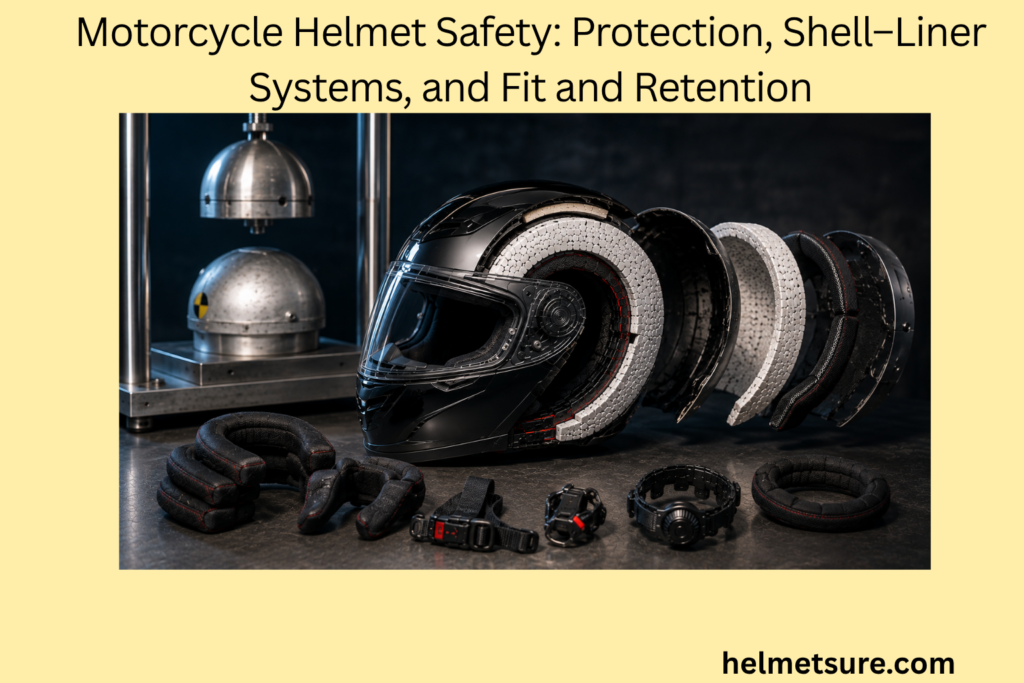
Motorcycle Helmet Safety: Protection, Shell–Liner Systems, and Fit and Retention
Motorcycle helmet safety depends on a complete system: the shell distributes impact loads, the liner deforms to slow the head, and correct fit, retention, certification, and condition keep that protection positioned, validated, and usable.
No single material, feature, specification, price, certification mark, or rating independently defines how safe a motorcycle helmet is. A helmet must combine an effective shell–liner structure with rider-compatible fit, secure retention, verified performance, intact condition, and correct use.
A motorcycle helmet can manage specific impact loads under defined conditions, but no helmet, standard, feature, or rating can guarantee prevention of concussion, traumatic brain injury, skull fracture, death, or any other outcome in an individual crash.
Motorcycle Helmet Safety Depends on a Complete Protective System Rather Than One “Best” Feature
Motorcycle helmet safety depends on the shell, impact liner, fit, retention system, condition, and verified performance working together rather than on one “best” feature. Component specifications describe parts of the design; only the assembled helmet can show how those parts perform together.
No shell material, liner property, fit trait, retention feature, certification mark, or condition check can substitute for the rest of the protective system.
Why shell strength alone cannot determine how much impact reaches the rider’s head
Shell strength alone cannot determine how much impact reaches the rider’s head because the shell’s deformation and load distribution interact with the energy-absorbing liner beneath it.
When the helmet contacts a surface, the shell receives a concentrated load. Its material, thickness, curvature, construction, and stiffness affect how the contact spreads and how the liner is loaded. The liner then supplies much of the controlled deformation distance that extends the stopping process. The relevant sequence is therefore impact contact, shell response, liner loading, and combined headform response—not shell strength in isolation.
Research on protective-helmet EPS and shells, including Di Landro, Sala, and Olivieri00073-3) and motorcycle-helmet modelling by Gilchrist and Mills80013-2), supports this coupled view. A stiffer or stronger shell may change the area and intensity of liner loading, but whether that change is beneficial depends on the matched liner and complete architecture. Carbon fiber, fiberglass, polycarbonate, ABS, and other material labels cannot provide a stand-alone safety ranking.
Why an energy-absorbing liner cannot protect as intended if the helmet moves out of position
An energy-absorbing liner cannot protect as intended if the motorcycle helmet moves substantially out of position because the designed protective coverage and load path no longer remain aligned with the rider’s head.
Impact-management material must stay around the head regions it was designed to cover. A compatible interior shape creates broad, stable contact, while the retention system resists lifting and roll-off. If the helmet is oversized, shape-mismatched, or unsecured, it can rotate or shift before or during sudden movement. That instability can change coverage and the path through which the head loads the liner.
This does not mean a correctly fitted helmet must show absolutely zero movement. Consumer fit guidance focuses on excessive slipping, rotation, or roll-off. Both NHTSA’s helmet-selection guidance and SHARP’s fitting guide treat stable positioning and secure strap use as essential checks. A technically capable liner cannot compensate for a fundamentally unstable fit.
Why fit, retention, structure, and verified impact performance must be evaluated together
Fit, retention, structure, and verified impact performance must be evaluated together because each controls a different condition required for the motorcycle helmet system to function as intended.
The protective structure manages loading. Fit positions that structure around the rider’s head. The retention system resists excessive displacement and roll-off. Certification tests whether the assembled helmet meets defined performance requirements. Current condition determines whether the original structure and retention system can still be relied upon.
NHTSA has long interpreted FMVSS No. 218 as evaluating the helmet as a total system, while the current federal standard specifies performance tests for complete helmets. These elements should not be converted into an invented weighted score. A weakness in any one can undermine the practical value of strength in another.
Why fit, retention, structure, and verified impact performance must be evaluated together
| System element | Primary job | What it cannot prove alone |
|---|---|---|
| Outer shell | Receives and redistributes external loading | Overall helmet safety |
| Energy-absorbing liner | Provides controlled deformation | Correct fit or retention |
| Fit | Positions the protective structure around the head | Retention-system integrity |
| Retention system | Resists roll-off and displacement | Impact attenuation |
| Certification or testing | Verifies defined assembled performance | Identical performance in every crash |
| Condition | Shows whether the structure remains suitable for reliance | Original design quality by itself |
How a Motorcycle Helmet Manages Crash Energy Before It Reaches the Head
A motorcycle helmet manages crash energy through a sequence in which the shell responds to contact, the liner deforms, and the combined structure extends the head’s stopping process. The shell and liner act at different stages of the same event and continually influence each other.
Impact management depends on preserving enough functioning shell response and liner deformation reserve through the event. Useful deformation is finite, not unlimited.
How the outer shell receives and distributes the initial impact load
The motorcycle helmet outer shell receives the initial contact load and changes how that concentrated loading is distributed into the structure and energy-absorbing liner beneath it.
At first contact, the load may be concentrated over a relatively small area. The shell deforms according to its construction and the impact location, expanding or changing the area over which the liner is loaded. This can allow more of the underlying liner to participate, although the distribution is never perfectly uniform and varies with impact shape, shell curvature, stiffness, and local geometry.
Experimental work on polystyrene foam and polycarbonate helmet shells00073-3) and finite-element research on composite motorcycle helmets00066-X) illustrates why shell deformation and liner loading must be considered together. The shell does not simply block or eliminate crash force. It changes the load path that reaches the liner.
How the energy-absorbing liner deforms to lengthen the head’s stopping process
The energy-absorbing liner lengthens the head’s stopping process by compressing and deforming over a finite distance as the helmet responds to impact loading.
Expanded polystyrene, or EPS, is not merely soft padding. Under sufficient load, its cellular structure progressively collapses. That controlled compression uses physical distance and performs deformation work, extending the interval over which the head’s motion changes. The liner must offer enough compression resistance to manage the load while retaining enough crush travel to avoid exhausting its useful deformation too early.
The mechanical behavior described in protective-helmet EPS research00073-3) and motorcycle-helmet impact-severity testing is why “energy absorption” must be tied to actual deformation. The liner does not soak up all force or remove all transmitted acceleration. It changes how the stopping process occurs.
Why controlled deformation can reduce the severity of abrupt head deceleration
Controlled helmet deformation can reduce the abruptness of head deceleration by spreading the required change in motion over a greater deformation distance and time interval.
For comparable loading conditions, stopping over more useful distance and time is less abrupt than stopping over a very short interval. Shell deformation and liner compression provide that additional interval. The value of this mechanism depends on the material compressing at a useful resistance and retaining enough travel as loading develops.
Tests across different motorcycle-helmet impact severities show why helmet response is severity-dependent, while shell–liner modelling80013-2) shows the importance of coupled properties. If the liner is overly resistant for a particular load, less deformation may occur; if its useful travel is exhausted, further stopping distance becomes limited. A lower headform acceleration in a laboratory condition must not be translated directly into a guaranteed clinical outcome for an individual rider.
Why impact protection depends on preserving enough functioning structure throughout the event
Motorcycle helmet impact protection depends on preserving enough functioning shell and liner structure throughout the event to continue distributing load and providing controlled deformation before available capacity is exhausted.
Protection is capacity-limited. The shell must continue to manage contact and load transfer, while the liner must retain usable deformation reserve. As EPS compression progresses toward densification, additional compression becomes increasingly difficult and the remaining stopping distance can diminish sharply. The exact transition depends on the foam, local liner depth, geometry, shell loading, and impact condition.
Useful deformation may leave the helmet changed after an impact. A cosmetically undamaged helmet is not the definition of successful protection, because sacrificial deformation can be part of its intended response. Conversely, an intact-looking exterior cannot establish that the internal structure retains its original capacity. Research on impact severity and liner response and helmet shell damage mechanics00066-X) supports this finite-capacity model.
- Contact: The impact surface loads the outer shell.
- Distribution: Shell deformation changes the area and pattern of liner loading.
- Compression: The energy-absorbing liner deforms over finite travel.
- Deceleration: The head’s stopping process is extended.
- Capacity: Protection continues while enough functional structure and deformation reserve remain.
How the Outer Shell and Energy-Absorbing Liner Divide the Protection Work
The outer shell and energy-absorbing liner divide motorcycle helmet protection work by managing different stages of the same impact rather than performing interchangeable functions. A useful shell response must be matched to a liner capable of using the resulting load distribution.
How the shell spreads concentrated loads across a larger liner area
The motorcycle helmet shell can spread a concentrated impact load across a larger liner area, allowing more of the underlying protective structure to participate in the response.
When a limited contact area loads the shell, the shell can bend, flex, fracture, or otherwise deform according to its architecture. This response changes the contact transmitted to the liner. A broader loaded area can engage more liner volume than the original contact patch alone, but the effect varies with impact site, shell stiffness, curvature, construction, and the interface between shell and liner.
The shell therefore redistributes rather than eliminates loading. Experimental shell–EPS work00073-3) and motorcycle-helmet response modelling80013-2) support the distinction: shell action determines how the liner is recruited, while the liner supplies the principal controlled crushing response.
How the liner uses controlled crushing rather than rigid resistance to manage impact energy
The motorcycle helmet liner manages impact energy through controlled crushing and deformation rather than by remaining rigid under loading.
As EPS cells collapse, the liner can continue deforming through a useful portion of its compression response. This deformation performs work and extends stopping distance. Resistance still matters: the liner must not compress so easily that its available travel is consumed prematurely, nor resist so strongly that insufficient deformation occurs for the loading condition.
EPS deformation research00073-3) and motorcycle-helmet testing at different severities show why no universal “softest is safest” rule is defensible. Tactile softness, material density, structural stiffness, and comfort are also different properties. A rider normally touches comfort padding, not a measured EPS specimen.
Why shell stiffness and liner response must be engineered as one system
Shell stiffness and liner response must be engineered as one motorcycle helmet system because shell deformation determines how and where the liner is loaded.
A change in shell stiffness can alter contact area, local stress, deformation timing, and the amount of liner recruited. That change may require a different liner density, thickness, or geometry to produce the intended complete-helmet response. The relevant load path is shell response, EPS loading pattern, liner compression, and headform response.
This coupling is described in protective-helmet material experiments00073-3), motorcycle-helmet modelling80013-2), and finite-element analysis of composite helmet damage00066-X). There is no universal optimum shell stiffness independent of helmet geometry, impact location, and liner response. Stiffness is also not the same as strength.
Why stronger shell materials do not automatically make the complete helmet safer
Stronger shell materials do not automatically make a complete motorcycle helmet safer because material strength does not independently determine load distribution, deformation, liner use, fit, or verified helmet-level response.
A material name describes one part of the design space. Finished shell performance also depends on formulation, reinforcement, layup or moulding method, thickness, curvature, transitions, hardware openings, and the way the shell couples to the liner. Different materials can support valid helmet designs through different architectures.
Strength, stiffness, toughness, mass, and impact attenuation are not interchangeable. Research on helmet shell and foam deformation00073-3) and composite motorcycle-helmet impact damage00066-X) does not justify a universal carbon-fiber, fiberglass, polycarbonate, or ABS safety ranking. Whole-helmet testing is the more relevant evidence.
Why stronger shell materials do not automatically make the complete helmet safer
| Component | Primary mechanical job | Key design variables | Wrong shortcut |
|---|---|---|---|
| Outer shell | Receives contact and redistributes loading | Material, stiffness, thickness, curvature, construction | “Stronger shell = safer” |
| Energy-absorbing liner | Provides controlled deformation and stopping distance | Thickness, density, geometry, zoning | “Softer, thicker, or denser = safer” |
| Shell–liner system | Couples load distribution with controlled compression | Interfaces, architecture, impact site | Judging either component alone |
How Liner Thickness, Density, and Geometry Change Impact Response
Liner thickness, EPS density, and geometry change motorcycle helmet impact response by controlling available deformation space, compression resistance, and how material is positioned around the head. Each is a useful design variable, but none is a stand-alone safety ranking.
Thickness, density, geometry, and multi-density zoning are engineering variables. They explain construction but do not create a stand-alone consumer safety score.
How liner thickness determines the amount of usable deformation space available during impact
Motorcycle helmet liner thickness determines the geometric space potentially available for controlled compression before useful deformation travel is exhausted.
Greater local liner depth can provide more potential crush travel. That potential becomes useful only when the material’s compression response, the shell’s loading pattern, and the local geometry allow the depth to be used progressively. Total helmet thickness is not the same as local EPS depth, and visible bulk does not reveal how the liner is shaped inside.
Research on EPS deformation volume00073-3) and motorcycle-helmet response at different severities supports treating thickness as available geometric capacity, not as a direct protection score. Millimetres of EPS cannot be converted into a universal safety ranking without density, geometry, shell interaction, and finished-helmet test evidence.
How EPS density changes the force required to compress the liner
EPS density changes the motorcycle helmet liner’s compression response, affecting the load required to produce a given amount of deformation under comparable conditions.
Lower-density EPS generally begins useful deformation under lower applied stress, while higher-density EPS generally offers greater compression resistance. Both responses involve tradeoffs. Material that compresses earlier can consume finite travel sooner under greater loading; material with higher resistance can require more load before reaching comparable deformation.
The density-dependent behavior reported in protective-helmet EPS testing00073-3) and the system interactions modelled by Gilchrist and Mills80013-2) do not establish a universally safest density. Density is not identical to stiffness, and any density value must be interpreted with foam formulation, liner depth, geometry, strain rate, shell response, and the impact condition.
Why exhausting available crush travel can sharply reduce further energy-management capacity
Exhausting the motorcycle helmet liner’s available crush travel sharply limits further controlled deformation, reducing the remaining distance available to extend the head’s stopping process.
As compression progresses, collapsed cells occupy more of the original structure. When the liner approaches strong densification, further compression requires a much steeper rise in load while yielding relatively little additional travel. This is often described as “bottoming out,” but it is not one universal standardized threshold.
The transition varies with foam formulation, density, local thickness, geometry, strain rate, and shell loading. EPS deformation studies00073-3) and motorcycle-helmet impact-severity research support the finite-travel principle, not a single bottoming-out percentage, speed, or force for all helmets.
How multi-density liners tune compression behavior across different helmet regions
Multi-density motorcycle helmet liners tune compression behavior across regions by assigning different material responses where geometry, available depth, and intended loading conditions differ.
Engineers can use regional zones, separate layers, or other multi-density arrangements to match compression response to local liner depth and expected load paths. A thinner region may require different tuning from a deeper region, and different helmet sizes or shell architectures may use different maps.
Multi-density construction therefore creates design flexibility; it does not automatically prove superior protection. The number of zones does not reveal whether the zones are well matched or how the assembled helmet performs. Unless a manufacturer publishes a model-specific construction, riders should not infer the location or value of individual densities. Complete-helmet test evidence remains more useful than the badge alone.
Why density, thickness, and geometry must be interpreted within the complete helmet architecture
EPS density, liner thickness, and geometry must be interpreted within the complete motorcycle helmet architecture because shell loading and component integration determine how those attributes are actually used.
Thickness supplies potential deformation space. Density influences compression response. Geometry places that material and shapes the local load path. The shell determines how contact is transmitted into those regions. Change one variable and the useful response of the others may change as well.
That interaction is consistent across the experimental EPS and shell literature00073-3), impact-severity testing, and motorcycle-helmet system models80013-2). Identical-sounding component specifications can produce different results in different helmets. No validated universal formula can add thickness, density, geometry, or zone count into a consumer safety score.
Why density, thickness, and geometry must be interpreted within the complete helmet architecture
| Liner variable | Primary mechanical effect | Useful interpretation | Cannot prove alone |
|---|---|---|---|
| Thickness | Available geometric deformation space | Potential crush travel | Overall safety |
| Density | Compression response | Load needed for deformation | Universal protection ranking |
| Geometry | Location and shape of usable material | Local load and deformation path | Impact performance by itself |
| Multi-density zoning | Regional tuning | Different responses in different regions | Automatic superiority |
Why Correct Helmet Fit Keeps the Protective Structure Where It Needs to Be
Correct motorcycle helmet fit keeps the shell and impact liner positioned around the intended areas of the rider’s head through compatible size, head shape, and stable contact. The goal is a secure, even fit—not the smallest or most painful helmet the rider can tolerate.
A secure helmet is not simply the smallest or tightest helmet a rider can tolerate. Stable broad contact and compatible head shape matter more than painful local pressure.
Why helmet size must match both head circumference and head shape
Motorcycle helmet size must match both head circumference and head shape because circumference establishes a starting size while shape determines how that interior geometry contacts the rider’s head.
Measure around the widest part of the head, approximately above the eyebrows and ears, then compare that measurement with the specific manufacturer’s chart. A medium in one brand or model may not match a medium in another. Measurement narrows the candidates; it does not prove fit.
NHTSA identifies round oval, intermediate oval, and long oval as broad head-shape descriptors. They refer to the head viewed from above, not the shape of the face. Two riders with similar circumferences can experience very different pressure patterns in the same helmet because their length-to-width proportions differ. The correct labeled size can therefore still be the wrong interior shape.
How excessive looseness allows the helmet to shift before or during an impact
Excessive motorcycle helmet looseness allows the protective structure to shift relative to the head, reducing positional stability before or during sudden movement.
If the interior lacks adequate contact, the shell can slide or rotate without carrying the scalp and cheeks with it. That movement can alter coverage and let the helmet gain motion relative to the head before the retention system engages. A loose helmet may also move noticeably during side-to-side or fore-and-aft checks.
NHTSA advises that a correctly fitting helmet should make even contact and should not move loosely, while SHARP tells riders to check for slipping during controlled rotation and tilting. There is no universal millimetre tolerance for every rider and helmet. Tightening the chin strap cannot correct an oversized shell or an incompatible head shape.
Why excessive pressure at isolated points signals shape mismatch rather than automatically proving a secure fit
Excessive pressure at isolated points signals motorcycle helmet shape mismatch because secure fit should produce stable, broadly distributed contact rather than painful localized loading.
Pressure concentrated at the forehead can indicate that the helmet is too round for the head, while strong pressure at the sides can indicate an interior that is too narrow or elongated for that rider. The exact pattern must be evaluated on the actual head and model. Pain, numbness, persistent hot spots, or pronounced red areas are not proof of extra protection.
Some initial snugness is normal, especially at the cheeks, but it should remain broadly distributed and tolerable during a sustained try-on. NHTSA’s fit guidance specifically distinguishes even pressure from painful pressure points. A shape mismatch can press hard in one area while leaving another poorly supported.
How even contact around the head helps keep the shell and liner correctly positioned
Even, stable contact around the head helps keep the motorcycle helmet shell and liner correctly positioned by limiting excess sliding and rotation without relying on isolated pressure points.
A compatible interior supports the head across the crown and around its circumference. When the helmet is gently moved, the scalp and cheeks should tend to move with it rather than the shell slipping independently. This broad contact supplies the positional foundation; a correctly secured chin strap then provides a separate barrier against lifting and roll-off.
The NHTSA selection guide and SHARP fitting guide both emphasize contact, comfort, and controlled movement checks. For a deeper explanation of the size, shape, pressure, and stability relationship, see fit safety.
Why comfort padding break-in should not be confused with the protective EPS liner changing size
Motorcycle helmet comfort-padding break-in should not be confused with the protective EPS liner changing size because rider-facing pads can compress with use while the structural impact liner serves a different function.
Cheek pads and other comfort components can settle, wear, or be replaced with manufacturer-approved alternatives. That change may make a helmet feel looser over time. The EPS behind those pads is the structural impact-management layer; severe permanent compression of that material is a damage state, not normal sizing or “break-in.”
NHTSA notes that some manufacturers provide replaceable cheek pads or liners for authorized fit adjustment. Altering the structural interior beyond manufacturer-approved parts can compromise integrity. Do not sand, cut, heat, crush, or reshape EPS to correct fit. SHOEI’s care guidance, for example, instructs riders to protect EPS from heat, solvents, scratches, and indentations; instructions remain product-specific.
Fit checklist
Use these checks after measuring a starting size; they do not replace the specific manufacturer’s sizing and fit instructions.
How the Retention System Prevents a Well-Fitted Helmet From Leaving the Head
The motorcycle helmet retention system backs up correct fit by anchoring the helmet beneath the jaw and resisting excessive displacement or roll-off during sudden movement. A helmet that fits correctly still requires a secured, undamaged strap, buckle, anchors, and fasteners.
How the chin strap anchors the helmet beneath the jaw during sudden movement
The motorcycle helmet chin strap anchors the retention system beneath the jaw so the helmet is less able to lift or roll off during sudden movement.
When fastened and adjusted according to the manufacturer’s instructions, the structural webbing forms a retention path between the helmet’s anchor points and the rider’s lower head and jaw area. This is a different function from the friction and contact supplied by basic fit. Chin-strap padding may improve comfort, but it is not the load-bearing strap itself.
The U.S. FMVSS No. 218 treats retention performance as a defined helmet requirement, while SHARP’s consumer guide requires the strap to be secured during fit and roll-off checks. Buckle type alone does not establish retention quality. Double D-rings and quick-release systems can both be valid when properly engineered, maintained, and used.
Why excessive strap slack can allow a correctly sized helmet to shift or roll
Excessive motorcycle helmet chin-strap slack can allow a correctly sized helmet to shift or roll because the retention path is not secured closely enough to resist displacement.
The helmet may fit the crown well yet still lift at the rear or rotate forward if the strap is unfastened or left excessively loose. Slack delays engagement and gives the helmet more room to move before the retention path becomes effective. Conversely, overtightening a strap cannot correct an incompatible shell size or head shape.
Adjust the buckle and strap using the helmet manufacturer’s instructions, then perform careful stability checks. Do not assume one internet “finger gap” applies to every fastening system and rider. SHARP’s guidance describes secure adjustment in practical terms, while FMVSS No. 218 uses a controlled laboratory procedure rather than a consumer gap rule.
How a roll-off check reveals whether the helmet can rotate excessively on the head
A motorcycle helmet roll-off check reveals gross fit or retention instability by testing whether a secured helmet can be rotated or lifted excessively from its intended position.
With the helmet correctly seated and the chin strap fastened, SHARP advises tilting the head forward while another person carefully pushes upward at the helmet’s rear base to see whether it can roll off. Side-to-side and fore-and-aft movement checks can also reveal slipping. The procedure should be controlled and non-destructive.
If the helmet can roll off, the cause may be wrong size, incompatible shape, poor positioning, or incorrect strap adjustment. Passing this practical screen is useful but is not certification. Formal retention testing under FMVSS No. 218 mounts a complete helmet on a defined headform and applies controlled loads; a showroom check cannot reproduce it.
Why damaged straps, anchors, or fasteners can undermine protection even when the shell appears intact
Damaged motorcycle helmet straps, anchors, or fasteners can undermine protection even when the shell appears intact because retention failure provides a separate path for the helmet to lose position.
Frayed or cut webbing, loose or corroded hardware, cracked buckles, pulled anchors, failed stitching, or unreliable fasteners can weaken the structural retention path. An intact shell and liner do not prevent roll-off if this anchoring system fails. Comfort covers should be moved only as permitted to inspect the load-bearing components beneath them.
Because retention parts are safety-critical and product-specific, do not improvise repairs or install a generic strap, buckle, rivet, or adhesive. Confirm whether the manufacturer authorizes a particular replacement or service. SHOEI’s maintenance guidance, for example, treats retention looseness or deterioration as a replacement condition for its helmets; that instruction must not be generalized into an unauthorized repair rule for other brands.
Retention checklist
Verify retention separately from basic fit. The strap and anchors are structural components, not merely comfort hardware.
What Helmet Certification Can—and Cannot—Tell Riders About Protection
Motorcycle helmet certification shows that an assembled helmet satisfies defined requirements under a specific standard, but it does not rank every compliant helmet or predict every real-world crash outcome. Regulatory compliance or type approval and independent comparative ratings are different evidence classes.
Certification establishes defined assembled-helmet performance under a specific scheme. It does not make every compliant helmet identical or guarantee any individual crash outcome.
Why helmet standards test the assembled protective system rather than one material specification
Motorcycle helmet standards test the assembled protective system because shell, liner, retention, geometry, and other components contribute jointly to measured helmet performance.
In the United States, FMVSS No. 218 mounts and conditions complete helmets for specified impact attenuation, penetration, and retention-system procedures. It evaluates performance rather than certifying a shell material, EPS density, or construction recipe by itself. NHTSA’s total-system interpretation supports the same principle, although the current eCFR text is the operative source for current U.S. requirements.
Other jurisdictions use their own approval systems, procedures, labels, and editions. A standard must therefore be identified with its market and legal context. “Certified” is not a material property; it is a claim about an assembled helmet under a particular scheme.
How impact, retention, penetration, and other test requirements establish minimum performance boundaries
Impact, retention, penetration, and other applicable test requirements establish defined performance boundaries by measuring complete helmets under repeatable standardized conditions.
Under current U.S. FMVSS No. 218, impact attenuation testing measures headform response when conditioned helmets strike specified anvils. Penetration testing applies a defined striker to the complete helmet, and retention testing applies controlled tensile loading to the fastening system. Together, these procedures set compliance criteria for that U.S. standard.
The word “minimum” means the boundary defined by the applicable scheme; it does not mean minimum injury risk, nor does it make different standards interchangeable. Other jurisdictions can use additional test conditions, impact locations, oblique tests, velocities, or criteria. Thresholds from one standard should never be copied into another without explicit scheme labels and context.
Why passing a certification does not mean every approved helmet performs identically in every crash condition
Passing a motorcycle helmet certification does not mean every compliant helmet performs identically because the standard establishes defined requirements rather than identical response across all impacts and designs.
Two helmets can meet the same legal boundary with different shells, liner maps, thickness distributions, masses, shapes, and retention architectures. Pass status establishes the required baseline within that scheme. It does not show that headform responses were identical at every site, that performance remains identical beyond the specified tests, or that every real crash will reproduce a laboratory configuration.
This limitation does not make certification meaningless. It is a necessary evidence filter that excludes designs not represented as meeting the applicable requirement. Independent comparative testing can then add information among eligible helmets. For a fuller explanation of baseline compliance and its limits, see certification safety.
Why independent test results can add comparative information beyond a certification label
Independent motorcycle helmet test results can add comparative information beyond a certification label by applying a defined rating methodology to differences among already eligible or compliant helmets.
SHARP is a UK Department for Transport consumer-information programme that publishes model-specific star ratings. Its testing programme subjects helmet samples to its own defined set of linear and oblique impacts and converts measured performance into a comparative rating. This adds a different layer of evidence from regulatory type approval or compliance.
SHARP stars are not legal certification and should not be treated as a universal injury-risk percentage. They are specific to SHARP’s protocol, market, scoring system, tested model, and test date. The programme itself advises riders to establish correct fit and comfort first, then use the rating to compare suitable candidates.
Why certification cannot compensate for incorrect size, poor fit, or improper strap use
Motorcycle helmet certification cannot compensate for incorrect size, poor fit, or improper strap use because laboratory performance assumes a helmet positioned and secured according to defined test conditions.
A certified design may still shift, rotate, or roll off if it is oversized, incompatible with the rider’s head shape, worn incorrectly, or left unfastened. That is a use and positioning problem, not a defect that the certification label can correct. NHTSA and SHARP both place fit and secure fastening at the centre of rider selection.
The reverse is equally important: excellent fit cannot transform an uncertified, noncompliant, counterfeit, or structurally compromised helmet into an equivalent option. Validated performance, compatible fit, and secure retention are cumulative requirements.
Why certification cannot compensate for incorrect size, poor fit, or improper strap use
| Evidence | What it establishes | What it does not establish |
|---|---|---|
| Applicable certification or compliance | Defined assembled-helmet requirements under a specific scheme | Identical performance among all compliant helmets |
| Impact test | Response under specified impact conditions | Every real-world crash outcome |
| Retention test | Defined retention-system performance | Correct fit on a particular rider |
| Penetration test where applicable | Defined resistance to the specified test striker | Complete injury protection |
| Independent rating | Additional method-specific comparison | Legal certification or rider-compatible fit |
When Impact Damage or Deterioration Can Compromise Motorcycle Helmet Protection
Impact damage or deterioration can compromise motorcycle helmet protection when shell, liner, retention, or hardware condition no longer supports the functions the complete system was designed to perform. The failure path may be visible, internal, component-specific, or unresolved.
An intact-looking shell cannot clear hidden liner damage, and intact EPS cannot compensate for a damaged retention path. Condition must be evaluated component by component.
How significant EPS compression can permanently reduce remaining deformation capacity
Significant EPS compression can permanently reduce a motorcycle helmet liner’s remaining deformation capacity because part of its original cellular crush structure and travel has already been consumed.
EPS is designed to undergo controlled, largely irreversible cellular collapse under sufficient impact loading. If a region is permanently crushed, it no longer presents the same original thickness and cell structure for a later event. The remaining liner may therefore have less available deformation reserve at that location.
EPS mechanics research00073-3) and motorcycle-helmet testing across impact severities support this finite-capacity principle. They do not provide a visual formula for calculating a percentage of protection remaining. Minor handling marks also cannot be equated automatically with significant impact compression. Event context, component condition, and authoritative product guidance determine the appropriate action.
Why internal liner damage can exist beneath a shell that still looks acceptable externally
Internal motorcycle helmet liner damage can exist beneath a shell that looks acceptable because shell appearance does not reveal every compressive or structural change in the impact liner below it.
The shell and liner respond differently during an impact. A shell can rebound or show limited external marking while the underlying EPS sustains localized permanent compression. Other structural changes can also be concealed by paint, trim, comfort padding, or the shell itself.
SHOEI’s current, manufacturer-specific impact inspection guidance warns that foam-liner damage may exist after a significant impact even without obvious external signs. That does not mean every normal-looking helmet is secretly damaged. It means appearance alone cannot clear a helmet after a meaningful event, and home inspection cannot reproduce the tests used to validate its original performance.
How shell cracks, delamination, deformation, or damaged hardware can compromise structural function
Shell cracks, delamination, permanent deformation, or damaged motorcycle helmet hardware can compromise structural function by changing load distribution, component attachment, or the integrity of the protective assembly.
A crack can interrupt the shell’s load path. Delamination can change the behavior of a laminated composite. Permanent deformation can alter geometry and liner contact. Broken visor-base components may be replaceable on some products, while damaged structural fasteners, shell penetrations, or anchor attachments can present a more serious concern. The significance depends on the specific construction and component function.
Composite motorcycle-helmet damage analysis00066-X) supports the link between shell damage and changed structural response. A light paint scuff is not automatically a structural crack, but riders should not invent a “safe” crack length, delamination area, or home repair. Use the manufacturer’s current instructions or authorized assessment where available.
Why damaged retention components create a separate failure path even if the impact liner remains intact
Damaged motorcycle helmet retention components create a separate failure path because an intact impact liner cannot perform as intended if straps, anchors, or fasteners fail to keep the helmet positioned.
Retention integrity is mechanically separate from impact-liner condition. Frayed webbing, weakened stitching, a cracked buckle, a loose rivet, or a disturbed anchor can reduce resistance to displacement even when the shell and EPS show no obvious damage. This can justify action based on retention condition alone.
The structural role of the retention assembly is explicit in FMVSS No. 218. Whether an individual part can be serviced is product-specific. Do not substitute a generic buckle, rivet, webbing strap, adhesive, or do-it-yourself anchor repair for manufacturer-authorized parts and procedures.
Why unknown crash history makes the remaining protection of a used helmet difficult to verify
Unknown crash history makes a used motorcycle helmet’s remaining protection difficult to verify because prior impacts, storage, wear, liner condition, and retention deterioration may not be reconstructable from appearance alone.
A second-hand helmet may look clean while its previous loads, storage temperatures, solvent exposure, pad wear, liner changes, strap use, and fit history remain unknown. It may also have adapted to another rider’s comfort and fit pattern. These unknowns reduce confidence in the helmet’s current state and rider compatibility.
SHARP’s used-helmet guidance highlights exactly these provenance problems. Unknown history is not proof that a specific defect exists; it is an inability to verify that the protective system remains in the assumed condition. That distinction supports conservative decisions without making unsupported damage claims.
Why unknown crash history makes the remaining protection of a used helmet difficult to verify
| Condition | Primary concern | What appearance can establish |
|---|---|---|
| Permanent EPS compression | Reduced original deformation reserve | Visible deformation confirms change but not exact remaining capacity |
| Shell crack, delamination, or permanent deformation | Altered structural behavior | Some structural damage can be seen, but not quantified at home |
| Damaged strap, anchor, or fastener | Loss of retention integrity | Visible damage can establish a retention concern |
| Significant impact with an intact-looking shell | Possible hidden liner or structural change | Appearance cannot clear every internal condition |
| Unknown used-helmet history | Unverifiable prior loading and wear | Current cosmetics cannot reconstruct full provenance |
When Should a Motorcycle Helmet Be Removed From Service or Replaced?
A motorcycle helmet should be removed from service when meaningful impact, visible structural damage, retention damage, or unresolved condition uncertainty prevents reliable confidence in the protective system under applicable guidance. Product-specific manufacturer instructions take priority over generic assumptions.
Meaningful impact, visible structural damage, damaged retention, or unresolved condition uncertainty can justify removing a helmet from normal reliance until disposition is resolved.
Why a helmet involved in a significant head impact should not be cleared solely by external appearance
A motorcycle helmet involved in a significant head impact should not be cleared solely by external appearance because impact-induced liner or structural changes can exist without obvious shell damage.
If the rider’s head was inside the helmet during a meaningful crash impact, the liner may have been loaded and permanently compressed as part of its protective function. A clean paint surface cannot demonstrate that the underlying EPS, shell interface, retention anchors, or hardware remains unchanged. Remove the helmet from normal reliance and follow the manufacturer’s current post-impact instructions.
SHARP’s replacement guidance and SHOEI’s model- and market-specific impact guidance both treat impact history as relevant even when exterior damage is limited. There is no universal rider-observable crash speed, drop height, or force that defines significance across every helmet and event.
When visible shell, EPS, strap, or anchoring damage creates a clear remove-from-service concern
Visible structural shell, EPS, strap, or anchoring damage creates a clear motorcycle helmet remove-from-service concern because one or more safety-critical system components no longer remain in verified original condition.
Examples include a structural shell crack, delamination, permanent shell distortion, visibly crushed or breaking EPS, separated liner, cut or frayed structural webbing, damaged anchor, unreliable buckle, or failed fastener. Each affects a different system function, but all create uncertainty about continued load management or retention.
Stop relying on the helmet until its disposition is resolved through the manufacturer’s current instructions or an authorized service where one exists. Replaceable comfort pads, a removable breath guard, or another manufacturer-listed convenience part belong to a different category. Never cut, glue, fill, heat, rivet, or otherwise repair a structural shell, EPS liner, strap, or anchor at home.
Why uncertain impact history raises a stronger replacement concern than cosmetic wear alone
Uncertain impact history raises a stronger motorcycle helmet replacement concern than cosmetic wear alone because unknown prior loading leaves structural and liner condition unresolved.
A known superficial scuff from gentle contact is a different evidence state from a helmet found after an unknown fall, purchased used without provenance, or recovered after an event no one can describe. The first may be cosmetic; the second leaves the protective structure’s loading history unverified.
Uncertainty still does not prove that the helmet will fail or that hidden damage certainly exists. It means there is no sound basis for clearing the system by appearance alone. SHARP’s second-hand buying guidance and replacement FAQ support treating provenance and condition separately from ordinary cosmetics.
When manufacturer inspection may help resolve uncertainty that cannot be assessed reliably at home
Manufacturer inspection can help resolve motorcycle helmet uncertainty when the manufacturer offers a documented assessment service for conditions that a rider cannot reliably evaluate at home.
Availability is limited. For example, SHOEI currently offers a U.S.-specific impact inspection service for eligible authentic helmets within stated purchase, warranty, and retailer boundaries. SHOEI says its evaluation is limited, does not use X-rays, may not identify every possible defect, and is not offered for every submitted helmet.
That service is an OEM assessment, not regulatory re-certification, and it cannot be generalized to other brands, markets, models, or damage conditions. Check the actual manufacturer and regional distributor. If no documented assessment exists, or if the manufacturer recommends replacement, a local visual opinion should not be presented as equivalent verification.
Why replacement is the safer decision when meaningful structural damage is known and protective capacity cannot be verified
Replacement is the safer motorcycle helmet decision when meaningful structural damage is known and the system’s remaining protective capacity cannot be verified through applicable authoritative or manufacturer guidance.
The logic is conservative but specific: a safety-critical component has changed, the helmet’s original performance assumption no longer holds, and no authoritative process has restored confidence in the assembly. Continued reliance would therefore rest on guesswork. Replacement manages that uncertainty; it does not prove the helmet would certainly fail in a future crash.
Cosmetic wear and manufacturer-authorized replacement of nonstructural comfort parts do not automatically trigger the same rule. Nor is there one universal age, crack size, impact speed, or drop height that applies to every helmet. Follow current product-specific guidance. SHARP and SHOEI provide examples of condition-based guidance, but SHOEI’s service-life and component instructions apply only to its own products.
Replacement decision checklist
Use these checks when impact history or damage raises doubt. Manufacturer and product-specific guidance takes priority.
How Should Riders Evaluate Motorcycle Helmet Safety Before Buying?
Riders should evaluate motorcycle helmet safety by confirming recognized certification first, then establishing compatible fit and secure retention before using materials, features, or independent ratings as secondary evidence. Fit and retention are gating conditions; marketing claims are not substitutes.
Certification, rider-compatible fit, and secure retention are gating conditions. Materials, features, price, and independent ratings are secondary evidence.
Why recognized certification should be treated as the first safety-performance filter
Recognized motorcycle helmet certification should be treated as the first safety-performance filter because it establishes that the helmet is represented as meeting defined requirements applicable to its market.
Identify the legal or recognized scheme for the jurisdiction in which the helmet will be used, then verify the required labels and model information through the appropriate authority. In the United States, the DOT label represents the manufacturer’s certification that the helmet conforms to FMVSS No. 218.
NHTSA explicitly states that it does not pre-approve helmets; the U.S. system relies on manufacturer self-certification, followed by agency compliance testing and enforcement. Certification is therefore the baseline filter, not a promise that every marked helmet was pre-tested by the regulator or that all compliant models perform identically.
Why correct head shape and stable fit should be established before comparing secondary features
Correct head shape and stable motorcycle helmet fit should be established before secondary feature comparisons because a technically advanced helmet loses practical value when its interior geometry does not match the rider.
Begin with the manufacturer’s size chart, then try the helmet on the actual rider. Look for even crown contact, firm but tolerable cheek contact, limited independent movement, and no severe isolated pressure points. Keep it on long enough to reveal shape mismatch. If the helmet slips, rotates excessively, causes pain, or cannot be positioned correctly, remove it from the candidate list.
A high rating, premium shell material, elaborate vent system, or higher price does not fix incompatible fit. SHARP’s selection advice is appropriately ordered: find helmets that fit correctly and comfortably, then use its rating to compare those suitable choices.
Why secure retention should be verified rather than assumed from helmet size alone
Secure motorcycle helmet retention should be verified separately from size because a correctly fitted shell still depends on the chin strap and anchoring system to resist displacement.
Fasten the actual buckle, adjust the strap according to the manufacturer’s instructions, and confirm that the system can be operated reliably. Inspect the webbing, stitching, anchors, and fastener. Then perform careful fore-and-aft, side-to-side, and roll-off screens without damaging the helmet.
Strap style preference is secondary to correct function. Fit contact and retention anchoring provide different forms of positional security, so a snug crown does not prove that the strap is correctly adjusted. SHARP’s practical checks and the formal retention requirements in FMVSS No. 218 illustrate the difference between rider verification and laboratory validation.
Why shell materials, EPS densities, and multi-density claims should be interpreted as design information rather than standalone safety rankings
Shell materials, EPS densities, and multi-density claims should be interpreted as motorcycle helmet design information rather than stand-alone safety rankings because complete performance depends on how those attributes are integrated.
Shell material tells the buyer something about construction. EPS density describes a material attribute related to compression response. Liner depth indicates potential deformation space, and multi-density construction describes a tuning strategy. None shows, by itself, how the complete helmet responds at different sites and severities.
Do not award automatic safety points for carbon fiber, thicker foam, greater density, more zones, or higher price. Shell and EPS experiments00073-3), motorcycle impact testing, and complete-system modelling80013-2) support using specifications to understand the architecture—not to replace finished-helmet evidence.
Why independent impact-test data can provide useful comparative evidence when available
Independent motorcycle helmet impact-test data can provide useful comparative evidence when available because it can reveal measured differences among helmets that already satisfy an applicable baseline standard.
Once certification, fit, and retention have narrowed the choices, use a recognised motorcycle-helmet testing scheme that identifies its method, market, model, and test status. SHARP’s model-specific ratings are one example for helmets assessed within its UK programme. The result should be matched to the exact model rather than assumed from brand reputation.
Do not combine stars or scores from unrelated sports, standards, or rating systems as if they share one scale. Test velocities, anvils, conditioning, impact locations, rotational methods, injury models, and scoring weights can differ. Comparative data is useful only within the methodology that produced it.
Why the safest specification on paper loses value if the helmet does not remain correctly positioned on the rider
The safest-looking motorcycle helmet specification on paper loses practical value when the helmet does not remain correctly positioned because protective coverage and retention depend on rider-specific fit and secure use.
The defensible buying sequence is cumulative: verify the applicable performance baseline, establish compatible size and shape, secure and inspect retention, confirm current condition and provenance, and only then compare design features and independent data. A failure at any gating step removes the candidate, even if another feature looks impressive.
Fit is not all that matters. Correct positioning cannot transform a noncompliant, counterfeit, damaged, or unverifiable helmet into a valid choice. The goal is a verified design that also fits the individual rider and remains securely positioned.
Pre-purchase safety checklist
Use this order to screen candidates before secondary features or marketing claims influence the choice.
What Defines an Effective Motorcycle Helmet Safety System?
An effective motorcycle helmet safety system combines shell–liner impact management, compatible fit, secure retention, applicable certification, intact condition, and correct use rather than relying on one feature.
Effective protection begins with a shell and liner engineered to manage impact together
Effective motorcycle helmet protection begins with a shell and liner engineered to manage impact together through coordinated load distribution and controlled deformation.
The shell receives contact and changes how the load reaches the liner. The liner compresses over finite travel to extend the head’s stopping process. Material labels and isolated specifications do not supersede this relationship. The more relevant evidence is how the complete helmet performs under a defined test method.
Correct fit and retention keep that protective structure positioned around the head
Correct motorcycle helmet fit and retention keep the protective shell and liner positioned around the head by combining compatible interior contact with secure anchoring beneath the jaw.
Size and head shape determine whether the helmet can make stable, broadly distributed contact. The retention system then resists excessive displacement and roll-off. A good fit cannot excuse an unfastened or damaged strap, and a tight strap cannot correct the wrong shell size or interior geometry.
Certification, condition, and correct use determine whether the engineered system can be relied upon in practice
Certification, current helmet condition, and correct use determine whether an engineered motorcycle helmet system has verified baseline performance and remains suitable to rely on in practice.
Certification or type approval establishes defined performance under the applicable scheme. Condition determines whether impact damage, deterioration, unauthorized modification, or retention damage has weakened confidence in the original structure. Correct use keeps the helmet seated and fastened as intended. None guarantees an injury-free outcome, but all are necessary parts of a defensible safety decision.
Motorcycle helmet safety is strongest when structure, fit, retention, and verified performance are evaluated as one system
Motorcycle helmet safety is strongest when structure, fit, retention, condition, and verified performance are evaluated as one system rather than as independent feature scores.
Start with a helmet that meets the applicable requirement. Understand its shell and liner as a coordinated impact-management structure. Confirm that the size and shape suit the rider, secure the retention system, use valid comparative evidence where available, and keep the helmet in an intact, manufacturer-supported condition.
This complete-system approach removes misleading shortcuts without removing the limits of helmet protection. Once the system itself can be evaluated, the next question is where its protection stops being reliable. Continue with protection limits.
Complete-system summary
- Start with an assembled helmet that meets the applicable safety-performance requirement.
- Understand the shell and liner as a coordinated impact-management system.
- Interpret thickness, density, geometry, and shell material as design variables rather than rankings.
- Match helmet size and shape to the rider.
- Secure the retention system separately from basic fit.
- Use independent test results as comparative evidence only within their methodology.
- Inspect condition and treat meaningful damage or unknown history conservatively.
- Judge motorcycle helmet safety as structure + fit + retention + validation + condition + correct use.
Frequently Asked Questions About Motorcycle Helmet Safety
These answers summarize the article’s complete-system, impact-management, fit, retention, certification, condition, replacement, and buying boundaries.
What makes a motorcycle helmet safe?
Motorcycle helmet safety depends on the complete system: shell–liner impact management, rider-compatible fit, secure retention, applicable certification, intact condition, and correct use.
Is a stronger shell automatically safer?
No. Shell strength alone cannot determine helmet-level protection because shell deformation and load distribution interact with the matched energy-absorbing liner beneath it.
Why does the impact liner matter?
The impact liner provides controlled deformation distance that extends the head’s stopping process. Its useful response depends on thickness, density, geometry, shell loading, and remaining deformation reserve.
How should a motorcycle helmet fit?
A suitable helmet should make stable, broadly distributed contact without excessive movement or painful isolated pressure points. Circumference establishes a starting size; head shape still has to match.
Why does the chin strap matter if the helmet already fits snugly?
Fit and retention are separate. Fit positions the protective structure; the secured strap, anchors, buckle, and webbing resist excessive lifting, displacement, and roll-off.
What does certification prove?
Certification shows that an assembled helmet met defined requirements under a particular scheme. It does not guarantee every real-world crash outcome or make every compliant helmet perform identically.
Can a helmet be damaged even if the shell looks fine?
Yes. The liner can sustain hidden permanent compression and retention components can be damaged independently. Exterior appearance alone cannot verify the complete system remains in its original condition.
What should riders prioritize when buying?
Start with recognized applicable certification, then establish compatible fit and secure retention. After those gating conditions, use condition, authenticity, design information, and valid independent test data as additional evidence.