
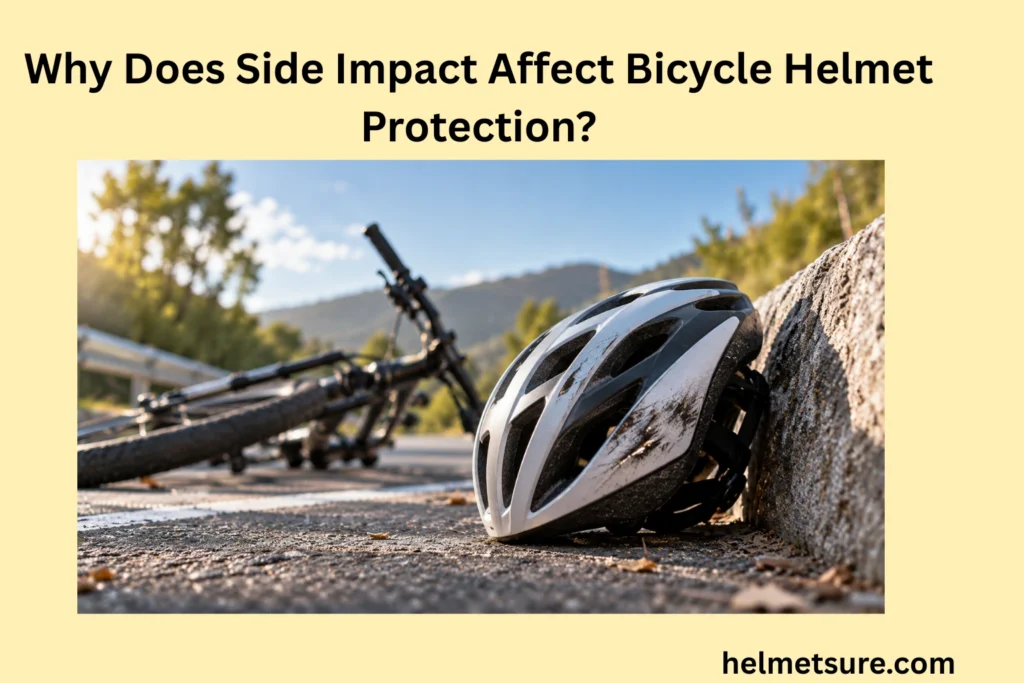
Why Does Side Impact Affect Bicycle Helmet Protection?
Side impacts change bicycle helmet protection because off-center contact combines direct and tangential loading, creating a turning effect around the head; protection therefore depends on how the complete helmet system manages both linear and rotational motion.
A more centrally aligned impact tends to push the helmet and head along a straighter path. Side or oblique contact changes that mechanical problem: the force can act inward while also driving across the helmet surface. The result is not the same in every crash, because impact speed, angle, location, surface friction, helmet construction, fit, and position all affect how much linear and rotational motion develops.
For that reason, side-impact protection should be evaluated as a property of the helmet-head system. The shell, impact liner, helmet geometry, any rotational-management structure, the fit, and the retention system interact with the impact rather than working as isolated safety features.
Side Impacts Load a Bicycle Helmet Differently From More Direct Impacts
Side impacts load a bicycle helmet differently from more direct impacts because off-center contact changes both the direction of loading and the path through which that loading enters the helmet-head system.
The term side impact identifies a general area or direction of contact. It does not automatically describe the exact force components or the motion that follows. An impact at the side of a helmet may be relatively direct, strongly oblique, or somewhere between those conditions. Similarly, an oblique impact can occur at more than one helmet location.
How off-center contact introduces tangential loading alongside direct force
The direct, or normal, component acts more nearly perpendicular to the contacting surface. It pushes the helmet toward the head and commonly contributes to translational, or straight-line, motion. The tangential component acts along the surface and can make the helmet slide, grip, deform, or turn relative to the object it strikes.
These components can exist in the same event. Imagine a helmet contacting pavement at an angle: part of the loading acts inward, while another part acts across the shell as the helmet and surface move relative to one another. A more centrally aligned impact may be dominated by the direct component, but that does not make it completely free of rotational motion.
The size of the tangential component cannot be inferred from the word “side†alone. Contact angle, surface interaction, shell shape, impact location, speed, and the helmet’s response all affect the resulting loading. These components describe the mechanical event; neither one, by itself, determines an injury outcome.
Why impact location changes how forces enter the helmet-head system
Impact location changes how forces enter the helmet-head system because different contact points alter the local helmet geometry, force path, and distance between the applied load and the head’s center of mass.
Impact direction answers which way the loading arrives. Impact location answers where it enters the helmet. The two variables are related, but they are not interchangeable. A contact near the temple, rear quarter, or crown meets different shell curvature, vent geometry, liner structure, and alignment with the head.
Location also changes the line of action of the force. When that line passes farther from the head’s center of mass, it can create more turning leverage under otherwise comparable conditions. When it passes closer, the response may be more strongly translational. The actual motion still depends on the complete impact rather than location alone.
Laboratory impact points are therefore protocol-specific. A result at one location on one helmet cannot establish that an entire side region is universally safe or unsafe. It shows how that model responded at the tested point, using the stated headform, speed, angle, surface, and measurement method.
Direct and Side-Impact Characteristics
| Impact characteristic | What it describes | Why it matters |
|---|---|---|
| More direct contact | Loading acts more strongly toward the head | Linear response receives greater emphasis |
| Oblique/off-center contact | Loading combines inward and tangential components | Turning effects become more relevant |
| Contact location | The point where loading enters the helmet | Local geometry and leverage change |
| Impact direction | The direction of incoming loading | The balance of direct and tangential components changes |
How Side Impacts Can Create Rotational Loading of the Head
Side impacts can create rotational loading of the head when off-center force acts away from the head’s center of mass and produces a turning moment.
Rotational loading describes the mechanical tendency to change the head’s angular motion. It is not another name for side impact, and it is not proof that an injury has occurred. The concept explains one way in which impact geometry can change the head’s movement.
How off-center force creates a turning effect around the head
In plain language, a force applied away from the middle of an object has leverage. That leverage creates a turning moment, also called torque. With the head, an off-center load can therefore contribute to angular motion as well as straight-line motion. If a comparable force acts closer to the center of mass, its turning leverage is generally smaller.
The magnitude of the resulting rotation is not fixed. It changes with the force, the offset distance, the orientation of the head, the contact geometry, friction, and the way the helmet moves and deforms. This is why rotational protection must be discussed as a condition-dependent response rather than a promise attached to one component or technology.
Rotational loading is also not equivalent to a diagnosed brain injury. Researchers measure head kinematics because they provide evidence about the mechanical response of the headform or head, but an individual medical outcome depends on many additional variables.
Why rotational acceleration differs from straight-line acceleration
Rotational acceleration differs from straight-line acceleration because it describes the rate of change in angular motion, while linear acceleration describes the rate of change in translational motion.
Linear acceleration tells us how quickly the head’s straight-line velocity changes. Rotational acceleration tells us how quickly its angular velocity changes. A head can translate, rotate, or do both during the same impact, so the measurements are complementary rather than interchangeable.
A helmet may also rank differently across the two responses. Its liner and geometry may manage direct loading effectively under one condition while its behavior under tangential loading produces a different rotational result. Neither metric should therefore be treated as a complete helmet-safety score without the test method, impact condition, and other measured responses.
The mechanical sequence is:
- Off-center contact places the force line away from the head’s center of mass.
- The offset creates a turning moment, allowing angular motion to develop.
- A change in angular velocity produces rotational acceleration.
- Direct loading remains present, so linear acceleration can develop at the same time.
- The helmet’s response modifies both components before they are measured at the head or headform.
Which Factors Change the Severity and Character of Side-Impact Loading?
The severity and character of side-impact loading change with impact speed, contact angle, surface friction, helmet position, and contact location because each variable alters the energy, direction, or concentration of loading.
These variables interact. Speed primarily changes the energy entering the event, while angle and friction influence the balance and transfer of direct and tangential loading. Position and location influence where that loading reaches the helmet. None is a standalone predictor of injury.
How higher impact speed increases the energy the helmet must manage
The basic relationship is expressed as (E_k = \frac{1}{2}mv^2). For the same effective mass, an increase in impact velocity produces a larger increase in kinetic energy because velocity is squared. That additional incoming energy increases the demand placed on the shell, liner, and other energy-management structures.
Speed does not determine the character of the loading by itself. A faster contact can still be more centrally aligned, while a slower one can be strongly oblique. Angle, friction, location, geometry, helmet position, and any secondary impacts influence the balance of linear and rotational response.
Nor does a speed value map directly to a predicted injury. The helmet’s condition and response, rider anatomy, impact sequence, and biological variability remain important. Speed identifies one part of the protection challenge, not the outcome.
How contact angle and surface friction change tangential loading
Contact angle and surface friction change tangential loading by altering how strongly the contacting surfaces push across one another during an oblique impact.
Angle changes the balance between the component directed inward and the component directed along the surface. Friction affects whether the helmet surface slides readily or couples more strongly with the contacting object. Together, these properties influence how tangential loading is transferred into the helmet-head system.
Stronger coupling can increase the opportunity for tangential force transfer in a defined setup, while easier sliding can change the duration and path of contact. Neither state is universally safer. Shell curvature, normal loading, surface materials, impact location, helmet movement, and headform properties can all change the measured response. Oblique-impact research also shows that headform friction and moments of inertia can materially influence rotational measurements, which is one reason test conditions must be reported clearly.
Friction is therefore an interface property, not a synonym for tangential force or rotational acceleration. It helps shape the response, but it does not determine it alone.
How helmet position and contact location alter where loading is concentrated
Helmet position and contact location alter where side-impact loading is concentrated because they determine which shell and liner regions receive the initial contact and how those regions align with the head.
A correctly positioned helmet places its intended protective regions over the intended parts of the head. If the helmet is tilted far back, sits too low, or shifts excessively, an impact may engage a different shell curvature, edge, vent, or liner region than the design assumes. Contact location then determines the local path through which the load moves from shell to liner and toward the head.
Correct positioning does not make every point on a helmet equally protective, nor does it prove impact attenuation. Local construction can vary, and the direction and severity of the crash still matter. Fit and retention support alignment; they do not erase design or impact-condition differences.
Side-Impact Loading Modifiers
| Modifier | Primary effect | What it does not establish |
|---|---|---|
| Impact speed | Changes incoming energy | A specific injury outcome |
| Contact angle | Changes the direct/tangential balance | That every oblique angle behaves alike |
| Surface friction | Changes sliding and tangential coupling | That one friction level is universally safer |
| Helmet position | Changes alignment of protective structures | That fit proves attenuation |
| Contact location | Changes local loading path and leverage | A universally safe or unsafe helmet region |
How a Bicycle Helmet Responds When Side-Impact Loading Reaches the Helmet
A bicycle helmet responds to side-impact loading through the combined behavior of its outer shell, energy-managing liner, geometry, retention system, and any engineered structure that changes motion between the helmet and head.
The protective sequence matters. The surface receives contact, the shell and underlying structure distribute and manage loading, the impact liner deforms, and the fit and retention system help keep those structures aligned. Depending on the design, another interface or deformable structure may also influence tangential transfer. The measured response belongs to the complete system.
How the outer shell spreads localized impact forces
When a small region contacts the ground or another object, the shell receives that local load first. Its material, curvature, vent layout, thickness, and connection to the liner influence how the load is spread into the structure beneath it. Distribution can reduce local concentration, but it does not make the force disappear.
The shell’s role should not be confused with the liner’s role. In many bicycle helmets, the shell helps preserve surface continuity, resist local damage, and spread contact, while the structural impact liner provides much of the deformation used to manage energy. Exact responsibilities vary with construction, so appearance or shell material alone cannot establish performance.
How the liner deforms to manage impact energy
The helmet liner manages impact energy by deforming under load, increasing the distance and time over which the head is slowed rather than transmitting the incoming loading unchanged.
Controlled deformation changes the force and deceleration history reaching the head. A structural liner may compress, crush, buckle, shear, or combine mechanisms depending on its material and architecture. This impact liner is different from the soft comfort padding that improves fit and feel.
Deformation space matters, but thickness alone is not a protection score. Density, material properties, cell structure, geometry, vents, local architecture, bonding, and impact severity all influence how and when the liner deforms. If a liner is too stiff for one loading condition, too soft for another, already damaged, or driven through its useful deformation range, the response can change substantially. Technical reviews of bicycle-helmet designs accordingly treat liner material and structure as interacting variables rather than isolated visual cues.
How helmet movement relative to the head can influence transmitted loading
Helmet movement relative to the head can influence transmitted loading when an engineered interface or deformable structure permits controlled motion that changes tangential coupling during an oblique impact.
Some helmets use low-friction interfaces, shear elements, collapsible structures, or other engineered mechanisms intended to change how tangential loading passes through the helmet. Under a defined test condition, controlled sliding or deformation can alter the rotational motion measured at the headform. Different systems work in different ways, and their effects can vary with model, location, angle, speed, and test method.
This engineered relative motion is not the same as a loose helmet. Uncontrolled displacement caused by incorrect size, poor adjustment, or incompatible head shape can move protective regions away from their intended positions. A technology name proves that a mechanism is present or claimed; independent testing of the specific helmet is needed to establish comparative performance.
The system response can be summarized as follows:
- The outer shell receives localized contact and distributes loading into the helmet structure.
- The impact liner deforms to manage incoming energy and the head’s deceleration.
- Oblique-response structures, where present, can modify tangential coupling through controlled motion or deformation.
- Fit and retention help preserve the intended position of those structures.
- The resulting linear and rotational headform kinematics provide condition-specific measurements of the response.
Which Helmet Attributes Can Influence Side-Impact Protection?
Helmet attributes that influence side-impact protection include coverage, shell geometry, liner construction, rotational-management features, fit, and retention because each affects a different stage of the helmet-head response.
Each is mechanically relevant, but relevance is not the same as proof. A plausible design mechanism explains how an attribute might influence loading. Verified performance requires credible measurements from the specific helmet under a stated test method.
How coverage and shell geometry influence side-impact contact
Coverage describes the physical extent of the helmet. If protective structure extends over a region, it can participate when that region is struck. Geometry describes the shape of the shell surface, including curvature, edges, and vents that can affect the initial contact and loading path.
Broader or deeper coverage can reduce the area of the head left outside the helmet’s structure, but it does not reveal how effectively the covered region attenuates an impact. That requires information about the local shell, liner, system construction, and measured response. This distinction is central when evaluating side coverage: coverage affects exposure and engagement, but it is not itself an impact-performance rating.
How liner construction and rotational-management features influence impact response
Liner construction and rotational-management features influence impact response by changing how the helmet deforms, manages incoming energy, and interacts with tangential loading.
Liner architecture includes more than visible depth. Materials, density distribution, internal geometry, vents, segmentation, and the way the liner connects to the shell can change its deformation response. Rotational-management structures may instead target tangential coupling through sliding, shearing, buckling, or other controlled mechanisms.
These are plausible mechanical pathways, not automatic proof of superiority. Even helmets carrying the same branded technology may implement it differently. Independent studies have found that measured benefits can depend on the specific helmet and impact condition; results should therefore remain attached to the tested models and protocol rather than generalized to every product using the label.
Why secure fit and retention help keep protective structures positioned as intended
Secure fit and retention help keep protective helmet structures positioned over the intended areas of the head so those structures remain aligned with the protection geometry the helmet was designed to provide.
Fit describes the compatibility between the helmet’s internal shape, size, and the wearer’s head. Retention describes the straps, buckle, anchors, and adjustment system that help preserve the helmet’s position. Together, they limit unwanted shifting and help keep the shell and impact liner over the intended regions.
The tightest possible adjustment is not the goal. A helmet should be correctly sized, level, stable, and secured according to its instructions without creating harmful pressure. The CPSC requires U.S. bicycle helmets to include fit and wearing instructions and evaluates positional stability and retention strength within its standard. Those requirements support positioning; they do not prove that the shell or liner outperforms another helmet in side-impact attenuation.
Helmet Attributes and Evidence Limits
| Helmet attribute | What it can influence | What it does not establish by itself |
|---|---|---|
| Coverage | Which head regions sit beneath helmet structure | Impact attenuation |
| Shell geometry | Initial contact and loading path | Overall injury protection |
| Liner construction | Deformation and energy-management behavior | Universal superiority |
| Rotational-management features | Response to tangential loading | Guaranteed injury reduction |
| Fit | Helmet position on the head | Material performance |
| Retention | Ability to preserve intended position | Energy-management capability |
Why Visible Helmet Features Do Not Predict Side-Impact Protection by Themselves
Visible helmet features do not predict side-impact protection by themselves because appearance reveals only selected design attributes and does not establish how the complete helmet responds under controlled impact loading.
A useful evaluation separates three levels of evidence. First, a feature may be relevant to the mechanics. Second, it may have a plausible effect based on design principles. Third, the specific helmet may demonstrate measured performance in a credible test. Seeing the first level does not prove the third.
Why greater coverage does not by itself indicate greater energy-management capability
Coverage establishes that helmet structure exists over more of a particular head region. This matters because an uncovered region cannot benefit from shell or liner material that is not there. Yet the amount of area covered says nothing by itself about the local liner material, deformation behavior, shell-liner integration, or kinematics measured during impact.
Coverage is therefore relevant but insufficient. A deeper-looking helmet may offer more physical extent without necessarily producing lower headform acceleration than another helmet under a particular test. Conversely, a measurement from one impact point should not be generalized to every point within the helmet’s covered area.
Why liner thickness does not by itself reveal actual impact behavior
Liner thickness does not by itself reveal actual impact behavior because energy management also depends on material properties, density, geometry, structural architecture, and the loading condition applied to the helmet.
Greater depth can provide more potential deformation distance, but only if the material and construction use that distance effectively under the relevant load. Two liners that appear equally thick can respond differently because their materials, densities, cell structures, vents, reinforcement, or shell connections differ. Even within one helmet, local liner architecture can vary by region.
Visual inspection also cannot show the full dynamic response or reliably reveal hidden impact damage. Controlled testing is the evidence layer that measures what happens when a known load is applied. Thickness remains a design variable; it is not a substitute for that measurement.
Why secure fit supports helmet positioning without substituting for protective-material performance
Secure fit supports helmet positioning without substituting for protective-material performance because fit determines where the helmet stays while the structural helmet components determine how incoming impact loading is managed.
A stable helmet is more likely to keep its intended coverage in place and less likely to shift before or during ordinary riding movement. That is essential to proper use. But fit cannot reveal how the shell distributes contact, how the liner deforms, or how an engineered interface responds to tangential loading.
The distinction works both ways. Poor fit does not prove that the helmet materials are inherently weak; it shows that the product is unsuitable or incorrectly adjusted for that wearer. Correct fit does not prove superior materials. A complete assessment needs both proper positioning and appropriate performance evidence.
Visible Features and Their Boundaries
| Visible or easily observed feature | What it can establish | What it cannot establish |
|---|---|---|
| Greater side coverage | More helmet structure extends over that region | Energy-management capability |
| Thicker-looking liner | Greater apparent material depth | Actual dynamic impact response |
| Branded rotational feature | A particular mechanism is incorporated or claimed | Comparative injury protection |
| Secure fit | The helmet can remain better positioned | Shell and liner performance |
| Certification label | Defined requirements were met within the certification scope | Identical protection in every crash |
How Helmet Tests Evaluate Straight and Oblique Impact Responses Differently
Helmet tests evaluate straight and oblique impact responses differently by controlling different loading conditions and measuring specific aspects of helmet or headform response under those conditions.
Control makes tests repeatable. It also creates boundaries: the chosen headform, impact site, anvil, speed, angle, surface, conditioning, instrumentation, and calculation determine what the result means. Certification and comparative rating programs may use different conditions and answer different questions.
How controlled tests can evaluate different linear and rotational response characteristics
A more direct drop test can emphasize impact attenuation along the principal direction of the drop and report a linear acceleration measure. An oblique method introduces surface-parallel loading and may use multi-axis instrumentation to measure linear acceleration, rotational acceleration, rotational velocity, or a protocol-specific calculation derived from those data.
These results are meaningful only within their methods. Headform mass properties and surface friction, helmet position, anvil geometry, speed, impact location, and filtering can affect measurements. Results from two programs should not be treated as interchangeable unless their methodologies support that comparison.
Independent programs can add evidence beyond pass/fail compliance. Virginia Tech’s bicycle STAR methodology, for example, uses multiple laboratory impacts and combines measured linear acceleration and rotational velocity within its bicycle-specific rating model. Its own guidance notes that scores are not comparable across sports because the methods, conditions, calculations, and weightings differ. When using impact ratings, compare helmets within the same current methodology and read the protocol before interpreting small score differences.
Why certification compliance does not imply identical protection across every crash condition
Certification compliance does not imply identical protection across every crash condition because certification verifies performance against defined requirements rather than every possible impact direction, location, speed, angle, or surface.
A standard specifies the samples, conditioning, headforms, impact sites, anvils, velocities, measurements, and pass/fail criteria that apply within its scope. For bicycle helmets sold in the United States, 16 CFR Part 1203 includes peripheral-vision, positional-stability, retention-strength, and impact-attenuation requirements. Its impact-attenuation procedure uses a guided drop onto defined anvils and records peak acceleration with a uniaxial accelerometer.
That compliance is meaningful: it verifies that the helmet met the applicable requirements through the required certification process. It does not establish identical performance at every point, prove comparative superiority among all compliant helmets, or evaluate every possible oblique impact. Standards also vary by jurisdiction and intended activity, so the exact label and current standard matter.
Why laboratory performance cannot predict the outcome of a specific real-world crash
Laboratory performance cannot predict the outcome of a specific real-world crash because actual crashes combine impact conditions, rider characteristics, environmental factors, and biological responses that no controlled helmet test reproduces completely.
Real crashes can involve different speeds, impact directions, surfaces, contact points, body motion, secondary impacts, and helmet positions. The helmet may also differ in age, fit, condition, or prior damage. Rider anatomy, health history, and biological response add further variation.
Laboratory simplification is not a defect; it is what allows repeatable measurement and comparison. A test can show how a helmet performs under defined conditions, whether it meets a standard, or how it compares with other helmets within one protocol. It cannot determine whether a particular rider will sustain a concussion, traumatic brain injury, skull injury, or no injury in a specific crash.
Straight and Oblique Test Comparison
| Test type | Loading emphasized | Response or metric observed | What it helps evaluate | What it cannot predict |
|---|---|---|---|---|
| More direct impact test | Predominantly normal/direct loading | Commonly linear response or a defined attenuation metric | Performance under the specified direct-impact condition | Every oblique or real-world crash |
| Oblique impact test | Direct plus tangential loading | Linear and/or rotational headform kinematics, depending on protocol | Response under defined angled-impact conditions | Universal rotational protection |
| Certification test | Loading defined by the applicable standard | Pass/fail or specified compliance metrics | Whether the helmet meets stated requirements | Identical protection across all crashes |
| Comparative rating methodology | Multiple program-specific impact conditions | Protocol-specific scores or kinematic metrics | Relative performance within that methodology | A specific rider’s injury outcome |
What Is the Most Accurate Way to Understand Side-Impact Bicycle Helmet Protection?
The most accurate way to understand side-impact bicycle helmet protection is to evaluate the full causal chain from impact conditions through helmet response to measured performance rather than relying on one visible feature, technology, or label.
Side-impact protection depends on how loading is created, modified, and managed
The causal sequence begins with direction and location. They determine how direct and tangential loading enters the helmet. Speed changes the energy demand; angle and friction affect surface interaction; helmet position changes alignment. The shell, liner, geometry, retention system, and any engineered interface then influence how the loading reaches the head. A controlled test measures part of the resulting response.
Changing any stage can change the result, but no stage becomes the sole determinant. More coverage does not prove greater attenuation. A thicker-looking liner does not reveal dynamic performance. A rotational-management feature does not guarantee the same benefit in every model or impact. Correct fit preserves position without replacing material performance.
No single helmet feature, test result, or certification label represents every real-world impact condition
No single helmet feature, test result, or certification label represents every real-world impact condition because each provides evidence about only one part of helmet design, controlled response, or verified compliance.
A sound evaluation combines the applicable certification for the intended use and jurisdiction, correct size and helmet fit, stable positioning and retention, suitable coverage, intact condition, relevant design information, and credible performance evidence from a transparent test. Each layer answers a different question; none is an injury guarantee.
Use this final model:
Side-Impact Evaluation Checklist