
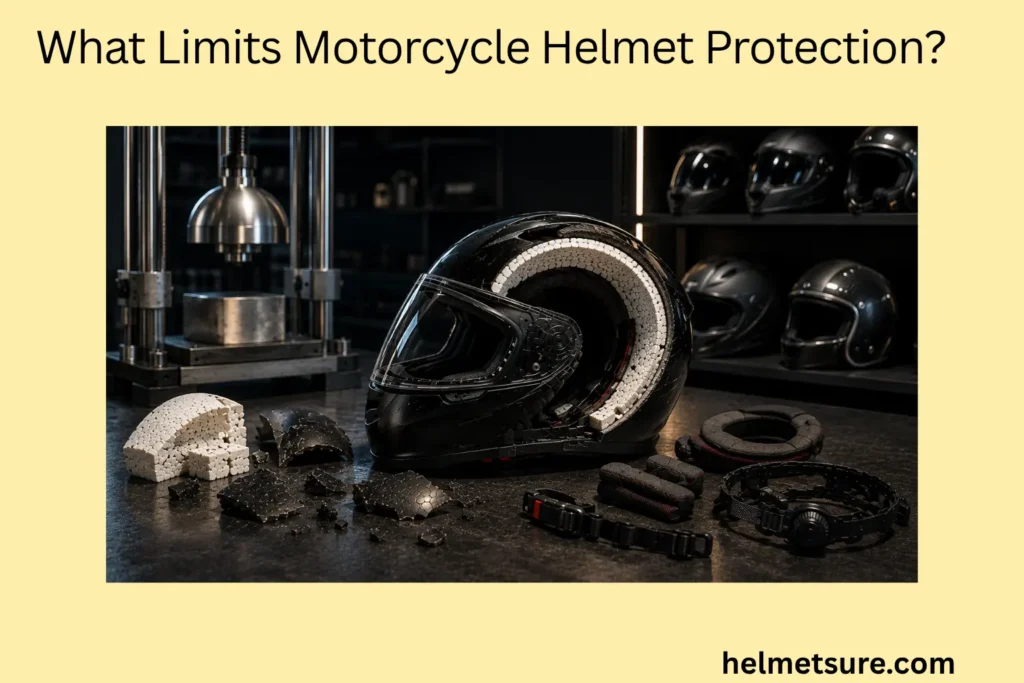
What Limits Motorcycle Helmet Protection?
Motorcycle helmet protection is finite: helmets reduce head-injury risk by managing impact energy and covering vulnerable areas, but crash severity, impact direction, fit, retention, condition, and certification boundaries determine how much protection remains available.
A motorcycle helmet is therefore best understood as a risk-reduction system with limited physical capacity. Its shell, impact liner, retention system, coverage, fit, and condition must work together while responding to a particular crash. No isolated material, feature, label, or rating can remove every limit.
No motorcycle helmet can make every crash survivable or guarantee prevention of head, brain, facial, neck, spinal, or fatal injury. A certified, correctly fitted, securely retained, undamaged helmet can materially reduce risk, but protection remains conditional on crash forces and circumstances.
Motorcycle Helmets Reduce Injury Risk Rather Than Eliminate It
Motorcycle helmets reduce the risk and severity of head injury, but they cannot eliminate injury because every helmet operates within finite mechanical, coverage, and crash-condition limits.
This distinction matters. Saying that helmets cannot prevent every injury does not weaken the evidence for wearing one. It defines the benefit accurately: helmet use improves the odds across populations, while the result of an individual crash remains uncertain.
Helmet protection as risk reduction rather than guaranteed injury prevention
Motorcycle helmet protection is a form of risk reduction rather than guaranteed injury prevention because helmet use lowers the probability and severity of some outcomes without removing all crash forces.
A helmet places engineered structure between the head and an impact. The shell can distribute loading, the impact liner can deform, and the retention system can help keep that structure in place. These actions can reduce part of the mechanical loading reaching covered regions of the head, but they do not make the head or brain immune to acceleration, deformation, or injury.
The population evidence is strong. NHTSA’s Countermeasures That Work[1] summarizes research indicating that helmets reduce rider fatalities by 22%–42% and brain injuries by 41%–69%. Those ranges describe findings across groups and studies. They are not the probability that one rider will survive or avoid brain injury in a particular event.
Protection can remain valuable even when it is incomplete. A helmet may reduce injury severity without preventing injury altogether. It may also be overwhelmed in a crash whose loading, impact location, or sequence exceeds what the helmet and the human body can tolerate.
Why protective performance changes with crash severity and impact conditions
Motorcycle helmet protective performance changes with crash severity and impact conditions because the helmet’s structure must respond to a specific combination of energy, direction, location, and surface interaction.
No single performance number describes every crash. The head may strike a flat road, an edge, another vehicle, or more than one object. Contact can be relatively direct or oblique. The helmet may be loaded at the crown, front, side, rear, or chin region, and different areas can have different geometry and available liner thickness.
Controlled research illustrates this variability. DeMarco and colleagues[2] found that motorcycle-helmet response changed across the tested impact severities, with foam densification appearing in some helmets at higher test energies. An oblique-impact study of seven modern helmets also found that measured responses varied by impact location, helmet technology, and metric.
These studies do not establish a universal failure speed. Road speed is not head impact speed: braking, sliding, rider trajectory, contacted objects, surface compliance, and impact angle all influence the actual head-loading event.
Which injuries fall partly or entirely outside a helmet’s protective scope
Motorcycle helmet protection primarily addresses head impacts within the helmet’s covered structure, while facial coverage varies by design and direct neck, spinal, torso, and limb protection lies outside that primary helmet function.
Direct protection requires protective structure over the contacted area. A shell-and-liner system can manage loading where it surrounds the skull, but it cannot form a direct barrier over an uncovered jaw, chest, arm, or leg. NHTSA’s helmet-selection guidance distinguishes helmet styles and notes that open-face and half helmets do not provide the same chin coverage as designs with structural chin bars.
Even full-face coverage has boundaries. A face shield may protect against wind, insects, debris, and some fragments, but it should not automatically be treated as equivalent to a structural chin bar or impact liner. A helmet also is not a direct cervical-spine protector. Its primary standardized function concerns the helmeted head, while crash forces can still reach the neck and the rest of the body.
Motorcycle helmet protection boundaries
| Protection boundary | What the helmet can do | What it cannot guarantee | Main evidence |
|---|---|---|---|
| Head-impact risk | Reduce risk and severity across populations | An injury-free outcome in a specific crash | NHTSA effectiveness evidence |
| Impact energy | Manage a finite amount through shell-and-liner response | Unlimited energy absorption | Foam and severity studies |
| Coverage | Protect regions enclosed by the helmet structure | Direct protection of every facial or body region | NHTSA style guidance |
| Fit and retention | Help maintain the intended helmet position | Compensation for structural damage or extreme loading | NHTSA and FMVSS guidance |
| Certification | Verify defined test requirements | Identical performance in every real crash | Applicable standard |
| Condition | Preserve intended function while the structure is serviceable | Reliable protection after meaningful unresolved damage | Manufacturer guidance |
How Impact Energy Can Exceed a Helmet’s Protective Capacity
Impact energy can exceed a motorcycle helmet’s protective capacity when the shell and impact liner can no longer manage the imposed loading within their available deformation and structural response.
The protection sequence is not simply “hard shell stops impact.” Contact loads the shell; the shell and geometry distribute that load; the impact liner compresses; and the combined system lengthens the head’s deceleration. Each stage has physical limits.
How the shell spreads load before energy reaches the impact liner
A motorcycle helmet shell helps distribute concentrated impact loading across the underlying structure so the impact liner can participate over a broader region.
At first contact, force may be concentrated over a relatively small area. The shell responds through its material, curvature, thickness, and construction, helping transfer loading into a wider portion of the helmet. That broader loading allows more of the underlying liner to contribute than would be available if the same contact acted on one very small foam region.
The shell is only one part of the system. A NHTSA interpretation of FMVSS No. 218 explains that impact attenuation, penetration resistance, and retention concern the helmet as a total system rather than isolated components. Research on polystyrene foams for protective helmets likewise shows that foam behavior and its coupling with shell material must be considered together.
A harder, thicker, or stronger-sounding shell is therefore not automatically safer. Material properties, shell geometry, liner response, helmet size, construction, and impact location all influence whole-helmet performance.
How liner deformation reduces the force transmitted to the head
Motorcycle helmet liner deformation manages impact energy by compressing over distance and time, reducing the abruptness of the headform’s deceleration compared with a rigid stop.
The impact liner—commonly expanded polystyrene, or EPS—uses controlled compression to create stopping distance inside the helmet. Instead of the headform losing velocity against an almost rigid boundary, the liner progressively deforms. Extending the stopping process can reduce peak loading compared with an equally abrupt stop.
This does not mean that the softest liner is always best. The liner must begin deforming appropriately while retaining enough resistance and usable travel for the imposed loading. Density, thickness, geometry, strain rate, shell coupling, and impact location all affect that balance. The protective liner is also different from the removable comfort padding that touches the rider’s head.
EPS should not be treated as a reusable spring. Its energy-management function can involve permanent cell collapse. After meaningful compression, the material may not return to its original protective structure even if comfort padding hides the affected region from view.
Why liner compression has a finite energy-management limit
Motorcycle helmet liner compression has a finite energy-management limit because the liner has only a limited volume and deformation distance available before its response changes substantially.
During useful crushing, the liner can absorb energy while limiting the abruptness of deceleration. As compression progresses, less deformation distance remains. If the foam approaches densification, its cells have substantially collapsed and additional compression can require a steep increase in load. The exact transition depends on the foam, helmet geometry, shell interaction, strain rate, impact site, and test method.
Neither thickness nor density creates unlimited capacity. A thicker liner can provide more possible deformation distance, but it must fit within the helmet architecture and be tuned to the expected loads. A denser liner can resist higher compression loads, but excessive resistance under another loading condition could transmit an unfavorable response. Protective-foam research supports interpreting density and available absorbing volume together rather than ranking either in isolation.
There is no universal bottom-out energy, crush percentage, or safe road speed for all motorcycle helmets.
What happens when impact severity exceeds that capacity
When impact severity exceeds a motorcycle helmet’s available energy-management capacity, additional loading can produce sharply higher headform acceleration or other unfavorable responses because little effective deformation capacity remains.
Once useful crush travel is largely consumed, the liner has less ability to extend the stopping process. Additional energy must be managed through a system with reduced remaining deformation, and measured headform response can rise. Shell failure, localized liner densification, excessive structural deformation, or unfavorable rotational motion may also contribute, depending on the event.
The transition is not an identical cliff across all helmets. In controlled severity tests, the response depended on the helmets and conditions tested; the work does not define a universal human injury threshold or real-road cutoff. A higher laboratory measurement also cannot be translated directly into a guaranteed clinical outcome for a rider.
The correct conclusion is bounded: helmet energy-management capacity is finite, and increasing impact demand can eventually leave the system unable to maintain the same attenuation response.
Impact-energy mechanism chain
- Receive: The shell encounters the initial contact load.
- Distribute: Shell geometry and deformation spread loading into the helmet structure.
- Deform: The impact liner compresses through available travel.
- Decelerate: Controlled deformation lengthens the stopping process.
- Approach capacity: Remaining usable deformation decreases.
- Exceed capacity: Additional severity produces a less favorable transmitted response, not unlimited extra protection.
How Helmet Coverage Creates Built-In Protection Boundaries
Motorcycle helmet coverage creates built-in protection boundaries because only areas enclosed by the helmet’s protective structure receive direct shell-and-liner protection.
Coverage answers “where is protective structure present?” Impact attenuation answers “how does that structure respond when loaded?” A helmet can perform well in a covered region while still providing no direct barrier to an uncovered region.
Why helmet geometry determines which areas receive direct protection
Motorcycle helmet geometry determines direct protection by defining where the shell and protective liner physically surround the rider’s head.
Shell edges, the eye opening, rear profile, lower side coverage, crown depth, and chin-bar structure create a physical map of protected and unprotected regions. The applicable safety standard may set configuration or coverage requirements, but models can still differ in shape and extent within those rules.
The protective map must also remain correctly positioned. If the helmet rides high, rotates, or rolls away from its intended seating, the relationship between the covered region and the rider’s head changes. This is why coverage, fit, and retention interact even though they remain distinct concepts.
More visible material is not automatically proof of better impact attenuation. Geometry may add direct coverage, but the response of that region still depends on its shell, liner, structural connections, certification configuration, and loading condition.
How facial and jaw coverage varies between helmet designs
Motorcycle helmet facial and jaw coverage varies by design because full-face, modular, open-face, and half-helmet structures enclose different portions of the face and lower head.
A conventional full-face design normally incorporates a structural chin bar as part of the helmet. A modular helmet may use a moving chin section and must be evaluated in the configuration covered by its approval and manufacturer instructions. Open-face and half helmets leave more of the lower face or jaw exposed. Off-road and dual-sport designs can also differ in chin-bar shape, eye opening, visor, and shield arrangements.
Style names alone are not enough to establish exact protection. Model geometry, structural construction, the applicable test configuration, and whether movable components are correctly closed all matter. A face shield should not be mistaken for the same structural role as a tested chin bar merely because both sit in front of the face.
Choose coverage with an accurate understanding of what is physically enclosed, not from appearance or marketing language alone.
Why head protection does not equal neck or spinal protection
Motorcycle helmet head protection does not equal direct neck or spinal protection because helmet standards and protective structures primarily address loads applied to the helmeted head rather than shielding the cervical spine itself.
The helmet surrounds portions of the head, not the neck or spinal column. It can reduce some head-impact loading without preventing the torso and head from moving relative to each other during a crash. The neck can still experience bending, extension, compression, tension, or rotation as the rider contacts the road, motorcycle, vehicle, or other object.
This scope boundary should not be misread as a claim that helmets worsen neck outcomes. NHTSA’s effectiveness review reports no evidence that helmet use increases neck-injury risk. The narrower point is that direct head coverage is not a certified neck-protection function and cannot guarantee prevention of cervical injury.
Direct helmet coverage and body-region limits
| Helmet area or body region | Direct helmet protection | Main limitation |
|---|---|---|
| Covered skull regions | Shell-and-liner structure can manage impact loading | Capacity remains finite |
| Lower face and jaw | Depends strongly on design and structural chin coverage | Not all styles enclose these regions |
| Eyes and face opening | Shield may provide environmental or fragment protection | Shield is not equivalent to structural impact coverage |
| Neck and cervical spine | No surrounding structure comparable with skull coverage | Whole-body crash loads remain |
| Torso and limbs | Outside helmet coverage | Requires other protective equipment |
How Poor Fit and Retention Reduce Effective Helmet Protection
Poor motorcycle helmet fit and retention reduce effective protection by allowing the helmet to shift away from the stable position in which its coverage and protective structure are intended to function.
Fit positions the helmet. Retention secures that position. They are separate requirements: the chin strap cannot create correct interior compatibility, and a good interior fit cannot compensate for an unfastened or damaged retention system.
How excessive movement can shift the helmet away from its intended protective position
Excessive motorcycle helmet movement can reduce effective protection by changing the relationship between the rider’s head, the helmet’s coverage, and the retention system before or during crash loading.
Surplus clearance can allow the helmet to slide, rotate, or ride upward while the rider’s head remains comparatively still. That movement changes the starting position of the shell opening, liner regions, helmet edge, chin bar, and retention anchors relative to the rider.
Correct fit does not mean mathematically zero movement. Comfort padding and skin can deform, and different designs have different contact patterns. The concern is obvious independent slipping or instability rather than a universal consumer rotation angle. NHTSA advises that a correctly sized helmet should provide even pressure and should not move independently when the rider shakes the head.
When instability appears, the cause may be incorrect size, incompatible head shape, poor seating, worn padding, or retention adjustment. Diagnose the cause instead of automatically tightening the strap or selecting the smallest helmet possible.
Why incorrect helmet size can reduce stability around the head
Incorrect motorcycle helmet size can reduce stability because a helmet that is too large permits excess movement while one that is too small can prevent correct seating or create excessive pressure.
An oversized helmet can leave clearance around the crown or sides, allowing rotation, sliding, or ride-up. An undersized helmet may perch high, fail to settle around the head, or create broad excessive compression and persistent pain. Either failure can prevent the helmet from occupying its intended protective position.
Circumference is only the starting point. Use the exact manufacturer and model size chart, because labels are not universal across brands or even across models. If a measured candidate still moves or creates severe localized pressure, head-shape compatibility must be evaluated before changing size.
Sizing down is not a universal cure for movement. A smaller version of an incompatible shape may intensify hotspots while leaving other regions poorly supported.
How head-shape mismatch creates uneven liner contact
Motorcycle helmet head-shape mismatch creates uneven liner contact when the helmet is too narrow in one direction and too spacious in another despite an apparently correct nominal size.
Circumference describes the distance around the head; it does not describe the full three-dimensional geometry. A rider can therefore experience a concentrated forehead or side hotspot while another region remains loose. Sizing up may ease the hotspot but enlarge the unsupported gap, while sizing down may reduce movement but worsen pain.
NHTSA describes round oval, intermediate oval, and long oval as practical shape categories and advises evaluating actual pressure patterns. These labels are useful starting points, not standardized dimensions. Interior geometry can vary among models, sizes, and generations from the same manufacturer.
A compatible fit distributes firm contact broadly enough to support stability without persistent painful pressure. When pressure and movement signals conflict, changing model geometry is often more appropriate than forcing a size change.
Why an insecure retention system increases the risk of helmet displacement
An insecure motorcycle helmet retention system increases displacement risk because the chin strap and its anchors are responsible for keeping the correctly fitted helmet secured to the head during sudden movement.
The retention path includes the strap or webbing, stitching, anchors, buckle or fastener, and correct routing. When it is intact, properly fastened, and adjusted according to the manufacturer’s instructions, it helps resist lifting and roll-off. When it is loose, misrouted, unfastened, or damaged, that resistance is reduced.
Retention does not resize the helmet. Overtightening the chin strap may create jaw or throat discomfort while leaving an oversized or shape-incompatible shell unresolved. Consumer roll-off checks also are not equivalent to formal regulatory testing, which uses defined headforms, fixtures, loads, and procedures under FMVSS No. 218[3].
For a focused explanation of sizing, head shape, positioning, movement, and strap security, see motorcycle helmet fit safety.
Fit and retention failure states
| Failure state | Primary mechanism | Protection concern | Corrective direction |
|---|---|---|---|
| Helmet too large | Excess clearance | Rotation, sliding, or ride-up | Reassess size and shape |
| Helmet too small | Incomplete seating or excessive pressure | Incorrect position or unsuitable fit | Reassess size and shape |
| Head-shape mismatch | Uneven contact | Hotspots plus unstable gaps | Change model or interior geometry |
| Loose retention | Weak securing force | Increased displacement risk | Fasten and adjust per manufacturer instructions |
| Damaged strap or anchor | Broken retention load path | Helmet may not remain secured | Remove from service or obtain manufacturer guidance |
How Damage and Material Condition Limit Future Protection
Motorcycle helmet damage and material condition limit future protection because impact performance depends on the shell, liner, retention system, and supporting components remaining structurally serviceable.
Certification describes a conforming helmet in its specified configuration. It does not guarantee that a helmet remains unchanged after a crash, chemical exposure, heat damage, unauthorized modification, or years of use.
Why a previous impact can permanently compress energy-absorbing material
A previous motorcycle helmet impact can permanently compress energy-absorbing material, leaving less intact deformation capacity available for a later impact in the affected region.
Protective EPS manages energy partly through irreversible cell collapse. A significant impact while the helmet is worn can compress the liner between the rider’s head and the contacted surface. The outer shell may recover or show only limited evidence while the internal foam remains crushed, indented, cracked, or separated.
SHOEI’s impact guidance[4] strongly recommends replacing a helmet after a significant impact and explains that liner damage may exist without obvious external signs. That is manufacturer-specific guidance, but the underlying uncertainty is important: visual appearance alone cannot measure remaining deformation capacity.
An empty helmet dropped during ordinary handling is a different scenario from a helmet carrying a head during a crash. Impact height, surface, location, helmet contents, visible damage, and manufacturer instructions all matter. Do not assume hidden damage from every minor handling event, and do not clear a significantly impacted helmet merely because it looks normal.
How shell cracks or deformation can change load distribution
Motorcycle helmet shell cracks or structural deformation can change load distribution because damaged shell geometry and continuity no longer provide the same load path as the intact design.
The shell is engineered to respond as a continuous structure. A meaningful crack, delamination, deep gouge, crushed region, or permanent deformation can interrupt load transfer, alter local stiffness, or change how force reaches the liner. The significance depends on material, depth, location, impact history, and the manufacturer’s construction.
Not every mark is structurally equivalent. Surface scuffs, paint chips, and cosmetic scratches can occur without proving that the load-bearing shell is damaged. Conversely, a finished exterior can hide internal separation or liner damage. There is no universal acceptable crack length, dent depth, or delamination area that riders can apply across all models.
When damage appears structural or its significance cannot be established, remove the helmet from use and follow the manufacturer’s inspection or replacement guidance rather than attempting an improvised repair.
Why damaged straps, fasteners, or retention hardware matter
Damaged motorcycle helmet straps, fasteners, or retention hardware matter because failure anywhere in the retention load path can prevent the helmet from remaining secured to the head.
Frayed webbing, torn stitching, damaged anchors, cracked fastener parts, a buckle that does not lock, corrosion, heat damage, or unauthorized alterations can all compromise retention. The shell and liner may remain visually intact while the helmet is still unsuitable because it cannot be reliably secured.
Formal standards test the assembled retention system under defined procedures. A casual pull at home cannot prove equivalent strength or predict crash performance. The practical screen is simpler: the hardware must be intact, correctly routed, fully functional, and used as the manufacturer specifies.
Do not knot damaged straps, drill new anchor points, substitute unrelated hardware, or rely on an unapproved repair. Where the manufacturer does not authorize a replacement component or qualified repair, loss of retention integrity is a reason to retire the helmet.
How material aging and environmental exposure can affect helmet condition
Motorcycle helmet material aging and environmental exposure can affect condition through wear, heat, solvents, ultraviolet exposure, sweat, oils, and other factors identified by manufacturers for their specific materials.
Heat can affect liners, adhesives, plastics, and bonded assemblies. Solvents and petroleum-based cleaners can degrade certain plastics or finishes. Sweat, hair products, skin oils, repeated wetting, ultraviolet exposure, abrasion, and storage conditions can contribute to material change or component wear over time.
SHOEI’s care guidance warns about heat and solvent sensitivity and identifies liner, shell, and retention conditions that warrant replacement. Arai’s warranty and service information separately identifies factors such as sweat, oils, chemicals, pollution, ultraviolet exposure, wear, heat, and aging. Each company also publishes its own service-life guidance.
Those intervals are manufacturer-specific, not a universal expiration law. Evaluate the actual model, impact history, use, storage, material condition, fit change, and current manufacturer instructions rather than treating age alone as proof of failure.
Condition screen
Which Crash Forces Are Most Difficult for Helmets to Manage?
Motorcycle helmets face different protection challenges from linear, oblique, rotational, repeated, and concentrated loading because each places different demands on the shell, liner, retention system, and available deformation.
These categories overlap in real crashes. A contact can include both normal and tangential force, and one crash can produce multiple contacts. Separating them helps explain why one test result or design feature cannot represent every loading condition.
Linear impacts that rapidly load the helmet and head
Linear motorcycle helmet impacts rapidly load the helmet and head along a translational path, making impact attenuation and controlled liner deformation central to limiting headform acceleration.
In a largely normal impact, the helmet moves toward the contact surface and the liner compresses as the headform decelerates. Shell load distribution and available foam travel are central to the response. Standards such as U.S. FMVSS No. 218 use controlled impact-attenuation tests to evaluate this part of performance.
Linear acceleration is important, but it is not the only loading dimension and a regulatory acceleration limit is not a guaranteed human injury threshold. Pulse duration, impact site, shell and liner behavior, effective mass, and the individual rider also matter. A helmet that manages one defined linear test is not proven to make every higher-energy or differently located impact harmless.
Oblique impacts that combine contact force with rotational motion
Oblique motorcycle helmet impacts combine normal and tangential loading, which can produce both translational and rotational motion of the headform.
The normal component compresses the helmet against the surface. The tangential component can make the helmet slide, grip, rotate, or interact with the headform in a more complex way. Surface friction, impact angle, helmet geometry, fit, location, and any rotational-management system can influence the measured response.
In the 2022 oblique-impact study, seven helmets were dropped onto a 45-degree anvil at a specified speed and tested at five locations. Results varied by impact site and metric, demonstrating why rotational performance cannot be reduced to one feature or one universal rank.
Those experimental conditions should not be generalized to every helmet or crash. Rotational acceleration, rotational velocity, translational acceleration, and modelled brain strain are related but distinct measures; no single one provides an individual injury guarantee.
Repeated impacts that load the helmet more than once during the same crash
Repeated motorcycle helmet impacts during one crash can load the helmet at multiple locations or load a structure that has already experienced deformation earlier in the event.
A rider may first contact a vehicle and then the road, or strike the road more than once while sliding or tumbling. A later contact can load a fresh helmet region, a region affected by the first impact, or retention and shell structures already subjected to force. The severity, location, timing, and direction of each contact determine the combined demand.
There is no universal number of impacts that every motorcycle helmet can safely withstand. Laboratory standards may include multiple prescribed impacts, but those procedures do not establish a consumer crash-count allowance. Once a helmet sustains a significant crash impact while worn, remaining capacity can be uncertain even if the exterior appears acceptable.
Penetration and concentrated-load scenarios that stress a small helmet area
Penetration and concentrated-load scenarios stress a small motorcycle helmet area by applying force through a limited contact region rather than distributing it broadly across the shell.
Edges, projections, or pointed objects can create high local stress. The shell’s material, curvature, continuity, and support from the liner influence whether the load spreads, causes localized deformation, or threatens penetration. This is a different challenge from a broad flat impact, even when both involve substantial energy.
U.S. FMVSS No. 218 includes a defined penetration test using a specified striker and procedure. Passing that test establishes resistance within its regulatory conditions; it does not make a helmet puncture-proof against every sharp object, edge, speed, or impact angle.
Crash-force demands and their main limitations
| Force or impact type | Primary helmet demand | Main measured concern | Key limitation |
|---|---|---|---|
| Linear | Manage normal impact energy | Translational acceleration and pulse | Finite liner deformation |
| Oblique | Manage normal and tangential interaction | Translational and rotational motion | Response varies by angle, friction, site, and design |
| Repeated | Manage more than one contact event | Remaining structure and later-load response | No universal safe impact count |
| Concentrated | Resist high local stress | Local response and penetration | Standardized tests cannot represent every object |
How Crash Conditions Change the Protection a Helmet Can Provide
Crash conditions change motorcycle helmet protection because impact speed, surface behavior, impact angle, location, and sequence determine how much and what type of loading reaches the helmet.
Vehicle speed is only one input to the crash. The helmet responds to the contact actually experienced by the head, not to the speedometer reading in isolation.
How relative impact speed changes the energy the helmet must manage
Relative impact speed changes the energy a motorcycle helmet must manage because translational kinetic energy increases with the square of impact velocity when effective mass is held constant.
The bounded mechanical relationship is E = ½mv². If effective mass stays the same, doubling impact velocity produces four times the translational kinetic energy in that simplified model. A modest increase in actual head impact velocity can therefore impose a much larger energy-management demand.
This equation is not a road-speed injury calculator. Braking, separation from the motorcycle, sliding, rotation, contact sequence, surface deformation, and object motion all influence the velocity and effective mass at the instant the helmet contacts something. Controlled motorcycle-helmet severity testing demonstrates that measured response changes with test severity, but it does not supply a universal safe riding speed.
Why impact surface hardness changes collision severity
Impact surface hardness changes motorcycle helmet loading because a rigid surface deforms less and therefore shares less of the collision deformation than a more compliant surface under otherwise comparable conditions.
When a contacted surface deforms, it can contribute to the overall stopping distance and energy dissipation. A rigid surface contributes little deformation, leaving more of the response to the helmet, head, body motion, and other interacting structures. Surface shape also matters: a broad flat surface and a rigid edge can load the same helmet very differently.
Hardness is not the only surface variable. Friction affects tangential loading, geometry affects contact area, and surface motion changes relative velocity. A compliant surface is not automatically safe, and a hard surface does not determine the outcome by itself. The complete interaction—velocity, angle, friction, location, helmet response, and sequence—controls the demand.
How impact angle alters where and how the helmet is loaded
Motorcycle helmet impact angle alters loading by changing the balance between normal compression and tangential motion and by shifting the helmet region that contacts the surface.
A more direct contact can emphasize compression and translational deceleration. An oblique contact adds tangential interaction that can promote sliding or rotational motion. The angle can also make a different shell region, edge, chin bar, or visor area contact first, changing local geometry and the available liner beneath the point of loading.
There is no universally worst angle for every helmet and crash. Surface friction, impact location, helmet design, fit, head motion, and the metric being evaluated all change the response. Oblique-impact research supports using multiple sites and measures rather than declaring one angle, rotational feature, or test result universally decisive.
Why secondary impacts can challenge different helmet areas during one crash
Secondary motorcycle helmet impacts can challenge different areas during one crash because the rider’s trajectory changes after each contact and can expose another helmet region to a new loading condition.
The first contact can redirect and rotate the rider. A subsequent contact may involve a different surface, angle, speed, or helmet site. It can therefore demand a different combination of shell distribution, liner compression, retention, and tangential response. If the earlier impact changed the structure, the later event may also act on reduced or uncertain remaining capacity.
The sequence cannot be represented by one universal second-impact multiplier. Crash reconstruction would be needed to estimate the actual kinematics, and even that cannot convert helmet measurements into guaranteed clinical outcomes. For the rider, significant crash exposure is primarily a post-impact condition and replacement question, not an invitation to count visible marks and continue using the helmet.
Crash variables that change available protection
| Crash variable | What changes | Why protection can differ |
|---|---|---|
| Relative impact speed | Energy demand | Greater velocity can require more deformation capacity |
| Surface compliance | Energy sharing | Rigid and deformable surfaces interact differently |
| Surface friction | Tangential loading | Rotational response can change |
| Impact angle | Normal and tangential balance | Loading direction and rotational motion change |
| Impact location | Local helmet response | Geometry and material arrangement differ around the helmet |
| Secondary contact | New loading event | Another region or already-loaded structure can be challenged |
What Safety Certification Does—and Does Not—Establish
Motorcycle helmet safety certification establishes compliance with defined test requirements, but it does not establish unlimited protection, identical performance among approved helmets, or suitability for every rider and crash.
Certification is essential evidence, but it has a defined jurisdiction and test scope. It must be combined with correct fit, secure retention, suitable coverage, authentic product identity, and current structural condition.
What passing a motorcycle helmet safety standard demonstrates
Passing a motorcycle helmet safety standard demonstrates that the tested helmet configuration satisfies the defined impact, penetration, retention, configuration, labeling, and related requirements of that applicable standard.
The exact meaning depends on the jurisdiction. In the United States, FMVSS No. 218 specifies performance and configuration requirements, conditioning procedures, headforms, positioning, impact attenuation, penetration, retention, labeling, and warnings. The helmet is evaluated as an assembled system under those rules.
The DOT symbol is not evidence that NHTSA pre-approved the helmet before sale. The U.S. system uses manufacturer self-certification, while NHTSA conducts compliance testing and enforcement. Certification is therefore a regulated compliance claim, not a government-issued prediction of how the helmet will perform in every possible crash.
Riders should identify the standard required in their market and verify that the helmet and label appear authentic. A novelty helmet, counterfeit label, or noncompliant product should not be treated as equivalent to a certified protective helmet.
Why standardized laboratory testing cannot reproduce every crash condition
Standardized motorcycle helmet laboratory testing cannot reproduce every crash condition because repeatable standards intentionally define specific headforms, impact sites, surfaces, velocities, conditioning procedures, and acceptance criteria.
Controlled variables make results repeatable and enforceable. Test laboratories can position a helmet consistently, condition it under defined environments, strike prescribed areas, and compare measurements with fixed criteria. If every test used a different road surface, rider anatomy, impact angle, or sequence, consistent compliance decisions would be impossible.
The same control necessarily samples only part of the real-world crash space. Actual events can combine different velocities, edges, friction levels, obliquity, locations, secondary impacts, temperatures, and rider positions. Academic tests may explore additional conditions, but they also remain bounded by their methods.
This limitation does not make standards useless. It means their result should be interpreted precisely: compliance shows that the helmet met defined requirements, not that the entire universe of crashes was reproduced.
Why certification does not compensate for poor fit or structural damage
Motorcycle helmet certification does not compensate for poor fit or structural damage because certification applies to a defined compliant helmet configuration rather than guaranteeing correct rider positioning or unchanged condition throughout service.
A label remains visible even if the helmet is too large for its current rider, sits incorrectly, has an unfastened strap, or has sustained meaningful damage. Those use and condition failures are separate from the original compliance evidence. Conversely, excellent fit cannot make a damaged, counterfeit, or noncompliant helmet equivalent to a conforming one.
Unauthorized cutting, drilling, liner modification, incompatible components, or chemical exposure can also change the helmet after manufacture. Certification should not be treated as a permanent condition guarantee. The rider needs a genuine certified model, current structural serviceability, correct individual fit, and secure retention at the same time.
Why helmets meeting the same standard can still differ in design and protective characteristics
Motorcycle helmets meeting the same safety standard can still differ in design and measured protective characteristics because compliance sets defined requirements without requiring identical materials, geometry, construction, or performance beyond those requirements.
Two compliant models may use different shell materials, shell sizes, liner densities, liner geometries, coverage profiles, mass, comfort systems, and rotational-management technologies. Both can meet the same regulatory criteria while producing different measurements in additional tests or at other impact locations.
The UK Department for Transport’s SHARP programme provides comparative ratings for helmets that have already met the relevant underlying approval requirement. Different star ratings demonstrate that compliance and comparative performance are separate evidence layers. SHARP’s own methods, impact conditions, and scoring boundaries still apply; a star rating does not predict a particular rider’s injury outcome.
For a fuller explanation of approval labels, test scope, and comparative evidence, see motorcycle helmet certification safety.
What motorcycle helmet certification establishes
| Certification or evidence layer | What it establishes | What it does not establish |
|---|---|---|
| Regulatory certification | Compliance with defined minimum requirements | Unlimited protection |
| Impact attenuation test | Performance under specified headform and anvil conditions | Every road impact |
| Penetration test | Resistance under the specified striker procedure | Universal puncture-proofing |
| Retention test | Performance of the assembly under the specified procedure | Correct rider-specific fit |
| Independent rating | Comparative performance within that programme | Guaranteed injury outcome |
| Current condition | Must be assessed separately | Permanent proof from the original label |
When Is a Helmet No Longer Reliably Protective?
A motorcycle helmet is no longer reliably protective when meaningful impact, structural damage, retention failure, unsuitable fit, or unresolved condition uncertainty prevents confidence that the original protective system remains intact and correctly positioned.
There is no single consumer number that resolves every case. Replacement decisions combine known events, visible condition, manufacturer instructions, service history, fit change, and uncertainty about hidden damage.
When crash exposure should trigger replacement rather than continued use
Motorcycle helmet crash exposure should trigger strong replacement concern when the helmet sustains a significant impact while worn because the impact liner or other structure may be damaged even without obvious exterior evidence.
The rider’s head can load the liner from inside while the struck surface loads the shell from outside. That sandwiching action may permanently compress foam or alter internal bonds without leaving a dramatic external crack. SHOEI consequently advises replacing a helmet after significant impact and cautions that its inspection process cannot identify every possible defect.
U.S. FMVSS No. 218 also requires a warning that a helmet subjected to a severe blow should be returned to the manufacturer for inspection or destroyed and replaced. This is U.S.-specific regulatory language, not a universal impact-speed threshold.
After a crash or significant impact while worn, stop relying on appearance alone. Follow the actual manufacturer’s replacement or qualified inspection process; where remaining capacity cannot be established, favor replacement.
Which shell, liner, strap, or fastening defects justify retirement
Motorcycle helmet shell, liner, strap, or fastening defects justify retirement when they represent meaningful structural damage, loss of retention integrity, separation, material breakdown, or another condition the manufacturer identifies as unsafe.
Clear concerns include structural shell cracks or deformation; delamination; impact-liner breakup, melting, separation, major indentation, or crushing; damaged strap anchors; torn stitching; frayed webbing; and a buckle or fastener that no longer locks reliably. Unauthorized structural alterations are also disqualifying unless the manufacturer explicitly provides an approved remedy.
Minor finish marks should not automatically be treated as equivalent to shell failure. Their significance depends on depth, material, location, and impact history. If a mark may extend into the structural shell, or if the history is unknown, obtain manufacturer guidance rather than using a generic scratch or dent threshold.
Authorized replaceable comfort items are different from load-bearing shell, EPS, and retention parts. Use only components and repair paths approved for the exact model.
When a change in fit means the helmet is no longer suitable for the rider
A change in motorcycle helmet fit can make the helmet unsuitable when wear, padding deterioration, rider changes, or component condition causes persistent movement or prevents stable, correctly seated positioning.
Comfort padding can compress with use, attachments can deteriorate, and the rider’s hair, body mass, medical condition, or head-contact pattern can change. If the helmet begins rotating, slipping, riding upward, or relying on excessive strap tension, its current suitability must be reassessed even when the shell has no known impact damage.
Some manufacturers offer approved replacement cheek pads or comfort liners that can restore intended contact when the structural size and head shape remain compatible. Those parts do not correct an oversized shell, incompatible EPS geometry, or damaged retention system. Do not add generic foam or modify the impact liner to keep an unsuitable helmet in service.
Why uncertain structural damage deserves more caution than cosmetic wear alone
Uncertain motorcycle helmet structural damage deserves more caution than cosmetic wear because the remaining protective capacity of unseen shell or liner damage cannot be established reliably from appearance alone.
Cosmetic finish wear may have little structural significance, while a visually modest impact can hide liner compression or internal separation. The key difference is not how dramatic the mark looks; it is whether the shell, liner, retention system, and load paths can still be relied upon.
Manufacturer inspection may help in limited circumstances, but it is not universally available and may not detect every defect. Unknown significant-impact history is itself a source of uncertainty. For a used helmet with unclear provenance, the rider may be unable to verify whether the liner has already been loaded or the shell exposed to damaging conditions.
When the possible consequence is reduced protective capacity and the uncertainty cannot be resolved through the manufacturer, caution supports retirement rather than reassurance from appearance alone.
Helmet condition and retirement decisions
| Condition | Primary concern | Recommended decision direction |
|---|---|---|
| Significant impact while worn | Possible hidden liner or structural damage | Follow manufacturer replacement or qualified inspection guidance |
| Visible structural shell crack or deformation | Altered structural load path | Remove from service |
| Liner breakup, separation, major indentation, or melting | Reduced or uncertain energy-management function | Remove from service |
| Damaged strap, anchor, buckle, or fastener | Retention failure path | Remove from service or use an authorized repair only |
| Fit has become persistently loose | Unstable protective position | Reassess approved interior parts, size, and model |
| Minor cosmetic finish mark with no known impact | Structural significance not established | Inspect; do not automatically equate it with structural failure |
| Unknown significant-impact history | Remaining capacity cannot be verified confidently | Favor caution and replacement |
What Ultimately Determines the Protective Limit of a Motorcycle Helmet?
The protective limit of a motorcycle helmet is determined by the interaction of its design, finite energy-management capacity, coverage, fit, retention, condition, verified performance, and the severity and direction of the crash.
The rider cannot control every crash variable, but can control many prerequisites for receiving the protection that the helmet is capable of providing.
Protection as the interaction of helmet design, fit, condition, and crash severity
Motorcycle helmet protection results from the interaction of helmet design, rider-specific fit, secure retention, structural condition, and crash severity rather than from any factor operating independently.
Design supplies the shell, liner, geometry, coverage, and retention architecture. Certification establishes defined performance evidence. Fit positions that architecture on the individual rider; retention helps keep it secured; current condition preserves the intended load paths; and the crash determines the demand placed on the system.
A weakness in one requirement can limit the whole. Greater coverage cannot compensate for a structurally damaged liner. A high rating cannot correct an oversized fit. Correct fit cannot restore impact-crushed foam. An undamaged helmet can still face loading beyond its finite capacity.
Available protection is therefore the result of a functioning helmet system meeting a specific crash demand—not a fixed property that can be read from one material name or label.
Why no single material, rating, or feature removes every limitation
No single motorcycle helmet material, rating, or feature removes every protection limitation because each addresses only part of the total system and remains bounded by coverage, fit, condition, and crash loading.
A shell material may enable a particular balance of stiffness, strength, mass, and deformation. A multi-density liner may tune response across regions or loading levels. A low-friction or other rotational-management feature may influence some oblique impacts. Certification establishes compliance, while an independent rating compares performance under its own protocol.
Each item can be useful evidence within its scope. None establishes universal superiority across impact location, severity, metric, helmet size, fit, damage state, and rider. Even controlled oblique-impact research has shown that results can change by test location and measure.
Avoid a composite consumer safety score based only on marketing features. Evaluate the complete certified helmet model, appropriate coverage, rider-specific fit, secure retention, current condition, and the methodology behind any additional rating.
The practical model: a certified, correctly fitted, undamaged helmet can reduce risk without making severe crashes harmless
A certified, correctly fitted, undamaged motorcycle helmet can materially reduce head-injury risk, but it cannot make severe crashes harmless because its energy capacity, coverage, and tested performance remain finite.
The practical decision is not “Will this helmet protect me in every crash?” It is: “Is this helmet compliant for my jurisdiction, genuine, correctly sized and shaped for me, securely retained, structurally sound, appropriately covering the areas I expect it to cover, and used with realistic expectations?”
Finite protection is not a reason to dismiss helmet use. NHTSA’s population evidence shows substantial reductions in fatality and brain-injury risk, while impact mechanics explain why no helmet can guarantee an injury-free outcome. The rational goal is to preserve every controllable part of the system while recognizing that crash severity, angle, location, surface, and sequence remain uncertain.
See motorcycle helmet safety for the complete shell, liner, fit, retention, certification, condition, and rider-use framework.
Final protection model
Frequently Asked Questions About Motorcycle Helmet Protection Limits
These answers summarize the article’s main boundaries involving crash energy, coverage, fit, condition, certification, and replacement decisions.
Can a motorcycle helmet prevent every head injury?
No. A certified, correctly fitted, undamaged helmet can materially reduce risk, but it cannot guarantee prevention of head, brain, facial, neck, spinal, or fatal injury in every crash.
What happens when impact energy exceeds the helmet liner’s capacity?
As useful liner deformation is consumed, less stopping distance remains. Additional loading can then produce a less favorable transmitted response, although there is no universal bottom-out energy or road-speed threshold for every helmet.
Does a full-face helmet protect every body region?
No. Full-face construction can provide more facial and jaw coverage than open-face or half-helmet designs, but the neck, spine, torso, and limbs remain outside the helmet’s direct protective structure.
Can tightening the chin strap correct a poorly fitting helmet?
No. Retention helps secure a correctly fitted helmet, but it cannot resize an oversized shell, correct incompatible head shape, restore missing crown contact, or repair damaged hardware.
Should a helmet be replaced after a significant crash impact?
A significant impact while the helmet is worn creates concern for hidden liner or structural damage. Stop relying on appearance alone and follow the exact manufacturer’s replacement or qualified inspection guidance.
Does motorcycle helmet certification guarantee real-world protection?
No. Certification shows that a helmet configuration met defined laboratory requirements. It does not reproduce every crash, establish rider-specific fit, or guarantee an injury outcome.
Is a harder shell or thicker liner automatically safer?
No single material property establishes universal superiority. Shell construction, liner density, thickness, geometry, coupling, helmet size, impact location, fit, and verified whole-helmet performance must be considered together.
When is a motorcycle helmet no longer reliably protective?
Strong retirement concerns include significant impact while worn, structural shell damage, liner breakup or crushing, retention failure, unauthorized structural modification, persistently unsuitable fit, or unresolved uncertainty about meaningful damage.