
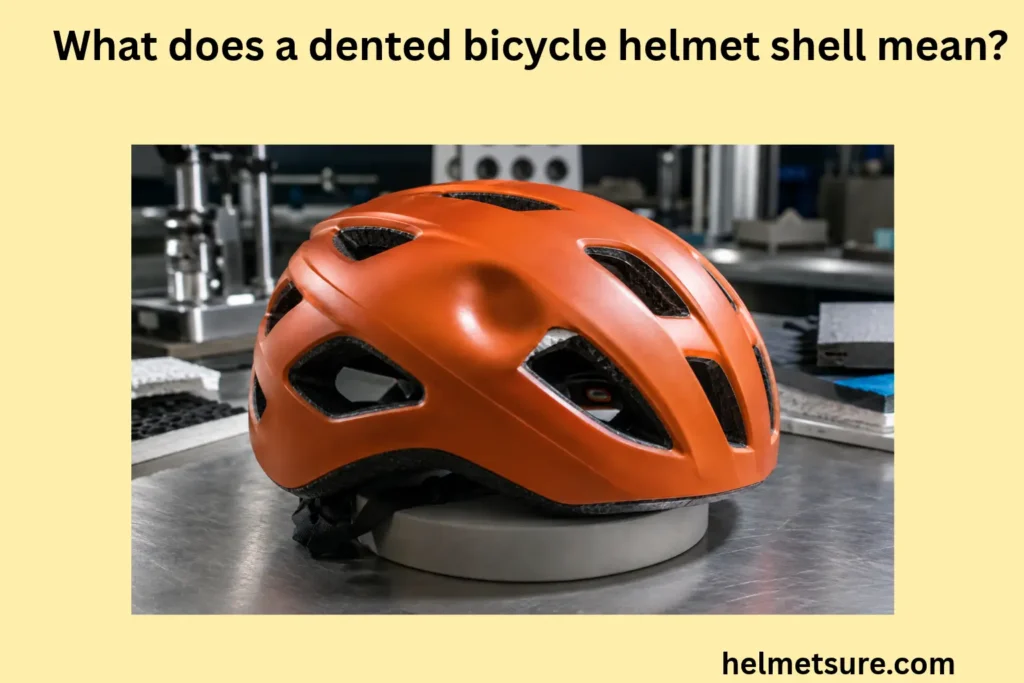
What Does a Dented Bicycle Helmet Shell Mean?
A dented bicycle helmet shell has undergone permanent localized contour deformation. The dent confirms shell deformation, but appearance alone cannot reveal how much hidden liner damage occurred or whether the helmet retains its original protective performance.
A true dent is more than a scuff in paint or finish. The load that changed the shell’s shape may also have loaded the liner and other parts of the helmet, although the dent does not reveal exactly what happened beneath it. That is why impact protection must be evaluated as a whole-helmet function rather than inferred from one visible shell clue.
The safety boundary is conservative. U.S. bicycle-helmet labeling rules require a warning that an impact can damage a helmet enough to impair protection even when the damage is not visible. Bell similarly instructs users to replace a helmet after a severe blow even if it appears undamaged, while Specialized states that crashed helmets are not repairable and recommends replacement after a head impact. The exact current guidance for the helmet’s brand and model should govern the decision.
A true shell dent is a persistent localized contour change. It is not the same thing as a surface scuff, a crack, a crease, or shell-to-liner separation.
A Shell Dent as Permanent Contour Deformation Rather Than Superficial Surface Damage
A true shell dent is a persistent localized change in the helmet shell’s contour, not merely discoloration, abrasion, or another surface-only mark.
That definition classifies what can be observed. It does not diagnose the condition of the hidden liner or assign a severity to the event that produced the deformation.
How a true dent permanently changes the shell contour while a superficial scuff changes only the surface finish
A true dent leaves the shell contour locally deformed, whereas a superficial scuff primarily changes the surface finish without establishing persistent shape change.
Viewed from several angles under good light, a dent changes the shell’s geometry: a reflection line bends, a previously smooth surface forms a depression, or the contour no longer matches the corresponding area on the other side. A scuff instead appears as abrasion, color transfer, scratching, or finish loss while the underlying contour remains essentially unchanged.
The two can coexist. Sliding contact may leave abrasion across a region that also contains a localized dent. The abrasion does not become a dent merely because it followed an impact, and a surface-only classification does not certify the hidden helmet structure as intact. Bicycle-helmet reconstruction studies treat exterior marks and residual deformation as separate observations for precisely this reason.
How a dent differs from a crack by deforming the shell without necessarily creating a visible break
A dent changes shell shape, while a crack introduces a visible break or fracture; the two damage states can occur separately or together.
A dent can leave the shell material apparently continuous across the depression. A crack creates a discontinuity, such as a fracture line, split edge, or visibly broken section. Shell construction and loading influence which state appears, so the absence of a crack does not establish that a dent is minor.
A crack may also start within or extend away from a dent. In that case, the helmet shows both contour deformation and fracture. Neither the dent nor the crack length reveals the exact impact energy or hidden liner condition by itself.
How a dent differs from a crease by producing localized contour change rather than a folded line of deformation
A dent is a localized depression or contour change, whereas a crease is a more line-like or sharply folded permanent deformation.
The distinction is geometric. A dent is usually described by an indented region; a crease follows a narrower line or fold. Both are persistent physical deformation when the shell does not return to its earlier shape.
The visible form is not a calibrated record of the crash. Different shell constructions, support from the liner, impact directions, and contact geometries can produce different shapes. A consumer therefore cannot calculate impact energy or direction from whether a damaged region looks rounded or sharply folded.
How shell separation differs from a dent by creating loss of normal contact between shell and liner
Shell separation means the outer shell has lost normal contact or bonding with the liner in an area, while a dent describes shell contour change whether or not separation is present.
These are different attributes. A shell may remain in contact with the liner while its contour is deformed. A shell can also lift, gap, or delaminate from the liner, with or without an identical dent shape. Real-world bicycle-helmet reconstruction has documented shell buckling and shell-liner delamination as distinct damage observations.
An exterior dent alone does not prove that the hidden interface has separated. That conclusion requires visible lifting or another reliable way to establish the interface condition.
Why permanent contour change distinguishes a true shell dent from superficial surface marking
Permanent contour change is the defining visible feature of a true shell dent because superficial marking alone does not alter the shell’s lasting shape.
This definition prevents a surface scrape from being mislabeled as deformation. It also prevents the opposite error: dismissing an actual contour change as merely cosmetic. The word “dent” identifies visible shell geometry, not the condition of every hidden component.
Why permanent contour change distinguishes a true shell dent from superficial surface marking
| Visible condition | Defining observation | What it does not establish |
|---|---|---|
| Dent | Persistent localized contour change | Amount of hidden liner damage |
| Scuff | Surface abrasion or finish change without established contour change | Hidden helmet integrity |
| Crack | Visible break or fracture | Exact impact severity |
| Crease | Line-like or sharply folded permanent deformation | Exact impact direction or energy |
| Shell separation | Loss of normal shell-to-liner contact | Amount of liner crushing by itself |
How an Impact Can Create a Shell Dent and Load the Liner Beneath It
A localized impact can deform the outer shell while transmitting load into the underlying liner, where the liner may compress, crack, or otherwise deform depending on its material, architecture, and loading.
A dent confirms residual shell deformation, but it does not reconstruct the impact. Shell response, load transfer into the liner, liner material, geometry, and rebound can differ by helmet and event.
The physical sequence is a coupled response: localized loading changes the shell, the shell distributes load into the structure beneath it, and the liner may deform while managing part of the impact. A persistent dent is one possible residual sign, not an exact record of the full event.
How localized impact loading deforms the outer shell at the contact point
Localized impact loading can deform the shell around the contact region as the helmet structure responds to the applied load.
Depending on construction and loading, the shell may flex, buckle, spread contact into a wider region, or retain a localized change in contour. The liner and surrounding geometry constrain that motion, so the shell does not respond in isolation.
Bicycle-helmet reconstruction studies have used matched helmets, controlled oblique impacts, and computed tomography to reproduce and quantify residual damage from real helmets. Their methods show why casual appearance is not enough to determine the loading condition: a controlled reconstruction needs known geometry, instrumentation, comparison samples, and objective damage measurements.
Not every impact leaves a persistent dent. Some shell deformation may rebound after unloading, and a shell that looks close to its former shape can still cover altered liner material.
How shell deformation transfers part of the impact load into the foam liner beneath it
As the shell deforms and distributes load, part of the impact is transmitted into the underlying energy-managing liner.
The shell and liner form a load path. The shell changes the contact pattern and distributes loading; the liner responds through its material and geometry. Neither “the shell absorbed everything” nor “the shell passed all force through” accurately describes that coupled structural behavior.
How the load reaches a specific liner region depends on shell construction, impact location, direction, liner thickness, vents, interfaces, and the liner material. Controlled bicycle-helmet studies have documented residual liner deformation and used it to reconstruct impacts, but those study-specific relationships do not create a universal shell-dent-to-liner-crush conversion.
How transmitted loading can compress the liner as the shell deforms
Transmitted impact loading can compress a crushable liner beneath the loaded shell region, but the amount and type of deformation cannot be inferred from the dent alone.
Where the liner is expanded polystyrene, impact management can involve permanent cellular crushing. The damage-visibility study cited here found altered EPS material properties in one tested road-style helmet after controlled impacts, including cases where consumers could not reliably distinguish impacted helmets from new ones in photographs. That result is evidence about the tested EPS design, not proof that every dent conceals the same failure.
Other liner systems can respond differently. Unless the material is known, “possible liner compression or deformation” is the accurate description. The exterior shell does not reveal liner crush depth, damaged volume, internal cracking, or remaining mechanical properties.
How localized shell deformation can persist after the impact load is removed
A shell dent remains visible when localized shell deformation persists after the impact load has ended rather than fully returning to the previous contour.
Residual deformation is what makes the dent observable after the event. The shell may rebound partly, leaving a smaller lasting contour change, or substantially, leaving little obvious exterior evidence. Meanwhile, the liner can retain crushing or other changes that the returning shell conceals.
Research using CT, direct material characterization, and controlled reconstruction has documented liner changes that are not reliably represented by exterior appearance alone. A shell that appears to return to shape therefore cannot clear the helmet for continued service.
Impact mechanism chain: Localized impact → shell deformation → load distribution into underlying structure → possible liner compression or other deformation → shell rebound or permanent contour change → incomplete exterior evidence of hidden condition.
What a Shell Dent Can—and Cannot—Reveal About Hidden Liner Condition
A visible dent confirms shell deformation but cannot by itself quantify hidden liner compression, cracking, material-property change, or remaining protective capacity.
Exterior appearance can identify evidence of concern, but it cannot quantify concealed liner crush, cracking, material-property change, or remaining protective capacity.
The dent is an observation. Hidden liner condition is a separate measurement problem that may require direct access, imaging, matched geometry, material testing, controlled reconstruction, or manufacturer evaluation.
Why a visible dent supports evidence of shell deformation without quantifying the amount of liner compression beneath it
A visible dent is direct evidence that shell shape changed, but it is not a measurement of how far or how extensively the liner beneath it compressed.
The shell and liner do not deform in a fixed one-to-one ratio. Shell stiffness, local curvature, liner depth, material, vents, interfaces, and load direction can all change the relationship. Measuring an exterior depression with a ruler therefore cannot establish liner crush depth in millimetres.
Researchers quantify bicycle-helmet damage with methods such as CT, comparisons with undamaged matched helmets, and controlled laboratory impacts. Those methods can measure crush depth, area, or volume in a defined case. They do not support a universal consumer threshold or a conversion from visible dent dimensions to remaining protective capacity.
How liner compression or fracture can exist even when exterior shell damage appears limited
Liner compression, cracking, or altered material behavior can exist even when exterior shell damage appears limited or is difficult for a consumer to recognize.
Impact attenuation occurs largely within the liner, so internal material changes need not produce a proportionate exterior cue. In a preliminary study of one road-style EPS helmet, every tested helmet showed altered liner properties after controlled impacts, while visibility was unreliable at the lower impact conditions examined. CT-based reconstructions likewise use direct measurements because surface appearance is not a sufficient damage metric.
This does not mean every subtle mark conceals major failure. Hidden damage depends on the particular helmet, material, location, and impact. It means limited exterior evidence cannot rule it out.
Why the absence of obvious visible liner damage does not prove that the underlying foam remains intact
An apparently intact liner surface does not prove that the material beneath or within the impacted region retained its original structure or properties.
What a rider can see may be limited by the outer shell, comfort pads, internal channels, or the depth of the affected material. Subsurface crushing, internal cracking, and material-property changes require evidence rather than assumption. Conversely, clearly visible permanent liner flattening is direct evidence of damage in the observed area.
CPSC-required warnings explicitly recognize that impact damage may not be visible, and bicycle-helmet research has demonstrated the limits of judging post-impact EPS condition from appearance. “I cannot see damage” is therefore not equivalent to “there is no damage.”
Why exterior appearance cannot quantify the condition of the foam directly beneath the dent
Exterior appearance can identify a concerning damage state but cannot quantify the remaining mechanical condition of liner material hidden beneath the shell.
CT can compare damaged and undamaged geometry. Direct measurements can characterize crush depth or volume. Material testing can detect changed deformation behavior. Controlled reconstruction can relate measured damage to a defined experimental impact. A home visual inspection cannot reproduce those methods.
Consumers do not need to calculate hidden crush before applying crash-replacement guidance. The practical role of exterior inspection is to identify evidence of concern, not certify hidden integrity.
Why exterior appearance cannot quantify the condition of the foam directly beneath the dent
| Observation | What it can support | What it cannot establish |
|---|---|---|
| Persistent shell dent | Shell underwent permanent contour deformation | Exact liner crush depth or remaining protective capacity |
| Visible liner flattening | Direct evidence of local liner deformation | Full extent of hidden damage elsewhere |
| Exterior crack | Visible shell fracture | Exact impact energy or injury severity |
| Shell lifting | Abnormal shell-to-liner contact | Exact amount of liner damage |
| No obvious damage | Only that damage is not readily visible | That the liner or helmet is intact |
How a True Dent Differs From Scuffs, Cracks, Heat Warping, and Shell Separation
A dent is one specific form of permanent shell deformation and should be distinguished from surface abrasion, fracture, heat-related warping, and shell-liner separation because each describes a different observed condition.
These terms are not severity grades. They identify different visible features or interfaces, and several can appear in the same damaged region.
How a cosmetic scuff differs from a dent by leaving the shell contour essentially unchanged
A cosmetic scuff primarily marks or abrades the surface while leaving the shell contour essentially unchanged, unlike a true dent.
Scuffing can include scratches, finish loss, or transferred material. Sliding or rubbing is one possible cause, but appearance alone may not establish the event. A dent is present only when the shell retains a changed contour.
A scuff can cross a dent or crack, so the conditions must be recorded separately. A surface-only mark also should not be called automatically harmless: it does not reveal impact history or certify the hidden liner as intact.
How a crack differs from a dent by creating a break in the shell rather than only changing its shape
A shell crack creates a visible break in the material, whereas a dent can change shape without an obvious fracture line.
Cracking can appear with or without a depression. If fracture lines extend from a dent, the helmet has compound visible damage rather than a dent alone. Real-world bicycle-helmet analysis has documented shell cracking alongside liner crushing, buckling, scraping, and delamination.
Neither condition can be ranked reliably from appearance alone. A short-looking crack is not a calibrated impact measure, and an uncracked dent is not evidence of intact hidden structure.
How heat warping differs from an impact dent by producing broader deformation without a single localized strike point
Heat-related warping is interpreted through heat exposure and broader shape distortion, whereas an impact dent is a localized persistent contour change associated with concentrated loading.
The exposure history matters. A helmet stored near high heat may show broad distortion, but shape alone does not prove heat was the cause. A broad deformation could also reflect storage pressure, manufacturing geometry, or another event.
Heat limits and damage guidance depend on construction and manufacturer instructions. Bell, for example, warns against heat exposure in its bicycle-helmet manual, but that brand-specific guidance is not a universal temperature threshold for every helmet.
How shell separation differs from a dent by disrupting shell-to-liner contact rather than only altering shell contour
Shell separation disrupts normal shell-to-liner contact, while a dent describes contour deformation and does not by itself prove that the interface has separated.
The shell may be indented yet remain in normal contact with the liner. Alternatively, an area can lift, gap, or delaminate while showing a different contour. The two states can also occur together. Published reconstruction of a specific bicycle collision documented shell-liner delamination as an observation separate from shell dents and buckling.
Because an opaque shell can hide the interface, separation must be observed or otherwise established rather than inferred from the dent. A deeper explanation of shell separation is useful when lifting or abnormal shell-to-liner contact is actually present.
How shell separation differs from a dent by disrupting shell-to-liner contact rather than only altering shell contour
| Damage state | Primary visible feature | What distinguishes it from a dent | Evidence boundary |
|---|---|---|---|
| Scuff | Abrasion or finish change | Contour remains essentially unchanged | Does not establish hidden integrity |
| Crack | Break or fracture line | Material continuity is visibly disrupted | Does not quantify impact energy |
| Heat warping | Broader distortion with supporting heat history | Cause and geometry differ from a localized impact dent | Appearance alone cannot prove heat cause |
| Shell separation | Loss of normal shell-to-liner contact | Interface disruption rather than contour change alone | May coexist with denting |
| Dent | Persistent localized contour change | Central damage state | Does not quantify hidden liner condition |
Which Signs Around a Dent Increase Concern About Deeper Helmet Damage?
Concern increases when a dent is accompanied by directly observable liner deformation, cracking, shell lifting, abnormal liner areas, or retention-system damage.
Visible liner deformation, cracks, shell lifting, or retention damage strengthen concern. Their absence does not certify hidden integrity, and forceful squeezing or prying is not a validated consumer test.
These are warning signs, not numerical retirement thresholds. Their absence cannot prove that concealed structure remains intact.
How visible foam flattening or crushing beneath the dent strengthens evidence of liner damage
Visible flattening or crushing of the impact liner beneath a dent strengthens the evidence that the impact affected the energy-managing structure as well as the shell.
Look for a permanent change in the liner’s contour, such as a locally flattened region, compressed cells, cracking, or a shape that no longer matches an undamaged adjacent area. Do not confuse removable comfort padding, which is intended to be soft, with the energy-managing liner.
CT and direct damage measurements in bicycle-helmet studies have documented residual liner crushing and quantified its depth, area, or volume in specific helmets. Those measurements illustrate the damage state; they do not establish a universally safe amount of visible compression. If the liner material is known to be EPS, “EPS crushing” is appropriate. Otherwise, use the material-neutral description “permanent liner deformation.”
How cracks extending from the dent indicate damage beyond simple contour deformation
Cracks extending from or through a dent show that the observed damage includes shell fracture rather than contour deformation alone.
Visible fracture lines add a second damage state to the dent. Record where the crack can be seen and whether it reaches an edge, vent, or interface, but do not pry the shell apart or guess how far a hidden crack continues.
Crack length is not a crash-severity scale. Shell material, thickness, local geometry, support from the liner, and impact direction influence fracture. The observation supports concern; it does not calculate the load.
How shell lifting or separation around the dent signals loss of normal shell-to-liner contact
Shell lifting around a dent signals abnormal shell-to-liner contact in that area and adds a distinct interface-damage concern.
Visible gapping, lifted shell edges, or delamination show that normal contact has been disrupted at the observed location. This differs from a contour change in which the shell remains supported against the liner.
Do not pull, peel, or pry the shell to investigate. Destructive inspection can create further damage and is not a validated consumer test. A normal-looking interface elsewhere also says nothing conclusive about concealed areas.
How localized soft spots or permanent liner deformation add evidence of deeper structural damage
A localized abnormal soft area or visibly permanent liner deformation can add evidence that damage extends beyond a superficial shell mark, but touch alone cannot identify the exact internal failure mechanism.
Comfort pads, vents, channels, and liner geometry naturally produce differences in feel. Casual squeezing cannot distinguish every material state or quantify remaining impact performance. A forceful indentation test may also damage the structure or confuse a soft comfort component with the impact liner.
Give greater evidentiary weight to visible permanent liner deformation, cracking, or a clear change from the normal geometry. A subjective soft spot is a reason to stop relying on appearance and consult the manufacturer, not proof of one specific hidden failure.
How damaged straps, buckles, or retention anchors create a separate usability concern alongside the shell dent
Damaged straps, buckles, or retention anchors create a separate helmet-retention concern even when the shell dent is the reader’s original focus.
Inspect for cuts, tearing, fraying, distorted buckle parts, loose stitching, pulled anchors, or parts that no longer fasten as designed. The retention system keeps the helmet positioned; the shell and liner manage impact. One function cannot substitute for the other.
Intact straps do not prove that the shell or liner remains intact. Likewise, a shell assessment cannot clear a visibly damaged retention system. CPSC’s bicycle-helmet framework treats retention and impact attenuation as separate required performance functions.
Non-destructive inspection checklist
How Dent Location, Extent, Impact History, and Cause Uncertainty Change Its Significance
A dent becomes more or less concerning only in context: where it is, how extensive the deformation appears, what impact history is known, whether damage appears in multiple areas, and how certain the cause is.
Context changes the strength of the interpretation. It does not turn the dent into a calibrated recorder of impact energy, direction, or injury severity.
How dent location changes significance when deformation occurs over areas that experienced concentrated loading
Dent location matters because it identifies where permanent shell deformation occurred, but location alone does not quantify the load or remaining protection at that site.
Liner thickness, vent geometry, shell curvature, interfaces, and structural features can vary around a helmet. The same visible depression at the front, side, rear, or crown therefore does not imply the same loading or hidden response across different designs.
CT-based research can use location as one part of a measured damage pattern and reconstruct a case with matched helmets and controlled impacts. A consumer inspection lacks those controls. Location adds spatial context; it does not reveal crash severity or impact direction by itself.
How greater permanent deformation raises concern that loading extended beyond the outer shell
Greater visible permanent deformation can increase concern that substantial loading affected the helmet structure, but dent size still cannot quantify underlying liner damage by itself.
A broad or deep-looking contour change is qualitatively more concerning than a barely discernible change because more shell geometry is visibly altered. Associated liner deformation, cracks, separation, and impact history then become especially important.
That remains a qualitative judgment. Different shells rebound differently, and different liners support the shell differently. Although research can measure damage depth, area, and volume in defined cases, it does not establish a universal “deeper than this” consumer replacement threshold.
How a dent associated with a known impact carries different significance from deformation with no known impact event
A dent known to have followed a crash or significant impact carries stronger impact-damage context than deformation whose cause is unknown.
The history supplies causal evidence that the shell’s shape alone lacks. It connects permanent deformation to an event capable of loading the helmet. CPSC warnings and manufacturer instructions make that history decision-relevant because protective damage may not be readily visible.
An unexplained dent is different. Its cause might be an impact, storage pressure, heat-related distortion, or another event, but appearance alone cannot decide which. Missing history reduces confidence in a cosmetic explanation without proving a crash occurred.
How multiple damaged areas suggest broader loading than one isolated contour change
Multiple damaged regions can indicate that the helmet experienced more than one contact or a broader loading sequence than one isolated dent suggests.
Separate dents, scrapes, cracks, or crushed regions expand the area of concern. Real-world reconstruction studies sometimes combine multiple damage observations with scene evidence, matched helmets, CT, and controlled tests to infer a loading sequence.
A rider should not reproduce that reconstruction from casual inspection. Several marks may result from multiple contacts, a single complex event, handling after the crash, or unrelated earlier damage. Record each region separately and avoid assigning an exact impact count.
Why uncertainty about how the dent occurred limits confidence in a cosmetic interpretation
When the cause of a dent is unknown, the reader has less basis for dismissing it as cosmetic because impact history and hidden liner condition remain unresolved.
Uncertainty is missing information, not evidence that one particular event definitely happened. It cannot prove a crash or a specific hidden failure. It does, however, remove the reassurance that might come from a clearly documented non-impact manufacturing feature or benign surface mark.
Because exterior appearance cannot certify the liner, an unresolved cause should move the reader toward current manufacturer guidance rather than an improvised home test.
Why uncertainty about how the dent occurred limits confidence in a cosmetic interpretation
| Contextual factor | Why it changes significance | What it cannot establish |
|---|---|---|
| Dent location | Identifies the region of permanent deformation | Exact impact severity from location alone |
| Deformation extent | Greater visible change can increase qualitative concern | A universal millimetre replacement threshold |
| Known crash or significant impact | Supplies causal impact history | Exact hidden-damage amount |
| Multiple damaged regions | Can indicate broader or multiple loading events | Exact crash sequence from casual inspection |
| Unknown cause | Reduces confidence in a cosmetic explanation | Certainty that a crash occurred |
When Should a Dented Bicycle Helmet Be Retired Rather Than Kept in Service?
A dented bicycle helmet should be retired when current crash-replacement guidance, visible structural damage, or unresolved protective-integrity concerns make continued service inappropriate under the applicable manufacturer’s instructions.
Do not invent a dent-depth, crack-length, or crush-depth threshold. Known impact history, direct structural damage, unresolved integrity, and the exact manufacturer’s current instructions govern the keep-or-retire decision.
This is not a dent-size rule. The decision combines known impact history, direct structural warning signs, the limits of exterior inspection, and the current instructions for the exact helmet.
When a dent linked to a known crash makes continued use inappropriate despite limited exterior damage
When a dent followed a known crash or significant helmet impact, limited exterior damage should not be used to justify continued use because impact damage may be hidden.
CPSC-required warnings state that a helmet receiving an impact may be damaged enough that it no longer protects the rider, even though the damage is not visible. Bell’s bicycle-helmet manual instructs replacement after a severe blow even if the helmet appears undamaged. Specialized states that crashed helmets are not repairable and recommends replacement after a head impact. Each manufacturer’s wording applies to the products it covers, so the exact current manual remains controlling.
Once the impact history and applicable guidance support retirement, a small-looking dent is not a reason to keep riding in the helmet. The broader decision framework for when to crash replacement follows the same principle: known impact history and authoritative instructions take priority over reassuring appearance.
How visible liner crushing, cracking, or shell separation strengthens the case for immediate retirement
Visible liner crushing, structural cracking, or shell separation adds direct evidence of damage and strengthens the case for removing the helmet from service.
These observations go beyond a surface-only concern. Permanent liner deformation shows that the energy-managing structure changed in the visible region. A crack shows shell fracture. Separation shows disrupted shell-to-liner contact. Real-world bicycle-helmet analysis has documented these as distinct forms of structural damage.
Do not search for an allowable amount. The cited evidence does not establish a universal safe depth, crack length, or separation area. Remove the helmet from use and follow its current manufacturer instructions rather than deciding that a visible defect is “small enough.”
When unresolved uncertainty about internal damage makes continued use difficult to justify confidently
Continued use becomes difficult to justify confidently when permanent deformation exists and the helmet’s impact history or hidden protective condition cannot be resolved adequately.
The decision is based on inability to establish serviceability, not certainty that a hidden failure exists. Exterior inspection cannot quantify concealed liner condition. Forceful squeezing, pushing the dent out, or comparing appearance with an online photograph cannot close that evidence gap.
Identify the brand and model, document what is known about the event, and ask the manufacturer or an authorized support channel how its current instructions apply. Where the helmet sustained a known significant impact or applicable guidance calls for replacement, uncertainty should not be resolved in favor of continued use.
How manufacturer inspection and replacement guidance should govern the final keep-or-retire decision
The exact helmet manufacturer’s current inspection and replacement instructions should govern model-specific keep-or-retire decisions because constructions and service guidance differ.
Use the owner’s manual or official support page for the precise brand and model where possible. Do not substitute retailer reassurance, forum advice, or instructions for a different helmet. Manufacturers may define “significant impact,” inspection steps, replacement, and support programmes differently.
Bell’s manual and Specialized’s FAQ illustrate this product-specific governance, not a universal policy authored by those two brands for all bicycle helmets. Manufacturer review may clarify what the company requires, but it should not be described as a guaranteed method for proving every hidden region intact.
Why reshaping or cosmetically repairing the shell cannot be assumed to restore original protective performance
Pushing a dent back into shape or cosmetically repairing the shell cannot be assumed to restore the liner, shell-liner interface, or original protective performance.
Restored appearance is not evidence that crushed liner cells, cracking, delamination, or altered material properties have been reversed. Heat, glue, filler, pressure, paint, or manual reshaping can also introduce new material or structural changes.
Specialized explicitly describes crashed helmets as not repairable. For any other helmet, repair permissibility requires current guidance from its own manufacturer. Without explicit authorization for the exact product and procedure, replacement—not DIY restoration—is the evidence-bounded direction.
Why reshaping or cosmetically repairing the shell cannot be assumed to restore original protective performance
| Condition | Decision direction | Evidence logic | Required boundary |
|---|---|---|---|
| Dent followed a known crash or significant helmet impact | Retire when required by applicable crash guidance | Impact damage may be hidden | Do not rely on small visible dent size |
| Visible liner crushing or permanent deformation | Strong evidence supporting removal from service | Direct evidence of liner damage | No invented safe crush threshold |
| Crack or shell separation accompanies dent | Strong evidence supporting removal from service | Multiple structural damage states are present | Do not infer exact impact severity |
| Cause and hidden condition remain materially uncertain | Follow manufacturer guidance and favor conservative retirement when integrity cannot be established | Visual inspection cannot certify hidden condition | Uncertainty is not proof of a specific hidden failure |
| Manufacturer directs replacement | Follow the current model-specific instruction | Manufacturer controls product-specific service guidance | Do not override it with appearance-based reassurance |
| Dent has been pushed out or cosmetically repaired | Do not treat repair as proof of restored protection | Appearance restoration does not verify structural restoration | No DIY repair procedure |
What Is the Safest Way to Interpret a Dented Bicycle Helmet Shell?
The safest interpretation treats a true shell dent as evidence of permanent deformation, combines it with impact history and associated warning signs, and avoids assuming hidden liner integrity from exterior appearance.
The final question is not simply whether the dent looks serious. It is whether the helmet can still be considered appropriate for service under its current manufacturer guidance and the known impact history.
Why a true shell dent should be treated as evidence of permanent deformation rather than dismissed as a superficial mark
A true dent should be treated as evidence that the shell underwent permanent deformation rather than dismissed as surface-only cosmetic marking.
A scuff alters the finish without establishing a changed contour. A true dent changes the shell’s lasting geometry. That physical deformation deserves contextual evaluation even though it does not reveal the exact impact or hidden liner condition.
Calling it “only cosmetic” skips the core observable fact. The accurate starting point is permanent shell deformation, followed by impact history, associated damage, and manufacturer guidance.
Why the meaning of the dent depends on associated warning signs, contextual significance, and known impact history
The dent’s practical significance depends on what accompanies it, where and how extensively deformation appears, and whether a crash or other significant impact is known to have occurred.
Visible liner deformation, cracks, separation, and retention damage add direct warning evidence. Location and extent identify where and how much shell geometry appears altered, without calculating crash severity. A known impact supplies causal history that an unexplained shape cannot.
These factors change confidence and serviceability context, but they do not form a validated points score. No cited source supports assigning consumer risk points to dent size, damage location, crack length, or impact history.
Why exterior inspection can identify evidence of concern without conclusively proving hidden liner integrity
Exterior inspection can reveal dents, cracks, separation, and visible liner deformation, but it cannot conclusively prove that hidden liner structure retains its original condition.
Research uses CT, direct measurement, material characterization, matched helmets, and controlled impacts to quantify damage that ordinary visual inspection can miss. A non-destructive consumer inspection can identify evidence of concern; it cannot reproduce those methods or certify remaining protective capacity.
This distinction prevents both overstatement and false reassurance. A normal-looking region does not prove hidden integrity, while a dent does not prove a specific depth of crushing. Current CPSC guidance recognizes that impact damage may not be readily visible.
Why uncertain protective condition should lead to conservative retirement decisions rather than appearance-based reassurance
When protective condition remains unresolved after a dent or known significant impact, the safer decision is to follow conservative replacement guidance rather than rely on reassuring appearance alone.
Use this sequence:
- Identify the exact helmet brand and model where possible.
- Establish whether a known crash, head strike, or significant blow occurred.
- Inspect non-destructively for liner deformation, cracks, separation, and retention damage without treating their absence as certification.
- Check the current manufacturer instructions for that helmet.
- Retire it when those instructions require replacement, when direct structural damage is present, or when integrity remains unresolved after a known significant impact.
This conclusion does not diagnose a hidden failure from uncertainty. It recognizes that an impacted helmet can contain damage that appearance does not reveal, while product-specific guidance controls the final serviceability decision.
Why uncertain protective condition should lead to conservative retirement decisions rather than appearance-based reassurance
| Final question | Evidence-bounded answer |
|---|---|
| What does the dent establish? | The shell has undergone persistent localized contour deformation. |
| What can the dent suggest? | The helmet experienced loading capable of deforming the shell and potentially loading underlying structure. |
| What can the dent not establish? | Exact impact energy, exact liner crush, remaining protective capacity, or hidden integrity. |
| What increases concern? | Known impact history, visible liner deformation, cracks, shell separation, multiple damaged regions, retention damage, or unresolved cause. |
| What is the safest decision rule? | Do not use appearance alone to clear a dented or crash-involved helmet for service; follow current model-specific manufacturer guidance and favor retirement when that guidance requires it or integrity remains unresolved after a known significant impact. |
Frequently Asked Questions About Dented Bicycle Helmet Shells
These answers summarize the article’s damage-classification, hidden-damage, inspection, and retirement boundaries.
What does a dented bicycle helmet shell mean?
A true dent means the shell has undergone persistent localized contour deformation. It confirms shell deformation but does not reveal the exact condition of the hidden liner or remaining protective capacity.
How is a shell dent different from a scuff?
A scuff changes the surface finish while the shell contour remains essentially unchanged. A dent changes the shell’s lasting geometry.
Does a dent prove the foam liner underneath is crushed?
No. A dent can indicate loading capable of affecting the liner, but the exterior shape alone cannot quantify or prove a specific amount of hidden liner crushing.
Can a helmet have hidden damage even if the shell looks almost normal?
Yes. Impact damage can be difficult to see, and liner changes do not always produce a proportionate exterior cue. Appearance alone cannot certify hidden integrity.
Which signs around a dent increase concern?
Visible liner flattening or cracking, cracks extending from the dent, shell lifting or separation, abnormal permanent liner areas, and damaged straps, buckles, or retention anchors all add concern.
Is there a safe dent depth or size for continued use?
No universal consumer dent-depth threshold is established by the cited evidence. Dent size should not be used as a stand-alone keep-or-retire rule.
Can I push the dent back out and keep using the helmet?
Restoring appearance does not prove restoration of the liner, shell-liner interface, or protective performance. Do not assume reshaping or cosmetic repair restores the helmet.
When should a dented bicycle helmet be retired?
Retire it when current model-specific crash guidance requires replacement, when direct structural damage is present, or when integrity remains unresolved after a known significant impact.