
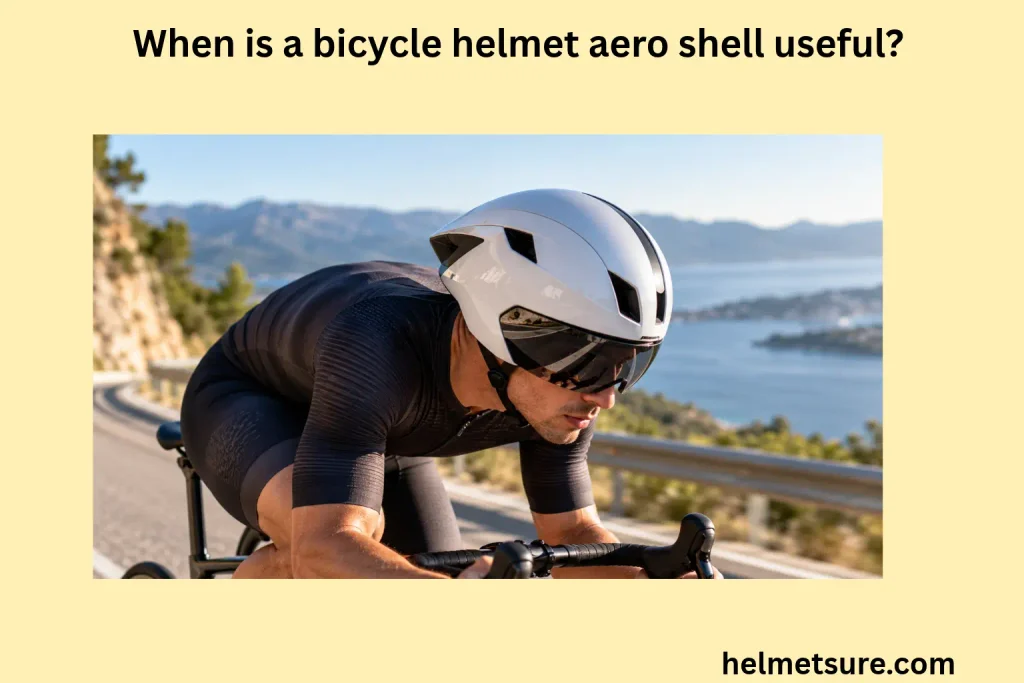
When Is a Bicycle Helmet Aero Shell Useful?
The strongest case is sustained riding where a relevant reduction in aerodynamic resistance matters. A compatible removable cover may also be worthwhile for weather shielding, even when its drag advantage has not been independently established. Neither benefit can be judged from smoothness, vent count, or an “aero” label alone.
What Makes a Bicycle Helmet Aero Shell Different From a Conventional Helmet Shell?
A bicycle helmet aero shell is an exterior aerodynamic configuration that may be integrated into a complete helmet or supplied as a manufacturer-compatible removable cover, while a conventional ventilated shell emphasizes a different exterior and ventilation arrangement.
Three things must remain distinct: the integrated exterior, a detachable accessory, and the complete protective helmet. The complete helmet includes the shell, impact-absorbing liner, retention system, and other components working together.
How an integrated aero shell differs from a conventional ventilated helmet exterior
An integrated bicycle helmet aero shell differs from a conventional ventilated exterior through its aerodynamic design emphasis, external contours, and arrangement of ventilation openings.
Its exterior is part of the helmet’s original construction. Designers can coordinate the profile, openings, and internal layout from the outset.
A conventional ventilated helmet can also have aerodynamic shaping. These categories overlap rather than forming a simple division between faster and slower helmets. The difference is design emphasis, while demonstrated performance requires testing.
How a removable aero cover changes an existing helmet’s external configuration
A removable bicycle helmet aero cover changes the exterior of a manufacturer-compatible helmet without replacing the underlying protective helmet structure.
The accessory fits over designated parts of the helmet and can bridge selected openings. Removing it restores the intended uncovered arrangement without replacing the protective shell or liner.
The relevant equipment is therefore a particular helmet-and-cover combination. Lazer’s Z1 KinetiCore Aeroshell illustrates this accessory category, but its existence does not establish compatibility with other generations or similarly shaped helmets.
Why fewer visible vents do not automatically create a faster aerodynamic shell
Fewer visible vents do not automatically create a faster bicycle helmet aero shell because aerodynamic drag depends on the complete exterior geometry and its interaction with surrounding airflow.
Underwood and colleagues tested opening arrangements on one reconfigurable aero helmet; Novak and colleagues tested adjustable prototypes. Both studies show that vent configuration can affect drag within a specific design.
How Does Bicycle Helmet Aero Shell Geometry Reduce Aerodynamic Drag?
Bicycle helmet aero shell geometry can reduce aerodynamic drag by changing pressure distribution, airflow separation, and wake formation around the rider’s head.
These mechanisms explain what designers seek to influence. They do not establish that a particular shell succeeds, or that its advantage survives changes in rider position and wind direction.
How a streamlined shell profile changes airflow separation around the helmet
A streamlined bicycle helmet shell profile changes airflow separation by influencing how air follows the helmet contours and forms a downstream wake.
As air passes over the helmet, surface curvature influences its motion and the surrounding pressure field. Where flow separates, a wake develops behind the helmet.
Changing these features can alter pressure drag, one contributor to total aerodynamic resistance alongside surface friction. Because the rider’s shoulders and back occupy the same flow field, a shell cannot be evaluated reliably as an isolated silhouette.
Why rider head angle changes the aerodynamic performance of a helmet shell
Rider head angle changes bicycle helmet aero-shell performance by altering the orientation of the shell relative to incoming air and the surrounding rider geometry.
Head pitch means tilting the head upward or downward. This changes the surfaces exposed to airflow and the relationship between the helmet’s rear profile and the rider’s back.
Beaumont and colleagues modeled three time-trial helmets in two head positions at 15 m/s, without crosswind. Their CFD study demonstrates position sensitivity under those modeled conditions; it does not prescribe a universal riding angle.
How yaw angle and crosswind conditions influence aero-shell performance
Yaw angle and crosswind conditions influence bicycle helmet aero-shell performance by changing the direction of airflow relative to the rider and helmet.
Yaw is the horizontal angle between the approaching relative airflow and the rider’s forward direction. It reflects the combination of bicycle movement and ambient wind.
Off-axis flow exposes different shell surfaces and can change pressure and separation patterns. A favorable head-on result therefore cannot describe an entire crosswind response. The Beaumont study above did not test a yaw sweep.
Why aerodynamic drag becomes more important as relative airspeed increases
Aerodynamic drag becomes more important as relative airspeed increases because drag force generally rises approximately with the square of airspeed when other aerodynamic factors remain constant.
The simplified drag relationship is:
FD = ½ ρ Cd A vair2
FDis aerodynamic drag force.ρis air density.Cdis drag coefficient.Ais reference frontal area.vairis relative airspeed.
The product CdA is commonly described as drag area.
In still air, aerodynamic power demand is drag force multiplied by riding speed, giving the familiar approximate cubic relationship when CdA remains constant.
In wind, relative airspeed and ground speed differ. Road power calculations must account for the force component opposing travel. These relationships explain increasing interest in aerodynamics at speed without creating a universal minimum speed for aero-shell usefulness.
What Aerodynamic Testing Shows Whether an Aero Shell Is Actually Useful
Aerodynamic testing establishes whether a bicycle helmet aero shell is useful by comparing relevant configurations under controlled, sufficiently matched conditions and reporting the measured or modeled drag response.
Useful evidence identifies what changed, what remained controlled, and what the reported number represents.
How wind-tunnel comparisons establish changes in helmet drag and rider drag area
Wind-tunnel comparisons establish changes in bicycle helmet drag and rider drag area by measuring controlled configurations against a defined aerodynamic baseline.
A comparison should identify the helmet, cover or opening state, rider or mannequin, airflow speed, orientation, and measurement scope.
Force is reported in newtons; CdA is reported in square metres. Helmet-only drag and whole-rider drag are different quantities. Sound bicycle helmet aerodynamic testing also needs sufficient repeatability to distinguish a configuration effect from positioning variation or measurement noise.
For example, Novak’s study used a road-position mannequin and compared commercial helmets with printed prototypes. Its adjustable-vent results belong to those prototypes and that setup, rather than establishing savings for an unrelated retail cover.
Why matched head position and yaw conditions are essential when comparing helmets
Matched head position and yaw conditions are essential for comparing bicycle helmet aerodynamics because changes in posture or airflow direction can affect measured drag independently of helmet configuration.
If the head drops between runs, the result may reflect both equipment and posture. Testing several positions can improve relevance, provided each comparison preserves or clearly accounts for those variables.
Look for repeat measurements and reported variability, especially when the claimed advantage is small. A single best run is a weaker basis for selection than a repeatable difference across relevant conditions.
How computational fluid dynamics differs from physical wind-tunnel testing
Computational fluid dynamics predicts bicycle helmet airflow and drag through numerical models, whereas physical wind-tunnel testing measures aerodynamic behavior using an actual test configuration.
CFD depends on the represented geometry, computational mesh, turbulence treatment, boundary conditions, and numerical solution. It can help explain pressure patterns and wakes, but prediction accuracy requires appropriate validation.
Beaumont’s three-helmet, two-position analysis used a fixed 15 m/s simulated flow without crosswind. Those limits matter when interpreting it.
Validation of a modeling method is also different from physically testing every commercial helmet being considered.
Why measured drag reductions cannot be converted into universal ride-time savings
Measured bicycle helmet drag reductions cannot be converted into universal ride-time savings because elapsed-time benefits depend on rider power, speed, wind, course conditions, and the aerodynamic setup.
A power estimate requires a specified operating speed and relevant drag difference. Estimating finish time additionally requires assumptions about power delivery, gradients, other resistance, and time spent in the tested posture.
| Evidence type | What it establishes | What it does not establish |
|---|---|---|
| Matched wind-tunnel comparison | Measured drag difference for the stated setup | The same gain for every cyclist |
| CFD analysis | Predicted behavior under modeled conditions | Physical confirmation of every prediction |
| Adjustable-vent experiment | Response of the tested opening arrangements | Equivalent performance from another cover |
| Manufacturer assertion | The company’s stated benefit | Independent confirmation without supporting methods |
| Controlled rider-specific comparison | Evidence for a particular position and setup | Transferability to other riders or courses |
How Does an Aero Shell Affect Helmet Ventilation and Thermal Comfort?
A bicycle helmet aero shell affects ventilation by changing the openings and airflow pathways available for cooling, while actual thermal comfort depends on the complete helmet and riding conditions.
Cooling evidence should identify whether researchers measured temperature, heat loss, airflow, or human perceptions.
How covering ventilation openings can alter fresh-air exchange beneath the helmet
Covering bicycle helmet ventilation openings can alter fresh-air exchange by changing the routes through which external air enters and leaves the helmet.
The result depends on which pathways remain available.
Underwood’s wind-tunnel study used a heated mannequin and one reconfigurable helmet at 16.7 m/s. Opening arrangement affected local temperature and drag; the study did not show that every covered helmet becomes hotter by a predictable amount.
How internal channels allow some streamlined helmets to retain useful airflow
Internal ventilation channels allow some streamlined bicycle helmets to retain useful airflow by connecting available intake and outlet regions beneath the exterior shell.
The important question is whether incoming air can move through the space beneath the helmet and leave through available outlets. Channel continuity, fit, and contact areas matter alongside opening size.
Inspect the actual airflow architecture rather than counting exterior holes. A streamlined design can retain functioning ventilation, although that does not establish equal cooling to another helmet.
Why low-speed and high-speed riding can produce different thermal experiences
Low-speed and high-speed riding can produce different bicycle helmet thermal experiences because relative airflow and heat-transfer conditions change with cycling speed.
Mukunthan and colleagues used a thermal manikin to examine five helmet configurations at 3 and 6 m/s, measuring dry and combined dry-and-evaporative heat loss.
A configuration that feels acceptable on a moving descent may feel different on a slow climb. Neither test speed is a universal comfort threshold.
Why measured cooling and subjective comfort must be evaluated separately
Measured bicycle helmet cooling and subjective comfort must be evaluated separately because laboratory heat-transfer and temperature measurements do not fully represent every rider’s perceived thermal experience.
Convective cooling involves heat exchange with moving air; evaporative cooling involves moisture changing to vapor. Neither is identical to sweating rate or perceived freshness.
Hair, humidity, effort, and personal preferences complicate the wearing experience. Use thermal tests to understand mechanisms and relative performance, then assess comfort in realistic conditions without loosening or repositioning the helmet incorrectly.
What Safety and Competition Requirements Limit Aero Shell Use?
Bicycle helmet aero-shell use is limited by complete-helmet safety requirements, manufacturer-supported accessory compatibility, and any competition rules governing the intended event.
These are separate checks. Passing one does not resolve the others.
Why aero-shell design cannot replace complete-helmet certification and correct fit
Bicycle helmet aero-shell design cannot replace complete-helmet safety compliance or correct fit because exterior aerodynamics do not establish impact attenuation, retention, coverage, or required vision performance.
In the United States, 16 CFR Part 1203 sets bicycle-helmet requirements, including impact attenuation, retention strength, positional stability, and peripheral vision.
European documentation may reference EN 1078; the relevant edition and conformity documentation require checking for the intended market.
These bicycle helmet safety standards address protective requirements rather than aerodynamic efficiency. A compliant helmet must still fit its wearer correctly.
Why removable aero covers require exact-model manufacturer compatibility
Removable bicycle helmet aero covers require exact-model manufacturer compatibility because attachment, fit, and approved use depend on the specific helmet and accessory configuration.
Confirm the model, generation, size, and fitting instructions. Similar appearance is insufficient.
Under 16 CFR 1203.7, helmets must pass applicable tests with and without manufacturer-offered attachments and their combinations. That requirement does not establish the suitability of an unidentified aftermarket cover.
How UCI Regulation 1.3.031 distinguishes traditional and time-trial helmet configurations
UCI Regulation 1.3.031 distinguishes traditional and time-trial helmet configurations through defined exterior features and discipline-specific equipment permissions under the applicable rule edition.
The February 2026 edition supplied in the brief differentiates the categories using ventilation openings, ear coverage, visors, and discipline permissions. Those dated provisions are not sufficient to establish eligibility at a later event.
Check the edition effective on the competition date, subsequent amendments, and relevant technical guidance. This article does not certify a particular configuration as currently UCI-eligible.
Why an independently unrated aero helmet is not automatically an unsafe helmet
An independently unrated bicycle aero helmet is not automatically unsafe because applicable safety compliance and voluntary comparative impact ratings establish different kinds of evidence.
Virginia Tech’s Bicycle STAR system compares complete helmets using defined impact scenarios, incorporating linear acceleration and rotational velocity.
Neither compliance nor a favorable rating guarantees an injury-free crash.
| Requirement | Evidence needed | What it does not establish |
|---|---|---|
| Complete-helmet compliance | Relevant labels, documentation, and applicable standard | Aerodynamic superiority |
| Cover compatibility | Manufacturer support for the exact pairing | Suitability for another generation |
| Correct fit and vision | Installed-configuration checks against instructions | Laboratory impact performance |
| Event permission | Effective governing rules and technical guidance | Permission at unrelated events |
| Independent impact rating | Exact-model result and its methodology | Drag reduction or guaranteed protection |
How Do Aero Road Shells, Time-Trial Shells, and Removable Covers Compare?
Integrated aero road shells, time-trial-oriented shells, and manufacturer-compatible removable covers differ in exterior geometry, ventilation architecture, and configuration flexibility, while their actual performance remains product-specific.
Compare their construction and adjustability first. A category name cannot substitute for a measured comparison.
How compact aero road shells differ from elongated time-trial shell designs
Compact aero road shells differ from elongated time-trial designs in overall profile, rear-shell geometry, and the intended relationship between the helmet and rider posture.
A compact profile and an extended rear section create different geometrical relationships with the rider’s back. Not every time-trial helmet is elongated, and length alone does not establish lower drag.
How removable aero covers alter exterior geometry without replacing the protective helmet
Removable bicycle helmet aero covers alter the exterior geometry of a compatible helmet while leaving the underlying complete protective helmet as the primary equipment assembly.
Their distinguishing feature is reversibility: a supported accessory can provide a second exterior arrangement for the same underlying helmet.
Installing a cover does not make the helmet geometrically or functionally equivalent to a purpose-designed time-trial model.
Which shell configurations allow fixed or reversible ventilation coverage
Bicycle helmet shell configurations provide fixed or reversible ventilation coverage depending on whether the exterior is integrated, manufacturer-removable, or designed with adjustable openings.
An integrated exterior is generally fixed unless the manufacturer provides a specific adjustment mechanism. A removable cover permits only the configurations supported by its instructions.
| Feature | Integrated aero road shell | Time-trial shell | Compatible removable cover |
|---|---|---|---|
| Exterior | Built into the helmet | Built into the helmet; geometry varies | Accessory over a specified helmet |
| Rear profile | Often relatively compact | May be elongated or compact | Limited by the underlying helmet |
| Ventilation | Model-specific pathways | Model-specific pathways | Changes selected openings |
| Reversibility | Only where designed | Only where designed | Removable as instructed |
| Evidence | Exact configuration needed | Exact configuration and posture needed | Exact helmet-and-cover pairing needed |
When Do Riding Conditions Make a Bicycle Helmet Aero Shell Worth Using?
A bicycle helmet aero shell becomes more useful when riding conditions make a credible aerodynamic or practical benefit relevant and the rider can maintain suitable fit, cooling, protection, and equipment eligibility.
Why sustained faster road riding can increase the value of an aerodynamic shell
Sustained faster road riding can increase the value of a bicycle helmet aero shell because aerodynamic drag becomes a larger contributor to the rider’s resistance as relative airspeed rises.
A repeatable advantage has more opportunity to matter when the rider spends substantial time in the conditions where it was demonstrated.
When time trials and triathlon make aero-shell optimization especially relevant
Time trials and triathlon can make bicycle helmet aero-shell optimization especially relevant when sustained aerodynamic positioning, measurable drag differences, and event-specific equipment requirements favor the configuration.
For an individual time trial, compare helmets in the position you can maintain while seeing ahead.
When a compatible aero cover can provide useful protection from wind and precipitation
A manufacturer-compatible bicycle helmet aero cover can provide useful weather shielding by covering selected openings and reducing direct exposure to wind or precipitation.
Why hot, slow climbing can make a more ventilated configuration preferable
Hot, slow climbing can make a more ventilated bicycle helmet configuration preferable when thermal comfort and adequate heat removal matter more than a small or uncertain aerodynamic advantage.
If a supported cover is removable, decide where a safe stop would allow adjustment. Do not assume it should be handled while riding.
Why stop-start urban riding often reduces the value of aerodynamic optimization
Stop-start urban riding often reduces the practical value of bicycle helmet aerodynamic optimization because frequent speed changes limit sustained exposure to the conditions in which drag reduction is most relevant.
For these trips, prioritize secure fit, useful vision, comfortable wearing, and convenient everyday handling.
| Riding scenario | Potential value | Conditional decision |
|---|---|---|
| Sustained faster riding | Relevant drag reduction | Favor repeatable evidence for your position |
| Individual time trial | Position-specific optimization | Verify posture, benefit, and event permission |
| Triathlon bike leg | Sustained aerodynamic benefit | Assess duration, comfort, and rules |
| Cool or wet riding | Partial weather shielding | Use a supported cover for a defined purpose |
| Hot, slow climbing | Reduced aero priority | Favor suitable ventilation |
| Stop-start urban riding | Limited sustained aero opportunity | Prioritize everyday suitability |
How Should You Evaluate an Aero Shell Before Buying or Using It?
A bicycle helmet aero shell should be evaluated by identifying the exact helmet and accessory configuration, reviewing relevant aerodynamic evidence, and confirming fit, cooling, safety, and intended-use eligibility.
How to verify the exact helmet and removable-cover configuration
Match the helmet model, size, generation, and accessory identifier to the manufacturer’s supported compatibility information.
How to confirm aerodynamic claims against relevant riding conditions
Identify the measured configuration, test method, airflow conditions, baseline, posture, yaw conditions, and reported drag metric.
When methods are unavailable, record the drag benefit as unverified. Do not replace missing information with a result from another helmet.
How to check fit, field of vision, and thermal comfort with the shell installed
Follow the fitting instructions, then adopt the intended riding posture while stationary. Check retention adjustment, forward and peripheral visibility, and interference with eyewear.
Assess comfort progressively in representative conditions. A showroom fitting cannot establish how the helmet will feel during a prolonged climb or race.
How to confirm the configuration’s safety and event eligibility
Check complete-helmet requirements, manufacturer-approved accessories, and the governing competition rules where relevant.
Aero-shell candidate evaluation checklist
0 / 10
When Should You Avoid or Reject a Bicycle Helmet Aero Shell?
A bicycle helmet aero shell should be avoided, rejected, or reconsidered when the installed configuration interferes with correct helmet use, lacks required compatibility or approval, or creates an unacceptable practical compromise.
When an aero shell interferes with secure fit or necessary field of vision
A bicycle helmet aero shell should be rejected when its installed configuration prevents secure helmet fit or obstructs the field of vision required for safe and compliant use.
When an unsupported removable cover makes the configuration unsuitable
Do not force an unsupported accessory into place or add improvised fasteners. Use a documented compatible pairing.
When helmet damage or unauthorized alteration requires action
Stop using a helmet with suspected structural damage and follow the manufacturer’s impact and replacement instructions. A smooth cover can conceal rather than resolve damage.
When competition regulations prohibit the selected configuration
A manufacturer-supported accessory can still be prohibited in a particular competition. Use the rules applicable to the exact event.
When thermal discomfort makes the configuration impractical
Reconsider the configuration before discomfort encourages loosening, lifting, or removing the helmet during riding.
| Finding | Action | Decision meaning |
|---|---|---|
| Fit or vision cannot be maintained | Reject the installed arrangement | Essential wearing requirements fail |
| Compatibility cannot be established | Do not use the accessory | Assembly suitability is unresolved |
| Construction may be damaged | Stop use and follow manufacturer guidance | A cover cannot restore protection |
| Event prohibits the configuration | Select permitted equipment | Eligibility fails |
| Comfort prevents correct wearing | Change configuration | Practical suitability fails |
| Drag evidence is missing | Treat the speed benefit as unverified | Missing evidence is not proof of unsafe equipment |
When Is Choosing an Aero Shell Better Than Using a Ventilated Helmet?
Choosing a bicycle helmet aero shell is better than using a ventilated alternative when its demonstrated aerodynamic or practical benefit is relevant to the intended ride and all essential fit, safety, cooling, compatibility, and eligibility requirements remain satisfied.
Choose an aero shell when comparable testing confirms a useful drag reduction
Choose an aero shell when comparable aerodynamic testing confirms a meaningful drag reduction for the intended riding conditions and the complete configuration remains suitable.
Consider an aero shell conditionally when aerodynamic evidence is incomplete
Weather shielding or a comfortable personal preference can justify consideration without a proven speed gain. Be explicit about that reason.
“Useful for this ride” can be defensible even when “faster than this alternative” remains unverified.
Prefer a suitable alternative when essential requirements cannot be met
Prefer a suitable ventilated alternative when the aero configuration cannot meet essential fit, safety, compatibility, event eligibility, or practical wearing requirements.
What makes an aero shell useful?
Select the strongest answer.
Sources and Reference Notes
All ten references retained from the supplied article.
- R1 — Vent placement, drag, and temperature: Underwood, L., Vircondelet, C., and Jermy, M. (2018). Thermal comfort and drag of a streamlined cycling helmet as a function of ventilation hole placement. Journal of Sports Engineering and Technology, 232(1), 15–21. Original study.
- R2 — Adjustable ventilation configurations: Novak, J., Burton, D., and Crouch, T. (2019). Aerodynamic test results of bicycle helmets in different configurations: Towards a responsive design. Journal of Sports Engineering and Technology, 233(2), 268–276. Original study.
- R3 — CFD and head position: Beaumont, F., Taiar, R., Polidori, G., Trenchard, H., and Grappe, F. (2018). Aerodynamic study of time-trial helmets in cycling racing using CFD analysis. Journal of Biomechanics, 67, 1–8. Original study.
- R4 — Experimental helmet aerodynamics: Alam, F., Chowdhury, H., Elmir, Z., Sayogo, A., Love, J., and Subic, A. (2010). An experimental study of thermal comfort and aerodynamic efficiency of recreational and racing bicycle helmets. Procedia Engineering, 2(2), 2413–2418. Study DOI.
- R5 — Thermal performance: Mukunthan, S., et al. (2019). Thermal-Performance Evaluation of Bicycle Helmets for Convective and Evaporative Heat Loss at Low and Moderate Cycling Speeds. Applied Sciences, 9(18), 3672. Original study.
- R6 — U.S. protective requirements: U.S. Consumer Product Safety Commission, Bicycle Helmets Business Guidance and 16 CFR Part 1203.
- R7 — Independent impact ratings: Virginia Tech Helmet Lab, Bicycle Helmet Ratings.
- R8 — Competition requirements: Union Cycliste Internationale, Regulations and Equipment guidance.
- R9 — Manufacturer accessory documentation: Lazer Sport, Z1 KinetiCore Aeroshell.
- R10 — European standard scope: NEN, NEN-EN 1078:2012+A1:2012.