
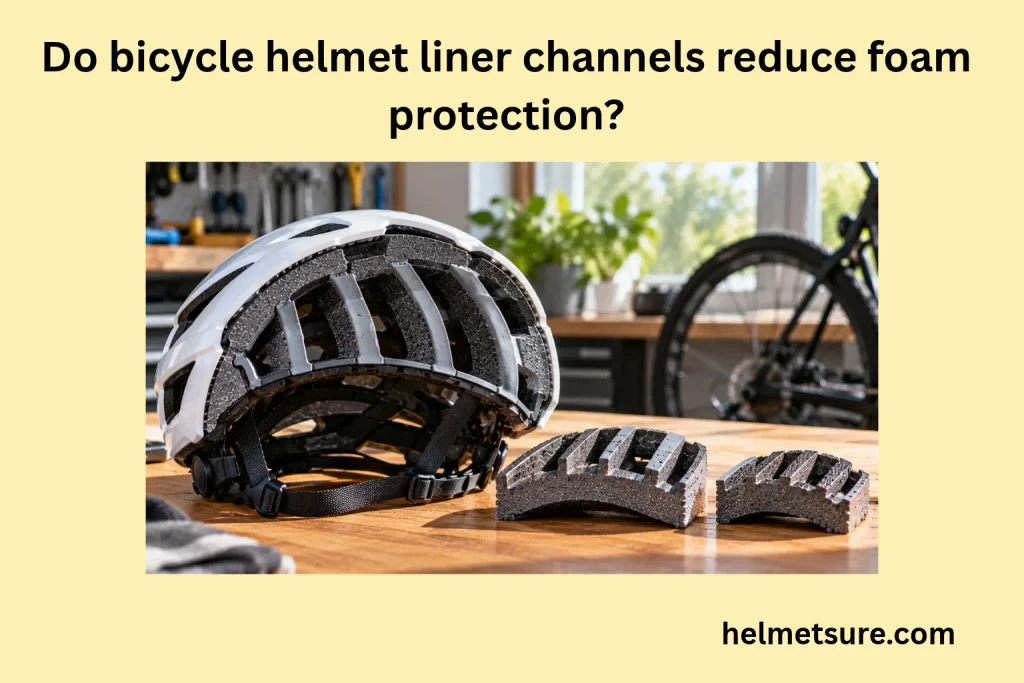
Do Bicycle Helmet Liner Channels Reduce Foam Protection?
Bicycle helmet EPS liner channels alter local foam geometry and can affect impact compression, but do not necessarily reduce overall protection. Their effects depend on channel design, remaining foam, crush resistance, impact conditions, and verified whole-helmet performance.
A groove inside a helmet is a visible construction feature, not a stand-alone safety score. It may change the amount and arrangement of foam at a particular location, while the shell and surrounding liner influence how that region responds when loaded. Whether the complete helmet performs well requires evidence beyond the appearance of its channels.
The same caution applies to ventilation. Channels can create routes for air, but their presence does not establish how much air reaches the scalp or how much cooling occurs during a ride.
EPS Ventilation Channels Versus Shell Openings and Comfort-Pad Gaps
Bicycle helmets may contain structural EPS grooves, full-depth liner openings, outer-shell vents, and comfort-pad gaps, but these features do not remove or displace impact-absorbing foam in equivalent ways.
Before judging a channel, identify the component that contains it. A recess in structural foam differs from a gap between soft pads, even when both appear to form an airflow passage.
How molded ventilation grooves differ from full-depth openings through the EPS impact liner
Molded ventilation grooves form recesses within the structural EPS liner, whereas full-depth openings extend completely through the foam at their locations.
EPS, or expanded polystyrene, is the structural impact-absorbing foam used in many bicycle helmets. An internal groove can leave EPS between the bottom of the recess and the outer shell. A full-depth opening has no continuous EPS through that particular opening, although structural foam remains around its edges.
This distinction matters because the two features create different local geometries. Groove depth describes how far a recess extends from its reference surface; remaining thickness describes the foam left in a specified direction. Neither measurement, by itself, establishes impact performance.
A shallow groove should therefore not be treated as equivalent to a hole through the liner. Equally, the presence of a full-depth opening does not automatically establish that the assembled helmet is unsafe.
Why outer-shell vents are not necessarily identical to openings through the EPS impact liner
Outer-shell vents are openings in a bicycle helmet’s external shell, and their position or dimensions do not necessarily match openings in the underlying EPS impact liner.
The external opening is only one part of the construction. Beneath it, the foam passage may narrow, change direction, or connect with an internal recess. Looking at the helmet from above does not reveal the entire route between the shell and the scalp.
For that reason, counting shell vents cannot establish how much structural EPS is present. Measuring the visible opening also cannot establish the depth of adjacent foam or the shape of an internal channel.
A meaningful construction description identifies which layer is being discussed. “Large vent” is otherwise ambiguous: it might describe the shell opening, the EPS passage, or the visible gap at the rider’s head.
Why gaps between removable comfort pads do not remove structural EPS foam
Gaps between removable bicycle helmet comfort pads do not independently remove structural EPS because they occur in the soft fitting layer rather than the impact-absorbing foam.
Comfort pads sit between the head and the structural liner. Their spacing can leave passages for air without creating a recess in the EPS underneath. A pad gap can also align with a molded EPS groove, but the two remain separate features.
This prevents a common misreading: an exposed area between pads is not necessarily missing structural foam. Conversely, thick or closely spaced comfort pads do not prove that the underlying impact liner is deeper or more protective.
| Feature | Structural distinction | What it means |
|---|---|---|
| Internal EPS groove | Recess within structural impact foam | May retain EPS beneath the groove |
| Full-depth EPS opening | Passage through the local impact-liner depth | Interrupts EPS continuity through that opening |
| Outer-shell vent | Opening in the external shell | May differ from the underlying EPS passage |
| Comfort-pad gap | Space between soft fitting pads | Does not independently remove structural EPS |
These distinctions describe components. They do not rank impact attenuation or measured cooling.
How Liner Channels Can Affect Local Foam Compression During an Impact
Bicycle helmet liner channels can affect local foam compression by changing remaining EPS geometry and possible load paths, while actual deformation depends on loading conditions and material resistance.
The mechanical question is how the loaded region deforms and transmits force. The amount of visible foam is relevant to its geometry, but does not provide a complete answer.
How Channel Depth and Position Change Local Remaining EPS Thickness and Potential Crush Distance
EPS channel depth and position change the local distribution of remaining foam and can influence the crush distance available along a particular impact-loading direction.
For otherwise comparable geometry, a deeper recess can leave less foam beneath it. However, that geometric depth is not automatically the distance the foam can usefully compress. EPS develops resistance as it deforms, and heavily compacted material has less useful crushing travel remaining.
Three quantities must therefore stay separate: the foam thickness present before impact, the compression travel mechanically available under the loading configuration, and the deformation that actually occurs.
Position matters as well. Loading near a channel edge may involve surrounding material differently from loading centered over another region. An impact approaching from a different direction can also engage a different combination of foam and shell.
These principles explain why a channel may matter locally. They do not establish a universal protection loss for a particular groove depth.
How Adjacent EPS Foam Regions Can Deform and Share Impact Loads Around Liner Channels
Structural EPS adjacent to liner channels can deform and participate in carrying impact loads, but the degree of load sharing depends on geometry, impact conditions, and foam response.
An impact need not load only the material directly beneath its initial contact point. The shell and connected liner can involve neighboring regions as deformation develops. Which regions participate depends on the construction and loading direction.
Participation is different from full compensation. The presence of foam beside a channel does not prove that it replaces the mechanical contribution of the material displaced by that channel. Nor does it establish an identical force response to an otherwise unchanneled design.
Quantifying load sharing would require directly applicable testing or a suitably validated mechanical model. Without that evidence, the accurate statement is conditional: adjacent EPS may help carry the load, but its contribution cannot be calculated from a photograph or channel count.
Why the effect of reduced local foam volume depends on impact energy and the foam's crush resistance
The effect of reduced local EPS foam volume depends on impact energy and crush resistance because these factors determine deformation demand and the force developed during compression.
A lower-demand impact may leave some available compression capacity unused. Under different loading, a region may use more of its travel. Under excessive demand, useful crushing capacity can become exhausted as the foam becomes heavily compacted.
Foam volume does not describe the resisting force throughout this process. Two regions with similar volumes can behave differently if their material properties, geometry, or loading differ.
Energy dissipated through compression depends on resisting force accumulated over actual deformation distance. The peak transmitted force is a different characteristic: similar compression work does not necessarily produce the same force peak.
The conditional mechanism is:
- Channel depth and position change local EPS distribution.
- That geometry may change available crushing capacity and load paths.
- Impact conditions and material resistance determine actual deformation.
- The resulting force–displacement response governs compression work and contributes to transmitted force.
Adjacent foam may participate without fully compensating. A local response, whether favorable or unfavorable, does not independently establish whole-helmet protection.
How Internal Liner Channels Can Support Airflow Without Guaranteeing Better Cooling
Internal bicycle helmet EPS channels can support scalp ventilation by connecting airflow spaces, but their effectiveness depends on inlet and outlet conditions, channel restrictions, fit, hair, and relative wind.
An open route, actual air movement, and heat loss are related but separate outcomes. The first can be inspected; the others require appropriate measurement.
How Connected EPS Channels Create Airflow Paths Across the Scalp
Connected EPS channels create potential airflow paths across the scalp by linking internal helmet passages with suitable inlet and outlet openings.
A channel that connects an inlet region with an outlet region can provide a continuous route for air. An interrupted or isolated recess may offer space without creating effective circulation through that area.
Connectivity is therefore useful, but insufficient. Air still needs conditions that drive it through the route, and the passage must remain sufficiently open when the helmet is worn.
Research by De Bruyne and colleagues used tracer gas to investigate local ventilation beneath bicycle helmets. This kind of measurement examines air exchange at particular locations rather than assuming that visible openings ventilate every scalp region equally.
Local air exchange is also different from cooling. Air moving through a passage does not, by itself, specify the resulting convective or evaporative heat loss.
How Inlet Area, Outlet Position, and Channel Restrictions Affect Airflow Capacity
Inlet area, outlet position, and channel restrictions influence bicycle helmet airflow capacity through their effects on air entry, pressure conditions, and resistance along the ventilation pathway.
The effective inlet area determines the space available for air entry under the relevant conditions. Downstream, a narrow section, abrupt restriction, or obstruction can limit flow through an otherwise connected route. Outlet position matters because discharge depends partly on the pressure conditions around the helmet.
These factors interact. Enlarging one opening does not establish that flow increases throughout the system if another section remains restrictive. Likewise, an apparently generous outlet is not proof of favorable pressure conditions during every head position or wind direction.
Conference-proceedings research by Aljaste and colleagues investigated channel and opening arrangements using thermal helmet mock-ups. Its ventilation findings inform design discussion, but its protection-related caution about large openings should not be treated as a measured crash-test result. Thermal testing cannot establish a numerical impact-protection penalty.
How helmet fit, hair, and riding airflow conditions can limit ventilation effectiveness
Helmet fit, hair, and riding airflow conditions can limit EPS channel ventilation by changing local airflow clearance, obstruction, and the pressure conditions driving circulation.
Hair can occupy spaces that remain open on a bare laboratory headform. Contact between the helmet’s fitting components and the head can also affect nearby passages. These influences are rider-specific and should be assessed while maintaining correct fit.
Relative wind means air movement relative to the helmet. Riding speed contributes, but wind direction and head position also affect the flow encountered by inlets and outlets. Ventilation experienced on a slow climb may therefore differ from that during faster riding.
Brühwiler and colleagues examined helmet heat transfer using controlled headform and wind-tunnel experiments, including the influence of hair and design details. Mukunthan and colleagues separately evaluated convective and evaporative thermal performance. Such studies show why airflow measurements, thermal measurements, and personal comfort should not be treated as interchangeable.
| Variable | Potential airflow support | Potential constraint |
|---|---|---|
| Channel connectivity | Continuous internal routes | Interrupted or isolated passages |
| Inlet area | Effective space for air entry | Small or obstructed entry regions |
| Outlet position | Discharge under favorable pressure conditions | Unfavorable surrounding pressure |
| Channel restrictions | Open passages | Narrow sections or obstructions |
| Riding airflow | Favorable relative wind | Low airflow or unfavorable direction |
| Hair and fit | Suitable clearance near the scalp | Local obstruction or close contact |
These factors interact; they cannot be universally ranked from appearance. Neither this matrix nor visible channel count establishes measured cooling.
Why Channel Size Alone Cannot Predict Bicycle Helmet Impact Protection
Bicycle helmet EPS channel size alone cannot predict impact protection because contact location, shell-liner construction, foam distribution, and oblique-impact conditions influence the complete helmet’s response.
A channel measurement describes one feature. Protective performance concerns the assembled helmet under identified loading conditions.
Why channel-area impact behavior cannot be generalized to other helmet impact locations
Impact behavior near one bicycle helmet EPS channel cannot automatically be generalized to other helmet locations because local foam geometry and loading conditions vary.
A crown impact, a side impact, and a rear impact can involve different liner regions and structural arrangements. Even nearby contact points may load a channel, its edge, or a broader surrounding section differently.
This limits both positive and negative conclusions. A favorable result at one location does not establish equivalent performance everywhere. A local concern also does not quantify the response of every other part of the helmet.
Multi-location testing is consequently more informative than judging a single visible recess. For example, Virginia Tech’s bicycle protocol evaluates impacts at several helmet locations. Its results describe performance across that program’s configurations rather than every possible crash.
Why Shell-Liner Construction and Foam Distribution Prevent Reliable Safety Predictions From Channel Dimensions Alone
Shell-liner construction and EPS foam distribution prevent reliable protection predictions from channel dimensions alone because impact loads act through the complete helmet structure.
The shell influences how contact loads reach the liner, while the connected foam geometry affects which regions can deform. Material response and the distribution of EPS around an opening also matter.
Two helmets can have similar-looking channels while differing in surrounding thickness, foam properties, shell construction, or coverage. Conversely, different-looking ventilation arrangements can both be incorporated into helmets that meet applicable requirements.
Without directly relevant controlled evidence, channel width, depth, or opening area cannot be converted into a reliable safety ranking. Evaluate the original assembled helmet rather than treating one dimension as a substitute for testing.
Why Liner Channel Dimensions Cannot Independently Predict Rotational Response in Oblique Impacts
Bicycle helmet EPS channel dimensions cannot independently predict rotational response in oblique impacts because angular head motion depends on impact orientation, contact conditions, and complete helmet geometry.
An oblique impact combines motion toward a surface with motion along it. The resulting head response can include translation and rotation, involving more than compression directly beneath the contact point.
Linear acceleration describes changes in translational velocity. Rotational acceleration describes changes in angular velocity, while rotational velocity describes the rate of rotation. A result for one measurement should not be presented as a result for all three.
Bland and colleagues investigated differences between helmet models during oblique impacts and reported design-related and location-specific findings. That work supports examining the complete system; it does not establish a universal channel-dimension rule for rotational protection.
A wider channel therefore cannot independently predict either improved or worsened angular head motion. Applicable testing is needed to evaluate the response of the actual helmet.
How Cyclists Can Evaluate Protection, Fit, and Ventilation in Channeled Bicycle Helmets
Cyclists can evaluate channeled bicycle helmets through applicable safety compliance, exact-model independent testing, secure fit, structural EPS condition, and practical ventilation comfort rather than visible channel size alone.
Use these checks together. Each provides information that the others cannot replace.
How to verify that the complete channeled helmet meets applicable bicycle helmet safety requirements
Compliance of a complete channeled bicycle helmet should be verified against the safety requirements applicable to the rider’s market through required labeling and supporting product documentation.
Identify the relevant jurisdiction and intended activity, then check the helmet itself and the manufacturer’s information. A generic safety statement or familiar brand name is insufficient to establish compliance for the exact product.
In the United States, bicycle helmets sold for that use are subject to CPSC requirements in 16 CFR Part 1203. Official guidance describes requirements including impact attenuation, positional stability, retention strength, and peripheral vision.
Bicycle helmet safety certifications concern identified requirements for the complete construction. They do not establish that channels have no mechanical effect or that every compliant helmet performs equally in comparative tests.
If labeling or product documentation is missing or contradictory, seek clarification before choosing the helmet.
Why independent impact-test results should be matched to the exact helmet model and relevant test conditions
Independent bicycle helmet impact-test results should be matched to the exact model and relevant testing conditions because ratings apply to defined products evaluated under specific protocols.
Confirm the manufacturer, model, relevant revision, and market variant. Check the tested size where reported. A matching appearance or model name does not prove that another version has equivalent construction.
Consult the originating laboratory for current bicycle helmet impact-test ratings and methodology. Virginia Tech’s bicycle STAR program, for example, measures linear acceleration and rotational velocity during defined laboratory impacts. Its score combines these measurements with the program’s risk calculations and impact weightings.
Compare results within compatible methods. A numerical score from one program cannot automatically be compared with a score from a different protocol. A good result also does not guarantee an individual crash outcome.
How to Verify Secure Helmet Positioning and Retention
Secure bicycle helmet positioning and retention require a properly sized helmet that sits correctly and remains stable with the chin strap and adjustment system appropriately fastened.
Measure your head and use the manufacturer’s sizing instructions. Position the helmet level and low enough to cover the forehead, rather than tipped backward. Adjust the fit system and straps as directed.
NHTSA’s fitting guidance describes checking the side straps, snug chin strap, and resistance to rocking forward or backward. The helmet should remain correctly positioned without painful pressure or excessive movement.
Bicycle helmet sizing and fit depend on head shape as well as circumference. If proper adjustment cannot produce a stable fit, try another size or model. Do not select an unstable helmet because its channels look more open, or loosen its retention system to create extra ventilation space.
How to Inspect EPS Channels for Damage Without Modifying Structural Foam
Bicycle helmet EPS channels should be checked for visible cracks, crushed foam, and other damage without drilling, cutting, deepening, or enlarging the structural liner.
Inspect accessible foam under good light, following the manufacturer’s instructions. Look for cracks, compressed regions, missing pieces, or unexpected changes around original channel edges. Check the shell and retention components as well.
Do not probe or dismantle structural components to search for hidden damage. Visual inspection is a screening step, not a test of retained impact performance. EPS damage may be concealed beneath the shell or within the liner.
Crash history matters even when the helmet looks intact. NHTSA advises replacing a helmet after crash involvement because damage is not always visible. Follow the manufacturer’s replacement instructions, and stop using a helmet with suspected structural compromise while arranging replacement or obtaining appropriate guidance.
How to Assess Ventilation Comfort Without Treating Visible Channel Count as an Airflow Rating
Bicycle helmet ventilation comfort should be evaluated through proper wear and relevant airflow or thermal evidence rather than by counting visible EPS liner channels.
First establish secure fit. Then consider how the helmet feels in your normal riding posture and under conditions relevant to your use. A stationary fitting can reveal pressure points, but cannot reproduce all the airflow encountered while riding.
Where comparative evidence exists, identify what was measured. Air-exchange measurements describe ventilation; thermal-headform measurements describe heat transfer under specified conditions. Neither directly establishes your exact comfort response.
Check whether test conditions resemble the intended use, including airspeed, head position, and treatment of hair. Avoid applying a single laboratory result to every rider and environment.
Visible channels can help explain a design, but their count is not an airflow rating. Compare ventilation comfort among otherwise suitable helmets without allowing cooling preferences to replace compliance, fit, or structural integrity.
Check the Complete Helmet
0/6 checked
Compliance is different from a comparative rating. An absent rating is different from failure. An intact appearance cannot prove post-crash protection, and cooling comfort cannot substitute for impact evidence.
Choosing a Ventilated Bicycle Helmet Without Assuming Reduced Foam Protection
Frequently Asked Questions
Do EPS liner channels automatically reduce bicycle helmet protection?
No. Channels change local foam geometry, but complete-helmet performance also depends on remaining foam, material resistance, shell-liner construction, impact location, and verified testing.
Is an EPS groove the same as a full-depth opening?
No. A molded groove can leave structural EPS beneath the recess, while a full-depth opening interrupts the local foam depth through that passage.
Do more visible channels guarantee better cooling?
No. Cooling depends on connected inlets and outlets, restrictions, pressure conditions, relative wind, hair, fit, and heat-transfer performance.
Can channel dimensions predict rotational protection?
No. Oblique-impact response depends on contact conditions, impact orientation, complete helmet geometry, and the tested model—not channel width or depth alone.
Can cyclists enlarge EPS channels to improve airflow?
No. Cutting, drilling, deepening, or enlarging structural EPS creates an unverified construction and can compromise the helmet.
How should a channeled helmet be evaluated?
Verify applicable compliance, exact-model evidence, secure fit, structural condition, crash history, and practical ventilation comfort.
What can visible liner channels establish by themselves?
Select the strongest answer.
Sources and References
All 10 sources retained from the supplied article.
- Kroeker et al. (2016). Age Does Not Affect the Material Properties of Expanded Polystyrene Liners in Field-Used Bicycle Helmets. EPS specimen mechanics; not a channel-specific impact experiment.
- DeMarco et al. (2016). The impact response of traditional and BMX-style bicycle helmets at different impact severities. Whole-helmet impact comparisons; does not isolate channel geometry.
- De Bruyne et al. (2012). Quantification of local ventilation efficiency under bicycle helmets. Local air-exchange measurements.
- Brühwiler et al. (2006). Heat transfer variations of bicycle helmets. Controlled thermal-headform and wind-tunnel research.
- Aljaste, Kuklane, and Heidmets (2015). The effects of air channel construction and design elements on heat transfer characteristics of bicycle helmets for commuters. Conference-proceedings research on thermal performance, rather than a channel-specific crash-test study.
- Mukunthan et al. (2019). Thermal-Performance Evaluation of Bicycle Helmets for Convective and Evaporative Heat Loss at Low and Moderate Cycling Speeds.
- Bland et al. (2018). Differences in Impact Performance of Bicycle Helmets During Oblique Impacts.
- Virginia Tech Helmet Lab. Bicycle Helmet Ratings. Original testing methodology and comparative results.
- U.S. Consumer Product Safety Commission. Bicycle Helmets Business Guidance.
- National Highway Traffic Safety Administration. Fitting Your Bike Helmet. Fit and post-crash replacement guidance.