
Why Do Bicycle Helmets Use Dual-Density Foam?
A helmet liner has a difficult job: it must deform enough to manage impact loading without using up its available crush space too quickly. A material that offers useful resistance in one loading condition may be less suitable in another. Combining two deliberately selected EPS densities gives engineers another way to adjust that response.
Dual-Density EPS Foam as a Protective Helmet Liner Rather Than Comfort Padding
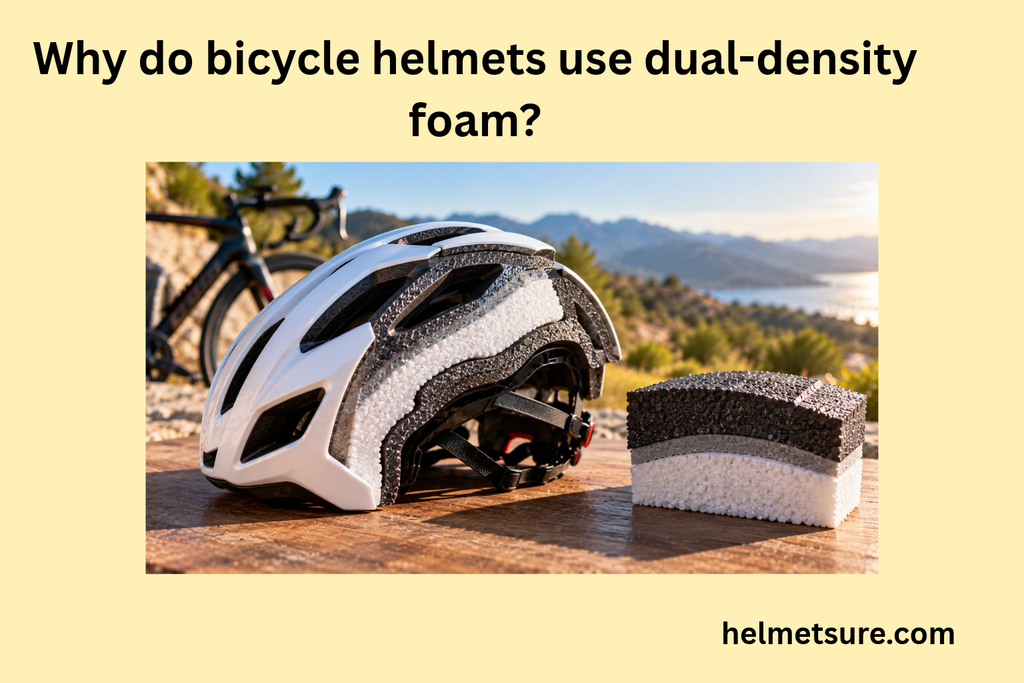
Dual-density bicycle helmet liners deliberately combine EPS regions with different nominal densities inside the impact-absorbing structure, rather than using two layers of ordinary comfort padding.
Dual-density EPS liners combine two deliberately specified foam densities within the protective structure
Dual-density EPS liners contain two intentionally specified foam densities arranged within the protective helmet structure so engineers can combine different compressive material responses.
EPS means expanded polystyrene. Its density describes mass per unit volume, commonly expressed in kilograms per cubic metre, or kg/m³. A dual-density design uses two specified density grades or regions within this same material family.
For a particular product, look for official documentation identifying its protective materials and intended density arrangement. Foam color, surface appearance, and marketing photographs cannot establish those specifications.
Impact-absorbing EPS differs from removable comfort padding used for helmet fit and cushioning
Impact-absorbing EPS differs from removable comfort padding because EPS is intended to manage collision loading through crushing, while soft padding primarily improves helmet fit and wearing comfort.
When comparing bicycle helmet liner materials, identify which component the manufacturer is describing. A soft brow pad, a fitting insert, and an EPS region have different roles, even though each may be called a “liner” in everyday product descriptions.
Dual-density EPS construction differs from multi-material liners and recoverable multi-impact foams
Dual-density EPS construction uses different densities within the EPS material family, whereas multi-material liners combine different substances and recoverable foams have distinct post-compression behavior.
These categories can coexist in a helmet, but they are not interchangeable. A product might contain two EPS densities plus a separate protective mechanism. That additional mechanism needs its own explanation and evidence.
Likewise, two EPS densities do not turn conventional crushable foam into a reusable spring. Post-impact suitability depends on the actual materials, damage, and manufacturer instructions.
| Term | Meaning | What it does not establish |
|---|---|---|
| Dual-density EPS | Two deliberately specified EPS densities | Superior protection by itself |
| Nominal single-density EPS | One intended EPS density specification | Perfectly uniform local density |
| Comfort padding | Soft cushioning used primarily for fit and comfort | A second protective EPS density |
| Multi-material construction | More than one material type in the assembly | A specific density arrangement |
| Recoverable impact material | Material with a defined recovery response | Unlimited reuse of the complete helmet |
How Does EPS Foam Compression Attenuate Impact Loading in a Bicycle Helmet?
EPS foam attenuates bicycle helmet impacts by deforming and crushing under load, dissipating mechanical energy and changing the deceleration history within the liner’s limited available compression distance.
EPS foam cells deform and crush under compressive impact loading, dissipating part of the collision energy
EPS foam cells deform and progressively crush under compressive impact loading, allowing the protective liner to dissipate part of the collision’s mechanical energy.
Expanded beads contain cellular structures with space available for deformation. Under sufficient loading, these structures collapse and the affected foam compresses. The protective function depends on this mechanical response, not simply on the presence of a thick-looking layer.
Compression is described using stress and strain. Stress is force divided by loaded area; strain describes the change in thickness relative to the original thickness. Neither quantity is the same as density or head acceleration.
Controlled liner crushing distributes deceleration over a finite available stopping distance
Controlled EPS liner crushing can increase the distance and duration over which a helmeted head slows, but that deceleration process is limited by the liner’s actual thickness and geometry.
This is central to understanding how bicycle helmets absorb impact. Managing a stop over a deformation distance can reduce loading compared with a much more abrupt stop. The useful result depends on how force develops throughout that deformation, not merely on the final dent.
Mechanically, energy managed through compression relates to force acting through displacement. A useful liner response therefore needs both appropriate resistance and available travel. Foam that barely compresses and foam that exhausts its crush space too early present different engineering problems.
Foam densification sharply increases compression resistance as the remaining crush capacity is exhausted
EPS densification occurs when cellular collapse leaves progressively less available compression space, causing the material’s resistance to rise sharply under further loading.
A simplified compression curve has an initial response, a substantial crushing region, and a later steep rise as the foam becomes compacted. These transitions vary with material properties and loading conditions.
| Compression stage | What happens in the foam | Why it matters |
|---|---|---|
| Initial loading | The cellular structure begins resisting and deforming | Establishes the early force response |
| Progressive crushing | Cellular collapse permits substantial deformation | Provides a working range for energy dissipation |
| Densification | Compacted material offers sharply increasing resistance | Leaves progressively less usable crush capacity |
Why Do Lower-Density and Higher-Density EPS Foams Respond Differently to Impact Loads?
Lower-density and higher-density EPS generally respond differently to comparable compressive loads because their foam structures exhibit different resistance and deformation characteristics, which engineers may combine to tune a protective liner.
Lower-density EPS generally requires less compressive stress to produce deformation under comparable test conditions
Lower-density EPS generally begins deforming under lower compressive stress than higher-density EPS of comparable formulation tested under similar conditions.
This can make a lower-density region useful where the design seeks deformation at lower applied stress. However, the same region may undergo substantial compression before a more resistant material would under a comparable load.
“Lower density” is consequently not a synonym for “more protective.” The question is whether that response suits the loading and whether sufficient crush capacity remains throughout the event.
Density is also separate from compressive modulus, which describes the slope of a specified part of the stress–strain response. A density specification does not replace measurements of modulus or crush stress.
Higher-density EPS generally resists greater compressive stresses at comparable deformation levels
Higher-density EPS generally exhibits greater compressive resistance and modulus than comparable lower-density EPS, allowing it to resist higher loads before reaching the same deformation level.
Kroeker and colleagues’ 2016 study tested EPS cores extracted from 63 helmets across ten models at a bulk strain rate of 195 s⁻¹. Higher measured density was associated with increases in several compression properties under those conditions.
That is material-level evidence. Greater resistance can be useful for managing demanding loading, but it can also produce greater transmitted force where a less resistant response would be preferable. Density alone cannot identify the best finished helmet.
Combining different compression responses may help tune a helmet liner for more than one loading condition
Combining lower-density and higher-density EPS can help engineers tune a liner’s compression response across different loading conditions, although the benefit depends on how the materials are arranged and tested.
The goal is to combine useful characteristics within one finite structure. However, it is too simple to say that softer foam always works first and harder foam switches on afterward. Different regions can carry load together, depending on the impact location and configuration.
There is also no universal cycling speed that separates the two responses. Helmet impact loading depends on the collision geometry and other conditions, not just the bicycle’s forward speed.
| Attribute | Lower-density EPS, under comparable conditions | Higher-density EPS, under comparable conditions |
|---|---|---|
| Mass per equal volume | Lower | Higher |
| Typical compression resistance | Lower | Higher |
| Possible engineering role | Permit deformation at lower stress | Provide greater resistance under demanding loading |
| Important limitation | Available crush space may be consumed | Resistance may be excessive for another condition |
| Protective conclusion | Requires evaluation in the complete design | Requires evaluation in the complete design |
How Does Density Placement Influence the Response of a Dual-Density Helmet Liner?
Density placement influences a dual-density helmet liner by determining where lower-resistance and higher-resistance EPS regions interact with local loading, available deformation space, and the surrounding structure.
Experimental embedded-density specimens show how lower-density EPS can be positioned within a higher-density structure
Experimental dual-density foam specimens can contain lower-density EPS embedded within higher-density EPS, as investigated in the Australian Transport Safety Bureau’s 2001 flat-sample research.
Morgan and Szabo compared 100 engineered dual-density specimens with 61 conventional specimens. Their samples placed lower-density foam within a denser structure, rather than simply treating every design as two uniform sheets.
Documented whole-helmet designs can encapsulate lower-density EPS regions within a denser EPS structure
Documented complete bicycle helmets can encapsulate lower-density EPS sections within a higher-density EPS envelope, as shown by the dual-density configuration evaluated in Bottlang and colleagues’ helmet-impact study.
That configuration also contained viscoelastic elements. In frontal oblique tests using a 6.2 m/s drop onto a 45° anvil, it produced higher measured linear and rotational acceleration than the control helmet.
Liner thickness and other technologies differed, preventing attribution of the result to density placement alone. The finding neither proves that dual-density EPS caused the unfavorable result nor supports an automatic protective advantage from the feature.
Density-region geometry and interfaces affect how different foam regions interact during compression
The shape, location, and interfaces of different-density EPS regions can influence how a dual-density liner shares load and deforms under impact.
Material position determines which regions lie beneath a particular contact area and how much of each region is available along the loading path. Interfaces also form part of the assembled structure’s behavior.
| Configuration evidence | Documented arrangement | What remains unresolved |
|---|---|---|
| Morgan and Szabo’s flat specimens | Lower-density EPS embedded in a higher-density structure | Transfer of specimen findings to a finished helmet |
| Bottlang and colleagues’ tested configuration | Lower-density sections within a denser envelope, plus other elements | The independent contribution of density placement |
| A product described only as dual-density | Two intended density regions, if documentation confirms them | Placement, dimensions, interfaces, and comparative performance |
What Thickness, Weight, and Ventilation Constraints Affect Dual-Density Helmet Design?
Dual-density EPS helmet design must balance compression distance, foam mass, and ventilation geometry because using two densities does not remove the physical limits of liner thickness or available material volume.
Liner thickness limits the physically available compression distance for both foam densities
Liner thickness limits the compression distance available to lower-density and higher-density EPS, so combining materials cannot create additional physical space for absorbing impact energy.
If one region occupies more of a fixed liner depth, less depth remains for another region along that path. Changing the density distribution can change the force response; it does not manufacture extra stopping distance.
DeMarco and colleagues conducted 127 flat-anvil drop tests across 13 helmet models at impact speeds from 1 to 10 m/s, using front-side locations. Greater liner thickness generally corresponded to lower peak headform acceleration, especially at higher speeds in that sample.
The study included a dual-density model but did not isolate density arrangement. Its findings show why thickness must be considered when interpreting comparisons.
Redistributing foam densities changes liner mass according to the volume of each material region
Redistributing EPS densities changes the liner’s mass according to how much volume each foam region occupies, so dual-density construction does not inherently make a helmet lighter.
For two regions, foam mass follows the basic relationship:
Foam mass = density of region 1 × its volume + density of region 2 × its volume.
Replacing some denser foam with lower-density foam can reduce foam mass if other dimensions remain unchanged. A complete redesign may change the volumes, shell, reinforcement, or fittings as well. Compare actual helmet weights before claiming a weight advantage.
Ventilation openings constrain the volume and continuity of impact-absorbing foam around the helmet
Ventilation openings constrain the volume and arrangement of impact-absorbing EPS because openings interrupt the liner geometry and leave surrounding foam regions to manage loading.
Engineers must place both density regions around the intended openings and within the remaining structure. The result depends on geometry as well as material choice.
| Constraint | What two densities can change | What they cannot remove |
|---|---|---|
| Liner thickness | Compression response within the available depth | Finite deformation distance |
| Foam mass | Mass distribution through region densities and volumes | The contribution of every other component |
| Ventilation | Material arrangement around openings | The need to validate the remaining structure |
| Packaging | Distribution of different foam regions | Space required for fit and other components |
What Protection Benefits Does Dual-Density Foam Not Automatically Guarantee?
Dual-density EPS foam does not automatically guarantee lower rotational acceleration, reduced concussion risk, or repeated-impact capability because these outcomes depend on evidence beyond the presence of two foam densities.
Better linear impact attenuation does not necessarily establish lower rotational head acceleration
Better linear impact attenuation does not necessarily mean lower rotational head acceleration because straight-line and angular head motion are different components of impact response.
A test that measures only linear acceleration cannot establish an improvement in a rotational quantity it did not record. Claims about rotational performance need an appropriate test arrangement and relevant measurements.
The Bottlang comparison illustrates why the finished configuration matters: the tested dual-density-containing design did not automatically outperform its control. Its result applies to the investigated configuration and loading condition, rather than every helmet with two EPS densities.
Favorable impact-test measurements do not independently demonstrate reduced concussion or brain-injury risk
Favorable laboratory impact measurements do not independently demonstrate lower concussion or brain-injury incidence because headform responses and clinical injury outcomes are different evidence categories.
Measured acceleration can inform an injury-risk model. The model then estimates an outcome using assumptions and relationships that extend beyond the raw measurement. Neither step is the same as observing clinical outcomes among riders.
When a claim says “reduced risk,” ask whether it refers to measured motion, a modeled estimate, or demonstrated injuries. A percentage reduction in acceleration cannot simply be relabeled as the same percentage reduction in concussion.
Two-density EPS construction does not make a helmet inherently suitable for repeated impacts
Two-density EPS construction does not make a bicycle helmet inherently suitable for repeated impacts because conventional EPS can retain permanent damage after significant crushing.
Soft comfort padding may rebound while the protective foam remains damaged. An apparently unchanged exterior also does not establish that the EPS beneath it retains its original capability.
| Proposed benefit | Evidence needed | Why the label is insufficient |
|---|---|---|
| Lower linear acceleration | Relevant complete-helmet impact comparison | Material identity is not a measured headform response |
| Lower rotational response | Appropriate oblique testing with rotational measurements | Linear and angular motion differ |
| Lower modeled injury risk | A stated model applied to suitable measurements | A model adds assumptions beyond the measurements |
| Fewer clinical injuries | Appropriate real-world outcome evidence | Laboratory comparisons do not directly measure incidence |
| Repeated-impact suitability | Material- and product-specific validation and instructions | Conventional EPS can retain permanent crush damage |
How Can Testing Establish Whether Dual-Density Foam Improves Bicycle Helmet Impact Performance?
Testing can establish a dual-density bicycle helmet’s impact performance only when the measured foam properties and complete-helmet results are documented under defined conditions, with suitable controls for competing design variables.
Foam-core compression testing establishes material behavior without proving whole-helmet impact superiority
Foam-core compression tests can establish how EPS densities respond to loading, but they cannot alone prove that a complete dual-density bicycle helmet protects better than a single-density helmet.
Material tests can measure density, modulus, compression stress, deformation, and the onset of densification. Their interpretation requires the specimen dimensions, loading rate, and relevant conditioning.
Matched dual-density and single-density helmet tests must control competing design variables
A valid comparison between dual-density and single-density helmets must control competing design variables so that observed impact differences can be meaningfully associated with foam-density arrangement.
For causal attribution, researchers should match relevant geometry, shell construction, thickness, fit, and other protective technologies as closely as possible. Replicate samples help distinguish consistent effects from sample variation.
A comparison between substantially different commercial helmets can still tell a rider which tested model performed better. It answers a different question from whether dual-density EPS caused that difference. The 2020 density-variation research also explains why checking actual sample properties matters.
Complete-helmet testing must report linear and rotational responses under explicitly defined impact conditions
Complete-helmet impact testing should report linear and rotational headform responses under defined loading conditions so that protective claims can be tied to the actual scenario tested.
Reports should identify impact velocity, location, direction, surface or anvil, headform, conditioning, and fitting method. Tests addressing rotational claims must permit and measure the relevant angular response.
An improvement at one frontal site does not establish improvement at every side or rear site. Multiple locations and severities help define where an advantage exists and where the evidence ends.
Certification compliance establishes specified test performance rather than comparative dual-density superiority
Bicycle helmet certification establishes compliance with specified performance requirements, but it does not prove that dual-density EPS provides superior protection to a single-density liner.
In the United States, 16 CFR Part 1203 addresses impact attenuation, retention, positional stability, and peripheral vision. Its impact-attenuation procedure limits peak headform acceleration to 300 g under specified conditions.
When interpreting bicycle helmet safety standards, separate required compliance from comparative testing. Two compliant helmets can have different measured responses, and the required compliance label does not isolate the contribution of either density system.
| Controlled-comparison check | What the report should establish |
|---|---|
| Material identity | Intentional density specifications and actual measured properties |
| Configuration | Region placement, dimensions, and interfaces |
| Geometry | Comparable liner thickness, curvature, and vent arrangement |
| Other technologies | Matched components or an explicit account of differences |
| Loading | Defined speed, site, direction, and impact surface |
| Test assembly | Headform, positioning, retention, and conditioning |
| Outcomes | Relevant linear and rotational measurements with variability |
| Replication | Enough samples to assess repeatability and uncertainty |
| Attribution | A clear separation between model performance and material causation |
When Should Dual-Density Foam Influence Bicycle Helmet Selection?
Dual-density EPS should influence bicycle helmet selection when relevant complete-helmet testing supports a genuine performance advantage; otherwise, fit, applicable certification, intended use, and verified model-level protection take priority.
Verify the Helmet Before Giving Dual Density Extra Weight
Verified comparative impact benefits can justify favoring a dual-density liner for the relevant use case
Verified comparative impact benefits can justify choosing a dual-density helmet when the tested advantage is relevant to the rider’s intended use and the actual helmet models being compared.
Check whether the evidence concerns the current model and relevant configuration. Also check the comparator: outperforming one alternative does not establish superiority over every single-density helmet.
If the comparison supports the finished model but does not isolate density arrangement, describe the advantage at model level. You can prefer the tested helmet without claiming that its two-density liner was solely responsible.
Manufacturer density labels and unverified protection claims cannot establish superiority over single-density EPS
A manufacturer dual-density foam label identifies a construction feature but does not establish that the helmet protects better than a well-designed single-density EPS alternative.
Useful documentation explains what the regions are and how they are arranged. Stronger performance claims also identify the test method, comparison, and measured outcome.
Without that evidence, treat “dual-density” as an explanation of design intent. Do not infer a premium safety category from the phrase alone.
Helmet fit, applicable certification, intended use, and demonstrated model-level performance determine the final selection
Helmet fit, applicable certification, intended use, and demonstrated model-level impact performance should determine the final bicycle helmet choice, with dual-density construction receiving additional weight only when relevant evidence supports it.
Start with an undamaged helmet appropriate for the activity and compliant with applicable requirements. Confirm that it fits securely in its intended position. Then compare relevant complete-helmet evidence among suitable options.
| Selection situation | How much weight to give dual-density construction |
|---|---|
| Exact-model testing supports a relevant advantage | Consider the documented model-level benefit |
| Matched testing also isolates the density arrangement | Give the feature additional weight within the tested scope |
| Only material or flat-specimen results are available | Recognize the mechanism without assuming finished-helmet superiority |
| Only a marketing label is available | Treat it as a construction claim requiring verification |
| Fit, required compliance, intended use, or condition is unsuitable | Exclude the helmet regardless of its density system |
Dual-density EPS is an engineering method for combining different compression responses within a limited protective liner. Its potential value depends on density selection, placement, interfaces, thickness, and the rest of the helmet. Verify the exact model’s suitability and measured performance before treating the feature as a reason to choose it.
Frequently Asked Questions
Is dual-density EPS automatically safer than single-density EPS?
No. It describes a construction method. Protection depends on density selection, placement, thickness, geometry, shell interaction, fit, and complete-helmet test results.
Does lower-density foam always compress first?
Not necessarily. Different regions can carry load together, and the response depends on contact location, interfaces, geometry, and loading direction.
Is dual-density foam the same as two comfort pads?
No. Dual-density EPS refers to intentionally specified regions in the protective impact liner. Removable soft pads primarily manage fit and comfort.
Can dual-density EPS make a helmet reusable after a crash?
No. Conventional EPS may retain permanent crush damage. Follow the exact manufacturer’s post-impact and replacement instructions.
Does a dual-density label prove better rotational protection?
No. Rotational claims require suitable oblique testing and angular measurements for the complete helmet; a material label cannot establish that result.
When should dual density influence helmet selection?
Give it extra weight only after fit, intended use, condition, and applicable compliance are satisfied and relevant exact-model testing supports a meaningful advantage.
What does “dual-density EPS” establish by itself?
Select the strongest answer.
Sources and References
All 8 sources retained from the supplied article.
- R1. Kroeker et al. (2016): ASME Digital Collection
- R2. Kroeker et al. (2020): PubMed
- R3. Morgan and Szabo (2001): infrastructure.gov.au
- R4. DeMarco et al. (2016): ScienceDirect
- R5. Bottlang et al. (online 2019; journal issue 2020): PMC
- R6. U.S. Consumer Product Safety Commission: CPSC.gov
- R7. Bicycle Helmet Safety Institute: BHSI
- R8. U.S. Consumer Product Safety Commission: CPSC.gov