
What Trade-Off Does Thicker Bicycle Helmet Foam Create?
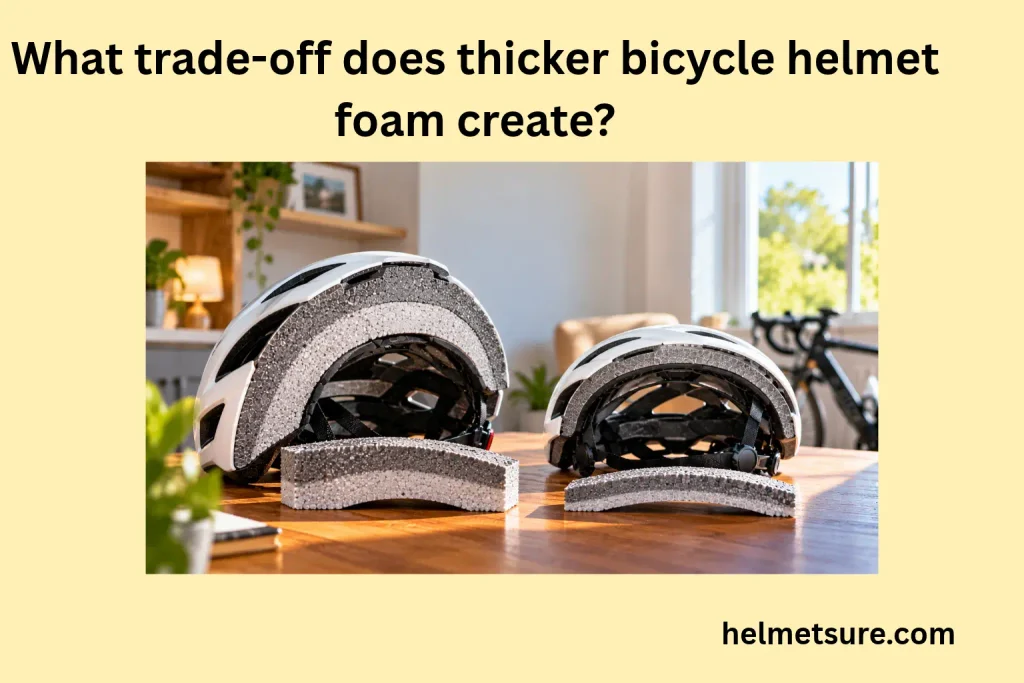
The distinction is between room to compress and how effectively a helmet uses that room. A deeper liner offers potential crushing capacity; its behavior during a crash depends on the material and the complete helmet. A larger-looking helmet therefore does not automatically offer better protection, and a thinner-looking helmet does not automatically offer worse protection.
Impact-Absorbing Helmet Foam Versus Soft Comfort Padding
Bicycle helmet structural EPS foam manages impact energy through deformation, whereas soft comfort padding primarily improves contact comfort and helmet fit.
Understanding which foam you are looking at comes before comparing thickness. The removable pads touching your head and the structural liner beneath the shell serve different purposes.
Why structural EPS foam manages impact energy while soft padding primarily improves helmet fit
Expanded polystyrene, or EPS, is the structural foam used in many bicycle helmets. Its cellular structure deforms under sufficient loading, allowing the liner to dissipate mechanical energy as it crushes.
The soft pads against your scalp primarily cushion contact and help the helmet fit comfortably. Depending on their construction, they may also manage sweat. Their apparent thickness does not reveal the depth or impact response of the EPS beneath them.
How liner thickness, foam density, and compressive stiffness describe different protective material attributes
Bicycle helmet EPS liner thickness describes structural foam depth, density describes mass per unit volume, and compressive stiffness describes resistance to deformation under specified loading conditions.
These properties answer different questions:
| Attribute | What it describes | What it cannot establish alone |
|---|---|---|
| Liner thickness | Foam depth at a specified location | The force developed during an impact |
| Foam density | Material mass per unit volume | A universal protection ranking |
| Compressive stiffness | Resistance to compression under defined conditions | How a complete helmet performs across crashes |
A deeper liner need not use denser foam. Equally deep liners can also resist compression differently. Experiments on EPS specimens have found density-related differences in mechanical properties, but those findings do not make “denser” a synonym for “safer.”
How Additional Helmet Foam Thickness Can Improve Impact Energy Management
Additional bicycle helmet EPS thickness can improve impact energy management by providing more potential compression travel, although the result depends on actual deformation and the foam’s force–displacement response.
The relevant question is how the liner resists loading throughout the distance it actually compresses.
How greater EPS liner depth can provide additional available crush distance before full compaction
Greater EPS liner depth can provide additional available crush distance before the material becomes heavily compacted. That extra distance is potential travel, rather than a measurement of compression that will occur in every impact.
As EPS crushes, its cellular structure progressively collapses. With extensive compression, the material densifies and resistance rises sharply. The liner then has less useful crushing travel remaining.
Adding depth can leave more room for this process, provided the impact loads the relevant region and the construction allows that foam to deform. The whole liner does not necessarily compress uniformly, and its original depth is not entirely usable travel.
A comparative study by DeMarco and colleagues found that increased liner thickness was generally associated with lower peak headform acceleration, particularly at higher impact speeds, among the helmet designs tested. Because this was a comparison of different helmets, it does not establish that thickness alone caused the differences.
How Effective Foam Compression Distance and Crush Resistance Influence Peak Linear Head Acceleration
Effective compression distance and crush resistance work together to determine the forces developed during loading. A liner must deform, but its resistance throughout that deformation also matters.
Two loading responses can involve similar compression work while producing different force peaks. A sharp force spike and a more gradual force response are not equivalent merely because their total work is similar.
Peak linear headform acceleration is a separate dynamic measurement recorded during a helmet test. Additional usable travel may help moderate the response under suitable conditions, but lower peak acceleration cannot be inferred from liner depth or energy dissipation alone.
How Impact Severity Determines Whether Extra Foam Depth Remains Unused or Helps Prevent Bottoming Out
Impact severity helps determine how much of the liner’s available compression travel is used. The outcome also depends on contact location, loaded area, foam resistance, and the surrounding construction.
Under a lower deformation demand, some additional depth may remain unused. That unused capacity is not proof of an additional measured benefit in that particular impact.
Under a suitable deformation demand, extra usable travel may allow crushing to continue over a longer distance before the foam becomes heavily compacted. This is the situation in which added depth can contribute meaningfully to energy management.
The mechanism can be understood as three conditional states:
| Deformation demand | Possible liner response | Meaning of extra depth |
|---|---|---|
| Lower | Only part of the available travel is used | Additional capacity may remain unused |
| Suitable | Progressive crushing uses additional travel | Extra depth may contribute useful capacity |
| Excessive | Useful crushing capacity becomes exhausted | Additional depth cannot guarantee protection |
Greater depth provides potential travel; impact conditions determine actual compression. The resulting force–displacement behavior governs compression work and contributes to the transmitted-force response. These related measurements must remain distinct when interpreting peak headform acceleration.
How Extra Helmet Foam Thickness Affects Bulk, Weight, and Ventilation
Extra bicycle helmet EPS thickness can increase external helmet dimensions, add foam mass, or constrain ventilation design, although these outcomes depend on the complete construction.
These are physical design tendencies. Finished helmets can differ in shell shape, density, coverage, and internal channels, so comparing their appearance alone can be misleading.
How greater liner depth can increase external helmet dimensions when internal head clearance remains unchanged
If the space for the rider’s head stays unchanged, increasing the structural liner depth outward generally requires additional space outside that cavity. The helmet may consequently have a larger external profile.
This comparison assumes other relevant geometry remains comparable. Between commercial helmets, designers may distribute material differently around the crown, sides, or rear. Shell shaping can also change how large a helmet looks.
A broad silhouette therefore does not reveal a uniform EPS depth. Nor does a compact appearance establish that every region contains less foam. Meaningful dimensional comparisons require the same size context and actual construction information.
Why additional EPS volume can increase helmet mass when material density and other design factors remain comparable
Additional EPS volume increases EPS mass when density stays the same. The relationship is straightforward: material mass equals density multiplied by volume.
Finished-helmet weight, however, includes more than EPS. The shell, straps, retention mechanism, comfort pads, and other components all contribute. A helmet with deeper foam can still weigh less overall than another model if its density or other components differ sufficiently.
For a practical comparison, use the published total weight for the relevant helmet size. Do not calculate a commercial helmet’s weight penalty from visible foam thickness without verified volume and density measurements.
How thicker liners can constrain ventilation-channel dimensions without necessarily reducing airflow in every design
Thicker liners can constrain how designers arrange ventilation openings and internal channels within the available space. Greater depth can change passage length and the geometry needed to connect inlet vents, scalp channels, and outlets.
Airflow nevertheless depends on the complete ventilation system. Opening placement, channel cross-sections, connections between passages, and external shell shape all influence how air moves through a helmet.
| Physical attribute | Thicker EPS liner | Thinner EPS liner |
|---|---|---|
| External profile | May require greater exterior volume when internal clearance remains unchanged | May permit a smaller external profile |
| Foam mass | May increase when density and other factors are comparable | May decrease when density and other factors are comparable |
| Ventilation design | Can constrain ventilation-channel geometry | Can allow additional geometric design flexibility |
These comparisons describe conditional construction differences, rather than guaranteed differences between finished products.
Why Foam Thickness Alone Cannot Determine Bicycle Helmet Protection
Foam thickness alone cannot determine protection because the material response, regional construction, and impact conditions all influence how a helmet behaves.
A thickness measurement describes geometry. It does not replace testing of the helmet as a complete system.
Why different EPS densities and compressive stiffnesses can produce different impact responses at equal liner thickness
EPS liners with equal thickness can produce different impact responses because foam density and compressive stiffness influence deformation resistance under loading.
Research by Kroeker and colleagues measured density variations within and between sampled bicycle helmets and found that these variations influenced impact performance. Separate experiments on extracted EPS specimens found density-related differences in compression behavior. The specimen work characterizes material response; it does not directly establish how changing the thickness of a complete helmet changes protection.
Neither higher nor lower density is universally preferable. Material that resists crushing differently can alter the forces developed and the travel used under a particular load. The useful combination depends on impact demands and the rest of the design.
For the rider, equal depth is therefore insufficient evidence of equal attenuation. There is no universal ideal density or stiffness that can be selected independently of the helmet system.
How nonuniform liner thickness and impact-zone coverage limit predictions based on a single foam measurement
One measurement describes only one location. It cannot establish the distribution of structural foam or coverage around the entire head.
A helmet’s geometry can vary between the crown, forehead, temples, and rear. Ventilation openings interrupt some areas, while shell shape and nearby supporting material influence how a region responds when loaded. Comparing one accessible edge does not capture these features.
Oblique-impact research has reported differences associated with impact location and helmet design. Such findings support evaluating regional behavior, but they do not mean that every geometric feature was independently isolated as a cause.
Why Oblique-Impact Protection Depends on Helmet Geometry and Impact Conditions, Not Foam Thickness Alone
Oblique impacts involve both motion toward a surface and motion along it. They can produce linear and rotational head motion, making their evaluation broader than the compression of foam in a straight impact.
Linear acceleration describes changes in translational velocity. Rotational acceleration describes changes in angular velocity, while rotational velocity describes the rate of rotation itself. These are distinct measurements.
Studies by Bland and colleagues and by McIntosh and colleagues examined head responses under specified oblique-impact conditions. Their findings show why impact orientation, location, helmet construction, and test configuration matter when interpreting results.
Those studies do not establish a universal relationship between EPS depth and rotational protection. A thickness measurement cannot predict how the complete helmet will interact with an angled surface, transmit tangential loading, or move relative to the head. Applicable oblique-impact testing provides more relevant evidence than a visual depth comparison.
How Cyclists Can Evaluate Bicycle Helmets Without Relying on Foam Thickness Alone
Cyclists can evaluate bicycle helmets without relying on EPS thickness alone by checking applicable safety compliance, proper fit, credible independent impact testing, and practical comfort.
These checks answer different questions: whether the helmet meets applicable requirements, whether it fits the rider, how it performed in a defined comparison, and whether it suits everyday use.
How to verify compliance with the bicycle helmet safety standard applicable to the rider’s market
Identify the requirements for the market where the helmet is purchased or used, then check the helmet’s labeling and manufacturer documentation for the exact product.
For example, bicycle helmets sold in the United States are subject to the CPSC requirements in 16 CFR Part 1203. CPSC guidance describes requirements covering impact attenuation, positional stability, retention strength, and peripheral vision.
Do not assume that a familiar brand, a generic safety claim, or compliance with a different activity’s standard establishes bicycle-helmet compliance. If information is missing or inconsistent, request clarification from the manufacturer or seller before choosing the helmet.
Bicycle helmet safety certifications establish compliance with identified requirements. They do not rank every compliant helmet against every other helmet or demonstrate performance in every crash configuration.
How to check helmet positioning, retention, and stability before considering liner thickness
Bicycle helmet positioning, retention, and stability should be checked before comparing EPS thickness because a helmet must fit securely and remain correctly positioned during use.
Begin with the manufacturer’s size range and fitting instructions. Position the helmet level, covering the forehead rather than tipped back. Adjust the retention system and straps so the helmet stays snug and stable without painful pressure.
With the buckle fastened, check whether the helmet shifts excessively, slides away from the forehead, or can readily move out of position. If appropriate adjustment cannot produce a stable fit, try another size or shape.
When independent impact-test results provide useful performance evidence beyond minimum certification
Independent bicycle helmet impact-test results provide useful comparative evidence beyond minimum certification when the tested helmet is correctly identified and the results are interpreted using the applicable methodology.
Virginia Tech’s bicycle helmet program, for example, uses laboratory impacts at multiple locations and severities, measuring linear acceleration and rotational velocity. Its STAR system combines measured responses with defined risk calculations and impact weightings. A lower numerical score indicates better performance within that system.
When using bicycle helmet impact-test ratings, match the manufacturer, model, relevant revision, and market variant. Confirm the tested size where reported and consult the original laboratory’s current results. A similar name or appearance does not establish equivalent construction.
Compare results within compatible methods. Scores from different programs, sports, or substantially different protocols cannot automatically be placed on one numerical scale. A laboratory risk estimate also does not predict exactly what will happen to an individual rider.
An independently unrated helmet is not necessarily a failed helmet. It means an applicable published result is unavailable; that absence should not be misrepresented as a documented test failure.
How to assess helmet weight and ventilation during a practical fit check
Bicycle helmet weight and ventilation should be assessed during a practical fit check to determine whether a compliant, securely fitting helmet is comfortable for the rider’s intended use.
Compare total weights in consistent units and equivalent sizes. Wear each suitable helmet long enough to notice pressure points, unwanted movement, or an uncomfortable feeling of weight in your usual riding posture.
For ventilation, inspect how inlets connect to internal channels and outlets. Consider intended riding conditions: a stationary shop fitting can reveal comfort problems, but it cannot establish cooling during a slow climb or a faster ride.
Distinguish published weight, visible vent area, measured airflow, and perceived cooling. None is interchangeable with the others, and none independently establishes impact protection.
Evaluate the Helmet Beyond Foam Thickness
A helmet without a published independent rating has not necessarily failed an impact test.
Choosing the Right Balance Between Bicycle Helmet Foam Protection and Comfort
Choosing the right balance between bicycle helmet foam protection and comfort requires applicable safety compliance, secure fit, credible whole-helmet impact evidence where available, and manageable weight and ventilation. Exclude helmets that fail mandatory requirements or cannot fit securely, then compare suitable options using applicable test results and practical comfort. Treat structural EPS thickness as one design attribute rather than a stand-alone protection score.
Frequently Asked Questions
Does thicker EPS automatically make a bicycle helmet safer?
No. Extra depth can provide more potential crush travel, but protection also depends on foam resistance, regional geometry, shell construction, impact conditions, fit, and complete-helmet testing.
Does doubling foam thickness double energy absorption?
No. Compression work depends on resisting force across the distance actually compressed. Original depth is not entirely usable travel, and force response may change.
Is thick comfort padding part of the protective EPS liner?
No. Soft removable pads primarily manage contact comfort and fit. Structural EPS is the firmer impact-absorbing liner beneath the shell.
Can thicker foam prevent bottoming out?
Additional usable travel may delay densification under some loading conditions, but excessive demand can still exhaust the liner’s effective crush capacity.
Does thicker foam always reduce ventilation?
No. Thickness can constrain channel geometry, but airflow depends on the complete system of intakes, internal passages, outlets, and external conditions.
How should riders compare helmets?
Start with applicable compliance, secure fit, condition, and intended use; then compare exact-model impact evidence and practical comfort. Treat thickness as one design attribute.
What does a thicker EPS liner establish by itself?
Select the strongest answer.
Sources and References
All 8 sources retained from the supplied article.
- R1. DeMarco et al. (2016). The impact response of traditional and BMX-style bicycle helmets at different impact severities — Whole-helmet comparison; does not isolate thickness as the sole cause of performance differences.
- R2. Kroeker et al. (2020). Density Variation in the Expanded Polystyrene Foam of Bicycle Helmets and Its Influence on Impact Performance — Regional density measurements and impact testing.
- R3. Kroeker et al. (2016). Age Does Not Affect the Material Properties of Expanded Polystyrene Liners in Field-Used Bicycle Helmets — Extracted-foam compression experiments; used here for material behavior rather than thickness-dependent whole-helmet predictions.
- R4. Bland et al. (2018). Differences in Impact Performance of Bicycle Helmets During Oblique Impacts
- R5. McIntosh et al. (2013). Bicycle helmets: head impact dynamics in helmeted and unhelmeted oblique impact tests
- R6. U.S. Consumer Product Safety Commission. Bicycle Helmets Business Guidance
- R7. National Highway Traffic Safety Administration. Bicycle Safety
- R8. Virginia Tech Helmet Lab. Bicycle Helmet Ratings