
How Does a Bicycle Helmet Inner Liner Affect Cooling?
A bicycle helmet’s inner liner affects cooling through ventilation pathways, scalp contact, and sweat handling. Actual heat loss depends on airflow, material resistance, evaporation location, fit, and riding conditions; visible vents and moisture-wicking labels do not prove cooling performance.
The term inner liner can describe several different components. The rigid impact foam, soft fitting pads, and any additional internal layers do different jobs. Understanding those differences helps explain why a helmet with large openings or thin padding is not necessarily the coolest option.
Cooling is a property of the complete helmet in use. It cannot be judged reliably from one material, a vent count, or the appearance of its interior.
EPS Impact Foam vs. Comfort Padding: What Functions Do the Inner-Liner Components Serve?
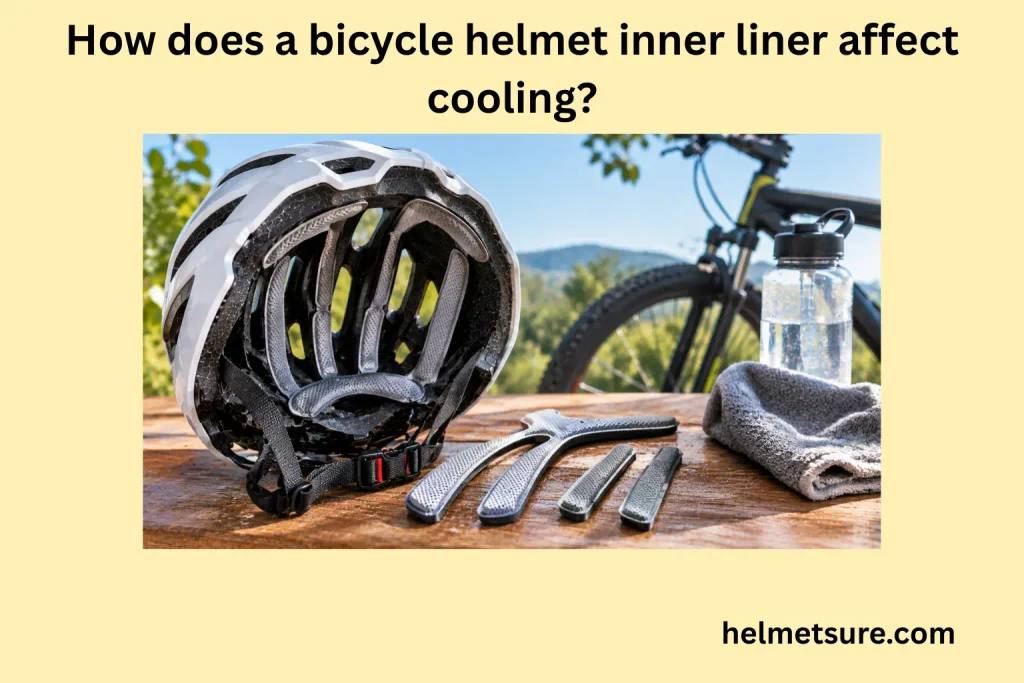
A bicycle helmet’s interior can include structural EPS impact foam, removable comfort padding, retention components, and optional internal systems. Their primary functions differ, even though each may influence the space around the head.
How EPS impact-absorbing foam provides protective structure and may incorporate molded ventilation channels
Expanded polystyrene, or EPS, forms the structural impact liner in many bicycle helmets. During a sufficiently severe impact, its cellular structure deforms and crushes to help manage impact energy and slow the head’s deceleration.
Manufacturers may mold grooves, channels, and openings into that structure. These create potential routes for air without requiring the rider to alter the foam.
An open channel is a design feature, however, rather than a measurement of airflow. Its thermal contribution depends on how it connects with the rest of the helmet and the conditions during use.
How removable comfort padding forms the designed contact interface between the helmet and scalp
Comfort padding forms the intended contact interface between the helmet and the scalp or hair. Its thickness, softness, position, and compression help determine how the helmet sits and feels.
Some pads also absorb or redistribute sweat. Those moisture properties are separate from the impact-management role of structural EPS.
How optional low-friction internal layers differ functionally from EPS foam and comfort padding
Some helmets contain an additional internal layer intended to permit controlled relative motion within the helmet system. Its mechanical role differs from EPS crushing and the fitting role of soft pads.
Such a layer may also change contact geometry or the available interior space. Whether that improves, reduces, or has little effect on cooling depends on its actual construction.
| Interior component | Primary purpose | Possible cooling relevance | What its presence does not establish |
|---|---|---|---|
| Structural EPS | Impact-energy management | May incorporate airflow channels | Measured ventilation or cooling |
| Comfort pads | Intended contact, comfort, and fit | May influence contact and moisture handling | Superior cooling from a material label |
| Optional low-friction layer | Design-specific motion management | May alter the interior interface | A universal thermal effect |
| Interior retention components | Stable helmet positioning | May affect local clearance | Permission to remove them for airflow |
How Do Inner-Liner Ventilation Pathways Influence Airflow and Convective Heat Transfer?
Ventilation pathways influence where air can enter, travel, and leave the helmet. Actual airflow depends on the connected passage network and pressure conditions; sensible cooling also requires a favorable temperature difference.
How inlet position and geometry influence airflow entering the liner's internal passages
Inlet position and geometry affect how an opening meets incoming air. The effective opening, its orientation, and the pressure around it help determine whether air enters the interior.
A large inlet can still feed a narrow or obstructed passage. Conversely, a smaller opening may connect to a useful flow route.
For that reason, inlet size alone cannot establish how much air reaches the scalp or how much heat the helmet allows the head to lose.
How internal channel routing directs airflow across different scalp regions
Connected channels can carry incoming air toward different parts of the head. Their routing determines which regions have a possible ventilation path and how directly that path connects to an outlet.
The effectiveness of bicycle helmet ventilation channels depends on more than visible groove depth. Restrictions, pad overlap, changes in direction, and pressure differences can affect local air exchange.
Helmet research has measured regional ventilation using tracer gas. That approach distinguishes air exchange at particular locations from the separate question of heat removed from the whole head.
How outlet placement can allow moving air to exit before reaching other scalp regions
An accessible outlet may let air leave before it crosses additional scalp regions. The route depends on the connected channels and the pressure distribution around the helmet.
An opening that increases discharge in one region might therefore reduce flow through another. This helps explain why adding openings does not guarantee a proportional cooling improvement.
Neither a rear outlet nor a top opening is universally best. The complete airflow arrangement matters.
How moving air transfers sensible heat away from the scalp when temperature conditions favor convective cooling
Moving air can carry sensible heat away when the relevant scalp or interior surface is warmer than the air passing it. This is convection: heat exchange involving moving fluid.
The useful distinction is between a possible air route, actual moving air, and the heat exchange produced under a particular temperature difference.
From passage geometry to heat exchange
- Inlets encounter incoming air.
- Pressure conditions drive air into connected passages.
- Routing and restrictions determine regional air exchange.
- Air discharges through available outlets.
Actual air movement then interacts with the surface-to-air temperature difference to produce sensible heat loss or gain. A visible path alone establishes neither the airflow rate nor the thermal result.
How Do Inner-Liner Materials and Contact Surfaces Influence Thermal Resistance?
Material conductivity, thickness, coverage, and effective contact area influence conductive heat-transfer paths. These properties explain parts of the thermal system without independently predicting whole-helmet cooling.
How EPS thermal conductivity and thickness influence conductive heat transfer through foam-covered regions
Thermal conductivity describes how readily a material conducts heat. For a comparable material and contact area, a thicker layer presents a longer conductive path and greater resistance.
A more conductive material offers less resistance along the same idealized path. Actual helmets also contain interfaces, air spaces, channels, and regions with different geometry.
Why the amount of scalp covered by EPS foam cannot independently predict total helmet heat loss
Scalp coverage changes where foam lies around the head, but uncovered area does not necessarily receive useful airflow. A large opening above a poorly ventilated region may contribute less than its appearance suggests.
Brühwiler and colleagues’ thermal-headform research found only a weak relationship between exposed scalp area and heat transfer. Their work also examined the influence of vent arrangement, head angle, and hair.
Coverage therefore describes geometry. It is not a substitute for a thermal measurement.
How comfort-pad material conductivity and thickness influence conductive thermal resistance
Comfort-pad conductivity and thickness influence heat moving through the pad along a defined path. Under otherwise comparable conditions, a longer path increases resistance, while greater conductivity reduces it.
In use, moisture, compression, and surface contact can alter the effective thermal behavior. A dry material specification may not describe a wet, compressed pad against hair or skin.
Neither “thin” nor “conductive” independently establishes that one pad will make a complete helmet cooler.
How comfort-pad contact area changes the regions available for conductive heat transfer
Actual pad contact determines where contact-based heat transfer can occur. Surface conformity, hair, compression, and small gaps affect the quality of that contact.
The visible area of a pad can differ from the area touching the head. Even when contact increases, the overall cooling consequence depends on the temperature gradient and the other available heat-transfer paths.
More contact may improve fit while changing local thermal conditions. Less contact is not automatically preferable.
| Property | Effect along a conductive path | Limit when evaluating a helmet |
|---|---|---|
| EPS conductivity | Influences heat conduction through foam | Does not measure ventilation |
| EPS thickness | Changes path length and resistance | Cannot independently predict total heat loss |
| EPS coverage | Changes the distribution of covered regions | Exposed area is not a cooling score |
| Pad conductivity | Influences conduction through the pad | Requires relevant material evidence |
| Pad thickness | Changes the pad’s conductive path | Compression and wetness matter |
| Effective contact area | Changes contact-based heat-transfer area | Visible pad area may differ from real contact |
These relationships describe conduction. Air movement and evaporation require separate consideration.
How Does Inner-Liner Padding Affect Sweat Transport and Evaporative Heat Loss?
Padding can store or redistribute liquid sweat, while evaporative heat loss depends on whether that moisture becomes vapor and where the required heat comes from.
How absorbent comfort-pad materials retain liquid sweat without necessarily increasing scalp heat loss
Absorbent padding takes up and temporarily stores liquid sweat. This may influence wetness and dripping, but liquid storage is not itself evaporation.
A pad can become wetter without a corresponding increase in scalp heat loss. Alternatively, sweat can remain on the skin and evaporate directly without first entering a pad.
Absorbency is therefore a moisture-handling characteristic, rather than proof of a cooling advantage.
How capillary wicking redistributes sweat within compatible padding materials without guaranteeing greater evaporation
Wicking moves liquid through suitable small pathways in a material. Its behavior depends on the material’s structure and how the liquid wets those pathways.
Redistribution may move sweat toward a region where evaporation is easier. It may also move moisture into a poorly ventilated region or leave it stored in the pad.
How moisture evaporation removes latent heat depending on evaporation location and heat supply
Evaporation requires energy to transform liquid sweat into vapor. When evaporation occurs directly on the skin, the required energy can be drawn substantially from the local skin-side thermal environment.
When it occurs from a pad, the energy may come from the pad, surrounding air, adjacent materials, and the scalp through their thermal connections. Not all of it must come from the head.
Wang and colleagues’ sweating-manikin research on tight-fitting sportswear illustrates why moisture transport and real skin cooling must be distinguished. It provides indirect context for helmet pads, not a quantitative pad ranking.
How saturated comfort pads lose capacity to absorb additional sweat
As a pad fills with liquid, less storage capacity remains for additional sweat. Continued input can increase wetness or lead to dripping when moisture arrives faster than it is removed.
Saturation does not necessarily stop evaporation. Moisture can continue to evaporate from an exposed wet surface, drain, or redistribute.
A soaked pad can therefore have little remaining absorption capacity while still losing moisture. Whether it feels comfortable depends on more than its storage capacity.
| Possible moisture pathway | What happens | Cooling interpretation |
|---|---|---|
| Direct skin evaporation | Sweat evaporates from the skin | Can remove heat from the local skin-side environment |
| Pad absorption or wicking | Liquid enters or spreads through padding | Transport or storage alone does not establish cooling |
| Evaporation from padding | Pad-held moisture becomes vapor | Heat comes from thermally connected surroundings |
| Continued accumulation | Padding approaches saturation | Further uptake becomes limited; evaporation may continue |
Sweat does not have to follow these pathways in order. Direct evaporation can occur without absorption or wicking.
How Does Helmet Fit Alter the Intended Airflow Interface of the Inner Liner?
Fit affects pad compression, component positions, and the space between the head and helmet. Designed ventilation clearance must coexist with secure positioning.
How comfort-pad compression changes scalp contact without necessarily reducing molded ventilation-channel clearance
Soft pads compress when a helmet fits against the head. This changes pad thickness and contact distribution.
It does not mean separate molded EPS channels collapse. Channel clearance changes only when the surrounding geometry brings the head, hair, padding, or another component into that space.
A correctly fitted helmet can have compressed pads and open structural channels at the same time.
How comfort-pad positioning across channel openings can restrict access to intended airflow pathways
A pad overlapping a passage can narrow its entrance or change local airflow resistance. Correct installation may preserve the intended openings while maintaining head contact.
Check apparent overlap against the manufacturer’s pad arrangement. A pad may occupy that position for a fitting reason, so an obstruction should not be “fixed” through unapproved removal or relocation.
If the intended arrangement is unclear, obtain the relevant instructions.
How retention bands positioned across ventilation passages can restrict local airflow
A retention band can occupy part of a passage it crosses. The effect depends on the band’s position and the surrounding space.
A band outside an active flow route may have little direct effect on that route. Neither situation provides a universal cooling penalty for retention systems.
How head shape affects comfort-pad contact distribution under a correctly fitted helmet
Head shape influences where pads contact and where clearance remains. Two riders with similar head circumference can experience different pressure patterns in the same helmet.
A suitable circumference range therefore does not guarantee a comfortable shape match. A helmet that presses strongly in one region or moves excessively elsewhere may be unsuitable despite its label size.
Choose an appropriate shape and size rather than an oversized helmet to create ventilation gaps.
How hair volume changes the scalp-to-liner interface and local ventilation conditions
Hair changes contact, occupies some interior space, and modifies thermal exchange. Its arrangement can also affect which air passages remain accessible near the scalp.
Thermal-headform experiments using hair simulations demonstrate that hair can materially affect measured heat transfer. The result should not be converted into a fixed penalty for every hairstyle or rider.
Evaluate fit with the hair arrangement you actually use for cycling, while following applicable helmet instructions.
| Fit variable | Possible interface effect | Practical boundary |
|---|---|---|
| Pad compression | Changes thickness and contact | Does not necessarily close EPS channels |
| Pad position | May overlap a passage | Use the approved arrangement |
| Retention band | May narrow a route it crosses | Preserve its intended function |
| Head shape | Changes local pressure and clearance | Choose a suitable fit |
| Hair | Changes contact and local air space | Assess with the actual riding arrangement |
These are conditional effects on geometry, not measured airflow-loss percentages.
How Do Cycling Speed and Environmental Conditions Modify Inner-Liner Cooling?
Relative airspeed, temperature, humidity, and orientation determine how a liner’s pathways operate. A helmet can behave differently across riding conditions without any change to its construction.
How relative airspeed influences forced convection through available inner-liner ventilation pathways
The relevant airspeed is the air moving relative to the helmet. Road speed alone does not describe it because headwinds, tailwinds, and crosswinds change the incoming flow.
More relative air movement may increase ventilation through available passages. The resulting heat exchange still depends on routing and thermal conditions.
Mukunthan and colleagues measured convective and evaporative performance separately using a zoned thermal headform. Their results demonstrate the importance of test conditions and regional measurements; they do not establish that faster riding always produces greater net cooling.
How the ambient-air-to-scalp temperature difference affects the direction and potential of sensible heat transfer
When air is cooler than the relevant scalp surface, sensible heat can move from the surface to the air. As that temperature difference narrows, the driving force for this exchange decreases.
Air warmer than the surface can instead add sensible heat. Evaporative cooling may occur at the same time if moisture and vapor-transfer conditions permit.
This explains why feeling moving air does not independently establish the direction of net heat exchange.
How atmospheric humidity influences the vapor-pressure gradient available for sweat evaporation
Evaporation depends partly on the difference between water-vapor pressure near the wet surface and in the surrounding air. Higher ambient vapor pressure can reduce the available outward driving force.
Relative humidity alone is insufficient because it depends on temperature. Surface temperature, liquid availability, and how readily ventilation removes moist local air also matter.
The conditions inside a humid helmet microclimate may differ from the weather report’s measurements.
How helmet orientation relative to incoming air changes inlet exposure and local ventilation patterns
Orientation changes how inlets meet incoming air and how pressure is distributed around the helmet. This can alter regional entry, circulation, and discharge.
Experimental helmet research has investigated orientation because the same vent arrangement can behave differently at different angles.
| Variable | Relevant change | Possible consequence | Essential qualification |
|---|---|---|---|
| Relative airspeed | More or differently directed incoming flow | Changes internal ventilation and convection | Road speed alone is insufficient |
| Temperature difference | Air cooler or warmer than the surface | Changes sensible heat-loss or heat-gain direction | Evaporation is a separate pathway |
| Atmospheric moisture | Different ambient vapor pressure | Changes evaporation potential | Temperature and local airflow also matter |
| Orientation | Different inlet exposure | Changes regional ventilation | Preserve correct helmet positioning |
How Can Cyclists Evaluate Inner-Liner Cooling Without Confusing Design Features With Measured Performance?
Evaluate construction, fit, documentation, and thermal evidence as separate kinds of information. Each answers a useful question, but none should be presented as a measurement it does not provide.
Inspect internal ventilation channels and check whether comfort padding obstructs intended airflow passages
Look at accessible channels and the installed pad arrangement without dismantling bonded parts. Compare what you see with the manufacturer’s illustrations.
A misplaced approved pad may warrant correction according to those instructions. An unfamiliar arrangement warrants clarification.
Verify stable helmet positioning and correct fit using the manufacturer's instructions before assessing cooling
Begin with appropriate bicycle helmet sizing and fit. Confirm the intended position, approved pad configuration, retention adjustment, and strap fastening.
Assess cooling while wearing the helmet correctly. Raising it, leaving it loose, or choosing an oversized shell changes the protective configuration and makes the comparison unsuitable.
A helmet that needs unsafe adjustment to feel tolerable is a reason to consider a different suitable model.
Examine documented comfort-pad construction and moisture-management characteristics without assuming a cooling advantage
Check what the manufacturer actually documents about pad material, thickness, placement, and approved replacements.
Separate absorbency, wicking, and drying claims. A pad that stores sweat well is not necessarily the one that produces the greatest scalp heat loss.
If the manufacturer supplies no material details, treat those properties as unknown rather than assigning them from appearance or fabric feel.
Check manufacturer cooling claims against independent performance evidence rather than relying on specifications alone
Identify what the claim means. “More ventilation” should relate to air exchange; “greater cooling” requires an appropriate heat-transfer comparison. A vent count measures neither directly.
Look for the tested model and size, comparison baseline, apparatus, outcome, and conditions. If these are unavailable, a promotional claim has limited value as comparative evidence.
Accurate construction specifications remain useful, but they are different from demonstrated thermal superiority.
Compare published ventilation and thermal-test results only when measurement methods, metrics, and conditions are sufficiently comparable
Tracer-gas measurements describe ventilation. Heated headforms measure thermal exchange. Wet tests can investigate evaporation, while computer models predict outcomes under assumptions.
Compare results only after checking airflow, temperatures, humidity, wetting, orientation, headform, hair representation, and measurement region. A whole-head result cannot be treated as identical to a scalp-only result.
Bröde and colleagues’ modeling framework, for example, predicts local sweating and comfort-related conditions. Such predictions are not direct rider observations or interchangeable with measured heat loss.
Record subjective riding comfort separately from experimentally measured heat-loss performance
During ordinary riding, note warmth, dampness, pressure, and dripping under relevant conditions. Weather, effort, hair, and duration can affect the experience.
These observations help identify whether a properly fitted helmet suits you. They do not establish a standardized thermal ranking.
When comparing personal impressions, record the conditions and keep conclusions specific: “felt less damp during this ride” is more defensible than an unmeasured claim of greater cooling.
Confirm applicable helmet safety compliance without treating protective certification as proof of superior cooling
Check bicycle helmet safety certifications and compliance information relevant to your market and activity. For the United States, the CPSC bicycle helmet requirements are in 16 CFR Part 1203.
The protective requirements address matters such as impact attenuation, retention, stability, and vision. They do not provide a comparative cooling score.
A helmet must be suitable for protection and fit before its thermal features become a useful selection criterion.
Evaluate the Complete Helmet
0/8 checked
Which Inner-Liner Characteristics Should Cyclists Prioritize for Cooling Without Compromising Protection?
Prioritize demonstrated ventilation performance, suitable moisture-handling padding, and stable fit over unsupported cooling claims
Among suitable, properly fitting helmets, give greater weight to relevant measurements than to vent counts or cooling adjectives. Prefer evidence that explains the tested configuration and conditions.
Choose padding that works comfortably for your sweating and riding conditions, while recognizing that absorbency or wicking alone does not establish scalp cooling.
Where comparable testing is unavailable, use documented construction and correctly fitted riding experience to make a qualified choice. They remain useful observations without becoming a universal performance ranking.
Preserve the impact-absorbing liner and use only manufacturer-approved comfort-padding adjustments or replacements
Keep structural EPS, the shell, and retention components intact. Do not drill openings, cut channels, raise the helmet with improvised spacers, or remove required pads to create airflow.
Use replacement pads and adjustments approved for the exact helmet. Recheck fit after any permitted change.
The most useful cooling configuration is one that works within a suitable helmet’s intended protective arrangement: connected ventilation pathways, manageable moisture, and stable contact, supported by measurements where available.
Frequently Asked Questions
Does EPS foam itself cool a bicycle helmet?
EPS is primarily the impact-energy-management liner. Molded channels and openings can create possible airflow routes, but EPS thickness, coverage, or channel appearance alone does not establish cooling performance.
Do more or larger vents guarantee better cooling?
No. Cooling depends on connected inlets, internal routes, outlets, restrictions, pressure, temperature, humidity, fit, hair, and riding conditions.
Does moisture-wicking padding always keep the head cooler?
No. Wicking redistributes liquid; it does not by itself establish evaporation rate or heat removed from the scalp.
Can comfort pads be removed to improve airflow?
Only when the manufacturer specifically permits that configuration. Required pads can contribute to fit and stability, and removing them may compromise the intended helmet position.
Does faster cycling always increase net cooling?
No. Relative airspeed may increase airflow, but sensible heat exchange also depends on air temperature and evaporation depends on moisture and vapor-pressure conditions.
How should cyclists compare liner cooling performance?
First confirm compliance and proper fit, then compare documented construction, model-specific ventilation or thermal tests under comparable conditions, and personal comfort recorded separately.
What does a visible inner-liner channel establish?
Select the strongest answer.
Sources
All 9 supplied sources retained at the end of the article.
Brühwiler PA and colleagues. Heat transfer variations of bicycle helmets. Journal of Sports Sciences. 2006;24(9):999–1011. DOI: 10.1080/02640410500457877. Thermal-headform research on helmet heat transfer, design, orientation, and hair. Research record. PubMed
Van Brecht A and colleagues. Quantification of ventilation characteristics of a helmet. Applied Ergonomics. DOI: 10.1016/j.apergo.2007.08.003. Tracer-gas research on helmet ventilation characteristics. Research record. ScienceDirect
Mukunthan S and colleagues. Thermal-Performance Evaluation of Bicycle Helmets for Convective and Evaporative Heat Loss at Low and Moderate Cycling Speeds. Applied Sciences. 2019;9(18):3672. DOI: 10.3390/app9183672. Zoned-headform experiments separating convective and evaporative heat transfer. Original article. mdpi.com
Bröde P and colleagues. A modelling framework for local thermal comfort assessment related to bicycle helmet use. Journal of Thermal Biology. 2023;112:103457. DOI: 10.1016/j.jtherbio.2022.103457. Modeling evidence, with prediction and validation limitations. Research record. PubMed
Bicycle Helmet Safety Institute. Bicycle Helmet Ventilation and Cooling. Practical background on interacting vents, channels, and riding conditions. Guidance. BHSI
U.S. Consumer Product Safety Commission. Bicycle Helmets Business Guidance. U.S. protective requirements and regulatory context. Official guidance. CPSC.gov
Wang F, Annaheim S, Morrissey M, Rossi RM. Real evaporative cooling efficiency of one-layer tight-fitting sportswear in a hot environment. Scandinavian Journal of Medicine & Science in Sports. 2014;24(3):e129–e139. DOI: 10.1111/sms.12117. Indirect textile evidence; not a helmet-pad comparison. Research record. PubMed
Health Canada. Helmet safety. Published December 8, 2025. Official guidance on fit, intact components, and avoiding modifications. Safety guidance. Canada.ca
OpenStax. University Physics Volume 2, Sections 1.6, “Mechanisms of Heat Transfer,” and 1.5, “Phase Changes”; College Physics 2e, Section 13.6, “Humidity, Evaporation, and Boiling.” General physical principles, rather than product-performance validation. Heat transfer, phase changes, and humidity and evaporation. OpenStax