
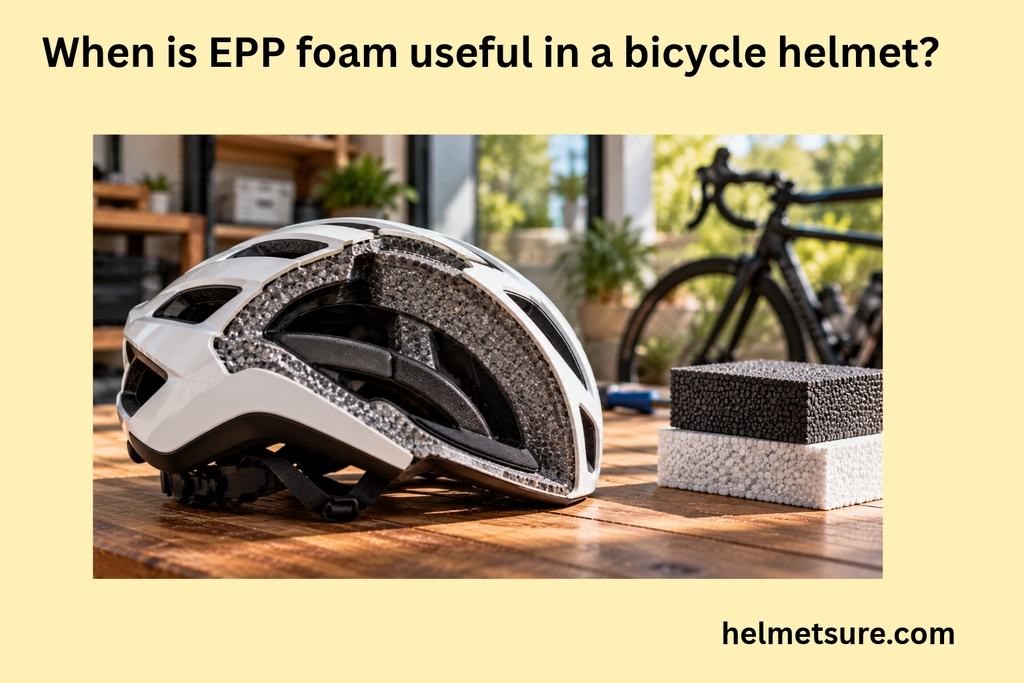
When Is EPP Foam Useful in a Bicycle Helmet?
Expanded polypropylene, or EPP, gives helmet designers another way to manage how a liner deforms and recovers. That can be valuable when the material’s measured response matches a defined engineering requirement. It does not mean every EPP-equipped helmet protects better than an EPS-equipped alternative, or that a helmet can be worn again after a crash because its foam looks normal.
How EPP Foam Differs From Conventional EPS Helmet Liners
EPP foam differs from conventional EPS bicycle helmet liners mainly in its characteristic compression and recovery behavior, with EPP generally showing greater dimensional recovery while EPS commonly retains more permanent crushing after substantial loading.
Both are cellular polymer foams used in protective equipment. Their names identify different polymers: expanded polypropylene and expanded polystyrene. The polymer matters, but density, processing, geometry, and loading conditions also influence the response.
How expanded polypropylene and expanded polystyrene differ in their deformation characteristics
Expanded polypropylene and expanded polystyrene differ in their characteristic deformation behavior, with EPP typically recovering more of its compressed shape and conventional EPS commonly retaining more permanent crush deformation.
With substantial compression, conventional EPS can undergo irreversible cellular damage. EPP generally has a more recoverable deformation response. These are characteristic material differences, rather than a guarantee of a particular result at every load.
What compression recovery means when EPP regains its shape after loading
Compression recovery means that EPP foam regains part or much of its original shape after unloading, although residual deformation and changes in material response may remain.
In a material test, recovery describes a dimensional change after the load is removed. Residual deformation is the change that remains after a specified recovery period. Neither term, by itself, describes how a finished helmet would perform in another impact.
Why EPP’s multi-impact material behavior does not guarantee helmet reusability
EPP’s multi-impact material behavior does not guarantee bicycle helmet reusability because laboratory compression resilience does not establish that the complete helmet remains protective after a crash.
“Multi-impact” can describe response under defined repeated laboratory loadings. A helmet also contains a shell, bonds, retention components, and potentially several liner materials. Their condition cannot be inferred from one foam’s ability to recover.
How Does EPP Foam Manage Impact Energy in a Bicycle Helmet?
EPP foam manages impact loading through cellular compression and deformation, with the resulting deceleration, dissipation, and rebound determined by its material properties and the complete helmet’s construction.
The objective is an appropriate impact response under the conditions being evaluated. A useful explanation must distinguish how the foam deforms, how the headform slows, and how much mechanical energy is returned or dissipated.
How EPP’s closed-cell structure compresses under impact loading
EPP’s closed-cell structure compresses under impact loading as its polymer cell walls deform and the foam changes shape in response to applied force.
The cellular structure provides deformation space within a relatively low-density material. As compression increases, the relationship between force and displacement changes. The response depends on the material formulation, density, and loading conditions.
How controlled foam deformation can reduce peak headform acceleration
Controlled foam deformation can reduce peak headform acceleration by allowing the impact to be managed over an appropriate stopping distance and time within the helmet’s tested construction.
For the same change in velocity, increasing stopping time reduces average deceleration. However, peak acceleration also depends on the shape of the force-time response. A liner must provide useful deformation while avoiding an excessively abrupt rise in force.
Why elastic rebound and irreversible energy dissipation are different responses
Elastic rebound and irreversible energy dissipation are different EPP foam responses because rebound returns some stored energy while dissipation removes energy from the recoverable mechanical cycle.
During compression, mechanical work is done on the foam. Part may be stored temporarily and returned during unloading; part is dissipated through irreversible processes. A loading-unloading curve can help distinguish these contributions.
How impact severity and loading rate influence EPP compression and bottoming-out risk
Impact severity and loading rate influence EPP compression because foam stiffness and deformation response can change with applied loading conditions, affecting the potential for excessive compression or bottoming out.
Strain rate describes how quickly deformation develops relative to the material’s original dimensions. Lee, Park, and Yoon tested EPP specimens at different densities under quasi-static and dynamic compression. Their results show that density and strain rate affect the tested material’s response; they do not identify one universally optimal helmet density.
When Is EPP Foam Functionally Useful in Bicycle Helmet Design?
EPP foam is functionally useful in bicycle helmet design when its documented compression and recovery behavior serves a defined liner-engineering objective under relevant loading conditions and the complete helmet is appropriately validated.
Its usefulness begins with a specific design question. “Contains EPP” identifies a material; it does not explain the objective, demonstrate the outcome, or establish a comparison with another helmet.
When controlled repeated compression makes EPP’s recovery behavior relevant to liner engineering
Controlled repeated compression makes EPP recovery relevant to liner engineering when designers must understand how material dimensions and mechanical response change across specified loading cycles.
Testing can examine whether recovery, residual deformation, and force response change between defined repetitions. To interpret the result, the loading severity, number of cycles, interval between cycles, and specimen construction need to be known.
Hegde, Liu, and Zerpa studied cycling EPS and hockey EPP materials in repeated lower-speed drop tests. Their research reported changes in impact response, including some loss of mitigation capacity after initial loading. Because the materials came from different helmet categories, it cannot establish a like-for-like comparison between bicycle helmets differing only in foam polymer.
When a helmet’s documented EPP liner construction serves a specified impact-management objective
A documented EPP bicycle helmet liner serves a meaningful engineering role when its placement and intended function support a specified impact-management objective within the complete design.
Useful documentation explains more than the material’s presence. It identifies the component or construction and describes the intended function. Protective claims then need appropriate helmet-level evidence.
For example, Fox lists both EPP and EPS among the materials in its Proframe RS helmet. That verifies material coexistence in the listed model. The materials list alone does not establish an exact polymer zone map or isolate how much either foam contributes to an observed result.
When EPP is considered for impact-response tuning across specified loading conditions
EPP is useful to consider for impact-response tuning when its measured force–deformation and recovery characteristics match the loading conditions and performance targets of a helmet-liner design.
Here, tuning means selecting a material response and geometry to meet defined targets. Designers may examine density, thickness, shape, and interaction with other components together.
This is an engineering inference from measured material behavior: EPP can be a relevant design option when its characteristics match the requirement. Demonstrating that the resulting helmet provides an advantage requires testing the assembled design under the conditions relevant to the claim.
Why BMX, downhill, commuting, and road cycling do not independently establish an EPP advantage
BMX, downhill, commuting, and road cycling do not independently establish an EPP advantage because activity categories specify equipment needs rather than the comparative protective performance of individual liner materials.
The activity helps determine appropriate coverage, construction, and safety requirements. It does not tell the rider which polymer produces the better finished helmet.
A downhill helmet containing EPP is not automatically more suitable than an appropriately validated downhill helmet using EPS. Likewise, a road helmet does not gain a demonstrated protective advantage simply by adding EPP to its specifications. Compare actual helmets for the actual activity.
Why EPP recovery cannot justify repeated crash use without explicit helmet-level evidence and manufacturer approval
EPP recovery cannot justify repeated crash use because the material’s visible rebound does not establish that the complete bicycle helmet remains suitable after protective impact loading.
A reusable-material claim and authorization to continue using a particular impacted helmet are different propositions. The latter cannot be inferred from recovery, a laboratory repetition count, or a marketing description.
| Condition | Potential functional role | Evidence needed | Practical limitation |
|---|---|---|---|
| Documented liner-design objective | EPP provides a selected material response | Construction documentation and relevant helmet tests | Design intention alone does not prove superiority |
| Controlled repeated compression | Recovery can be evaluated across specified cycles | Defined material tests; helmet tests for helmet claims | Laboratory cycles are not repeated crashes |
| Impact-response tuning | Material response may match a loading target | Relevant force-deformation data and helmet validation | Density, rate, formulation, and geometry matter |
| Mixed-material construction | EPP can serve a role alongside another foam | Exact-model documentation | Presence does not isolate contribution |
| Riding category alone | No material-specific advantage follows | Activity requirements and model-level evidence | A discipline label cannot rank foams |
| Crash reuse inferred from recovery | No established clearance for continued use | Applicable warnings and manufacturer instructions | Restored shape cannot establish protective integrity |
What Engineering Trade-Offs Affect EPP’s Usefulness Compared With EPS?
EPP’s usefulness compared with EPS depends on how its compression recovery and rebound interact with liner geometry, density, ventilation, manufacturing requirements, and the finished helmet’s performance targets.
The relevant comparison is between complete designs. Changing the polymer while ignoring geometry, processing, and performance targets does not produce a reliable purchasing rule.
How EPP’s compression and rebound behavior can influence liner thickness and geometry
EPP’s compression and rebound behavior can influence helmet liner thickness and geometry because designers must provide suitable deformation capacity while controlling the resulting impact response.
Available deformation space and unloading behavior must be considered together. A recoverable foam is not automatically suitable for a thinner liner, and extra thickness alone does not establish a better result.
How liner density and geometry affect helmet mass, bulk, and ventilation
Liner density and geometry affect a bicycle helmet’s mass, bulk, and ventilation by determining how much material is used and how the protective structure is arranged.
For a specified foam volume, density influences material mass. Finished-helmet mass also includes the shell, retention system, padding, and other components. A material label cannot establish which complete helmet is lighter.
Ventilation depends on openings, channels, and the structure around them. EPP does not automatically improve airflow, and EPS does not automatically restrict it. Compare finished helmets for size, mass, airflow design, and relevant cooling evidence.
When EPP manufacturing requirements and cost affect material selection
EPP manufacturing requirements and cost affect material selection when production processes, material availability, or processing expenses influence the feasibility of a particular helmet-liner design.
Manufacturers must produce the intended geometry and material response consistently. Tooling, processing capability, quality control, production volume, and integration with other components can affect the choice.
These considerations explain why a promising material is not automatically the most practical option for every design. They do not establish that every EPP helmet costs more, or that a higher retail price buys better impact protection. Price reflects the complete product and its market position.
What mixed EPP/EPS liner construction demonstrates about material selection
Mixed EPP/EPS bicycle helmet construction demonstrates that manufacturers can use both foams within one protective design rather than relying on a single liner material.
The verified Fox Proframe RS materials listing is one example. It supports the statement that a bicycle helmet can contain both polymers; it does not prove that one is the superior component.
Also distinguish mixed polymers from multiple densities. A description such as “dual-density foam” does not, by itself, establish that one region is EPP and another is EPS. Exact construction claims require documentation that identifies those materials and their locations.
| Engineering factor | What to evaluate | What cannot be assumed from EPP labeling |
|---|---|---|
| Compression and recovery | Relevant loading and unloading response | Greater recovery means lower headform acceleration |
| Thickness and geometry | Available deformation and complete construction | EPP always needs a fixed extra thickness |
| Density and mass | Material volume and finished-helmet measurements | EPP is always lighter or heavier |
| Ventilation | Openings, channels, fit, and cooling evidence | EPP automatically improves cooling |
| Manufacturing | Repeatable processing and component integration | One polymer is universally easier to use |
| Cost | Actual product price and documented performance | Higher cost demonstrates better protection |
| Mixed construction | Verified materials and stated component roles | A material list isolates each foam’s contribution |
How Can You Verify an EPP Bicycle Helmet’s Safety and Intended Use?
An EPP bicycle helmet’s safety and intended use should be verified through documented material construction, applicable safety requirements, complete-helmet testing, and correct fit rather than EPP labeling alone.
Verification should resolve four separate questions: what the helmet contains, what it is intended for, what testing supports it, and whether it fits the rider.
How to confirm a bicycle helmet contains EPP and identify its documented purpose
A bicycle helmet’s EPP content and intended function should be confirmed through exact-model manufacturer specifications rather than appearance or marketing terminology alone.
Match the product name, generation, market version, and relevant size to its documentation. Determine whether EPP is identified in the protective construction or merely appears in a general materials list.
Which bicycle and activity-specific standards apply to an EPP-equipped helmet
The standards applicable to an EPP-equipped bicycle helmet depend on its intended activity and sales jurisdiction, not on the presence of expanded polypropylene foam.
For covered bicycle helmets in the United States, 16 CFR Part 1203 includes impact attenuation, positional stability, retention strength, and peripheral-vision requirements. Compliance concerns the helmet, not an isolated EPP sample.
In the European Union, distinguish EN 1078 technical requirements from the legal conformity framework under Regulation (EU) 2016/425. The September 2026 consolidated harmonized-standards decision lists EN 1078:2012+A1:2012. A listed standard is not proof that an individual product conforms; check the helmet’s actual documentation.
Activity-specific specifications address different intended uses. ASTM F2032-26 concerns BMX cycling; ASTM F1952-26 concerns downhill mountain bicycle helmets; ASTM F1492-25 concerns skateboarding and trick roller skating. None establishes EPP as the universally preferred liner.
When checking bicycle helmet safety standards, match the actual model’s declared compliance to the activity. A skate-style appearance or one additional standard does not automatically resolve every bicycle requirement.
| Intended use or market | Relevant reference | Verification task |
|---|---|---|
| Covered U.S. bicycle use | 16 CFR Part 1203 | Confirm model-specific compliance information |
| European cycling and activities within its scope | EN 1078:2012+A1:2012 | Check the declared technical standard and applicable edition |
| EU market conformity | Regulation (EU) 2016/425 and applicable harmonized references | Check relevant conformity documentation and marking |
| BMX cycling | ASTM F2032-26 | Confirm the helmet’s activity-specific claim and declared edition |
| Downhill mountain biking | ASTM F1952-26 | Verify intended-use documentation and applicable requirements |
| Skateboarding and trick roller skating | ASTM F1492-25 | Confirm that activity; separately verify bicycle suitability where needed |
How complete-helmet testing establishes protection beyond material claims
Complete-helmet testing establishes measured protective performance under specified conditions beyond what EPP material properties or manufacturer construction descriptions can demonstrate alone.
It evaluates the assembled protective system rather than assuming a foam sample represents the helmet. Results still belong to the tested protocol and configuration.
A helmet absent from a voluntary ratings database has not necessarily failed applicable compliance testing. Missing independent comparison and unverified mandatory compliance are different gaps.
Why correct fit, retention, and coverage remain essential regardless of EPP content
Correct fit, retention, and coverage remain essential for an EPP-equipped bicycle helmet because protective suitability depends on how the complete helmet is positioned and secured on the wearer’s head.
Follow the exact model’s sizing and adjustment instructions. Check its instructed position, strap routing, buckle engagement, and retention adjustment. Do not accept a poor fit because the helmet contains a preferred foam.
EPP helmet verification checklist
0 / 10
When Must an EPP Bicycle Helmet Be Replaced After an Impact?
An EPP bicycle helmet that has sustained a protective impact must be removed from use and handled according to applicable impact warnings and manufacturer instructions, even when the foam appears to recover.
The rider’s task is to follow the correct post-impact action, not to decide whether the polymer has recovered enough to provide another crash allowance.
Why a helmet that has sustained an impact requires replacement or manufacturer-directed assessment
A bicycle helmet that has sustained a protective impact requires manufacturer-directed assessment or replacement because the impact may cause damage that is not visible to the wearer, regardless of EPP content.
U.S. labeling requirements under 16 CFR 1203.6 warn about hidden impact damage and require a statement directing an impacted helmet to manufacturer inspection or destruction and replacement.
Which visible shell, liner, and retention-system defects require helmet retirement
Cracked shells, crushed or cracked liners, and compromised straps or buckles are bicycle helmet defects that require replacement or manufacturer-directed corrective action, regardless of whether the liner contains EPP.
Inspect accessible parts without removing bonded components or altering the protective structure. Structural cracks, persistent crushing, damaged attachment points, failing stitching, or unreliable buckle engagement are reasons to stop use.
Why uncertain impact history and recovered EPP cannot establish continued protection
Uncertain impact history and recovered EPP cannot establish continued bicycle helmet protection because the apparent foam shape does not reveal all previous loading or possible structural damage.
This matters when considering a used helmet or one whose history cannot be reliably established. An absence of visible crushing does not prove it has avoided protective impacts.
Inspection can reveal reasons to reject a helmet; it cannot independently certify a questionable helmet as protective. Follow manufacturer guidance for uncertain history, and choose a suitable replacement when its condition cannot be established sufficiently for continued use.
| Situation | Appropriate action | Why EPP recovery does not resolve it |
|---|---|---|
| Known protective impact | Stop use; follow replacement or manufacturer-assessment instructions | Hidden damage may remain |
| Cracked or persistently crushed liner | Remove from service and replace as instructed | Structural damage is already evident |
| Structural shell damage | Stop use and obtain manufacturer-directed action | The shell contributes to the complete construction |
| Compromised straps, buckle, or attachments | Stop use; use only an authorized remedy or replacement | Retention remains essential regardless of foam |
| Apparently restored foam after impact | Do not use appearance as clearance | Shape is not a protective-performance test |
| Uncertain history or suspected damage | Seek manufacturer guidance; replace when suitability remains unresolved | Previous loading cannot be reconstructed visually |
When Should EPP Foam Influence Your Bicycle Helmet Choice?
EPP foam should influence a bicycle helmet choice when its documented material role is relevant to the intended use and the complete helmet already satisfies essential safety, fit, and performance criteria.
Treat EPP as one documented design attribute within a broader equipment decision. Its value depends on the supported function, not on how prominently the polymer appears in marketing.
Prioritize verified helmet suitability before considering EPP material benefits
Verified complete-helmet suitability should take priority over EPP material benefits because intended-use compliance, protective evidence, fit, retention, and coverage determine whether the helmet is appropriate to select.
First establish that the candidate is intended for the activity and meets applicable requirements. Review relevant complete-helmet evidence where available, then confirm that it fits and can be secured correctly.
These are essential conditions, not tradeable advantages. Favorable material properties cannot compensate for an unsuitable activity rating, unverified compliance, or a helmet that does not fit.
Prefer EPP when its documented material role provides a relevant design advantage
Prefer EPP when its documented material role serves a relevant bicycle helmet design objective and suitable evidence supports the benefit being claimed.
For an engineering claim, look for documentation connecting the material response to the design objective. For a comparative protection claim, require appropriate complete-helmet comparison rather than a material description alone.
When otherwise suitable options remain, a well-documented EPP function can be a reasonable preference. Keep the conclusion specific to the supported advantage and avoid extending it into a universal safety ranking.
Treat EPP as a secondary preference when comparative protection remains unverified
EPP should remain a secondary bicycle helmet preference when comparative protective performance is unverified, because recoverable foam behavior alone does not establish superiority over a suitable alternative.
If both candidates meet essential requirements but there is no relevant protective comparison, acknowledge that limitation. Compare fit, comfort, finished weight, ventilation, and cost without claiming EPP has resolved an unanswered protection question.
| Priority | Decision criterion | Selection action |
|---|---|---|
| 1 | Intended activity and applicable requirements | Establish exact-model suitability for the activity and market |
| 2 | Complete-helmet impact performance | Use relevant comparative evidence where available |
| 3 | Fit, retention, and coverage | Confirm correct, secure wearing before purchase or use |
| 4 | Documented EPP functionality | Consider a verified material role relevant to the design |
| 5 | Weight, ventilation, comfort, and cost | Compare practical attributes between suitable options |
Frequently Asked Questions
Is EPP automatically safer than EPS in a bicycle helmet?
No. EPP and EPS have different characteristic deformation and recovery behavior, but material identity alone does not establish which complete helmet provides better protection. Compare exact helmets using applicable compliance, complete-helmet evidence, fit, retention, and coverage.
Can an EPP bicycle helmet be reused after a crash if the foam regains its shape?
Visible recovery does not authorize reuse. Remove an impacted helmet from use and follow its labeling and exact manufacturer instructions, because damage to the liner, shell, bonds, or retention system may not be visible.
What does “multi-impact” EPP actually mean?
It can describe material response under specified repeated laboratory loading. It does not mean a particular bicycle helmet is approved for unlimited crashes or that recovered foam proves retained helmet-level protection.
How can I confirm that a helmet really contains EPP?
Use exact-model manufacturer documentation matched to the helmet generation, size, and market version. Do not identify protective foam by color, bead appearance, squeezing, cutting, or unsupported retailer descriptions.
When should EPP influence a buying decision?
Consider it after the helmet is already suitable for the intended activity, supported by applicable requirements, correctly fitted, and acceptable for retention and coverage. EPP becomes meaningful when its documented role serves a relevant design objective.
What does visible EPP recovery establish?
Select the strongest answer.
Sources and References
All 15 references retained from the supplied article.
- R1. Bicycle Helmet Safety Institute. Bicycle Helmet Liners: Foam and Other Materials. Specialist material guidance; not a controlled ranking of complete EPP and EPS bicycle helmets.
- R2. Lee, Y. S., Park, N. H., and Yoon, H. S. (2010). Dynamic Mechanical Characteristics of Expanded Polypropylene Foams. Journal of Cellular Plastics, 46(1), 43–55. Specimen-level compression research; no universal helmet density or EPP/EPS protective ranking follows.
- R3. Hegde, S., Liu, M., and Zerpa, C. (2023). Investigating the Performance of Cycling and Hockey Helmet Liner Materials in Mitigating Impacts at Lower Speeds During Free Falls. ISBS Proceedings Archive, 41(1), Article 46. Cycling EPS and hockey EPP were compared; this is not a matched bicycle-helmet polymer experiment or permission for crash reuse.
- R4. U.S. Consumer Product Safety Commission. Bicycle Helmets Business Guidance, explaining 16 CFR Part 1203. Complete-helmet requirements are distinct from material properties.
- R5. 16 CFR §1203.6 — Labeling and instructions, especially paragraph (a)(4), covering hidden impact damage and manufacturer inspection or destruction and replacement.
- R6. British Standards Institution. BS EN 1078 standard record. Scope: helmets for pedal cyclists and users of skateboards and roller skates. A standards record is not model-specific conformity evidence.
- R7. European Union. Regulation (EU) 2016/425 on personal protective equipment. The legal conformity framework is distinct from a comparative material-performance claim.
- R8. European Commission. Commission Implementing Decision (EU) 2026/1279, consolidated 4 September 2026. Includes the EN 1078:2012+A1:2012 reference; individual helmet conformity requires separate documentation.
- R9. ASTM International. ASTM F1492-25, Standard Specification for Helmets Used in Skateboarding and Trick Roller Skating.
- R10. ASTM International. ASTM F2032-26, Standard Specification for Helmets Used for BMX Cycling.
- R11. ASTM International. ASTM F1952-26, Standard Specification for Helmets Used for Downhill Mountain Bicycle Racing.
- R12. Virginia Tech Helmet Lab. Bicycle Helmet Ratings. Independent complete-helmet comparison; ratings do not isolate EPP’s contribution or guarantee injury prevention.
- R13. Fox Racing. Proframe RS Helmet, item 32499. Manufacturer listing identifies both EPP and EPS; a materials list does not establish a precise component map or independently isolate protective effects.
- R14. Bicycle Helmet Safety Institute. Bicycle Helmet Inspection. Inspection can identify defects but cannot establish retained protection after a known impact.
- R15. Bicycle Helmet Safety Institute. When Should I Replace My Bicycle Helmet?. Replacement and impact-history guidance; no universal safe EPP recovery interval is established.