
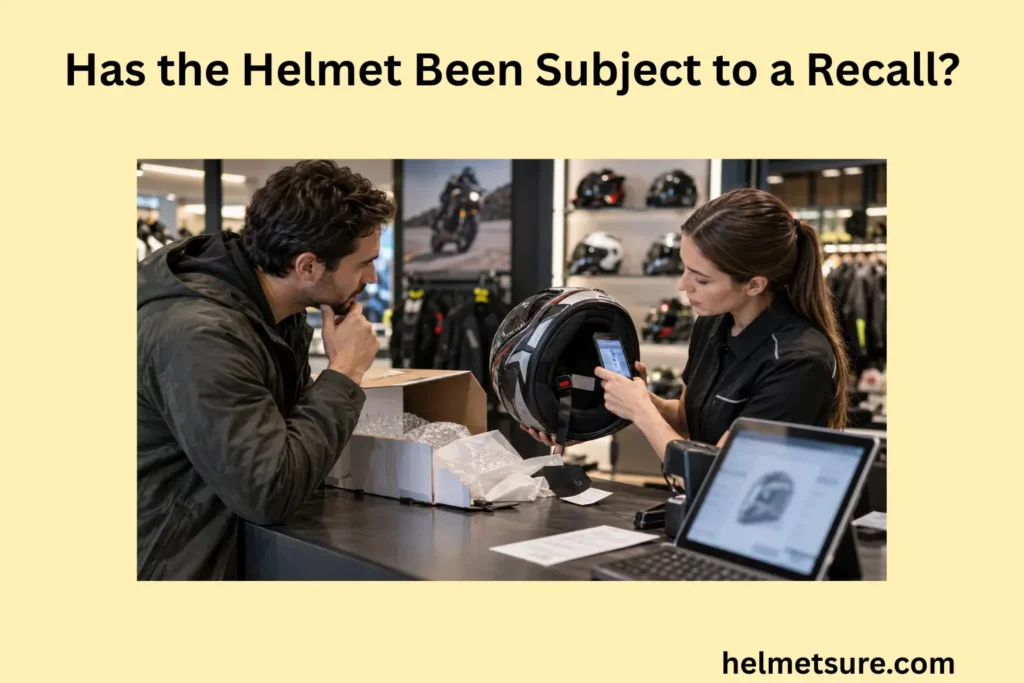
Has the Helmet Been Subject to a Recall?
A helmet is subject to a recall when an official notice covers its exact model and affected identifiers; verify the model, production details, and serial, lot, or batch information, then follow the remedy specified for matching units.
Checking the brand name alone is not enough. An official notice may cover only one model, size, production period, batch, lot, serial range, or combination of characteristics. The correct task is therefore to identify the helmet, locate the authoritative notice for the market in which it was sold, and compare every criterion the notice requires.
This process should end in one of three results:
- Confirmed match: The helmet satisfies every applicable criterion in the official notice.
- Non-match: A required identifier clearly falls outside that notice.
- Unresolved: A necessary identifier is missing, illegible, altered, or cannot yet be verified.
Identify the Exact Helmet Model Before Checking Its Recall Status
The exact helmet model must be identified before its recall status can be checked reliably.
Begin by creating a short identification record. Write down the manufacturer or brand exactly as printed, the complete model name and model number, and any production date, serial number, lot number, or batch number visible on the helmet. Also note the market or country in which the helmet was sold, because recall authorities and affected products may differ between jurisdictions.
Do not fill gaps from memory or appearance. If a code is incomplete, record it as incomplete. An unresolved field is safer and more accurate than an invented match.
Where to find the brand, model name, model number, and production date
The helmet's brand, model name, model number, and production information are typically identified from the manufacturer's labels, markings, packaging, or documentation rather than appearance alone.
Inspect the helmet's permanent markings and interior labels carefully. Depending on the manufacturer and model, useful information may also appear on the original box, sales receipt, order history, user manual, registration record, or official product page. Used helmets may no longer have packaging, so the markings on the helmet itself usually deserve the closest attention.
Label placement and terminology are not universal. One notice may refer to a “manufacture date,” another to a “production date,” and another may rely on a batch or lot code without using a date. Preserve the wording and formatting shown on the helmet. Include leading zeros, prefixes, suffixes, hyphens, and spaces because small differences may identify another model or production run.
Do not assume every helmet has every identifier. Record only what is actually present. If a label is partly illegible, take clear photographs in good light and ask the manufacturer or responsible regulator for help. If labels appear missing, altered, or inconsistent with official product documentation, treat that as a separate product authenticity question rather than guessing the identity.
Why helmet color or appearance alone may not identify the recalled version
A recall photograph can help you recognize a possible product family, but it is not automatically proof that your unit is included. Visually similar helmets may have different model codes, sizes, production dates, or batch numbers. Conversely, a notice may cover several colors or graphics even when it displays only one product photograph.
Appearance matters only to the extent that the notice makes it part of the affected-product description. For example, the CPSC's June 2026 Gudook notice identifies a blue-and-white, medium-size helmet, but it also restricts the recall to model KY-055, batch 202503, and a March 2025 manufacture date. A visual resemblance begins the check; the official identifiers complete it. The full CPSC notice shows those criteria together[3]. Because that notice also identifies noncompliance with certification requirements as part of the hazard, helmet safety certification may be examined as a separate supporting factor; it does not replace the model-and-production recall match.
Identification Checklist
Check the Helmet Against Official Recall Records
The helmet's recall status must be checked against official regulator or manufacturer recall records using its exact identifying information.
Use a source hierarchy. Government regulator records and the manufacturer's official recall page are the primary evidence. Retail listings, news summaries, review sites, forums, social posts, and search-result snippets may alert you to a possible issue, but they should not be the final authority for a recall decision.
The responsible source depends on the helmet category and sales market. In the United States, the CPSC recall database[1] covers applicable consumer products, while NHTSA's recall search[2] covers vehicles and applicable equipment within its jurisdiction. For a helmet sold in another country, use that market's competent regulator and the manufacturer's notice for that market. A U.S. result does not automatically establish recall status elsewhere.
Search recall notices using the manufacturer and exact model number
Recall notices should be searched using the helmet manufacturer and exact model number whenever that identifier is available.
Search the applicable regulator using the manufacturer plus the complete model designation. Then check the manufacturer's official recall or product-safety page. Open the full notice rather than relying on a search snippet, because the page title may identify the brand or product family while the body narrows the affected population.
A search for a brand alone can still be useful when the model is unknown, but it produces candidates rather than a verdict. Once a possible notice appears, verify that it concerns the correct product category and market, then copy the model designation exactly as the notice presents it.
This distinction is especially important in databases that display several types of safety information together. NHTSA, for example, explains that year/make/model or equipment searches can return recalls, investigations, complaints, and manufacturer communications. Those records are related, but they do not all mean that a recall has been confirmed.
Confirm the affected production dates, batch numbers, or serial numbers
A candidate recall applies to a specific helmet only when the production dates, batch numbers, serial numbers, or other affected-unit criteria in the notice also match where required.
Read the notice's “Description,” “Affected Products,” or equivalent section and list each criterion separately. Compare the helmet against each one without skipping ahead:
- Does the manufacturer match?
- Does the complete model designation match?
- Does the notice require a particular size, color, label, or other identifying characteristic?
- Does it restrict the affected units by manufacture or production date?
- Does it require a serial, lot, or batch number to match?
Not every recall uses all five tests. Apply only the criteria actually stated in the notice. The November 2025 Outdoor Master recall, for example, identifies two models and a specific manufacture date for each. The Gudook notice uses a model, size and color description, batch number, and manufacture date. These examples demonstrate why there is no universal “model only” or “all identifiers” rule; the controlling rule is the language of the applicable notice. The Outdoor Master notice provides its model-and-date criteria[4].
Never substitute the purchase date for the manufacture date. Never treat the recall announcement date as a production date. If a range or character is unclear, preserve the uncertainty and request authoritative confirmation.
Separate official recalls from customer complaints and product reviews
A complaint documents a reported experience or suspected problem. An investigation evaluates information that may indicate a defect. A manufacturer communication may provide service information. An official recall notice identifies the action, affected products, hazard, and remedy. NHTSA's published process likewise separates complaints, investigations, and recalls: complaints can contribute to an investigation, but they are not themselves recall notices.
This does not make complaints meaningless. Multiple or serious reports may justify checking more closely, contacting the manufacturer, or reporting a safety concern to the relevant authority. They simply answer a different question. Use customer reviews to evaluate owner experiences, but use official records to determine recall status.
Official Recall-Source Checklist
Determine Whether Your Specific Helmet Falls Within the Recall
Your specific helmet falls within a recall only when it satisfies the affected-unit criteria stated in the applicable official notice.
Turn the notice into a field-by-field comparison. Mark each field as match, non-match, not required, or unresolved. Do not issue a final result until every criterion used by the notice has been addressed.
Model-number matches
Compare the entire printed model name or number. Preserve variant codes, prefixes, suffixes, punctuation, and hyphens. A shared brand or similar model name is not an exact match, and shortening the code may erase the feature that separates an affected model from an unaffected one.
If the model does not match, that specific notice will normally not apply unless it expressly groups several models under a broader designation. If the model cannot be read, the result remains unresolved. If the marking conflicts with official documentation, verify the helmet's identity before making a recall decision.
Manufacturing-date matches
A manufacturing-date match confirms that the helmet was produced within the affected date criterion when the recall notice limits the recall by production date.
Compare the date printed on the helmet with the exact date or range in the notice. Use the notice's own terminology—such as “manufacture date” or “production date”—and confirm the date format before interpreting it. A code presented as MM/YYYY, for example, should not be silently read as YYYY/MM.
The purchase date is not a substitute. A helmet purchased during an affected sales period may have been manufactured outside the affected production period, while a later purchase could involve older stock. If the notice does not use a manufacturing date, mark that field not required rather than inventing a date test.
Serial, lot, or batch-number matches
Serial, lot, or batch numbers provide unit- or production-group confirmation when the recall notice uses those identifiers to define affected helmets.
Compare the complete number or code with the exact identifier or range in the notice. Serial, lot, and batch numbers are not interchangeable terms; use the label named by the source. Keep leading zeros and prefixes, and do not guess whether an unclear character is a zero, letter O, one, or letter I.
When a model matches but a required batch, lot, or serial criterion clearly does not, the helmet is a non-match for that notice. When the necessary code cannot be verified, the status remains unresolved until the manufacturer or regulator confirms it.
Recall-match table
Recall-Identifier Match Table
| Recall criterion | Helmet identifier | Official notice criterion | Result |
|---|---|---|---|
| Manufacturer | [Record from helmet] | [Record from notice] | Match / Non-match / Unresolved |
| Model number | [Record from helmet] | [Record from notice] | Match / Non-match / Unresolved |
| Manufacturing date | [Record from helmet] | [Affected date/range or Not Used] | Match / Non-match / Not required / Unresolved |
| Serial number | [Record from helmet] | [Affected number/range or Not Used] | Match / Non-match / Not required / Unresolved |
| Lot number | [Record from helmet] | [Affected lot or Not Used] | Match / Non-match / Not required / Unresolved |
| Batch number | [Record from helmet] | [Affected batch or Not Used] | Match / Non-match / Not required / Unresolved |
| Final status | — | All required notice criteria | Confirmed match / Non-match / Unresolved |
What to Do When the Helmet Matches a Recall Notice
When the helmet matches an official recall notice, the next action must follow the stop-use and remedy instructions stated in that notice.
Read the full remedy section before altering, shipping, returning, destroying, or disposing of the helmet. Recall procedures differ, and taking an irreversible step too early may remove information or evidence required to complete the claim.
Stop using the helmet when the recall instructions require it
Stop using the helmet when the applicable recall notice instructs consumers to stop use.
Place that instruction ahead of questions about refunds, replacements, or repairs. A confirmed match combined with an official stop-use direction means use should discontinue while the remedy is pursued. Do not soften the instruction, and do not continue using the affected helmet while waiting for a more convenient time to submit the claim.
Equally, do not invent a stop-use order for a notice that does not contain one. State the official action accurately and apply it only to units that match the affected-product criteria.
Follow the manufacturer's replacement, refund, or repair procedure
The notice may offer a refund, replacement, repair, new instructions, or another defined resolution. These are not universally interchangeable choices. Follow the contact method, registration process, documentation rules, and return or disposal sequence stated for the matching recall and market.
For example, the Gudook notice requires affected owners to stop using the helmet and contact the seller for a full refund; it also specifies cutting the straps, photographing the destroyed helmet with the batch number visible, emailing the photograph, and then disposing of the product. The Outdoor Master notice instead directs affected consumers to stop using the helmets and contact the company for instructions to register for a full refund. These are recall-specific examples, not procedures to copy for other helmets.
A recall remedy is also different from an ordinary warranty claim or retailer return. Do not assume a receipt, store return, repair, or replacement is required unless the current notice says so. CPSC notes that remedy availability and company operating information can change, which is another reason to consult the live official record immediately before acting.
Preserve labels, receipts, and identifying information needed for the claim
Preserve the helmet labels and other identifying information required by the recall procedure until the claim requirements have been documented and completed.
Before any irreversible action, photograph every label used to establish the match. Capture the full helmet, model designation, production date, and any relevant serial, lot, or batch code. Save the official notice, claim confirmation, and any instructions received from the manufacturer.
A receipt or order record may be useful, but it is not universally mandatory. Some procedures rely on a product photograph or identifying label instead. Check the notice before removing labels, cutting straps, shipping the helmet, or disposing of it. The correct sequence is the one the official procedure specifies.
Recall Action Checklist
What If No Recall Is Listed but the Helmet Appears Unsafe?
No listed recall does not establish that a helmet with visible damage, degradation, or a compromised retention system is safe for continued use.
A recall result applies to a manufacturer-defined group of products. Physical condition applies to the individual helmet in front of you. The two evaluations may overlap, but neither replaces the other.
Recall status does not replace a condition and damage inspection
“No applicable recall found” means only that the official sources and identifiers checked did not produce a matching recall. It is not a certification of physical integrity, remaining protective performance, correct fit, or authenticity. The helmet may still require action because of its history or present condition.
The reverse is also true: visible damage does not prove that an official recall exists. Use the recall workflow to determine whether a notice covers the product, and use the helmet condition workflow to evaluate the individual helmet.
Cracks, impact damage, degraded straps, or compromised retention systems require separate evaluation
Cracks, impact damage, degraded straps, and compromised retention components require a separate condition evaluation regardless of whether an official recall is listed.
These are triggers to consult the helmet manufacturer's inspection and replacement guidance; they are not substitutes for an official recall notice. Do not attempt to infer a recall from damage, and do not assume a damaged helmet is acceptable because no recall matches it.
Avoid home repair of protective components unless the manufacturer expressly provides a procedure for that helmet. Detailed inspection criteria vary by helmet type, design, and manufacturer, so an unseen helmet cannot be certified as safe through a general recall check.
Recall vs. Condition Decision Rule
Confirm the Helmet's Recall Status Before Continuing to Use It
Confirm the helmet's recall status by matching its exact identifiers against the affected-unit criteria in an official notice before treating the verification process as complete.
The full sequence is straightforward: identify the helmet, search the correct official sources, open the complete notice, compare every required field, and then classify the result. A confirmed match activates the official remedy. A clear non-match closes only that particular notice check. Missing or unreliable information keeps the status unresolved.
Match the exact model and production identifiers—not just the brand
A brand result is only the beginning. Continue through the model, manufacturing date, serial, lot, batch, size, color, or other identifying characteristics only where the notice requires them. The final classification must be supported field by field:
- Confirmed match: Every required criterion matches.
- Non-match: At least one required criterion clearly does not match.
- Unresolved: A required criterion cannot be read or verified.
Do not convert unresolved status into a negative result. Obtain missing product information from official documentation, the manufacturer, or the responsible regulator. If the identity itself remains doubtful, resolve that issue before issuing a recall verdict.
Treat a confirmed recall as an action trigger rather than a general warning
A confirmed helmet recall is an action trigger that directs the owner to the specific remedy stated in the official notice.
For a confirmed match, follow the notice's stop-use and remedy instructions. For a non-match, record which required identifier excluded the helmet from that notice. For an unresolved result, preserve the helmet and its labels, avoid guessing, and seek authoritative confirmation.
Final Recall Decision Checklist