
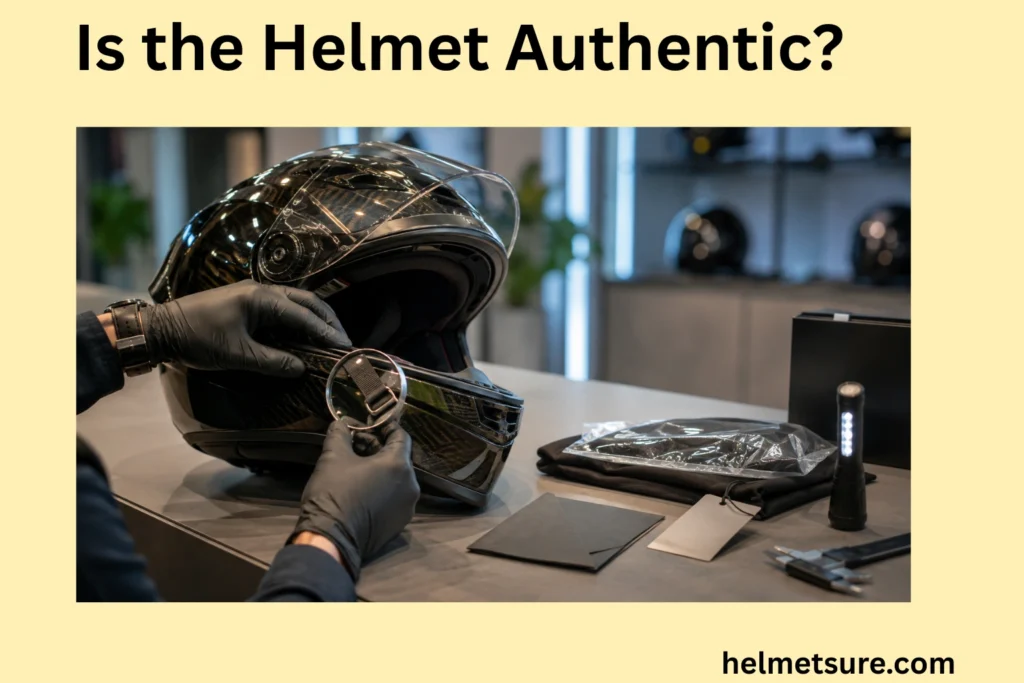
Is the Helmet Authentic?
Helmet authenticity is established through traceable origin, manufacturer-consistent identifiers, model-specific evidence, and authoritative verification; appearance, packaging, or safety markings alone do not prove a helmet is genuine.
The strongest authenticity case connects the physical helmet to a legitimate chain of sale and to identity information the claimed manufacturer can recognize. Receipts, seller records, model designations, product codes, serial or production identifiers where applicable, official model references, and manufacturer or authorized-distributor confirmation should support the same product identity. Logos, packaging, finishing, price, and certification markings can reveal inconsistencies, but they are supporting evidence—not independent proof of origin.
This guide uses an evidence hierarchy: begin with provenance, cross-check identifiers, compare the exact model and production context, validate certification claims with the correct authority, and escalate unresolved conflicts to the manufacturer or documented authorized channel. A visible DOT, CPSC, Snell, ECE, or other mark must be interpreted according to the relevant helmet category, market, and certification system; it is not a universal authentication device.
Helmet Authenticity as Verified Origin Rather Than Genuine-Looking Appearance
Helmet authenticity means establishing legitimate manufacturer origin and product identity rather than deciding that a helmet merely looks genuine.
Origin asks who produced or legitimately supplied the helmet represented by the seller. Identity asks whether the physical item corresponds to the claimed brand, model, configuration, market, and production context. Visible branding communicates that claim, but evidence from the transaction, manufacturer, distributor, product identifiers, and relevant certification authority determines how much confidence the claim deserves.
Why authentic branding alone does not prove genuine manufacturer origin
A logo, color scheme, slogan, box design, hangtag, label, or instruction sheet can resemble genuine material without connecting the helmet to the manufacturer’s actual production or distribution records. SHOEI, for example, warns specifically that counterfeit helmets and accessories sold through internet auctions and mail-order sites may appear very similar to its genuine products.[4] That is a manufacturer-specific warning, but it illustrates the broader evidentiary limit of appearance.
Branding remains useful when compared with trustworthy material for the exact model, market, and production period. A logo in an unexpected location or typography that conflicts with the correct reference is a discrepancy to record. It becomes more meaningful when independent evidence—such as an identifier conflict, an untraceable seller, or a construction mismatch—points in the same direction. One printing anomaly alone does not establish counterfeit manufacture because legitimate graphics, labels, and packaging can change.
How counterfeit, altered, and misrepresented helmets create different authenticity problems
Counterfeit, altered, and misrepresented helmets create different authenticity problems because each involves a different mismatch between claimed identity and actual product history.
A counterfeit helmet is represented as a genuine product of a manufacturer that did not produce it. An altered helmet may have begun as a genuine product but later acquired unauthorized labels, components, paint, hardware, or other changes. A misrepresented helmet may be described with the wrong model, size, market version, production year, certification, or condition even when the underlying product is not proven counterfeit.
These categories require different conclusions. A replaced visor, repaint, or missing pad can be a condition or configuration issue without proving false manufacturer origin. A seller’s incorrect listing may reflect error or deception, but it is not automatically evidence of counterfeit manufacture. Record exactly what conflicts: claimed brand, model, component, market, certification, or transaction history. Then ask whether the evidence challenges original manufacture, later alteration, listing accuracy, or more than one of those questions.
Why authenticity does not by itself prove that a helmet is undamaged, correctly certified, or safe to use
Helmet authenticity does not prove that a genuine helmet is undamaged, correctly certified for the claimed use, properly fitted, or safe to continue using.
Origin and safety condition answer different questions. A genuine helmet can have a compressed liner, cracked shell, degraded retention system, significant impact history, unauthorized modification, or recall. It can also be genuine but lack the certification required for the buyer’s activity or jurisdiction. Conversely, a certification mark is a compliance claim within a defined system; it does not independently prove manufacturer origin.
The U.S. Consumer Product Safety Commission’s bicycle-helmet guidance illustrates this boundary. For bicycle helmets covered by 16 CFR Part 1203, required warnings include that impact damage may not be visible and may warrant return to the manufacturer or destruction and replacement.[1] That rule is specific to covered U.S. bicycle helmets, but it demonstrates why a verified genuine identity cannot substitute for a separate condition and use decision.
What Purchase and Seller Evidence Supports the Helmet’s Authenticity?
Purchase and seller evidence supports helmet authenticity when it creates a traceable chain between the product, transaction, seller, and claimed manufacturer.
Provenance is the documented history of how the helmet reached the buyer. Strong provenance does not make every other check unnecessary, but it supplies evidence independent of the product’s appearance and gives the manufacturer, seller, payment provider, or consumer authority something concrete to verify.
How an authorized retailer or traceable seller strengthens product provenance
An authorized retailer or otherwise traceable seller strengthens helmet provenance by creating an independently checkable connection between the sale and the claimed supply channel.
“Authorized” should mean the manufacturer or its official regional distributor recognizes that seller for the relevant product and market. Do not accept a badge on the seller’s own page as conclusive. Where an official dealer directory exists, confirm the exact business name, website domain, physical location, and relevant region. If no directory exists, ask the manufacturer or distributor through an official channel rather than inventing an authorization rule.
A seller may still be traceable without a formal authorized designation. Useful evidence can include a verifiable legal or trading name, stable contact details, a documented marketplace account, a physical address, clear transaction terms, and records connecting the seller to the item. Traceability supports accountability and follow-up; it does not independently establish certification, condition, or authenticity.
Why receipts, order records, and matching product details provide stronger evidence than verbal claims
Receipts, order records, and matching product details provide stronger authenticity evidence than verbal claims because they create records that can be cross-checked against the helmet and seller.
A useful record may identify the seller, transaction date, order number, brand, model, color or variant, size, SKU or product code, price, and delivery address. Not every document contains every field, and the manufacturer determines what it accepts for warranty or verification. Preserve the original electronic confirmation, invoice, payment record, shipment information, and listing where lawful and practical.
Cross-check rather than merely collect. The model and size on the order should agree with the physical helmet and packaging where applicable. The seller named on the receipt should match the entity that received payment. Product photographs in the listing should correspond to what arrived. A document can be incomplete, altered, or attached to a different item, so records are strongest when their details agree with independent manufacturer and product evidence.
How missing or inconsistent seller information can weaken confidence in the helmet’s origin
Examples include a receipt with no identifiable seller, a website domain unrelated to the named business, conflicting addresses, a payment recipient that cannot be explained, an order record describing another model, or a seller who refuses to provide ordinary product details. These are reasons to seek clarification, not automatic proof of counterfeiting.
Ask the seller to reconcile the specific inconsistency in writing and retain the response. Then verify the explanation through a source the seller does not control, such as the manufacturer’s official dealer information, the distributor’s records, or the transaction platform. A plausible, documented explanation may resolve the issue; evasive or contradictory answers leave provenance weaker.
Authenticity evidence hierarchy
| Evidence source | Relative strength | What it can establish | Important limitation |
|---|---|---|---|
| Manufacturer confirmation | Highest when available | Recognition of claimed product identity or origin | Verification systems and available records vary |
| Authorized-channel record | Strong | Traceable connection to a recognized supply channel | Does not establish current condition |
| Matching transaction documentation | Moderate to strong | Support for the chain of sale | Documents still require cross-checking |
| Exact-model physical consistency | Supporting | Consistency with known product features | Resemblance is not standalone proof |
| Packaging or cosmetic appearance | Weak alone | Visual resemblance | Can be copied or legitimately vary |
Which Product Identifiers Should Match the Manufacturer’s Records?
Product identifiers should match the manufacturer’s documented model structure and the specific helmet’s other identity information.
The applicable identifiers vary. Depending on the manufacturer and helmet category, a product may use a model designation, catalog or product code, SKU, size code, serial number, production-lot identifier, date information, certification label, or regional distributor marking. Never assume that every helmet has a consumer-verifiable serial number or that different identifier types are interchangeable.
How model names, product codes, serial numbers, and size identifiers should correspond
Model names, product codes, serial numbers, and size identifiers should form an internally consistent identity for the same helmet configuration.
Begin with the claimed model and variant. Compare the helmet’s permanent labels and markings with the transaction record, packaging, manual, official product page, parts documentation, and manufacturer support response. A product code should resolve to the same family and configuration; a size label should agree across the helmet and transaction; and any serial or production identifier should follow the manufacturer’s documented purpose where verification is available.
Do not decode an unexplained number using a pattern from another brand or model. A SKU can identify a sellable configuration, a batch code can identify multiple units, and a serial number can identify one unit—but only if the manufacturer defines them that way. Record every identifier exactly, including capitalization, separators, and its physical location, without publishing a sensitive code unnecessarily.
Why identifier format and placement must be checked against the specific helmet model
Identifier format and placement must be checked against the specific helmet model because manufacturers can change labels, codes, and production details across models, markets, and production periods.
An official image from the wrong year, shell size, colorway, region, or certification version can create a false mismatch. Find references for the closest possible configuration and date. Use current and archived manuals, official product pages, parts catalogs, regional distributor material, and manufacturer responses where available. If a reference shows only one side of the helmet, do not infer what must appear elsewhere.
Placement is supporting evidence, not a universal rule. A code under removable comfort padding on one model does not prove that another model must use the same location. Likewise, a redesigned label does not automatically indicate tampering. Distinguish documented production revision from physical alteration by checking the model’s actual timeline and market context.
How duplicated, altered, missing, or inconsistent identifiers can justify further verification
Concern increases when an identifier resolves to another product, two supposedly unique units display the same code, label data conflict with the helmet’s size or model, a required field is absent, or a marking appears physically altered. Before judging, confirm that the code is meant to be unique, that the field is required for this model and market, and that the comparison source covers the correct production period.
Photograph the full label in context and a close view of the inconsistency. Do not peel, scratch, chemically clean, or dismantle the helmet to test a label. Send the manufacturer the model claim, code, purchase record, seller details, and images it requests. A conflict is a reason for authoritative verification; it is not permission to invent what the “correct” format should be.
Identifier verification table
| Identifier | Expected relationship | Compare against | Inconsistency requiring escalation |
|---|---|---|---|
| Model name or designation | Same product family and claimed variant | Helmet, transaction record, OEM reference | Conflicting model identity |
| Product code or SKU | Same documented configuration | OEM catalog and order record | Code resolves to another product |
| Serial or production identifier | Manufacturer-recognized format where applicable | OEM documentation or support | Altered, unexplained, or contradictory code |
| Size identifier | Same stated size or configuration | Helmet label, packaging, order record | Cross-record size conflict |
| Production or batch information | Plausible for the documented product | OEM or support records | Impossible or contradictory production data |
Do the Helmet’s Construction and Branding Match the Genuine Model?
Helmet construction and branding should be compared with trustworthy references for the exact genuine model, but physical similarity alone cannot establish origin.
Physical comparison tests whether the claimed identity is internally consistent. It is most useful after the buyer has identified the correct model, configuration, market, and production period. Without that context, differences may reflect normal variants rather than counterfeiting.
How shell shape, vents, liner construction, and fitted components can expose model inconsistencies
Shell shape, vent layout, liner construction, and fitted components can expose model inconsistencies when they conflict with official references for the same helmet configuration.
Compare overall geometry, coverage, openings, molded features, edge profiles, shell-to-liner relationships, retention routing, fit mechanisms, visors, peaks, face shields, rails, fasteners, and other documented components. Use several official views or a manual rather than a single marketing image. Shell sizes within the same model can have different proportions, and regional or production revisions may use different parts.
Record material discrepancies, not tiny photographic differences. A vent missing from the physical helmet, a liner architecture that conflicts with the official specification, or hardware from another model deserves investigation. A camera angle, lighting condition, optional accessory, or approved replacement component can create an apparent difference without changing origin. Never dismantle protective layers to compare hidden construction unless the manufacturer directs an authorized inspection.
How logo placement, typography, labels, and finishing should align with genuine model references
Logo placement, typography, labels, and finishing should align with genuine model references closely enough to support the claimed product identity.
Check the spelling, wording, relative placement, proportions, color treatment, label hierarchy, and finish against official references for the same version. Examine whether branding appears integrated in the documented way or looks newly applied, misaligned, obscured, or inconsistent with other identifiers. Also compare required warnings and manufacturer information where the applicable model and market specify them.
“Align” does not mean pixel-identical. Printing tolerances, photography, shell size, curved surfaces, authorized graphics, regional labeling, and production updates can change appearance. A suspected typographic or finish difference should lead to a dated OEM comparison and manufacturer inquiry, not an immediate public accusation. Stronger authenticity evidence still comes from provenance and verifiable identity.
Why packaging differences or minor cosmetic variation should not be treated as standalone proof of counterfeiting
Boxes, protective bags, inserts, manuals, stickers, hangtags, color names, graphics, and accessory bundles may change without changing the manufacturer of the helmet. Retailers may also add shipping material, or a legitimate second-hand product may no longer have its original packaging. Compare like with like: the same market, approximate sale period, model revision, and authorized bundle.
Packaging becomes more significant when its product code conflicts with the helmet, its described model does not exist in official records, or several independent details contradict the claimed identity. Even then, determine whether the wrong box or replaced documentation explains the difference. Packaging can support a chain of identity, but it cannot replace helmet-level and manufacturer-level evidence.
Genuine-model comparison matrix
| Observable feature | Trustworthy reference | Discrepancy to record | Evidentiary interpretation |
|---|---|---|---|
| Shell or vent layout | Exact-model OEM reference | Material structural mismatch | Supporting concern |
| Liner or fitted components | OEM specification or manual | Missing or incompatible component | Supporting concern |
| Branding or labels | Same-period OEM imagery or documentation | Material wording or placement conflict | Supporting concern |
| Finish or color | Official variant reference | Unrecognized variation | Weak alone; verify context |
| Packaging | Same-market OEM or distributor reference | Packaging-to-product conflict | Weak alone; corroborate |
Are the Helmet’s Certification and Compliance Markings Credible?
Helmet certification and compliance markings are credible only when the claimed standard, helmet category, market, manufacturer information, and model context agree with authoritative requirements.
Certification evidence should be evaluated within the governing system. Different regulators and certification bodies use different legal structures, labels, testing programs, records, and terminology. A rule for a U.S. bicycle helmet cannot be transferred to a motorcycle, industrial, climbing, equestrian, snow, tactical, or other helmet without evidence that the same requirement applies.
How the claimed certification should correspond to the helmet model and intended market
A claimed helmet certification should correspond to the product category, model claim, and market in which that certification is applicable.
Identify the helmet’s intended activity and country or region of sale, then identify the exact standard claimed. Check the current regulator or certification body and the manufacturer’s official information for that model. Confirm that the standard covers the helmet category and that any edition, designation, or configuration information is plausible for the production and sales context.
Terminology matters. For U.S. motorcycle helmets, NHTSA explains that FMVSS No. 218 operates through manufacturer self-certification; NHTSA does not pre-approve helmets, although it conducts compliance testing and can issue recalls.[2] For U.S. bicycle helmets covered by 16 CFR Part 1203, CPSC specifies certification-label information and requires certification to rest on a reasonable testing program.[1] These are different systems and should not be described as a generic government “approval.”
Why certification labels should be checked for internally consistent standard, manufacturer, and model information
Certification labels should contain information that is internally consistent with the applicable standard, manufacturer identity, and helmet model requirements.
Use the authority’s current labeling rule, not an online photo of another product. For covered U.S. bicycle helmets, CPSC guidance lists a compliance statement, information for the manufacturer or importer issuing the certificate, foreign-manufacturer information where applicable, and production-lot and manufacture-date information among required label elements.[1] For DOT-compliant U.S. motorcycle helmets, NHTSA lists manufacturer or brand, model designation, DOT, FMVSS No. 218, and “CERTIFIED” on the external label for the relevant modern labeling format.[2]
Those examples are category- and market-specific. Check wording, required fields, internal consistency, and applicability rather than demanding the same label on every helmet. A seemingly complete label supports the certification claim only when its data agree with the physical product and authoritative records.
Why copied or fabricated safety markings can appear convincing without proving genuine certification
NHTSA warns that fake DOT labels are sold for unsafe novelty motorcycle helmets.[2] The Snell Memorial Foundation separately maintains model listings for helmets that have met its standards, requires serialized labels inside certified helmets under its licensing agreement, provides a label-authenticity query, and publishes a notice concerning counterfeit labels.[3] These mechanisms show why a mark should be connected to the correct system and model instead of accepted at face value.
Use the certification body’s database or inquiry channel where one exists, then compare make, model, size, standard, category, and configuration. Not every authority offers unit-level consumer verification, and a certified-model listing does not authenticate an individual helmet or establish its current condition. Certification plausibility is one evidence stream within an authenticity assessment.
Which Warning Signs Increase the Risk That the Helmet Is Counterfeit?
Counterfeit risk increases when multiple independent inconsistencies affect price, provenance, identifiers, branding, construction, or documentation.
Warning signs should organize further verification, not substitute for it. Give the greatest weight to contradictions grounded in authoritative, model-specific records and to conflicts replicated across independent evidence sources.
How unexplained pricing far below normal market levels can increase counterfeit risk
Pricing far below the documented market level can increase counterfeit concern when the seller cannot provide a credible reason for the difference.
Compare the actual price with the manufacturer’s published price and contemporaneous authorized-retailer prices for the same model, variant, size, market, and condition. Legitimate discounts can arise from clearance, discontinued graphics, seasonal promotions, damaged packaging, open-box status, used condition, or regional pricing. Currency, tax, shipping, and included accessories can also distort comparison.
Do not invent a percentage at which a helmet becomes counterfeit. Record the anomaly and ask for a documented explanation, original transaction evidence, and seller provenance. A low price is a weak-to-moderate risk signal by itself; it becomes more important when identifiers, construction, certification, or seller records also conflict.
Why mismatched branding, identifiers, documentation, or construction create stronger concern when they occur together
Mismatched branding, identifiers, documentation, and construction create stronger counterfeit concern when several independent evidence streams contradict the same claimed identity.
Suppose the order record names one model, the helmet label names another, the product code resolves to a different size, and the vent or liner arrangement conflicts with the correct OEM reference. Each discrepancy should first be checked for an ordinary explanation, but their cumulative direction matters if they come from separate trustworthy comparisons.
Independence is essential. Several observations copied from the same inaccurate listing are not several sources. Prefer a transaction record, a manufacturer model reference, a certification-body record, and a direct support response that were created for different purposes. Do not assign an unsupported numerical score; explain which claims conflict, which sources support the conflict, and whether the manufacturer can reconcile it.
How questionable seller history or unverifiable sourcing compounds physical authenticity concerns
Questionable seller history or unverifiable sourcing compounds physical authenticity concerns because it weakens the independent provenance evidence that could otherwise explain product differences.
Review the seller’s verifiable identity, account history, domain, contact details, transaction terms, and relationship to the claimed manufacturer. Sudden account changes, copied product material, inconsistent business names, unexplained payment routing, refusal to issue documentation, or an authorization claim the manufacturer does not recognize all justify closer scrutiny. Seller reviews can add context but do not authenticate the particular helmet.
Combine seller evidence with product evidence. A retailer outside an official channel is not automatically selling counterfeits, and a well-known seller does not make every listing genuine. When physical discrepancies exist, a traceable seller may produce invoices or distributor records that resolve them. An untraceable seller cannot supply that independent explanation, leaving the authenticity case weaker.
Why one cosmetic irregularity should be interpreted differently from multiple independent inconsistencies
A slightly different box, color shade, logo position, stitching line, or finish can reflect production tolerance, photography, regional variation, approved replacement, or a model revision. First confirm that the reference is truly comparable. If the only anomaly is cosmetic and provenance and identifiers remain consistent, seek clarification rather than declaring a counterfeit.
Concern becomes stronger when unrelated evidence converges: the seller cannot be traced, the product code resolves elsewhere, required label data conflict, the construction differs from the exact model, and the manufacturer cannot reconcile the item. Keep conclusions calibrated. Multiple contradictions can justify stopping reliance and escalating; they do not authorize a legal accusation beyond what the evidence proves.
Counterfeit warning-sign table
| Signal | Interpretation | Evidentiary strength |
|---|---|---|
| Unexplained extreme price anomaly | Raises sourcing questions | Weak to moderate alone |
| Unverifiable seller or provenance | Weakens chain-of-origin confidence | Moderate |
| Identifier conflict with OEM records | Contradicts claimed identity | Strong when model-specific |
| Structural mismatch against exact OEM model | Supports an identity concern | Moderate to strong |
| Certification inconsistency | Challenges the compliance claim | Strong when authority-confirmed |
| One cosmetic irregularity | Requires production and market context | Weak alone |
| Multiple independent contradictions | Justifies authoritative escalation | Strong cumulative concern |
How Can the Manufacturer or Authorized Seller Confirm Authenticity?
Manufacturer or authorized-seller confirmation provides stronger authenticity evidence when the organization can evaluate the helmet against its own product, production, or sales records.
Contact confirmation works best when the buyer supplies a precise, organized evidence package through a channel independently verified as official. The organization may be able to confirm identity, explain a legitimate revision, recognize a seller, or identify a conflict—but its records and authentication services may have limits.
Which model, serial, purchase, and product photographs may be needed for verification
Manufacturer verification may require model information, available identifiers, purchase records, and clear photographs that connect the physical helmet with the claimed product identity.
Start with the claimed brand, exact model or family, size, variant, market, purchase date, seller, and order number. Record every product code, serial or production identifier, manufacture-date marking, and certification label that legitimately applies. Provide an unedited full view of the helmet, front, rear, both sides, accessible interior, labels in context, close images of the relevant codes, packaging identifiers, and the specific discrepancy.
This is a preparation list, not a claim that every brand requires the same items. Follow the manufacturer’s published instructions and protect personal information. Do not post unique codes publicly if the manufacturer can receive them privately. Do not remove permanent labels, peel bonded padding, open the shell, or perform destructive inspection merely to obtain a photograph.
Why official manufacturer or authorized-distributor channels provide stronger evidence than third-party opinions
Official manufacturer or authorized-distributor channels provide stronger authenticity evidence because they have direct access to product specifications, distribution records, or internal identity systems unavailable to ordinary third parties.
Verify the support address or form from the manufacturer’s own website, manual, or documented regional distributor page. Do not rely on contact details supplied only by the questioned seller, a social-media reply, image-search result, marketplace commenter, or unofficial serial-checking site. An official response can also clarify whether the organization authenticates individual units, recognizes the seller, or can only compare general model information.
Third-party expertise may help document an observation, especially where an authorized inspection service exists, but it should not be presented as manufacturer confirmation. Likewise, a brand’s reputation does not authenticate an individual helmet. Evidence authority comes from direct access to relevant records and a reliable connection between the response and the exact product.
How to interpret a manufacturer’s inability to verify a product without assuming that uncertainty proves counterfeiting
Older records may be unavailable; some products may use batch rather than unit identifiers; regional distributors may hold separate records; photographs may be insufficient; a label may be unreadable; or the manufacturer may not offer individual authentication. Ask what could not be verified, why, and whether another official channel, document, inspection, or certification authority can address the gap.
Preserve the wording of the response. “We cannot authenticate from photographs” is different from “this serial is assigned to another product” or “we did not manufacture this model.” If the answer remains non-verification, keep the status as unresolved. That uncertainty may still be too great for a protective-equipment decision, but it should not be converted into a factual counterfeit determination without stronger evidence.
When Is Authenticity Too Uncertain to Rely on the Helmet?
Helmet authenticity becomes too uncertain to rely on when material origin, identifier, certification, or provenance conflicts remain unresolved after reasonable authoritative verification.
The practical threshold does not require the owner to prove who made a suspicious item. It asks whether the available evidence is strong and consistent enough to rely on the claimed identity of equipment intended to protect the head. A material conflict that survives manufacturer, distributor, seller, or certification checks moves the decision beyond casual visual review.
When conflicting identifiers or provenance records justify stopping reliance on seller claims
Conflicting helmet identifiers or provenance records justify stopping reliance on seller claims when those claims cannot reconcile material contradictions in the product’s identity or chain of sale.
A material contradiction could include a product code that the manufacturer identifies as another model, a supposedly unique serial attached to multiple units, an order record that does not describe the delivered helmet, or a claimed authorized seller that the relevant manufacturer or distributor does not recognize. Confirm the meaning of each identifier and give the seller a reasonable chance to provide documentary clarification.
If the response merely repeats the original claim, supplies unrelated records, or creates further conflicts, change the evidence source. Escalate to the manufacturer, relevant distributor, marketplace, payment provider, or consumer authority as appropriate. “Stop relying on the seller’s claim” does not necessarily mean publicly declare counterfeiting; it means the claim no longer resolves the authenticity question.
When unverifiable certification or manufacturer origin creates a safety-relevant uncertainty
If a certification label conflicts with the relevant authority’s requirements, a model cannot be found in an applicable certified-model list where such a list should contain it, or the claimed manufacturer cannot recognize material identity information, the buyer lacks a reliable connection between the physical item and the represented protective product. Check category, market, standard edition, production period, and database scope before treating absence as a conflict.
The uncertainty concerns reliance, not an invented technical failure result. Do not claim the helmet failed a test that was never performed, and do not call it noncompliant solely because a consumer database lacks a unit-level record. At the same time, do not let a convincing label substitute for unresolved origin. NHTSA’s warning about fake DOT labels and Snell’s counterfeit-label notice show why certification markings require authoritative context.[2][3]
Why unresolved authenticity should not be treated as something maintenance, inspection, or cosmetic condition can correct
Unresolved helmet authenticity cannot be corrected by maintenance, cleaning, cosmetic repair, or ordinary condition inspection because those actions do not establish manufacturer origin.
Cleaning can reveal a label or feature, and inspection can identify physical damage or alteration. Neither creates a missing chain of sale, validates a product code, confirms a manufacturer, or proves a certification claim. Repainting a poor finish, replacing a suspicious sticker, reattaching a pad, or polishing the shell removes or changes evidence without resolving identity.
Keep authentication and condition assessment separate. A helmet can look unused and remain unverified; it can be authentic and still be damaged. When identity is unresolved, preserve photographs and records, avoid further modifications, and seek authoritative verification. Do not treat a successful fit check, clean appearance, or absence of visible cracks as a substitute for origin evidence.
When return, refund, authorized inspection, or replacement becomes the safer decision path
Return, refund, authorized inspection, or replacement becomes the safer decision path when material authenticity uncertainty remains unresolved and the helmet would otherwise be relied on as protective equipment.
Use the transaction’s deadlines and evidence requirements promptly. Notify the seller in writing, describe the discrepancy without overstating it, preserve the listing and records, and follow the marketplace, payment provider, retailer, or applicable consumer-protection process. Do not surrender original evidence or ship a questioned product until the authorized process explains how to preserve tracking and documentation.
An authorized inspection can be useful only when the manufacturer or relevant authority recognizes the inspector and defines what the inspection can establish. Replacement from a traceable source may reduce unresolved origin risk when verification is unavailable. Review the applicable helmet return policy to move from “Can I prove this helmet’s origin?” to a documented remedy that leaves you with protective equipment of traceable provenance.
Verify, escalate, or do not rely
| Evidence state | Interpretation | Appropriate next action |
|---|---|---|
| Traceable provenance and manufacturer-consistent identifiers | Strong origin evidence | Complete separate condition and certification checks |
| Minor cosmetic difference with otherwise consistent evidence | Weak isolated anomaly | Verify model, market, or production variation |
| Missing provenance with no direct contradiction | Origin unresolved | Request seller and OEM evidence |
| Conflicting identifiers or certification information | Material inconsistency | Escalate to manufacturer or certification authority |
| Manufacturer cannot verify | Unresolved authenticity | Do not assume genuine; consider return or authorized evaluation |
| Manufacturer confirms an identity conflict or the product cannot be reconciled | Strong adverse evidence | Follow return, refund, replacement, and reporting options as applicable |
What Is the Most Reliable Way to Decide Whether the Helmet Is Authentic?
The most reliable helmet-authenticity decision prioritizes traceable provenance and manufacturer-verifiable identity over appearance-based impressions.
Helmet Authenticity Verification Checklist
Use a layered decision rather than a fake-spotting trick. Establish where the helmet came from, determine exactly what product it claims to be, test that identity against authoritative records, use physical and certification details to find conflicts, and escalate uncertainty before relying on the product.
Prioritize traceable provenance and manufacturer-verifiable identifiers over visual impressions
Traceable provenance and manufacturer-verifiable identifiers deserve more weight than visual impressions because they connect the helmet to evidence of actual product origin.
The strongest available case normally combines a documented transaction, a traceable or manufacturer-recognized sales channel, internally consistent model and size information, and identifiers the manufacturer can interpret. No single item must exist universally: some helmets lack a unit serial, some brands do not authenticate photographs, and some legitimate sellers are outside formal dealer programs. The task is to build the strongest product-specific chain available.
Visual comparison then checks whether the physical helmet agrees with that chain. When appearance and records conflict, use the exact-model OEM source and ask the manufacturer to explain the difference. Do not let a convincing box outweigh contradictory production data, and do not let one graphic variation outweigh otherwise consistent, authoritative evidence.
Use physical and certification inconsistencies as supporting evidence rather than isolated proof
Physical and certification inconsistencies should support an authenticity assessment rather than serve as isolated proof of counterfeiting.
Check shell geometry, vents, liner and components, branding, labels, construction, and market-specific compliance information against trustworthy sources. Record discrepancies precisely and seek alternative explanations such as shell-size differences, production revisions, regional labels, authorized accessories, or replacement parts. Then determine whether independent inconsistencies converge on the claimed identity.
Certification checks must remain within their system. CPSC information supports claims about covered U.S. bicycle helmets; NHTSA information supports U.S. motorcycle helmets under FMVSS No. 218; Snell’s database and label inquiry support Snell-specific claims.[1][2][3] None is a universal helmet-authentication database, and none makes a visual mark sufficient evidence by itself.
Treat unresolved origin uncertainty as a decision problem rather than assuming authenticity
Classify the outcome honestly: verified or strongly supported, minor discrepancy still being checked, materially unresolved, or contradicted by authoritative evidence. The strongest available evidence may not produce absolute certainty, but it should be independent, internally consistent, relevant to the exact model and market, and sufficient for the reliance being placed on the helmet.