
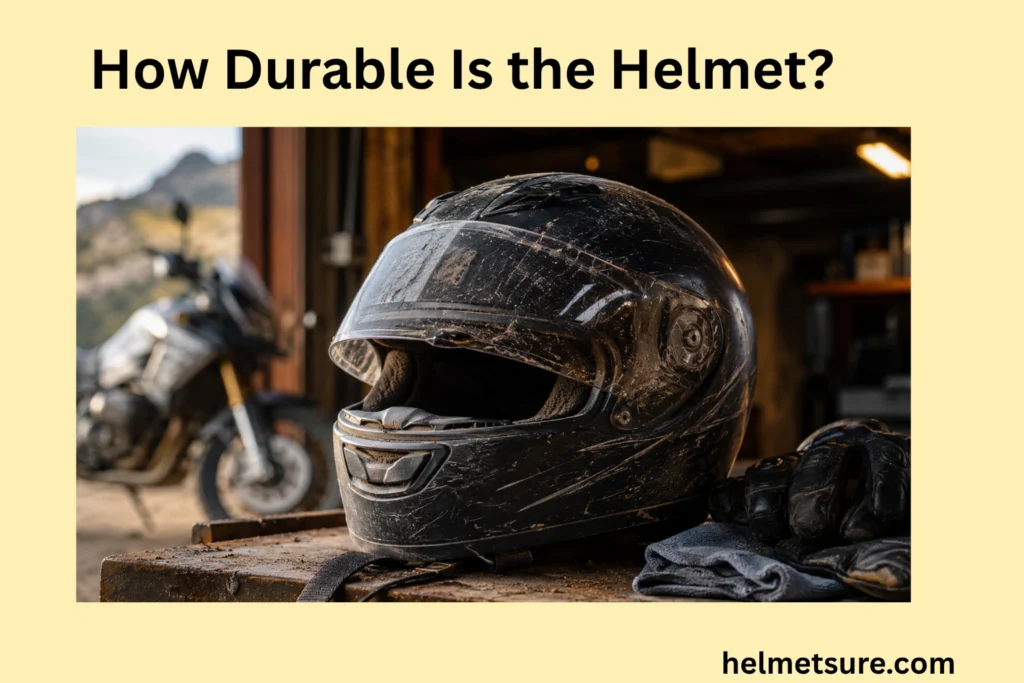
How Durable Is the Helmet?
Helmet durability depends on whether the shell, impact liner, retention system, padding, hardware, and bonded components remain physically and functionally intact as normal wear, environmental exposure, and use accumulate.
Durability is not a universal number of years and cannot be judged from the shell finish alone. A helmet may collect harmless-looking surface marks while its critical components remain sound, or it may retain a clean exterior while an impact liner, bond, strap, buckle, or hidden composite layer has changed. The practical question is whether the whole assembly still retains its intended physical and functional condition.
Three broad outcomes help organize that judgment. Ordinary cosmetic wear can be monitored when it remains superficial. Meaningful deterioration—such as progressive padding wear, damaged webbing, unreliable hardware, or material separation—requires service or closer assessment. Structural cracks, permanent deformation, residual liner crush, delamination, or uncertain damage after a significant impact require manufacturer-specific guidance rather than visual reassurance.
Helmet Durability Means Maintaining Useful Condition Through Wear, Not Simply Looking Undamaged
Helmet durability means the helmet continues to maintain useful structural and functional condition as wear accumulates, not merely that its visible surfaces still look clean.
Useful condition has several dimensions. The shell must retain its intended form and material integrity. The impact liner must remain correctly positioned and free from established crushing or separation. Webbing, stitching, anchors, buckles, and adjusters must remain intact and operate consistently. Comfort components must retain the shape and attachment needed for the helmet’s intended wearer interface.
This whole-system definition prevents two opposite errors. A small scuff should not automatically condemn a helmet, but a glossy shell should not automatically clear it. Durability is established by the location, depth, progression, history, and functional consequence of observed change—not by appearance alone.
Why cosmetic scuffs do not always mean the helmet has lost durability
Cosmetic scuffs do not automatically mean helmet durability has been materially reduced because superficial finish damage can exist without extending into the structural shell.
A helmet exterior can include paint, printed graphics, decals, clear coating, and the underlying shell substrate. Contact with a wall, bag, storage shelf, or another item may mark the finish without cutting through the shell material. In that situation, the observable change is cosmetic: the surface looks different, but the inspection has not established a structural change.
Depth and material involvement change the interpretation. A scuff is a rubbed surface mark; a gouge removes or cuts material; a crack represents separation within a coating or substrate; and delamination refers to separation between layers in a composite or bonded construction. Those words should not be used interchangeably. Finish and substrate must be evaluated separately because a surface mark and damage extending into shell material represent different observations.
Cosmetic does not mean “proven harmless.” A mark with uncertain depth, an unknown impact history, swelling, distortion, exposed reinforcement, or a surrounding crack deserves closer assessment. Home inspection can classify an obvious surface mark, but it may not reveal what lies beneath the finish or within the shell.
Why hidden material changes can matter even when the helmet still looks intact
Hidden material changes can matter even when a helmet looks intact because impact liners, bonded interfaces, and composite layers can change beneath an apparently acceptable exterior.
An EPS impact liner can retain a crushed region after sufficient loading even when the outer shell has recovered or shows little obvious change. A bonded shell-liner interface can separate locally. Within a fiber-reinforced composite, matrix cracking, fiber damage, and delamination can develop below the visible surface. Research on composite motorcycle-helmet shells describes those internal failure modes, while controlled testing of equestrian helmets documented residual EPS crushing and reduced attenuation during later impacts at the same location.
Neither finding means that normal handling causes invisible failure in every helmet. It means exterior appearance and internal material state are different observations. A helmet with no known impact, no progressive symptoms, and no manufacturer warning signs presents a different evidence profile from one with a significant impact history or suspicious deformation.
Some hidden conditions require manufacturer assessment, authorized disassembly, imaging, or laboratory testing. Owners should not remove bonded liners, peel composite layers, drill inspection holes, or strike the helmet to “test” it. Destructive investigation can create new damage without establishing serviceability.
Why durability should be judged across the whole helmet rather than by the shell alone
Helmet durability should be judged across the whole helmet because shell integrity, liner condition, retention components, padding, hardware, and attachment points all contribute to continued functional condition.
A sound shell cannot compensate for a buckle that no longer engages, a cut retention strap, loose anchorage, or an impact liner that has visibly crushed or separated. Conversely, a worn but manufacturer-replaceable comfort pad is not automatically equivalent to structural shell damage. Each component has a different job and a different serviceability pathway.
OEM inspection systems reflect this breadth. Gentex’s manual for one tactical helmet separately checks the shell, pad or liner system, webbing, stitching, buckle, adjusters, screws, and other hardware.[1] The exact acceptance limits belong to that product, but the inspection architecture demonstrates the correct general principle: examine the component network rather than one attractive surface.
Durability remains a condition judgment, not a certification result. Passing an ownership inspection means no known or observable durability concern was found under the applicable guidance; it does not reproduce whole-helmet impact testing or rule out every hidden change.
How Helmet Construction Influences Long-Term Durability
Helmet construction influences long-term durability because material selection, shell geometry, component interfaces, bonding, fasteners, and retention architecture determine how repeated stresses are distributed through the product.
Wear acts on a built assembly rather than isolated ingredients. Curvature can stiffen a shell region; openings can alter local geometry; a thin integrated shell can interact with its liner differently from a separately formed rigid shell; and sewn, bolted, bonded, molded, or removable components create different interfaces. The same generic material name can therefore produce different durability patterns in different designs.
Construction does not supply a simple ranking. A thicker shell is not always more durable, an integrated interface is not immune to separation, and a complex assembly is not automatically weaker. Durability depends on the specified material, geometry, manufacture, attachment method, loading, exposure, and condition together.
How shell material and thickness affect resistance to scratches, dents, and deformation
Shell material and thickness influence helmet durability because different thermoplastic and composite constructions resist abrasion, deformation, cracking, and delamination through different material behaviors.
Thermoplastic shells can scratch, gouge, flex, crack, or retain local deformation depending on polymer grade, thickness, curvature, temperature, and loading. Fiber-reinforced composites use fibers within a matrix and laminate; under sufficient loading, they can develop matrix cracks, fiber damage, interlaminar separation, or combinations of those modes. Composite-shell research demonstrates why “crack” and “delamination” require laminate context rather than being treated as ordinary surface marks.[2]
Thickness affects stiffness and available material, but it is only one variable. A curved rib, vent edge, local reinforcement, unsupported span, or shell-liner bond can change stress distribution. Two shells of equal nominal thickness can behave differently if their material system, geometry, or manufacturing quality differs. No generic shell-thickness number can serve as a durability threshold across helmet categories.
Scratch resistance is also different from structural-damage resistance. A coating can mark easily while the substrate remains intact, or a hard-looking surface can conceal deeper change. Shell material and thickness help explain possible damage patterns; the actual durability judgment still depends on verified condition and product-specific criteria.
How bonded or integrated components influence structural consistency over repeated use
Bonded and integrated helmet components influence durability because adhesives, molded interfaces, edging, fasteners, and laminate bonds must remain secure as the helmet is handled and worn repeatedly.
An interface is the physical relationship between parts. It may be a structural adhesive between shell and liner, resin binding composite layers, molded foam around a shell, edge trim secured to a rim, hook-and-loop holding a removable pad, a sewn strap connection, or a bolt and insert joining hardware. Each interface experiences its own combination of tension, shear, flexing, vibration, heat, moisture, contamination, and handling.
Loosening, peeling, separation, delamination, missing hardware, or a component that no longer stays positioned can indicate declining interface durability. Gentex’s model-specific guidance, for example, treats loose edging, delamination, failed pad attachment, loose fasteners, and missing hardware as separate inspection findings. These examples support inspecting the joint as well as the parts; they do not create universal acceptance limits.
Removable attachments must be distinguished from bonds intended to remain fixed. A washable pad may be detached exactly as the manufacturer directs, while a bonded impact liner should not be pulled free and reattached at home. Material choice and assembly method work together, and the separate guide to helmet construction explains those manufacturing relationships in detail.
Why durability depends on the combined condition of shell, liner, retention system, and padding
Helmet durability depends on the combined condition of the shell, liner, retention system, and padding because deterioration in one functional component can make the overall helmet condition unacceptable despite other components remaining intact.
Consider three simple combinations: an intact shell with a buckle that will not remain closed; sound-looking webbing attached to a visibly crushed liner; or an undamaged structural body with comfort pads that no longer attach or maintain stable contact. The durability consequence comes from the function of the affected part, not from averaging its condition against several good components.
Components also wear at different rates. A shell may resist years of ordinary surface contact while pad fabric tears, hardware becomes contaminated, or webbing abrades at an adjuster. A replaceable comfort component may have an authorized service path, while a structural crack or liner separation may not. Manufacturer guidance determines that distinction for the specific helmet.
Construction Factors and Durability Outcomes
| Construction Factor | Repeated Stress or Exposure | Durability Outcome to Explain |
|---|---|---|
| Thermoplastic shell | Abrasion, flexing, knocks, heat, or UV | Surface wear, deformation, or cracking depending on material and design |
| Composite shell | Impact, bending, or repeated handling | Matrix cracks, fiber damage, or delamination under sufficient loading |
| Shell-liner interface | Handling, impact, heat, or chemical exposure | Separation or loss of secure integration |
| EPS or EPP liner | Compression or impact | Shape change or residual deformation depending on material and event |
| Webbing and stitching | Tension, adjustment, abrasion, or sweat | Fraying, stretching, or loose and damaged stitches |
| Buckles and adjusters | Repeated engagement, tension, or dirt | Wear, cracking, looseness, or unreliable operation |
| Comfort padding | Compression, sweat, washing, or repeated wear | Loss of resilience, shape, attachment, or stable contact |
How Does the Outer Shell Hold Up Against Everyday Wear?
A helmet shell normally accumulates surface wear through handling and use, but durability concern increases when marks progress from superficial finish damage to cracks, deep gouges, delamination, or permanent deformation.
Everyday wear can come from setting the helmet down, moving it through a storage compartment, contact with clothing or equipment, normal cleaning, and low-level bumps during handling. These events often affect coatings and graphics first. The task is to inspect the mark’s depth, surrounding shape, material involvement, progression, and known event history.
Shell category matters. A thin thermoplastic skin integrated with foam does not present the same inspection context as a thick rigid thermoplastic shell or a fiber-reinforced laminate. The manufacturer’s terminology and criteria should control any pass, service, or replacement decision.
How repeated abrasion and minor impacts create scratches, gouges, or surface deformation
Repeated abrasion and minor knocks can mark a helmet shell through scratches, scuffs, gouges, or local deformation, with significance depending on depth, material, and whether structural layers are affected.
Abrasion drags one surface across another and can dull a finish, remove paint, or create a shallow scratch. A sharper edge or concentrated contact can cut a gouge. A knock can leave a transient mark, a local dent, or permanent distortion if the material and loading allow it. The observable pathway is stress → visible mark → inspection of depth, geometry, and involved layer.
A thermoplastic shell may show whitening, a crease, a dent, or a crack around a deformed region. A composite may show a surface crack, exposed fibers, a soft or raised area, or signs of layer separation. These are possible patterns, not a home diagnostic rule: similar-looking marks can have different depths, and subsurface damage can be difficult to confirm visually.
Unknown impact history raises uncertainty. A mark found after lending, transport, or storage should be evaluated with more caution than a known superficial paint rub. Do not scrape, flex, tap, sand, or polish a suspicious area to discover how deep it goes; such actions can alter the evidence or damage the component.
Why cracks, deep cuts, or permanent distortion matter more than ordinary cosmetic scuffs
Cracks, deep cuts, delamination, and permanent shell distortion deserve greater durability concern because they indicate material or structural change beyond superficial finish wear.
A structural crack divides shell material; a deep gouge removes or severs part of it; delamination disrupts a layered interface; and permanent distortion changes the shell’s original geometry. These conditions reduce confidence that the component still matches its manufactured state, even before the exact mechanical consequence is known.
OEM guidance illustrates the distinction. Gentex manuals for specified helmets identify damage extending below paint, structural cracking, gouging, and delamination as serviceability concerns, while also distinguishing surface finish conditions. Those manuals do not create a universal crack length or gouge depth for bicycle, motorcycle, climbing, industrial, or other helmets.
When depth or mechanism is uncertain, defer to the manufacturer rather than making a pass/fail call from a photograph. Permanent change deserves reassessment because durability evaluates retained condition; it should not be “tested” through deliberate bending, impact, heat, adhesive, or a cosmetic patch.
How Does the Impact Liner Change With Age and Repeated Use?
Impact-liner durability depends more on material condition, compression, impact history, density, and exposure than on chronological age alone.
The impact liner is a structural energy-management component, commonly made from cellular material such as EPS or EPP in many—but not all—helmet designs. It must be distinguished from the soft comfort foam touching the wearer. Those materials can both compress, yet their recovery behavior, purpose, and durability implications differ.
Two errors should be avoided: calling every packed pad a damaged impact liner, and assuming EPS becomes ineffective solely because calendar years pass. Condition, impact history, exposure, and manufacturer guidance provide the necessary context.
How repeated compression can reduce the liner’s original shape or firmness
Repeated compression can alter foam shape or feel, but the durability meaning depends on whether the material is comfort padding or the helmet’s impact-managing liner.
Comfort padding is designed to conform during ordinary wear. Over time it can pack down, lose rebound, or feel softer because of repeated head contact, sweat, washing, and flexing. Those changes can affect contact and positioning, but they should not automatically be described as loss of impact attenuation.
EPS impact liner behaves differently. Under a sufficiently significant load, its cells can crush and remain deformed rather than returning like upholstery foam. EPP and other resilient structures can recover more shape under some loading conditions, but recovery is not proof of unlimited serviceability. The foam type, loading event, geometry, and helmet instructions must be known.
“Firmness” felt by hand is not a certified measure of impact performance. Do not squeeze structural foam aggressively or compare it with a new helmet as a substitute for testing. The useful ownership observation is whether accessible material shows a persistent dent, crushing, separation, breakup, or change from its original geometry.
Why dents, crushing, separation, or permanent deformation indicate more than normal wear
Dents, residual crushing, liner separation, or permanent deformation deserve closer reassessment because they indicate a physical change in the impact-liner system rather than ordinary surface wear.
Residual crushing means the cellular structure has not returned to its prior form after loading. Separation means the liner or a relevant interface no longer sits as designed. A dent may be a localized shape change, while crumbling or breakup indicates material deterioration. These signs belong to the structural liner only when the component has been correctly identified; a shallow impression in removable comfort padding is a different observation.
In controlled testing of seven equestrian helmet models, repeated impacts at the same crown location produced residual liner compression and worsening subsequent attenuation at that location.[3] The finding demonstrates a mechanism—significant loading can permanently change EPS—but the study’s impact count and measured crush values are not generic consumer thresholds.
Known significant impact history has priority over casual visual reassurance. The absence of an obvious dent does not clear a helmet after an event, because shell, liner, or interface changes may be inaccessible. Apply the manufacturer’s post-impact instructions for that helmet category and model.
How aging can change foam condition even without obvious exterior damage
Aging does not automatically degrade helmet foam; any age-related durability judgment must distinguish chronological time from actual exposure, material type, compression history, and measured condition.
A study of 770 field-used bicycle helmets, including examples up to twenty-six years old, found no or only small age effects on impact attenuation within its sample and methods.[4]
These findings correct the claim that EPS inevitably “expires” on a universal calendar. They do not prove that old EPS is always equivalent to new foam, that every helmet category behaves the same way, or that shells, straps, adhesives, buckles, pads, and prior impacts are unaffected. The studies also do not override manufacturer service-life or replacement guidance.
Age is best treated as a prompt to examine exposure and condition. Heat, ultraviolet radiation, chemical contact, compression, impact, moisture, contamination, adhesive change, and component wear accumulate differently across owners and products. A calendar date supplies history; it does not supply the whole durability verdict.
How Durable Are the Straps, Buckles, Padding, and Retention Parts?
Straps, buckles, adjusters, stitching, and padding lose durability through repeated tension, abrasion, compression, sweat exposure, and mechanical use, so their condition must be checked separately from the shell.
These parts form the helmet’s functional interface with the wearer. Webbing carries tension through anchors and stitching. Buckles and adjusters repeatedly engage, release, and slide. Padding compresses and rebounds while its fabric and attachments experience sweat, friction, and cleaning. A shell-focused check misses these different wear mechanisms.
The inspection should distinguish cosmetic change from functional deterioration. Mild discoloration does not prove fiber failure; a polished buckle surface does not prove unreliable engagement; and gradual pad packing is not the same as structural liner crushing. Cuts, broken fibers, failed stitches, cracks, slipping hardware, and lost attachment provide stronger condition evidence.
How fraying, stretched webbing, or weakened stitching can reduce retention durability
Fraying, damaged fibers, excessive stretching, or weakened stitching indicate declining webbing condition because the retention assembly depends on intact woven material and secure attachment.
Webbing is a woven load path. Repeated tension, movement through adjusters, rubbing against edges, contamination, and handling can abrade yarns or wear a localized region. Stitching holds webbing to another strap, anchor, or component; loose, cut, or broken thread can change that connection even when the main strap looks acceptable.
Gentex’s tactical-helmet manual specifically inspects retention webbing for cuts and frays, checks stitching, and assesses related hardware. Its dimensional limits remain Gentex-specific. A general durability guide can identify cut fibers, meaningful fraying, pulled stitches, and loose attachment as concerns without inventing an industry-wide allowable length.
Color change must be interpreted carefully. Fading, staining, or salt residue can prompt cleaning or closer inspection, but it is not automatically proof that tensile capacity has declined. Physical fiber breakage, edge loss, seam separation, unusual stretching, or an unreliable anchor provides more direct evidence of deterioration.
How worn buckles and adjusters can develop looseness or unreliable engagement
Worn buckles and adjusters reduce durability when cracking, deformation, damaged engagement surfaces, or looseness prevents the retention system from operating consistently.
A buckle experiences repeated closing, opening, tension, and release. An adjuster experiences sliding contact while it must hold webbing at the intended position. Dirt or salt can interfere temporarily, while a cracked latch, deformed slot, missing part, worn engagement face, or recurring adjustment slip indicates a mechanical condition problem.
Normal operation provides the appropriate ownership check: engage and release the closure as designed, move the adjuster through its intended range, and confirm that it holds without unintended slip. Do not perform improvised pull tests, hang weights from the strap, file engagement surfaces, lubricate parts without authorization, or substitute a visually similar buckle.
Hardware architecture varies widely, including side-release buckles, rings, magnetic-assisted closures, molded sliders, metal fittings, and proprietary assemblies. Any service or replacement must follow the manufacturer’s procedure and approved parts list rather than a generic material assumption.
How compressed padding and liner wear can reduce comfort and stable positioning over time
Compressed or deteriorated comfort padding can reduce helmet durability as a wearable system when the padding no longer maintains its intended shape, attachment, or stable contact.
Comfort pads can pack down, tear, expose foam, lose resilience, separate from fabric, or stop attaching securely. Hook-and-loop surfaces can wear; snaps or tabs can break; seams can open. The result may be altered contact or positioning even when the shell and impact liner remain structurally unchanged.
Manufacturer maintenance systems can treat pad damage, rebound, exposed foam, loose comfort components, and failed attachment as separate inspection findings. These are product-scoped examples, not universal pad-thickness limits. Some comfort components are approved for replacement, while others are integrated differently.
Flattened comfort padding should not be mislabeled as crushed impact foam. It can still matter to the helmet’s usable condition, but the mechanism and service path are different. Replace or reposition only the components and thicknesses authorized for the specific helmet.
Retention and Padding Wear Conditions
| Component | Ordinary Wear to Monitor | Higher-Concern Condition |
|---|---|---|
| Webbing | Mild fuzzing or discoloration | Cuts, significant fraying, or damaged fibers |
| Stitching | Minor cosmetic wear | Loose, broken, or separating stitches |
| Buckle | Normal surface marks | Crack, deformation, or unreliable engagement |
| Adjuster | Normal polished contact surfaces | Unintended slip or failure to hold |
| Comfort padding | Gradual packing-in | Loss of shape, torn foam or fabric, or failed attachment |
| Hook-and-loop | Mild surface wear | No longer secures the pad as designed |
How Heat, Sunlight, Moisture, and Storage Conditions Affect Helmet Durability
Heat, ultraviolet radiation, moisture, chemicals, and poor storage can affect helmet durability because polymers, foams, adhesives, fabrics, and hardware respond differently to environmental exposure.
Exposure is an accelerating factor, not an automatic failure verdict. Its effect depends on intensity, duration, temperature, material, coatings, ventilation, contamination, and construction. A faded shell does not automatically contain structural degradation, and an unfaded shell does not prove that every interface avoided heat or chemical exposure.
Environmental history should therefore guide inspection. Known high heat, prolonged direct sun, solvent contact, persistent dampness, salt contamination, or crushing during storage raises different questions for different components.
How prolonged heat and sunlight can accelerate aging in plastics, foams, and adhesives
Prolonged heat and sunlight can accelerate material change in some helmet polymers and interfaces, although the rate and significance depend on material, exposure intensity, and construction.
Ultraviolet radiation can initiate photo-oxidative chemical change in susceptible polymers, potentially altering surfaces and contributing to microcracking over time. The rate and significance of photo-oxidative change depend on the polymer, coating, climate, exposure history, and construction, so no universal sunlight-hour threshold can be inferred.
Heat can soften, warp, or otherwise alter some plastics, foams, coatings, and adhesive interfaces when exposure exceeds what the product is designed to tolerate. Manufacturer warnings about heat and solvents are product-specific and should not be converted into an unsupported temperature limit for every helmet.
Fading alone is not proof of structural degradation; it is a surface observation and an exposure clue. The durability question is whether the shell, liner, bond, or geometry shows actual change and whether the manufacturer identifies the exposure as a service or replacement trigger.
How repeated sweat and moisture exposure can affect fabrics, padding, and retention components
Repeated sweat and moisture exposure can contribute to odor, contamination, textile wear, attachment deterioration, and hardware issues, but specific material effects depend on construction and care.
Sweat carries moisture and salts into fabric, pad covers, seams, webbing, and nearby hardware. Repeated wetting combined with friction, dirt, delayed drying, or incompatible cleaning can increase odor, stiffness, abrasion, staining, corrosion concern, or attachment wear. Those are component-specific pathways rather than proof that moisture weakens every helmet in the same way.
Laboratory hot-wet exposure, ordinary perspiration, and a damp ride are not equivalent. The correct durability response is to consider environment, contamination, drying, and prior compression without inventing a household humidity or temperature cutoff.
Inspect what can be observed: persistent contamination, torn textile, deteriorated backing, corrosion, failed hook-and-loop, hardened residue, swelling, odor that returns after approved cleaning, or hardware that no longer operates normally. Follow the manufacturer’s cleaning and drying instructions for the exact materials.
Why poor storage conditions can shorten usable material life even when the helmet is not being worn
Poor storage can undermine helmet durability when the helmet remains exposed to excessive heat, direct sunlight, solvents, crushing loads, moisture, or other conditions the manufacturer advises against.
A parked vehicle, window ledge, unventilated container, damp equipment bag, chemical workspace, or stack of heavy gear can continue loading or exposing the helmet between uses. “Stored” does not mean isolated from temperature, UV, vapors, moisture, pressure, or contamination.
Crushing during storage is particularly different from calendar age. A load that distorts padding, shell geometry, a brim, or another shape-sensitive part creates a physical condition change. Solvent vapor or direct contact can affect susceptible polymers and coatings. Persistent dampness can prolong contamination and textile or hardware problems.
Keep the helmet in the environment and orientation specified by its manufacturer, free from prohibited chemicals and imposed loads. Detailed cleaning, drying, and storage procedures belong in the separate guide to helmet care and maintenance, because authorized methods vary by product.
Environmental Exposures and Material Effects
| Exposure | Material or Component Potentially Affected | Durability Interpretation |
|---|---|---|
| UV or sunlight | Some polymer shells and coatings | Prolonged exposure can contribute to photo-oxidative change in susceptible materials |
| Excess heat | Foams, plastics, and adhesives | High temperature can alter some materials or interfaces |
| Sweat or moisture | Textiles, padding, webbing, and hardware | Repeated contamination and wetting can increase wear or maintenance burden |
| Solvents or chemicals | Plastics, foams, coatings, and adhesives | Some chemicals can attack or soften polymer components |
| Crushing during storage | Foam, padding, and shape-sensitive parts | Persistent imposed deformation can change component shape |
| Poor drying | Textiles, padding, and hardware | Prolonged dampness can worsen contamination or condition |
Which Wear Signs Mean Helmet Durability Should Be Reassessed?
Helmet durability should be reassessed when wear progresses into structural cracking, permanent deformation, liner damage, material separation, frayed retention components, or unreliable hardware.
Reassessment does not require the owner to identify the exact failure mechanism. It means the evidence has moved beyond stable cosmetic wear or an obviously serviceable component, reducing confidence that the helmet remains in its original functional condition. Manufacturer instructions then determine the next decision.
The highest-priority signs fall into three groups: structural shell change, impact-liner or interface change, and retention deterioration. Unknown significant impact history can raise concern even when those signs are not clearly visible.
Why cracks, deep shell damage, or permanent deformation deserve immediate reassessment
Structural cracks, deep shell damage, delamination, or permanent deformation deserve immediate reassessment because they indicate that the shell no longer remains in its original physical condition.
These signs differ from a shallow finish scuff. A structural crack extends into the shell material; a deep gouge removes substrate; delamination changes the relationship between composite or bonded layers; and permanent distortion changes geometry. Composite research and OEM manuals both treat these as meaningful material or serviceability issues in their applicable contexts.
Do not “confirm” a crack by bending the shell, press a soft-looking composite region repeatedly, strike a dent from inside, fill a gouge, or cover it before assessment. Improvised loading can propagate damage, and a cosmetic repair can hide evidence without restoring the original construction.
Immediate reassessment does not mean this article independently certifies failure. It means the condition no longer supports a casual durability pass. The manufacturer, an authorized service channel, or applicable replacement guidance should resolve the model-specific outcome.
How crushed foam, separation, or visible liner damage indicates material deterioration
Crushed foam, liner separation, crumbling, or permanent visible deformation indicates that the liner system has changed physically and should not be treated as routine cosmetic wear.
First identify the component. Soft removable comfort padding can develop a temporary impression or pack down, while a structural EPS impact liner can retain crush after significant loading. Separation at the shell-liner interface, breakup of the structural foam, or a permanent dent represents a different condition from ordinary contact-pad compression.
Repeated-impact research provides direct evidence that EPS in the tested equestrian helmets retained crush and delivered reduced attenuation during subsequent same-location impacts. Manufacturer maintenance guidance can treat liner breakup, shell-liner separation, and prohibited heat or solvent damage as replacement concerns for the specified helmet.
Visible deterioration establishes change; absence of visible deterioration does not clear a helmet after a significant impact. Do not remove glued components or carve foam to look for hidden damage. Use product-specific post-impact instructions.
Why frayed straps, failing buckles, or loose retention parts signal declining durability
Frayed straps, damaged stitching, failing buckles, or loose retention hardware signal declining helmet durability because the retention system is no longer maintaining its original functional condition.
Condition and operation must be judged together. Cut or broken webbing fibers change the textile path. Loose or separated stitches affect attachment. A cracked buckle, missing fastener, recurring adjuster slip, or closure that will not engage shows functional deterioration even when the shell remains visually excellent.
OEM inspection guidance explicitly checks these features. Gentex identifies webbing cuts and frays, damaged stitching, worn or cracked buckles and adjusters, and loose or missing hardware in the specified tactical system. Exact thresholds and replacement parts remain product-specific.
Home sewing, knots, tape, glue, generic buckles, or improvised fasteners do not recreate an approved retention assembly. Once these warning signs are present, use the broader helmet condition framework and follow the manufacturer’s service or replacement direction.
Wear Signs and Appropriate Responses
| Observed Sign | Likely Interpretation | Appropriate Response |
|---|---|---|
| Light surface scuff | Possibly cosmetic | Inspect depth and surrounding condition |
| Deep gouge or structural crack | Shell material may be affected | Reassess promptly using OEM guidance |
| Permanent shell distortion | Shape or material state changed | Treat as higher-concern damage |
| Composite delamination | Layer or interface integrity changed | Reassess; do not treat as cosmetic |
| Residual liner crush | Impact-liner shape changed | Treat as impact-related material change |
| Liner-shell separation | Interface no longer remains original | Reassess condition |
| Frayed or cut webbing | Retention textile deteriorated | Follow OEM service or replacement guidance |
| Broken or worn buckle | Retention operation compromised | Do not rely on improvised repair |
| Padding no longer rebounds or attaches | Comfort or stability component worn | Assess approved replacement options |
How to Inspect Helmet Durability During Normal Ownership
Inspect helmet durability by checking the shell, impact liner, retention system, hardware, padding, and interfaces in a consistent sequence and comparing current condition with the helmet’s original functional state.
A repeatable sequence makes progressive change easier to notice. Work in good light with the helmet clean enough to view its surfaces, but do not remove bonded structural parts or perform a destructive test. Record or photograph a questionable area so future change can be compared without repeatedly manipulating it.
Inspection after ordinary use is not the same as verification after a significant impact. Where an impact, chemical event, extreme heat exposure, or other manufacturer trigger is known, follow that higher-priority instruction even if the routine check appears normal.
Check the shell and liner for cracks, dents, separation, or permanent deformation
Check the shell and impact liner for structural cracks, deep gouges, residual dents, delamination, separation, crumbling, or permanent deformation.
Begin with the exterior under good light. Scan the crown, sides, front, rear, edges, openings, mounting regions, and any area with a known event. Compare a mark with the surrounding surface: is it confined to paint or a decal, or does it enter the shell? Has the geometry changed? Is reinforcement exposed? Is an edge, vent, trim, or mounted component lifting?
Next inspect only the liner areas the manufacturer makes accessible. Remove washable comfort pads only if the instructions permit it, keeping their position and orientation. Look for retained dents, crushed areas, cracking, crumbling, missing material, shell-liner gaps, or an interface that has moved.
Do not cut, pry, flex, peel, or remove a bonded liner. Accessible inspection can identify evidence of change but cannot prove that every hidden region is undamaged. Apply the manufacturer’s post-impact guidance whenever a significant event is known.
Test straps, buckles, and adjusters for fraying, looseness, or unreliable operation
Test retention components by inspecting webbing and stitching and confirming that buckles and adjusters engage, hold, and release as designed without unintended slipping or looseness.
Trace each visible strap from anchor to closure. Check the edges and areas that pass through hardware for cuts, broken yarns, abrasion, thinning, unusual stretching, chemical contamination, or heat damage. Examine stitching for pulled, loose, broken, or separating thread, and check anchors and fasteners for movement or missing parts.
Operate the buckle normally. It should engage, remain closed under ordinary intended tension, and release through its designed action. Move each adjuster and confirm it holds the webbing rather than creeping or slipping. Look for cracks, deformation, sharp edges, damaged engagement surfaces, corrosion, or contamination.
This is a functional ownership check, not a certified pull test. Do not hang weights from the straps or deliberately overload the system. If the manufacturer specifies a check, approved cleaning method, or replacement procedure, use that exact instruction.
Compare current padding and overall condition with how the helmet felt and functioned when newer
Compare current padding, component tightness, attachment, and overall helmet condition with its earlier state to identify progressive wear that a one-time inspection can miss.
Ask whether pad rebound has decreased, fabric has thinned or torn, attachments release more easily, hardware has become loose, straps require repeated readjustment, or shell marks are growing. A photo record and brief note about impacts, storage, heat, chemical contact, or component service can provide a more reliable baseline than memory alone.
Subjective feel still has limits. A helmet that “feels fine” can contain a shell or liner concern, and a changed feeling may come from a replaceable comfort pad rather than structural degradation. Compare the observation with manufacturer criteria before deciding whether to continue monitoring, service a component, or escalate.
Helmet durability inspection checklist
When Is a Helmet Still Durable Enough for Continued Use?
A helmet remains durable enough from a condition standpoint when its shell, liner, retention system, hardware, padding, and interfaces remain intact and functional without meaningful progressive damage or deterioration.
That conclusion is condition-based. Light wear can pass when it remains superficial, stable, and acceptable under the manufacturer’s criteria. A serviceable part can require authorized replacement without proving that the entire helmet is structurally damaged. Uncertain depth, unknown internal state, significant impact history, progressive change, or unreliable operation moves the result into reassessment.
A condition pass does not independently prove residual protective performance. Applicable certification, correct fit, intended use, post-impact instructions, and manufacturer replacement triggers remain separate requirements.
A durable helmet should remain structurally intact without progressive cracks, deformation, or component failure
A durable helmet should remain structurally intact without progressive shell cracking, permanent deformation, liner damage, or component failures that worsen through continued ownership.
Progression matters because it shows that a material, interface, or component is continuing to change. A stable superficial scuff and a crack that lengthens between inspections are not equivalent. Recurring buckle slip, growing delamination, worsening pad attachment, or increasing shell distortion similarly indicates declining condition.
“Structurally intact” is ownership-condition language, not laboratory certification. It means no known structural change has been identified under the applicable inspection criteria. If hidden damage cannot be excluded after a significant impact, or if the manufacturer directs replacement after the known event, a clean visual inspection does not override that instruction.
Continued durability requires the shell, liner, retention system, and padding to remain functional together
Continued helmet durability requires the shell, liner, retention system, hardware, and padding to remain functional together because deterioration in one important component can compromise the helmet’s overall usable condition.
The whole-system rule is simple: a sound shell does not cancel a failed buckle; sound webbing does not cancel a crushed liner; and a replaceable worn pad should not be confused with a structural crack. The severity and service path come from the component’s function and the manufacturer’s design.
Approved component replacement can restore intended function where the manufacturer supports it. A new comfort pad, buckle assembly, or other service part must be the correct approved item and installed through the authorized method. Replacement of a serviceable component does not erase a separate shell, liner, impact-history, or interface concern.
The helmet passes the durability check when normal wear has not developed into structural damage, persistent deformation, material separation, or failing retention components
The helmet passes the durability check when ordinary wear remains cosmetic or serviceable and has not progressed into structural damage, permanent deformation, material separation, or unreliable retention components.
Use three outcomes:
- Passes condition check: Wear remains superficial, stable, or manufacturer-serviceable; critical components remain intact and operate normally; no known overriding impact or exposure instruction applies.
- Service or reassess: A replaceable component is worn, or the depth, internal condition, impact history, environmental exposure, progression, or hardware reliability is uncertain.
- Fails the functional durability check: Clear structural or material damage is present, or a critical retention component no longer performs its intended function under the applicable manufacturer criteria.
Calendar age alone does not select among those outcomes. An older helmet with no established degradation still requires evaluation of manufacturer life guidance, exposure, impacts, and every important component. A younger helmet can require reassessment after one significant event or prohibited exposure.
Final Helmet Durability Decision Matrix
| Condition | Durability Judgment | Interpretation |
|---|---|---|
| Light cosmetic wear; components function normally | PASS CONDITION CHECK | Continue monitoring according to OEM guidance |
| Progressive pad, webbing, or hardware wear with an authorized service option | SERVICE OR REASSESS | Follow manufacturer component guidance |
| Uncertain deep shell mark or unknown internal condition | REASSESS | Do not clear solely by appearance |
| Permanent shell deformation, structural crack, or delamination | HIGH CONCERN / OEM DECISION | Structural condition has materially changed |
| Residual impact-liner crushing or separation | HIGH CONCERN / OEM DECISION | Impact-liner condition has changed |
| Cut retention webbing or an unreliable buckle | FAILS FUNCTIONAL DURABILITY CHECK | Retention no longer remains reliably functional |
| Helmet is simply older with no established degradation | AGE ALONE IS INSUFFICIENT | Consider OEM life guidance, condition, and exposure separately |
The final durability judgment is therefore whole-helmet and evidence-based: distinguish cosmetic wear from structural change, examine hidden-condition uncertainty, assess every critical component, and apply manufacturer guidance. Once the condition is classified, use authorized care, service, storage, or replacement instructions rather than improvised repair.