
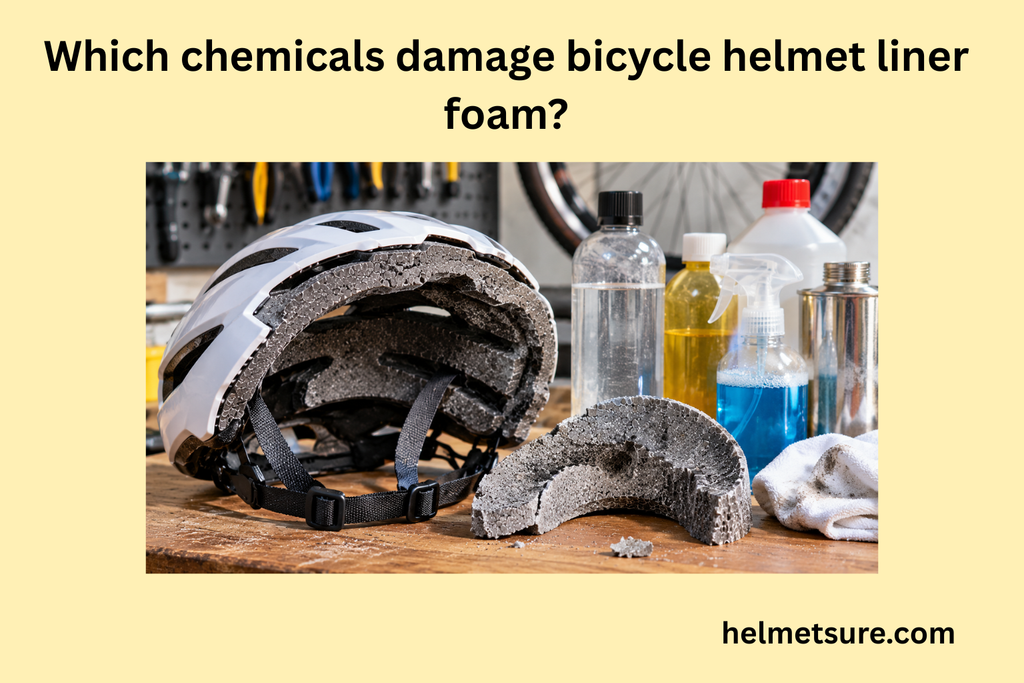
Which Chemicals Damage Bicycle Helmet Liner Foam?
Gasoline can severely destroy bicycle helmet EPS liner foam. Supplier data also identify acetone, toluene, xylene, and certain petroleum solvents as incompatibility hazards. Some historically tested DEET repellents and sunscreens caused surface deterioration without meaningful measured impact-performance losses under the tested conditions.
These findings answer different questions. A chemical-resistance table describes a material’s compatibility; a photograph documents visible change; an instrumented helmet test measures impact performance. None independently establishes whether your particular helmet remains suitable for use after an exposure.
This article concerns the rigid structural liner that manages impact energy, primarily expanded polystyrene, or EPS. Removable comfort padding serves a different purpose. The exact helmet manufacturer’s instructions govern cleaning and decisions about continued use.
Which Chemicals Are Known to Damage Expanded Polystyrene Helmet Foam?
Gasoline, acetone, toluene, xylene, and several petroleum solvent mixtures have documented EPS incompatibility evidence. The strongest direct helmet observation concerns gasoline; much of the remaining evidence comes from EPS suppliers.
Gasoline caused severe visible destruction in a bicycle helmet experiment
Gasoline severely damaged the structural EPS liner in the Bicycle Helmet Safety Institute’s historical Giro Section experiment. BHSI described large channels reaching toward the shell, with substantial foam destruction.
That observation establishes a serious material hazard. It does not establish a reliable gasoline-specific impact-performance figure: BHSI’s reports conflict about whether the gasoline-treated helmet was submitted for laboratory testing. The discrepancy is explained in the next section.
Benchmark Foam separately classifies gasoline as NC — Not Compatible with EPS. That supports the material incompatibility finding without resolving the laboratory reporting conflict.
Acetone, toluene, and xylene have unfavorable supplier classifications
Acetone and xylene receive Benchmark’s Not Compatible classification. The supplier defines that category as significant effects on EPS, potentially including dissolution.
Plasti-Fab’s indexed chemical-resistance bulletin also lists acetone, toluene, and xylene with its unfavorable resistance symbol. However, the original PDF could not be retrieved during this article’s source check. Its precise edition and classification legend remain unverified against an accessible original.
Diesel, white spirit, and paint thinners are additional concerns
Plasti-Fab’s indexed bulletin lists diesel fuel, specified white spirit fractions, and paint thinners in its unfavorable resistance category. These entries remain subject to the original-document verification limitation above.
White spirit and paint thinner describe mixtures rather than one fixed chemical composition. Their ingredients can differ between products. The listed concerns therefore should not be expanded into a claim that every petroleum-derived oil, grease, or lubricant produces identical EPS damage.
Commercial product categories do not establish compatibility
Paints, adhesives, aerosols, and degreasers may contain EPS-incompatible solvents, but their category names do not establish their complete composition.
A verified acetone ingredient provides relevant information. A label saying “multipurpose cleaner” does not. Even an ingredient list may be insufficient to approve use on a complete helmet because concentration, other ingredients, and affected components matter.
| Chemical or product | Available EPS evidence | Direct helmet evidence | Important limit |
|---|---|---|---|
| Gasoline | Benchmark: Not Compatible | Severe visible foam destruction in BHSI’s experiment | Gasoline-specific laboratory attribution remains disputed |
| Acetone | Benchmark: Not Compatible | None established in this source set | Material rating does not quantify helmet performance |
| Toluene | Unfavorable Plasti-Fab indexed classification | None established | Original bulletin verification remains outstanding |
| Xylene | Benchmark: Not Compatible | None established | Supplier material evidence |
| Diesel fuel | Unfavorable Plasti-Fab indexed classification | None established | Original bulletin verification remains outstanding |
| Specified white spirit fractions and paint thinners | Unfavorable Plasti-Fab indexed classifications | None established | Mixture composition varies; original bulletin unavailable |
| Other paints, adhesives, aerosols, and degreasers | No universal rating | No category-wide result established | Exact formulation and helmet guidance are needed |
An unknown mixture is unverified, which is different from proving that it destroys EPS. It also provides no basis for approving deliberate contact with a helmet.
What Did Helmet Tests Find About DEET, Sunscreens, and Hair Products?
BHSI observed EPS surface deterioration from certain historical DEET repellents and sunscreens, while reporting no meaningful measured impact-performance deterioration for the non-gasoline treatments. These findings concern particular 2011–2012 formulations and one helmet model.
Some repellents and sunscreens softened the surface without a reported impact-performance decline
The tested DEET products included OFF Deep Woods Sportsman and Bull Frog Sunblock with DEET. BHSI observed sticky, softened liner surfaces. A photographed cross-section of a DEET-treated helmet showed that the affected zone was shallow.
Coppertone Sport and Neutrogena UltraSheer SPF 55 also produced pronounced surface softening. Kinesys spray sunscreen produced visible effects that were less pronounced than those from the tested lotions.
Despite these observations, BHSI reported that the non-gasoline samples performed close to the reference helmets, with differences within normal testing variation. The Coppertone-treated helmet also showed increased shell brittleness, a separate component effect that did not produce a reported impact-performance difference under the test conditions.
Other products left films or showed no obvious EPS damage
The tested Rogaine formulations left white films without apparent foam destruction. Selected hair sprays, gels, and shampoos showed no obvious EPS deterioration.
The Sawyer non-DEET repellent likewise produced no obvious EPS degradation, although the shell developed a white appearance during water conditioning. That was a component-specific appearance change, not demonstrated destruction of structural EPS.
| Historical treatment | Observed effect | BHSI’s reported impact finding |
|---|---|---|
| OFF Deep Woods Sportsman and Bull Frog with DEET | Softened or sticky EPS surfaces; shallow damage shown in a DEET sample | No meaningful measured deterioration |
| Coppertone Sport and Neutrogena UltraSheer SPF 55 | Pronounced EPS surface softening; separate Coppertone shell brittleness | No meaningful measured deterioration |
| Kinesys spray sunscreen | Less pronounced visible surface deterioration | No meaningful measured deterioration |
| Rogaine formulations | White films without apparent foam destruction | No meaningful measured deterioration |
| Selected hair sprays, gels, and shampoos | No obvious EPS damage | No meaningful measured deterioration |
| Sawyer non-DEET repellent | No obvious EPS degradation; shell whitening during wet conditioning | No meaningful measured deterioration |
| Gasoline | Severe visible structural foam destruction | Gasoline-specific attribution disputed |
“No obvious damage” describes an observation. “No meaningful measured deterioration” describes a reported test outcome. Neither is a universal compatibility guarantee.
The experiment used repeated direct applications on one helmet model
BHSI purchased 50 Giro Section helmets and assembled 20 substances. Beginning in October 2011, two helmets per treatment received 16 applications, with removable fitting pads taken out so the products could contact the liner directly.
The experiment used baseline control helmets and subsequent laboratory impact testing. Treated samples were tested under ambient and water-conditioned conditions after the dosing period, with laboratory work undertaken in January 2012.
Repeatedly smearing or spraying products onto exposed EPS differs from ordinary incidental transfer from skin or hair. The single-model design also limits conclusions about other foam formulations, shell constructions, and bonding arrangements.
The tests are useful evidence about those samples. They cannot authorize reuse of every chemically exposed helmet.
BHSI’s gasoline records contain an unresolved contradiction
The main report attributes impact deterioration to the gasoline sample. Its photographic companion explicitly says that the gasoline-damaged helmet was not submitted to the laboratory because it might damage the equipment.
Those accounts conflict. The linked numerical PDF could not be independently retrieved during this source check, so individual readings are not reproduced here.
There is no verified basis for explaining the discrepancy as a mislabeled sample, replacement specimen, or later test. The defensible conclusion is narrower: severe visible gasoline damage is documented; the gasoline-specific instrumented outcome remains unresolved.
Which Helmet Cleaning Chemicals Are Unsafe, Restricted, or Unverified?
Cleaning decisions require both material compatibility information and the helmet manufacturer’s instructions. A complete helmet includes shells, straps, coatings, adhesives, and interfaces as well as EPS.
Bleach and ammonia warnings concern the complete helmet
Some supplier entries for specified aqueous substances are favorable. Benchmark, for example, rates ammonia as compatible, while its listed calcium hypochlorite solution receives limited compatibility. Such entries cannot be combined into one universal rating for all household bleach products.
A favorable EPS rating does not override the helmet’s cleaning restrictions or establish compatibility with its other components.
Alcohol disinfectants do not have one universal rating
Benchmark classifies 95% ethyl alcohol and isopropyl alcohol as LC — Limited Compatibility under listed conditions of 77°F over 365 days. Those are supplier data conditions, not recommended helmet exposure limits.
Plasti-Fab’s indexed bulletin distinguishes limited ethanol resistance from favorable isopropanol resistance. Its original-document limitations still apply.
Differences between entries reinforce why neither “all alcohol destroys EPS” nor “alcohol is safe for every helmet” is justified. A formulated disinfectant requires consideration of its ingredients and applicable helmet instructions.
Mild soap and water have manufacturer support
Trek recommends mild soap and water for helmet cleaning. This provides a practical, documented approach for helmets covered by that guidance.
Follow your own helmet’s instructions. “Natural,” “gentle,” “water-based,” and “helmet-safe” labels do not independently establish chemical compatibility.
| Cleaner | Evidence-based interpretation |
|---|---|
| Bleach or ammonia cleaner | Follow whole-helmet warnings; isolated EPS ratings do not approve use |
| Alcohol disinfectant | Verify the formulation and model instructions; no universal approval follows |
| Mild soap and water | Supported by Trek guidance; use as permitted by the applicable manufacturer |
| Proprietary cleaner or degreaser | Product category alone is insufficient; check exact product guidance and helmet approval |
How Do Solvents Damage EPS Foam, and Does the Same Evidence Apply to Other Liners?
Incompatible solvents can soften polystyrene and disrupt EPS’s cellular structure. The resulting deterioration may range from localized surface changes to substantial loss of structural material.
Solvent attack affects the foam’s physical structure
EPS is expanded polystyrene: a rigid cellular material used in many bicycle helmet structural liners. Incompatible substances can affect the polymer, alter its dimensions, and destroy parts of the cellular structure.
Calling this “melting” can be misleading because thermal melting and solvent attack are different processes. The visible outcome may resemble collapse, but chemical exposure does not need to heat the foam to damage it.
A tacky surface and channels of missing material also represent different degrees and forms of change. They should not be assigned the same protective consequence without evidence.
Exposure conditions influence the outcome
Chemical identity, formulation, contact duration, temperature, and the particular EPS product can influence deterioration. Foam density and construction are also relevant material variables.
Supplier ratings apply within their stated scope. They do not establish a universal number of seconds, concentration, or temperature below which contact with a bicycle helmet is harmless.
Substantial material loss creates a protective-integrity concern
An EPS liner manages impact energy by deforming and allowing the head to stop more gradually. Its material properties and geometry contribute to impact attenuation.
Substantial missing or destroyed foam therefore creates a serious concern about the integrity of that function. This is a technical safety inference from the liner’s role, not a measured percentage of lost protection.
Actual impact-performance measurement requires controlled testing, including measured peak acceleration. Appearance alone cannot establish a particular test result.
Other liner polymers require their own evidence
EPP is expanded polypropylene; EPS is expanded polystyrene. Polyurethane foams and hybrid constructions introduce additional materials and interfaces.
EPS chemical compatibility tables cannot establish how these other systems respond. Mechanical resilience or a multi-impact design does not prove chemical resistance.
No matched evidence in this source set supports a universal EPS-versus-EPP chemical resistance ranking. Identify the actual liner material and obtain material- and model-specific guidance.
How Can You Tell Whether Chemical Exposure Affected Structural Helmet Foam?
Begin by identifying the exposed component, then describe what changed. Inspection can reveal important warning signs, but it cannot independently certify remaining protection.
Structural EPS and removable pads serve different functions
The rigid EPS liner manages impact energy. Removable fitting pads primarily provide comfort and help fit the helmet.
Contaminated comfort pads and damaged structural EPS therefore require different assessments. Replacing removable pads cannot restore structural foam that has deteriorated.
Softening and missing foam establish different findings
Unusual tackiness or softening may indicate a material change. Channels, collapsed regions, or missing EPS provide more direct evidence of structural material loss.
The BHSI observations illustrate that distinction: some personal-care treatments affected the surface, whereas gasoline caused severe destruction.
There is no supported universal depth or area of chemical damage that consumers can declare acceptable. Texture alone also cannot identify which chemical caused a change.
Cracks, compression, shell changes, and deposits need separate interpretation
Cracked or compressed EPS may indicate impact damage or other deterioration. A surface film may be residue. Shell discoloration is different again from shell brittleness or damaged foam.
These observations should be recorded separately rather than grouped under “chemical damage.” Their cause and significance depend on the affected component and exposure history.
BHSI’s inspection guidance calls for replacement when cracked or crushed structural foam is discovered.
A normal appearance cannot clear the helmet
The CPSC’s cleaner warning specifically recognizes that damage may not be visible. Concealed areas and other helmet components also limit what a home inspection can establish.
Record What the Exposure Affected
0/5 checked
Use these observations to inform a manufacturer assessment, not as a home certification test.
What Should You Do Immediately After Chemical Exposure to a Bicycle Helmet?
Identify the product and affected components, avoid additional unapproved treatment, and suspend use when significant protective-component damage is suspected or remains unresolved.
Record the chemical, helmet model, and contact location
Keep the product container or photograph its label. Record the helmet model, the exposed area, and whatever is reliably known about the incident.
Ingredient information or a safety data sheet may help identify relevant substances. Do not infer chemical composition from odor, color, or marketing language.
Unknown details should remain unknown rather than being converted into assumed quantities or contact times.
Withhold the helmet when protective integrity is uncertain
Keep the helmet out of use if there is serious visible deterioration or significant uncertainty about damage to a protective component. Use another suitable helmet while the concern is assessed.
Temporary suspension is a precaution while uncertainty is resolved. It is different from a confirmed permanent replacement condition.
Seek guidance that applies to the actual helmet
Provide the manufacturer with the model, product identity, photographs, affected components, and known circumstances. Ask whether its instructions support cleaning, further assessment, or replacement.
General EPS supplier data can help frame the question, but they cannot clear the complete helmet. Likewise, sending a support request does not authorize continued use while a significant concern remains.
How Can You Prevent Chemical Damage When Cleaning and Storing a Helmet?
Follow approved cleaning instructions, limit deliberate chemical contact with exposed EPS, and store the helmet away from avoidable chemical exposure and excessive heat.
Use the manufacturer’s approved cleaning method
For helmets covered by Trek’s guidance, gently clean with mild soap and water. For another make or model, follow its own instructions.
Do not invent a soaking procedure or substitute a stronger cleaner because contamination is difficult to remove. Persistent residue is a reason to seek guidance, particularly after an uncertain chemical exposure.
Keep personal-care products off exposed structural foam
Avoid spraying or smearing repellents, sunscreens, and hair products directly onto EPS. This reduces unnecessary contact with formulations whose effects may be product-specific.
The historical BHSI experiment used repeated direct application. Ordinary incidental contact does not necessarily reproduce those conditions or effects.
Continue using appropriate sun and insect protection according to product directions, while avoiding deliberate contamination of the helmet.
Care for removable pads and choose suitable storage
Clean removable fitting pads only as the manufacturer permits. Trek recommends hand washing pads with cold water and mild soap, then air drying. Other models may have different instructions.
Store the helmet in a cool, dry place away from excessive heat and direct sunlight as directed by its manufacturer. Keep fuels, paints, adhesives, and chemical sprays from contacting it.
Pad removal does not authorize disassembly of bonded protective components. Neither storage advice nor supplier tables establish a universal safe distance from chemicals or an allowable vapor concentration.
When Should a Chemically Exposed Bicycle Helmet Be Replaced or Kept Out of Use?
Confirmed serious structural deterioration warrants replacement
Do not fill damaged regions, glue deteriorated foam together, or replace comfort pads as a substitute for replacing a damaged structural liner. No validated consumer restoration procedure in this evidence set returns chemically destroyed EPS to its original protective condition.
Replace the helmet with a correctly fitting product meeting the applicable bicycle helmet requirements.
Unresolved significant exposure requires suspension
Keep the helmet out of use when the formulation is uncertain, relevant components may have been affected, or the manufacturer has not resolved a significant concern.
A lack of visible damage does not settle those questions. If the concern cannot be resolved, continued use is not justified by appearance or a general material rating.
Minor incidental exposure requires applicable guidance
Continued use may be considered when the product and affected component are reliably identified, no disqualifying condition is known, and applicable manufacturer instructions support cleaning or reuse.
That guidance may already be present in the manual; otherwise, obtain clarification. Historical BHSI results do not independently approve an individual exposed helmet.
| Exposure evidence and condition | Decision |
|---|---|
| Confirmed serious structural deterioration, substantial material loss, or a manufacturer-defined replacement condition | Replace the helmet |
| Significant exposure with unresolved compatibility or possible protective-component damage | Suspend use and seek manufacturer assessment |
| Identified minor incidental exposure, no known disqualifying condition, and applicable manufacturer support | Follow the approved cleaning or continued-use guidance |
Documented material destruction warrants replacement. Significant unresolved exposure warrants keeping the helmet out of use. Minor incidental exposure supports continued-use consideration only within applicable manufacturer guidance.
Frequently Asked Questions
Which chemicals can damage bicycle helmet EPS foam?
Gasoline has direct severe helmet-damage evidence. Supplier data also flag acetone, xylene, toluene, and certain petroleum-solvent mixtures, but exact formulations and helmet instructions still matter.
Does DEET always ruin a bicycle helmet?
No universal conclusion is supported. Historical tests found shallow surface softening from particular DEET products without meaningful measured impact-performance loss under those specific test conditions.
Can alcohol be used to disinfect every bicycle helmet?
No. Supplier ratings differ by alcohol and test conditions, while a complete helmet includes shells, straps, coatings, adhesives, and interfaces. Follow the exact helmet manufacturer’s instructions.
Is mild soap and water suitable for helmet cleaning?
Trek supports mild soap and water for helmets covered by its guidance. Owners of other helmets should follow their own manufacturer’s cleaning instructions.
Can normal appearance prove that chemically exposed EPS is safe?
No. A normal appearance means no obvious visible abnormality; it does not certify unchanged protective performance or rule out effects in concealed areas or other components.
When should a chemically exposed helmet be replaced?
Replace it when serious structural deterioration, substantial EPS loss, cracked or crushed structural foam, or an applicable manufacturer replacement condition is established.
What does an EPS compatibility rating establish?
Select the strongest answer.
Sources and Evidence Notes
All 9 supplied sources retained. Checked November 4, 2026.
Sources checked November 4, 2026. The historical product findings do not establish the composition or behavior of current formulations. No independent specialist review is claimed.
- Bicycle Helmet Safety Institute — Test of Products That Might Damage Helmets. Experimental methods, product observations, reported impact findings, and limitations. Original report.
- Bicycle Helmet Safety Institute — Testing products that might damage helmets, page two. Photographic observations and the statement that the gasoline-treated helmet was not submitted for laboratory testing. Photographic report.
- Bicycle Helmet Safety Institute — Substance Tests: Summary of Lab Test Results. The linked numerical PDF could not be retrieved independently for this article; sample-level values are omitted. Linked laboratory summary.
- Bicycle Helmet Safety Institute — Bicycle Helmet Liners: Foam and Other Materials. Liner materials and impact-management principles. Materials guide.
- Bicycle Helmet Safety Institute — Bicycle Helmet Inspection. Component inspection and cracked or crushed foam. Inspection guidance.
- U.S. Consumer Product Safety Commission — Bicycle Helmets. Whole-helmet cleaner warnings and regulatory context. CPSC guidance.
- Trek Bicycle Corporation — How to Wash & Care for a Bike Helmet? Cleaning, fitting-pad care, chemical precautions, and storage. Manufacturer guidance.
- Benchmark Foam — EPS Chemical Compatibility Information. Preliminary EPS material ratings and stated conditions. Compatibility table.
- Plasti-Fab — Chemical Resistance of Plasti-Fab EPS Products, indexed Bulletin 364. Supplier-hosted search-indexed content supports the provisional entries discussed above, but the original PDF returned an unavailable page. The supplied Bulletin 1019 identity has not been reconciled with Bulletin 364. Supplier document location.