
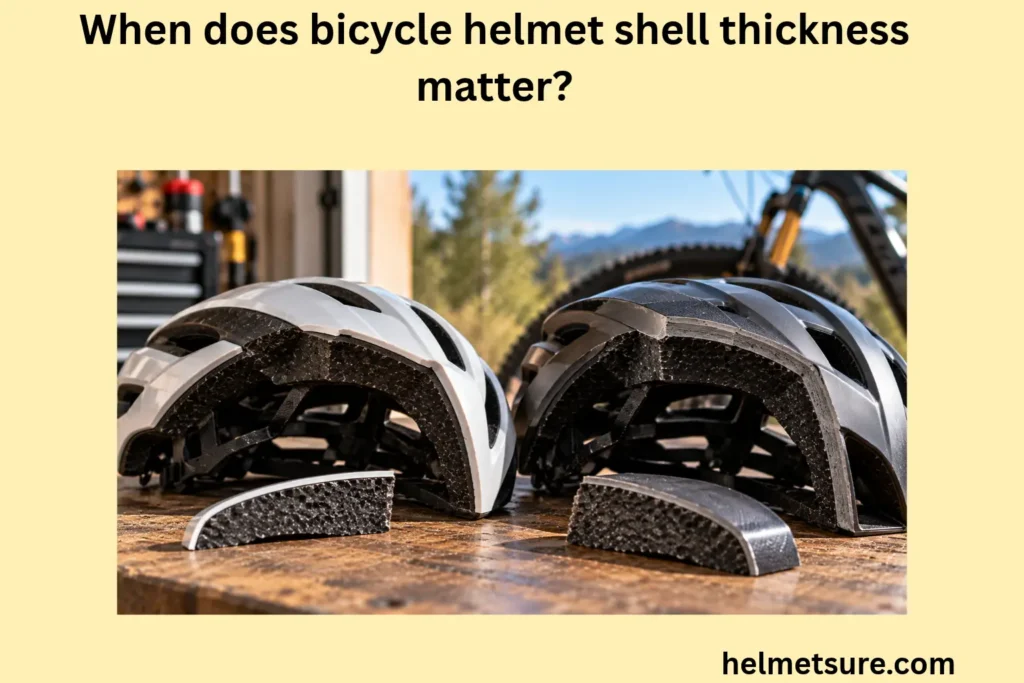
When Does Bicycle Helmet Shell Thickness Matter?
The distinction starts with the component being measured. Outer shell thickness is the gauge of the exterior material. EPS liner thickness is the depth of the impact-managing foam beneath it. Overall helmet depth includes those layers and other design features. These dimensions cannot be substituted for one another.
Thickness is useful when asking a defined engineering question, such as how an otherwise comparable shell resists bending. It becomes misleading when used to predict the safety of an entire helmet without appropriate tests.
Bicycle Helmet Outer Shell Thickness vs. Impact-Absorbing Foam Thickness
Bicycle helmet outer shell thickness measures the exterior shell layer, while impact-absorbing foam thickness measures the separate liner that deforms to manage impact energy.
Where outer shell thickness is measured in a layered bicycle helmet
Bicycle helmet outer shell thickness is measured through the external shell material, from its outer surface to the boundary adjoining the impact-absorbing liner.
The measurement concerns shell material alone. It excludes protective foam, comfort pads, and the space between the head and helmet. Shell gauge may also vary by location, so a documented measurement should identify where it was taken.
This distinction is fundamental to bicycle helmet construction. Manufacturer specifications or controlled research measurements are useful; exterior appearance is not a substitute. Do not cut or separate a helmet to measure its shell.
Why EPS foam liner thickness and compression capacity differ from outer shell thickness
EPS foam liner thickness and compression capacity differ from outer shell thickness because the foam manages impact energy through deformation, while the shell forms a separate structural layer.
Expanded polystyrene is the protective foam used in many bicycle helmets. Its density, geometry, and available deformation affect its response to loading. Soft fitting pads serve another purpose and should not be mistaken for this liner.
The Bicycle Helmet Safety Institute identifies shell, liner, and straps as distinct components and explains the liner’s impact-energy-management role. [S1] Neither shell gauge nor foam depth alone establishes complete-helmet protection.
Why a bicycle helmet’s overall thickness cannot reveal its outer shell gauge
A bicycle helmet’s overall thickness cannot reveal its outer shell gauge because the visible profile includes the impact-absorbing liner and other structural features.
A bulky silhouette may reflect deeper foam, curvature, internal structures, or the space occupied by the fitting system. Conversely, a streamlined shape does not supply a reliable shell measurement.
Two helmets can therefore look different without having the shell-thickness relationship you expect. Unless reliable specifications exist, the gauge remains unknown.
| Dimension | What it measures | What it does not reveal alone |
|---|---|---|
| Outer shell thickness | Exterior shell material | Liner compression capacity or whole-helmet performance |
| EPS liner thickness | Protective foam depth | Shell gauge or universal impact attenuation |
| Overall helmet depth | Combined profile and construction geometry | The separate thickness of each component |
How Does Outer Shell Thickness Influence a Bicycle Helmet’s Protective Functions?
Outer shell thickness influences a bicycle helmet’s structural responses through its relationship with bending stiffness, localized loading, and abrasion behavior, although the resulting protection depends on material and design.
How increasing shell thickness affects local bending stiffness when shell material, curvature, and other design conditions are comparable
Increasing shell thickness increases local bending stiffness under comparable material, geometry, and loading assumptions, making the shell more resistant to bending deformation.
Classical thin-plate theory expresses bending rigidity as D = Et³/[12(1 − ν²)], where E is elastic modulus, t is thickness, and ν is Poisson’s ratio. Kropiowska and colleagues use this relationship for a thin, elastic, homogeneous, isotropic plate. [S2]
How shell thickness and material toughness jointly influence resistance to concentrated point loading
Shell thickness and material toughness jointly influence resistance to concentrated point loading because localized deformation and failure depend on both shell geometry and material behavior.
Stiffness describes resistance to deformation; toughness concerns the material’s resistance to fracture through energy absorption. A thick but brittle material cannot automatically be ranked above a thinner, tougher one.
Object shape, shell curvature, and underlying support also matter. No verified controlled comparison isolating these factors is supplied here, so this article establishes no thickness-based puncture advantage or guaranteed resistance to sharp objects.
How shell thickness and material abrasion resistance jointly influence wear-through during sliding contact
Shell thickness and material abrasion resistance jointly influence potential wear-through during sliding contact, but their relative importance depends on the material and the contact conditions.
Abrasion removes material through rubbing against another surface. Available thickness is relevant to the amount of material present, but wear behavior also depends on the polymer, surface roughness, pressure, and sliding exposure.
Controlled material-specific data would be needed to rank two shells. Without those data, greater thickness cannot establish longer wear-through time, a particular sliding distance, or improved injury protection.
| Mechanical question | Thickness-related consideration | Required boundary |
|---|---|---|
| Resistance to bending | Greater thickness increases rigidity under the stated model assumptions | Rigidity is not a clinical safety outcome |
| Concentrated contact | Gauge is one input alongside material and geometry | Comparative puncture performance requires testing |
| Abrasive sliding | Gauge contributes to available material | Wear resistance and contact conditions remain necessary |
Under Which Crash Conditions Can Bicycle Helmet Shell Thickness Become Relevant?
Bicycle helmet shell thickness becomes relevant to particular crash-contact characteristics, especially localized or abrasive contact, but it does not independently predict protection in any crash type.
When sharp edges or protruding objects create concentrated loading on the outer shell
Sharp edges or protruding objects create concentrated loading on a bicycle helmet’s outer shell when contact forces act over a small surface area.
A projecting rock or an exposed edge is a reason to consider local shell integrity and documented construction. It does not establish that a thicker shell will prevent penetration or injury.
The useful question is whether the complete helmet has relevant evidence for the contact being considered. Thickness is only one possible design input.
When sliding across abrasive pavement makes shell wear-through resistance relevant
Sliding across abrasive pavement makes a bicycle helmet shell’s wear-through resistance relevant because sustained surface contact can remove material from the outer layer.
This is a crash-contact exposure, distinct from a small storage scratch. How much shell material is lost depends on the actual surface and loading.
No universal thicker-shell recommendation follows. Comparative abrasion testing would be needed to establish a product advantage under matching conditions.
When broad, blunt impacts make shell thickness an insufficient standalone evaluation criterion
Broad, blunt impacts make bicycle helmet shell thickness an insufficient standalone evaluation criterion because impact attenuation depends on the complete helmet structure.
A flat-surface impact engages the shell, liner, and their interaction. Shell gauge does not describe the liner’s compression response or the headform’s measured acceleration.
Choose evidence that tests the assembled helmet. A thickness specification cannot replace the result.
When glancing impacts make shell surface interaction more relevant than outer shell gauge
Glancing impacts make bicycle helmet shell surface interaction and complete-helmet rotational response important considerations, while outer shell gauge alone does not establish an advantage.
Angled contact involves movement along the surface as well as loading toward it. Friction, contact geometry, and helmet–head interaction become relevant.
A shell’s gauge does not independently specify those interactions. Relevant oblique-impact measurements are needed before drawing conclusions about rotational performance.
| Contact condition | Why shell construction is relevant | Why thickness is insufficient |
|---|---|---|
| Sharp edge or projection | Concentrated local loading | Material, geometry, and support influence failure |
| Sliding on rough pavement | Possible abrasion and material loss | Wear characteristics and exposure differ |
| Broad, blunt surface | Combined shell-and-liner response | Attenuation belongs to the whole system |
| Glancing contact | Surface interaction and head rotation | Gauge does not determine friction or rotational response |
How Does Shell Thickness Differ Between In-Mold and Hard-Shell Bicycle Helmets?
Shell thickness differs between in-mold and hard-shell bicycle helmets primarily through their materials and manufacturing methods, but neither construction category defines a universal shell gauge.
How thin thermoplastic microshells integrate with EPS foam during in-mold construction
Thin thermoplastic microshells integrate with EPS foam during in-mold construction when the foam liner is formed directly against the prepared shell.
BHSI describes this process as placing a suitable shell in the mold before the EPS expands, bonding the layers during manufacture. [S1]
The shell is therefore part of an integrated construction. Its apparent thinness does not describe how the assembled helmet performs. Assess the finished design rather than judging a detached layer in isolation.
How thicker molded hard shells can be formed separately before being joined with an impact-absorbing liner
Thicker molded hard shells are commonly manufactured separately from the impact-absorbing liner and subsequently joined to it, creating a different construction arrangement from in-mold microshells.
BHSI identifies ABS and polycarbonate hard shells, as well as composite constructions used in some helmets. [S1] The material and assembly details belong to the actual model.
This typical contrast does not justify assigning a fixed gauge to every hard-shell helmet. It also does not establish that a separately formed shell produces better impact attenuation.
Why in-mold and hard-shell construction labels do not specify exact shell thickness or establish a safety ranking
In-mold and hard-shell construction labels do not specify exact outer shell thickness or establish a safety ranking because they identify manufacturing methods rather than measured protective performance.
Use the labels to understand assembly and materials. Use reliable dimensions to understand gauge. Use appropriate complete-helmet tests to understand measured response.
A manufacturing label cannot substitute for either of the latter two kinds of evidence.
| Attribute | Typical in-mold microshell construction | Typical separately formed hard shell |
|---|---|---|
| Assembly | Liner forms against the prepared shell | Shell forms separately before assembly |
| Exterior | Thin thermoplastic microshell | Commonly a more substantial molded shell |
| Exact gauge | Requires a documented specification | Requires a documented specification |
| Impact ranking | Not established by the label | Not established by the label |
Why Doesn’t a Thicker Bicycle Helmet Shell Always Provide Better Impact Protection?
A thicker bicycle helmet shell does not always provide better impact protection because measured head response depends on the EPS liner, shell material, impact conditions, and complete helmet design.
Why EPS liner properties and overall helmet design prevent thicker shells from guaranteeing lower linear acceleration in blunt impacts
EPS liner properties and overall helmet design prevent thicker bicycle helmet shells from guaranteeing lower linear head acceleration because impact attenuation depends on the response of the complete helmet.
Jung and colleagues tested 21 youth bicycle helmet models in 2025 at front, side, and rear locations, using resultant impact speeds of 3.1 and 5.2 m/s against a 25° anvil. Their shell-thickness estimate was +14.9 g peak linear acceleration per additional millimeter, with a reported 95% confidence interval of 0.2–29.6 g and p = 0.068. [S3]
The authors emphasized variability and an uneven thickness distribution. This was a comparison of different commercial designs, not an experiment changing shell thickness alone. The estimate does not establish causation or a universal thin-shell advantage.
Why outer shell thickness cannot independently predict surface friction or rotational head response during oblique impacts
Outer shell thickness cannot independently predict surface friction or rotational head response during oblique impacts because these outcomes depend on contact conditions and complete-helmet dynamics.
In the same study, the shell-thickness estimate for peak rotational acceleration was +465.5 rad/s² per additional millimeter, with a 95% confidence interval of −18.1 to 949.1 rad/s² and p = 0.081. That uncertain association does not support a universal causal rule. [S3]
Rotational acceleration describes change in angular velocity; rotational velocity describes angular speed. Neither is interchangeable with linear acceleration. A valid comparison must identify which quantity was measured.
| Design or contact factor | Why it matters | Prediction limit |
|---|---|---|
| Shell thickness | Changes structural behavior under defined assumptions | Does not determine peak linear acceleration alone |
| Liner properties | Influence compression and energy management | Foam depth alone is insufficient |
| Surface interaction | Contributes to tangential loading | Gauge does not establish friction |
| Complete design | Combines materials, geometry, and interfaces | Requires relevant measured outcomes |
What Do Helmet Safety Standards and Independent Tests Establish Beyond Shell Thickness?
Helmet safety standards and independent tests establish defined whole-helmet requirements or comparative impact performance beyond outer shell thickness, but they do not identify one universally protective shell gauge.
Why CPSC bicycle helmet certification evaluates complete-helmet impact attenuation rather than requiring one universal shell thickness
CPSC bicycle helmet certification evaluates specified complete-helmet safety requirements rather than prescribing one universal outer shell thickness.
The U.S. regulation, 16 CFR Part 1203, addresses impact attenuation, positional stability, retention strength, peripheral vision, and labeling. Its prescribed impact test limits peak acceleration to 300 g. [S4]
This is a test criterion, not an injury-free threshold. Compliance provides baseline evidence under specified conditions; it does not rank all compliant helmets or establish an ideal gauge.
How EN 1078 evaluates shock absorption and retention without ranking outer shell thickness
EN 1078 evaluates bicycle helmets through requirements covering shock absorption, retention, construction, and related characteristics without ranking helmets according to outer shell thickness.
The official catalog summary for EN 1078:2012+A1:2012 covers helmets for pedal cyclists, skateboard users, and roller skaters. It identifies field of vision, shock absorption, retention, marking, and information among its topics. [S5]
That scope supports discussion of the assembled helmet’s requirements. It does not provide a thickness-based product league table. Detailed numerical requirements require the full normative document.
What NTA 8776 establishes for speed-pedelec helmets without demonstrating a thicker-shell advantage
NTA 8776 establishes helmet requirements and test methods for speed-pedelec riders without demonstrating that greater outer shell thickness independently improves protection.
NEN identifies NTA 8776:2016-12 as addressing S-EPAC helmets, including construction, field of vision, shock absorption, retention, marking, and information. [S6]
Check the helmet’s documented intended use and the requirements applicable where you ride. A thick-looking shell cannot substitute for appropriate compliance.
How Virginia Tech STAR ratings evaluate whole-helmet impact performance without isolating outer shell thickness
Virginia Tech STAR ratings evaluate complete bicycle helmets through laboratory impact measurements rather than isolating outer shell thickness as the cause of protective performance.
The live bicycle ratings checked in October 2026 describe 24 laboratory impacts across six locations, measuring linear acceleration and rotational velocity. Weighted measurements contribute to an overall modeled concussion-risk score. Lower STAR scores indicate better performance within that system; higher star categories reflect better rated performance. [S7/S8]
These are comparative results for specified impacts, not observed personal injury outcomes. Check the exact model and current methodology. STAR scores from different sports cannot be compared directly.
Understanding bicycle helmet safety standards requires keeping baseline compliance separate from optional comparative ratings.
| System | Main role | What it does not establish |
|---|---|---|
| CPSC 16 CFR Part 1203 | U.S. bicycle helmet safety requirements | One optimal gauge or identical performance |
| EN 1078:2012+A1:2012 | Requirements for its specified activities | A shell-thickness ranking |
| NTA 8776:2016-12 | Requirements for S-EPAC helmets | An independent thicker-shell benefit |
| Virginia Tech bicycle STAR | Comparative complete-helmet impact ratings | Shell thickness as the isolated cause |
What Weight and Durability Trade-offs Can Bicycle Helmet Shell Thickness Create?
Bicycle helmet shell thickness can influence shell mass and everyday wear characteristics, although both outcomes depend on material properties, geometry, and complete helmet construction.
When greater outer shell thickness increases helmet mass under comparable material and coverage conditions
Greater outer shell thickness increases shell mass when material density, shell coverage, and other geometric conditions remain comparable.
The engineering relationship is straightforward: mass equals density multiplied by volume. More material across otherwise equivalent coverage increases the shell’s contribution to mass.
That does not establish which complete helmet weighs more. Other components and coverage may differ. Use the manufacturer’s weight for the relevant size and configuration when comparing actual products.
How shell thickness and material properties jointly influence wear from routine handling, storage, and minor non-crash contact
Shell thickness and material properties jointly influence some forms of everyday wear, but resistance to routine handling and storage damage cannot be predicted from shell gauge alone.
A cosmetic scratch, a dent, and a crack describe different conditions. Material, finish, contact type, and construction affect their significance. No verified matched durability tests are supplied here, so thicker shells cannot be assigned longer service life or superior scratch resistance.
Ventilation also cannot be inferred from gauge alone; it depends on the complete vent and airflow design.
| Practical attribute | Conditional thickness relationship | What to check |
|---|---|---|
| Shell mass | More volume adds mass at equal density | Actual complete-helmet weight |
| Routine cosmetic wear | Material and finish remain important | Product instructions and condition |
| Structural durability | Gauge alone cannot predict it | Relevant tests and damage history |
| Service life | No universal thickness rule | Manufacturer replacement guidance |
When Does Outer Shell Damage Matter More Than Its Original Thickness?
Outer shell damage matters more than original bicycle helmet shell thickness when cracking, deformation, liner damage, or impact history raises questions about the helmet’s continued protective integrity.
Why superficial shell scratches without a known significant impact cannot establish either structural failure or continued safety
Superficial bicycle helmet shell scratches without a known significant impact do not independently establish structural failure or prove that the helmet remains safe.
A surface mark provides limited information. Check its history and follow the manufacturer’s inspection guidance. If its depth or significance is unclear, seek guidance rather than treating appearance as clearance.
A minor cosmetic mark is not automatically equivalent to a structural crack. Equally, apparently minor marking cannot rule out hidden impact damage.
When shell cracks, deformation, or shell-to-liner separation require replacement regardless of original thickness
Shell cracks, unusual deformation, or shell-to-liner separation indicate potential structural compromise that requires removing the bicycle helmet from use and replacing it regardless of its original thickness.
Distinguish newly damaged or unintended separation from features designed into the helmet. If uncertain, keep it out of use while seeking manufacturer guidance.
Original gauge cannot compensate for a compromised structure. Do not attempt an improvised repair to return a damaged protective shell to service.
Why compressed or cracked EPS foam requires replacement even when the outer shell appears intact
Compressed or cracked EPS foam requires bicycle helmet replacement because the impact-managing liner may be compromised even when the outer shell appears intact.
BHSI advises replacement for cracked or crushed foam and notes that damage can be difficult to detect. [S9] Inspect accessible surfaces without dismantling bonded construction.
An undamaged-looking exterior cannot establish that the liner retains its original response. There is no universal consumer measurement that clears damaged EPS for another crash.
Why a helmet that absorbed a crash impact must be retired from use pending manufacturer inspection or replacement
A bicycle helmet that absorbed a crash impact must be taken out of service because the impact may have damaged its protective structure without leaving visible evidence.
CPSC’s required warnings address potentially invisible impact damage and direct return to the manufacturer or replacement. [S4] Follow the actual helmet’s post-impact instructions; many EPS helmets require replacement.
Manufacturer contact is not automatic permission to reuse it. Do not confuse a helmet that absorbed crash energy with an insignificant incidental touch, and do not invent a force threshold for deciding between them.
When uncertain damage or impact history requires manufacturer guidance rather than thickness-based assumptions
Uncertain bicycle helmet damage or impact history requires manufacturer guidance because original shell thickness cannot establish whether the helmet remains structurally reliable.
Explain the event, model, and observed damage to the manufacturer. Where meaningful damage remains unresolved, keep the helmet out of service.
An unknown history cannot be corrected by choosing a thick-looking used helmet. Favor traceable condition and follow the manufacturer’s decision rather than relying on a visual guess.
| Signal | Required response |
|---|---|
| Apparently superficial mark, no known significant impact | Inspect under manufacturer guidance; appearance alone does not clear condition |
| Structural crack, abnormal deformation, or unintended separation | Stop using and replace |
| Cracked or crushed EPS | Replace |
| Known absorbed crash impact | Remove from service; follow manufacturer-directed return or replacement |
| Unresolved meaningful damage or impact history | Keep out of use and seek manufacturer guidance |
How Should Cyclists Decide Whether Shell Thickness Matters for Their Riding?
Cyclists should treat bicycle helmet shell thickness as a conditional structural consideration while prioritizing suitable safety certification, proper fit, head coverage, and verified impact performance.
When localized contact hazards or abrasive surfaces make robust outer shell construction an additional selection criterion
Localized contact hazards or abrasive surfaces make robust bicycle helmet outer shell construction an additional consideration when the intended riding environment creates relevant contact exposures.
Examine documented materials, intended use, integration, and any relevant test results. Compare gauge only where reliable measurements exist and the purpose is clear.
Robust construction must be supported by appropriate documentation rather than assumed from bulk. Missing puncture or abrasion comparisons leave a thickness-specific protective advantage unverified.
When road cycling and everyday riding make verified impact performance, proper fit, and suitable head coverage higher priorities than shell thickness alone
Road cycling and everyday riding make verified bicycle helmet impact performance, proper fit, and suitable head coverage higher selection priorities than outer shell thickness alone.
Start with appropriate compliance and a helmet that fits the intended wearer. Evaluate coverage in the correct wearing position, then review applicable independent results.
Follow the manufacturer’s instructions on how to fit a bicycle helmet. A gauge specification cannot resolve a helmet that slips, rocks, or requires incorrect positioning.
When speed-pedelec use or discipline-specific requirements make appropriate helmet certification more important than shell gauge
Speed-pedelec use and discipline-specific riding requirements make appropriate helmet certification and intended-use suitability more important than comparing outer shell thickness alone.
For speed-pedelec riding, examine relevant NTA 8776:2016-12 documentation and applicable local requirements. [S6] For another discipline, verify its actual equipment requirements.
Do not assume a conventional helmet becomes suitable for specialized riding because its shell appears substantial. Intended-use evidence must come from the product and relevant requirements.
How cyclists should compare helmets when manufacturers do not provide shell thickness specifications
Cyclists should compare helmets without published shell thickness specifications using applicable certification, fit, coverage, intended use, and verified complete-helmet performance.
Missing gauge information does not prevent a useful comparison. It also does not establish that a helmet is unusually thin, thick, safe, or unsafe.
Use the evidence available for the actual model. Do not infer a hidden dimension from price, photographs, styling, or marketing terminology.
| Rider situation | Shell-thickness relevance | Selection priority |
|---|---|---|
| Localized or abrasive contact is plausible | Conditional structural consideration | Suitable construction and relevant evidence |
| Everyday road cycling | Insufficient as an independent safety indicator | Compliance, fit, coverage, measured performance |
| Speed-pedelec or specialized activity | Cannot replace intended-use requirements | Appropriate standards and documented suitability |
| Gauge is undisclosed | Unknown | Verified information about the complete helmet |
Compare suitable candidates through their manufacturer documentation and original independent test results, keeping the distinction between a structural feature and demonstrated protection clear.
What Does Shell Thickness Establish?
Choose the most accurate statement.
Frequently Asked Questions
Does a thicker bicycle helmet shell provide better impact protection?
Not automatically. Impact protection depends on the complete helmet, including the shell material, EPS liner, geometry, fit, coverage, retention, and tested performance.
Can overall helmet thickness reveal the outer shell gauge?
No. The visible profile includes the liner and other construction features, so overall depth cannot isolate shell thickness.
When can shell thickness become relevant?
It can be relevant to defined structural questions involving comparable bending conditions, localized loading, or abrasion exposure, but those questions still require material and test context.
Do in-mold and hard-shell labels specify exact thickness?
No. These construction categories describe manufacturing approaches; they do not define one universal shell gauge or establish a safety ranking.
What matters after a helmet absorbs a crash impact?
Remove it from use and follow the manufacturer’s post-impact instructions. Original shell thickness does not clear a crash-affected helmet for continued use.
Sources
- [S1] Bicycle Helmet Safety Institute. How Bicycle Helmets Are Made.
- [S2] Kropiowska, D., Mikulski, L., and Szeptyński, P. (2019). Optimal Design of a Kirchhoff-Love Plate of Variable Thickness.
- [S3] Jung, C., Stark, N. E.-P., Gagliardi, S. M., Begonia, M. T., and Rowson, S. (2025). Design Features and Youth Bicycle Helmet Oblique-Impact Performance.
- [S4] U.S. Consumer Product Safety Commission. Bicycle Helmets Business Guidance—16 CFR Part 1203.
- [S5] UNI/CEN. EN 1078:2012+A1:2012.
- [S6] NEN. NTA 8776:2016-12—Helmets for S-EPAC Riders.
- [S7] Virginia Tech Helmet Lab. Bicycle Helmet Ratings.
- [S8] Bland, M. L., McNally, C., Zuby, D. S., Mueller, B. C., and Rowson, S. (2020). Development of the STAR Evaluation System.
- [S9] Bicycle Helmet Safety Institute. Bicycle Helmet Inspection.