
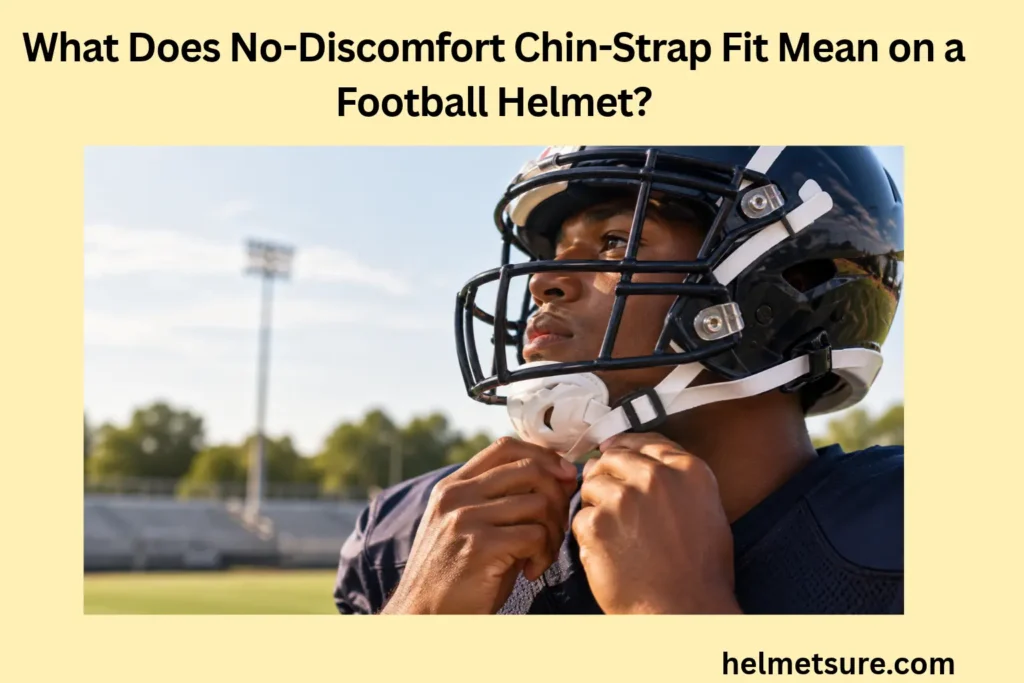
What Does No-Discomfort Chin-Strap Fit Mean on a Football Helmet?
No-discomfort chin-strap fit means the chin cup stays seated with snug, balanced strap tension and no excess slack while avoiding painful pressure; acceptance requires both comfort and retention to remain acceptable during the helmet maker’s prescribed post-buckling check.
This is a fit condition, not a claim that the chin strap alone makes the entire helmet fit correctly. Shell size, helmet position, liners, pads, and other components have separate roles. The chin-strap check asks a narrower question: does the strap system retain the correctly positioned chin cup comfortably and consistently after the buckles are fastened?
Secure Chin-Strap Fit Sits Between Loose Retention and Painful Pressure
Secure chin-strap fit combines snug retention with comfort: the system should not carry unnecessary slack, but it also should not create painful or excessive pressure. Current Xenith instructions express both sides of that boundary: Epic+ fitting calls for buckle adjustment with no discomfort or slack, while X1 fitting warns that overtightening may cause discomfort. In practical terms, neither “loose enough to feel easy” nor “as tight as possible” describes the target.
Secure contact means the chin-strap system stays snug without creating painful pressure
Secure contact means the chin-strap system remains snug enough to retain its fitted position without producing excessive or painful local pressure. The chin cup should stay properly seated while the straps maintain contact without unnecessary slack. That is different from maximizing tension. A secure static state combines three observations: the cup is correctly positioned, the straps are snug, and the wearer does not feel painful or sharply concentrated pressure at the strap or cup.
The word snug therefore describes a useful fitted relationship, not the tightest setting the hardware permits. If extra tightening creates discomfort, the comfort side of the fit has failed even if the cup appears firmly held.
Excess strap slack signals insufficient retention rather than comfort
Excess strap slack indicates insufficient chin-strap retention rather than a desirable comfort feature. Slack allows the strap or cup to move before the system becomes tensioned, so the fitted relationship is not being maintained continuously. This is why current Xenith Epic+ guidance calls for no slack while the helmet remains comfortable, and VICIS ZERO2 guidance likewise says the straps should have no slack.
When visible slack appears, treat it as a retention issue and readjust according to the helmet maker’s instructions. The related question of chin-strap security concerns what happens when the system is not adequately secured. Removing slack is still bounded by comfort: the correction should stop before it creates painful pressure.
Pinching or concentrated pressure signals excessive tightness rather than a better fit
Pinching, painful pressure, or concentrated local pressure should be treated as an over-tightness signal rather than evidence of a better fit. The problem may be too much overall tension, uneven strap adjustment, or a local strap position that focuses pressure in one area. The immediate conclusion is that the current fit should be reassessed—not that a medical condition or damaged component has been identified.
Correcting the pressure must also preserve retention. Loosening the entire system until discomfort disappears can create the opposite problem: slack. The target remains a middle state in which contact is secure and pressure is comfortable rather than sharp, painful, or one-sided.
How the Chin-Strap System Helps Retain Position After the Helmet Is Buckled
After buckling, the chin-strap system helps keep the chin cup seated and contributes to retaining the helmet’s fitted position without replacing the job of the helmet’s internal fit system. The straps create the lower retention relationship between the cup and the helmet’s attachment points. They cannot correct a helmet that is the wrong size, seated incorrectly, or fitted with unsuitable internal components.
Strap tension helps keep the chin cup seated under the chin
Properly adjusted strap tension helps keep the chin cup seated against the chin in its intended fitted position. The cup must first be placed correctly; tension then retains that position. Tightening a cup that begins off-center or away from its intended location simply secures a positioning error.
Manufacturer instructions illustrate this sequence. Xenith X1 guidance says the low straps move the chin cup up to meet the chin, while VICIS ZERO2 guidance tells the player to hold the chin strap firmly at the chin before the straps are attached and adjusted. The exact cup shape and strap route vary by model, so placement and adjustment should follow the current instructions for that helmet.
Balanced tension at the attachment points helps the chin-strap system maintain its set position
Balanced strap adjustment across the relevant attachment points helps the chin-strap system retain the position established during fitting. One side should not remain obviously loose while the other carries concentrated pressure. On the Xenith X1, for example, the maker instructs the fitter to pull the low straps evenly so the chin cup stays centered.
“Balanced” is a qualitative fitting judgment. It does not mean that an uninstrumented visual check proves identical mechanical force at every attachment point. The useful observations are simpler: the cup remains centered, corresponding strap sections do not show obvious imbalance, and no single side creates disproportionate pressure or looseness.
Consistent retention contributes to helmet stability during normal head movement
Consistent chin-strap retention contributes to helmet stability by helping preserve the fitted chin-cup and strap relationship as the wearer moves. When the cup remains seated and the strap state does not develop slack, the lower retention system continues doing its assigned job.
That contribution should not be mistaken for sole control of the helmet. Internal liners, shell size, helmet seating, pads, and other fitted components also influence whole-helmet stability. If the helmet remains unstable after the chin strap has been correctly positioned and adjusted, the problem may extend beyond the strap system and should be evaluated using the manufacturer’s full fitting guidance or by a qualified football-equipment fitter.
Which Static Conditions Show That Chin-Strap Fit Passes the Initial Check?
A static chin-strap fit passes the initial check when contact is snug and comfortable, the chin cup remains correctly seated, unnecessary slack is absent, and tension is not visibly or perceptibly concentrated to one side. This is only the at-rest check. Final acceptance still requires the model-appropriate post-buckling verification specified by the helmet maker.
Even, snug contact indicates the chin-strap system is tensioned without localized pressure
Even, snug contact without localized discomfort indicates that the chin-strap system is near the intended static tension state. Enough tension should be present to remove unnecessary slack and keep the cup in contact, but the fit should not create a painful edge, pinch point, or distinctly overloaded area.
Because current OEM fitting instructions use qualitative language, there is no universal pressure number, force value, or finger-width rule to apply across football helmets. Evaluate the actual strap and cup contact for the specific model. A comfortable static result is a positive signal, but it is not final proof that the adjustment will remain stable during the prescribed post-buckling check.
The chin cup remains centered and fully seated under the chin
The chin cup should remain centered and properly seated at the chin during the static fit check. Confirm the component’s position separately from how tight the straps feel. A strap can feel tight while holding the cup too far to one side, and that state does not pass simply because tension is present.
Where the manufacturer instructs an even pull, use that fitting action to help preserve centered placement. Do not invent a universal cup-depth or location measurement; cup geometry and strap architecture differ among models. The pass condition is that the cup occupies the intended position described by the maker and remains fully seated there without painful pressure.
Strap tension feels balanced across the attachment points rather than concentrated on one side
Strap adjustment should feel and appear balanced enough that one side or attachment area is not carrying obviously disproportionate tension. Compare corresponding strap sections and contact areas. Look for a centered cup, the absence of obvious one-sided looseness, and no isolated pressure point caused by one section doing most of the retaining work.
This is an observational comparison, not an engineering measurement. Visual symmetry cannot prove equal load, and the article does not prescribe a force ratio. If one side feels tight while the other remains loose, the system has not reached a balanced static state and should be readjusted using the model’s actual buckle and strap arrangement.
The fitted system remains comfortable while maintaining continuous contact
The fitted chin-strap system should remain comfortable while maintaining continuous fitted contact rather than gaining comfort through looseness. Comfort and contact must exist at the same time: the cup stays seated, the straps remain snug, unnecessary slack is absent, and the wearer does not experience painful or concentrated strap pressure.
This combined condition prevents two common errors. A loose strap may feel less noticeable but fail retention, while an overtightened strap may feel firmly secured but fail comfort. The static check passes only when neither tradeoff is present. The setting must then be tested through the helmet maker’s prescribed post-buckling procedure.
When Does Chin-Strap Tension Cross Into Excessive Tightness?
Chin-strap tension crosses the upper fit boundary when it creates painful, pinching, concentrated, or clearly uneven pressure rather than secure comfortable contact. These signals concern the strap-and-cup contact area. Discomfort originating elsewhere in the helmet should not automatically be attributed to the chin strap.
Painful pressure indicates tension has exceeded the acceptable comfort boundary
Painful pressure at the chin-strap or chin-cup contact area indicates that tension should be reduced or reassessed rather than accepted as secure fit. Xenith X1 instructions specifically warn against overtightening because it may cause discomfort. Pain is therefore a reason to stop treating additional tension as improvement.
First confirm that the pressure comes from the chin-strap system. Then identify whether the problem is excessive overall tension or a local distribution issue. This is a fit classification, not a medical diagnosis. Persistent pain, numbness, or suspected injury falls outside a strap adjustment guide and requires appropriate evaluation.
Pinching or strap edges digging into the skin indicates concentrated rather than balanced tension
Pinching or edge pressure localized to one strap area indicates concentrated tension that should be reassessed rather than treated as normal snugness. The strap may be positioned unevenly, one adjustment point may be carrying disproportionate tension, or the overall setting may be too tight. Observation comes before assigning a cause.
Do not automatically loosen every strap if the pressure is confined to one location. A broad reduction could introduce slack while leaving the underlying distribution problem unresolved. Use the model’s specified adjustment points to restore comfortable contact, and do not infer that digging or pinching alone proves the hardware is damaged.
One-sided pressure at the attachment points indicates uneven tension distribution that requires correction
Obvious one-sided strap pressure indicates an uneven adjustment state that should be corrected before the chin-strap fit is accepted. Compare the corresponding sides, confirm that the chin cup is centered, and identify whether one strap section is visibly shorter, tighter, or more heavily loaded in feel than its counterpart.
The purpose is to correct an obvious fitting imbalance, not to claim mechanically identical tension. Rebalance the adjustment according to the helmet maker’s directions, then reassess comfort, slack, and cup position. A visually even arrangement is helpful, but the fit still has to pass by its actual contact and retention behavior.
When Does Chin-Strap Tension Fall Into Insufficient Retention?
Chin-strap tension falls below the acceptable retention boundary when slack, separation, chin-cup movement, or uneven looseness prevents the system from maintaining its fitted contact. These are lower-boundary failures: they indicate that the strap system is not consistently retaining the intended cup position.
Visible separation or slack after buckling indicates the chin-strap system is not maintaining continuous contact
Visible strap slack or separation after buckling indicates that the chin-strap system has not maintained the intended continuous fitted contact. Current Xenith Epic+ instructions call for no slack, X1 instructions call for minimal slack, and VICIS ZERO2 instructions say there should be no slack in the straps. The wording is model-specific, but none treats obvious looseness as the desired comfort state.
Do not apply a universal millimeter gap or finger-width allowance; the cited manufacturers do not establish one across platforms. Adjust the applicable strap or buckle only enough to restore the maker’s specified fitted state, then check that the correction has not created painful pressure.
A chin cup that can shift away from its seated position indicates insufficient retention
A chin cup that loses or shifts away from its properly seated position indicates that the strap system is not retaining that fitted relationship adequately. Compare the cup’s position with the accepted starting position rather than using a vague impression that the whole helmet feels loose.
Before tightening, make sure the cup began centered and seated correctly. Tension should preserve a valid position, not lock a misplaced cup in place. If correct strap adjustment does not retain the cup, consult the current manufacturer instructions or a qualified fitter instead of repeatedly increasing tension without resolving the cause.
Unevenly loose tension at the attachment points indicates the strap system is not holding its intended position consistently
Uneven looseness across the strap system indicates inconsistent retention that should be rebalanced before fit is accepted. One loose side can allow cup displacement or create a fitted relationship that changes as soon as the helmet undergoes the prescribed check, even if the opposite side feels tight.
Do not compensate by maximizing tension on the already tighter side. Identify the loose section, restore the manufacturer-supported strap relationship, and keep the cup centered while adjusting. The goal is consistent contact across the relevant points without converting local looseness into one-sided pressure.
How Should Chin-Strap Fit Be Verified During Gentle Post-Buckling Movement?
During a model-supported post-buckling movement check, verify that chin-cup position, strap tension, slack state, and comfort remain consistent with the accepted static fit. The exact method is not universal. For example, current Xenith Epic+ and X1 instructions call for controlled force to the facemask in multiple directions after all four buckles are snapped; another maker may prescribe a different check. Follow the current instructions for the exact helmet.
Check chin-cup position → pass when it stays seated throughout gentle head movement
Where the helmet maker supports a gentle wearer-movement check, the chin-cup criterion passes when the cup remains seated in the fitted chin position. Observe the cup throughout the approved procedure and compare it with the centered, seated position established during the static check. If it shifts away, the retention criterion fails.
Do not substitute wearer-led head movement for a manufacturer procedure that specifies something else. The broader task of checking post-buckle movement should always be performed using the model’s current instructions. The outcome criterion is stable cup position; the test method belongs to the helmet maker.
Check strap tension → pass when tension remains consistent instead of becoming loose or uneven
Strap tension passes dynamic verification when the fitted relationship remains consistent rather than developing obvious looseness or asymmetry during the approved check. Compare the strap state before, during, and immediately after the procedure. Look for a buckle shift, a newly loose section, a one-sided change, or a chin cup that no longer remains centered.
“Consistent” is qualitative here. No instrument is measuring load, and the straps do not have to meet an invented numeric force target. The check passes when the accepted strap relationship persists without observable deterioration in contact, balance, or cup retention.
Check for new slack → fail when movement creates visible separation that was not present during the static check
The retention check fails if the approved movement check produces new visible strap slack or separation that was absent at rest. That change shows that the static adjustment did not remain stable under the model-prescribed verification procedure.
Compare the same fitted state before and after the check. Do not invent a minimum gap that must appear before the result counts as a failure. If new slack is visible, readjust and repeat both the static and post-buckling checks. New slack calls for reassessment, but it does not by itself prove that a strap or buckle is damaged.
Check comfort under movement → fail when normal head movement creates pinching or painful concentrated pressure
Comfort verification fails if the manufacturer-supported movement check introduces painful or concentrated pressure that was absent or acceptable at rest. Movement may reveal a local pressure point that the static check did not expose, so ask the wearer about the strap and cup contact while also observing whether the system has shifted.
Treat movement-induced pain or pinching as a reason to readjust, not as a diagnosis of tissue or jaw injury. Correct the relevant tension or distribution without indiscriminately adding slack. If discomfort persists despite proper adjustment, stop the strap-only correction and seek qualified equipment and, where appropriate, medical evaluation.
Post-buckling dynamic verification checklist
- Use the current helmet manufacturer’s prescribed post-buckling fit-check method.
- Confirm that the chin cup remains in its accepted seated position.
- Check that strap tension remains qualitatively consistent.
- Check that no new slack or visible separation develops.
- Confirm that the check does not introduce painful or concentrated strap pressure.
- Fail the chin-strap fit if any strap-specific comfort or retention criterion deteriorates.
- Separate strap-related failure from broader shell-size, padding, or whole-helmet fit problems.
Which Fit Failures Require Readjustment Before the Chin-Strap Fit Is Accepted?
Readjust the chin-strap system whenever excessive pressure, new or existing slack, chin-cup displacement, or unstable tension prevents comfort and retention from passing together. Each signal should lead to a specific interpretation and response rather than indiscriminate tightening or loosening.
Painful or concentrated pressure → excessive tension → reduce or redistribute tension before rechecking
Painful or concentrated strap pressure crosses the readjustment threshold and requires tension to be reduced or redistributed before fit is rechecked. Do not accept the current setting merely because the cup feels firmly retained. Identify whether the pressure is broad, local, or one-sided, then use the model’s adjustment points to address that pattern.
Reduce only the excess or redistribute the imbalance. A large, uniform loosening may create a retention failure while leaving a local positioning problem unresolved. After the correction, recheck cup position, slack, overall comfort, and the manufacturer-prescribed post-buckling behavior.
Visible or newly developing slack → insufficient tension → increase or rebalance tension before rechecking
Existing or newly developed strap slack crosses the lower acceptance threshold and requires the fitted tension to be increased or rebalanced before rechecking. Adjust the appropriate strap length or buckle to restore continuous contact while keeping the chin cup centered and seated.
Stop increasing tension if painful or concentrated pressure appears. The endpoint is enough tension to satisfy the model’s no-slack or minimal-slack instruction, not maximum possible tightness. Once the visible looseness is corrected, repeat the complete acceptance sequence rather than assuming that the new setting passes.
Loss of chin-cup position → inadequate retention → readjust the chin-strap system before accepting fit
Loss of the chin cup’s accepted position indicates inadequate retention and requires readjustment before the fit can pass. Return the cup to the correct starting position first, then establish the strap lengths and tension specified for the model. Do not simply tighten around a cup that has already moved off-center.
After resetting the system, verify that the cup remains seated, the straps are not slack, and pressure remains comfortable. A repeated loss of position after correct adjustment may point to a broader helmet-fit or hardware concern that falls outside a strap-only fix.
Tension that becomes uneven during gentle movement → unstable retention → rebalance the strap system and repeat verification
If tension becomes noticeably uneven during the applicable movement check, treat the retained state as unstable and rebalance the system before repeating verification. Restore the maker’s intended strap relationship, recenter the chin cup if necessary, and make sure one side has not become loose while the other becomes excessively tight.
Persistent instability should not trigger endless tightening. If correct, model-specific adjustment cannot produce a stable and comfortable strap state, consult the current OEM guidance and have the complete fit and hardware examined by a qualified football-equipment professional.
Fit state and required response
| Fit state | Observable signal | Interpretation | Required response |
|---|---|---|---|
| Secure fit | Chin cup seated; straps snug; no unnecessary slack; no painful local pressure | Comfort and retention pass statically | Proceed to the model-prescribed post-buckling check |
| Excessive tightness | Painful pressure, pinching, or concentrated or one-sided pressure | Upper comfort boundary failed | Reduce or redistribute tension, then recheck |
| Insufficient tension | Visible slack, separation, cup displacement, or uneven looseness | Lower retention boundary failed | Increase or rebalance tension, then recheck |
| Dynamic failure | New slack, cup movement, imbalance, or movement-induced painful pressure | Static fit did not remain acceptable | Readjust and repeat both static and post-buckling checks |
| Persistent failure after correct strap adjustment | Strap criteria cannot be stabilized | Possible broader fit or hardware issue | Refer to current OEM guidance or qualified equipment evaluation |
How Should the Chin-Strap System Be Readjusted Without Creating a New Fit Problem?
Readjust the chin-strap system only enough to restore secure continuous contact, correct tension distribution, and chin-cup retention without creating new slack or excessive pressure. Use the exact adjustment hardware and sequence specified for the helmet model; buckle positions, strap routing, and locking methods are not universal.
Remove excess slack only until the chin-strap system reaches secure continuous contact
Remove excess slack only until the chin-strap system reaches secure, comfortable contact and the chin cup remains properly seated. Shorten the effective strap length or move the applicable buckle according to the model instructions, watching the cup position as tension increases. Stop when unnecessary slack is removed and contact is secure—not when the system reaches its mechanical limit.
If painful pressure appears, back out the overcorrection and reassess distribution. Once the fitted strap length is established, follow the separate model-specific procedure for buckle fit locking. Locking preserves the chosen adjustment; it does not determine whether that adjustment was correct in the first place.
Redistribute tension when one attachment point or side carries disproportionate pressure
Redistribute the fitted strap adjustment when one side or attachment area shows obvious looseness or concentrated pressure. Compare the corresponding strap positions, restore the manufacturer-supported relationship, and keep the cup centered while correcting the imbalance.
The goal is observable balance and comfortable retention, not identical measured load. Avoid chasing visual symmetry so aggressively that new pressure appears, and do not leave one section loose merely because the cup looks centered. After redistribution, reassess every static criterion because changing one strap can alter the behavior of the rest of the system.
Recheck both static fit criteria and gentle-movement retention after each adjustment
After each meaningful chin-strap adjustment, repeat the static fit check and then the helmet maker’s applicable post-buckling retention check. Confirm cup position, strap contact, slack state, comfort, and qualitative balance before moving to the prescribed dynamic procedure. A previous pass no longer governs after strap length or tension changes.
If the system still cannot retain a comfortable, stable state, do not improvise a new test, modify the hardware, or continue tightening indefinitely. Consult the current manufacturer instructions and obtain direct evaluation from a qualified football equipment professional, equipment manager, or helmet fitter familiar with that model.
Correct Chin-Strap Fit Must Pass Both the Comfort Test and the Retention Test
Correct chin-strap fit is acceptable only when the system remains comfortable without excess slack and also retains the chin cup and fitted strap relationship through the applicable post-buckling check. The two tests answer different questions, and neither can substitute for the other.
The comfort test passes when secure contact produces no painful or concentrated pressure
The comfort side of the fit passes when secure contact is maintained without painful or concentrated strap pressure. The straps can be snug and the cup can remain seated without the system pinching, digging, or focusing pressure on one side. No numerical pressure threshold is required or supported across all models.
Comfort alone is not enough. If comfort is achieved by leaving slack, the retention test fails. The acceptable comfort state is therefore secure contact without over-tightness, not the absence of all sensation from the chin strap.
The retention test passes when the chin cup stays seated and strap tension remains consistent during gentle movement
The retention side passes when the chin cup and strap relationship remains stable through the helmet maker’s applicable post-buckling movement check. The cup stays in its accepted position, no new slack or separation appears, and the strap state does not become obviously loose or uneven.
The result matters more than a generic test label: the exact verification method must come from the current instructions for the helmet model. Where a maker specifies controlled external movement rather than wearer-led head motion, follow that prescribed procedure.
Chin-strap fit is acceptable only when comfort and retention pass together
Accept the chin-strap fit only when comfort and retention pass together; failure of either condition requires readjustment or broader fit evaluation. A comfortable but loose system fails. A firmly retained but painful system also fails. Acceptance requires the centered chin cup, the specified no-slack or minimal-slack strap state, comfortable pressure, and successful model-prescribed verification to coexist.
This decision applies only to chin-strap fit. It does not prove that every other helmet component fits correctly, and it is not a guarantee against injury. Persistent failure after correct strap adjustment should be referred to the current manufacturer guidance and a qualified football-equipment fitter.
No-discomfort chin-strap fit is the middle state: the chin cup stays correctly seated with snug, balanced tension and no excess slack, while avoiding painful or concentrated pressure. Both comfort and retention must pass together.
Frequently Asked Questions
Short answers about comfortable and secure football helmet chin-strap fit.
Does no discomfort mean the chin strap should feel loose?
No. The strap should remain snug and free of excess slack while avoiding painful or concentrated pressure.
Is the tightest possible setting the safest fit?
No. Pinching, digging, pain, or one-sided pressure signals excessive or uneven tension that requires correction.
What should the chin cup do after buckling?
It should remain centered and fully seated under the chin through the helmet maker’s applicable fit check.
Why must static and movement checks both pass?
A strap can look correct while still developing slack, shifting the cup, or creating discomfort during the prescribed post-buckling check.
Does a passing chin-strap check prove complete helmet fit?
No. Helmet size, position, liners, pads, and other fit components must be evaluated separately.
Sources
Manufacturer fitting instructions used for the comfort and retention criteria.