
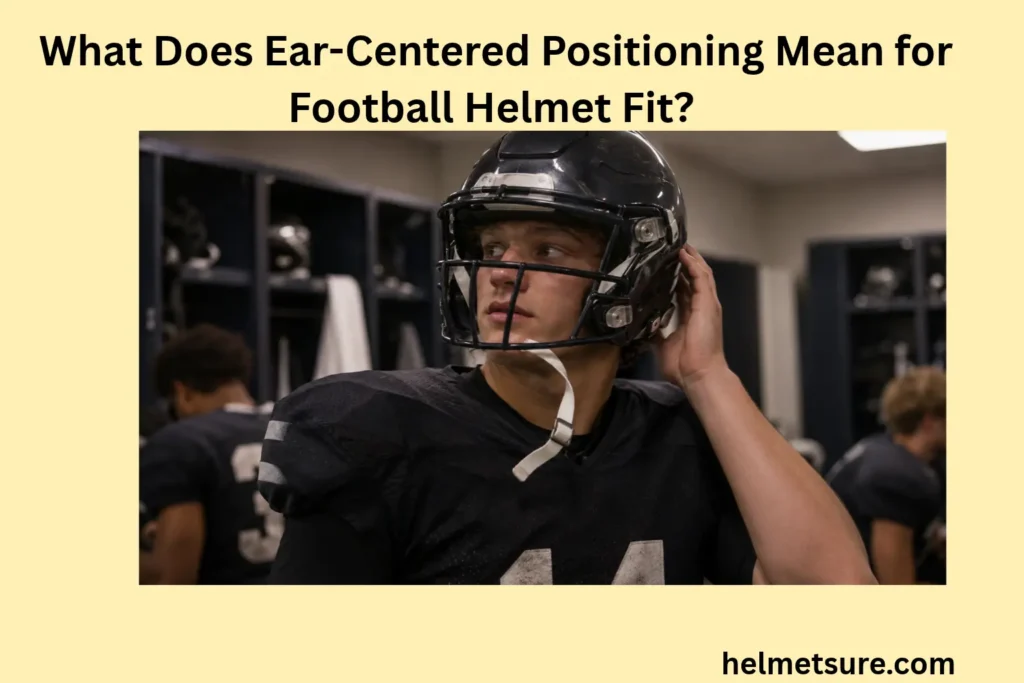
What Can Happen When a Football Helmet Chin Strap Is Not Secured?
An unsecured football helmet chin strap reduces the restraint that helps maintain the helmet's seated position. The helmet can lift, shift, or displace, but movement alone does not prove the chin strap is the only fit problem.
That distinction matters. The chin strap is part of the helmet's retention system: it helps preserve a position that must first be established by correct sizing, seating, liner contact, jaw-area contact, and manufacturer-approved configuration. If the strap is unsecured, the helmet has less restraint against motion. If the strap is correctly secured and the helmet still moves excessively, the evidence points beyond the strap and toward a broader fit review. CDC guidance similarly separates general helmet fit from chin-strap placement and instructs users to follow the helmet manufacturer's fitting directions.
Chin-Strap Security as Helmet Retention Rather Than a Substitute for Proper Fit
Chin-strap security helps retain a football helmet in its fitted position. It does not create that fitted position on its own. The helmet must already be the appropriate size, correctly seated, and supported by the contact points specified for its design. The strap then supplies lower-face restraint that helps the helmet stay in that established relationship as the player moves.
USA Football's fitting sequence places head measurement, helmet position, front-to-back and side-to-side adjustment, face-pad adjustment, and a proper-fit check before chin-strap adjustment. That order shows why retention and fit should be evaluated as related but separate functions. A secured strap is necessary; it is not an independent verdict that the complete fit is correct.
How a secured chin strap helps maintain the helmet's seated position on the head
A secured chin strap restrains movement away from the helmet's fitted seated position. When the chin cup and required attachment points are arranged as the manufacturer specifies, the retention system opposes the shell's tendency to lift or shift relative to the head. In a four-point system, for example, CDC guidance says all four straps must be snapped and tightened during fitting, while also directing the reader to the manufacturer's instructions.
The important word is maintain. Retention begins with a known seated position; it does not determine that position. A strap can be attached while the helmet sits too high, too low, or otherwise outside the manufacturer's fit references. In that case, the strap may hold the wrong starting relationship. Verification therefore has to compare the shell's position before and after an approved movement check, not merely confirm that the buckles or snaps are closed.
Why chin-strap retention and internal helmet fit perform different jobs
Chin-strap retention and internal helmet fit control different parts of helmet stability. The strap restrains displacement through the chin cup, webbing, and attachment hardware. Internal fit comes from the relationship among the player's head, the shell size, liners or fit system, and the jaw-area components approved for that model.
These functions support each other. Correct internal contact helps the shell move with the head rather than slide around it; correct strap security helps keep that fitted shell from moving away from its seated position. Manufacturer instructions illustrate the division. Riddell's platform guide checks liner and jaw-pad relationships before its chin-strap step, and Xenith's fitting guidance describes a model-specific interaction among lower straps, chin-cup position, and an internal suspension system. Neither architecture should be generalized to every helmet.
This is why a fit check should preserve separate observations. Record whether the chin cup changes position, whether the shell lifts, and whether the head appears to move inside the shell. Combining those signs into a single label such as “loose helmet” hides the evidence needed to identify which system deserves attention.
Why tightening the strap cannot compensate for incorrect sizing or poor liner contact
Tighter chin-strap adjustment cannot correct incorrect shell sizing or poor internal contact. Increasing restraint may change how the cup feels against the chin, but it does not make an oversized shell smaller, restore missing liner contact, or place approved components into their correct configuration.
“Secure” also does not mean “as tight as possible.” The applicable manufacturer defines the correct setup for its own strap, buckle, snap, and fit architecture. A strap that is pulled beyond that prescribed relationship can create discomfort without resolving the source of whole-helmet movement. CDC warns that a helmet can also be too tight, and its general guidance repeatedly defers model-specific fitting to the manufacturer.
If movement persists after a correct strap setup, stop treating strap tension as the only variable. The appropriate next step is to reassess seating, shell/head compatibility, liner contact, jaw-area contact, approved fit components, and equipment condition. Do not add padding, substitute hardware, or improvise a modification to force stability; use only components and procedures approved for the exact helmet.
How an Unsecured Chin Strap Allows the Helmet to Move Away From Its Seated Position
Reduced chin-strap restraint gives the helmet more freedom to move away from its seated position. The result can appear as lift, fore-aft shift, rotation, or a changed relationship between the shell and the player's face. Which motion appears depends on the direction of movement, the strap arrangement, and the rest of the fit.
This section explains how displacement can develop; it does not diagnose why a particular helmet moved. An unsecured attachment, poor cup position, incorrect adjustment, shell sizing, liner contact, component condition, or more than one factor can produce overlapping observations. The mechanism becomes useful only when it is followed by a controlled fit check and source classification.
How reduced chin-strap restraint allows greater vertical helmet movement
Reduced chin-strap restraint permits greater vertical movement between the helmet and the head. As the shell is urged upward, a properly configured retention system should resist the helmet leaving its seated relationship. If the strap is not fastened at every required point, is routed incorrectly, or does not maintain the prescribed chin-cup relationship, that opposition is reduced.
Visible lift is therefore a retention warning, not a one-step diagnosis. The helmet may rise because the strap was left unsecured, but similar movement can remain when the entire helmet is too loose or its fit system is not correctly configured. CDC's fit guidance uses helmet movement with the chin strap in place as part of a broader looseness check, which reinforces the need to interpret shell lift alongside internal fit.
No cross-brand amount of permissible lift should be invented. Instead, use the exact movement procedure and acceptance language in the current instructions for the helmet being fitted. Where those instructions do not publish a numeric threshold, a reviewer should not create one.
How inadequate lower-face restraint permits the helmet to shift relative to the head and jaw
Inadequate lower-face restraint permits the helmet to shift relative to the head and jaw. The chin cup provides a lower reference for the retention system; if that relationship is absent or unstable, the shell can change position while the head and jaw follow a different path.
That change may be noticed as the cup sliding, a strap losing its maintained relationship, or the shell shifting relative to facial landmarks. These observations belong to the movement record. They do not yet establish whether the source is strap slack, cup placement, attachment hardware, broader fit, or a combination. A player can also have a centered cup while the shell remains unstable elsewhere, so cup position must not become the only checkpoint.
Different helmet systems create this relationship in different ways. Some couple lower-strap adjustment to internal suspension; others use a chin strap primarily as retention after liner and jaw-pad fit have been established. Follow the model-specific sequence instead of transferring a familiar technique from one platform to another.
How sudden head or body movement can amplify displacement when the strap is not maintaining retention
Sudden head or body movement can expose greater displacement when chin-strap retention is inadequate. A strap may appear acceptable while the athlete is still, yet fail to maintain the cup or shell relationship when movement changes direction. The movement does not make the strap defective by itself; it reveals how the fitted system behaves under the approved check.
This is why a static “buckled” observation is incomplete. The reviewer should first establish the manufacturer's required fastening condition, then use only the prescribed movement check for that helmet. A severe or improvised test is unnecessary and may be unsafe. The goal is to observe whether the shell remains seated and whether the chin cup and internal references remain consistent—not to recreate contact or prove a protection outcome.
If the helmet shifts during ordinary activity, remove the player from equipment use until the fit can be checked. Do not wait for game-speed movement to confirm a problem that is already visible during a fitting procedure.
How Chin-Strap Security Works With Helmet Seating, Jaw Contact, and Internal Fit
Chin-strap security works with helmet seating, chin-cup position, jaw contact, and internal fit to maintain a stable helmet relationship. Each reference contributes different evidence: seating describes where the shell begins, the chin cup describes the lower retention relationship, and liner and jaw-area contact describe how the head is supported inside the shell.
A useful fit review therefore asks two questions in order: Is the helmet correctly fitted and seated? Does the secured retention system maintain that position? Reversing the questions can lead someone to tighten the chin strap around a helmet whose starting fit has not been established.
How chin-cup position helps maintain the strap's retention relationship with the jaw
Chin-cup position establishes where the chin strap applies its lower retention relationship to the jaw. The cup should be placed and maintained according to the instructions for the exact helmet and strap system. CDC's general guidance calls for the cup to be centered under the chin and the strap to fit snugly, while manufacturer documents supply the platform-specific steps.
Lower straps can also interact with jaw-area components or, on some designs, with the internal fit system. That is why lower strap becomes a separate fit question once the cup relationship has been established. A displaced cup can change the lower retention geometry, but an uncomfortable or uneven jaw-pad relationship can also signal a broader fit issue.
Do not use cup pressure as a universal quality metric. The practical observation is whether the cup starts in the manufacturer-specified position and maintains that relationship during the approved check without prohibited alteration or obvious discomfort. A stable cup is necessary evidence of lower retention; it is not proof that shell size, liner contact, or the rest of the fit is correct.
How proper helmet seating gives the secured strap a stable position to retain
Proper helmet seating gives the secured chin strap a defined shell position to retain. Seating references—such as the manufacturer's brow, ear-opening, or other platform-specific alignment points—establish where the helmet belongs before the retention system is judged.
If the helmet begins out of position, the strap can preserve an incorrect relationship. The apparent problem may then look like poor retention when the first error was seating. Conversely, a helmet can begin in the correct position and leave it because the strap is unsecured. Comparing the same references before and after the applicable movement check separates those observations.
CDC and USA Football both treat helmet position and overall fit as parts of the sequence that surrounds chin-strap adjustment. Exact alignment values, however, remain source-specific. Use the current instructions for the named model rather than carrying a measurement from a different manufacturer or helmet family.
How liner and jaw-area contact help distinguish internal fit from strap restraint
Liner and jaw-area contact provide evidence about internal fit that chin-strap tension cannot supply alone. If the shell remains seated and the head moves with it, that pattern differs from a head that shifts within the liner system while the chin cup stays in place.
Manufacturer guidance can define the expected contact for a particular system. The Riddell guide, for example, checks whether the forehead skin moves with the front pad and whether jaw pads feel firm against the face before it addresses the chin strap. Those are Riddell-specific fitting references, not universal pass/fail rules. Another platform may use different liners, fit pods, or a suspension design and must be checked under its own instructions.
Keep the findings separate in the record: chin-cup position, strap balance, shell seating, liner contact, jaw-area contact, and whole-helmet movement. When multiple findings disagree, that disagreement is useful. It tells the reviewer that strap security alone cannot explain or clear the fit.
Why a secure chin strap cannot make an oversized or poorly configured helmet stable by itself
A secure chin strap cannot independently stabilize an oversized or poorly configured football helmet. Retention can restrain the shell from moving away, but it cannot supply missing support throughout the helmet or correct the relationship between shell size and head shape.
An oversized helmet may continue to move as a whole around the head even after the cup and attachments are correct. A poorly configured fit system may show gaps, uneven contact, or a changed seated position that does not resolve when the strap is secured. Those outcomes call for a model-specific reassessment, not progressively greater strap tension.
Use only approved components and settings. CDC specifically advises against altering, removing, or replacing padding or internal parts unless the work is supervised by a trained equipment manager. A substitute pad, improvised filler, mixed hardware, or altered strap can change the intended configuration and make the fit harder—not easier—to evaluate.
What Signs Show That Chin-Strap Retention Is Not Holding the Helmet Securely?
Retention failure appears as observable changes in helmet position, chin-cup contact, or strap balance during a fit check. Useful signs include shell lift, directional shift, a cup that leaves its intended position, a different seated position after movement, or an unbalanced left-to-right strap relationship.
These are screening observations. They identify instability that needs classification; they do not name its cause. Begin with the helmet seated under the current manufacturer procedure, secure every required attachment for that system, and use the prescribed retention or movement check. That known baseline makes before-and-after comparison meaningful.
Whether the helmet visibly lifts or shifts during a normal retention check
Observe whether the helmet visibly lifts or shifts during the applicable retention check. Compare the shell's starting position with its position during and immediately after the manufacturer-directed movement. Note the direction and distribution of motion rather than reducing the result to “tight” or “loose.”
Upward lift may indicate insufficient restraint, while rotation or translation can show that the helmet is leaving its seated relationship in another direction. Yet no one movement pattern proves an unsecured strap. CDC says the helmet should not easily move front-to-back or side-to-side once the chin strap is fastened, and it also says a helmet that slides or can be removed with the strap in place is too loose. That broader context is why internal fit must be checked with retention.
Do not improvise force, use game contact as a test, or invent a universal displacement allowance. Apply only the procedure described by the manufacturer or fitting authority for the exact system.
Whether the chin cup loses consistent contact with its intended jaw position
Observe whether the chin cup remains in its intended position against the chin during the retention check. Record whether it slides, tips, separates, or returns to a different location after movement. Also note whether the player reports pinching or discomfort, because an apparently stationary cup is not automatically a correctly configured cup.
Cup movement narrows attention toward the lower retention relationship, but it does not identify one component as the cause. Strap routing, unequal adjustment, incomplete fastening, cup sizing or compatibility, hardware condition, and the broader helmet fit can contribute. Only current instructions for the helmet and approved chin-strap system can define the corrective step.
Once the cup is stable, continue checking the shell. A chin cup can maintain contact while the head still shifts within the helmet, so cup stability must not be recorded as a complete-fit pass.
Whether the helmet settles into a different seated position after movement
Observe whether movement leaves the helmet in a different seated position. A shell that begins at its intended references but finishes higher, lower, rotated, or translated has not maintained a repeatable relationship, even if it appears still once the movement stops.
Compare the same manufacturer-defined references before and after. Do not “correct” the shell between observations, because that erases the evidence. Record the changed position first; then determine whether restoring correct strap security resolves it. If the different seating persists with the retention system correctly set, broaden the fit review to shell size, liners, jaw-area contact, configuration, and component condition.
The changed seat is a consequence of instability, not proof of a specific source. It also does not predict an injury. Keep the conclusion within equipment fit: the helmet did not maintain the position being evaluated.
Whether left-to-right strap tension appears uneven during the retention check
Observe whether the left and right chin-strap relationships remain balanced during the retention check. The relevant comparison is functional: does the chin cup remain in the intended position, do both sides maintain the prescribed relationship, and does the shell stay seated?
Visible strap lengths need not look perfectly symmetrical on every athlete or system. Hardware position, strap path, facial anatomy, and the helmet's design can affect appearance. Do not turn visual symmetry into a universal fit requirement. Instead, compare the setup with the exact manufacturer's routing and adjustment instructions and look for a movement pattern that changes when the strap is correctly balanced.
If left-to-right instability remains after the strap is set properly, inspect broader asymmetry in liner or jaw-area contact. The observation then moves from a strap-balancing question to a complete fit question.
Retention Evaluation Checklist
Chin-Strap Retention Check
What Can Inadequate Chin-Strap Retention Cause During Football Activity?
Inadequate chin-strap retention can allow helmet displacement that disrupts the fitted relationship between the helmet and the player. The practical consequences are positional: the shell can move, the chin cup can lose its maintained relationship, and the helmet's openings and attached components can sit differently relative to the player.
These outcomes are serious enough to stop use and require a fit check, but they should not be translated into a prediction of concussion, facial injury, or another medical result. CDC explicitly says no helmet is concussion-proof. Equipment-fit evidence can establish instability; it cannot establish what injury will or will not occur.
How excessive helmet movement can disrupt the intended fit relationship around the head and jaw
Excessive helmet movement disrupts the intended positional relationship between the helmet, head, and jaw. As the shell lifts or shifts, the points intended to support and retain the helmet no longer remain in the same relationship. The player may feel the cup move, notice changing liner contact, or experience the shell settling somewhere different.
This disruption does not reveal its own cause. An unsecured strap can permit it, but wrong shell size, inadequate internal contact, incorrect seating, unapproved configuration, worn or missing components, or combined problems can produce similar movement. The observer should document what changed and reserve source classification for the controlled recheck.
The response is an equipment stop, not a medical forecast: remove the helmet from activity until the exact system can be inspected, correctly configured, and verified by a qualified fitter.
How helmet displacement can change the position of the face opening and attached components relative to the player
Helmet displacement changes where the helmet's face opening and attached components sit relative to the player. If the shell rotates or translates, features attached to the shell move with it. This can alter sightlines, clearances, and where the shell sits around the face, regardless of whether each attached component remains fastened.
Describe only the positional change that is observed. Do not infer that a certain injury will result, and do not attempt to correct an attached component independently when the shell itself is displaced. First restore and verify the complete helmet position under the applicable fitting instructions.
This article does not prescribe facemask adjustment or modification. The relevant point is narrower: a face opening cannot remain in its intended relationship if the helmet carrying it has moved away from its fitted seat.
How repeated displacement can make helmet position inconsistent from one movement to the next
Repeated displacement makes the helmet's seated position less consistent from one movement to the next. It may return near the starting position once and settle differently the next time. That variability makes a quick still-frame inspection unreliable because the helmet can look acceptable between movements.
A repeatable, manufacturer-approved fit check helps reveal this pattern. Use the same starting references, secure the retention system the same way, and compare the same observations. Do not create an arbitrary number of repetitions or a pass rate; follow the governing document for the helmet. The meaningful finding is that the fitted relationship is not being maintained consistently.
Repeated movement still does not tell the reviewer whether the strap is the only source. That distinction comes from what happens after the strap is correctly secured and the complete fit is rechecked.
How severe retention loss can allow partial or complete helmet displacement from the head
Severe loss of helmet retention can permit substantial displacement away from the head. If required attachments are open or the retention relationship is otherwise absent, the shell may move well beyond its intended seat and, in an extreme case, no longer remain on the head.
The possibility should be stated without claiming that helmet loss is inevitable. Direction of motion, the remaining attachments, internal fit, and the specific event all affect the observed result. Likewise, substantial displacement is not proof that the strap alone caused it; a broader fit or equipment-condition problem can coexist.
Any substantial movement warrants immediate removal from play and an equipment-fit review before reuse. Do not use a forceful test to see how far the helmet can travel.
Instability → Consequence Table
| Observed instability | Immediate fit relationship | Functional consequence | Do not conclude automatically |
|---|---|---|---|
| Helmet lifts or shifts away | Head and jaw relationship changes | Intended positional relationship is disrupted | Strap looseness is the sole cause |
| Shell moves relative to the face | Face opening and attached components move with the shell | Their position changes relative to the player | A specific injury will occur |
| Helmet settles differently | Starting and ending positions do not match | Retention repeatability is reduced | The helmet is the wrong size |
| Severe retention loss | Helmet moves substantially away from its seat | Stable retention is lost | Complete helmet loss is inevitable |
When Helmet Movement Points to the Chin Strap Versus a Broader Fit Problem
Helmet movement points more strongly to a chin-strap problem when correct strap security resolves the instability. If movement remains after every required attachment, cup position, strap path, and buckle state have been verified for the exact system, the evidence shifts toward a broader fit issue.
This is source classification, not correction. The aim is to decide which system deserves further evaluation by comparing evidence before and after a known correct retention condition. Improvement increases confidence that retention contributed; persistence increases the priority of shell sizing, seating, liner contact, jaw-area contact, configuration, and component condition.
How response to correct strap security separates a strap-retention problem from persistent fit instability
Movement that resolves after correct strap security is more consistent with a strap-retention problem. The strongest pattern is a stable initial fit, an incomplete or incorrect strap condition, and restored seated stability once the same helmet is secured under its manufacturer's instructions.
“More consistent with” is deliberately narrower than “proves.” Securing the strap may also improve the behavior of a helmet that has another fit defect. Multiple problems can coexist, and the check may not isolate them in one pass. Continue to compare shell position, cup position, internal contact, and whole-helmet movement even after the obvious motion improves.
If the movement persists, do not keep tightening beyond the prescribed setup. That result is evidence that the investigation must expand beyond lower retention.
How incorrect chin-cup position differs from poor internal helmet contact
Incorrect chin-cup position is a lower-retention problem, while poor internal contact involves the helmet's support against the head. A cup-centered observation asks whether the strap's lower reference remains where the manufacturer intends. An internal-contact observation asks whether the liners, fit system, and jaw-area components maintain the support described for the model.
The two can feel similar to the player because both may produce movement or discomfort. Their evidence patterns differ. If repositioning and correctly securing the approved chin cup restores the lower relationship and the shell remains stable, retention is the leading issue. If the cup is correct but gaps, slipping, or whole-shell movement remain, internal fit needs priority.
Do not add material behind the liner or substitute a different cup to make the test pass. Only approved components and the manufacturer's configuration keep the result interpretable.
How unequal strap adjustment differs from broader left-to-right fit asymmetry
Unequal strap adjustment and broader left-to-right helmet-fit asymmetry produce different evidence patterns. A strap-centered pattern changes when the applicable left and right strap relationships are corrected; the chin cup recenters or the directional pull diminishes. A broader-fit pattern remains as uneven shell position or contact after the straps are correctly set.
Appearance alone is weak evidence. Equal-looking tails do not prove equal function, and unequal-looking hardware positions do not automatically mean a poor fit. Use the manufacturer's strap route and buckle position, then observe whether the shell and cup maintain their intended relationships.
Persistent asymmetry should trigger a full review of seating, head-to-shell compatibility, internal components, and jaw-area contact. It should not trigger improvised padding or a cross-brand “matching” rule.
How whole-helmet looseness differs from movement centered mainly around the chin cup or lower retention system
Whole-helmet looseness differs from movement concentrated around the chin cup or lower retention system. In a lower-retention pattern, the cup, straps, or lower shell relationship provides the dominant abnormal signal, and the pattern improves when those elements are correctly secured. In whole-helmet looseness, the head continues to move within the helmet or the shell shifts broadly despite correct lower retention.
CDC's general fit check connects sliding with the strap in place to a fit that is too loose, while USA Football places the chin-strap step after broader helmet adjustment. Together, those sources support the classification boundary: a closed chin strap does not clear an unstable internal fit.
Because fit systems differ, the broader review must use the current manual for the helmet model. An equipment professional should not transplant liner, inflation, jaw-pad, or suspension instructions from one brand to another.
Chin-Strap vs. Broader Fit Matrix
| Classification axis | Strap-retention pattern | Broader-fit pattern | Do not conclude automatically |
|---|---|---|---|
| Response to correct strap security | Movement largely resolves | Instability persists | Improvement proves the strap was the sole cause |
| Chin-cup relationship | Cup position or strap condition is the primary abnormal signal | Internal contact remains poor despite correct cup position | Correct cup position proves complete fit |
| Side-to-side pattern | Pattern changes when strap balance is corrected | Shell or contact asymmetry remains | Different visible strap lengths always mean poor fit |
| Movement distribution | Instability centers on the lower-retention relationship | The whole helmet moves within the broader fit | Any movement is automatically a strap problem |
How to Verify Helmet Retention After Securing or Adjusting the Chin Strap
Helmet retention must be rechecked after the chin strap is secured or adjusted according to the applicable helmet system. An adjustment is not a result. Verification determines whether the chin cup maintains its relationship, the shell remains seated, and the internal fit references stay coherent during the prescribed check.
The order matters: establish the correct retention condition, evaluate the lower relationship, evaluate the whole fitted system, and escalate if instability remains. Do not make a second correction while still interpreting the first one. A clean before-and-after comparison is more informative than repeated unsystematic tightening.
Secure the chin strap according to the helmet system before repeating the retention check
Secure the chin strap according to the helmet manufacturer's fitting procedure before repeating the retention check. Confirm the approved strap and cup, required fastening points, routing, chin-cup position, buckle or snap state, and any platform-specific locking step. Replace or repair damaged equipment only through the manufacturer-approved process and qualified personnel.
There is no universal buckle sequence. Riddell's cited guide directs users of the listed Riddell systems to connect top and bottom straps at snaps around the ear opening and center the cup, while current Xenith Shadow guidance uses low-strap and high-strap steps followed by a model-specific buckle-locking method. Those details apply only to the systems named in their documents.
For a helmet whose instructions include a separate locking step, complete that step exactly as directed; the narrower issue is buckle fit, not merely snapping a buckle shut. Do not assume a locking method seen on another helmet is compatible. A correctly secured strap creates the baseline for the next check, but it still does not prove that the helmet's size or internal configuration is correct.
Recheck whether the chin cup maintains its intended position during normal movement
Recheck whether the chin cup maintains its intended position during the approved movement check. Compare its position at rest with its position while the manufacturer-prescribed movement is applied and immediately afterward. The useful finding is maintained location and relationship, not a subjective impression that the cup feels tighter.
CDC's general fit sheet uses an open-mouth check and says the helmet should pull down, but it also directs users to follow manufacturer instructions. If the exact OEM supplies a different or more specific procedure, that procedure governs the named system. Do not convert the CDC example into a universal tolerance or add force beyond the described check.
A maintained cup strengthens the evidence that lower retention has been restored. Continue, however, to observe the shell and internal contacts. The cup can remain positioned while whole-helmet looseness persists.
Confirm that the helmet remains seated while internal fit references stay consistent
Confirm that the helmet remains seated while its internal fit references remain consistent during the retention check. Compare the relevant shell-position references, liner contact, jaw-area contact, and movement distribution before and after the strap is correctly secured.
Once all required buckles or snaps are fastened, evaluate helmet movement using the check specified for the exact platform. Xenith's Shadow instructions, for example, call for all four buckles to be secured before a multidirectional facemask movement check; that is a Xenith procedure, not a license to use the same method or force on every helmet.
Stronger evidence of stable retention exists when the shell maintains its seat, the cup maintains position, and the manufacturer's internal fit references remain consistent together. If the cup is stable but the head slides inside the shell, or if the shell settles differently, the complete fitted system has not passed merely because the strap is fastened. Stable equipment fit also must not be described as a guarantee against concussion or any other injury.
Escalate to a broader helmet-fit review when correct strap adjustment does not restore stable retention
Persistent instability after correct chin-strap adjustment requires a broader football helmet fit review. Reassess helmet seating, shell/head compatibility, liner contact, jaw-area contact, fit-system configuration, approved component condition, and the exact model's fitting instructions.
The escalation trigger is not a universal number of failed attempts. It is a verified correct retention setup followed by continued instability. At that point, further tightening can obscure the problem and add discomfort without correcting its source. A different size, approved configuration, replacement component, or helmet platform may need evaluation, but movement alone cannot determine which one.
Direct the case to a football equipment professional, certified athletic trainer, equipment manager, or other practitioner with documented experience fitting that helmet system. If the player has symptoms or there is a suspected injury, stop activity and follow the organization's emergency and medical protocols; equipment fitting is not a medical assessment.
Post-Adjustment Verification Checklist
Chin-Strap Retention Check
A Secured Chin Strap as One Part of Stable Football Helmet Retention
A secured chin strap is one required part of stable football helmet retention. Its job is to help preserve a helmet position that correct sizing, seating, internal contact, and approved configuration have already established. It cannot replace those conditions, and they cannot replace the strap.
The final interpretation is therefore evidence-based: movement with an unsecured strap identifies a retention concern; movement that resolves after correct securing is more consistent with a strap-retention problem; and movement that persists shifts attention to the broader fit. None of those equipment observations, by itself, predicts a medical outcome.
Chin-strap security as the restraint that helps preserve an already-correct helmet position
Chin-strap security helps preserve an already-correct helmet position. The strap restrains the helmet from leaving its seat through the approved chin cup, webbing, attachment points, and hardware. CDC includes a centered, snug chin strap and complete fastening in its general football helmet fit guidance.
“Preserve” is the essential boundary. If the shell begins in the wrong position or lacks appropriate internal support, correct retention cannot transform that condition into a good fit. If the fit is correct but the strap is unsecured, the fitted position lacks a required restraint. Both parts must be present and verified under the instructions for the exact helmet.
Why helmet movement becomes more meaningful when strap retention and supporting fit references disagree
Helmet movement becomes more informative when strap security and supporting fit references point to different conclusions. A correctly positioned cup and secured strap paired with continued shell movement directs attention toward the broader fit. Coherent liner and jaw-area contact paired with an unsecured or displaced cup directs attention toward retention.
Disagreement is diagnostic evidence, not proof. It helps prioritize the next inspection, but several problems may exist at once. That is why the observer should retain separate findings for seating, cup position, strap balance, internal contact, and whole-shell movement instead of collapsing them into a single pass/fail label.
NOCSAE's football documents establish performance and certification requirements for products, while wearer-specific fit remains a separate evaluation performed under manufacturer guidance. A certification mark therefore does not settle the athlete-specific question raised by conflicting fit references.
The final retention model: strap security maintains position, while broader fit determines whether that position can remain stable
Strap security maintains helmet position, while broader fit determines whether that position has stable support. The complete sequence is: select and configure the helmet under current manufacturer instructions; seat it correctly; secure every required retention point; observe cup, shell, and internal references during the approved check; classify persistent instability; and verify any correction.
Good internal fit with an unsecured strap is incomplete. A securely fastened strap around an oversized, incorrectly seated, or poorly configured helmet is also incomplete. The stable relationship depends on both the fit being retained and the restraint that maintains it.
When correct manufacturer-directed retention setup does not restore stability, stop equipment use and arrange a broader review by a football equipment professional, certified athletic trainer, equipment manager, or another practitioner experienced with the applicable helmet system. Continue only after the complete fitted relationship—not strap tightness alone—has been re-established and verified.
Frequently Asked Questions About Football Helmet Chin-Strap Security
Short answers covering retention, movement, adjustment, broader fit, and safety boundaries.
What can happen if a football helmet chin strap is unsecured?
The helmet can lift, shift, settle into a different position, or move substantially away from its intended seat.
Does buckling the chin strap prove it is secure?
No. Every required point and any separate locking step must be completed according to the exact helmet system.
Can tightening the chin strap fix an oversized helmet?
No. Strap tension cannot replace correct size, seating, liner contact, jaw contact, or approved configuration.
Why does chin-cup position matter?
The cup helps maintain the lower retention relationship with the jaw and should remain in its manufacturer-directed position.
What signs suggest retention is not holding?
Look for shell lift or shift, changing chin-cup contact, a different ending position, uneven strap behavior, or persistent whole-helmet movement.
Should I use a forceful test to check retention?
No. Use only the recognized or manufacturer-directed movement check for that exact helmet.
What if the helmet still moves after correct strap adjustment?
Stop use and broaden the review to seating, size, internal contact, jaw contact, configuration, and component condition.
Does a secure chin strap guarantee protection?
No. It supports retention but cannot guarantee protection or prevent every head or brain injury.