
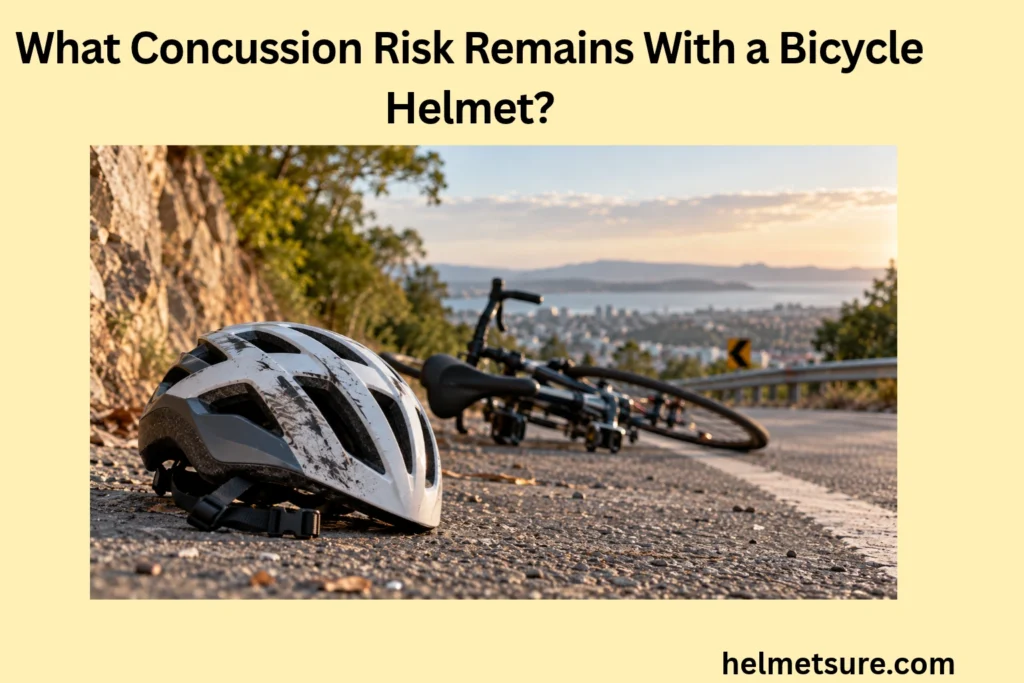
What Concussion Risk Remains With a Bicycle Helmet?
A bicycle helmet can reduce head-injury risk and attenuate head loading, but concussion risk can remain because residual linear and rotational motion can still occur and neither certification nor laboratory performance establishes zero risk in a specific crash.
Meaningful protection and residual risk are not contradictory. A helmet can reduce parts of the mechanical loading delivered to the head while still leaving some motion and load. Whether a person sustains a concussion in a particular event cannot be read directly from a certification mark, one laboratory metric, or a broad head-injury statistic.
Measured injury outcomes, certification performance, and laboratory kinematics answer different questions: an outcome study estimates what happened in its studied population, a standard establishes compliance with defined tests, and a laboratory comparison measures helmet response under its protocol.
Medical and safety boundary: This article explains bicycle-helmet performance evidence and residual concussion risk. It does not diagnose concussion, list symptoms for self-diagnosis, provide treatment, or advise when someone should return to cycling. A suspected head injury requires appropriate medical assessment.
A Bicycle Helmet Can Reduce Head-Injury Risk Without Guaranteeing Concussion Prevention
A bicycle helmet can reduce measured head-injury risk without guaranteeing concussion prevention because protective benefit and concussion immunity are different claims.
The strongest defensible starting point is positive but bounded. The U.S. Centers for Disease Control and Prevention states that bicycle helmets reduce the risk of head and brain injuries in a crash. That statement supports helmet use for the outcomes it names. It does not establish that every helmeted rider will avoid concussion or that one population-level finding determines the outcome of a specific crash.
Three distinctions keep the protection claim accurate:
- Outcome label: Head injury, brain injury, traumatic brain injury, and concussion are related terms, but they are not interchangeable endpoints.
- Risk reduction: A lower measured risk is meaningful protection, not proof that risk reaches zero.
- Evidence scope: A finding applies within the population, comparator, exposure, and method used to produce it.
What head-injury risk reduction supports as a legitimate helmet-protection claim
Head-injury risk reduction supports the claim that bicycle helmets provide meaningful protection against the injury outcomes actually measured, not guaranteed concussion prevention.
When an authoritative source reports fewer head injuries or brain injuries among helmet users, the legitimate claim keeps that outcome name intact. If the source measures traumatic brain injury, the result should remain a TBI result. If it measures a broader head-injury category, the article should not silently relabel it as concussion.
This creates a direct evidence rule:
Measured injury category → evidence-supported risk-reduction claim for that category.
CDC’s bicycle-safety guidance supports the broad conclusion that helmets reduce head and brain injury risk. The wider evidence behind head-injury risk must still be interpreted by its original outcome labels rather than converted into a concussion-specific statistic.
No numerical estimate is necessary to answer the present question. Avoiding a headline percentage also prevents differences in study populations, crash definitions, comparators, and injury coding from being compressed into a false universal figure.
Why that protection claim stops short of guaranteeing concussion prevention
That protection claim stops short of guaranteed concussion prevention because reducing measured injury risk does not establish concussion immunity.
A protective intervention can lower the frequency or severity of an outcome across a studied group without eliminating every event. It also cannot automatically establish a result for a different endpoint. Head injury may include diagnoses and anatomical injuries that are not concussion, while concussion is a clinical form of traumatic brain injury with its own assessment requirements.
The correct relationship is:
Risk reduction = meaningful protective value. Risk reduction ≠ elimination of all residual risk.
CDC explains that a concussion can result when a blow to the head—or a hit to the body—causes rapid head and brain movement. A helmet can influence the loading produced in an impact, but the existence of a protective effect does not show that those concussion-relevant motions are absent in every crash.
For that reason, “can reduce” is evidence-aligned language. “Always prevents,” “concussion-proof,” and “zero risk” are not.
Why a helmet can perform as intended without establishing a zero-concussion-risk outcome
A bicycle helmet can perform as intended without establishing zero concussion risk because equipment performance and guaranteed clinical outcome are different claims.
At a high level, intended equipment performance means that the helmet functions within its design, applicable standard, correct-use conditions, and tested performance framework. It may attenuate impact loading, remain in position, and meet its required criteria. None of those observations alone establishes what diagnosis will or will not follow a particular real-world event.
A concussion after a helmeted impact therefore does not, by itself, prove that the helmet mechanically failed. Determining product performance in one event would require evidence about the helmet, fit, impact, environment, and applicable criteria. The clinical outcome and the mechanical product assessment are separate investigations.
This boundary protects both sides of the answer: useful helmet performance should not be dismissed simply because residual injury is possible, and useful performance should not be exaggerated into a clinical guarantee.
Residual Head and Brain Motion Can Remain After a Bicycle Helmet Attenuates an Impact
Residual head and brain motion can remain after a bicycle helmet attenuates an impact because attenuation reduces components of loading rather than eliminating all motion in every crash.
In a helmeted impact, the helmet system can change how the head decelerates and how loading develops over time. “Attenuation” describes reduction or management of measured loading relative to another condition; it does not mean that the head becomes motionless.
Concussion-relevant biomechanics can involve both translational and rotational components. CDC’s clinical framing describes rapid head and brain motion, including bouncing or twisting within the skull, while laboratory helmet research separately measures linear and rotational headform response. These are connected evidence layers, but a laboratory motion value is not itself a clinical diagnosis.
How linear head acceleration can remain after impact attenuation
Linear head acceleration can remain after impact attenuation because a bicycle helmet can reduce translational loading without eliminating all head motion.
Linear motion describes translation: movement of the head’s center of mass through space. During an impact, the helmet’s protective structure can deform and extend the time over which the head slows. That can reduce the measured acceleration under a given comparison, but the helmeted head can still accelerate or decelerate.
The correct interpretation is comparative:
Helmet attenuation → potentially lower measured linear response under the tested condition → residual linear acceleration can still remain.
The remaining value depends on the impact and test setup. A lower result in one protocol supports a statement about that measurement and condition, not a promise about concussion outcome in every crash.
How rotational head motion represents a distinct component of impact kinematics
Rotational head motion is a distinct component of impact kinematics because the head can rotate as well as translate during a crash.
Linear and rotational responses can occur together, but they are not the same measurement. A laboratory can record linear acceleration while also recording rotational velocity or rotational acceleration. Modern whole-helmet studies and the Virginia Tech bicycle protocol use multiple kinematic measures because one value does not describe the complete headform response.
Rotational-management features are intended to influence some part of that rotational response. The relevant question is what the complete helmet achieves in a transparent test, not whether a technology name appears on the package. A deeper explanation of rotational protection should therefore remain separate from any claim of guaranteed clinical benefit.
Rotational loading is concussion-relevant, but a measured rotational value alone does not diagnose concussion. Clinical outcome depends on more than one motion component or isolated peak metric.
How oblique impacts can combine linear and rotational head motion
Oblique impacts can combine linear and rotational head motion because angled or tangential loading can produce both translational and rotational response.
A purely conceptual straight-on impact and a real-world angled contact do not necessarily create the same kinematic balance. Tangential interaction at the contact surface can contribute to head rotation while the overall collision still produces linear deceleration.
Peer-reviewed oblique-impact testing illustrates this combined measurement approach. The 2024 study by Baker and colleagues assessed complete bicycle helmets with linear acceleration, rotational acceleration, rotational velocity, and related model-based criteria under its specified protocol. The study found substantial variation across helmets and impact locations, but those laboratory results remain bounded by the selected headform, anvil, locations, speeds, metrics, and analytical models.
The evidence supports combined kinematic response under tested oblique conditions. It does not support a universal claim that every oblique impact produces concussion or that one laboratory setup reproduces every road crash.
How residual brain motion can remain even after the helmet reduces head loading
Residual brain motion can remain after a bicycle helmet reduces head loading because reducing head response does not require all motion within the head to disappear.
CDC describes concussion-producing events in terms of rapid head and brain movement, including the brain bouncing or twisting within the skull. Helmet attenuation can reduce components of the input to that system, yet reduced input is not the same as no input.
The evidence chain must remain disciplined:
- An impact loads the helmet-head system.
- The helmet can attenuate parts of the head loading.
- Some linear and rotational head response can remain.
- Residual mechanical exposure may still be transmitted to internal tissues.
- The measured exposure does not, by itself, establish a concussion diagnosis.
This article does not assign a universal brain-motion or acceleration threshold. Individual anatomy, impact sequence, measurement method, and other crash conditions prevent one value from functioning as a universal diagnostic cutoff.
Crash Severity, Direction, and Impact Location Modify the Remaining Head Loading
Crash severity, impact direction, and impact location modify the amount and pattern of head loading that can remain after a bicycle helmet attenuates an impact.
Residual risk is not one fixed property of a helmet. The same helmet can be challenged differently by changes in impact energy, contact angle, contact surface, strike location, and the motion of the rider. Laboratory protocols control selected variables so designs can be compared, while real crashes can combine them in ways the protocol did not reproduce.
How greater impact severity changes the load the helmet system must manage
Greater impact severity increases the loading challenge the helmet system must manage, while the residual response remains dependent on the specific impact conditions.
Severity is not reducible to speed alone. Effective impact conditions can also depend on mass, relative motion, the compliance and geometry of the contact surface, impact angle, and how the body and head move during the event.
Within a defined laboratory comparison, a more severe input can create a larger response or consume more of the helmet system’s available deformation. That statement does not create a universal speed threshold for concussion. It describes a mechanical relationship that remains conditional on the rest of the setup.
Therefore, no consumer-facing speed can divide “concussion-safe” from “concussion-causing” crashes. The article can say that changing severity changes the loading challenge; it cannot calculate an individual clinical outcome from speed alone.
How impact direction changes the balance of linear and rotational head motion
Impact direction changes the balance of linear and rotational head motion because different loading orientations can produce different combinations of translation and rotation.
A contact directed closer to the head’s center of mass may produce a different balance from an off-center or tangential contact. Oblique interaction can increase the importance of rotational measurements, while other geometries may emphasize the translational component.
The 2024 whole-helmet study reported location- and direction-dependent differences in measured kinematics under its oblique test method. That supports the narrow conclusion that direction can change laboratory response. It does not identify one direction as universally concussion-producing across riders and crashes.
Use direction as a modifier in the evidence model, not as a stand-alone clinical predictor.
How impact location changes the loading pattern across the helmet-head system
Impact location changes the loading pattern across the helmet-head system because different contact regions engage the helmet and head geometry differently.
Front, side, rear, and intermediate locations can interact with different shell shapes, liner geometries, vents, edges, and local curvature. In a controlled test, those differences can produce different measured linear and rotational responses. The result applies to the tested helmet, location, and method.
Location should not be converted into a universal ranking of the “most dangerous” place to hit a bicycle helmet. Clinical outcome also depends on severity, direction, repeated contacts, rider factors, and other crash conditions.
| Crash modifier | What changes mechanically | What the evidence can support | Unsupported inference to avoid |
|---|---|---|---|
| Impact severity | Loading challenge and residual response | Comparative biomechanical differences under studied conditions | Universal concussion probability at a given speed |
| Impact direction | Balance of linear and rotational motion | Direction-dependent kinematic response | One direction always causes concussion |
| Impact location | Loading pattern across the helmet-head system | Location-dependent measured response where tested | Universal “most dangerous” helmet impact zone |
These variable real-world conditions explain why certification must be read as defined performance testing rather than an exhaustive simulation of every crash.
Bicycle Helmet Certification Establishes Defined Performance Requirements, Not Concussion Prevention
Bicycle helmet certification establishes compliance with defined performance requirements, not a guarantee that a certified helmet will prevent concussion in every crash.
In the United States, 16 CFR Part 1203 requires bicycle helmets within its scope to meet specified requirements that include peripheral vision, positional stability, dynamic strength of the retention system, and impact attenuation. Each domain answers a product-compliance question under defined procedures. The regulation does not produce an individual rider’s concussion probability.
What impact-attenuation testing evaluates about helmet performance
Impact-attenuation testing evaluates specified bicycle-helmet and headform response under defined test impacts and compliance criteria.
The CPSC regulation specifies the equipment, headforms, conditioning, anvils, impact sites, test procedures, and performance criterion used for this compliance domain. Passing shows that the tested product meets the applicable impact-attenuation requirement under that regulatory framework.
The test is important precisely because it is controlled. Control makes repeatable compliance assessment possible, but it also defines the claim boundary. The result is not an observation of every surface, angle, sequence, helmet position, or rider that can occur in the real world.
Most importantly, the regulatory criterion is not a clinical concussion threshold. It should not be described as the acceleration below which concussion cannot happen.
What positional-stability and retention testing evaluate about keeping the helmet in place
Positional-stability and retention testing evaluate defined aspects of whether a bicycle helmet remains appropriately positioned and secured under specified test conditions.
The positional-stability test assesses roll-off resistance on a test headform. The retention-system test evaluates the dynamic strength of the system under its specified setup. Together, these domains address whether the product satisfies required stability and retention performance—not whether it fits every rider or will remain perfectly positioned in every crash.
Product testing and individual use remain separate. A model can meet the regulation while still being the wrong size or shape for a particular wearer. Conversely, a helmet that feels snug does not become certified unless the product satisfies the applicable regulatory requirements.
What passing the standard establishes about compliance with defined performance requirements
Passing the applicable bicycle-helmet standard establishes compliance with its defined performance requirements under the specified test conditions.
That is a meaningful minimum product filter. It distinguishes verified compliance from unsupported marketing language and provides a common set of required test domains. It does not claim that every compliant helmet performs identically in additional laboratory protocols or that every wearer has the same outcome in a crash.
The broader framework behind CPSC certification should therefore be understood as defined regulatory compliance, not a concussion-prevention guarantee.
Compliance also does not replace the need to verify that the label applies to the actual helmet, that the model is used as intended, and that it fits the individual rider correctly.
How certification remains bounded by its specified tests, criteria, and test conditions
Certification remains bounded by its specified tests, criteria, and test conditions because compliance does not test every possible crash or clinical outcome.
The CPSC framework defines what is tested, how it is conditioned, how it is mounted, where and how impacts occur, and what counts as passing. Those boundaries are necessary for compliance testing. They also prevent the result from being expanded into an all-crash clinical promise.
A crash that differs from the laboratory setup does not automatically prove that the standard is ineffective. It shows why standard compliance and event-specific outcome are different propositions.
| Test domain | What it evaluates | What passing establishes | What it does not establish |
|---|---|---|---|
| Impact attenuation | Specified response under defined impacts | Compliance with applicable impact-performance criteria | Individual concussion probability |
| Positional stability | Defined resistance to unwanted helmet displacement | Compliance with the standard’s stability requirement | Correct fit on every rider |
| Retention-system performance | Defined performance of straps and retention under test conditions | Compliance with applicable retention criteria | Guaranteed retention in every real-world crash |
| Overall standard compliance | Performance across required test domains | Meets the applicable defined standard | Concussion immunity or zero residual risk |
Certification answers whether defined product requirements have been met. Correct fit answers the next question: whether the compliant helmet is being worn in its intended protective configuration.
Correct Fit and Retention Help the Helmet Deliver Its Intended Protection
Correct fit and retention help a bicycle helmet deliver its intended protection by keeping the helmet appropriately positioned, but correct fit does not eliminate residual concussion risk.
Fit is a correct-use dependency, not a separate certification and not a concussion guarantee. The CPSC consumer guidance says a helmet should be comfortable and snug, sit level, resist movement, and have the chin strap securely fastened. These principles help preserve the intended relationship among the helmet, head, and retention system.
This section does not provide a full sizing or adjustment tutorial. It establishes why position and retention matter to the interpretation of helmet performance.
Why correct helmet position keeps the intended protective area over the head
Correct helmet position keeps the intended protective area aligned over the head regions the bicycle helmet is designed to cover.
A helmet tilted far backward can leave more of the forehead outside the intended position. A helmet pulled too low or sitting unevenly can also change the way it rests and interferes with normal use. CPSC guidance calls for level placement rather than a backward tilt or an excessively low position.
Position does not create new protective capacity; it helps make the existing certified design available in the way it was intended to be worn. The manufacturer’s instructions should control model-specific setup.
How the retention system helps preserve that position during an impact
The retention system helps preserve bicycle-helmet position during an impact by keeping the correctly fitted helmet secured to the rider’s head.
The CPSC standard separately evaluates retention-system performance, while consumer fit guidance directs the wearer to fasten the chin strap securely. These are related but distinct evidence layers: one concerns product performance under a defined test, and the other concerns correct individual use.
A strap cannot repair an incorrect base size or make an unstable helmet appropriate. It works with the shell fit and adjustment system to retain an already correctly positioned helmet. Model-specific routing and adjustment should follow the manufacturer’s instructions.
Secure retention can support intended performance, but it cannot guarantee that the helmet will remain perfectly positioned in every crash or eliminate residual head motion.
Why correct fit supports intended helmet performance without changing the underlying certification claim
Correct fit supports intended bicycle-helmet performance without changing what the helmet’s certification itself establishes.
Certification applies to the helmet model’s compliance with the defined standard. Fit applies to the relationship between the particular helmet and the individual wearer. A compliant helmet can fit one rider and fail to fit another; a comfortable helmet does not acquire certification through fit alone.
The proper logic is:
Verified product compliance + correct individual fit and retention → a compliant helmet used in its intended configuration.
That combined condition is important, but it still does not establish concussion immunity. Neither certification nor correct use removes all possible residual loading or predicts one rider’s clinical outcome.
Fit-to-protection dependency checklist
Fit and Retention Evidence Check
Once compliance and correct use are separated, additional whole-helmet testing can answer a different question: how complete designs compare under the same laboratory protocol.
Bicycle Helmet Designs Can Differ in Measured Laboratory Performance
Bicycle helmet designs can differ in measured laboratory performance, including linear and rotational head-response metrics, even when the helmets meet the applicable certification requirements.
Independent and peer-reviewed testing has measured meaningful variation across complete bicycle helmets. Virginia Tech’s STAR methodology assesses linear acceleration and rotational velocity across controlled impact scenarios, while Baker and colleagues measured several linear and rotational responses in oblique impacts. Both approaches compare complete products under defined protocols rather than treating one component label as the helmet’s total performance.
The results should be used comparatively. They show how tested helmets performed in those methods; they do not recreate every crash or produce a guaranteed diagnosis for the wearer.
How rotational-management features target specific components of head motion in laboratory testing
Rotational-management features target rotational components of head motion, but their value must be judged through measured whole-helmet laboratory performance rather than the technology label alone.
The intended mechanism is narrower than the marketing conclusion often attached to it. A feature may be designed to influence rotational velocity or acceleration, but its presence does not establish how much the complete helmet changes those metrics under every test condition.
The 2024 whole-helmet study found that some paired helmet versions with a rotational-management system produced lower rotational kinematics under that study’s test conditions, while also showing that not every helmet carrying the same feature label ranked among the strongest complete-helmet performers. The legitimate inference is protocol-bounded: the feature can influence rotational response, but the label alone does not determine total performance or clinical outcome.
Construction descriptions can explain what a feature is intended to do. Independent whole-helmet measurements are needed to show what the finished product did in a particular test.
How measured linear performance can differ across complete helmet designs
Measured linear performance can differ across complete bicycle helmet designs because multiple design elements interact during the laboratory impact.
Even when every product in a sample has passed an applicable standard, an additional protocol can produce a range of peak linear acceleration or related linear-response results. Virginia Tech explicitly notes that certified helmets can offer different levels of impact protection, and the 2024 oblique-impact study reported variation in linear measures among the tested designs.
This does not mean that the lowest value in one condition is automatically superior in every condition. A proper comparison preserves the tested model, impact location, energy, headform, anvil, repetitions, uncertainty, and metric.
How measured rotational performance can differ across complete helmet designs
Measured rotational performance can differ across complete bicycle helmet designs because helmet geometry and internal systems can alter rotational response under tested impact conditions.
Whole-helmet protocols can record rotational velocity, rotational acceleration, or a model-based criterion derived from motion. The Baker study found a substantial spread in rotational response across the helmets and locations it tested, while Virginia Tech uses measured rotational velocity with linear acceleration in its bicycle STAR evaluation.
The important noun is measured. A result belongs to the laboratory method that produced it. Differences can inform comparison, but they cannot be converted directly into an individual concussion prediction without additional validated clinical linkage.
What measured kinematic differences reveal about comparative whole-helmet performance
Measured kinematic differences reveal comparative whole-helmet performance under the studied laboratory conditions, not a universal prediction of individual clinical outcome.
This evidence can show that one tested helmet produced a lower linear or rotational response than another in particular impact conditions. It can also reveal tradeoffs: a design may perform comparatively well on one metric or location and less strongly on another.
Kinematic differences do not prove why the result occurred unless the study isolates the causal design feature. Nor do they establish a universal clinical ranking. They support an evidence-backed comparison of the finished helmets under the documented method.
For consumers, the most useful independent program is one that explains its test conditions, measures relevant motion components, identifies the exact helmet models, and states its limitations. The comparison should remain within that program; scores from different sports or incompatible protocols should not be treated as interchangeable.
Why whole-helmet test results are more informative than a technology label alone
Whole-helmet test results are more informative than a technology label alone because they measure the performance of the complete helmet system.
A named feature identifies one intended mechanism. It does not describe liner thickness throughout the helmet, local coverage, shell behavior, retention, ventilation geometry, or how those elements work together at every test site.
The 2024 study provides a useful boundary: rotational-management technology was associated with lower rotational response in specific paired comparisons, but the feature label did not place every equipped helmet among the best-performing products in the sample. The finding argues for complete-helmet evidence, not for dismissing the mechanism or treating it as a universal guarantee.
Therefore, evaluate a label as a design description and a transparent whole-helmet result as performance evidence. Neither should be described as concussion immunity.
Head-Injury Statistics and Laboratory Metrics Cannot Be Converted Directly Into Your Concussion Probability
Head-injury statistics, certification results, and laboratory kinematics cannot be converted directly into an individual cyclist’s concussion probability because those evidence classes measure different outcomes under different conditions.
This is the article’s central interpretation boundary. A study can estimate a group-level association for a named injury outcome. A regulation can establish product compliance. A laboratory can compare kinematic response. None automatically supplies the probability that one identified rider will receive a concussion in one future crash.
Why reductions in head injury or TBI cannot automatically be reported as concussion-specific protection
Reductions in head injury or TBI cannot automatically be reported as concussion-specific protection because those outcome categories can include injuries other than concussion.
Concussion is a type of TBI, but a TBI endpoint is not necessarily a concussion-only endpoint. Likewise, “head injury” can include scalp, skull, facial, intracranial, or other coded outcomes depending on the research definition.
Changing the label changes the claim. If a study reports a reduction in serious head injury, the article may report that exact result with its population and uncertainty; it may not rename the result “concussion reduction” for simplicity.
The safe evidence rule is:
Use the outcome term the source actually measured. Do not infer a narrower clinical endpoint without direct evidence.
Why lower laboratory head-motion metrics do not translate directly into a guaranteed concussion outcome
Lower laboratory head-motion metrics do not translate directly into a guaranteed concussion outcome because physical kinematic measurements and clinical diagnoses are different endpoints.
Lower linear or rotational response under a controlled comparison is directionally useful: it indicates reduced measured loading for that metric and condition. The inference stops before “this rider will not be concussed.”
Clinical concussion assessment incorporates the event and the person, while a laboratory test uses a headform, sensors, selected inputs, and a defined analytical model. Individual anatomy, health history, prior exposure, body motion, impact sequence, and other variables are not fully reproduced by one helmet test.
Virginia Tech explicitly states that no helmet is concussion-proof and that a specific person’s risk can vary. Its ratings offer a comparative risk model within the program, not a guarantee for an individual impact.
Why passing a helmet standard cannot predict an individual rider’s concussion probability in a specific crash
Passing a bicycle-helmet standard cannot predict an individual rider’s concussion probability because compliance tests product performance under defined conditions rather than rider-specific clinical outcomes.
The CPSC standard does not know the future rider’s crash speed, direction, contact surface, head position, anatomy, medical history, fit, secondary impacts, or exposure sequence. It evaluates whether the helmet meets specified performance requirements.
Certification is therefore necessary as a verified compliance filter where the regulation applies, but it is not sufficient evidence for a numerical concussion prediction. The correct claim is “meets the defined standard,” not “prevents concussion” or “reduces this individual’s concussion risk by a specified amount.”
When a concussion-protection percentage would require concussion-specific outcome evidence
A concussion-protection percentage requires evidence that directly measures concussion as the outcome in a defined study population and exposure context.
At minimum, the evidence would need to define the studied population, exposure context, helmet comparator, concussion identification method, effect estimate, and uncertainty. The article would also need to preserve the limits of study design and explain that a population estimate is not a universal individual probability.
Certification values and laboratory kinematics cannot be combined arithmetically to manufacture that percentage. Nor can separate head-injury statistics be averaged or relabeled as concussion-specific evidence.
Because no concussion-specific percentage is needed to resolve the H1, this article does not provide one. It retains the more accurate conclusion: residual concussion risk can remain despite meaningful helmet protection.
| Evidence or function | What it legitimately supports | Residual limitation | Unsupported inference to avoid |
|---|---|---|---|
| Head-injury or TBI outcome evidence | Risk estimates for the injury category actually measured | The outcome may be broader than concussion | Relabeling the estimate as concussion-specific |
| Certification performance | Compliance with defined helmet-performance requirements | Tests occur under specified conditions and do not output individual clinical risk | “Certified = concussion-proof” |
| Laboratory linear metrics | Comparative measured linear head response | A laboratory metric is not a clinical diagnosis | Converting a lower value directly into personal concussion probability |
| Laboratory rotational metrics | Comparative measured rotational head response | Rotational response is one biomechanical evidence class | Treating lower rotation as guaranteed concussion prevention |
| Fit and retention dependency | Correct use helps preserve intended helmet position and configuration | Correct use cannot eliminate all residual loading | Treating good fit as zero concussion risk |
| Concussion-specific outcome evidence | Concussion-related estimates within the studied population and conditions | Generalizability remains bounded by study design and exposure context | Treating one estimate as universal across all riders and crashes |
The Most Accurate Expectation Is Meaningful Protection Without Concussion Immunity
The most accurate expectation is meaningful bicycle-helmet protection without concussion immunity: helmets can reduce measured injury risk and head loading while residual concussion risk still remains.
This expectation preserves the full evidence hierarchy. Outcome research supports claims about the exact injuries it measured. Certification establishes defined product compliance. Correct fit supports intended use. Independent laboratory testing can compare complete helmet designs. Clinical concussion probability remains a separate question that none of those evidence classes resolves alone.
What the combined evidence supports about the protective value of a bicycle helmet
The combined evidence supports bicycle helmets as meaningful protective equipment that can reduce measured head-injury outcomes and attenuate head loading under studied conditions.
CDC provides the population-level protection framing. CPSC defines minimum performance requirements for helmets within the U.S. regulation. Independent and peer-reviewed testing shows that complete helmets can differ in measured linear and rotational response beyond a common certification baseline.
Together, those sources support wearing an appropriate, compliant, correctly fitted helmet and using transparent performance evidence when it is available. They do not support dismissing helmet protection simply because concussion risk cannot be eliminated.
The practical transition is from asking for a zero-risk promise to evaluating verifiable attributes: applicable certification, correct fit and retention, and evidence about complete-helmet performance.
Why residual physical loading means concussion risk can remain despite intended helmet performance
Residual physical loading means concussion risk can remain despite intended helmet performance because some head and brain motion can persist after impact attenuation.
A compliant, well-fitted helmet can function as intended while some head and brain motion remains. The presence of residual loading does not prove concussion occurred; it explains why a zero-risk claim is not justified.
Crash severity, direction, location, surface, body motion, rider factors, and helmet response can combine differently from one event to another. That variation prevents one certification mark, laboratory score, or technology feature from guaranteeing the clinical outcome.
The useful purchasing and use question is not “Which helmet makes concussion impossible?” It is “Which appropriate, certified, correctly fitting helmet has the strongest relevant whole-helmet evidence available for my riding context?”
How to describe bicycle-helmet protection without overstating what the evidence establishes
Describe bicycle-helmet protection as meaningful risk reduction and impact attenuation within studied conditions, not as guaranteed concussion prevention.
Use evidence-matched language:
- Say: “This helmet meets the applicable certification requirements.”
- Do not say: “Certification proves that concussion cannot occur.”
- Say: “This test found a lower measured linear or rotational response under its protocol.”
- Do not say: “The laboratory result guarantees the rider will avoid concussion.”
- Say: “Correct fit and retention support the intended helmet configuration.”
- Do not say: “A good fit removes all residual risk.”
- Say: “Helmet use is associated with lower risk for the injury outcome measured in the cited study.”
- Do not say: “A broader head-injury statistic is a concussion-prevention percentage.”
The final decision is practical: evaluate bicycle helmets through verified certification, correct fit and retention, and evidence-backed whole-helmet performance—never through concussion-prevention guarantees.
Frequently Asked Questions About Bicycle Helmets and Concussion Risk
Short answers covering residual risk, biomechanics, certification, fit, laboratory evidence, statistics, and medical evaluation.
Can a bicycle helmet prevent every concussion?
No. A helmet can reduce head-injury risk and attenuate impact loading, but residual concussion risk remains.
Does lower head-injury risk mean zero risk?
No. Risk reduction is meaningful protection, but it does not mean the measured or personal risk reaches zero.
Why can concussion occur while wearing a helmet?
Residual linear acceleration, rotational motion, and brain motion can remain after the helmet reduces part of the impact loading.
Does CPSC certification prove concussion prevention?
No. It establishes compliance with defined performance requirements under specified tests—not concussion immunity.
Does correct fit eliminate concussion risk?
No. Fit and retention help preserve the intended helmet position, but they cannot eliminate every crash load or clinical outcome.
Do lower laboratory metrics guarantee no concussion?
No. Laboratory metrics compare measured responses under a protocol; they are not individual clinical diagnoses or guarantees.
Can a head-injury statistic be reported as concussion protection?
Only if the original evidence measured concussion as that outcome. Broader head-injury or TBI estimates must retain their original labels.
What should happen after a suspected concussion?
Stop the activity and seek appropriate medical evaluation. A helmet’s appearance, certification, or rating cannot rule out concussion.