
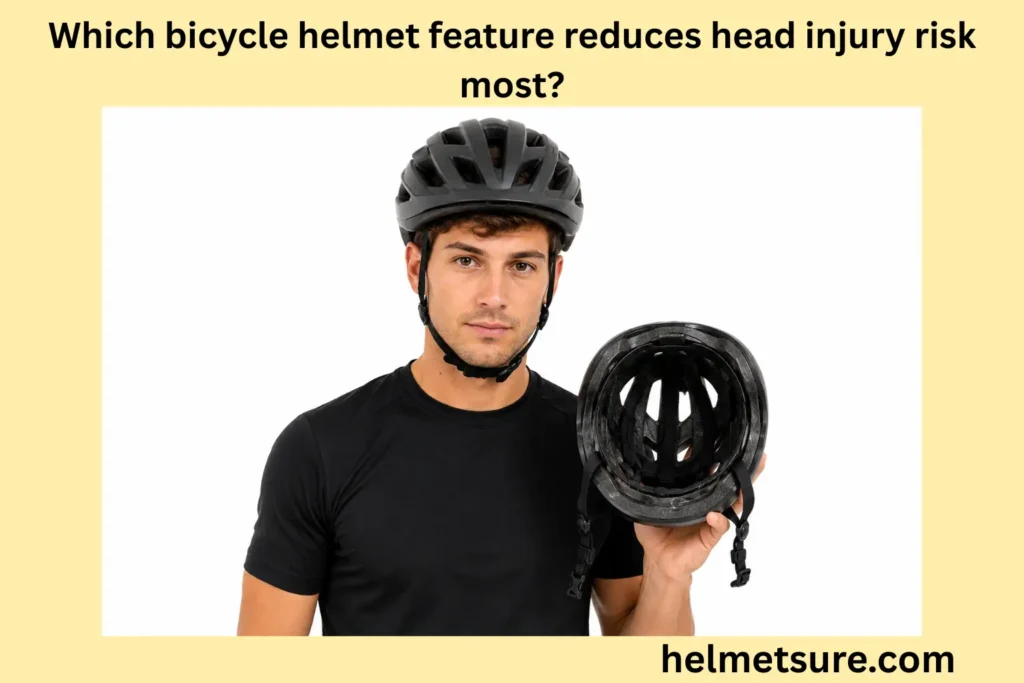
Which Bicycle Helmet Feature Reduces Head Injury Risk Most?
Impact-energy management is the foundational bicycle helmet protective feature because the helmet’s impact-absorbing structure deforms to manage loading transmitted toward the head; correct fit enables that protection, while rotational-impact systems may provide additional protection during angled impacts. Independent laboratory research consistently evaluates this foundational function through changes in headform loading, while also showing that helmet performance varies by design and impact condition (Bland et al., 2018; Baker et al., 2024). [1] [2]
That hierarchy does not mean one feature makes a rider invulnerable. Real-world research associates bicycle helmet use with lower odds of head and serious head injury, but neither a helmet nor any individual feature guarantees prevention of concussion or serious head injury (Olivier and Creighton, 2017). [3]
Protective Helmet Features Are Not the Same as Fit Conditions, Certification, or Secondary Attributes
Bicycle helmet protection is evaluated most clearly when physical protective mechanisms are separated from fit conditions, certification signals, and secondary attributes. These categories work together, but they do not do the same job.
A protective mechanism changes the helmet’s physical response during impact. An enabling condition helps that mechanism remain in the intended position. Certification validates performance under a named test protocol. Secondary attributes influence usability, visibility, riding performance, or purchasing decisions. Keeping those categories separate makes the question “Which feature matters most?” answerable without dismissing the importance of fit, certification, or consistent use.
Impact-energy management as the foundational protective feature
Impact-energy management is the foundational protective feature because the helmet structure manages loading created during a direct impact. When the helmet contacts a surface, its assembled shell, liner, and supporting structures respond together. Controlled deformation changes how the impact develops before the remaining loading reaches the head.
The important unit is the complete helmet, not foam or shell in isolation. Experimental testing shows that measured response differs among helmet models, impact locations, and impact conditions; a favorable result for one liner or construction cannot be assigned automatically to every bicycle helmet (Bland et al., 2018; Baker et al., 2024). Energy management also does not mean that all loading disappears. It means the helmet changes the magnitude, duration, or distribution of loading under the conditions in which it performs.
Rotational-impact management as an additional protective feature
Rotational-impact management is an additional protective feature intended to address rotational loading associated with angled impacts. Oblique contact can create tangential forces and rotational head motion at the same time that the helmet is managing a direct component of impact.
Different systems attempt to influence that response through different forms of relative motion, sliding, deformation, or structural behavior. Independent studies have measured differences in rotational headform kinematics among helmet constructions, but the results depend on the helmet, system, test method, impact location, and impact condition (Bottlang et al., 2020; Baker et al., 2024). A rotational system can therefore be valuable additional protection without becoming the sole measure of helmet safety or a replacement for foundational impact-energy management.
Correct fit and retention as conditions that enable protective performance
Correct fit and secure retention are enabling conditions that help keep a bicycle helmet’s protective structure positioned as intended. A helmet that sits in its intended position can maintain the coverage the design is supposed to provide; straps and the retention system help limit unwanted movement.
Fit does not absorb impact energy, but it affects whether the impact-managing structure is where it needs to be. The U.S. Consumer Product Safety Commission includes positional-stability and retention-strength tests among the requirements for bicycle helmets, reflecting the importance of keeping the complete helmet secured (CPSC bicycle helmet guidance). A case-control study of helmeted riders also found an association between poor helmet fit and head injury in children, although that population-specific finding should not be converted into a universal prediction for every rider or crash (Rivara et al., 1999). [4]
Safety-standard certification as validation rather than an injury-reduction mechanism
Safety-standard certification validates tested bicycle helmet performance rather than functioning as a physical injury-reduction mechanism. The helmet’s materials and structure produce its impact response; certification records that the complete tested product met the applicable requirements of a named standard.
For bicycle helmets sold in the United States, the CPSC framework in 16 CFR Part 1203 covers prescribed areas such as impact attenuation, positional stability, retention-system strength, and peripheral vision. That is a meaningful tested baseline, but it is bounded by the regulation’s test methods and pass/fail criteria. Certification does not itself absorb impact, identify which component produced the result, or reproduce every possible real-world crash.
Comfort, visibility, weight, aerodynamics, and price as secondary attributes rather than primary impact-protection features
Comfort, visibility, weight, aerodynamics, and price affect use, riding experience, or purchasing decisions rather than serving as primary impact-protection mechanisms. Comfort and manageable weight may help a rider tolerate the helmet and wear it consistently. Lights or reflective elements may support conspicuity before a collision. Aerodynamic shaping can affect airflow and riding performance. Price reflects a mix of construction, finish, brand, features, and market positioning.
Those attributes are not irrelevant; they simply belong to different decision categories. None of them establishes how effectively the helmet manages impact loading. In independent testing of popular helmets, protective performance varied among models and was not reliably explained by price alone, reinforcing the need to examine tested performance rather than using cost as a safety shortcut (Baker et al., 2024).
Helmet Feature Semantic Classes
| Semantic class | Example | What it does | What it is not |
|---|---|---|---|
| Foundational protective feature | Impact-energy management | Manages impact loading | Fit or certification |
| Additional protective feature | Rotational-impact management | Addresses rotational loading associated with angled impacts | Substitute for baseline impact management |
| Enabling condition | Fit and retention | Helps keep protection positioned as intended | Energy-absorbing mechanism |
| Validation signal | Certification | Confirms defined tested performance | Physical protective structure |
| Secondary attribute | Comfort, weight, visibility, price | Supports use, visibility, performance, or purchasing decisions | Primary impact mechanism |
What Criteria Determine Whether a Helmet Feature Meaningfully Reduces Head-Injury Risk?
A bicycle helmet feature meaningfully supports head-injury risk reduction when its mechanism addresses relevant impact loading and its effect is supported by evidence appropriate to the claim. The strongest evaluation does not ask only whether a feature sounds protective; it asks what loading it addresses, how its effect was measured, how broadly the result applies, and how directly the evidence supports an injury-risk conclusion.
How effectively the feature manages loading during a direct impact
A helmet feature has direct-impact relevance when credible testing shows that it changes loading transmitted toward the head during impact. Researchers commonly assess a helmeted headform under controlled conditions and compare measures such as linear acceleration, impact duration, force response, or other defined biomechanical outcomes.
These measurements can show that a helmet or feature changes the physical exposure delivered to the headform. They cannot, by themselves, prove that a specific rider will avoid concussion. Direct-impact studies also show why the test context matters: performance can change with impact speed, location, surface, and helmet construction (Bland et al., 2018; McIntosh et al., 2013). A marketing label is therefore weaker evidence than an independently measured response under clearly described conditions.
Whether the feature addresses rotational loading during angled impacts
A helmet feature has additional protective relevance when evidence shows that it changes rotational loading during relevant angled impacts. Oblique contact can combine a normal component with tangential loading, producing linear and rotational head motion in the same event.
The correct question is not simply whether a helmet carries a rotational-technology label. It is whether independent testing of the actual helmet or a directly comparable configuration found a meaningful change in rotational kinematics under relevant conditions. Studies of rotation-management designs have found model- and condition-specific effects, while broader testing has also shown that not every helmet using the same general technology ranks alike (Bliven et al., 2019; Baker et al., 2024).
Whether the protective effect applies across relevant impact conditions rather than one narrow scenario
Confidence in a helmet feature increases when its protective effect is supported across multiple relevant impact conditions rather than one isolated test scenario. Bicycle crashes differ in impact direction, location, surface, severity, body motion, and helmet contact geometry. A feature that performs well in one carefully selected condition may respond differently when any of those variables change.
This is why multi-condition testing has greater decision value than a single favorable demonstration. Comparative studies have reported that helmet rankings and measured responses can vary across locations or protocols, and that differences between technologies cannot be generalized beyond the configurations actually tested (Bland et al., 2020; Bottlang et al., 2020). Evidence breadth strengthens a claim; it does not remove the boundaries of the test.
How evidence quality and uncertainty affect confidence in an injury-risk claim
Confidence in a bicycle helmet injury-risk claim depends on the quality, relevance, independence, and uncertainty of the evidence supporting it. Laboratory biomechanics can establish whether a helmet changes measured loading. Independent comparative testing can show how models perform relative to one another under a defined protocol. Observational injury research can examine what happens to riders in actual crashes. Medical evidence interprets diagnosed outcomes.
These evidence types answer different questions. A manufacturer can accurately describe how its design is intended to work, but that description does not independently establish performance or clinical benefit. A laboratory reduction in a headform metric is mechanistic evidence, not a diagnosed injury outcome. A real-world association can support risk reduction, but it may still be influenced by study population, crash context, fit, helmet use, and other variables. Claim strength should rise only when the evidence is independent, reproducible, and directly relevant.
Why risk reduction must remain distinct from a guarantee of concussion or serious-injury prevention
Systematic reviews associate bicycle helmet use with lower odds of head and serious head injury among cyclists who crash, supporting the real protective value of helmets (Olivier and Creighton, 2017; Høye, 2018). At the same time, the CDC states plainly that there is no concussion-proof helmet and emphasizes proper fit, certification, maintenance, and correct wear (CDC HEADS UP helmet guidance). Meaningful protection and residual risk are both true.
Evidence Criteria for Head-Injury Risk Claims
| Evaluation criterion | Evidence question |
|---|---|
| Direct-impact relevance | Does independent testing show a measurable effect on relevant transmitted loading? |
| Rotational relevance | Does evidence show an effect on rotational loading during relevant angled impacts? |
| Breadth | Is the effect supported across multiple relevant conditions or only one narrow setup? |
| Evidence quality | Is the claim supported by independent peer-reviewed, institutional, or standards evidence appropriate to the claim? |
| Injury boundary | Does the wording preserve risk reduction rather than guaranteed prevention? |
How Does Impact-Energy Management Reduce Loading Transmitted to the Head?
Impact-energy management changes transmitted head loading by allowing the bicycle helmet’s protective structure to respond and deform during impact. The process is mechanical: contact loads the helmet, the complete structure responds, and that response changes the loading delivered to the headform under the tested conditions.
How an impact creates energy that the helmet structure must manage
A bicycle helmet impact creates mechanical loading that the helmet structure must manage during contact and deformation. The moving rider and head do not stop without forces developing. When the helmet contacts a surface, the shell, liner, internal interfaces, retention system, head, and body form a coupled system whose response unfolds over time.
The helmet does not make energy vanish. It changes the pathway through which the impact is handled by deforming, distributing contact, and extending or reshaping the loading event. Experimental comparisons of helmeted and unhelmeted oblique impacts show that helmet use can substantially change measured linear and angular head dynamics, while also demonstrating that impact direction, restraint, and speed affect the result (McIntosh et al., 2013).
How the impact-absorbing structure manages energy during helmet deformation
The bicycle helmet’s impact-absorbing structure manages loading through controlled deformation during the impact event. In many conventional helmets, an expanded-polystyrene liner crushes or cracks as part of that response, while the shell and other structures help manage contact and keep the assembly functioning as designed. Other constructions may use different materials or architectures.
The relevant principle is controlled structural response, not loyalty to one material. Deformation changes how quickly the headform slows and how the load is distributed through the helmet-head system. Testing across multiple bicycle helmet models has shown meaningful differences in effective liner behavior, energy dissipation, and headform response, including cases where available deformation capacity was exhausted under a particular test condition (Bland et al., 2018). Those findings remain specific to the tested models and setups.
How energy management changes the loading transmitted toward the head
Effective impact-energy management changes the magnitude, duration, or distribution of loading transmitted toward the head under the tested impact conditions. A laboratory headform records the response after the helmet has deformed and redirected part of the loading. Researchers can then compare that response across helmets, locations, or impact configurations.
Lower measured loading under a defined test is evidence of improved biomechanical performance for that condition. It is not identical to a clinical diagnosis. Modern comparative work shows that helmets can differ substantially in both linear and rotational response, which is why a complete evaluation should preserve the exact protocol, model, and impact location behind any result (Baker et al., 2024; Bland et al., 2020).
Where impact-energy management reaches its protective limits
Impact-energy management has finite protective limits because a bicycle helmet cannot eliminate all loading across every crash condition. The structure has limited coverage and finite deformation capacity. Impact severity, direction, location, surface, helmet condition, and how the helmet is positioned can all alter the protection available.
Laboratory studies demonstrate these boundaries when a helmet performs differently at separate locations or when its liner reaches the end of useful deformation under a demanding condition (Bland et al., 2018; Baker et al., 2024). There is no universal crash-speed cutoff below which every rider is safe or above which every outcome is predetermined. Residual loading remains, and injury response varies among people and events.
Impact-energy mechanism chain
- Impact contact
- Helmet loading
- Protective structure responds and deforms
- Impact loading is managed
- Transmitted head loading changes
- Residual loading remains
How Can Rotational-Impact Management Add Protection During Angled Impacts?
Rotational-impact management can add protection during angled impacts by addressing rotational head motion or loading that direct-impact energy management does not fully describe. A deeper examination of rotational protection helps explain how this supplementary design objective is tested and why the evidence must remain tied to particular helmets and impact conditions.
How angled impacts can produce rotational head motion alongside direct-impact loading
Angled bicycle helmet impacts can produce rotational head motion alongside direct-impact loading. When a helmet meets a surface obliquely, the contact includes a tangential component. Friction and impact geometry can then contribute to rotation while the normal component loads the helmet in compression.
Linear and rotational loading are therefore not competing descriptions of separate crashes. They can occur during the same event. Controlled oblique-impact studies have recorded both response classes and shown that head motion changes with impact orientation, horizontal velocity, friction, and contact location (Mills and Gilchrist, 2008; McIntosh et al., 2013). No single laboratory angle reproduces every fall, but the research establishes the biomechanical reason for evaluating rotational loading.
How rotational-impact systems are designed to manage motion or loading associated with an angled impact
Rotational-impact systems are designed to alter relative motion, deformation, or structural response associated with angled-impact loading. One design may permit controlled sliding between layers; another may use a collapsible cellular structure, low-friction interface, shear-sensitive element, or different liner architecture.
Design intent and measured performance must be separated. A technical description can explain how a system is meant to respond, but only testing can show what happened in a defined impact. Independent comparative studies have measured changes in rotational headform kinematics for some equipped helmets, while also finding differences between systems and models (Bliven et al., 2019; Bottlang et al., 2020). A result from one model or generation should not be transferred to every helmet carrying the same family of technology.
Why rotational-impact management supplements rather than replaces foundational impact-energy management
Rotational-impact management supplements foundational impact-energy management because a bicycle helmet must still manage direct loading during impact. An oblique impact can generate linear and rotational motion together, so a complete strategy needs a structure capable of managing the overall impact while any added mechanism targets the rotational component.
This relationship is additive, not substitutive: foundational impact management addresses the central contact-and-deformation problem, while rotational management can broaden the response for certain angled impacts. Laboratory comparisons that measure both linear and rotational kinematics illustrate why the two outcomes should be evaluated together rather than allowing one technology label to stand for total helmet safety (McIntosh et al., 2013; Baker et al., 2024).
How evidence strength changes confidence in claims about additional rotational-impact protection
Confidence in additional rotational-impact protection increases when independent evidence supports the effect across relevant angled-impact conditions. The most persuasive evidence identifies the exact helmet, comparator, headform, neck condition, impact orientation, location, surface, and outcome measure. Repeated effects across more than one relevant condition justify broader confidence than a single favorable test.
Evidence does not support treating every rotational system as equal. A systematic review of helmet impact-testing research found that results depend materially on test setup and whether a neck surrogate is used, and modern multi-model testing found that some—but not all—helmets with a commonly used rotation-management system performed among the strongest models tested (Abderezaei et al., 2021; Baker et al., 2024). The defensible conclusion is that evidence-supported systems may add protection under relevant conditions, not that a label guarantees a clinical outcome.
Why Does Correct Fit and Retention Enable a Helmet’s Protective Features to Perform as Intended?
Correct fit and retention enable bicycle helmet protective features to perform as intended by keeping the helmet appropriately positioned and secured. They are essential real-world conditions for coverage and stability, even though they do not themselves attenuate impact energy.
How helmet position determines whether intended head coverage is maintained
Bicycle helmet position determines whether the protective structure maintains the head coverage intended by the helmet design. A helmet worn too high, tilted back, substantially shifted, or poorly matched to the head may leave different areas exposed or place the structure outside the position assumed by its design and fitting instructions.
Correct position aligns the helmet’s coverage with the wearer’s head. Exact adjustment details can vary by product, so the manufacturer’s instructions for the model should be followed. At the regulatory level, the CPSC tests a helmet in the manufacturer-specified position and requires fitting instructions, underscoring that intended position is part of how the complete helmet is evaluated (CPSC bicycle helmet guidance).
How secure retention limits unwanted helmet displacement
Secure bicycle helmet retention limits unwanted displacement by helping the helmet remain positioned during movement and impact. The straps, buckle, anchors, and adjustment system work together to resist roll, lift, or separation from the head.
Their primary function in this context is positional control, not impact-energy absorption. CPSC testing distinguishes positional stability and dynamic retention-system strength from impact attenuation, which keeps those roles technically separate (CPSC bicycle helmet guidance). A properly adjusted retention system supports more stable coverage, but different systems should not be assumed to perform identically without comparative evidence.
How helmet movement during a crash can alter the protection available at impact
Unwanted bicycle helmet movement during a crash can alter the coverage and positioning available when impact occurs. If the helmet shifts, rotates, or rolls away from its intended position before or during contact, the impact may engage a different part of the protective structure—or a less-covered area—than the design assumes.
That changes the protective condition; it does not determine one inevitable injury. A laboratory test bed developed to study helmet fit and retention illustrates how researchers can examine helmet-head contact and displacement alongside head and neck measures, while CPSC positional-stability and retention tests establish official baseline requirements (Henry et al., 2017; CPSC bicycle helmet guidance). No single retention test captures every movement that could occur in a real crash.
Why advanced protective technology can underperform when the helmet is badly fitted or poorly retained
Advanced bicycle helmet protective technology can underperform in real-world use when poor fit or retention prevents the helmet from remaining properly positioned. A feature tested in a defined helmet position cannot automatically be expected to provide the same coverage or response after substantial mispositioning or displacement.
This is the practical reason poor fit and protection: certification establishes tested performance, but it does not make fit irrelevant. Rivara and colleagues reported an association between poor fit and head injury among helmeted children, while the CDC advises that helmets should fit properly and be worn consistently and correctly (Rivara et al., 1999; CDC HEADS UP helmet guidance). The evidence supports treating fit as an enabling condition, not claiming that every poorly fitted helmet becomes completely ineffective.
Fit and retention condition map: Correct helmet position → intended head coverage → secure retention → reduced unwanted displacement → protective structure remains better positioned to perform its intended role.
What Does Safety-Standard Certification Validate About Helmet Protection?
Safety-standard certification validates that a bicycle helmet has met defined requirements under the named standard’s specified test conditions. It provides a necessary performance baseline for the tested product, but it is a validation result rather than a physical structure inside the helmet.
Protective performance as the helmet property tested or validated by a safety standard
Bicycle helmet safety standards evaluate defined aspects of complete-helmet protective performance under prescribed test conditions. The helmet is mounted, conditioned, positioned, and tested according to a protocol, and its measured results are compared with the applicable requirements.
For the U.S. market, CPSC guidance identifies impact attenuation, positional stability, retention-system strength, and peripheral vision as required test areas under 16 CFR Part 1203 (CPSC bicycle helmet guidance). The compliance decision applies to the complete tested helmet and configuration. It does not validate an isolated marketing feature or prove that one component alone produced the passing result.
What certification establishes about performance under the standard’s specified test conditions
Bicycle helmet certification establishes that the tested helmet satisfies the applicable requirements of the named standard under its specified conditions. In the United States, verifying CPSC certification confirms that the exact bicycle helmet model is represented as complying with the federal bicycle helmet framework.
That gives the buyer a tested baseline. The CPSC protocol specifies how samples are conditioned and positioned and how impact attenuation, positional stability, retention strength, and vision are evaluated. Certification does not claim maximum protection, rank all compliant helmets, or establish performance for an untested configuration. The label and product documentation should match the exact helmet being considered.
What certification does not establish about every crash, impact direction, or injury outcome
Bicycle helmet certification does not establish identical protection across every crash severity, impact direction, or clinical injury outcome. A standard uses finite, repeatable test conditions so regulators and manufacturers can determine compliance. Real crashes can involve contact locations, surfaces, angles, multiple impacts, speeds, helmet conditions, and body motions outside that protocol.
Why certification validates a protective baseline without identifying the single most important injury-reduction feature
Bicycle helmet certification validates an applicable tested baseline but does not identify which individual protective mechanism contributes most to head-injury risk reduction. The standard evaluates whether the complete helmet satisfies defined requirements; it does not need to assign a percentage of the result to the liner, shell, retention system, or any added rotational technology.
Mechanism analysis and certification answer different questions. Certification asks, “Did this complete helmet meet the applicable test requirements?” The feature hierarchy asks, “What physical function most directly manages impact loading?” That is why certification remains a required validation check while impact-energy management remains the foundational protective feature.
What Certification Establishes and Does Not Establish
| Certification establishes | Certification does not establish |
|---|---|
| The helmet met the named standard’s applicable requirements | Every real-world crash will produce the same outcome |
| Performance was evaluated under prescribed conditions | One individual feature is responsible for all protection |
| The tested configuration achieved the required baseline | Concussion or serious injury is impossible |
| Compliance applies to the named standard and product/configuration | The helmet is superior to every other certified helmet |
This limitation does not weaken the value of certification; it defines the value accurately. CPSC guidance itself requires a warning that no helmet can protect against all possible impacts, and the CDC likewise rejects the idea of a concussion-proof helmet (CPSC bicycle helmet guidance; CDC HEADS UP helmet guidance). Compliance is evidence of tested baseline performance, not a prediction of every crash outcome.
Which Secondary Helmet Attributes Should Not Be Mistaken for Primary Impact Protection?
Secondary bicycle helmet attributes can improve comfort, usability, visibility, or riding performance without functioning as primary impact-protection mechanisms. They can still matter to the final choice, but they should be evaluated for their actual purpose rather than used as substitutes for impact evidence, correct fit, or applicable certification.
Ventilation as thermal-comfort management rather than impact-energy management
Bicycle helmet ventilation primarily manages airflow and thermal comfort rather than directly attenuating impact energy. Vent openings and internal channels can help move air across the head, which may make a helmet more tolerable in warm conditions or during sustained effort.
Vent count alone is not a safety rating. Openings, reinforcement, shell geometry, liner shape, and overall construction interact as a complete design. A highly ventilated helmet can perform well, and a helmet with fewer vents can perform poorly—or the reverse—depending on the assembled product. Only applicable certification and relevant testing can establish protective performance; visual inspection of the vents cannot.
Helmet weight as a wearability attribute rather than direct impact protection
Bicycle helmet weight primarily affects wearability rather than serving as a direct impact-protection mechanism. A lighter helmet may reduce perceived burden, while a heavier design may incorporate more coverage, accessories, materials, or a different construction.
Neither direction proves safety by itself. Mass is one design variable among many, and the same weight can be distributed or used differently across models. Contemporary comparative testing has found relationships between mass and particular modeled outcomes under its own protocol, but such findings do not justify a universal rule that lighter is safer or heavier is safer (Baker et al., 2024). Buyers should treat weight as a wearability preference after confirming the helmet’s intended use, fit, certification, and evidence-supported performance.
Aerodynamics as a riding-performance attribute rather than an injury-reduction mechanism
Bicycle helmet aerodynamics primarily affects airflow and riding performance rather than directly reducing impact-related head loading. Shell shape, frontal area, vents, and rider position can influence drag, cooling, and noise, especially for performance-oriented cyclists.
Those effects occur in a different performance domain from impact attenuation. An aerodynamic helmet may also be protective because its complete design meets the applicable standard and performs well in relevant testing, but aerodynamic efficiency is not the reason it manages crash loading. A claim about reduced drag should not be converted into a claim about reduced head injury.
Lights and reflective elements as visibility aids rather than impact-protection mechanisms
Bicycle helmet lights and reflective elements function as visibility aids rather than impact-protection mechanisms. Their intended role occurs before a possible collision: they may help the rider be noticed under conditions in which the light or reflective material is visible to another road user.
They do not deform to manage head loading after contact. Their practical value also depends on placement, viewing angle, ambient conditions, obstruction, battery status, and the behavior of other road users. A light or reflector can be a useful layer in a broader visibility strategy without replacing primary bicycle lighting, attentive riding, correct helmet fit, or impact protection.
Comfort as an adherence-supporting attribute rather than a direct protective mechanism
Bicycle helmet comfort supports consistent and correct use but does not directly manage impact loading. Pressure distribution, padding, ventilation, weight, strap feel, and compatibility with the rider’s head shape can affect whether the helmet remains comfortable during a normal ride.
Comfort matters because a helmet that a rider can tolerate is more likely to be worn as intended. That is an indirect behavioral contribution, not physical impact attenuation. Comfort should also be distinguished from looseness: a helmet can feel unobtrusive yet still be secure, whereas an oversized or unstable helmet may feel comfortable initially while failing to maintain the intended position.
Price as a purchasing attribute rather than reliable evidence of protective performance
Bicycle helmet price is a purchasing attribute and does not reliably establish protective performance by itself. A higher price can reflect low weight, ventilation, finish, brand, integrated accessories, aerodynamic development, production volume, or additional technology. A lower price does not automatically indicate inadequate protection if the exact helmet meets the applicable standard and fits correctly.
Independent multi-model research has found substantial performance differences without finding price to be a reliable predictor of the modeled injury outcomes in the protocol used (Baker et al., 2024). The practical lesson is not that price never matters; it is that cost must not replace evidence. Compare like-for-like helmets intended for the same activity, then examine certification, fit, tested performance, and feature-specific evidence.
Secondary Bicycle Helmet Attributes
| Attribute | Primary function | Direct impact-protection mechanism? |
|---|---|---|
| Ventilation | Thermal comfort | No |
| Weight | Wearability | No |
| Aerodynamics | Riding performance | No |
| Lights and reflectivity | Visibility and conspicuity | No |
| Comfort | Adherence and usability support | No |
| Price | Purchasing attribute | No |
How Should Bicycle Helmet Protection Priorities Be Ranked Without Mixing Semantic Classes?
Bicycle helmet protection priorities should be ranked by separating foundational protection, enabling conditions, additional mechanisms, validation, and adherence attributes. The order below is a decision hierarchy, not a claim that later items are unimportant. Each item answers a different evaluation question.
Foundational priority — impact-energy management as the feature that answers the literal “which protective feature matters most?” question
Impact-energy management ranks as the foundational protective feature because it directly addresses the loading created when a bicycle helmet strikes an impact surface. Through controlled response and deformation, the complete helmet changes the loading transmitted toward the head under the conditions it can manage.
That function answers the literal feature question. Independent impact research shows both the protective value of the helmet response and the meaningful variation among helmet models and impact configurations (Bland et al., 2018; McIntosh et al., 2013). “Foundational” does not mean “the only consideration,” and it does not mean one foam or shell component can be judged apart from the complete helmet.
Real-world performance condition — correct fit and retention as requirements for the helmet’s protection to remain properly positioned
Correct fit and retention form the real-world performance condition that helps keep the bicycle helmet’s protective structure properly positioned. The rider should select the correct size and shape, position the helmet as directed, and adjust the retention system so the helmet remains secure without creating intolerable pressure.
A poorly positioned helmet changes coverage; an insecure one may move. That is why fit should be checked before giving extra technology, low weight, or premium features much decision value. CPSC requirements address positional stability and retention, and injury research in children has associated poor fit with greater head-injury risk (CPSC bicycle helmet guidance; Rivara et al., 1999). Fit remains an enabling condition rather than an impact material.
Additional protective consideration — rotational-impact management where relevant evidence supports added protection
Rotational-impact management is an additional protective consideration when credible evidence supports reduced rotational loading in relevant angled-impact conditions. The presence of a rotation-management system can be a useful differentiator only after the exact helmet’s foundational performance, intended use, and fit have been considered.
Prefer independent, model-specific testing over a generic technology label. Evidence from comparative studies supports potential added benefit for some designs and conditions, while also showing variation across systems, models, and protocols (Bottlang et al., 2020; Baker et al., 2024). Lower rotational headform metrics are evidence of biomechanical performance under the test—not a guarantee that concussion will be prevented.
Validation requirement — certification as confirmation of applicable tested baseline performance rather than a competing protective feature
Applicable safety-standard certification is a validation requirement because it confirms tested baseline performance rather than competing with physical protective mechanisms. Verify the certification required for the helmet’s activity and the market in which it is sold, and confirm that the label applies to the exact model and configuration.
For a U.S. bicycle helmet, CPSC compliance is the relevant federal baseline. The complete helmet is evaluated through specified requirements, including impact attenuation and retention-related performance (CPSC bicycle helmet guidance). Certification does not automatically identify the best-performing helmet among all compliant choices, but a feature-rich helmet without the applicable baseline should not outrank a properly certified option.
Adherence consideration — comfort-related attributes when they influence whether the helmet is worn consistently and correctly
Comfort-related attributes matter as adherence considerations when they influence whether a bicycle helmet is worn consistently and adjusted correctly. Once intended use, certification, fit, retention, and protective evidence have been addressed, ventilation, pressure distribution, weight, strap feel, and adjustability can help distinguish between otherwise suitable choices.
Comfort should support correct wear, not be achieved by leaving the helmet unstable or the straps loose. The best practical choice is a helmet that the rider can wear for the intended activity while maintaining the proper position and secure retention. This gives comfort real-world value without pretending it absorbs impact energy.
Protection priority hierarchy
- Foundational protective feature: Impact-energy management.
- Real-world enabling condition: Correct fit and secure retention.
- Additional protective consideration: Rotational-impact management where independent evidence supports added benefit.
- Validation requirement: Applicable safety-standard certification.
- Adherence consideration: Comfort and usability attributes that support consistent correct wear.
What Is the Most Accurate Synthesis of Which Bicycle Helmet Feature Matters Most?
Impact-energy management is the foundational bicycle helmet protective feature, while correct fit, rotational-impact management, certification, and comfort support helmet protection through different roles. The most accurate answer preserves that division rather than forcing unlike categories into a single ranking.
Foundational impact-energy management as the primary protective feature in the head-injury-risk hierarchy
Foundational impact-energy management ranks first because it directly manages the loading created during bicycle helmet impact. The helmet’s complete impact-absorbing structure responds and deforms, changing how loading is transmitted toward the head under the conditions it can manage.
That is the physical function most directly connected to the H1 question. Experimental studies show that helmets change headform response and that the result varies among models, impact locations, and setups (Bland et al., 2018; McIntosh et al., 2013). The conclusion belongs at the functional level: no brand, foam, shell, or proprietary system can be declared the universal answer without compatible comparative evidence.
Correct fit and retention as enabling conditions for that protection to function in real-world use
Correct fit and retention enable foundational bicycle helmet protection to remain properly positioned in real-world use. They help align the helmet’s intended coverage with the rider’s head and limit movement that could change the protective condition at impact.
That makes fit essential, but it does not turn fit into impact attenuation. Follow the model’s fitting instructions, confirm stable coverage, and secure the retention system. Official CPSC and CDC guidance both treat proper position and correct wear as part of helmet safety, while population-specific research supports concern about poor fit (CPSC bicycle helmet guidance; Rivara et al., 1999).
Rotational-impact management as potential additional protection rather than a substitute for foundational impact performance
Rotational-impact management provides potential additional protection during relevant angled impacts rather than replacing foundational impact-energy management. It targets a rotational component that may occur alongside direct loading, so its value should be assessed as part of a broader complete-helmet response.
Independent studies support the plausibility and measured benefit of some systems under some conditions, but the effect is not uniform across technologies, helmet models, impact locations, or test protocols (Bliven et al., 2019; Baker et al., 2024). The appropriate conclusion is potential additional protection supported by relevant evidence—not universal superiority and not guaranteed clinical benefit.
Why no helmet or single protective feature guarantees prevention of concussion or serious head injury
No bicycle helmet or single protective feature guarantees prevention of concussion or serious head injury because crash loading and injury outcomes vary across conditions and individuals. Helmet use has demonstrated real risk-reduction value in observational injury research, yet residual risk remains in every helmeted activity (Olivier and Creighton, 2017; Høye, 2018). The CDC’s statement that no helmet is concussion-proof captures the necessary clinical boundary (CDC HEADS UP helmet guidance).
Use the hierarchy as an evaluation sequence:
Final bicycle helmet protection checklist
Complete each evaluation step before treating advanced features, comfort, or price as reasons to prefer one bicycle helmet.
Frequently Asked Questions About Bicycle Helmet Protective Features
These answers summarize the article’s feature hierarchy, impact-energy mechanism, rotational-impact evidence, fit and retention role, certification boundary, and injury-risk limits.
Which bicycle helmet feature reduces head injury risk most?
Impact-energy management is the foundational protective feature because the complete helmet structure deforms and responds to manage loading transmitted toward the head. Fit, rotational-impact management, certification, and comfort support protection through different roles.
Is correct fit the most important bicycle helmet protective feature?
Correct fit is essential, but it is an enabling condition rather than an impact-energy mechanism. It helps keep the protective structure positioned and retained as intended.
Does rotational-impact protection replace normal impact protection?
No. Rotational-impact management can provide additional protection during relevant angled impacts, but a helmet still needs foundational impact-energy management for the direct component of impact.
Does bicycle helmet certification itself reduce impact energy?
No. Certification validates that the complete helmet met defined requirements under a named standard. The helmet’s physical materials and structure produce the impact response.
Can an expensive bicycle helmet be assumed to provide better protection?
No. Price can reflect weight, ventilation, finish, brand, accessories, aerodynamics, or added technology. It is not a reliable substitute for applicable certification, fit, or tested helmet-level performance.
Why does evidence from multiple impact conditions matter?
A feature that performs well in one test condition may respond differently at another speed, location, surface, or angle. Evidence across multiple relevant conditions supports broader confidence while remaining bounded by the test protocols.
Can any bicycle helmet or feature guarantee prevention of concussion?
No. Bicycle helmets can reduce risk, but no helmet or individual feature guarantees prevention of concussion or serious head injury across every crash and rider.
What order should I use when comparing bicycle helmet protection?
Start with applicable certification and correct fit, examine independent evidence for the complete helmet’s impact performance, assess rotational-impact features using model-specific evidence, and then use comfort and usability to distinguish otherwise suitable choices.