
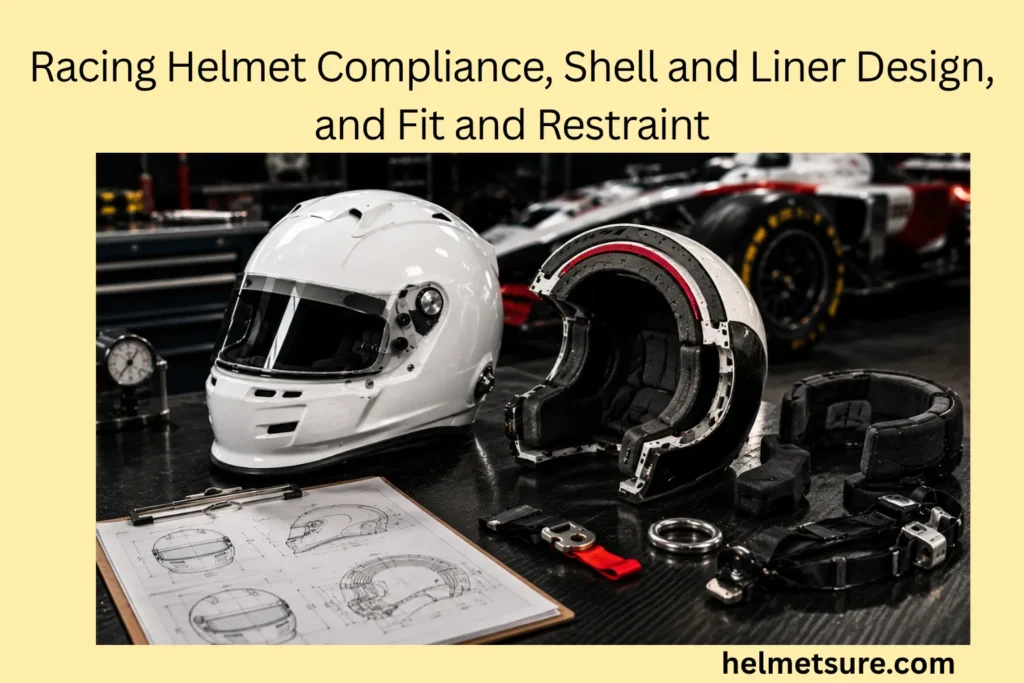
Racing Helmet Compliance, Shell and Liner Design, and Fit and Restraint
A racing helmet is competition-ready only when its required compliance, event eligibility, shell-liner system, fit, retention, condition, and restraint interfaces all pass verification for the specific motorsport event.
They also do not override a sanctioning body’s current rulebook. A complete pre-race decision must therefore move through six separate questions: Is the helmet certified or homologated as claimed? Is that standard accepted for the event? Is the shell-liner system intact? Does the helmet fit the individual driver? Does its retention system work correctly? Are any required frontal head restraint interfaces approved and compatible?
Why a Racing Helmet Must Be Evaluated as a Complete Protection System
A racing helmet must be evaluated as a complete protection system because compliance, shell construction, impact-liner performance, fit, and retention solve different parts of the safety decision. A strong shell does not correct a poor fit. A valid label does not repair a crushed liner. A tightened chin strap does not make an oversized helmet fit, and an approved frontal head restraint does not replace the helmet’s own retention system.
Complete racing helmet protection system
| Part of the system | Primary function | Failure or uncertainty that matters |
|---|---|---|
| Certification or homologation | Shows that the helmet model and configuration met a defined standard | Missing, altered, inconsistent, counterfeit, or unverified evidence |
| Event eligibility | Confirms that the governing rules accept the standard, version, and configuration | An otherwise certified helmet is not accepted for the class or event |
| Outer shell | Distributes localized loading and provides structural and penetration resistance within tested conditions | Cracking, delamination, deformation, holes, or unauthorized alteration |
| Impact liner | Deforms to manage energy transferred through the shell | Crushing, cracking, separation, or permanent deformation |
| Comfort padding | Provides contact, comfort, and model-specific fit adjustment | Excessive wear, incorrect parts, gaps, or unapproved modification |
| Fit | Couples the helmet to the driver’s head and maintains its intended position | Excessive movement, unsupported gaps, or concentrated painful pressure |
| Retention system | Keeps the fitted helmet secured through its strap, anchorage, and closure | Damaged webbing, stitching, hardware, anchorage, or poor adjustment |
| FHR interface | Connects an approved helmet to a compatible frontal head restraint when required | Incompatible anchors, tethers, helmet standard, or installation |
Certification vs Actual Event Eligibility
Racing helmet certification and actual event eligibility are separate because a helmet can meet a recognized standard while failing the specific rules governing a competition.
Compliance evidence → current event rule → technical inspection → eligible or not eligible
A genuine certification label is therefore necessary evidence, not a universal “race-legal” pass. A rulebook may accept only specified standards, may distinguish open- and closed-cockpit use, may require an FHR-compatible helmet, or may phase out an older standard. The 2026 FIA Appendix L, for example, publishes driver-equipment conditions for FIA-governed competition, while a national body, series, circuit, or organizer may publish a different applicable rule set. Always verify the exact event documents in force on the date of competition.
How Shell, Liner, Fit, and Retention Work Together
The racing helmet shell, impact liner, fit, and retention system work together by controlling external loading, managing transmitted energy, coupling the helmet to the head, and maintaining its position.
During an impact, the outer shell responds first. It helps spread a concentrated contact over a broader area and supports the structure surrounding the liner. The impact liner then deforms to lengthen the head’s stopping process and manage the load transferred inward. Correct fit keeps these components properly positioned relative to the driver’s head, while the chin strap, anchorage, and closure resist unwanted displacement or roll-off.
This is why one-feature marketing is an unreliable basis for judging protection. A premium shell material cannot restore the intended behavior of a damaged liner. A thick-looking liner does not establish tested performance. A snug-feeling helmet is not acceptable if its labels cannot be verified, and a certified helmet cannot perform as intended if it shifts independently of the head.
How Racing Helmet Standards Determine Compliance
Racing helmet compliance is determined by the applicable certification or homologation evidence and then verified against the rules governing the intended motorsport event. FIA, Snell, and SFI operate distinct systems; their labels are not interchangeable, and none should be treated as a universal ranking.
Compliance evidence and event-rule checks
| Standard system | Evidence to verify | What the evidence supports | Separate event-rule check |
|---|---|---|---|
| FIA | Exact FIA standard, homologation label, helmet identity, and—where applicable—the model’s presence on the relevant FIA Technical List | The helmet is homologated to the identified FIA standard in its approved configuration | Confirm that the event accepts that FIA standard and that the helmet meets its conditions of use |
| Snell | Exact SA designation, certification decal, manufacturer, model, and listing in Snell’s certified-helmet records | The certified model met the identified Snell Special Applications standard | Confirm that the sanctioning body accepts that SA version for the class and date |
| SFI | Exact specification and label, plus manufacturer and product identity | The manufacturer certifies the helmet to the named SFI Quality Assurance Specification | Confirm that the class permits that specification, label year, helmet configuration, and flame-resistance category |
FIA, Snell, and SFI Certification Requirements
FIA, Snell, and SFI racing helmet requirements are distinct standards or specification systems whose relevance depends on the discipline and competition rules.
The FIA publishes helmet standards, homologated product lists, and conditions of use. As of August 2026, its active catalog includes Technical List No. 107 for helmets homologated to FIA 8859-2024 and Technical List No. 69 for helmets approved to FIA 8860-2018. FIA 8878-2024 covers karting helmets. These examples show why the full designation matters: “FIA approved” is too vague for verification. The exact standard, helmet label, relevant list, application, and event rule must agree. The FIA standards catalog is the primary place to verify published standards, but eligibility still comes from the applicable sporting rules.[1]
Snell’s SA series is intended for competitive automotive sports. SA2025 took effect on October 1, 2025, while Snell states that production and shipping of SA2020-labelled units may continue through December 31, 2026. That production transition does not tell a driver which SA version a particular race accepts. It simply confirms that SA2020 and SA2025 labels may both be encountered during 2026. The event rulebook must provide the acceptance decision. Snell’s official SA2025 transition document also shows that a standard revision can alter test requirements, which is another reason to record the full year designation.[2]
SFI distinguishes SFI Spec 31.1, Flame Resistant Motorsports Helmets, from SFI Spec 41.1, Motorsports Helmets. SFI explains that each specification can cover open-face and full-face designs, but 41.1 is non-flame-resistant and is primarily associated with motorcycle applications; some sanctioning bodies may nevertheless permit it in particular automobile-racing classes. This is a direct example of why the standard body and the race organizer answer different questions. See the SFI helmet specification overview for the specification distinction, then check the governing class rule.[3]
For a deeper standards comparison, see HelmetSure’s guide to Snell and FIA certification.
How to Verify Helmet Labels and Homologation
Racing helmet labels and homologation markings should be checked against the exact issuing standard and helmet identity rather than trusted from appearance alone.
First locate the certification or homologation evidence specified by the issuing organization. Record the complete designation, including its year or revision where present. Then compare it with the helmet’s manufacturer, model, size, serial or homologation details, and any other identification required by the official records. A standards label, a manufacturer label, and a size label perform different jobs; one should not be used as a substitute for the others.
Next, validate the helmet against the issuing body’s current information. FIA publishes technical lists of homologated helmets. Snell maintains certified-model information and a reference area for scrutineers. SFI publishes its specifications and participating manufacturers. A logo that looks familiar is not enough: missing, altered, unreadable, inconsistent, or unverifiable labeling is an unresolved compliance condition.
The label also applies to an approved helmet configuration, not merely to a shell that once carried a sticker. Unapproved structural changes, incompatible components, or questionable replacement parts may create a separate condition or eligibility problem even when the original label is genuine.
Why Sanctioning-Body Rules Still Determine Eligibility
Sanctioning-body rules still determine racing helmet eligibility because the competition organizer defines which standards, versions, configurations, and dates it accepts.
The correct verification path begins with the exact series, class, vehicle, cockpit type, driver age category, and event date. Read the current rulebook and any bulletins or supplementary regulations, then confirm ambiguous wording with the organizer or technical inspector before arrival. Do not transfer a rule from one championship, club, country, or class to another.
A useful real-world contrast appears in FIA’s 2026 land-speed regulations, which list multiple FIA and Snell standards for a specific application. That list is evidence for those regulations—not a universal motorsport list. The lesson is procedural: identify the rule that governs the intended competition, compare the helmet’s complete marking with that rule, and let technical inspection provide the final event-side decision.
How the Racing Helmet Shell Protects the Head
The racing helmet shell forms the outer structural layer that distributes localized loading, resists penetration under defined test conditions, and supports the impact-management system beneath it. These functions depend on the complete shell design, not just the name of a fiber or polymer.
Racing helmet shell functions and limits
| Shell function | What the shell contributes | What it does not prove |
|---|---|---|
| Load distribution | Spreads concentrated contact across a larger part of the helmet structure and liner | That the shell absorbs the entire impact |
| Penetration resistance | Resists controlled penetrator challenges required by the applicable standard | Resistance to every object, speed, angle, or crash condition |
| Structural continuity | Maintains the engineered load path around openings, edges, anchor areas, and shell geometry | That a cracked, drilled, or delaminated shell remains serviceable |
| Material and layup | Influences mass, stiffness, strength, deformation, manufacturability, and durability | That carbon fiber, fiberglass, or polymer is universally safest |
How the Shell Distributes Impact Loads
The racing helmet shell distributes localized impact loading across a broader structure before the remaining load reaches the impact liner.
When a limited area of the shell contacts another surface, the shell bends and carries load through its geometry and material structure. This response can engage a wider region of the impact liner than the original contact patch alone. The process is therefore local impact → shell response and load distribution → liner loading.
Load distribution is not the same as energy absorption. The shell can deform and participate in the overall impact response, but the crushable impact liner performs the primary controlled energy-management role inside the helmet. Technical work published by the Snell Foundation on helmet impact response illustrates how shell stiffness, impact-surface shape, and the area of liner engaged can change the response. The precise behavior remains specific to the assembled helmet and impact condition.
How Shell Construction Resists Penetration and Structural Failure
Racing helmet shell construction resists penetration and structural failure by maintaining engineered strength and continuity under the conditions addressed by the applicable standard.
Penetration tests use defined test equipment and conditions. Passing such a test supports a controlled performance claim; it does not mean the shell is impenetrable in every crash. The shell must also retain the structural relationships established by its design—around the eyeport, lower edge, vents, visor hardware, strap anchorages, and any approved FHR terminal provisions.
Cracks, punctures, delamination, abnormal deformation, exposed fibers, loose anchorage, or unauthorized holes interrupt confidence in that structure. These observations do not need a consumer-invented “acceptable size.” They require the helmet maker’s instructions, an authorized inspection where available, and the event’s eligibility rules. Do not drill a shell to add a camera, communications mount, ventilation opening, or restraint anchorage unless the helmet manufacturer and applicable homologation explicitly permit the exact procedure and parts.
How Shell Materials Affect Strength, Weight, and Deformation
Racing helmet shell materials influence strength, mass, stiffness, and deformation, but material name alone does not determine complete helmet protection.
Composite shells may combine fiberglass, carbon fiber, aramid fibers, resins, and other reinforcements. Other helmets may use engineered thermoplastic shells. Their performance depends on fiber orientation, layup, resin control, wall thickness, geometry, shell-size strategy, quality control, bonding, and interaction with the liner. Two helmets advertised with the same headline material can therefore behave differently.
How the Impact Liner Absorbs and Manages Energy
The racing helmet impact liner manages energy transferred through the shell by deforming so the head experiences a less abrupt deceleration. It is not interchangeable with the removable padding that makes the interior comfortable.
Shell, impact liner, and comfort padding roles
| Component | Primary role | Typical decision question |
|---|---|---|
| Outer shell | Distributes concentrated loading, provides structural continuity, and resists penetration within tested conditions | Is it intact, unmodified, and consistent with its approved configuration? |
| Impact liner | Deforms in a controlled way to manage the energy transmitted inward | Is it free from crushing, cracking, separation, or permanent deformation? |
| Comfort padding | Supports contact, comfort, moisture management, and model-specific fit tuning | Is it correctly installed, serviceable, and approved for this exact model? |
How Liner Compression Reduces Head Deceleration
Racing helmet liner compression manages head deceleration by increasing the distance and time over which transmitted impact energy is dissipated.
In simple terms, bringing a moving head to rest over a greater controlled distance and time can reduce the abruptness and peak of the loading compared with a rigid stop. The crushable liner supplies that limited working distance. Its material, density distribution, thickness, geometry, ventilation channels, coverage, and coupling to the shell are engineered together.
Impact Liner vs Comfort Padding
The racing helmet impact liner performs the main engineered energy-management role, while comfort padding primarily controls contact, comfort, and fit unless the manufacturer specifies another function.
The impact liner is commonly a comparatively firm, crushable structure attached inside the shell. Comfort padding, cheek pads, crown pads, and removable interior pieces are softer and may be designed for cleaning or approved fit adjustment. Their exact construction varies by model, so appearance alone is not a reliable identification method.
Replacing cheek pads may be an approved way to refine contact in one helmet family, but it does not change the nominal shell or impact-liner size and should not be used to rescue a fundamentally oversized or wrong-shape helmet. Use only the manufacturer’s compatible parts and permitted combinations. Never cut, sand, compress, heat, or remove impact-liner material to alter fit.
Why Crushed or Damaged Liners Reduce Protection
A crushed or damaged racing helmet liner reduces confidence in protection because permanently altered liner material no longer matches its intended impact-management condition.
Damage may include cracking, crushing, separation from the shell, missing material, or a permanent local depression. Some damage may be hidden beneath comfort components or may exist even when the outer shell appears normal. A soft or worn comfort pad is a different condition, but it must still be replaced only with an approved part if it affects fit.
The decision path is known or suspected damage → stop use → consult the exact manufacturer guidance or authorized inspection service → replace when required. Snell advises replacement when a helmet has been involved in an impact while in use and explains that a crushable liner manages severe impact by collapsing. Do not attempt to restore a damaged liner with adhesive, filler, heat, added foam, or reshaping; its material and geometry belong to the tested helmet design.
How Shell and Liner Design Work Together During an Impact
Racing helmet shell and liner design work together by distributing external loading first and managing the remaining transmitted energy through controlled liner deformation.
Impact contact → shell response → load distribution and transfer → impact-liner deformation → managed loading at the head
This chain describes complementary functions, not a promise that every impact can be controlled. Impact speed, angle, location, surface geometry, repeated contact, helmet position, and the limits of the specific design all affect the outcome.
Shell Load Distribution and Liner Energy Absorption
Racing helmet protection combines shell load distribution with liner energy absorption so localized contact is spread before the remaining energy is managed inside the helmet.
On contact, shell stiffness and geometry affect how much of the structure and liner become involved. The liner then supplies a controlled crush distance. If too little liner area is engaged, or the available crush distance is exhausted, loading can rise sharply. Conversely, simply making the shell or liner “softer” is not a complete solution because penetration resistance, stability, repeated-test requirements, geometry, and other performance demands must also be satisfied.
The correct unit of evaluation is the certified assembled helmet. Shell material, liner thickness, foam density, and visible bulk are design inputs—not independent safety scores.
How Controlled Deformation Helps Manage Impact Forces
Controlled deformation helps the racing helmet manage impact forces because engineered changes in the shell and liner affect how rapidly energy reaches the head.
Designed deformation is the response intended to occur during the impact event. Residual deformation is what remains afterward. The first is part of the energy-management mechanism; the second raises a serviceability question. A shell that flexes during a test is not automatically defective, and a helmet that looks normal after a crash is not automatically reusable.
Consumers cannot calculate absorbed energy from dents, scratches, liner marks, or crash appearance. When impact history is known or damage is suspected, preserve the helmet, stop using it, and follow the maker’s inspection or replacement instructions. Race eligibility and medical clearance are separate matters: an equipment inspection cannot diagnose injury or authorize a return to racing.
Why Protection Depends on the Shell-Liner System Rather Than One Component
Racing helmet protection depends on the shell-liner system because the shell and liner perform sequential but interdependent functions during an impact.
Shell integrity affects how load reaches the liner. Liner integrity affects how the transferred energy is managed. Fit determines where the system sits relative to the head, and retention helps it remain there. A premium shell cannot compensate for crushed liner material; an intact liner cannot restore a cracked or altered shell; and neither can correct a helmet that does not fit.
Verified system performance, correct configuration, and condition carry more weight than a single marketing feature. Once the construction is acceptable, the next question is whether that specific helmet couples correctly to that specific driver’s head.
How to Check Racing Helmet Fit
Racing helmet fit is correct when size, head shape, internal contact, and helmet position match the wearer without excessive looseness or harmful concentrated pressure. Fit must be established before the chin strap is used to assess retention.
Racing helmet fit observations and actions
| Observation | Likely meaning | Action |
|---|---|---|
| Even, firm contact around the head with no painful hot spot | Size and internal shape may be appropriate | Continue with the maker’s full fit and retention checks |
| Helmet shifts independently while the head remains comparatively still | Helmet may be oversized, the wrong shape, or fitted with incorrect/worn comfort parts | Recheck measurement, size, shape, and approved interior configuration |
| Large unsupported areas combined with tight pressure elsewhere | Likely head-shape mismatch | Try a different model or internal shape rather than merely increasing size |
| Immediate concentrated or painful pressure | Size may be too small or shape may be wrong | Remove the helmet and reassess both size and shape |
| Correct circumference range but unstable position | Nominal size alone has not produced correct fit | Test another model/shape and confirm all approved pads are installed |
| Fit changes after interior wear or component replacement | Padding condition or incompatible parts may have changed contact | Use only exact approved parts and repeat the full fit check |
Head Circumference, Head Shape, and Internal Contact
Head circumference establishes the starting racing helmet size, while head shape and internal contact determine whether that nominal size actually fits.
Measure at the location and in the manner specified by the helmet manufacturer, then use the size chart for the exact model—not a generic racing-helmet chart. Size labels are not standardized closely enough to assume that the same nominal size will fit across brands or even across models. Bell Racing’s official size guide explicitly describes measurement as only the starting point because heads with the same circumference may have different shapes.[4]
Try the measured starting size with every required interior component installed. Check that the helmet sits at its intended height and orientation, gives the required field of view, and produces firm, consistent contact around the head and cheeks where the maker intends it. Then assess movement and pressure. HelmetSure’s detailed guide to racing helmet fit explains this measurement-to-contact process.
Signs a Racing Helmet Is Too Loose
A racing helmet is too loose when it shifts independently of the head, loses even contact, or fails to maintain its intended position during approved fitting checks.
Observable signs can include the shell rotating while the head does not follow, the helmet settling into a different position after movement, unstable eyeport alignment, or gaps inconsistent with the maker’s fitting instructions. When the helmet is moved gently according to the manufacturer’s procedure, some skin movement can indicate coupling; obvious independent helmet travel suggests looseness.
Signs a Racing Helmet Is Too Tight or the Wrong Shape
A racing helmet is too tight or the wrong shape when pressure becomes concentrated, painful, or uneven instead of firm and consistently distributed.
A new helmet can feel firmly snug, especially at the cheeks, without being harmful. The warning pattern is focused discomfort: a painful forehead point, strong pressure at the temples, numbness, or a narrow high-load area combined with looseness elsewhere. That combination often suggests shape mismatch rather than a simple size problem.
Moving immediately to a larger size may remove the pressure point while creating excessive overall movement. Recheck the exact size chart, confirm the model’s intended internal shape, and try an alternative model or manufacturer-approved pad configuration. Do not rely on an invented break-in period, and never compress or remove the impact liner to create space.
How the Helmet Retention System Keeps the Helmet Secure
The racing helmet retention system keeps the helmet secured through the chin strap, anchorage, closure system, and correctly fitted helmet structure. It controls helmet displacement; it does not create correct fit and it does not perform the same function as an FHR.
Retention system inspection and stop conditions
| Retention element | Inspect or verify | Stop or escalate when |
|---|---|---|
| Webbing | Clean routing, intact fibers, no cuts, burns, chemical damage, or severe wear | Webbing is frayed, cut, stiffened, contaminated, or altered |
| Stitching and anchorage | Secure, undisturbed attachment consistent with the original design | Stitching is broken or the anchorage is loose, corroded, deformed, or modified |
| Closure hardware | Correct engagement, release, routing, and approved operation | Hardware does not lock, is damaged, or uses an improvised part |
| Adjustment | Manufacturer-approved snug adjustment after correct fit is established | Strap cannot remain adjusted or is used to compensate for an oversized helmet |
| Roll-off resistance | Helmet maintains its intended position during the maker’s approved fitting check | Helmet rolls, displaces, or exposes the head beyond its intended position |
| FHR interface | Approved helmet anchors, compatible tether and FHR, correct installation | Any component, approval, standard combination, or installation is uncertain |
How Chin Straps and Anchorage Control Helmet Movement
Racing helmet chin straps and anchorage control helmet movement by maintaining the retention path between the helmet shell and the wearer’s head.
That path runs from one shell anchorage through the webbing and closure beneath the jaw to the anchorage on the other side. Each part matters. Strong webbing cannot compensate for a damaged anchor; intact anchors cannot compensate for a closure that is misrouted or does not engage; and a correct closure cannot make a poorly fitting helmet stable.
Inspect the system exactly as supplied. Look for cuts, fraying, heat or chemical damage, damaged stitching, corrosion, deformation, loose hardware, and unauthorized repair. Use the closure procedure documented for the exact helmet. Double-D rings, quick-release mechanisms, and other certified designs should be judged by their approved configuration and event rules—not by a universal claim that one closure type is always safest.
How to Check Strap Adjustment and Helmet Roll-Off
Racing helmet strap adjustment is correct when the approved retention system closes securely and keeps the helmet from rolling or displacing beyond its intended position.
Begin only after correct size and head-shape compatibility are established. Route and fasten the strap exactly as the manufacturer instructs, remove avoidable slack using that procedure, and confirm the closure remains engaged. Then perform only the maker’s user-level positional-stability or roll-off check. The aim is to identify obvious displacement, not to reproduce a certification laboratory test.
If the helmet rolls, shifts excessively, or changes position, diagnose fit and retention separately. Recheck size and shape first, then examine strap routing, adjustment, closure, and anchorage. Do not pull with test-machine force, invent a strap-slack distance, or assume that painful tightening is the solution.
How Helmet Retention Interfaces With Frontal Head Restraints
Racing helmet retention interfaces with a frontal head restraint through approved helmet anchors, while the chin strap remains the separate system responsible for retaining the helmet on the head.
The chin strap completes the helmet’s retention path. An FHR—of which HANS is one type—uses approved helmet anchors and tethers as part of a broader system intended to control relative head movement during defined frontal or angled-frontal loading. The FHR does not hold the helmet onto the head in place of the chin strap.
When a Racing Helmet Should Be Inspected or Replaced
A racing helmet should be inspected or replaced when impact history, structural damage, liner deterioration, retention wear, aging, modification, or changing competition eligibility creates uncertainty about continued use. “Looks fine” is not a serviceability finding.
Racing helmet inspection and replacement triggers
| Trigger | Affected component or status | Authority to check | Action |
|---|---|---|---|
| Crash, occupied impact, or other significant impact history | Shell, impact liner, retention, visor hardware, anchors | Exact manufacturer instructions or authorized inspection service | Stop use; replace or inspect only as directed |
| Crack, delamination, puncture, abnormal deformation, or exposed structural material | Shell | Manufacturer | Stop use and seek an authoritative decision; do not patch or refinish it |
| Crushed, cracked, separated, or permanently deformed energy-management material | Impact liner | Manufacturer | Stop use; do not attempt DIY repair |
| Frayed webbing, damaged stitching, loose anchorage, or unreliable closure | Retention system | Manufacturer or authorized service | Stop use until the approved repair or replacement path is completed |
| Worn or compressed comfort components affecting fit | Comfort padding and fit | Exact model documentation | Replace only with approved compatible parts, then repeat the fit check |
| Age or long service history without obvious damage | Physical condition and administrative eligibility | Manufacturer plus current sanctioning-body rule | Inspect condition and check the two timelines separately |
| Paint, wrap, mount, drilling, hardware, liner, or anchor change | Shell integrity, configuration, homologation, or eligibility | Manufacturer, standard/homologation documents, and sanctioning body | Verify approval before use; unresolved status means not ready |
Impact Damage to the Shell, Liner, and Retention Hardware
Impact damage to a racing helmet shell, liner, or retention hardware requires evaluation because external appearance alone does not establish continued serviceability.
Record what happened without trying to calculate severity from memory. Inspect the shell, impact liner, comfort interior, chin strap, closure, anchorage, visor hardware, and FHR terminals as separate elements. External scuffing may be cosmetic in one documented situation, while an apparently clean shell may hide liner crushing or internal separation in another. Consumers should not invent a drop height, crack length, dent depth, or number of impacts that supposedly proves safety.
If the helmet was worn during a crash or impact, or if structural damage is suspected, stop using it and follow the exact maker’s policy. Snell’s helmet replacement guidance advises replacement after an impact while in use and when compromise is suspected. The helmet manufacturer may provide a model-specific inspection service, but only that documented process can support continued use. For the complete decision path, see HelmetSure’s guide to racing helmet replacement.
How Age and Wear Affect Continued Helmet Use
Racing helmet age and wear affect continued use through physical condition, manufacturer guidance, and sanctioning-body acceptance, which must be checked separately.
Physical aging concerns the actual helmet: liner condition, adhesive or bond integrity, comfort-padding wear, strap webbing, stitching, closure hardware, anchor areas, visor mechanisms, and signs of heat, moisture, UV, chemical, or storage damage where the manufacturer identifies them. Administrative eligibility concerns whether the event still accepts the certification or homologation designation.
How Modifications and Certification Status Affect Eligibility
Racing helmet modifications can affect certification status or event eligibility when they alter the shell, restraint interfaces, approved accessories, or configuration covered by the helmet’s original compliance.
Potentially relevant changes include drilling, cutting, sanding, impact-liner alteration, replacement of retention hardware, non-approved FHR posts, camera or communication mounts, paint, solvents, wraps, adhesives, visor components, and substituted interior parts. The effect is not identical in every case. A manufacturer-approved visor or cheek pad is different from a hole drilled through the shell, while a paint system permitted by one manufacturer may be prohibited or restricted by another.
Use a three-part check: manufacturer approval → certification or homologation conditions → sanctioning-body acceptance. Obtain permission for the exact helmet model, material, product, component, and installation—not for a broad category such as “stickers” or “mounts.” Unresolved modification status is both a physical-integrity question and an eligibility stop condition.
How to Verify a Racing Helmet Before Competition
A racing helmet should enter competition only after compliance, physical condition, fit, retention, and required restraint compatibility have all been verified. These checks are gates, not a score: one unresolved critical item cannot be offset by several successful ones.
Confirm Compliance, Condition, and Correct Fit
Confirm the racing helmet’s compliance evidence, physical condition, and correct head fit before accepting it for competition.
Start with the complete certification or homologation designation and confirm that it belongs to the helmet’s identified manufacturer, model, and approved configuration. Match it to the governing event rule in force, including any class, cockpit, date, or FHR condition. Treat missing, altered, inconsistent, or unverified evidence as unresolved.
Next inspect shell, liner, interior, visor hardware, chin-strap anchorage, and other fitted components using the maker’s instructions. Review impact history rather than relying only on visible condition. Finally, repeat the model-specific fit process: circumference, nominal size, head-shape compatibility, even contact, position, vision, and resistance to independent movement.
Confirm Retention and Restraint Compatibility
Confirm racing helmet retention and frontal-head-restraint compatibility separately so both systems meet their intended functions and competition requirements.
For retention, verify intact webbing, stitching, shell anchorage, closure operation, correct routing, manufacturer-approved adjustment, and maintained helmet position. A retention pass assumes that the helmet already fits correctly.
Where an FHR is required, independently verify the helmet’s approved anchors, tether, FHR model, applicable standards, permitted combination, and installation. The chin strap must still retain the helmet on the head. An uncertainty in either system is a stop condition; do not merge them into a single “restraint fitted” judgment.
Complete a Final Pre-Race Helmet Safety Check
Complete the final pre-race racing helmet safety check only after every compliance, condition, fit, retention, and restraint requirement has already been established.
Use the checklist as a pass/fail summary. A failed or unresolved item means the helmet is not competition-ready until the manufacturer, sanctioning body, or qualified technical inspector resolves it. Do not average the results into “mostly ready.”
Final Pre-Race Racing Helmet Checklist
Frequently Asked Questions About Racing Helmet Compliance and Fit
These answers summarize the article’s compliance, construction, fit, retention, condition, and FHR boundaries.
Does a certification label make a helmet legal for every race?
No. Certification or homologation identifies tested compliance, while the current sanctioning-body rule determines whether the exact standard, version, configuration, and helmet type are eligible for a particular class and date.
Is carbon fiber automatically the safest racing helmet shell?
No. Material name alone does not establish helmet-level performance. Shell geometry, layup, quality control, liner design, verified homologation, condition, fit, and intended application all matter.
Can laboratory testing guarantee prevention of concussion?
No. Standards compare defined performance under controlled conditions. They cannot predict or guarantee an individual medical outcome in every uncontrolled crash.
Can a tighter chin strap fix a loose racing helmet?
No. The chin strap retains an already correct fit. It cannot correct an oversized helmet, a head-shape mismatch, missing pads, or worn interior components.
Are comfort pads and the impact liner the same component?
No. The crushable impact liner manages transmitted energy, while removable comfort components primarily support contact, comfort, moisture control, and approved fit refinement.
Does an FHR replace the helmet chin strap?
No. The chin strap retains the helmet on the head. An FHR uses approved helmet anchors and tethers within a separate, compatible restraint system.
Should a helmet be reused after a significant impact if it looks normal?
External appearance alone is not enough. Stop use and follow the exact manufacturer’s impact, inspection, and replacement instructions or an authorized inspection process.
Does helmet age alone determine replacement?
No universal age decides every case. Physical condition, manufacturer guidance, impact and service history, modification status, and current event eligibility must be checked separately.