
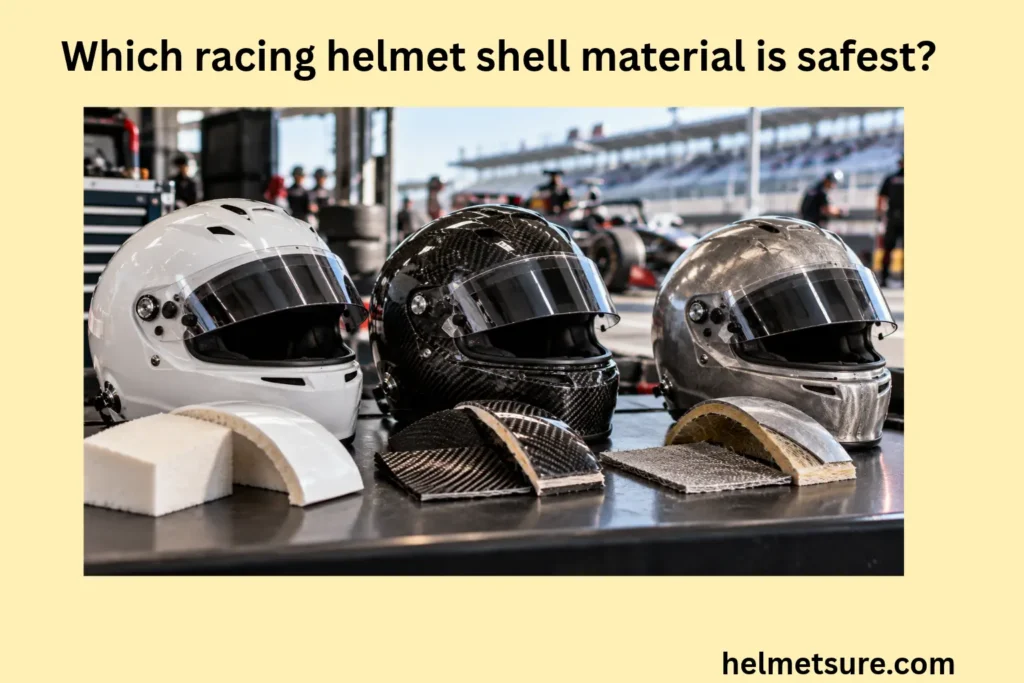
Which Racing Helmet Shell Material Is Safest?
No racing helmet shell material is universally safest by name alone. Carbon fiber, fiberglass, aramid, and hybrid composites create different shell behaviors, but finished protection depends on construction, shell-liner interaction, certification, fit, and racing requirements.
No shell material guarantees prevention of head injury. The useful comparison begins with what each material can contribute, then checks whether the finished helmet meets the driver’s actual requirements. Certification and shell-material identity cannot guarantee prevention of concussion, traumatic brain injury, or another injury, and they cannot determine medical fitness to race after a crash.
The Safest Racing Helmet Cannot Be Identified by Shell Material Alone
Shell material describes part of a protective system. It cannot establish the complete helmet’s impact performance, suitability for an individual driver, or acceptance in competition.
Carbon fiber, fiberglass, aramid, and hybrid are material families—not complete safety ratings.
Why raw material strength and shell-material identity cannot independently determine complete helmet protection
Raw material strength describes resistance to a particular failure under specified loading. It does not describe every response a finished helmet must provide.
Strength, stiffness, and toughness answer different questions. Strength concerns failure under load. Stiffness concerns resistance to deformation. Toughness concerns resistance to fracture and the energy associated with damage. A favorable result for one property does not establish favorable results for all three. Composite-impact research treats response as dependent on several interacting parameters.
A fiber specification therefore cannot replace a complete helmet test. The test evaluates the assembled product under defined conditions rather than predicting protection from its reinforcement name.
Why shell material should be treated as one safety variable rather than the final safety verdict
Shell material belongs in a safety comparison, but it is only one input. Complete-helmet evidence must carry more weight than a material label.
Helmet engineering research links shell behavior to the response of the assembled helmet. Official racing standards evaluate finished protective headgear. Neither evidence type establishes a universal material winner.
For a driver, “carbon” or “fiberglass” should prompt questions about a particular helmet. It should not end the investigation. Certification, individual fit, and racing eligibility require their own checks.
Shell Material vs Complete Helmet Safety
| Shell material can influence | Shell material alone cannot establish |
|---|---|
| Stiffness and deformation behavior | Complete helmet impact performance |
| Shell mass | Prevention of head injury |
| Fracture and delamination behavior | Appropriate shell-liner interaction |
| Penetration-related behavior | Certification status |
| Material-specific design possibilities | Correct individual fit |
| Available construction approaches | Competition eligibility |
Which Shell Materials Are Commonly Used in Racing Helmets?
The relevant families are carbon-fiber composites, fiberglass composites, aramid reinforcement, and hybrids combining reinforcement types. These names identify constituents rather than complete shell specifications.
How carbon fiber is used as a lightweight structural reinforcement in racing helmet shells
Carbon fibers reinforce a resin-based composite shell. Their high specific stiffness can support structural stiffness with comparatively low material mass. “Specific stiffness” means stiffness relative to density.
The shell is a composite structure, rather than a collection of independent fibers. Bell’s RS7 PRO specification provides one racing example: its stated shell combines carbon and fiberglass. That description applies to this model, not every helmet marketed with carbon fiber.
How fiberglass is used as a fiber-reinforced shell material
Fiberglass shells use glass fibers as reinforcement in a composite material. Helmet-shell engineering literature includes glass-fiber constructions among the structures investigated for impact response.
“Fiberglass” therefore names a reinforcement family. It does not specify a helmet’s mass, damage behavior, or certified performance. A fiberglass helmet deserves evaluation through its own product documentation and finished-helmet evidence.
How aramid is used as reinforcement within racing helmet shell constructions
Aramid can serve as reinforcement within a composite shell, including a hybrid containing other fibers. Its role is to change selected mechanical characteristics of that construction.
Kevlar is a familiar trade name associated with aramid, but the presence of an aramid name does not reveal its structural contribution. Carbon/aramid research shows that impact and damage behavior change with how the reinforcement is incorporated. These specimen findings explain mechanisms; they do not certify a racing helmet.
How hybrid composites combine multiple reinforcement materials within one shell
Hybrid composites combine two or more reinforcement types to pursue a particular balance of properties. Hybridization describes an engineering approach, not an assurance of superior protection.
A carbon/glass shell is one example. Bell documents that combination for the RS7 PRO and separately identifies its energy-managing liner. This illustrates an actual racing-helmet construction without establishing a comparison against other models.
Racing Helmet Shell Material Map
| Material family | Structural role | Main comparison question | Do not infer |
|---|---|---|---|
| Carbon-fiber composite | Carbon reinforcement | What stiffness and mass does the actual shell achieve? | Universally superior protection |
| Fiberglass composite | Glass reinforcement | How does the actual shell respond to loading? | Automatic inferiority |
| Aramid reinforcement | Constituent in some composite systems | What role does it serve in this shell? | Guaranteed penetration superiority |
| Hybrid composite | Multiple reinforcement types | What properties does this combination target? | Best-of-all-materials performance |
How Do Racing Helmet Shell Materials Behave During an Impact?
An impacted shell can resist deformation, change shape, and develop damage. Concentrated loading also raises the separate question of penetration resistance. These responses require different interpretations.
Greater stiffness, more flex, or visible damage cannot be converted into a universal safety ranking without the complete structure and test context.
How shell stiffness affects impact load distribution through the shell structure
Shell stiffness influences how a localized load travels through the structure and how much the shell deforms. It is a mechanical property, not an independent measure of protection.
Helmet modeling has investigated changes in shell stiffness as a contributor to dynamic impact response. The resulting system response cannot be reduced to “more stiffness means more safety.”
The practical distinction is between maintaining structural resistance and demonstrating the finished helmet’s performance. A stiffness claim addresses the former question.
How shell deformation changes structural response under impact loading
Deformation changes the shell’s shape and stress distribution during loading. Its significance depends on the extent of the movement and whether damage develops.
Elastic movement can recover after unloading. Fracture-related changes can leave lasting damage. Observing more flex therefore does not, by itself, establish either greater energy dissipation or worse protection. Composite and helmet-impact research examine deformation together with damage and loading conditions.
Shell deformation is also distinct from liner compression. The functions of those components are considered together later in this article.
How cracking and delamination affect energy dissipation and remaining shell integrity
Cracking and delamination can dissipate energy while damaging the shell. Both effects matter when interpreting an impact.
Cracking involves fracture within the composite. Delamination involves separation between layers. Helmet-shell research identifies damage and delamination as mechanisms involved in energy absorption during modeled impacts.
Energy consumed by damage does not establish that the shell retains its original protective capacity. A damaged shell’s remaining integrity is a separate concern. Neither visible cracking nor an apparently intact exterior provides a complete post-impact safety assessment.
How penetration resistance affects the shell’s ability to maintain structural coverage
Penetration resistance concerns maintaining a protective barrier under concentrated loading. It is separate from blunt-impact attenuation.
Snell SA2025 includes a shell-penetration test. FIA 8859-2024 also includes penetration requirements. These procedures evaluate helmet performance under prescribed conditions.
A shell’s resistance to a concentrated strike cannot establish how the helmet manages every blunt impact. Conversely, a favorable impact result should not be treated as a substitute for required penetration evidence.
Shell Impact Behavior Sequence
| Shell response | Mechanical role | Required interpretation |
|---|---|---|
| Stiffness | Influences load paths and deformation | Greater stiffness is not a universal safety ranking |
| Deformation | Changes shape and stress distribution | Flex alone does not prove energy absorption |
| Cracking or delamination | Can dissipate energy through damage | Remaining structural integrity is also affected |
| Penetration resistance | Preserves a barrier under concentrated loading | Separate from blunt-impact attenuation |
What Are the Safety Advantages and Limitations of Carbon-Fiber Racing Helmet Shells?
Carbon fiber offers useful stiffness-to-weight design potential. Its limitations concern how a particular composite responds to damage and how the finished helmet performs.
How carbon fiber’s stiffness-to-weight characteristics affect shell design priorities
Carbon fiber’s specific stiffness can help designers pursue structural stiffness while limiting mass. That is a property-level advantage rather than a complete safety conclusion.
A driver should ask whether this potential produces a relevant benefit in the actual helmet being considered. The material label alone does not establish the model’s stiffness, mass, or impact-test results.
How lower shell mass can influence helmet mass without independently proving greater impact protection
A lighter shell can contribute to a lighter helmet. Finished helmet mass also includes the liner, retention system, visor, and other components.
Carbon’s low-mass design potential is a legitimate comparison point. Certification remains a separate question because the standard evaluates protective performance rather than awarding protection according to mass.
Compare the manufacturer’s specification for the relevant size and configuration. Do not assume that a material name establishes the assembled mass. For the separate question of sustained wear, see helmet weight.
How carbon fiber’s toughness and brittle-failure characteristics affect shell-response trade-offs
High stiffness does not establish high toughness. Carbon-composite damage can involve fracture and delamination rather than extensive recoverable deformation. The particular failure response remains construction-dependent.
“Brittle” should describe a specified failure behavior, not serve as a blanket verdict on every carbon helmet. Damage mechanisms can consume impact energy while changing the shell’s integrity. A meaningful comparison needs the actual structure and test context.
How carbon fiber’s material advantages can be offset by differences in actual helmet design
Carbon’s material advantages may not produce an advantage in the finished helmet. Different designs can use the same reinforcement family and deliver different system responses.
This is why a carbon label should not settle a comparison against a fiberglass or hybrid model. Compare documented characteristics and applicable finished-helmet evidence. Detailed construction factors are addressed separately below.
Carbon-Fiber Safety Trade-Off Matrix
| Carbon-related attribute | Potential design advantage | Required limitation |
|---|---|---|
| High specific stiffness | Structural stiffness with limited mass | Stiffness is not impact attenuation |
| Low-mass design potential | A lighter assembled helmet may be possible | Actual mass must be checked |
| Fracture and delamination behavior | Damage may dissipate energy | Damage changes structural integrity |
| Composite design flexibility | A shell can target particular properties | The executed design determines the result |
How Do Fiberglass and Hybrid Composite Shells Compare for Crash Protection?
Fiberglass and hybrid shells offer alternative balances of mechanical properties. Neither can be ranked for crash protection from its reinforcement name alone.
How fiberglass flex and stiffness influence impact load distribution
Fiberglass composites can offer a different stiffness and deformation response from carbon composites. A fiberglass shell is not necessarily more flexible than every carbon shell, because the comparison concerns complete structures.
Glass-fiber helmet-shell research examines distinct constructions rather than treating all glass reinforcement as mechanically identical. Compare stiffness claims only when the tested structures and conditions are genuinely comparable.
For a dedicated comparison, see carbon vs fiberglass.
How fiberglass toughness affects cracking and structural continuity under load
Fiberglass toughness affects how a glass-reinforced composite develops damage and resists fracture. It does not guarantee that a shell stays intact through a crash.
The relevant question is how the particular composite tolerates damage while carrying load. Composite and hybridization reviews show why behavior must be evaluated in its material and structural context. A universal “fiberglass is tougher” claim would omit that context.
Visible cracking also cannot establish the amount of energy managed by a complete helmet.
How aramid reinforcement affects toughness and penetration-related behavior in a hybrid shell
Aramid reinforcement can alter a hybrid’s damage tolerance and response to concentrated loading. Its presence alone does not establish greater penetration resistance in a racing helmet.
Carbon/aramid specimen research found different impact-damage responses among different hybrid configurations. The study supports the importance of architecture, not a general helmet-protection ranking.
For a helmet-specific penetration claim, the appropriate evidence is finished-helmet testing under the relevant standard.
How hybrid material combinations produce different structural trade-offs from single-fiber shells
Hybridization can combine complementary properties, but the combination may introduce its own trade-offs. It does not automatically reproduce the strongest characteristic of each constituent.
Carbon/glass and carbon/aramid are different material approaches. Even within one pairing, the resulting response can differ. The carbon/aramid study illustrates this dependence on configuration under its particular laboratory loading. Its results cannot substitute for racing-helmet testing.
Fiberglass/Hybrid Safety Comparison Matrix
| Material approach | Safety-relevant property to investigate | Main limitation |
|---|---|---|
| Fiberglass composite | Stiffness, deformation, and damage behavior | Actual response belongs to the specific structure |
| Aramid reinforcement | Contribution to damage tolerance and concentrated-load response | Presence alone does not establish penetration performance |
| Carbon/glass hybrid | Balance of stiffness, mass, and damage characteristics | Combined fibers do not guarantee superiority |
| Carbon/aramid hybrid | Balance of stiffness and damage mechanisms | Specimen results do not establish racing-helmet protection |
Why Does Shell Construction Matter Separately From the Fiber Name?
Construction determines how reinforcement becomes a load-bearing shell. Orientation, placement, laminate architecture, thickness, resin, and bonding can change its response independently of the fiber name.
How fiber orientation and reinforcement placement change directional and local shell behavior
Fiber orientation changes directional properties. Reinforcement placement changes where those properties act within the shell.
A shell must respond to loads at different locations and directions. Reinforcing one direction does not establish equal resistance in every direction. Local reinforcement also need not have the same effect as adding material throughout the shell.
No universal fiber angle or placement can be identified as safest without the shell geometry and loading context.
How laminate architecture changes how loads move through the shell
Laminate architecture determines how reinforcement layers are organized and how they interact. It influences load transfer and potential damage paths.
Layering different fibers is one form of hybrid construction. Mixing them within a layer is another. These approaches need not produce identical properties even when they use the same named constituents.
An exposed carbon weave shows a surface appearance. It does not establish the architecture of the entire shell.
How laminate thickness affects stiffness, mass, and failure behavior
Laminate thickness affects structural stiffness and mass. It can also change stress distribution and damage development.
Adding thickness is therefore a design change with several consequences. It is not a standalone rule for increasing helmet protection. A thinner structure is likewise not automatically inadequate.
Thickness comparisons require the rest of the construction to be understood. Neither an unspecified “thick shell” claim nor a material label supplies that information.
How resin-system quality and bonding affect structural integrity
The resin matrix and its interfaces help transfer loads between fibers and layers. Their behavior contributes to the integrity of the composite structure.
Fibers do not operate independently of the material holding them together. Interfacial damage can interrupt load transfer and contribute to layer separation. A fiber’s favorable properties therefore do not establish the properties of the completed laminate.
Product-specific claims about resin chemistry, curing, or bonding quality require documentation for that product. A visible finish cannot verify those manufacturing details.
Shell Construction Factor Map
| Construction factor | What it changes | Comparison boundary |
|---|---|---|
| Fiber orientation | Directional response | No universally safest ply angle |
| Reinforcement placement | Local behavior | More reinforcement is not automatically better |
| Laminate architecture | Load transfer and damage paths | Fiber names do not describe the whole arrangement |
| Laminate thickness | Stiffness, mass, and stress distribution | Greater thickness is not a safety verdict |
| Resin or matrix | Composite integration and fracture behavior | Chemistry claims require product evidence |
| Interfaces and bonding | Structural continuity and layer separation | Material identity does not establish manufacturing quality |
How Does the Shell Work With the Helmet’s Energy-Absorbing Liner?
The shell changes the loading presented to the liner. The liner then deforms to manage impact energy. These functions interact during the same impact rather than operating as isolated stages.
How shell response redistributes a localized impact and changes the load presented to the liner
Shell response changes the area and load path through which an impact reaches the liner. Its stiffness, movement, and damage can influence that loading.
The liner therefore responds to an impact already affected by the shell. This explains why a shell’s mechanical behavior matters even though it does not independently establish the complete outcome.
The cited helmet studies investigate system mechanisms. They concern modeled helmet impacts and do not establish a racing-material ranking.
How the liner manages energy after the shell’s initial structural response
An energy-absorbing liner manages impact energy through deformation, including crushing in the systems described by Snell. Liner compression is a different component response from shell bending or fracture.
The shell and liner responses overlap in time. “After” describes the load path, not a guarantee that shell action finishes before liner action starts.
Bell’s RS7 PRO documentation identifies a multi-density liner separately from its carbon-fiberglass shell. That distinction illustrates separate component functions within one helmet.
Why shell and liner performance must be interpreted as interacting parts of one protective system
Complete protection depends on how the shell and liner work together. Assessing either component alone leaves part of the impact response unresolved.
For example, a claim about shell stiffness supplies no independent evidence about how the liner responds to the resulting load. Similarly, a liner description does not establish shell penetration resistance.
Finished-helmet testing addresses the assembled system under defined conditions. That is the appropriate evidence level when moving from component mechanisms to protective performance.
Shell → Liner Energy Management Sequence
| Stage in the load path | Mechanical job | Interpretation |
|---|---|---|
| Impact reaches shell | Initiates structural response | Material and construction influence this response |
| Shell responds | Redistributes load and may deform or develop damage | Shell behavior is part of the outcome |
| Loading reaches liner | Presents shell-modified loading | Component interaction matters |
| Liner deforms | Manages impact energy | Liner compression is distinct from shell deformation |
| Finished helmet is tested | Evaluates the assembled system | Test evidence is stronger than material-name assumptions |
These stages describe interacting functions, not discrete time steps.
How Should Certification Influence a Shell-Material Safety Comparison?
Certification provides evidence of finished-helmet compliance with a specified standard. It should establish a comparison’s minimum requirements before shell-material preference enters the decision.
Certification evaluates the finished helmet under defined tests. It does not certify a raw fiber as universally safest or guarantee event eligibility.
Why certification evaluates the finished helmet rather than shell material in isolation
Racing-helmet certification concerns an assembled helmet’s performance under prescribed tests. It does not certify a raw fiber as universally safest.
Snell SA2025 and FIA 8859-2024 define requirements for protective headgear. Their scope is more useful to a driver than an isolated reinforcement specification because it addresses the finished protective product.
The exact certification or homologation record must correspond to the model being considered.
Why helmets using different shell materials can satisfy the same required standard
Different shell constructions can meet the same performance requirements. Compliance depends on the submitted helmet meeting those requirements rather than belonging to a universally preferred material family.
Use the Snell certified-model list or the relevant FIA technical list to verify the exact product. Those records establish certification or homologation status. Manufacturer documentation supplies the separate construction description.
Neither source should be used as a substitute for the other.
Why certification does not prove that one raw material is universally superior
Certification establishes compliance within the standard’s scope. It does not establish an unrestricted ranking among certified helmets or their raw materials.
Two compliant models may have different construction and mass. A shared certification does not prove identical behavior in every crash. It also does not establish that either model’s reinforcement would produce the same results in another design.
Any stronger comparison needs relevant finished-helmet evidence and a clearly defined test context.
Why the exact racing standard must still be confirmed for the driver’s intended competition
Competition eligibility comes from the governing rules. A helmet’s certification status does not independently establish acceptance in every event.
For example, the SCCA General Competition Rules specify accepted helmet standards for their covered competition. Those requirements belong to that rulebook’s scope; they should not be transferred to another championship.
Check the current rulebook and applicable event updates for the intended competition. A shell-material preference cannot change a mandatory equipment requirement.
Certification Evidence
Which Racing Helmet Shell Material Should a Driver Choose?
Choose among eligible, appropriately certified helmets that fit correctly. Within that group, use documented material and model characteristics to match a relevant priority.
A preferred material cannot correct poor fit or replace a mandatory competition approval.
When carbon fiber may fit a driver who prioritizes lower mass and high structural stiffness
Carbon fiber may suit a driver seeking low mass alongside structural stiffness. The actual helmet must demonstrate the desired characteristics; the fiber name establishes only design potential.
Compare the relevant size and configuration’s published mass. Check certification independently. A carbon model becomes a suitable option when the complete product meets the requirements and fits the driver, rather than simply because its shell contains carbon.
When fiberglass may fit a driver who prioritizes a different balance of toughness, mass, and structural behavior
Fiberglass may suit a driver considering a different balance of mechanical characteristics. It should remain in the comparison when the finished helmet meets the required standard and individual fit needs.
A fiberglass construction is not automatically inferior because another material can provide greater specific stiffness. Glass-fiber helmet-shell research evaluates actual structures and their damage response.
Look for documented model characteristics. Avoid assigning a toughness advantage to a particular helmet without comparable evidence.
When hybrid composite construction may fit a driver seeking combined material characteristics
A hybrid may suit a driver seeking a combination of material characteristics in a documented shell design. Multiple reinforcement types do not guarantee the best result in every property.
Confirm what the manufacturer actually specifies. If the internal architecture is undisclosed, do not reconstruct it from exterior weave or marketing language. Architecture-sensitive hybrid research explains why the missing information cannot be supplied by the word “hybrid.”
The final comparison still concerns the complete helmet.
How certification, fit, and mandatory racing requirements determine how much weight shell material should receive in the final choice
Mandatory requirements and correct fit determine which helmets are suitable candidates. Shell material helps compare the candidates that remain.
Begin with racing compliance and verify the exact model’s certification. Then check racing helmet fit and follow the applicable manufacturer’s instructions. Bell’s motorsport fitting guidance treats head measurement as a starting point, calls for firm, even contact, and includes a retention check with the chinstrap fastened. It also advises fitting with the competition balaclava when one is used.
If a candidate cannot provide the prescribed fit, a preferred shell material cannot resolve that problem. Use the manufacturer’s guidance for the particular helmet rather than a generic sizing rule.
Material Choice Decision Matrix
| Driver priority | Material approach that may fit | Required checks |
|---|---|---|
| Lower mass with high structural stiffness | Carbon-fiber composite | Actual model mass, certification, eligibility, and fit |
| A different balance of deformation and damage behavior | Fiberglass composite | Documented model characteristics, certification, eligibility, and fit |
| Combined material characteristics | Hybrid composite | Verified construction claims, certification, eligibility, and fit |
| Uncertain which property matters | Begin with the required standard and fit | Compare material after suitable candidates are established |
The matrix identifies possible approaches. It does not rank them by crash protection.
No Racing Helmet Shell Material Is Universally Safest on Material Name Alone
The safest shell-material decision is context-dependent. Material properties matter, but they must be interpreted through construction, complete-helmet evidence, fit, and competition requirements.
Why material properties must be interpreted together with shell construction quality
Material properties identify possibilities. Construction determines how those possibilities are expressed in a shell. The distinction explains why a reinforcement name cannot stand in for the entire design.
Use specific documentation where it is available. Leave undocumented construction details unresolved rather than assuming that a familiar material label verifies them.
Why shell-material behavior must be interpreted within the complete shell-and-liner system
Shell behavior affects the liner’s loading. The resulting helmet response belongs to the interacting system, not to the shell material alone.
This is the limit of material-level comparison: it can explain a component’s potential contribution, but finished-helmet evidence is needed to evaluate protective performance.
Why certification and fit determine whether material advantages translate into an appropriate helmet choice
Certification and fit connect material preferences to an actual helmet choice. A mechanically attractive shell does not establish that the product is compliant or fits the individual driver.
Competition acceptance adds another independent check. The applicable rulebook governs that decision. A material advantage cannot replace any of these requirements.
Why the safest shell-material decision is context-dependent rather than a universal carbon-fiber, fiberglass, or hybrid ranking
No universal carbon-fiber, fiberglass, or hybrid ranking resolves the driver’s decision. The appropriate choice depends on the finished design, required certification, individual fit, and governing racing rules.
Carbon can offer useful stiffness-to-weight potential. Fiberglass and hybrids remain valid approaches with their own structural characteristics. None of those descriptions proves universal superiority.
To resolve the adjacent certification question, read Snell vs FIA. Use that explanation alongside the current competition rulebook and the helmet manufacturer’s fitting guidance. The linked comparison does not independently establish event eligibility or correct fit.
No racing-helmet shell material is universally safest by name alone. Choose among competition-eligible, correctly fitted, certified helmets, then compare the complete design, documented mass, shell-liner system, and material characteristics that match the driver’s priorities.
Frequently Asked Questions
Is carbon fiber the safest racing-helmet shell material?
Not universally. Carbon fiber offers useful stiffness-to-weight potential, but safety depends on the complete construction, liner interaction, certification, fit, and intended competition.
Are fiberglass racing helmets less safe than carbon helmets?
No general conclusion follows from the material names alone. Compare each finished helmet’s certification, construction, fit, and documented characteristics.
What is a hybrid-composite racing helmet shell?
It combines two or more reinforcement types—such as carbon, glass, or aramid—to target a chosen balance of structural properties.
Does a racing-helmet certification prove the best shell material?
No. Certification establishes finished-helmet compliance within a defined standard; it does not rank raw materials universally.
How should a driver choose between carbon, fiberglass, and hybrid shells?
Confirm competition requirements, exact certification, correct fit, and complete construction first. Then compare verified mass and material characteristics among the suitable models.
Sources
Official standards and primary technical references used for this material comparison.
- Snell Foundation: SA2025 standard and certified models
- FIA: FIA 8859-2024 and technical lists
- Composite research: Impact-response review and hybridisation review
- MIT materials guidance: Composite materials and laminated plates