
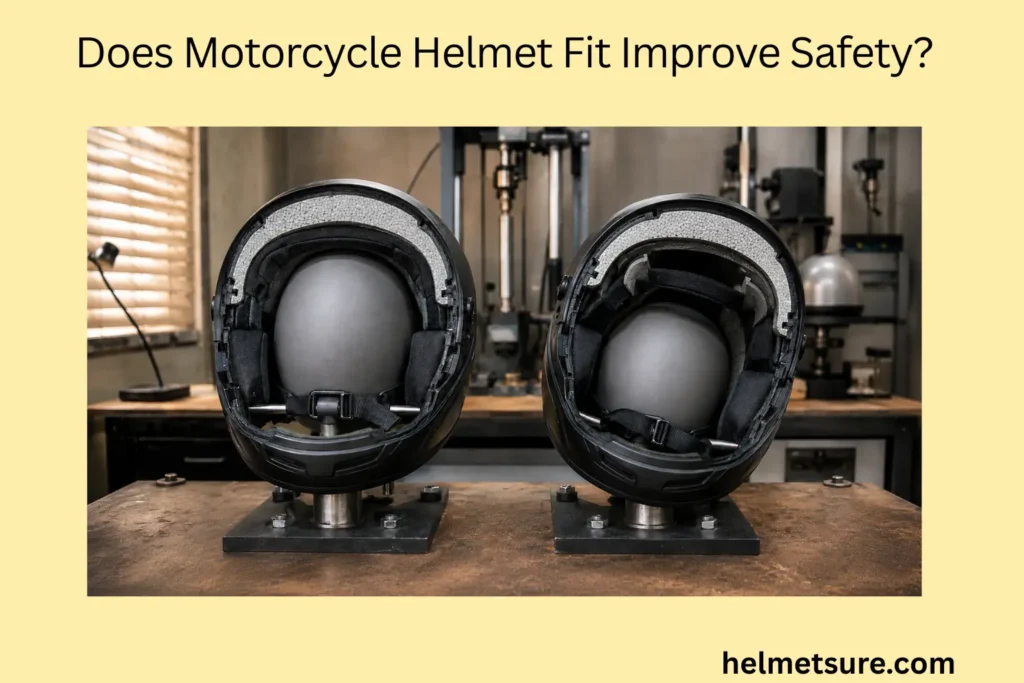
Does Motorcycle Helmet Fit Improve Safety?
Proper motorcycle helmet fit improves usable protection by keeping a certified, undamaged helmet correctly positioned and stable, while compatible size, head shape, even contact, and secure retention prevent comfort or tightness alone from being mistaken for safe fit.
Fit matters because the helmet must remain seated around the head regions it was designed to cover. A correct fit combines the right starting size, compatible interior geometry, firm and broadly distributed contact, limited independent movement, and a properly secured retention system. It does not mean choosing the tightest helmet possible.
Correct fit supports motorcycle helmet protection, but it cannot guarantee prevention of concussion, traumatic brain injury, skull fracture, death, or any other injury in every crash. Certification, helmet construction, condition, coverage, correct use, and crash conditions also matter.
Proper Helmet Fit as a Safety Factor Rather Than a Comfort Preference
Proper motorcycle helmet fit is a safety factor because it keeps the protective structure positioned around the rider’s head, while comfort alone only describes how the helmet feels. Fit, comfort, certification, and current helmet condition are related considerations, but they answer different questions.
Safety-relevant fit is not the same as comfort. Correct fit requires stable seating, distributed contact, compatible shape, and separately secured retention.
Why a helmet must stay correctly positioned to protect the intended areas of the head
A motorcycle helmet must stay correctly positioned so its intended shell coverage, impact liner, and retention geometry remain aligned with the rider’s head.
The shell and energy-absorbing liner already have a defined shape and coverage area. Correct seating places that existing structure where the design intends it to sit. Broad contact around the crown and sides helps limit unwanted movement, while the retention system helps resist lifting and roll-off. Fit does not create extra coverage; it positions the coverage the helmet already provides.
Current NHTSA fitting guidance tells riders to evaluate head shape, size, even pressure, and movement. SHARP’s fitting guide likewise emphasizes whole-head contact and positional stability. A certified helmet can satisfy an applicable standard and still fit a particular rider poorly because certification is model-level evidence, whereas fit is rider-specific.
How secure fit differs from a helmet that merely feels comfortable
Secure motorcycle helmet fit combines stable position and broadly distributed contact, while comfort alone can exist even when a helmet is too loose or poorly matched to the rider’s head shape.
A loose helmet can feel pleasant in a showroom because it applies little pressure. That sensation does not show whether the helmet slides independently, rides upward, or leaves unsupported gaps around the crown. Secure fit requires observable stability: the helmet should be fully seated, contact should be firm and reasonably even, and the rider’s skin and cheeks should tend to move with the helmet during gentle checks.
Correct fit should also remain tolerable. Persistent painful pressure, numbness, headache, or an isolated hotspot can indicate an undersized helmet or incompatible interior geometry. The goal is neither effortless looseness nor maximum compression. NHTSA recommends a sustained try-on to reveal pressure points that may not be immediately apparent, while SHARP advises checking for whole-head contact without painful pressure marks.
Why safety certification cannot compensate for a helmet that fits incorrectly
Motorcycle helmet safety certification cannot compensate for incorrect fit because certification verifies defined helmet-level performance under standardized conditions rather than rider-specific size, shape, contact, and stability.
In the United States, FMVSS No. 218 uses defined headforms, helmet-positioning procedures, conditioning, impact tests, and retention tests. Those procedures evaluate a helmet under controlled conditions; they do not approve the fit of that helmet on every rider. NHTSA also explains that the U.S. DOT system is based on manufacturer self-certification rather than prior agency approval of each helmet.
Certification and fit are cumulative requirements. Poor fit does not make certification meaningless, and excellent fit cannot make an uncertified, counterfeit, damaged, or structurally unsuitable helmet equivalent to a compliant one. Riders need both an appropriately validated helmet and a compatible individual fit.
Why safety certification cannot compensate for a helmet that fits incorrectly
| Attribute | Proper safety-relevant fit | Comfort alone |
|---|---|---|
| Helmet position | Correctly seated and stable | May be correct or incorrect |
| Crown and head contact | Broadly distributed | May include unsupported gaps |
| Movement | Limited independent slipping or rotation | Can still be excessive |
| Pressure | Firm without persistent painful hotspots | May feel loose and effortless |
| Retention | Secured separately | Not established by comfort |
| Certification | Still required | Not established by comfort |
How Helmet Fit Influences Protection During a Crash
Motorcycle helmet fit influences crash protection by controlling how consistently the helmet remains positioned, coupled to the head, and supported by its retention system during sudden movement. Fit affects the helmet-to-head relationship; it does not add impact-absorbing material or guarantee a specific injury outcome.
Fit changes the helmet-to-head relationship and starting position during motion. It does not add energy-absorbing material or guarantee a specific crash outcome.
How a stable helmet position helps keep the impact-absorbing liner aligned with the head
A stable motorcycle helmet position helps keep the impact-absorbing liner aligned with the head regions the helmet was designed to surround during use.
Compatible size and head shape create contact across multiple areas rather than at one isolated point. That distributed contact limits independent lag, rotation, and sliding during ordinary movement and helps preserve the intended relationship between the head, liner, shell opening, and retention anchors. “Stable” does not mean mechanically fixed: the helmet, padding, shell, and liner can still move or deform dynamically under crash loading.
Controlled motorcycle-helmet testing by Bonin and colleagues found that helmet-to-headform size mismatch changed residual liner crush and measured headform kinematics. The study used specific helmets, headforms, impact sites, and loading conditions, so it does not supply a universal equation for rider fit or injury risk. It supports the narrower point that fit mismatch is mechanically relevant.
Why excessive helmet movement can change where the shell and liner contact the skull
Excessive motorcycle helmet movement can change the helmet’s position relative to the head, altering where its shell, liner, opening, and retention geometry sit during sudden motion.
Surplus internal space allows the helmet to rotate, slip forward or backward, or ride upward with less movement of the rider’s skin and face. That changes the starting position and contact pattern between helmet and head. The effect is a less stable and less predictable positional relationship, not proof that a specific amount of movement will cause a particular injury.
Research on motorcycle helmet size selection, stability, and position supports evaluating fit with more than subjective comfort. Its quasistatic stability tests are not complete crash simulations and should not be converted into a universal safe angle or displacement. Consumer guidance instead focuses on obvious independent slipping, unstable seating, and roll-off potential.
How the retention system helps prevent helmet displacement during sudden movement
The motorcycle helmet retention system helps resist displacement by securing the helmet beneath the jaw after correct size and head-shape fit establish its basic position.
The chin strap, buckle, structural webbing, anchors, and fasteners form a separate retention path. Correct fit establishes contact and seating; the secured strap then helps resist lifting and roll-off. Buckle type alone does not determine safety, because retention depends on the complete assembly, correct fastening, sound anchors, appropriate adjustment, and validated performance.
A tight strap cannot manufacture missing crown contact or change incompatible interior geometry. It may temporarily mask looseness while creating discomfort beneath the jaw. FMVSS No. 218 formally defines the retention system as the complete assembly that keeps the helmet positioned during use, while SHARP provides practical rider-facing fastening and roll-off guidance.
- Fit: Size and head shape establish basic helmet-to-head compatibility.
- Contact: Crown, side, and cheek contact limit independent movement.
- Position: The shell and impact liner remain seated around intended head regions.
- Retention: The secured chin strap resists lifting and roll-off.
- Usable protection: The helmet is better positioned to function as its validated design intends, without a guaranteed injury outcome.
What Correct Motorcycle Helmet Fit Should Feel Like
Correct motorcycle helmet fit should feel firm and evenly supported around the head and cheeks without persistent painful pressure, excessive slipping, or dependence on the chin strap to hold the helmet in place. Pressure, cheek contact, movement, and strap security must each be checked.
Properly snug means firm and broadly supported, not maximally tight. Persistent pain, numbness, headache, or isolated hotspots require reassessment.
Firm, even pressure without localized pain points
Correct motorcycle helmet fit creates firm, even pressure without persistent localized pain points because the interior shape should support the head broadly rather than load only a few areas.
The crown and sides should feel consistently supported. A new helmet can feel noticeably firm as unworn comfort padding conforms to the rider, but firm contact is different from a sharp hotspot, headache, numbness, or persistent pain. Those symptoms can indicate that the helmet is too small, too narrow, too round, too long, or otherwise incompatible.
NHTSA advises wearing a new helmet for 30 to 45 minutes before riding to check for emerging pressure points. That is consumer guidance, not a universal engineering threshold for every model. Do not assume that serious discomfort will disappear after break-in. Comfort padding may settle, but fundamental shell and impact-liner geometry does not become compatible merely through waiting.
Cheek-pad contact that limits side-to-side movement
Correct motorcycle helmet cheek-pad contact should hold the cheeks firmly enough that the rider’s face tends to move with the helmet during gentle side-to-side checks.
In helmets with substantial cheek pads, firm lower-face contact helps limit lateral slipping and rotation. SHARP advises that the cheeks should follow the helmet during controlled movement while staying firmly and comfortably in contact with the pads. The pads may feel snug when new, but they should not create intolerable pressure, prevent normal jaw movement, or serve as the only point holding the helmet steady.
Cheek tightness cannot establish the entire fit. A helmet may squeeze the cheeks while remaining loose at the crown, or it may have excellent crown compatibility and need only a model-approved cheek-pad adjustment. Helmet style, pad construction, wear, and rider anatomy all affect the appropriate contact pattern.
Minimal rotation when the rider moves the helmet by hand
Correct motorcycle helmet fit should show minimal independent slipping or rotation during gentle hand movement, with the rider’s skin and cheeks tending to move with the helmet.
Place both hands on the helmet and move it gently from side to side, then front to back. A positive fit signal is coupled movement: the scalp, cheeks, and helmet move largely together. A poor-fit signal is obvious shell movement over the head while the skin and face remain comparatively still.
This is a qualitative screening check, not a crash test. “Minimal” does not mean mathematically zero movement, and no authoritative cross-model rotation angle defines acceptable consumer fit. Do not yank, wrench, or apply laboratory-like force. The aim is to reveal obvious independent slip under controlled hand movement.
A secure chin strap that keeps the helmet seated correctly
A secure motorcycle helmet chin strap should keep an already well-fitted helmet seated and resist lifting or roll-off without being used to compensate for a loose shell or incompatible head shape.
Fasten the buckle exactly as the manufacturer instructs, remove excessive slack, and check that the strap and its anchors remain undamaged. The system should retain the helmet without requiring painful overtightening. A loose strap leaves room for displacement; an overtight strap can cause discomfort without fixing the crown or shell fit.
There is no universal one-finger or two-finger gap rule that applies to every buckle, helmet, and rider. Practical adjustment should follow the actual manufacturer’s instructions. Consumer fastening checks also remain separate from the controlled retention loads and displacement criteria used in regulatory testing.
Helmet fit checklist
Use these checks after the helmet is fully seated. Pressure, movement, cheek contact, and retention should agree rather than contradict one another.
How a Helmet That Is Too Loose Can Reduce Safety
A motorcycle helmet that is too loose can reduce positional stability by allowing excessive rotation, vertical movement, and independent slipping between the helmet and the rider’s head. These are fit failure signals, not numerical predictions of a particular crash outcome.
Obvious independent rotation, slipping, ride-up, or dependence on extreme strap tension are fit-failure signals—not numerical injury predictions.
Excessive rotation that shifts the helmet away from its intended position
Excessive motorcycle helmet rotation shifts the protective structure away from its intended seated position because surplus internal space allows the shell to move independently around the head.
With a compatible fit, gentle side-to-side helmet movement tends to pull the cheeks and scalp with it. When contact is weak or uneven, the shell can rotate over the head instead. That motion can move the eye port, chin bar, shell edge, liner regions, and retention geometry away from their normal positions.
The distinction is between the head and helmet moving together and the helmet slipping independently. Not every small movement is a failure, and a showroom rotation angle cannot predict ejection or injury in a crash. SHARP’s practical guidance uses observable slipping rather than a numerical angle, while stability research shows that helmet type, position, adjustment, and head compatibility all affect measured displacement.
Vertical movement that allows the helmet to ride up on the head
Excessive vertical motorcycle helmet movement allows the helmet to ride upward from its intended seated position, indicating that size, shape, contact, or retention requires reassessment.
Ride-up may occur when the shell is too large, the crown geometry is incompatible, the lower contact is weak, or the chin strap is poorly adjusted. As the helmet lifts, the eye port and coverage relationship change, and the helmet may no longer remain firmly seated around the crown. A helmet that perches high from the outset can show a different problem: it may be too small or unable to pass over the widest part of the head.
Strap adjustment is part of the diagnosis, but overtightening is not a universal cure. If correct seating and normal secure fastening do not control the lift, reassess the size and model rather than forcing the strap tighter.
Loose cheek contact that reduces stability during rapid head movement
Loose motorcycle helmet cheek contact reduces lateral stability because the helmet can rotate more independently instead of moving with the rider’s face and head.
Weak cheek engagement is especially noticeable in full-face and other designs with substantial cheek pads. During gentle movement, the shell may slide while the cheeks remain still. Worn or compressed comfort pads can contribute, as can a shell that is too large or a model whose lower interior geometry does not suit the rider.
Thicker pads are not an automatic fix. First confirm crown fit, head-shape compatibility, correct seating, and shell size. If those pass and the manufacturer offers approved pad thicknesses for that exact helmet, adjustment may be reasonable. Generic foam, improvised stuffing, or incompatible aftermarket pads should not be used to conceal a fundamental fit problem.
Why a loose helmet can become less predictable during impact forces
A loose motorcycle helmet can create a less predictable helmet-to-head relationship during impact because surplus fit clearance changes position, contact, and liner engagement before and during loading.
The starting position may vary more when the helmet can slide, rotate, or ride up. The head can also travel farther within the available clearance before loading different interior regions. Controlled research confirms that fit conditions can change measured response, but it does not support a simple claim that every looser helmet always transmits more acceleration.
The Bonin et al. experiment used four sizes of one shorty-style helmet model on instrumented headforms during defined forehead impacts. Results depended on helmet size, headform, impact site, loading, and outcome measure. Thai, McIntosh, and Pang studied size selection, position, and quasistatic stability in riders, but their displacement method is not a direct crash-ejection model. Together, the studies support fit as a mechanical variable—not a universal loose-equals-more-force formula.
Why a loose helmet can become less predictable during impact forces
| Loose-fit signal | Immediate fit problem | Why it matters | Corrective direction |
|---|---|---|---|
| Excessive side rotation | Weak circumferential contact | Helmet moves independently | Reassess size and shape |
| Ride-up | Poor seating or retention | Helmet leaves its intended position | Recheck shell fit and strap |
| Loose cheek contact | Weak lateral support | Rotation becomes easier | Consider approved pads only after crown fit passes |
| Fore-aft slipping | Excess clearance or geometry mismatch | Position becomes unstable | Reassess model and shape |
| Strap must be overtightened | Retention is masking a fit problem | Internal fit remains unresolved | Change size or model instead |
When a Helmet Is Too Tight Rather Than Properly Snug
A motorcycle helmet is too tight rather than properly snug when pressure becomes persistently painful, concentrated, or incompatible with the rider’s head shape instead of remaining firm and broadly distributed. Maximum tightness is not a safety target.
Less movement does not automatically mean better fit. Undersizing or shape mismatch can create painful compression without establishing correct distributed contact.
Normal break-in pressure versus persistent pressure points
Normal motorcycle helmet break-in pressure is firm and broadly distributed, while persistent pressure points remain concentrated in specific areas and indicate that fit requires reassessment.
New comfort pads can feel firmer before regular use settles their rider-facing foam. That change affects feel and local contact; it does not resize the shell or structural energy-absorbing liner. A helmet should not be purchased loose in anticipation of future break-in, nor should a painful mismatch be accepted on the assumption that it will disappear.
General, tolerable firmness may ease slightly as approved comfort components settle. A recurring forehead hotspot, sharp side pressure, numbness, headache, or pronounced local pain is different. NHTSA’s sustained try-on guidance helps reveal these symptoms before riding. No universal mileage or compression percentage predicts how every pad system will change.
How head pain or concentrated pressure can indicate shape mismatch
Motorcycle helmet head pain or concentrated pressure can indicate head-shape mismatch when the interior geometry loads one region heavily while leaving another region less supported.
NHTSA explains that forehead pressure can indicate an interior that is too round for the rider, while pressure at the sides can indicate a shape that is too elongated or narrow. These are practical diagnostic patterns, not brand-wide labels. The exact interpretation must be made on the actual rider and helmet model.
Shape mismatch often explains why a helmet can feel tight and loose at the same time. A narrow region compresses one part of the head, while excess space remains elsewhere. Absence of pain does not prove correct fit either; a helmet may be uniformly oversized and feel comfortable because it applies too little contact.
Why tighter does not automatically mean safer
A tighter motorcycle helmet does not automatically become safer because correct fit requires stable, distributed contact rather than maximum compression against the rider’s head.
Undersizing may reduce some movement while creating broad excessive compression or localized pain. It can also prevent the helmet from seating fully. A smaller version of the same incompatible shape may worsen hotspots without establishing better contact elsewhere. Conversely, a loose helmet remains unacceptable even if it is comfortable.
Evaluate size, shape, crown contact, cheek engagement, seating, and independent movement together. If movement is present, diagnose the cause before sizing down. Worn pads, incorrect positioning, a large shell, weak cheek contact, or shape mismatch can produce similar symptoms but require different corrections.
Why tighter does not automatically mean safer
| Fit state | Pressure pattern | Movement | Interpretation |
|---|---|---|---|
| Properly snug | Firm and broadly distributed | Little obvious independent slipping | Candidate correct fit |
| Too loose | Light or uneven contact, possibly with gaps | Excess rotation, slip, or ride-up | Reassess size and shape |
| Too tight from undersizing | Broad excessive compression | May feel immobile | Reassess size |
| Shape mismatch | Localized painful hotspot with possible loose area elsewhere | May move unevenly | Change interior shape or model |
| New comfort padding | Firm but tolerable contact | Stable | Use sustained try-on; do not assume break-in fixes mismatch |
How Riders Can Check Helmet Fit Before Riding
Riders can check motorcycle helmet fit before riding by confirming correct seating, testing controlled movement, checking crown and cheek contact, and verifying that the secured chin strap resists excessive roll-off. Follow the order position, movement, contact, and retention so one adjustment does not mask another failure.
Movement and roll-off checks are qualitative screening steps. They do not reproduce laboratory certification loads, fixtures, headforms, or crash forces.
Confirming the helmet sits level and fully seated on the head
A motorcycle helmet fit check should begin by confirming that the helmet is fully seated and positioned as intended rather than perched high, tilted, or resting unevenly on the head.
Open the chin straps, pull them outward as instructed for the model, and place the helmet over the widest part of the head. Settle it onto the crown without violent force. The eye port and brow relationship should look normal for the helmet’s design, and the shell should not be tilted unnaturally forward, backward, or to one side.
A helmet that cannot seat fully may be too small or geometrically incompatible. A helmet that immediately drops too low may be too large or poorly shaped for the rider. Eye-port geometry differs among full-face, modular, open-face, and off-road designs, so do not invent a universal eyebrow distance. Use the manufacturer’s positioning instructions where they provide model-specific guidance.
Testing side-to-side and front-to-back movement
Side-to-side and front-to-back motorcycle helmet movement tests should reveal whether the helmet moves with the rider’s head or slips independently over it.
Before relying on the strap to stabilize the shell, hold the helmet with both hands and move it gently in each direction. Watch and feel whether the cheeks, scalp, and helmet move together. Obvious sliding over the skin, easy rotation, or repeated repositioning suggests excess space or shape incompatibility.
The check is qualitative and should remain controlled. Do not yank the chin bar, wrench the neck, or try to reproduce crash forces. If movement appears only in one direction, consider whether the interior is too long, too round, too wide, or unevenly supported rather than assuming the nominal size alone is wrong.
Checking cheek-pad engagement and liner contact
Motorcycle helmet cheek-pad engagement and liner contact should feel firm and broadly supportive without obvious gaps, painful hotspots, or dependence on one contact area to stabilize the entire helmet.
Check the crown, sides, front, rear, and cheeks as the helmet design permits. Crown contact should be present without a narrow pressure ridge. Side contact should not create severe hotspots. In a full-face helmet, the cheeks should remain firmly and comfortably engaged, but cheek squeeze must not hide crown looseness.
Comfort padding is the rider-facing material being assessed for contact. The structural impact liner beneath it performs a different role and must not be cut, sanded, crushed, heated, or reshaped. Contact expectations also vary by helmet style; an open-face helmet cannot be judged with the same cheek-pad criterion as a full-face design.
Testing the chin strap and helmet roll resistance
Motorcycle helmet chin-strap and roll-resistance checks should confirm that a correctly fitted, securely fastened helmet resists being lifted or rolled from its intended position.
After the basic shell fit passes, fasten and adjust the strap according to the manufacturer’s directions. Tilt the head forward and have another person carefully push upward at the rear base of the helmet, following SHARP’s practical fitting method. A helmet that readily rolls off or exposes a gross loss of position fails the fit or retention screen and should not be accepted for riding.
Use only gentle, controlled force. This consumer check does not duplicate certification testing, which uses defined headforms, loads, fixtures, and procedures. For a focused explanation of the mechanism and evaluation boundary, see roll-off resistance.
Pre-ride fit audit
Run this audit before riding. Use gentle controlled movement only; do not try to reproduce crash or laboratory forces.
Why Head Shape Matters as Much as Helmet Size
Motorcycle helmet head shape matters as much as labeled size because circumference selects an initial size range while interior geometry determines whether pressure and contact are distributed correctly. Size and shape must both match the individual rider.
Circumference selects a size range; it cannot establish interior-geometry compatibility. Size and head shape must both match the individual rider.
Why two helmets labeled the same size can fit differently
Two motorcycle helmets labeled the same size can fit differently because manufacturers and models use different internal dimensions, shell groupings, padding systems, and head-shape geometry.
A size label is a manufacturer- and model-specific category. One medium may correspond to a different circumference range, internal length, width, crown depth, shell group, or pad configuration than another. Model generations within the same brand can also change. A rider’s old size is therefore a starting clue, not a transferable result.
Measure the head and consult the exact current size chart for each candidate. NHTSA and SHARP both treat circumference as a starting point and emphasize actual try-on. Any published centimetre range belongs to the named model’s chart; it should not be generalized across brands.
How head-shape mismatch creates loose areas and pressure points at the same time
Motorcycle helmet head-shape mismatch can create loose areas and pressure points at the same time because an incompatible interior can be too narrow in one direction and too spacious in another.
Consider a head that is longer front to back than the helmet interior. The rider may feel strong forehead or rear pressure while excess space remains at the sides. A comparatively rounder head in a narrow interior may experience side hotspots while having extra space front to back. These mixed symptoms show why “tight” and “loose” are not always opposite diagnoses.
Sizing up may reduce the hotspot but enlarge the unsupported regions. Sizing down may reduce movement while intensifying pain. When pressure pattern and movement pattern conflict, reassess interior shape before changing size. Round oval, intermediate oval, and long oval are useful descriptors, but they are not universal standardized dimensions.
Why brand or model changes may solve fit problems that sizing changes do not
Changing motorcycle helmet brand or model can solve a head-shape mismatch that sizing changes do not because another interior geometry can distribute contact more appropriately at a similar measured circumference.
If the candidate size matches the rider’s circumference but produces persistent hotspots and gaps, a different model may offer a better length-to-width relationship, crown profile, cheek structure, or shell grouping. The solution is geometry compatibility, not loyalty to a particular label.
No entire manufacturer should be declared best for one head shape. Fit can vary across models, generations, sizes, and interior options within the same brand. Try the exact product on the actual rider and repeat the full fit audit. For a deeper guide to matching head geometry and helmet interiors, see head-shape fit.
Why brand or model changes may solve fit problems that sizing changes do not
| Variable | What it establishes | What it cannot establish alone |
|---|---|---|
| Head circumference | Initial size candidate | Final fit |
| Size label | Manufacturer and model category | Cross-brand equivalence |
| Head shape | Interior-geometry compatibility | Correct circumference |
| Pressure pattern | Possible mismatch location | Exact replacement model |
| Helmet movement | Stability signal | Cause of mismatch by itself |
| Model try-on | Combined rider-to-helmet compatibility | Future crash outcome |
Which Fit Problems Can Be Adjusted and Which Require a Different Helmet?
Motorcycle helmet fit problems can be adjusted only when the manufacturer provides authorized interior options and the underlying shell size and head shape are already compatible; fundamental mismatch requires a different size or helmet.
Manufacturer-approved comfort components can fine-tune a compatible helmet. They cannot correct an oversized shell, incompatible structural geometry, or a liner that would need modification.
When replaceable cheek pads may improve a borderline fit
Replaceable motorcycle helmet cheek pads can improve a borderline fit when the helmet’s crown, shell size, and head shape already fit correctly and the manufacturer provides approved pad-thickness options.
This is fine-tuning, not resizing. A rider may have stable crown contact, correct seating, and compatible head shape but need slightly more or less local cheek contact. If the exact manufacturer and model offer approved alternatives, changing pad thickness can alter lateral support and comfort while keeping the helmet in a supported configuration.
For example, SHOEI publishes multiple OEM thickness choices for the RF-1400 cheek-pad system. That evidence applies to the RF-1400 system only; it does not prove that another model accepts the same pads or adjustments. Do not add generic foam, stack pads, or install incompatible parts.
When liner adjustment cannot correct an incompatible shell or head shape
Motorcycle helmet liner adjustment cannot reliably correct an incompatible shell size or head shape because removable comfort components cannot change the helmet’s fundamental structural geometry.
Approved cheek pads or comfort liners can refine contact within the range the manufacturer designed. They cannot reduce an oversized shell, deepen a shallow crown, widen structural EPS, or change the primary length-to-width relationship. If the basic interior shape is wrong, added padding may create a new pressure point while leaving the original gap elsewhere.
Never cut, sand, crush, heat, carve, or chemically alter the energy-absorbing liner. NHTSA warns that interior alterations beyond manufacturer-provided fit features can compromise helmet integrity. A helmet that requires structural modification to fit is the wrong candidate.
When persistent movement indicates that the helmet size is fundamentally wrong
Persistent motorcycle helmet movement indicates a fundamental fit problem when the helmet remains unstable after correct seating, correct strap use, and any manufacturer-authorized fit adjustment.
Repeat the evaluation after each legitimate correction. If the helmet still slips independently, rides upward, rotates easily, or requires extreme strap tension, reject the current fit. The remaining cause may be an oversized shell, incompatible crown geometry, worn interior parts, or another shape problem.
Do not automatically choose the next smaller size. A smaller version of an incompatible model may introduce painful compression without producing better distributed contact. Recheck both circumference and head shape, then compare another size or model using the complete fit sequence.
When discomfort suggests the rider should reassess both size and shape
Persistent motorcycle helmet discomfort should trigger reassessment of both size and head shape when firm contact becomes painful, concentrated, or inconsistent with otherwise stable fit.
Look at the symptom pattern. Broad excessive compression may indicate undersizing. A concentrated forehead or side hotspot with looseness elsewhere suggests shape mismatch. Jaw discomfort may come from cheek-pad configuration, while pressure at the crown may point to shell or interior geometry. Discomfort alone cannot identify the exact replacement, but it shows that the current fit has not passed.
Do not use riding exposure as the test for significant fit pain. Resolve the problem during a sustained indoor try-on while the helmet remains returnable, or with a trained fitter who follows manufacturer guidance. Mild new-pad firmness and persistent painful mismatch are different conditions.
When discomfort suggests the rider should reassess both size and shape
| Fit problem | Approved adjustment may help? | Different size or model more likely? | Decision rule |
|---|---|---|---|
| Slightly loose cheeks with good crown fit | Yes, if OEM pad options exist | Sometimes | Use only model-approved pads |
| Persistent crown looseness | Usually no | Yes | Reassess size and shape |
| Forehead hotspot with side gaps | Usually no | Yes | Treat as shape mismatch |
| Broad excessive tightness | Limited | Yes | Reassess size |
| Movement despite correct seating and strap use | Limited | Yes | Reject the current fit |
| Comfortable but obviously loose | No meaningful comfort-based fix | Yes | Stability overrides comfort preference |
| Structural liner requires cutting or crushing | No | Yes | Never modify the impact liner |
What Is the Safest Way to Think About Motorcycle Helmet Fit?
The safest way to think about motorcycle helmet fit is as one required part of a complete protective system that also depends on certification, helmet condition, retention, compatible size, and head shape.
Good fit does not excuse missing certification, damage, or an unsecured strap. Fit is one required part of the complete protective system.
Proper fit as part of the helmet protection system rather than an optional preference
Proper motorcycle helmet fit is part of the protection system rather than an optional preference because it determines whether the helmet remains correctly positioned and stable on the individual rider.
Compatible size and shape create distributed contact. That contact limits excessive independent movement and helps keep the shell, liner, opening, and retention geometry seated as intended. Fit improves the helmet’s usable relationship with the rider; it does not increase the material’s impact capacity or eliminate the helmet’s protection limits.
Why helmet certification, condition, retention, size, and head shape must work together
Motorcycle helmet certification, condition, retention, size, and head shape must work together because each controls a different requirement for reliable protective use.
Certification or type approval establishes defined performance under the applicable scheme. Current condition determines whether the shell, liner, straps, anchors, and hardware remain suitable for reliance. Circumference selects the initial size; head shape establishes interior compatibility; distributed contact stabilizes the position; and retention resists displacement.
One passing criterion cannot cancel a failure elsewhere. Good fit does not excuse structural damage, missing certification, or an unsecured strap. A high safety rating does not correct rider-specific shape mismatch. These requirements should not be converted into a numerical consumer score because no validated universal weighting exists.
The practical rule: a safer helmet is one that is certified, undamaged, and correctly fitted to the individual rider
The practical motorcycle helmet fit rule is to choose an appropriately certified, undamaged helmet that matches the individual rider’s size and head shape, stays stable, and remains securely retained.
Start with the standard or approval applicable to the rider’s market. Confirm the helmet’s current condition and provenance. Measure the head, use the exact model’s chart, evaluate interior shape, check for firm distributed contact, reject excessive movement and persistent pain, then secure the retention system according to the manufacturer’s instructions.
If any critical step fails, reassess before riding. Even the best-fitting helmet cannot guarantee survival or freedom from injury, because crash energy, direction, coverage, human tolerance, and other variables remain. Fit is a necessary contributor to usable protection, not a promise of a particular outcome. See motorcycle helmet safety for the full shell, liner, fit, retention, certification, and condition framework.
Final fit decision
Use this as the final decision order. If stability and pressure criteria cannot both be satisfied, change size or model rather than forcing the fit.
Frequently Asked Questions About Motorcycle Helmet Fit
These answers summarize the article’s fit, movement, pressure, head-shape, retention, adjustment, and safety boundaries.
Does motorcycle helmet fit improve safety?
Yes, proper fit improves usable protection by keeping a certified, undamaged helmet correctly seated, stable, and securely retained. Fit does not guarantee prevention of injury in every crash.
Should a motorcycle helmet feel tight?
It should feel firm and broadly supported, not painfully compressed. Persistent hotspots, numbness, headache, or concentrated pressure suggest that size or head shape needs reassessment.
Can a helmet be comfortable but too loose?
Yes. A loose helmet may feel comfortable because it applies little pressure, yet still rotate, slip, ride upward, or leave unsupported gaps around the crown.
How much helmet movement is acceptable?
Consumer fit checks are qualitative. The goal is limited independent slipping or rotation, with the rider’s skin and cheeks tending to move with the helmet. There is no universal cross-model angle threshold.
Can a tighter chin strap fix a loose helmet?
No. The strap can resist lifting and roll-off after basic fit is correct, but it cannot create missing crown contact or correct incompatible interior geometry.
Why does head shape matter if the circumference size is correct?
Circumference only selects a starting size. Interior length, width, crown depth, and shape determine whether pressure and contact are distributed correctly on the individual rider.
Can thicker cheek pads fix a poor fit?
Only in limited cases when crown fit, shell size, and head shape already pass and the manufacturer provides approved pad options for that exact model.
What is the safest final fit rule?
Choose an appropriately certified, undamaged helmet that matches the rider’s size and head shape, has broad firm contact without persistent pain, shows no obvious independent slipping or ride-up, and remains securely retained.