
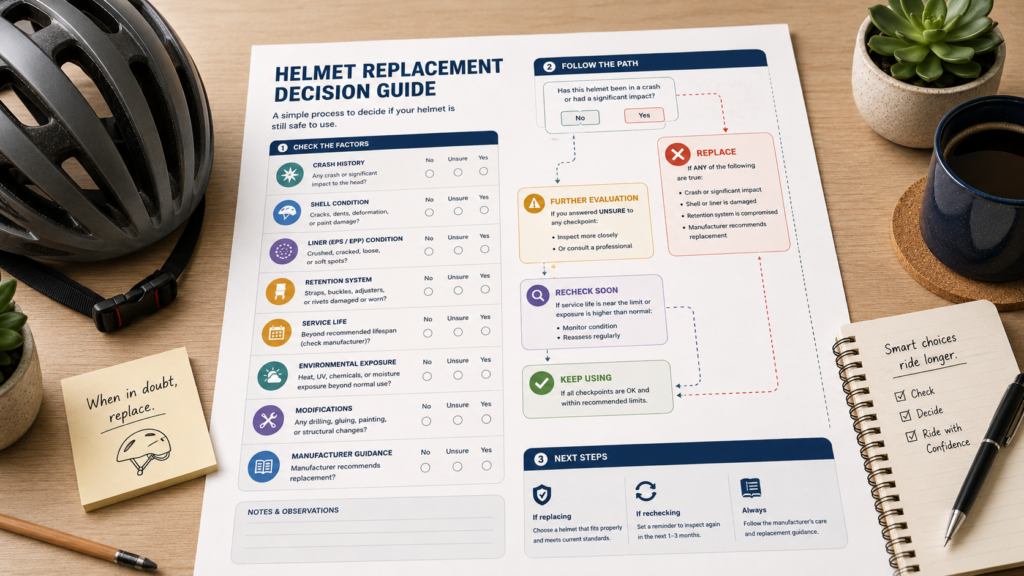
Helmet Replacement Decision Template: How to Know When It’s Time to Stop Using a Helmet
Helmet replacement need is determined by impact history, observable shell and liner condition, retention integrity, service-life evidence, and manufacturer instructions; critical findings or unresolved evidence can require replacement, further evaluation, correction and re-test, or monitored continued use.

Download the Helmet Replacement Decision Template
Preview the first page, then download the full PDF to record helmet identity, five evidence-domain scores, critical overrides, significant unknowns, the final classification, and the next action.
Download the Printable TemplateUse this template for one exactly identified helmet at a time. It evaluates replacement-related evidence across five domains:
- Crash and impact history
- Shell and structural condition
- Impact-absorbing liner condition
- Retention and essential-component integrity
- Service life, exposure, and traceability
The process also checks critical replacement overrides, significant unknowns, and manufacturer instructions before reaching a final decision.
Important safety boundary: An accessible inspection cannot rule out hidden damage or prove how much protective capacity remains. A favorable score is not a laboratory performance rating. An explicit manufacturer replacement instruction or an identified critical condition takes priority over the score.
Replacement Decision Helper
Answer these short questions using what you know about this exact helmet. The helper suggests one of the template’s five decision categories and tells you what to do next. It does not prove the helmet is safe or predict future protection.
The helper will show a bounded decision and the next useful action.
Important: A confirmed manufacturer replacement instruction or critical condition takes priority. Unknown history is not the same as confirmed damage, and a favorable result is not proof of remaining protective capacity.
CPSC bicycle-helmet guidance warns that impact damage may not be visible, illustrating why appearance alone cannot establish continuing condition after an applicable impact. CPSC bicycle helmet guidance. Snell likewise advises replacement after an impact while a helmet is in use and recommends replacement when compromise is suspected. Snell Foundation FAQ.
Helmet Replacement Need Depends on Evidence Rather Than Appearance Alone
Helmet replacement need depends on impact history, observable condition, component integrity, service-life evidence, and applicable manufacturer instructions rather than appearance alone.
A helmet that looks clean and intact may still have an unresolved history. Conversely, a scratched or dirty helmet does not automatically have structural damage. The purpose of this template is therefore not to judge a helmet from appearance. It is to organize the evidence that is actually available and identify what that evidence supports.
The result is a bounded service decision, not a declaration that the helmet is safe, undamaged, or guaranteed to perform in a future impact.
What the replacement assessment evaluates: history, observable condition, components, exposure, and manufacturer guidance
The replacement assessment evaluates documented history, observable helmet condition, essential-component integrity, exposure and service-life evidence, traceability, and manufacturer guidance.
The five scored domains answer different questions:
- Impact history: What crashes, direct impacts, drops, crushing events, or comparable events are known?
- Shell condition: What structural findings can actually be observed?
- Liner condition: What can be observed in manufacturer-permitted accessible areas of the impact-absorbing liner?
- Retention and essential components: Are required straps, buckles, anchors, adjustment components, and other essential parts intact and functioning?
- Service life and traceability: How complete is the record of age, use, ownership, exposure, modification, repair, storage, and applicable manufacturer guidance?
These observations support a replacement decision, but they do not directly measure remaining impact attenuation.
What the assessment cannot independently determine: hidden damage, remaining protective capacity, or future impact performance
The replacement assessment cannot independently determine hidden damage, quantify remaining protective capacity, or predict how the helmet will perform in a future impact.
Accessible inspection can show that a crack, deformation, failed buckle, crushed liner area, or other concern is present. What it cannot do is prove that an apparently normal inaccessible area has no internal damage.
| The assessment can support | The assessment cannot independently prove |
|---|---|
| Classifying documented impact history | Absence of hidden damage |
| Recording visible shell and liner findings | Remaining protective capacity |
| Testing permitted retention functions | Future impact performance |
| Recording service-life and exposure evidence | Laboratory compliance |
| Applying verified manufacturer instructions | Continuing certification validity |
| Identifying critical conditions and significant unknowns | Guaranteed future protection |
Use bounded language such as “no obvious structural concern was observed in accessible areas.” Do not turn that statement into “the helmet is undamaged.”
Why manufacturer-identified replacement conditions sit outside ordinary scoring logic
Manufacturer-identified replacement conditions sit outside ordinary scoring logic because the template must not use a favorable general score to override an explicit instruction for the exact helmet.
The order is:
Exact helmet identity → applicable manufacturer documentation → controlling condition → scoring framework.
A manufacturer may have model- or category-specific instructions concerning impacts, service life, components, chemicals, cleaning, modification, storage, or replacement. These instructions are not interchangeable between unrelated products.
For example, Bell’s instructions for a specific Star-series motorcycle helmet include their own impact and service-life replacement directions. That is evidence for that product family—not a universal interval that should automatically be applied to every helmet. Bell Star-series instruction manual.
Manufacturer instruction record
- Manufacturer: ______________________________
- Exact model: _______________________________
- Variant: ___________________________________
- Manual/support document: ____________________
- Document revision/date: _____________________
- Replacement instruction found: Yes / No / Unknown
- Exact applicable condition: _________________
- Does it control the current decision? Yes / No
Lock the Exact Helmet Identity Before Evaluating Replacement Evidence
Exact helmet identity must be locked before replacement evidence is evaluated because model-specific guidance only applies when the assessed helmet is correctly identified.
Do not start by scoring damage. Start by identifying the object being assessed.
Record brand, model, variant, helmet type, and intended activity
Brand, model, variant, helmet type, and intended activity identify the specific helmet to which replacement guidance and evidence must be applied.
Copy identifying information from the helmet, label, manual, packaging, receipt, registration record, or manufacturer documentation wherever possible.
Do not identify a model from color, shell shape, graphics, or resemblance to another product.
Helmet identity
- Brand: _____________________________________
- Model: _____________________________________
- Variant: ____________________________________
- Helmet type/category: _______________________
- Intended activity: __________________________
- Size: _______________________________________
- Serial/production identifier: ________________
- Identity confidence: Verified / Partial / Uncertain
If exact identity remains uncertain, mark it as an evidence gap before using manufacturer-specific rules.
Capture manufacturing date, purchase date, first-use date, and production identifiers where available
Manufacturing date, purchase date, first-use date, and production identifiers create the service-history timeline used to evaluate age, traceability, and applicable manufacturer instructions.
Keep the dates separate. Manufacturing date identifies when the helmet was produced. Purchase date identifies when it changed into the purchaser’s possession. First-use date identifies when service actually began. They are not interchangeable.
- Manufacturing date: _________________________
- Evidence source: Label / Record / Unknown
- Purchase date: ______________________________
- Evidence source: Receipt / Record / Memory / Unknown
- First-use date: ______________________________
- Evidence source: Record / Memory / Unknown
- Serial or batch identifier: __________________
- Other production code: ______________________
Mark a missing date unknown rather than estimating it to complete the form.
Record certification markings, current ownership, and assessment date without treating them as proof of serviceability
Certification markings, current ownership, and assessment date provide identification and traceability context but do not prove that the helmet remains serviceable.
A standard or certification marking can help identify a helmet or its claimed compliance context. It does not inspect the helmet’s current shell, liner, retention system, impact history, or service life.
When you need to evaluate what a certification statement actually claims, use the Helmet Certification Claim Verification Template rather than treating the marking as proof of the helmet’s current condition.
Traceability record
- Certification/standard marking visible: __________________
- Marking text recorded exactly: ___________________________
- Current owner: __________________________________________
- Original owner: Yes / No / Unknown
- Known previous owners: __________________________________
- Ownership continuity: Complete / Partial / Unknown
- Assessment date: ________________________________________
Helmet Identification Record
- Record brand.
- Record model.
- Record variant.
- Record helmet type.
- Record intended activity.
- Record manufacturing date or mark it unknown.
- Record purchase date or mark it unknown.
- Record first-use date or mark it unknown.
- Record production/serial identifiers where available.
- Record certification markings as identification/context only.
- Record current ownership and known prior ownership.
- Record assessment date.
- Flag uncertain identity before applying model-specific instructions.
How Crash, Impact, Drop, and Crushing History Change Replacement Concern
Crash, impact, drop, and crushing history changes replacement concern according to the event’s known significance, the applicable manufacturer instruction, and the amount of unresolved history.
Do not use one universal drop height, speed, force, or impact threshold. Record what actually happened and compare it with the exact manufacturer’s instructions.
Significant crashes, direct impacts, crushing events, and object impacts as major replacement concerns
Significant crashes, direct impacts, crushing events, and serious object impacts create major replacement concern when they meet a manufacturer-defined replacement condition or otherwise establish substantial impact history.
- Was the helmet being worn? Yes / No / Unknown
- Crash occurred: Yes / No / Unknown
- Direct helmet impact: Yes / No / Unknown
- Crushing/compression event: Yes / No / Unknown
- Heavy object impact: Yes / No / Unknown
- Event date: __________________________________
- Event description: ____________________________
- Exact location struck: ________________________
- Manufacturer guidance checked: Yes / No
- Manufacturer replacement condition met: Yes / No / Unknown
A major event is not downgraded merely because the exterior still looks acceptable. CPSC bicycle-helmet requirements recognize that an impacted helmet may have damage that is not visible. CPSC bicycle helmet guidance.
Unknown impact history as unresolved evidence rather than evidence of no impact
Unknown impact history is unresolved evidence and must never be scored or described as proof that no relevant impact occurred.
This is particularly important with second-hand helmets, borrowed or issued helmets, helmets with several previous users, helmets stored where their treatment was not observed, and incomplete ownership records.
Write Impact history: Unknown rather than No impact history unless the available history genuinely supports that statement.
Unknown history increases uncertainty, but it is not automatically proof of damage. Keep those concepts separate.
Minor known events with no obvious major damage as limited-concern cases with remaining uncertainty
Minor known events with no obvious major damage can remain limited-concern cases only when the event does not meet an applicable replacement condition and the assessment preserves residual uncertainty.
Before using this category, confirm that the event is reasonably documented, exact manufacturer instructions have been checked where available, no applicable replacement trigger has been identified, accessible inspection shows no obvious major defect, and the event is not an ambiguous significant crash, crushing event, or high-concern impact.
“Limited concern” does not mean harmless.
No known relevant event as the strongest impact-history score
No known relevant crash, direct impact, crushing event, or equivalent manufacturer-defined trigger receives the strongest impact-history score only when the available history is sufficiently traceable.
A current owner saying “I have never crashed in it” is not enough when the helmet had an unknown previous owner.
Score 3 represents the strongest history evidence available in this framework. It does not prove maximum protection or absence of hidden damage.
Crash & Impact History Score
| Score | Evidence state | Classification |
|---|---|---|
| 0 | Significant crash/direct impact/crushing event or applicable manufacturer replacement trigger | Major replacement concern / critical-override review |
| 1 | Important impact history is unknown, ambiguous, or insufficiently traceable | Significant uncertainty |
| 2 | Minor known event with no obvious major damage and no verified replacement trigger | Limited concern with residual uncertainty |
| 3 | Traceable history with no known relevant crash, impact, crushing, or replacement-trigger event | Strongest impact-history evidence |
Variable A score: ____ / 3
Reason: _______________________________________________
Which Shell Conditions Create Structural Replacement Concern?
Shell conditions create structural replacement concern when observable cracking, puncture, deformation, separation, delamination, missing material, deterioration, or another significant abnormality affects the helmet’s structural condition.
Inspect only accessible areas. Do not cut, drill, remove bonded components, or otherwise damage the helmet to improve visibility.
Cracks, punctures, deformation, separation, delamination, and missing material as major structural findings
Cracks, punctures, deformation, separation, delamination, and missing structural material are major shell findings that require replacement-level concern or manufacturer-directed evaluation.
- Type: Crack / Puncture / Deformation / Separation / Delamination / Missing material / Other
- Location: ___________________________________
- Approximate extent: __________________________
- Structural involvement clearly visible: Yes / No / Uncertain
- Photograph recorded: Yes / No
- Manufacturer guidance checked: Yes / No
- Critical override review required: Yes / No
Do not attempt home repair of structural shell damage merely to improve the assessment result.
CDC public helmet-safety guidance recommends replacement when helmets are damaged. CDC helmet safety guidance.
Heat, chemical, vent, abrasion, and deterioration findings that require classification
Heat, chemical, vent-area, abrasion, and deterioration findings require classification according to observable severity, material involvement, exposure history, and applicable manufacturer instructions.
Look for and record warping, softening, unusual brittleness, material loss, severe abrasion, abnormal separation, unusual surface change, vent-area damage, discoloration associated with a documented exposure, or other observable deterioration.
Do not diagnose “chemical damage” or “heat damage” solely from color. Instead record the observed abnormality, possible exposure history, whether the cause is confirmed, and whether manufacturer guidance is available.
Unresolved abnormalities versus minor observable wear
Unresolved abnormalities differ from minor observable wear because uncertainty about material or structural significance must remain visible instead of being automatically classified as cosmetic.
Minor observable wear may include a clearly superficial mark where no structural involvement is identified. Unresolved abnormality means the assessor sees something unusual but cannot confidently determine whether it is cosmetic, material, or structural.
An unresolved finding should not receive the strongest favorable shell score.
What “no obvious structural concern” means within an accessible visual inspection
“No obvious structural concern” means that accessible inspection found no visible major shell defect; it does not mean that hidden damage or reduced protective capacity has been ruled out.
Shell Finding → Concern Level → Score
| Score | Shell evidence state | Concern level |
|---|---|---|
| 0 | Major crack, puncture, deformation, separation, delamination, missing structural material, or equivalent critical finding | Major structural concern / override review |
| 1 | Unresolved abnormality, significant deterioration, or condition that cannot be confidently classified | Significant uncertainty |
| 2 | Minor observable surface wear with no obvious structural involvement | Limited concern |
| 3 | No obvious structural concern in accessible inspection | Strongest observable shell evidence |
Variable B score: ____ / 3
Finding/location: ______________________________________
Which Impact-Liner Findings Raise a Replacement or Evaluation Concern?
Impact-liner findings raise replacement or evaluation concern when accessible areas show crushing, cracking, compression, permanent deformation, missing material, separation, brittleness, deterioration, or an unresolved abnormality.
Inspect only areas that can be accessed without prohibited disassembly.
Crushing, cracking, compression, deformation, and missing material as major liner findings
Crushing, cracking, major compression, permanent deformation, and missing impact-liner material are major findings that require replacement-level concern or manufacturer-directed evaluation.
- Liner area inspected: _________________________
- Crushing observed: Yes / No
- Cracking observed: Yes / No
- Permanent deformation observed: Yes / No
- Missing material observed: Yes / No
- Separation observed: Yes / No
- Finding location: _____________________________
- Finding clearly major: Yes / No / Uncertain
Do not press, carve, cut, heat, reshape, or destructively probe the liner to determine whether it is still functional.
Separation, indentation, brittleness, and environmental deterioration as observable concerns
Separation, unusual indentation, brittleness, and environmental deterioration are observable liner concerns that require classification against known construction, exposure history, and manufacturer guidance.
Separate observation from diagnosis. For example: “An unusual indentation is visible in the rear liner. Cause and significance remain unresolved.” Avoid asserting a degradation mechanism unless the history and applicable evidence establish it.
Why inaccessible or inadequately assessed liner areas increase uncertainty
Inaccessible or inadequately assessed liner areas increase uncertainty because the framework cannot treat an unobserved area as evidence of normal condition.
- Front liner adequately visible: Yes / No
- Rear liner adequately visible: Yes / No
- Left side adequately visible: Yes / No
- Right side adequately visible: Yes / No
- Crown adequately visible: Yes / No
- Significant inaccessible area: Yes / No
- Manufacturer permits further access: Yes / No / Unknown
Unseen does not equal normal. At the same time, do not dismantle structural or bonded helmet elements simply to reduce uncertainty.
Minor observable wear versus no obvious liner concern
Minor observable liner wear differs from “no obvious liner concern” because one records a limited visible condition while the other records no obvious concern in the accessible areas examined.
Neither state proves remaining impact performance.
Liner Condition and Uncertainty Matrix
| Score | Liner evidence state | Decision meaning |
|---|---|---|
| 0 | Crushing, cracking, major compression, permanent deformation, missing material, or equivalent major liner damage | Major replacement concern / override review |
| 1 | Significant abnormality, uncertain deterioration, or material inspection gap preventing confident classification | Significant uncertainty / further evaluation |
| 2 | Minor observable wear with no obvious major liner damage | Limited concern |
| 3 | No obvious liner concern in adequately accessible areas | Strongest observable liner evidence |
Variable C score: ____ / 3
Access limitation: _____________________________________
How Retention-System and Essential-Component Failures Affect Continued Service
Retention-system and essential-component failures affect continued service when straps, buckles, anchors, adjustment systems, or required components cannot remain intact, secure, and reliable during normal manufacturer-intended use.
Use only ordinary user-level checks permitted by the manufacturer. Do not invent pull loads or destructive retention tests.
Strap damage, detachment, modification, and material deterioration
Strap damage, detachment, unauthorized modification, or material deterioration creates retention concern when the strap can no longer be relied upon as an intact part of the helmet’s retention system.
Inspect accessible strap material and attachment areas for cuts, serious fraying, melted material, obvious chemical deterioration, broken stitching, separation, detachment, unauthorized knots, unauthorized stitching, glued repair, or other modification.
An intact but misadjusted strap is different from a structurally damaged strap. Do not sew, glue, knot, melt, or otherwise improvise a repair to a safety-critical strap merely to obtain a passing result.
Buckle engagement, intentional release, and unexpected-release failures
Buckle integrity requires consistent engagement, intentional release when operated correctly, and no unexpected release during normal manufacturer-permitted functional testing.
- Engage the buckle normally.
- Confirm that it engages as designed.
- Operate the intended release mechanism.
- Confirm intentional release.
- Repeat only as reasonably necessary to determine consistency.
Stop if the buckle is visibly broken. Unexpected release during ordinary operation is a functional failure, not a cosmetic issue.
Anchor security and adjustment-system holding ability
Anchor security and adjustment-system holding ability determine whether the retention assembly remains attached and maintains the intended setting during ordinary use.
Check visible strap anchors, adjustment cradle, dial or locking mechanism, sliders, junctions, and user-adjustable retention parts. Record whether they remain attached and whether permitted adjustment components hold their setting.
Do not drill, rivet, glue, or reinforce an anchor as an improvised repair.
Missing, damaged, modified, or uncertain essential components
Missing, damaged, modified, or uncertain essential components create replacement or evaluation concern when the helmet cannot be confirmed to match its required manufacturer configuration.
| Component | Present? | Original/approved? | Condition | Function |
|---|---|---|---|---|
| Strap | ||||
| Buckle | ||||
| Anchors | ||||
| Adjustment system | ||||
| Required pads/components | ||||
| Other essential part |
Do not assume that a missing pad, insert, clip, anchor, or accessory is non-essential without checking its defined role.
Functional failure versus correctable minor condition issues
Functional failure requires stop-use or escalation, while a correctable minor condition qualifies for correction and re-test only when the underlying component remains intact and the manufacturer permits the correction.
Potentially correctable conditions can include permitted strap adjustment, removal of permitted dirt or debris, correct routing of an intact component, or installation of a manufacturer-approved user-replaceable part.
The Correct and Re-Test pathway is not for restoring cracked shells, crushed liners, broken load-bearing parts, detached anchors, or other safety-critical structural failures.
Retention-System Functional Test
- Inspect straps for cuts, severe fraying, heat/chemical damage, detachment, or unauthorized modification.
- Check buckle engagement through normal manufacturer-intended operation.
- Check intentional buckle release through normal operation.
- Reject unexpected buckle release as a functional failure.
- Inspect visible anchors for separation, fracture, or detachment.
- Check that permitted adjustment systems hold their setting.
- Confirm all manufacturer-required essential components are present.
- Identify whether any problem is a permitted correctable condition or a structural/functional failure.
- Re-test every corrected condition before assigning the final domain score.
Variable D score
- 0 — Critical functional failure
- 1 — Significant component uncertainty
- 2 — Correctable/minor condition successfully resolved
- 3 — Intact and reliably functional
Variable D score: ____ / 3
How Service Life, Exposure, Modification, and Manufacturer Guidance Shape Replacement Evidence
Service life, exposure, modification, repair history, traceability, and manufacturer guidance shape replacement evidence by showing how well the helmet’s history can be reconstructed and whether a known replacement condition applies.
This domain does not use a universal helmet age limit.
Manufacturing date, purchase date, first-use date, and ownership continuity
Manufacturing date, purchase date, first-use date, and ownership continuity establish separate points in the helmet’s service-history timeline and must not be collapsed into one assumed age.
- Manufacturing date: Verified / Estimated / Unknown
- Purchase date: Verified / Estimated / Unknown
- First-use date: Verified / Estimated / Unknown
- Original owner: Yes / No / Unknown
- Full ownership continuity known: Yes / No
- Long periods of unknown storage: Yes / No
- Use intensity documented: Yes / No
Do not infer how heavily a helmet was used merely from its chronological age.
Manufacturer replacement intervals and condition-specific replacement instructions
Manufacturer replacement intervals and condition-specific replacement instructions must be applied exactly to the identified helmet rather than replaced by an assumed universal helmet lifespan.
Look separately for time-based replacement guidance, crash/impact instructions, damage-triggered replacement, exposure conditions, cleaning restrictions, component failure rules, modification restrictions, and repair restrictions.
Do not use “replace every X years” unless that interval is actually applicable to the identified product.
Heat, sunlight, chemicals, moisture, cold, and unknown storage exposure
Heat, sunlight, chemicals, moisture, cold, and unknown storage conditions contribute to replacement evidence only when the exposure is documented, materially plausible, or addressed by applicable manufacturer guidance.
| Exposure | None known | Confirmed | Suspected | Unknown | Notes |
|---|---|---|---|---|---|
| Excessive heat | |||||
| Sunlight/UV history | |||||
| Chemical exposure | |||||
| Moisture/water | |||||
| Extreme cold | |||||
| Unknown storage |
Do not invent universal temperature, UV-duration, chemical-concentration, or moisture thresholds.
Drilling, cutting, painting, gluing, re-lining, re-strapping, accessory modification, and previous repair
Drilling, cutting, painting, gluing, re-lining, re-strapping, accessory modification, and previous repair require classification against manufacturer instructions because unauthorized alteration can change the helmet’s original configuration or material condition.
- Modification present: Yes / No / Unknown
- Type: _______________________________________
- Component affected: __________________________
- Date: _______________________________________
- Installer: ___________________________________
- Manufacturer authorization verified: Yes / No / Unknown
- Compatible component verified: Yes / No / Unknown
- Structural material altered: Yes / No / Unknown
Do not assume a modification is acceptable because it looks professionally finished.
Strong traceability versus partial evidence, significant uncertainty, and major service-life concern
Service-life evidence ranges from strong traceability to partial evidence, significant uncertainty, and major concern according to the completeness of dates, ownership, exposure, modification, repair, and manufacturer-guidance records.
Service-Life, Exposure & Traceability Evidence Grid
| Score | Evidence state | Typical classification logic |
|---|---|---|
| 0 | Verified manufacturer replacement condition, prohibited/serious modification or repair, major exposure concern, or other established service-life trigger | Major concern / override review |
| 1 | Critical dates/history unavailable, major storage/exposure history unknown, prior ownership uncertain, or significant modification/repair uncertainty | Significant uncertainty |
| 2 | Partial but usable service history with limited unresolved gaps and no identified critical trigger | Partial evidence |
| 3 | Strongly traceable dates, ownership, exposure, modification/repair history, and applicable guidance with no identified trigger | Strongest service-life evidence |
Variable E score: ____ / 3
Most important service-history issue: ____________________
Keep Fit, Cosmetic Wear, Hygiene, Identity, and Manufacturer Guidance Separate as Decision Controls
Fit, cosmetic wear, hygiene, identity, and manufacturer guidance must remain separate decision controls so they do not distort the five replacement-evidence domains.
Poor fit does not automatically establish structural replacement need
Poor fit does not automatically establish structural replacement need because fit describes how the helmet interfaces with the wearer rather than whether the shell, liner, or retention structure is damaged.
A helmet can be structurally unremarkable but unsuitable for a particular wearer because of size, shape, positioning, or retention fit. Poor fit therefore requires its own correction or fit decision.
For a structured fit assessment that keeps movement, pressure, discomfort, and retention findings separate, use the Helmet FitCheck Protocol.
Cosmetic wear should not automatically be classified as structural damage
Cosmetic wear should not automatically be classified as structural damage because surface appearance and structural integrity are separate evidence questions.
A surface mark should be examined for cracking, separation, deformation, penetration, material loss, and underlying abnormality. If structural significance cannot be resolved, classify the mark as an unresolved abnormality.
Dirt and odor remain hygiene issues unless deterioration or contamination is involved
Dirt and odor remain hygiene issues unless the evidence indicates material deterioration, prohibited contamination, or another condition relevant to the helmet’s components or manufacturer instructions.
Ordinary soiling does not automatically equal structural damage. Use manufacturer-approved cleaning instructions rather than improvised solvents.
Exact helmet identity controls which manufacturer guidance applies
Exact helmet identity controls which manufacturer guidance applies because replacement, service, component, exposure, and maintenance instructions are product-specific.
Do not transfer a rule merely because two helmets share a brand, look similar, use the same nominal size, belong to the same sport, or appear to use similar materials.
Manufacturer instructions should be recorded rather than replaced by an assumed universal interval
Manufacturer instructions should be recorded directly because an assumed universal replacement interval can conflict with the service-life, impact, exposure, or component guidance for the exact helmet.
Decision Control vs Replacement Evidence
| Control | What it changes | What it does not automatically prove |
|---|---|---|
| Poor fit | Whether this helmet is appropriate for the wearer | Structural damage |
| Cosmetic wear | Appearance classification | Structural failure |
| Dirt/odor | Hygiene/cleaning need | Replacement need |
| Exact identity | Which instructions apply | Current serviceability |
| Certification marking | Identification/context | Remaining protective performance |
| Manufacturer instruction | Controlling service/replacement rule when applicable | Universal rule for other helmets |
Calculate the Five-Domain Evidence Total
Select one 0–3 evidence score for each domain. The tool calculates the 0–15 total and evidence band. It does not certify protection or automatically overrule critical findings.
Use the 0–15 Replacement Evidence Score Without Letting It Cancel a Critical Finding
The 0–15 replacement evidence score summarizes five domain ratings from 0 to 3, but the total must never cancel a critical finding or applicable manufacturer replacement instruction.
The score exists to organize evidence. It is not a laboratory-derived measure of remaining protective performance.
Score each of the five replacement domains from 0 to 3
Each replacement domain receives a score from 0 to 3 for crash history, shell condition, liner condition, retention/component integrity, and service-life/exposure/traceability evidence.
- A — Crash & Impact History: ____ / 3
- B — Shell & Structural Condition: ____ / 3
- C — Impact-Absorbing Liner Condition: ____ / 3
- D — Retention & Essential Components: ____ / 3
- E — Service Life, Exposure & Traceability: ____ / 3
Total: ____ / 15
Do not calculate the total until each domain has been classified.
12–15 as strong continued-use evidence with the critical-override limitation
A total score of 12–15 represents strong continued-use evidence only when no critical replacement condition or controlling manufacturer instruction is present and significant unknowns do not undermine the conclusion.
A total of 15 is not proof of future protection. It means the evidence recorded in the five domains is in the strongest favorable range defined by this template.
8–11 as an uncertain replacement decision
A total score of 8–11 represents an uncertain replacement decision that requires the writer to identify which evidence domains, unresolved conditions, or history gaps prevent a confident classification.
Do not stop at a number. State the reason for uncertainty and then select the appropriate bounded outcome after the override and uncertainty audit.
4–7 as strong replacement concern and 0–3 as major replacement concern
A total score of 4–7 indicates strong replacement concern, while 0–3 indicates major replacement concern, subject to the same rule that critical findings determine direction independently of the total.
Low totals show that several evidence domains are adverse or unresolved. They still do not quantify remaining impact performance.
Why a favorable total score cannot override an identified critical replacement condition
A favorable total score cannot override an identified critical replacement condition because the framework treats certain impact, structural, retention, modification, exposure, and manufacturer-defined findings as independent stop-use controls.
Use this order:
- Score the five domains.
- Calculate the total.
- Check critical overrides independently.
- Audit significant unknowns.
- Identify the primary driver.
- Select one final classification.
Five-Domain Scorecard
| Domain | 0 | 1 | 2 | 3 |
|---|---|---|---|---|
| A — Crash & Impact History | Major concern/trigger | Significant uncertainty | Limited concern | Strongest favorable history evidence |
| B — Shell & Structural Condition | Major structural finding | Unresolved significant abnormality | Minor observable wear | No obvious structural concern |
| C — Impact-Absorbing Liner Condition | Major liner finding | Significant uncertainty/access limitation | Minor observable wear | No obvious liner concern |
| D — Retention & Essential Components | Critical functional failure | Significant component uncertainty | Correctable/minor issue successfully resolved | Intact and reliably functional |
| E — Service Life, Exposure & Traceability | Major concern/trigger | Significant uncertainty | Partial usable evidence | Strong traceability |
| Total | Interpretation |
|---|---|
| 12–15 | Strong continued-use evidence only if no critical override exists and significant unknowns are acceptably resolved |
| 8–11 | Uncertain replacement decision |
| 4–7 | Strong replacement concern |
| 0–3 | Major replacement concern |
Score boundary: The 0–15 score is an editorial decision-support framework. It is not a laboratory-derived rating of remaining impact performance and cannot cancel a critical condition.
Which Critical Findings Move the Decision Directly Toward Replace / Stop Using?
Critical findings move the decision directly toward Replace / Stop Using when an impact event, structural defect, retention failure, prohibited alteration/exposure, or applicable manufacturer instruction establishes a non-compensatory replacement condition.
Impact overrides involving significant crashes, direct impacts, or crushing events
Significant crashes, direct impacts, and crushing events become impact overrides when they meet an applicable manufacturer replacement condition or establish an event the framework classifies as a major replacement concern.
Impact override present: Yes / No / Unknown
Evidence: _____________________________________________
Shell overrides involving cracks, punctures, deformation, delamination, separation, or serious material damage
Cracks, punctures, deformation, delamination, separation, and serious shell material damage activate a structural override when they constitute major observable defects or meet an applicable manufacturer replacement condition.
Liner overrides involving crushing, major compression, cracking, permanent deformation, or serious deterioration
Crushing, major compression, cracking, permanent deformation, or serious deterioration in the impact-absorbing liner activates a liner override when the finding is major or manufacturer-defined as requiring replacement.
Retention overrides involving broken straps, detached anchors, unreliable buckles, or failed critical adjustment components
Broken straps, detached anchors, unreliable buckles, and failed critical adjustment components activate a retention override when they prevent the helmet from remaining reliably retained in normal intended use.
One exception may exist where the exact manufacturer identifies the failed part as user-replaceable and supplies an approved replacement procedure. In that case, correction and successful re-test must be completed before reconsidering the classification.
Modification, exposure, repair, and manufacturer-guidance overrides
Modification, exposure, repair, and manufacturer-guidance overrides apply when documented history establishes a prohibited condition, incompatible alteration, unapproved repair, or explicit replacement instruction for the exact helmet.
Critical Replacement Override Matrix
| Critical condition | Override category | Required direction |
|---|---|---|
| Significant crash/direct impact/crushing event meeting a verified replacement condition | Impact | Replace / Stop Using |
| Major shell crack, puncture, deformation, delamination, separation, or serious material loss | Shell | Replace / Stop Using |
| Major liner crushing, cracking, compression, permanent deformation, or serious deterioration | Liner | Replace / Stop Using |
| Broken strap, detached anchor, unreliable buckle, or failed essential retention component | Retention | Replace / Stop Using, except a specifically manufacturer-approved replaceable component that is correctly replaced and successfully re-tested |
| Prohibited drilling/cutting/chemical alteration or incompatible modification | Modification | Replace / Stop Using or manufacturer-directed disposition |
| Verified prohibited/severe exposure condition addressed by manufacturer guidance | Exposure | Replace / Stop Using or manufacturer-directed disposition |
| Unapproved structural repair affecting shell, liner, anchors, or retention | Repair | Replace / Stop Using or qualified manufacturer-directed evaluation |
| Explicit exact-model manufacturer replacement instruction | Manufacturer guidance | Replace / Stop Using regardless of favorable total score |
Critical override identified: Yes / No / Unknown
Override category: _____________________________________
Controlling evidence: __________________________________
Separate Evidence Gaps From Confirmed Replacement Triggers
Evidence gaps must be separated from confirmed replacement triggers because missing history reduces confidence while confirmed critical findings directly support a replacement direction.
Unknown crash, drop, manufacturing, first-use, and service-duration history
Unknown crash, drop, manufacturing, first-use, and service-duration history must be recorded as specific evidence gaps rather than collapsed into a generic “history unknown” label.
Unknown storage, chemical exposure, previous repair, and modification history
Unknown storage, chemical exposure, previous repair, and modification history create service-history uncertainty when records or reliable ownership continuity cannot establish what the helmet experienced.
Unknown is neither favorable evidence nor confirmed damage.
Inaccessible liner areas and uncertain component originality
Inaccessible liner areas and uncertain component originality are evidence gaps because the assessor cannot confirm condition or original configuration from the available evidence.
Unavailable manufacturer guidance as a remaining evidence gap
Unavailable manufacturer guidance remains an evidence gap when model-specific replacement, service-life, exposure, component, or maintenance instructions cannot be located or verified.
Do not silently substitute guidance from another product.
Identify the primary replacement driver separately from the total number of unknowns
The primary replacement driver must be identified separately from the number of unknowns so the final decision reflects the most consequential evidence rather than a simple count of missing fields.
Significant Unknowns Checklist
- Mark crash history unknown.
- Mark drop/direct-impact history unknown.
- Mark manufacturing date unknown.
- Mark purchase date unknown.
- Mark first-use date unknown.
- Mark service-duration history unknown.
- Mark prior ownership unknown.
- Mark storage conditions unknown.
- Mark chemical/heat/sunlight/moisture/cold exposure unknown.
- Mark previous repair history unknown.
- Mark modification history unknown.
- Mark important liner areas inaccessible.
- Mark essential component originality/compatibility uncertain.
- Mark applicable manufacturer guidance unavailable.
- Record the single primary decision driver separately.
- Record which unknown most limits confidence.
Most consequential unknown: _____________________________
Match the Evidence to One of Five Helmet Replacement Decisions
Helmet replacement evidence must resolve to one of five bounded decisions: Replace / Stop Using, Further Evaluation Required, Correct and Re-Test, History Too Uncertain, or Continue in Service With Monitoring.
Select one final classification.
Replace / Stop Using when a critical or other strong replacement-level concern is established
Replace / Stop Using applies when a critical override, explicit manufacturer replacement instruction, or other clearly established replacement-level concern prevents a favorable continued-service decision.
Examples include an applicable manufacturer impact-replacement trigger, major shell damage, major liner damage, failed essential retention component, prohibited structural modification, or controlling manufacturer replacement instruction.
Action: Stop using the assessed helmet and follow applicable manufacturer replacement, inspection, or disposal guidance.
Further Evaluation Required when an important condition cannot be confidently classified
Further Evaluation Required applies when an important observed condition cannot be confidently classified as minor, correctable, or replacement-level with the available evidence.
This category is for uncertain condition, not for a defect that is already known to be critical.
Correct and Re-Test when the issue is appropriately correctable without treating structural damage as repairable
Correct and Re-Test applies only when the issue is manufacturer-permitted, non-structural, and realistically correctable without treating cracked, crushed, broken, detached, or otherwise critical damage as repairable.
Define the pass and fail condition before performing the correction. Afterward, re-score all five domains and recheck the critical override—not only the corrected domain.
History Too Uncertain when inspection reveals no obvious major defect but critical service-history evidence remains unavailable
History Too Uncertain applies when accessible inspection reveals no obvious major defect but missing impact, ownership, service-life, exposure, repair, modification, or manufacturer-guidance evidence prevents a confident continued-service decision.
Do not convert lack of evidence into “nothing happened.” At the same time, do not describe uncertainty itself as confirmed structural damage.
Continue in Service With Monitoring when no critical trigger is identified and the required evidence conditions support continued use
Continue in Service With Monitoring applies only when no critical trigger is identified, required evidence is sufficiently resolved, applicable manufacturer guidance does not require replacement, and the five-domain evidence supports a favorable bounded decision.
This classification does not mean safe, undamaged, as good as new, guaranteed to protect, laboratory-cleared, or certified for continued service.
It means only that the current evidence review has not identified a controlling replacement condition or material unresolved issue under this framework.
Five-Outcome Decision Matrix
| Final classification | Evidence condition | Required next action |
|---|---|---|
| Replace / Stop Using | Critical override, explicit manufacturer replacement instruction, or otherwise established replacement-level concern | Stop using the assessed helmet and follow manufacturer replacement/disposition guidance |
| Further Evaluation Required | Important observed condition cannot be confidently classified | Obtain qualified/manufacturer evaluation before reassessing |
| Correct and Re-Test | Non-structural, manufacturer-permitted, correctable issue | Correct the issue, run predefined re-test, then re-score all domains |
| History Too Uncertain | No obvious major defect identified, but critical history/traceability evidence remains unavailable | Seek missing records/guidance; do not convert uncertainty into favorable clearance |
| Continue in Service With Monitoring | No critical trigger; applicable guidance does not require replacement; evidence and uncertainty support favorable bounded decision | Continue monitoring and reassess after new impact, material change, component failure, new evidence, or manufacturer-trigger condition |
Selected classification: __________________________________
Turn an Unresolved Decision Into a Testable Next Action and Re-Test
An unresolved helmet replacement decision should be converted into one testable next action that targets the primary evidence gap or a manufacturer-permitted correctable condition before the helmet is re-scored.
State the current decision, primary driver, and most important unresolved issue
Every unresolved case must begin with the current classification, the primary decision driver, and the single unresolved issue that most affects the next decision.
- Current classification: ______________________
- Primary decision driver: _____________________
- Most important unresolved issue: _____________
- Why it affects the decision: _________________
Form a testable hypothesis around the missing evidence or permitted correction
The next action should use a testable hypothesis that states what missing evidence or permitted correction would change the current helmet replacement classification.
Use: If [specific evidence or correction] shows [predefined condition], then the current classification may change from [current result] to [possible result], provided no other critical override remains.
Specify the evidence source, responsible person or organization, and expected evidence
- Source needed: Manufacturer / Qualified evaluator / Owner record / Purchase record / Other
- Responsible party: ___________________________
- Evidence requested: __________________________
- Expected format: Manual / Written response / Inspection report / Receipt / Photograph / Other
- Date requested: ______________________________
- Evidence received: Yes / No
- Date received: _______________________________
Define pass and fail conditions before re-testing
Pass and fail conditions must be defined before re-testing so new evidence is judged against a predetermined decision rule rather than interpreted opportunistically after the result is known.
Pass condition: ________________________________________
Fail condition: _________________________________________
Unresolved condition: __________________________________
Re-score all five domains and reassess the critical override after new evidence is obtained
All five replacement domains must be re-scored and the critical-override status rechecked after new evidence is obtained because one resolved issue does not automatically leave every other domain unchanged.
- A — Crash & Impact History: Before ____ / After ____
- B — Shell & Structural Condition: Before ____ / After ____
- C — Impact-Absorbing Liner: Before ____ / After ____
- D — Retention & Essential Components: Before ____ / After ____
- E — Service Life, Exposure & Traceability: Before ____ / After ____
Previous total: ____ / 15
New total: ____ / 15
Previous critical override: Yes / No / Unknown
New critical override: Yes / No / Unknown
Updated classification: _________________________________
Testable Next-Action Protocol
| Current issue | Action | Evidence needed | Pass condition | Fail condition | Updated decision |
|---|---|---|---|---|---|
| Unresolved observed condition | Obtain manufacturer/qualified evaluation | Written classification or applicable technical guidance | Condition classified as non-critical and all other decision gates remain favorable | Condition classified as critical or remains materially unresolved | Re-score and select applicable five-outcome decision |
| Missing service-history evidence | Obtain records from owner/manufacturer/source | Verified date/event/exposure/repair record | Material history gap resolved without trigger | Trigger identified or critical history remains unavailable | Re-score or retain History Too Uncertain |
| Permitted correctable retention issue | Perform manufacturer-approved correction | Correct component/procedure + normal functional result | Component functions reliably and no critical failure remains | Failure persists, unexpected release occurs, or correction is not permitted | Escalate to Replace / Stop Using or Further Evaluation |
| Missing manufacturer guidance | Obtain exact-model instructions | Applicable primary-source documentation | Guidance resolves replacement/service condition | Guidance requires replacement or remains unavailable | Apply override or retain uncertainty |
Final Helmet Replacement Decision Checklist
The final helmet replacement decision is complete only when identity, five-domain evidence, critical overrides, significant unknowns, the primary driver, final classification, limitation, and required next action are all documented.
Confirm helmet identity, manufacturing information, and available service dates
Confirm the exact helmet identity, manufacturing information, purchase date, first-use date, production identifiers, and available ownership/service dates before closing the decision record.
Confirm impact, shell, liner, retention, exposure, and modification checks
Confirm that impact history, shell condition, liner condition, retention integrity, exposure history, modification history, and previous repair checks were completed or explicitly marked incomplete.
Confirm all five domain scores, total score, critical override, and significant unknowns
Confirm all five domain scores, the 0–15 total, critical-override status, and significant unknowns as separate fields before assigning the final classification.
| Domain | Score |
|---|---|
| A — Crash & Impact History | ____ / 3 |
| B — Shell & Structural Condition | ____ / 3 |
| C — Impact-Absorbing Liner | ____ / 3 |
| D — Retention & Essential Components | ____ / 3 |
| E — Service Life, Exposure & Traceability | ____ / 3 |
| Total | ____ / 15 |
Critical replacement override: Yes / No / Unknown
Override: ______________________________________________
Significant unknowns: __________________________________
Record the final classification, primary reason, supporting evidence, and most important limitation
Record the final classification, primary reason, supporting evidence, and most important limitation in one compact decision statement.
Use: Final classification: [one of five outcomes]. Primary reason: [most consequential evidence]. Supporting evidence: [key domain findings and manufacturer evidence]. Most important limitation: [hidden-condition boundary or material unresolved evidence].
Record the required next action and schedule a re-test when applicable
Record the required next action and a re-test trigger when applicable so the helmet replacement decision ends with an executable step rather than an unresolved recommendation.
Required next action: ___________________________________
Responsible person: ____________________________________
Required evidence/correction: ___________________________
Re-test required: Yes / No
Re-test trigger: ________________________________________
Target date if applicable: ______________________________
Final Helmet Replacement Decision Record
- Confirm exact brand, model, variant, helmet type, and intended activity.
- Confirm manufacturing information and production identifiers where available.
- Confirm purchase date, first-use date, ownership continuity, and assessment date.
- Confirm Crash & Impact History score.
- Confirm Shell & Structural Condition score.
- Confirm Impact-Absorbing Liner Condition score.
- Confirm Retention & Essential Component Integrity score.
- Confirm Service Life, Exposure & Traceability score.
- Calculate the 0–15 total.
- Check the critical replacement override independently from the total.
- List all significant unknowns.
- Identify the primary decision driver.
- Select exactly one final classification.
- Record the primary reason.
- Record supporting observations and source evidence.
- Record the most important limitation.
- Record the required next action.
- Define pass/fail criteria before any re-test.
- Re-score all five domains after new evidence or correction.
- Re-check critical override status after re-testing.
- Reassess after any new crash, impact, crushing event, structural change, liner concern, retention failure, significant exposure, modification, or newly discovered manufacturer instruction.
Final Decision Summary
Helmet
- Brand: ______________________________________
- Model: ______________________________________
- Variant: _____________________________________
- Type: ________________________________________
- Intended activity: ____________________________
- Assessment date: _____________________________
Evidence score
- Crash & Impact History: ____ / 3
- Shell & Structural Condition: ____ / 3
- Impact-Absorbing Liner: ____ / 3
- Retention & Essential Components: ____ / 3
- Service Life, Exposure & Traceability: ____ / 3
- Total: ____ / 15
Decision controls
- Critical replacement override: Yes / No / Unknown
- Manufacturer replacement instruction applies: Yes / No / Unknown
- Significant unknowns remain: Yes / No
- Primary decision driver: ________________________________
Final classification
- Replace / Stop Using
- Further Evaluation Required
- Correct and Re-Test
- History Too Uncertain
- Continue in Service With Monitoring
Primary reason:
Supporting evidence:
Most important limitation:
Required next action:
Re-test required: Yes / No
Re-test condition:
Decision boundary: A favorable inspection or score does not prove absence of hidden damage or guarantee future helmet performance. Applicable manufacturer replacement instructions and identified critical conditions remain controlling.