
What Materials Is the Helmet Made From?
Helmets combine structural shells, energy-managing foams, comfort padding, textiles, webbing, and hardware because each material supplies a different property needed within the complete helmet system.
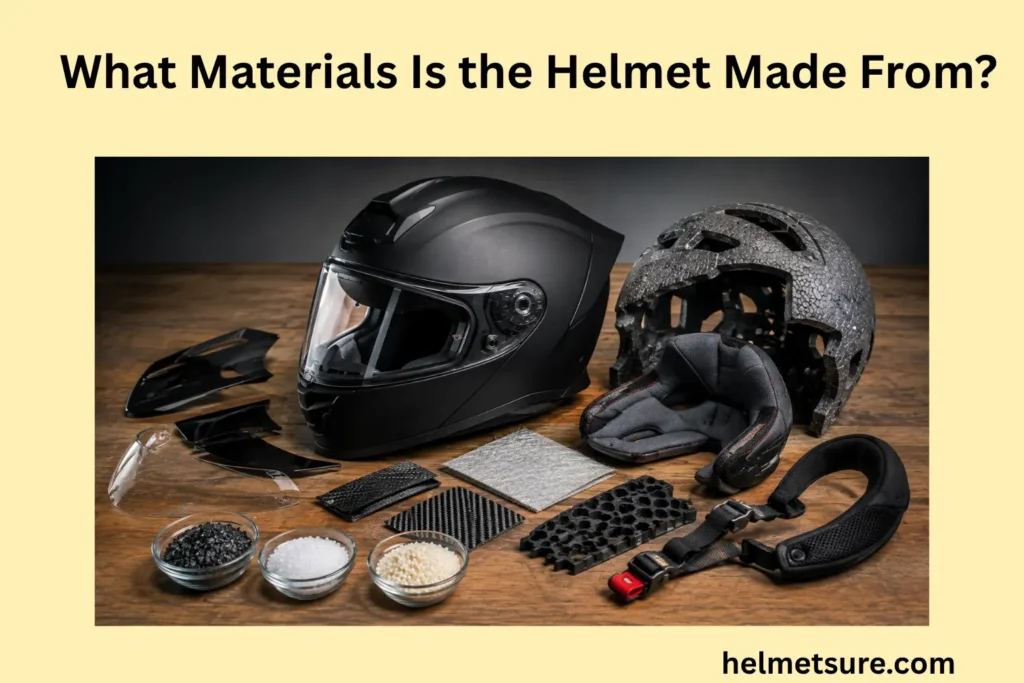
A typical material map begins outside with a thermoplastic or fiber-reinforced shell, moves inward to a cellular impact liner, and finishes with soft foams and fabrics at the wearer interface. Straps, anchors, adjusters, buckles, adhesives, coatings, and molded connections cross that layered structure. The exact map varies among bicycle, motorcycle, equestrian, snow, industrial, military, and other helmet categories; some designs also use a suspension or headband rather than a conventional sport-helmet foam stack.[1]
Material names therefore answer only part of the question. Polycarbonate describes a polymer family, for example, but it does not reveal a shell’s thickness, geometry, grade, forming process, or connection to the liner. Likewise, “EPS” identifies a foam family without specifying density, molded shape, local thickness, or how the liner works with the rest of a particular helmet.
A Helmet Uses Multiple Materials Because Each Layer Performs a Different Job
A helmet uses multiple materials because the shell, impact liner, comfort layers, and retention components require different mechanical and contact properties.
The outside must form and support the helmet’s external geometry. The structural liner must deform in a controlled way under loading. The contact layers must accommodate the wearer’s head and manage pressure, friction, and moisture. The retention subsystem must remain flexible enough to route around the wearer while connecting securely through anchors and closure hardware. These demands are different enough that one material is rarely suited to every position.
This division of labor is recognizable across many helmets, but it is not a universal bill of materials. A hard hat with a shell-and-suspension system, a bicycle helmet with a thin polymer shell over molded foam, and a composite-shell motorcycle helmet can all follow the multi-material principle while using different parts, interfaces, and assembly sequences.
Why the outer shell, impact liner, padding, and retention system use different materials
The outer shell, impact liner, padding, and retention system use different materials because each component performs a different mechanical or wearer-contact function.
Shell materials are selected and formed to create the external body, edges, openings, and attachment regions. Cellular liner materials occupy an internal structural role and are shaped to deform under load. Softer pad foams and textiles sit closer to the head, where compliance, surface feel, moisture movement, and removability can matter. Woven webbing bends and routes through hardware in ways that a molded shell cannot.
The interfaces are part of the material system too. Adhesive films, molded interlocks, hook-and-loop patches, sewn seams, anchors, and fasteners position the principal components and help them remain a single assembly. Two helmets can list similar materials yet use different bonding areas, liner shapes, strap anchors, or pad attachments. That is why material identity and helmet construction are related but not interchangeable questions.
The roles in the following table are intentionally broad. A named material class is an example, not a promise that every helmet contains it or that every version behaves identically.
Helmet Layers, Material Classes, and Primary Jobs
| Helmet Layer or Component | Common Material Classes | Primary Material Job |
|---|---|---|
| Outer shell | Polycarbonate, ABS, fiber-reinforced composites | Provide external structure and distribute or manage mechanical loading within the design |
| Impact liner | EPS, EPP, and other engineered cellular materials | Deform under impact as part of the energy-management system |
| Comfort padding or liner | Soft polymer foams and knitted, woven, or non-woven textiles | Provide fit, contact comfort, and a moisture interface |
| Retention straps | Nylon, polyester, or other engineered webbing | Hold the helmet while remaining flexible |
| Buckles and adjusters | Molded engineering plastics and/or metals | Secure and adjust the retention system |
| Bonding and interface materials | Adhesives, hook-and-loop, and molded interfaces | Join or position components |
Why no single material determines how the entire helmet performs
No single helmet material determines overall performance because each component interacts with the geometry, density, thickness, interfaces, and materials around it.
A shell polymer can be molded into different shapes and thickness distributions. A composite can use different fibers, matrices, fiber orientations, layer sequences, and local reinforcements. An EPS liner can contain different regional densities or geometries. A strap material operates through its weave, seams, anchors, adjusters, and buckle rather than as loose fiber. These variables change the physical system even when the label on one component stays the same.
Testing reinforces this system-level view. Research on bicycle helmets has examined how shell material, liner density, helmet geometry, and test configuration interact, while studies of liner materials treat density and structural design as important variables rather than assuming the polymer name is sufficient. Results from one helmet class, model, or laboratory method should not be turned into a universal rule for all head protection.
This distinction also prevents misleading comparisons. “Carbon” does not automatically mean that a helmet is safer than a thermoplastic design, and “more foam” does not automatically mean better impact management. A complete assessment needs verified construction details and applicable whole-helmet testing, not a single impressive-sounding ingredient.
What Materials Are Commonly Used for the Outer Shell?
Common helmet shell materials include thermoplastics such as polycarbonate and ABS and fiber-reinforced composites using glass, carbon, aramid, or related reinforcement systems.
These material families appear in different helmet categories and manufacturing systems. A thermoplastic shell may be injection molded, thermoformed, or incorporated as a thin formed skin, depending on the design. A composite shell is built from reinforcement held within a polymer matrix, with its properties influenced by the complete laminate and manufacturing process. Some helmets combine material families or use different shell constructions in different regions.
“Outer shell” identifies the component’s physical position, not a single job or material specification. The shell creates the external surface and contributes to how loads, abrasion, edges, attachments, and openings are handled within a particular design. Its behavior cannot be separated from the liner and the interface between them.
How polycarbonate and ABS plastics provide a durable outer structure
Polycarbonate and ABS are thermoplastic shell materials used because they can be molded into durable helmet structures with useful toughness and impact-related mechanical properties.
Heating and forming a thermoplastic allows a manufacturer to create repeatable curves, ribs, openings, edge profiles, and attachment zones. Polycarbonate is also used as a thin shell or cover over molded EPS in some bicycle helmets. ABS appears in rigid shell constructions and in products where a separately formed shell is combined with an internal liner or suspension. These are construction examples rather than universal definitions; polymer grade and processing remain product-specific.
The word “durable” needs the same scope. It can refer to resistance to ordinary handling, surface contact, or local deformation within an intended design, but it does not make a shell immune to cracking, chemical attack, heat, ultraviolet exposure, or impact damage. Nor does a thermoplastic label reveal the helmet’s certification or its response in a particular test.
Material studies of bicycle helmets illustrate the construction dependence: even helmets that use broadly recognizable EPS-and-polycarbonate architectures can differ in geometry and material distribution.[2] A thin polymer cover bonded to foam should not be treated as structurally equivalent to every separately molded rigid shell merely because both contain polycarbonate.
How fiberglass and carbon-fiber composites combine reinforcement with lower weight
Fiberglass and carbon-fiber helmet shells use reinforcing fibers within a polymer matrix so the composite structure can be engineered for stiffness, strength, toughness, thickness, and weight.
The fibers do not form a usable shell by themselves. A matrix—often a thermoset polymer in conventional composite construction—binds the reinforcement, transfers load between fibers, preserves the molded form, and creates the laminate. Fiber type, orientation, weave or fabric form, layer sequence, resin system, cure, void content, and local thickness all influence the resulting shell. “Carbon fiber” without that matrix-and-laminate context is incomplete.
Glass reinforcement and carbon reinforcement also should not be reduced to a simple heavy-versus-light hierarchy. Carbon fibers can offer high stiffness and strength relative to mass, while glass-fiber systems can contribute different combinations of cost, toughness, formability, and laminate behavior. Hybrid laminates may place more than one reinforcement in the same shell to tailor local properties. The result depends on design and manufacture, not merely the most recognizable fiber in the product name.
Composite helmet research has examined impact-induced matrix cracking, fiber damage, and delamination as mechanisms within a shell.[3] That evidence supports treating a composite as a structured laminate; it does not establish that every composite shell, or every carbon-labeled helmet, provides the same performance.
Why shell material choices vary by helmet design and intended construction
Shell material choices vary because helmet designers balance manufacturability, geometry, thickness, weight, durability, cost, and the mechanical requirements of the complete construction.
A complex vented shape, a broad rigid shell, a thin skin fused to foam, and a layered composite body impose different manufacturing constraints. Tooling, forming radius, trim operations, edge treatment, bonding surface, paint or coating compatibility, and attachment provisions can all influence the selected material system. The choice must also fit the liner, retention architecture, and other components that occupy the finished shell.
The material family is therefore one input to shell design. A polymer name does not tell the reader whether the shell is thin or thick, what grade was used, where material is concentrated, or whether the shell was formed together with or separately from the liner. A composite label likewise omits the matrix, laminate, local reinforcement, and manufacturing quality.
Outer-Shell Material Families and Boundaries
| Shell Material Family | Material Structure | Useful Characteristics | Important Boundary |
|---|---|---|---|
| Polycarbonate | Molded or formed thermoplastic | Toughness, moldability, and use in shell structures | Not automatically safer or inferior to another family |
| ABS | Molded thermoplastic | Durable molded construction and geometric freedom | Formulations and shell designs are not all identical |
| Fiberglass composite | Glass fibers within a polymer matrix | Reinforcement and a tunable laminate | More fiberglass does not automatically mean more protection |
| Carbon-fiber composite | Carbon fibers within a polymer matrix | Potential for high specific stiffness or strength and engineered weight | A carbon label does not prove superiority |
| Hybrid composite | Multiple reinforcements or material systems | Local property tailoring | “Hybrid” is not automatically better |
What Is the Impact-Absorbing Liner Made From?
Helmet impact liners commonly use engineered cellular materials such as expanded polystyrene or expanded polypropylene because these foams deform under load as part of the helmet’s impact-management system.
EPS and EPP are important examples, not a universal list. Reviews of helmet liner research also discuss polyethylene, polyurethane, honeycombs, lattices, and other engineered materials or structures, some established in specific applications and others still experimental. The relevant question is how a verified liner material and geometry behave in the helmet category and loading condition being examined.
The impact liner is a structural component. It should not be confused with the soft comfort pad touching the head. In many conventional designs, the impact liner lies beneath the shell and outside the removable comfort layer; in other helmet categories, a suspension or different internal architecture changes that sequence.
How EPS foam compresses to absorb impact energy
Expanded polystyrene foam manages impact energy by compressing and crushing within its cellular structure as the helmet is loaded.
EPS consists of expanded, fused polymer beads containing a large volume of cellular space. Under sufficient compressive load, cell walls buckle and collapse, allowing the liner to deform through a distance while managing energy within the complete helmet. The molded foam can also be shaped into channels, ribs, recesses, and regions that interact with the shell and internal components.
Crushing is not simply a temporary softness. A significantly loaded EPS region can retain deformation rather than springing fully back to its original form. Research on repeated impacts to equestrian helmets found liner compression and reduced attenuation in subsequent impacts at the same location, but that result belongs to the tested helmets and protocol rather than establishing a universal replacement rule for every helmet class.
This construction mechanism explains what the material does; the separate topic of helmet impact protection requires whole-helmet test evidence, an applicable standard, and the relevant impact conditions. The presence of EPS by itself does not demonstrate a particular injury outcome.
How EPP and similar foams differ in deformation and recovery behavior
Expanded polypropylene differs from conventional EPS partly because its cellular structure is more resilient and can recover more of its shape after some loading conditions.
That recovery behavior is why EPP is considered for designs that must address more than one loading event or need a different balance of stiffness and resilience. Research has evaluated EPP as a motorcycle-helmet liner material and compared its response with conventional alternatives under specific modeling and test conditions. Similar-looking foams can still use different grades, densities, bead structures, molding processes, and liner geometries.
Resilience does not mean unlimited reuse, immunity to damage, or automatic multi-impact certification. An EPP liner can still be overloaded, cut, compressed, detached, aged by its environment, or combined with other components that have different damage behavior. A helmet’s serviceability after an event must follow the manufacturer’s instructions and any applicable inspection or replacement requirements.
The same caution applies to alternative foams and engineered structures. A research-stage honeycomb, lattice, auxetic structure, or polymer blend may demonstrate a useful laboratory response without being common in commercial helmets or equivalent across test methods. Material claims should retain the exact study and helmet context.
Why liner density and structure matter as much as the foam name
Liner density and structure matter because two liners made from the same foam family can deform differently when their density, thickness, geometry, or local construction changes.
Density affects the amount and arrangement of polymer within a cellular volume, but it should not be interpreted in isolation. A denser foam is not automatically better, and a lower-density foam is not automatically softer in every finished helmet. Strain rate, cell morphology, liner thickness, curvature, vents, channels, shell support, temperature, and impact location all contribute to the response.
A bicycle-helmet study documented regional EPS density variation within and between sampled helmets and connected those differences to impact response under its test conditions. A manufacturer example also shows how one motorcycle-helmet liner can incorporate multiple EPS densities within a one-piece structure. Neither example creates a generic target density or proves that a multi-density label is superior without model-specific testing.
Geometry supplies another design variable. Channels remove or redirect material; ribs can change local support; thickness can vary around openings and coverage areas; and separate blocks or layers can create interfaces. The usable description is therefore “EPS liner of a verified density distribution and geometry,” not merely “EPS helmet.”
What Materials Make Up the Comfort Padding and Inner Liner?
Helmet comfort padding and inner liners commonly combine soft polymer foams with textile layers that provide fit, skin contact, cushioning, and moisture-management functions.
This wearer-contact assembly may include flexible polyurethane foam, spacer fabric, mesh, knitted covers, wicking textiles, non-wovens, hook-and-loop patches, and other model-specific materials. The components may be sewn, laminated, bonded, snapped, or otherwise attached. Some pads are removable or offered in alternative thicknesses; others are not intended for user removal.
“Inner liner” is ambiguous unless qualified. In this section it means the comfort liner or pad system, not the impact-absorbing liner. The difference is functional and physical: comfort materials manage contact and fit, whereas the structural liner is part of the primary energy-management architecture.
How soft foams cushion contact between the head and helmet structure
Soft comfort foams cushion the contact between the wearer and the helmet’s harder internal structure by conforming locally to the head.
Compliance allows a pad to spread contact over a local area, fill modest gaps designed into the fit system, and reduce the sensation of hard edges or attachment points. The foam may be open-cell or otherwise engineered for the pad’s intended compression, resilience, moisture behavior, and durability. Those details vary by product and should not be inferred solely from softness.
Repeated wear can compress a comfort pad and reduce its thickness or resilience. That change may alter contact and perceived fit, yet it is not the same mechanism as crushing the structural EPS impact liner. Replacing, rearranging, or modifying pads can also affect intended fit or component positioning, so any user-serviceable change should follow the manufacturer’s instructions.
A soft pad can absorb a small amount of mechanical energy in a general physical sense, but that does not make it the helmet’s primary impact liner. Calling both components “foam” hides the important distinction between a wearer-interface material and a structural energy-management material.
How fabric liners manage skin contact, sweat, and moisture
Fabric liners form the immediate skin-contact surface and can influence friction, moisture transport, breathability, and perceived comfort during wear.
Knitted, woven, mesh, and non-woven structures create different surface textures, stretch, porosity, and paths for liquid or vapor. Fiber choice and textile construction both matter: two fabrics made from the same polymer can feel and transport moisture differently because their yarns, knit pattern, thickness, finish, and layering differ.
Moisture-managing fabric does not independently ventilate the helmet. It can move or spread sweat at the contact surface, while ventilation depends on the larger relationship among vents, internal channels, air movement, and coverage. Antimicrobial or odor-control finishes, when present, are also product-specific treatments rather than properties that should be assigned to every liner fabric.
Research on warp-knitted spacer fabrics for motorcycle-helmet comfort liners demonstrates how textile geometry can be tuned for compression, air permeability, and heat or water-vapor transfer. That study supports the principle that fabric structure matters; it does not establish a universal textile specification for all helmets.
Why removable or washable liners often use layered textile-and-foam construction
Removable or washable comfort liners often combine a textile cover with soft foam because the two layers serve different contact, cushioning, and maintenance functions.
The textile supplies the skin-facing surface and can protect or contain the softer core. The foam contributes local compliance and shape. Stitching, lamination, pockets, hook-and-loop, snaps, or tabs keep the layers together and position the pad within the helmet. A manufacturer may also use moisture-resistant films or modular pad assemblies for a particular helmet, as shown in technical documentation for a rescue helmet.
Removability is an interface decision, not a sign that the component is unimportant. A pad still affects how the helmet contacts the wearer and how internal hardware is covered. Washing or replacement instructions can differ because heat, detergent, agitation, or incorrect reassembly may affect foam, textile finishes, adhesive-backed patches, or attachment geometry.
Comfort-Liner Materials and Functional Boundaries
| Material or Component | Primary Property | Main Role | Do Not Confuse With |
|---|---|---|---|
| Soft polymer foam | Compliance and compressibility | Local cushioning and fit interface | Primary impact liner |
| Knitted or woven fabric | Skin-compatible surface | Covering and contact comfort | Outer shell |
| Moisture-managing textile | Capillary transport and breathability | Sweat and wearer-interface management | Complete ventilation system |
| Layered pad | Combined textile-and-foam behavior | Removable or sizing-related contact component | Whole helmet protection system |
What Materials Are Used in the Straps, Buckles, and Retention System?
Helmet retention systems commonly combine flexible synthetic webbing with molded polymer or metal hardware so the helmet can be secured and adjusted while remaining wearable.
The subsystem can include straps, sewn joints, anchors, dividers, sliders, buckles, rings, rivets, and model-specific fittings. A sport helmet may use webbing routed around the ears and under the chin, while an industrial or tactical helmet may use a different suspension, chin-cup, or multi-point architecture. The materials and part count must therefore be verified for the helmet being described.
Retention materials work as a connected load path. Webbing properties matter, but so do weave, width, edge finish, stitching, routing, anchor design, adjuster grip, buckle engagement, and the connection to the structural body. The name of the strap fiber alone cannot describe the complete assembly.
How woven synthetic webbing provides flexible strap strength
Woven synthetic webbing provides helmet straps with a flexible load-bearing structure that can pass around the head and through adjustment hardware.
Nylon and polyester are common examples because fibers can be organized into a narrow woven tape that bends repeatedly while carrying tension. The weave keeps many yarns aligned as a strap, controls width and thickness, and creates a surface that can interact with sliders or other hardware. Fiber chemistry, yarn construction, weave, finishing, and stitching all influence the actual webbing.
An OEM data sheet for one search-and-rescue helmet, for example, identifies nylon webbing as part of its retention system. That is a scoped product example, not proof that every helmet uses nylon. Polyester or other engineered webbings can appear in different categories, and exact strap specifications should come from the manufacturer or an applicable technical standard.
The material remains dependent on its interfaces. Fraying at an edge, a cut across yarns, damaged stitching, contamination, or a loose anchor can affect the connected system even if the remaining webbing still looks flexible. Hidden routing and anchor design should not be guessed from an exterior photograph.
Why buckles and adjusters commonly use durable molded plastics or metal components
Helmet buckles and adjusters use molded engineering plastics, metals, or combinations of both because the hardware must hold, release, and adjust the retention webbing reliably.
Molded polymers can form complex latch arms, slots, teeth, housings, and smooth strap paths in compact parts. Metals may be used for rings, pins, springs, rivets, cable elements, or other fittings where a design calls for their particular stiffness, wear behavior, geometry, or environmental resistance. One verified rescue-helmet example uses acetal buckles and cams, but that material choice must remain attributed to that product.
“Plastic buckle” is not a sufficient strength rating. Polymer grade, molded geometry, wall section, engagement depth, wear, temperature, chemical exposure, and its relationship with the strap all matter. “Metal hardware” is equally broad; alloy, forming, coating, connection, and corrosion condition can vary.
The closure and adjustment parts complete the retention path from the helmet’s anchors through the webbing to the wearer. They should not be replaced with unapproved substitutes or modified on the assumption that a visually similar material will behave the same way.
Why Do Helmets Combine Plastics, Foams, Fibers, and Fabrics?
Helmets combine plastics, foams, fibers, and fabrics because no single material class provides every structural, deformation, comfort, and retention property the helmet requires.
Rigid and semi-rigid materials preserve external form; cellular structures provide deformation distance; soft layers conform to the wearer; textiles manage surfaces and moisture; webbing supplies flexible tension paths; and hardware provides closures and adjustments. Adhesives, coatings, stitches, fasteners, and molded interfaces connect those roles.
The combination is an engineering compromise rather than a recipe with one ideal answer. Reducing mass in one component may require a different geometry or material elsewhere. Adding coverage, ventilation channels, washable layers, attachment points, or accessories changes the space and interfaces available to the remaining parts.
How rigid materials provide structure while foams manage energy and contact
Rigid shell materials provide external structure while cellular and soft foams supply different forms of deformation, cushioning, and contact management inside the helmet.
Thermoplastic or composite shells establish the outer form and an interface for the layers beneath them. Structural cellular foams such as EPS or EPP provide crush or deformation behavior within the impact architecture. Softer pad foams create local conformity at the head. The word “foam” therefore covers materials with very different density, cell structure, stiffness, resilience, and intended function.
The boundary between these roles is not always visible from the outside. A thin shell may be permanently integrated with foam, a rigid shell may contain a separately installed liner, and a suspension-based helmet may maintain space between shell and head without following the same stack. The material map must be built from verified technical documentation rather than appearance.
Material roles also overlap without becoming identical. The shell, liner, and interfaces can all contribute to the mechanical response, while comfort layers can influence how the assembly contacts the wearer. Overlap does not justify describing a soft pad as the impact liner or the shell as the only protective component.
How fabrics and webbing add comfort, moisture control, and retention
Fabrics and webbing add functions that rigid shells and impact foams cannot provide efficiently, including skin contact, moisture handling, flexible fit support, and retention.
Textiles can bend, stretch, breathe, wick, cover seams, and create removable contact surfaces. Webbing applies textile engineering to a narrow load-bearing strap: yarns and weave form a flexible tape that connects anchors, adjusters, and closures. These structures make the interior and retention system usable without requiring the shell or impact liner to perform every contact function.
Fabric is not one material. Polyester, polyamide, natural fibers, elastomeric yarns, meshes, spacer fabrics, coatings, and finishes can be arranged in many ways. Webbing is similarly specific to its fiber, weave, thickness, stitching, and hardware. A material statement should identify the component and verified construction rather than using “fabric” as a catch-all.
These secondary materials remain part of the complete system. A torn pad cover can expose or displace foam; a failed seam can change strap routing; and a worn patch can stop a removable component from staying in its intended position. Their role is not the same as the structural liner, but their interfaces still matter.
Why material combinations balance weight, durability, comfort, and structural needs
Helmet material combinations balance competing requirements because changing one component’s material, density, thickness, or construction can affect weight, durability, comfort, geometry, and mechanical behavior elsewhere in the system.
A stiffer shell laminate may allow one geometric approach while a molded thermoplastic supports another. Increasing liner thickness can alter external size or internal space. Adding large channels changes the liner geometry and the amount of surrounding material. Thicker comfort pads can change contact, but they cannot substitute automatically for structural liner thickness. Hardware choices can influence strap routing, bulk, adjustment, and maintainability.
This dependency is why material rankings are unreliable when detached from design. A lower-mass composite shell is not universally better than a thermoplastic shell; resilient EPP is not universally better than crushable EPS; and a more breathable fabric is not automatically suitable for every environment or maintenance system. Each property has to be evaluated in its component, construction, helmet category, and applicable test context.
Material Classes Across the Complete Helmet System
| Material Class | Typical Helmet Role | Property to Understand | Important Boundary |
|---|---|---|---|
| Thermoplastics | Shells, covers, or hardware | Moldability, toughness, and formed geometry | Polymer name does not determine whole-helmet performance |
| Fiber composites | Shells | Fiber-matrix system and laminate design | Fiber name alone is insufficient |
| EPS or EPP | Impact liners | Controlled deformation and density-dependent response | Impact liner is not comfort padding |
| Soft foams | Comfort pads | Compliance, resilience, and contact behavior | Not automatically the primary energy absorber |
| Textiles | Inner liners | Surface, moisture transport, and breathability | Fabric is not one uniform material |
| Webbing | Retention straps | Tensile behavior and flexibility | The sewn and anchored system matters |
| Polymers or metals | Buckles and adjusters | Shape, closure, wear, and adjustability | Material alone does not establish retention strength |
| Adhesives and interfaces | Component joining | Bonding and positioning | Chemistry and process are model-specific |
How Do Helmet Materials Change With Age and Use?
Helmet materials can change through impact, compression, abrasion, moisture, ultraviolet exposure, handling, and normal wear, but the relevant change depends on the material and helmet design.
Different components show different evidence. Comfort foam may pack down; EPS may retain a crushed region after substantial loading; shell surfaces may crack, gouge, deform, or delaminate; textiles can tear; webbing can fray; hardware can crack or stop engaging; and attachment interfaces can loosen. Some damage may be hidden beneath a shell, cover, or pad.
Chronological age is not the same as material condition. A study of field-used bicycle helmets found that age alone did not significantly reduce the tested impact-attenuation properties of their EPS liners, but the finding does not override manufacturer replacement guidance or address every shell, strap, adhesive, exposure, impact history, or helmet category.[4]
How foam compression and padding wear alter shape and comfort over time
Foam compression can alter a helmet’s internal shape because comfort padding can lose thickness through use and impact liners can remain crushed after significant loading.
In comfort pads, repeated pressure, perspiration, washing, heat, and flexing can change softness, rebound, thickness, or attachment. The immediate result may be a different contact pattern or a looser-feeling interior. This is a wearer-interface change and should not be used as a direct measure of structural-liner performance.
In an EPS impact liner, a crushed area represents a different material state: cells that have collapsed may not recover their original geometry. EPP and other resilient foams may recover more shape under some conditions, but visible recovery does not prove that the complete helmet remains serviceable. Shells, anchors, interfaces, and unseen regions may have experienced loading too.
The appropriate response is model-specific. Do not add material, heat foam, reshape the liner, or rely on a comfort-pad swap to repair suspected structural damage unless the manufacturer explicitly authorizes the procedure.
How shell surfaces, straps, and fabrics can show visible wear or degradation
Shells, straps, hardware, and fabrics can reveal material-condition problems through cracks, delamination, gouges, fraying, torn seams, damaged buckles, or loss of pad resilience.
The meaning and acceptable limit of each observation depend on the helmet and its instructions. Manufacturer documentation for an industrial helmet, for example, directs users to inspect chin straps for cuts, fraying, broken stitching, and damaged hardware. Other helmet manuals may define additional shell, liner, pad, or hardware checks. These examples show what material changes can look like; they do not create one inspection threshold for every helmet.
Composite-shell damage deserves particular restraint. Cracks, exposed reinforcement, or delamination can be significant, but a clean-looking surface does not rule out internal damage. Thermoplastic shells can likewise hide liner or interface changes. Exterior appearance alone cannot reconstruct an impact history or validate the assembly.
For a use-specific inspection process, follow the manufacturer’s guidance and the separate framework for evaluating helmet condition. Never drill, glue, paint, patch, heat, or otherwise modify a suspect component as a substitute for an authorized assessment.
Why material condition should be judged as part of the whole helmet rather than one component alone
Helmet material condition should be judged across the complete helmet because the shell, impact liner, comfort layers, retention system, and interfaces depend on one another during use.
An impact can load more than the visible contact point. A worn strap can undermine retention even when the shell looks intact. A cracked buckle can interrupt closure despite undamaged webbing. Packed comfort pads can alter the wearer interface while the structural liner remains visually unchanged. A loosened bond or attachment can change the relationship between otherwise sound materials.
Condition assessment should therefore trace the component network: shell surface and geometry, liner state, shell-liner interface, comfort components, anchors, webbing, seams, adjusters, buckle, and any model-specific attachment. The manufacturer’s criteria determine whether a component is inspectable, replaceable, repairable by an authorized party, or grounds for retiring the helmet.
Material-Condition Changes to Inspect
| Material or Component | Observable or Known Change | What It Means |
|---|---|---|
| Comfort padding | Packs down or tears | Fit and contact can change |
| EPS liner | Crushes or remains compressed | The impact material’s state has changed |
| EPP or another resilient liner | May recover differently after loading | Shape recovery does not establish serviceability |
| Thermoplastic shell | Cracks, gouges, or deforms | Requires manufacturer-scoped assessment |
| Composite shell | Cracks, exposes fiber, or delaminates | Surface appearance may not reveal all internal damage |
| Webbing | Frays, cuts, or loses stitching integrity | The retention path may have deteriorated |
| Buckles or adjusters | Crack, break, or stop engaging | Closure and adjustment need reassessment |
| Textile liner | Tears or loses seams or attachment | The comfort and fit interface can deteriorate |
What Is the Best Way to Understand a Helmet’s Material Construction?
The best way to understand helmet materials is to identify each component, name its material or material class, and explain the specific role that material performs within the complete helmet.
Start with verified documentation rather than marketing shorthand or exterior appearance. For the shell, record the polymer or the complete fiber-and-matrix composite description when available. For the impact liner, identify the cellular material, density architecture, and geometry only to the level the source supports. Then separate comfort foam and textiles from the structural liner, and trace webbing through anchors, adjusters, and closure hardware.
For every item, ask four linked questions: What is the material? What property is relevant here? How is the material formed and connected? What can the name not establish? That method preserves the difference among composition, construction, fit, condition, certification, and tested performance.
Helmet construction combines structural, impact-managing, comfort, and retention materials
Helmet construction combines structural shell materials, deformable impact-liner materials, soft comfort materials, and flexible retention materials into one integrated system.
From outside to inside, the shell establishes the external form; the impact liner supplies a designed deformation structure; comfort foam and fabric create the wearer-contact surface; and the retention subsystem connects the assembly to the wearer. Bonding materials, molded interfaces, stitches, anchors, and hardware join or position those components. Openings and channels alter the geometry of one or more layers.
That conceptual sequence remains useful even when a helmet uses a different architecture. Suspension-based industrial head protection, separately assembled hard shells, thin-shell in-mold designs, composite motorcycle helmets, and specialist protective systems can distribute the roles differently. The component map must follow the actual category and model.
Material analysis is therefore strongest when it describes interfaces as well as ingredients. “Polycarbonate shell with EPS” is more informative than “plastic and foam,” but it still omits thickness, density, geometry, integration, pads, retention, and openings. A complete material description reconnects those facts without claiming that the list proves performance.
The most useful material question is what each material does within the helmet system
The most useful helmet-material question is not whether one material sounds better than another, but what property that material supplies in its specific component and construction.
For a thermoplastic shell, the relevant properties may include moldability, toughness, and the ability to hold a defined geometry. For a composite shell, the fiber, matrix, laminate, and manufacturing quality matter together. For EPS, EPP, or another cellular liner, deformation behavior depends on density and structure. For comfort layers, compliance and moisture-interface behavior matter. For webbing and hardware, the continuous anchored retention path is the meaningful system.
The stable answer is therefore component → material → property → role → limitation. A helmet is made from a coordinated set of plastics, foams, fibers, fabrics, and joining materials whose value comes from how they are specified, shaped, connected, and verified as one design. Material identity helps explain the helmet; it never replaces certification, correct fit, condition assessment, manufacturer instructions, or whole-helmet testing.
Interactive helmet-material verification checklist
Frequently Asked Questions About Helmet Materials
Short answers about shell polymers, composites, EPS, EPP, comfort layers, retention materials, aging, and material comparisons.
Are all helmet shells made from plastic?
No. Common families include thermoplastics such as polycarbonate and ABS, plus fiber-reinforced composites. Exact construction varies by helmet category and model.
Is carbon fiber automatically safer?
No. Fiber, matrix, laminate design, geometry, manufacturing quality, and whole-helmet testing matter together; the carbon label alone cannot prove superiority.
What is the difference between EPS and EPP?
Both are cellular materials, but conventional EPS crushes and can retain deformation, while EPP is generally more resilient under some loading conditions. Grade, density, geometry, and complete design still decide behavior.
Is soft padding the impact liner?
Usually not. Soft comfort pads manage contact and fit; the structural impact liner is a separate energy-management component.
What are helmet straps made from?
Many use engineered synthetic webbing such as nylon or polyester, but exact fiber, weave, stitching, anchors, and hardware are product-specific.
Are metal buckles always stronger than plastic buckles?
No. Material family alone cannot establish retention strength. Geometry, grade, engagement, wear, webbing, anchors, and whole-system testing matter.
Do helmet materials become unsafe only because they are old?
Chronological age and condition are not identical. Follow manufacturer guidance and assess impact history, exposures, shell, liner, retention, hardware, and interfaces together.
What is the best helmet material?
There is no universal best ingredient. The useful question is what property each verified material supplies within the complete helmet design and its intended use.