
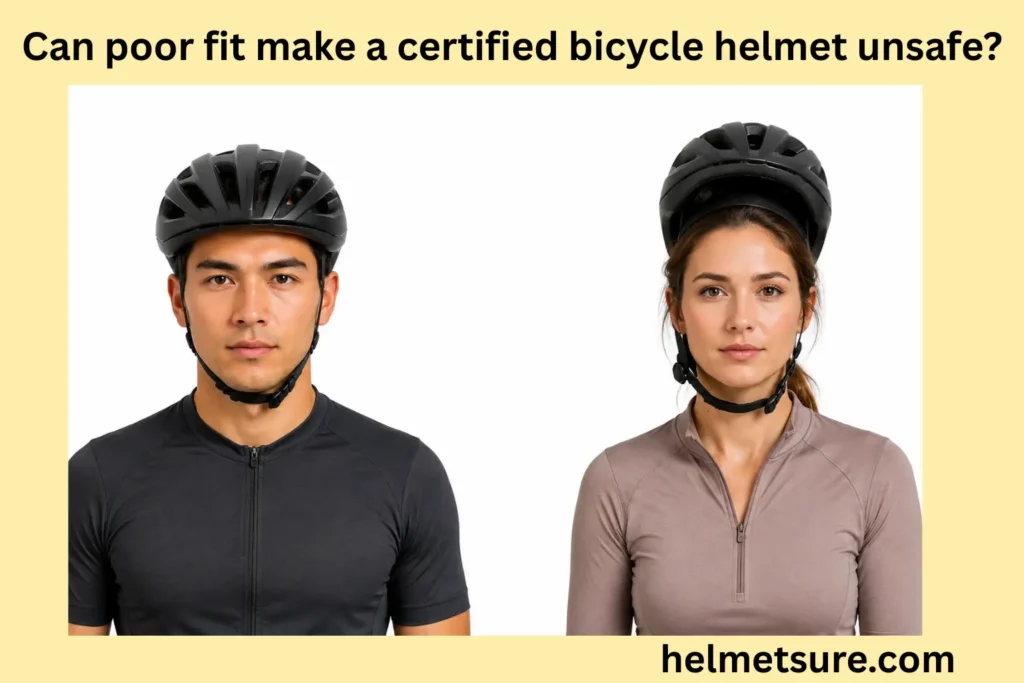
Can Poor Fit Make a Certified Bicycle Helmet Unsafe?
Poor fit can compromise a certified bicycle helmet’s real-world protection by allowing unstable or incorrect positioning, while the helmet itself remains certified; correct sizing, position, and retention help keep its protective structure where intended.
Here, “unsafe” does not mean that poor fit automatically cancels certification or guarantees injury. It means the helmet may not remain in the position needed to provide its intended coverage reliably. Certification validates the helmet as a product under specified test conditions; fit determines whether that product is suitably positioned and retained on a particular rider.
Neither certification nor proper fit makes a helmet concussion-proof or guarantees prevention of serious head injury. Correct fit is still essential because it helps keep the helmet’s protective structure where it is intended to be during use.
Certification validates specified tested helmet performance. Correct sizing, positioning, and retention enable that protection to remain positioned as intended. Poor fit can compromise real-world protection without changing certification status.
Certification Status and Helmet Fit Describe Different Safety Conditions
Certification status describes verified helmet performance under an applicable standard, while helmet fit describes whether that protection remains properly positioned on an individual rider. These conditions support each other, but they are not interchangeable.
Certification as validation of specified tested helmet performance
Bicycle-helmet certification validates compliance with specified performance requirements under the applicable standard; it does not describe every real-world wearing condition.
In the United States, CPSC certification is tied to federal requirements for matters including impact attenuation, positional stability, retention-system strength, peripheral vision, labeling, and instructions. The U.S. Consumer Product Safety Commission’s bicycle-helmet guidance also explains that certification must be supported by a reasonable testing program. [1]
That is a meaningful product-level validation. It is not evidence that every compliant helmet will fit every rider, remain correctly positioned under every wearing condition, or protect against every possible impact.
Correct fit as an enabling condition for maintaining protective positioning
Correct fit enables a bicycle helmet to remain level, stable, and positioned over the areas it is intended to cover.
The helmet must be compatible with the rider’s head dimensions and shape, sit in its intended position, and use its retention system effectively. Together, those conditions create a stable helmet-to-head relationship. Comfort matters, but comfort alone does not prove correct fit: a helmet may feel acceptable while sitting too high, tilting rearward, or moving excessively.
Poor fit as a use-condition failure rather than a change in certification status
Poor fit is a failure of the helmet’s wearing conditions, not evidence that the helmet itself has lost its certification.
A compliant helmet can be too large, too small, incompatible with a rider’s head shape, incorrectly positioned, or inadequately retained. Those conditions concern the rider-helmet pairing. They can make protective positioning unreliable without proving that the helmet failed the standard under which it was certified.
The reverse is also true: a certification label does not prove correct individual fit. Product compliance and rider compatibility must be evaluated separately.
Compromised protection as distinct from guaranteed injury occurrence
Compromised helmet positioning makes the protection available in a crash less reliable; it does not establish that an injury will occur.
Crash direction, impact location, severity, sequence, and the helmet’s final position all vary. Poor fit should therefore be discussed as a risk-management problem involving stability and coverage—not as a prediction of a particular medical outcome. Correct fit improves the conditions under which protection is available, but it also cannot guarantee an injury-free result. The CDC’s helmet-safety guidance states that no helmet is concussion-proof and emphasizes proper fit, certification, maintenance, and correct use. [2]
Certification and Fit Conditions
| Condition | What It Establishes | What It Does Not Establish |
|---|---|---|
| Certified helmet | Compliance with applicable specified performance requirements | Correct fit on a particular rider |
| Correct fit | Stable individual positioning and retention | Guaranteed injury prevention |
| Poor fit | Failure to maintain intended wearing conditions | Automatic loss of certification |
| Compromised positioning | Less reliable protective placement in use | Certainty that injury will occur |
Fit does not absorb impact. The helmet’s protective structure performs that function. Fit enables that structure to remain positioned as intended.
What Bicycle Helmet Certification Actually Validates
Bicycle-helmet certification supports a defined tested-performance claim, not a claim that every rider, wearing condition, or crash scenario has been validated.
Protective performance evaluated under the safety standard’s specified test conditions
The bicycle-helmet standard evaluates defined performance requirements using specified test procedures rather than unrestricted real-world crash scenarios.
For U.S. bicycle helmets, 16 CFR Part 1203 defines minimum performance criteria and test methods. Its performance requirements cover peripheral vision, positional stability, dynamic strength of the retention system, and impact attenuation. These controlled procedures provide a consistent basis for determining compliance. [3]
The regulation’s positional-stability test should not be confused with an ordinary rider fit check. One is a prescribed regulatory test performed under defined conditions; the other evaluates whether a specific helmet remains correctly positioned on a specific wearer.
Passing a standard as evidence of a tested baseline rather than universal crash protection
Passing an applicable bicycle-helmet standard establishes a tested safety baseline, not universal protection against every impact or injury.
A pass means the helmet met the defined requirements applicable to that certification. It does not rank the helmet against every other compliant model, reproduce every possible collision, or predict what will happen to an individual rider. Impact energy, direction, contact location, and crash sequence may differ from standardized testing.
Certification therefore deserves weight in a helmet decision, but terms such as “fully safe,” “maximum protection,” or “guaranteed protection” exceed what a compliance result establishes.
Why certification does not remove manufacturer sizing, positioning, or retention requirements
Certification does not replace the manufacturer’s sizing, positioning, and retention instructions for the individual helmet and rider.
Different models can use different shell sizes, internal shapes, fitting pads, cradles, dials, strap arrangements, or adjustment sequences. A rider must follow the current instructions for the exact helmet being fitted. General fit principles are helpful, but they should not be used to invent a feature the helmet does not have or override its manufacturer’s procedure.
A certification label answers a compliance question. The instructions explain how the helmet is intended to be sized, worn, and secured.
Protection conditions that certification alone cannot establish for an incorrectly worn helmet
Certification alone cannot establish that an incorrectly worn helmet has adequate individual coverage, retention, or positional stability during use.
Those conditions depend on the interaction between the helmet and the rider: whether the shell size and internal shape are compatible, whether the helmet starts in the correct position, and whether its retention system keeps that position stable. They must be evaluated on the wearer.
This limitation does not diminish certification. It simply identifies the point where product validation ends and individual fit evaluation begins.
Certification vs Individual Fit Questions
| Question | Certification Establishes It? | Individual Fit Evaluation Required? |
|---|---|---|
| Did the helmet meet the applicable specified performance requirements? | Yes | No |
| Does this helmet size and shape suit this rider? | No | Yes |
| Does the helmet maintain its intended position? | No | Yes |
| Does the retention system control movement on this rider? | No | Yes |
| Will the helmet prevent every concussion or serious head injury? | No | No guarantee exists |
Correct Fit Keeps Certified Protection Positioned Where It Is Intended to Work
Correct bicycle-helmet fit combines compatible size, intended head position, and secure retention so the helmet remains stable where its protective structure is meant to stay. NHTSA’s bicycle-helmet fitting guidance supports measuring for size, placing the helmet level and low on the forehead, adjusting it for a snug fit, securing the straps, and checking that it does not rock out of position. [4]
Correct shell size as the basis for stable helmet-to-head contact
Correct shell size provides the fit range needed for stable helmet-to-head contact without relying on excessive retention-system tightening.
Head circumference is an important starting point, but a size label alone may not capture internal head-shape compatibility. A suitable helmet should settle into its intended position and allow its designed fit system to create reasonably even, stable contact. Concentrated pressure in one area and open space in another can indicate a shape mismatch even when the listed circumference range appears suitable.
Exact size ranges differ by manufacturer and model. Use the current size chart for the helmet being considered, then confirm the fit on the rider rather than relying on the label alone.
Proper fore-aft position as the basis for intended head coverage
Proper fore-aft position keeps a bicycle helmet level and low enough on the forehead to maintain its intended coverage.
Guidance on helmet position begins with level placement rather than a shell tilted high or far back. This starting position establishes the relationship between the helmet and the areas it is intended to cover. Retention can then preserve that placement.
Do not turn one generic forehead measurement into a universal rule for every helmet. Follow the helmet manufacturer’s placement instructions, particularly if the model’s coverage geometry or fit system requires a specific procedure.
Secure retention as the control that limits unwanted helmet movement
Secure retention limits unwanted helmet displacement after the helmet has been sized and positioned correctly.
The helmet’s straps, buckle, and any supplied fit-adjustment system should work according to their intended design to preserve the established position. Retention controls movement within a compatible fit; it does not create compatible shell size or head shape.
Secure also does not mean maximally tight. If the rider must create excessive pressure merely to stop the shell from shifting, the underlying size or shape may be unsuitable.
Combined sizing, position, and retention as the conditions for stable protective placement
Stable protective placement depends on compatible sizing, correct helmet position, and effective retention working together.
Size supplies the usable fit range. Position places coverage where it belongs. Retention helps stop the helmet from leaving that position. A weakness in any one of these conditions can undermine the whole fit even when the other two appear acceptable.
For that reason, correct fit should be judged as a coordinated system, not reduced to a tight chin strap, a fully turned dial, or a comfortable shell.
Stable-fit sequence
- Select a shell size and internal shape compatible with the rider.
- Position the helmet at its intended level fore-aft location.
- Stabilize helmet-to-head contact with the designed fit system.
- Secure retention so the position remains controlled without excessive pressure.
- Confirm that intended coverage remains stable during normal head movement.
- Treat stable placement as an enabling condition for real-world protective positioning, not a guarantee of injury prevention.
Poor Fit Creates a Path From Helmet Movement to Reduced Protective Coverage
Poor fit can create a mechanical pathway from excess helmet movement or incorrect initial position to altered coverage and less reliable protective placement.
Excess internal space allowing relative movement between the helmet and head
Excess internal space allows a helmet to move relative to the rider’s head instead of maintaining a consistently coupled position.
When the shell and the head are not stably connected through the helmet’s intended fit system, the head can begin moving before the helmet follows, or the helmet can slide independently. This freedom can change the helmet’s position and the coverage it maintains.
Movement alone does not immediately prove the helmet is oversized. An incomplete adjustment or incompatible internal shape can produce similar symptoms. The correct classification comes only after the intended fitting sequence has been completed.
Insufficient retention permitting forward, backward, or lateral displacement
Insufficient retention permits a bicycle helmet to shift forward, backward, or laterally instead of maintaining its intended position.
Loose or ineffective retention provides too little control once the helmet begins to move. An initially correct position may then be lost during ordinary head motion or riding activity. The resulting shift can change coverage even though the buckle remains closed.
Not every wobble is a strap problem. Incompatible shell size, unsuitable internal shape, uneven adjustment, or a poor starting position can produce similar movement, so tightening should not begin until those conditions have been considered.
Incorrect initial position placing intended coverage away from the target area
Incorrect initial helmet position can place intended coverage away from the area it is meant to protect before any later displacement occurs.
A helmet worn high or tilted backward begins with a placement error. That differs from a helmet that starts level and then shifts because retention is ineffective. In the first case, intended coverage is misplaced at the moment of fitting; in the second, correct coverage is lost afterward.
The distinction matters because correcting retention alone cannot reliably preserve a position that was wrong from the start.
Displacement changing which part of the helmet remains available at impact
Helmet displacement changes the alignment between helmet coverage and the rider’s head, making intended protective placement less reliable at impact.
As the helmet shifts, the area of the shell and liner aligned with a given part of the head also changes. This is the practical connection between unwanted movement and compromised protection. It should not be extended into a claim that a particular area will necessarily be exposed or that a specific injury will result.
Final helmet position, impact location, direction, severity, and crash sequence remain uncertain in a real event.
Reduced positional stability as the link between poor fit and compromised real-world protection
Reduced positional stability is the key link between poor fit and less reliable real-world protective placement.
Poor fit matters because it makes the intended position and coverage harder to maintain. That is the causal chain: incompatible or incomplete fit permits incorrect placement or movement; movement changes alignment; changed alignment makes protection less reliably positioned.
Stable fit strengthens that positioning relationship. It does not guarantee a particular crash or medical outcome.
Poor-fit causal chain
- Poor fit → creates excess movement freedom or incorrect initial placement.
- Movement or placement error → changes helmet position relative to the head.
- Changed position → changes maintained coverage.
- Changed coverage → makes protective placement less reliable.
- Less reliable placement → compromises the protection available in real-world use without determining a specific injury outcome.
Distinct Fit-Failure Modes Compromise Protection in Different Ways
Poor bicycle-helmet fit is not one failure state; oversizing, undersizing, positional error, loose retention, and uneven adjustment create different stability or coverage problems.
Oversized fit as an excessive-movement failure
An oversized helmet can leave excess room that permits unwanted movement even after the intended fit system is adjusted.
The important sign is not movement before setup is finished. It is excessive space and position-changing movement that remain after the helmet has been adjusted as designed. A compatible but under-adjusted helmet may appear loose, and a shape mismatch may also create movement even when nominal size seems correct.
Use the manufacturer’s current size range and fit procedure before classifying persistent looseness as oversizing.
Undersized fit as an incomplete-seating failure
An undersized helmet can prevent full intended seating on the head even when the fit feels very tight.
Insufficient internal room may leave the helmet sitting high, make correct level positioning impossible, or create persistent concentrated pressure. This is not secure snugness. It is a compatibility problem that can prevent intended coverage.
Head shape can also create local pressure even when circumference falls within a listed range, so pressure should be evaluated together with seating, position, and the manufacturer’s fit guidance.
High or rearward position as a coverage-placement failure
A helmet that sits too high or too far rearward creates a coverage-placement failure even when its retention system is fastened.
A closed buckle proves only that the buckle is closed. It does not prove that the shell is level, that the forehead position is correct, or that intended coverage has been established. Position must be checked independently.
Do not infer a specific injury from a high or rearward helmet. The observable problem is misplaced coverage.
Loose retention as a displacement-control failure
Loose retention is a displacement-control failure because the helmet can leave its intended position after initial fitting.
This failure may be correctable if the shell size and shape are compatible and the intended strap or fit-system adjustment has not been completed. If correct retention adjustment stabilizes the helmet without excessive pressure, the problem was setup rather than fundamental compatibility.
If instability remains, do not assume that ever-greater strap tension will solve it.
Uneven adjustment as an asymmetric-stability failure
Uneven adjustment can create asymmetric helmet contact and directional instability even when overall tightness appears adequate.
Depending on the helmet’s design, uneven strap positioning or fit-system setup may encourage tilt or movement in one direction. The relevant observation is balanced stability, not identical component lengths or maximum overall tightness.
Because retention architectures differ, follow the exact helmet’s instructions and do not impose a universal symmetry rule on components it may not use.
Fit-Failure Modes
| Fit-Failure Mode | Dominant Failure | Observable Consequence | Do Not Confuse With |
|---|---|---|---|
| Oversized fit | Excess internal space | Persistent excessive movement | Incomplete adjustment alone |
| Undersized fit | Incomplete seating | High seating or persistent pressure | Secure snugness |
| High/rearward position | Misplaced coverage | Intended position begins too high or rearward | Retention closure |
| Loose retention | Weak displacement control | Helmet shifts after initial placement | Shell-size mismatch alone |
| Uneven adjustment | Asymmetric stabilization | Directional tilt or instability | Overall tightness |
Observable Fit Checks Reveal Whether Helmet Stability Is Adequate
Observable fit checks reveal whether a bicycle helmet remains positioned, covered, and stable after its intended adjustment system is secured.
Helmet movement that remains excessive during normal head motion
Helmet movement is a fit warning when normal head motion produces displacement that changes the helmet’s intended position or coverage.
The useful question is whether the helmet follows the head as a stable unit or moves independently enough to alter placement. Guidance on acceptable helmet movement should be applied through maintained position and the helmet manufacturer’s instructions, not through an invented universal distance.
Position that changes after the retention system is secured
A helmet that changes position after its retention system is secured has not achieved stable protective placement.
Begin with correct level placement, complete the helmet’s intended retention sequence, and then observe the fit during normal movement. A helmet that looks correct only while the rider remains still has not yet demonstrated maintained positioning.
This check evaluates the rider’s fit. It is not a substitute for—or equivalent to—the standard’s laboratory positional-stability test.
Coverage that cannot be maintained without repeated repositioning
Repeatedly needing to return a helmet to its intended position indicates that protective coverage is not being maintained reliably.
Initial adjustment is normal. Recurring drift after the fit process is complete is different: it shows that the helmet is repeatedly losing the position the rider established. The cause may be size, shape, positioning, retention, or a combination, so the observation should trigger a complete fit review rather than an immediate single-cause diagnosis.
Tight strap pressure without corresponding helmet stability
Tight strap pressure without stable helmet positioning indicates that added tension is not resolving the underlying fit problem.
Pressure and stability are separate observations. A strap can feel very tight while the shell still rocks because the helmet-to-head contact is incompatible. Increasing tension further can conceal the problem without creating a suitable shell fit.
When pressure rises but position-changing movement remains, stop treating greater tightness as proof of improvement and reassess size, shape, and setup.
Residual movement after all intended fit adjustments are completed
Residual position-changing movement after all intended fit adjustments are complete is a strong signal that the current helmet fit may be unsuitable.
This judgment belongs at the end of the fitting sequence, not the beginning. Confirm that placement, supplied fit components, and retention have been set according to the manufacturer’s current instructions. Then repeat the movement and coverage check.
Unfinished adjustment may be correctable. Movement that still changes position after the complete process is the observation that moves the rider toward a different fit solution.
Observable fit checklist
Complete these checks after positioning and adjustment according to the manufacturer instructions.
Minor design-dependent movement that does not change intended placement is not the same as movement that exposes repeated drift, rocking, or loss of coverage. If the movement changes where the helmet sits, the fit requires further evaluation.
Persistent Instability Marks the Boundary Between Adjustment and Unacceptable Fit
Persistent instability after correct, complete adjustment marks the practical boundary between a correctable setup problem and a helmet size or shape that does not fit adequately.
Movement that remains excessive after the intended adjustment system is properly set
Movement that remains position-changing after the intended adjustment system is correctly set should not be treated as resolved fit.
Movement caused by unfinished adjustment remains a setup issue. Movement that persists after correct completion indicates that ordinary adjustment has not solved the fit.
Helmet position that cannot remain stable during normal head movement
A helmet position that cannot remain stable during normal head movement fails the practical requirement for maintained fit.
The rider does not need to invent an aggressive shaking or stress test. The goal is to observe normal wearing movement after proper setup and determine whether the helmet stays in its intended position. Recurrent forward, backward, or lateral displacement shows that the fit remains unresolved.
This practical check does not reproduce or replace certification testing.
Size mismatch that prevents secure retention and intended coverage simultaneously
A size mismatch becomes unacceptable when the rider cannot achieve secure retention and intended coverage at the same time.
For example, an adjustment that controls movement but forces the helmet high, or correct placement that becomes unstable as soon as retention is secured, reveals a conflict. A successful fit must satisfy both coverage and retention without excessive pressure.
Nominal circumference is not enough by itself. Individual head shape and the model’s internal geometry also determine compatibility.
Retention adjustment that requires excessive tightening to control displacement
Retention that requires excessive tightening to suppress displacement indicates that adjustment is compensating for an unresolved fit problem.
Retention should preserve compatible fit, not manufacture it through excessive force. If the helmet remains stable only under objectionable pressure—or becomes uncomfortable while still moving—the appropriate response is reassessment, not continued tightening.
No universal strap tension, dial torque, or pressure cutoff applies to every helmet. Use the model’s instructions and the practical requirement that intended position and coverage remain secure without excessive pressure.
Persistent fit failure as the point for changing helmet size or fit shape
Persistent fit failure after correct adjustment is the point to try a different helmet size, internal shape, or model rather than continue compensating with retention pressure.
A different size may resolve excess space or incomplete seating. A different model may provide a more compatible internal shape even when its nominal circumference range looks similar. Fit the new candidate from the beginning and judge it by stable position, maintained coverage, and effective retention.
Do not add homemade padding or cut, compress, heat, or otherwise alter the helmet. Fit-related replacement is also separate from replacement required because of a crash, damaged shell or liner, broken retention component, or another equipment-safety concern.
Adjustment vs Size or Shape Change
| Observation | Continue Intended Adjustment? | Change Size / Shape / Model? |
|---|---|---|
| Manufacturer-intended adjustment is incomplete | Yes | Not yet |
| Position becomes stable after correct adjustment | No further correction needed | No |
| Position-changing movement remains after complete adjustment | No | Yes |
| Stable coverage requires excessive tightening | No | Yes |
| Secure retention prevents correct seating or intended coverage | No | Yes |
| Correcting one fit problem repeatedly creates another | Limited recheck only | Yes |
| Rider falls outside the manufacturer’s applicable fit range | No | Yes |
The threshold is functional: does displacement still change the helmet’s intended position or coverage? It is not a universal number of centimeters, inches, or degrees. Manufacturer criteria should be used where the exact model provides them.
Correcting Poor Fit Requires Position, Stabilization, Retention, and Recheck in Sequence
Correct poor bicycle-helmet fit in sequence: establish the intended position, stabilize helmet-to-head contact, secure retention, then recheck movement and coverage.
Setting intended helmet position before tightening any retention components
Set the helmet in its intended level position before tightening the fit or retention components.
Place the shell according to current manufacturer guidance and confirm its fore-aft orientation. Retention should preserve that correct placement; it should not be used to pull a high, rearward, or otherwise misplaced helmet into an acceptable-looking position.
Once placement is correct, proceed to stabilizing helmet-to-head contact.
Stabilizing helmet-to-head contact with the available fit-adjustment system
Use the helmet’s intended fit-adjustment system to create stable, even helmet-to-head contact without relying on excessive pressure.
Follow the procedure for the components actually supplied with or approved for the helmet. Depending on the model, that may involve approved pads, a fit ring, a cradle, a dial, or another designed system. Seek distributed, stable contact rather than isolated pressure points or a setting that must be forced to its limit.
Do not insert improvised padding or modify internal components unless the manufacturer explicitly approves it. If correct use of the fit system still leaves instability or persistent pressure, the size or shape may be incompatible.
Adjusting retention to preserve position rather than maximize tightness
Adjust the retention system to preserve the helmet’s intended position, not to maximize strap tightness.
Set the straps, buckle, and related components in the order specified for the helmet while keeping the shell level. The completed retention system should be snug and should help prevent forward, rearward, or lateral displacement.
Discomfort does not prove security. When more strap pressure fails to improve positional stability, further tightening is no longer a useful correction.
Rechecking movement and coverage after the complete adjustment sequence
Recheck movement and coverage only after the complete fitting sequence is finished.
With all intended components secured, use normal head motion and the manufacturer’s fit-check instructions to confirm that the helmet maintains its position and coverage. Do not declare success merely because a setting changed or a strap became tighter.
If the result is stable, use the helmet according to its instructions and recheck the fit before riding. If position-changing movement remains, move to a different size, internal fit shape, or model.
Switching size or helmet shape when adjustment cannot produce stable fit
Switch to a different helmet size, internal fit shape, or model when the intended adjustment system cannot produce stable position and coverage.
Use the replacement candidate’s current size chart and fitting procedure, then repeat the complete sequence. The goal is a naturally compatible helmet-to-head relationship, not a shell held in place only through excessive retention pressure.
Keep damage and post-impact decisions separate. Repositioning, new pads, or tighter straps do not repair a damaged shell, compressed liner, broken retention component, or a helmet that requires replacement under its manufacturer’s instructions.
Poor-fit correction sequence
- Position the helmet at its intended level fore-aft location.
- Stabilize helmet-to-head contact using the manufacturer-intended fit system.
- Secure retention so it preserves that position without excessive pressure.
- Recheck movement and coverage during normal head motion.
- Accept the fit when intended position and coverage remain stable.
- Change size, internal fit shape, or model when instability persists after correct intended adjustment.
- Separate unrelated damage or post-impact concerns from ordinary fit correction.
Poor Fit Can Compromise Real-World Protection Without Changing Certification Status
Poor fit can compromise a certified bicycle helmet’s real-world protective positioning without changing the fact that the helmet met its applicable certification requirements.
Certification establishes tested helmet performance while fit governs whether that protection remains properly positioned
Certification establishes tested helmet performance, while fit governs whether the helmet remains positioned as intended on the individual rider.
These statements answer different questions. Certification concerns the compliant product and its performance under the applicable standard. Fit concerns whether a particular rider can keep that helmet in its intended position with suitable sizing, placement, and retention.
The strongest use condition combines both: an appropriately certified helmet and a compatible, correctly executed individual fit.
Poor sizing, positioning, or retention can compromise the protection available in real-world use
Poor sizing, incorrect positioning, or ineffective retention can make a certified helmet’s protective placement less reliable in real-world use.
Incompatible sizing can prevent stable contact or full seating. Incorrect positioning can misplace coverage from the start. Ineffective retention can allow correct placement to be lost. Each pathway leads to positional unreliability, although none proves that all protection has disappeared or that a specific injury will occur.
A helmet can remain certified even when an individual rider’s fit makes its protective performance unreliable
A helmet can remain certified even when poor individual fit makes its protective positioning unreliable for that rider.
There is no contradiction. Certification remains attached to the product’s compliance status; fit suitability belongs to the individual rider-product pairing. A fit observation should not be used to declare that the helmet has been “decertified,” and a certification label should not be used as evidence that the wearer’s fit is correct.
Neither certification nor correct fit guarantees prevention of concussion or serious head injury
Neither bicycle-helmet certification nor correct fit guarantees prevention of concussion or serious head injury.
A certified, correctly fitted helmet is a risk-management measure: certification establishes tested performance, and correct fit helps keep that protection positioned as intended. The outcome of a real crash still depends on conditions that neither a certification label nor a fit check can control completely.
The practical conclusion is straightforward: verify certification for the intended use, fit the helmet according to the manufacturer’s current instructions, recheck position and coverage after adjustment, and change the size, internal shape, or model if stable positioning cannot be achieved.
Final certified-bicycle-helmet fit checklist
Keep certification status, fit suitability, stability, coverage, and injury-risk boundaries separate.
Frequently Asked Questions About Certified Bicycle Helmet Fit
These answers summarize the article’s certification-versus-fit distinction, stability and coverage logic, fit-failure modes, adjustment threshold, and injury-risk boundary.
Can poor fit make a certified bicycle helmet unsafe?
Poor fit can compromise real-world protective positioning by allowing incorrect or unstable helmet placement, while the helmet itself remains certified.
Does poor fit cancel a bicycle helmet’s certification?
No. Poor fit concerns the rider–helmet pairing and wearing conditions; it does not by itself remove certification status.
Why does correct fit matter if a helmet is already certified?
Certification validates product performance under specified tests. Correct size, position, and retention help keep that protective structure positioned as intended on the rider.
Can tightening the chin strap fix a helmet that is too large or the wrong shape?
Not reliably. Retention can preserve a compatible fit, but it cannot create compatible shell size or head shape.
What are the main bicycle helmet fit-failure modes?
Oversizing, undersizing, high or rearward position, loose retention, and uneven adjustment are distinct failure modes.
How do I know whether helmet movement is too much?
The functional question is whether movement changes intended position or coverage after complete manufacturer-intended adjustment; no universal distance applies to every helmet.
When should I change helmet size, shape, or model?
When position-changing movement, unstable coverage, or excessive pressure persists after intended fitting and retention adjustments are correctly completed.
Does correct fit guarantee prevention of concussion or serious head injury?
No. Correct fit improves the conditions under which protection remains positioned, but neither fit nor certification guarantees injury prevention.