
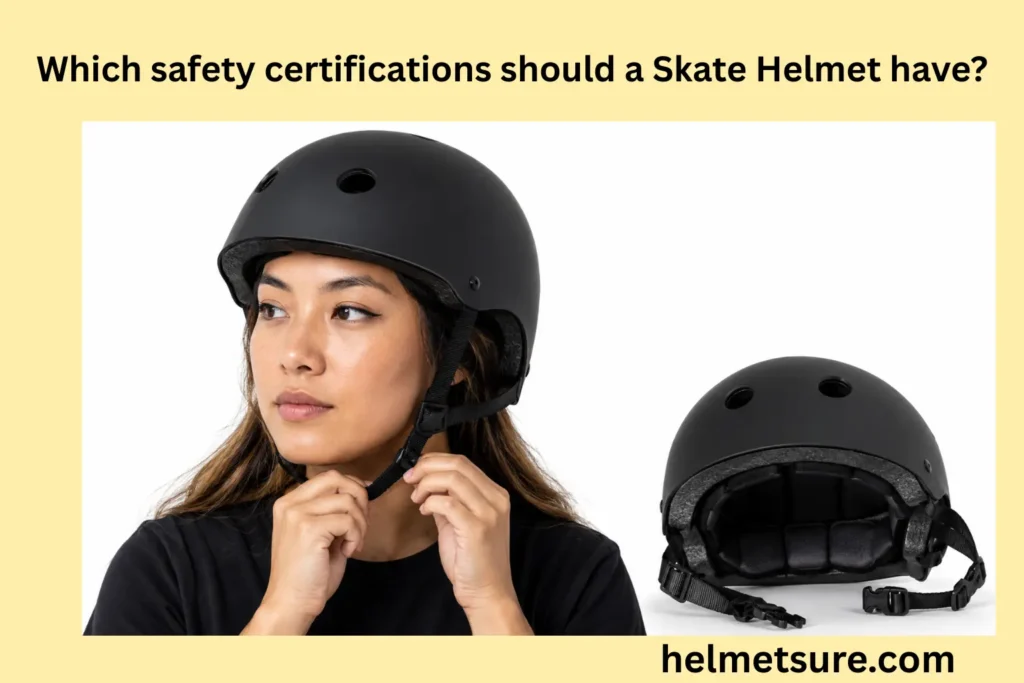
Which Safety Certifications Should a Skate Helmet Have?
A skate helmet should carry documented compliance with a safety standard that matches its intended activity and market, verified on the exact helmet/model and official documentation before purchase.
For skateboarding, longboarding, or aggressive/trick roller or in-line skating in the United States, current U.S. Consumer Product Safety Commission (CPSC) guidance lists ASTM F1492 and Snell N-94. In the European Union, the current harmonised-standards list identifies EN 1078:2012+A1:2012 for pedal cyclists and users of skateboards and roller skates; CE marking communicates conformity with applicable EU legislation rather than naming the helmet test standard. If the helmet is also represented for bicycling in the United States, verify applicable CPSC bicycle-helmet compliance separately. [1]
Skate Helmet Certification Quick Reference
| Intended use and market | Evidence to look for | Important boundary |
|---|---|---|
| U.S. skateboarding, longboarding, or aggressive/trick roller or in-line skating | Documented ASTM F1492 or Snell N-94 compliance | A generic “multi-sport” claim does not identify a standard |
| U.S. recreational roller or in-line skating | CPSC guidance permits a CPSC-compliant bicycle helmet | Recreational skating is treated differently from aggressive/trick skating |
| U.S. skating plus bicycling | Evidence appropriate to the skating use and CPSC 16 CFR Part 1203 bicycle compliance | One claim does not automatically prove the other |
| EU skateboarding or roller skating | Product-specific conformity evidence connected to EN 1078 and applicable CE marking requirements | EN 1078 is the technical standard; CE is the conformity marking |
Skate Helmet Certification as Activity-Specific Testing Rather Than a Generic “Safety Approved” Claim
Skate helmet certification means documented compliance with a defined safety standard applicable to a stated activity, not an undefined claim that a helmet is “safety approved.” The useful question is not whether a helmet looks protective or carries a certification-like badge. It is whether an identifiable standard applies to the planned activity and whether the exact product is documented as complying with it.
Why a named safety standard provides stronger compliance evidence than a generic “safety approved” claim
A named safety standard provides verifiable compliance evidence because its scope and requirements can be identified, while “safety approved” does not identify what standard was met.
An identifier such as ASTM F1492, Snell N-94, CPSC 16 CFR Part 1203, or EN 1078 gives the buyer something that can be checked against an authoritative source. Its scope can be examined, its institutional role can be identified, and the helmet’s claim can be compared with the intended activity. By contrast, phrases such as “safety approved,” “protective,” or “professionally tested” do not say which requirements applied, who defined them, or whether the claim belongs to the exact model.
A named standard is not automatically relevant merely because it is genuine. It still needs to match the activity and market. Meaningful evidence therefore follows a short chain: named standard → verified scope and requirements → product-specific compliance claim.
How certification connects a skate helmet to a defined activity and testing framework
Certification connects a skate helmet to a defined activity by tying product compliance to a standard whose scope and test requirements apply to that use.
Helmet standards are not activity-neutral. ASTM F1492 identifies skateboarding and trick roller skating in its scope; CPSC Part 1203 is a U.S. bicycle-helmet regulation; EN 1078 covers a defined group of cycling and skating users within the European framework. The activity named by the standard determines what the compliance claim means.
The correct reasoning sequence is intended activity → applicable standard → defined testing framework → exact product evidence. Treating every standard for a wheeled-sport helmet as interchangeable breaks that sequence and can turn a real certification into irrelevant evidence for the planned use.
Why skate-style appearance does not establish compliance with a skate helmet safety standard
Skate-style appearance does not establish compliance because shell shape and visual design do not prove that a helmet meets an applicable safety standard.
A rounded shell, limited ventilation, deep rear coverage, or a skate-shop product category may suggest how a helmet is styled, but none identifies the tests it passed. CPSC guidance tells buyers to look for a label or marking showing compliance with an applicable standard and warns against relying solely on the helmet’s name, appearance, or packaging claim.
Check the label inside or on the helmet, the exact manufacturer and model, the intended-use statement, and official product documentation. Appearance alone proves neither compliance nor noncompliance; documentary evidence is what makes the claim auditable.
How a safety standard, compliance claim, and conformity marking perform different roles
A safety standard defines requirements, a compliance claim states that a product meets applicable requirements, and a conformity marking communicates conformity within its relevant regulatory framework.
Which U.S. Safety Standards Apply Specifically to Skate Helmet Use?
Current CPSC guidance lists ASTM F1492 and Snell N-94 for longboarding, aggressive/trick roller or in-line skating, and skateboarding. These are distinct standards, and the CPSC guidance that recommends them should not be confused with the wording of each standard’s own scope.
How ASTM F1492 functions as a skate-specific helmet safety standard
ASTM F1492-25 covers performance requirements for helmets used in skateboarding and trick roller skating.
ASTM currently identifies F1492-25 as the active Standard Specification for Helmets Used in Skateboarding and Trick Roller Skating. Its scope states that it covers performance requirements for those activities. It also says testing and requirements follow ASTM F1446 except where F1492 states otherwise, and that partial compliance is prohibited: a compliance statement is a claim that the headgear meets the specification in its entirety. [2]
That makes F1492 skate-specific evidence, not a federal bicycle-helmet regulation. The standard’s identifier and edition should be checked because ASTM can revise, reapprove, replace, or withdraw standards over time.
When ASTM F1492 is relevant to skateboarding, longboarding, and aggressive or trick skating
ASTM itself scopes F1492 to skateboarding and trick roller skating, while current CPSC guidance also lists F1492 for longboarding and aggressive/trick roller or in-line skating.
This source distinction is important. ASTM supplies the standard’s own scope. The CPSC’s March 2026 activity guide supplies the current U.S. consumer guidance that groups longboarding, aggressive/trick roller or in-line skating, and skateboarding under the skateboard-helmet category and lists ASTM F1492 and Snell N-94.
For any of those planned activities, look for product-specific evidence of the applicable standard. Do not say that ASTM’s own scope expressly names longboarding; that practical connection comes from CPSC activity guidance.
Where Snell N-94 fits within U.S. skate helmet certification guidance
Snell lists N-94 as its 1994 standard for non-motorized activities, and current CPSC guidance lists N-94 for longboarding, aggressive/trick roller or in-line skating, and skateboarding.
The official Snell N-94 standard names roller skating, roller blading, skateboarding, and other non-motorized activities in its foreword. Snell also continues to list N-94 in its current standards directory as the “1994 Helmet Standard For Use in Non-Motorized Activities.” Its age alone therefore does not establish that the standard is invalid or absent from current guidance.
N-94 is a separate Snell certification route. It is not ASTM F1492 and it is not a federal requirement. Its relevance to the three skate-oriented activity groups above is supported by current CPSC guidance, while its own scope and test requirements come from Snell.
Why a named skate-specific standard matters more than an undefined multi-sport safety claim
A named skate-relevant standard matters more than an undefined multi-sport claim because it identifies the activity scope and requirements the buyer can verify.
“Multi-sport” describes breadth of intended use, not compliance. A legitimately multi-purpose helmet may carry documented evidence for more than one activity, but the wording alone does not reveal which standards were met. The buyer must translate the claim into specific represented activities and check the applicable evidence for each one.
For example, a helmet represented for both skating and bicycling in the United States raises both a skate-use question and a bicycle-regulatory question. A broad label without named standards leaves those questions unanswered; product-specific documentation naming the applicable standards resolves them.
Why CPSC 16 CFR Part 1203 Does Not Automatically Establish Skate-Specific Compliance
CPSC 16 CFR Part 1203 establishes the U.S. bicycle helmet safety standard, so CPSC bicycle compliance does not by itself establish ASTM F1492 skate-specific compliance. The two frameworks have different scopes even though a single helmet can have documented evidence for both.
Why CPSC 16 CFR Part 1203 is primarily a bicycle helmet compliance standard
CPSC 16 CFR Part 1203 is the federal safety standard for bicycle helmets within its defined product scope.
The current eCFR text for 16 CFR Part 1203 defines a bicycle helmet as headgear marketed, or implied through marketing or promotion, as protecting against head injury while riding a bicycle. The regulation establishes construction, labeling, instructions, certification, and performance requirements for products inside that definition. [3]
Part 1203 therefore should not be described as a universal certification for every wheeled sport. It proves compliance with the U.S. bicycle-helmet framework. Whether it is relevant to a skating activity depends on separate activity guidance and the exact product’s represented use.
Why a helmet marketed only for skateboarding is treated differently from a helmet represented for bicycling
CPSC guidance excludes helmets specifically marketed for exclusive skateboarding use from its bicycle-helmet requirements, while bicycle or ambiguous multi-purpose representation can bring a helmet within the bicycle-helmet framework.
The CPSC’s Bicycle Helmets Business Guidance explains that a helmet promoted for general use or several activities can still be considered a bicycle helmet if a reasonable consumer could conclude that bicycling is among its intended uses. The same guidance says a helmet marketed specifically for exclusive skateboarding, in-line skating, baseball, or roller-hockey use is not covered by the bicycle-helmet requirements.
This classification turns on represented use and the regulatory definition—not a rounded shell, retailer category, or product photograph. It is a U.S. regulatory distinction and should not be projected onto other markets.
How recreational roller or in-line skating differs from aggressive or trick skating in activity-specific helmet guidance
Current CPSC guidance permits a CPSC-compliant bicycle helmet for recreational roller or in-line skating but places aggressive/trick roller or in-line skating in the skateboard-helmet category with ASTM F1492 and Snell N-94.
That means “roller skating” is too broad to determine the relevant certification. The rider must identify the actual style of use:
- For recreational roller or in-line skating, the CPSC says a CPSC-compliant bicycle helmet can be used.
- For aggressive or trick roller or in-line skating, the current activity table points to the skateboard-helmet category and lists ASTM F1492 and Snell N-94.
This is an activity-classification rule, not a claim that one standard is universally more protective than another. The planned use determines which evidence is relevant.
Why CPSC compliance should not be interpreted as automatic skate-specific certification
CPSC compliance should not be interpreted as automatic ASTM F1492 compliance because Part 1203 regulates bicycle helmets while ASTM F1492 separately defines requirements for skateboarding and trick roller skating helmets.
A CPSC label can be valid bicycle-compliance evidence without proving that the same helmet meets F1492. The reverse is also true: an F1492 claim does not automatically establish CPSC bicycle compliance. Each claim must be documented independently.
This does not mean every CPSC bicycle helmet is unsuitable for every form of skating. CPSC guidance permits bicycle helmets for recreational roller or in-line skating. It means only that a buyer should not translate one certification into another or use a bicycle-compliance label as proof of skate-specific F1492 compliance.
How EN 1078 and CE Marking Work Together for Skate Helmets in Europe
EN 1078:2012+A1:2012 is currently listed as a harmonised PPE standard for pedal cyclists and users of skateboards and roller skates, while CE marking provides evidence of compliance with applicable EU legislation. The technical-standard reference and the conformity marking work together but perform different functions.
How EN 1078 functions as a helmet performance standard for relevant cycling and skating activities
The current EU harmonised-standards list identifies EN 1078:2012+A1:2012 for helmets used by pedal cyclists and users of skateboards and roller skates.
The official Commission Implementing Decision (EU) 2026/1279 lists that title and edition in its PPE standards annex. EN 1078 is therefore the technical-standard node for the listed activities within this EU conformity context. [4]
It should not be treated as simply a European name for ASTM F1492. The two standards belong to different systems, have separately defined scopes, and require their own authoritative documentation. The EU harmonised list verifies EN 1078’s reference and named activity coverage; it does not by itself provide every detailed test procedure in the underlying standard.
Why CE marking indicates conformity with applicable EU requirements rather than acting as the helmet test standard itself
CE marking on PPE provides evidence of compliance with applicable EU legislation; it is not itself the name of the helmet performance standard.
The European Commission’s PPE guidance states that Regulation (EU) 2016/425 covers the design, manufacture, and marketing of PPE and that CE marking affixed to PPE provides evidence of the product’s compliance with applicable EU legislation. It also explains that CE marking follows the prescribed testing and conformity-assessment process.
Calling CE a “helmet test standard” collapses two different functions. EN 1078 identifies relevant technical requirements; CE marking communicates conformity within the applicable EU legal framework.
How EN 1078 and CE-related conformity information perform different compliance functions
EN 1078 supplies the relevant harmonised technical-standard reference, while CE-related conformity evidence communicates compliance with applicable EU legislation.
For a product-level decision, the buyer should connect the pieces: represented skate activity → applicable technical standard → conformity assessment and documentation → marking on the exact product. An unexplained CE symbol on a marketplace image is not the same as a coherent product-specific conformity trail.
A CE symbol alone should not be described as proof of EN 1078 compliance without checking the helmet’s documentation and applicable standard. Likewise, the presence of EN 1078 in the EU harmonised list does not identify which exact retail models have completed the necessary conformity process.
Why European compliance evidence should be interpreted within the helmet’s stated activity and market
European compliance evidence is relevant when the applicable standard and conformity information match the helmet’s represented activity and EU market context.
For a skateboard or roller-skate helmet evaluated in the EU, check the exact product’s intended-use statement, EN 1078-related documentation, CE marking, manufacturer identity, and any supporting conformity information supplied for that product. Do not treat CE as universal certification for every sport or every helmet sold worldwide.
This is an applicability decision, not a contest between U.S. and European systems. No reliable conclusion about which framework is “safer” follows merely from different standard names. The task is to verify the framework that applies to the activity, product, and market being evaluated.
How to Match Helmet Certification to Skate-Only and Skate-and-Bike Use
Helmet certification should be matched to every activity the helmet is represented to cover, so skate-only and skate-and-bike use create different verification tasks. Begin with what the rider will actually do, then check how the manufacturer represents the exact helmet.
Why skate-only use points first to documented compliance with an appropriate skate-specific standard
Skate-only use points first to documented skate-relevant compliance because the standard should correspond to the rider’s actual skating activity.
In the United States, that may mean checking ASTM F1492 or Snell N-94 for skateboarding, longboarding, or aggressive/trick skating under current CPSC guidance. For recreational roller or in-line skating, CPSC guidance allows a CPSC-compliant bicycle helmet. In the EU context covered here, EN 1078 and product-specific conformity evidence are relevant to skateboard and roller-skate use.
Bicycle compliance should not be imposed on every helmet marketed exclusively for skateboarding in the United States. The required check follows represented use and jurisdiction, not a universal “more labels are better” rule.
Why skating plus bicycling can require documented compliance for both represented activities
A helmet represented for both skating and bicycling requires the buyer to verify compliance evidence appropriate to both represented activities.
For a U.S. dual-use product, that means checking the applicable skate evidence and verifying CPSC Part 1203 compliance for the bicycle representation. The same product may legitimately document both, but neither claim should be inferred from the other. The practical difference involved in using one helmet for skating and bicycling is therefore a dual verification task, not permission to treat “multi-sport” as a certification.
There is no single universal pair of standards for every country. Apply the framework relevant to the market in which the helmet is evaluated.
How intended-use labeling confirms which activities a certified helmet is actually represented to cover
Intended-use labeling helps confirm which activities the exact helmet/model is represented to cover and therefore how its certification evidence should be interpreted.
Compare the manufacturer’s activity statement with the named standard on the helmet, packaging, user instructions, or official product page. If bicycling is included, check the bicycle framework. If only skateboarding is named, evaluate the skate-relevant evidence. If the documentation limits or excludes an activity, do not extend the certification beyond that wording without authoritative evidence.
Retailer categories and shell styling are weaker than model-specific manufacturer documentation. Never transfer the intended use or certification of one model, size family, or product generation to another simply because the brand name is the same.
How market and jurisdiction change which standard or conformity marking the buyer should verify
Market and jurisdiction change which compliance evidence the buyer should verify because U.S. and EU frameworks assign different roles to standards, regulations, and conformity markings.
In the U.S. context discussed here, ASTM F1492 and Snell N-94 are skate-relevant standards identified by current CPSC guidance, while CPSC Part 1203 is the federal bicycle-helmet standard. In the EU context, EN 1078 is the harmonised technical-standard reference for the named cycling and skating activities, and CE marking communicates conformity with applicable EU legislation.
Do not treat a label from one framework as globally universal, and do not infer equivalence between standards merely because both apply to helmets. If the helmet will be bought, sold, or used in another jurisdiction, verify that jurisdiction’s current authoritative requirements rather than extending this U.S.–EU comparison.
Why additional certification logos matter only when they correspond to the helmet’s intended activities
Additional certification logos matter only when the standards behind them apply to the helmet’s represented activities and are documented for that exact product.
- What named standard does it represent?
- What activity does that standard cover?
- Which market or conformity framework applies?
- Does the documentation belong to this exact model?
Certification also differs from independent skate helmet ratings. Certification asks whether defined requirements were met; a properly designed comparative rating may examine relative performance within its own test protocol. A rating cannot replace required compliance evidence, and the number of certification logos is not a common protection score.
What Do Skate Helmet Certification Standards Actually Test?
Depending on the applicable standard, helmet testing evaluates defined categories such as impact attenuation and retention/stability under controlled conditions; the exact procedures and criteria differ by standard. Similar category names do not mean ASTM, CPSC, Snell, and EN use identical test setups or pass/fail rules.
How impact-attenuation testing evaluates the helmet’s response to specified impact conditions
Impact-attenuation testing evaluates helmet response under impact conditions and pass/fail criteria defined by the applicable standard.
In plain language, a helmeted test headform is subjected to controlled impacts, the resulting response is measured, and the result is compared with that standard’s criteria. ASTM F1492, CPSC Part 1203, and Snell N-94 each contain or reference their own procedures. Their details must be described from the relevant source rather than blended into one generic skate-helmet test.
Laboratory impact testing is valuable because it creates a consistent compliance question. It does not reproduce every fall angle, surface, speed, body motion, prior impact, or individual medical outcome that can occur in real life.
Why retention-system testing matters to certification performance
Retention-system testing evaluates whether the helmet’s securing system meets stability or strength requirements defined by the applicable standard.
A helmet’s impact-management structure can help only while the helmet remains positioned as intended. That is why standards may evaluate positional stability, strap or retention-system strength, or related securing performance. CPSC Part 1203 expressly includes positional-stability and dynamic retention-strength tests, while Snell N-94 identifies helmet stability and retention-system strength among its four principal performance areas.
This laboratory evaluation is not a personal fitting session. Passing a retention test does not prove that a particular size fits every head or that a wearer has adjusted the straps correctly.
How defined impact locations, test conditions, and test surfaces create repeatable compliance criteria
Standards create repeatable compliance criteria by defining controlled test variables such as impact locations, conditioning, and impact interfaces where those variables are required by the specific standard.
Controlled variables let test results be judged against the same documented requirements. Depending on the standard, those variables can include headforms, impact sites, preparation or environmental conditioning, impact surfaces or anvils, and the order or number of specified impacts. ASTM’s published F1492 summary, for example, identifies headforms, impact anvils, retention, impact sites, velocity, and schedule, while Part 1203 and N-94 define their own procedures.
Never combine one standard’s anvil, another standard’s conditioning method, and a third standard’s threshold into a synthetic protocol. Repeatability exists inside each defined framework; it does not make all helmet standards procedurally identical.
Why passing a certification standard means meeting specified test requirements rather than proving universal protection
Passing a certification standard means satisfying its defined requirements; it does not prove universal protection, and no helmet is concussion-proof.
This boundary preserves the real value of certification without overstating it. A pass shows that the product met the requirements associated with the compliance claim under the prescribed conditions. It does not guarantee a medical outcome in every crash, continued performance after damage, or protection outside the standard’s activity scope.
Avoid absolute terms such as “fully protects,” “injury-proof,” and “concussion-proof.” The correct interpretation is narrower and more useful: documented compliance is bounded evidence that should be combined with correct activity selection, proper fit and retention, and current helmet condition.
Skate Helmet Certification Test Categories
| Test category | What the standard-specific test can evaluate | Evidence rule | What passing does not prove |
|---|---|---|---|
| Impact attenuation | Helmet response under controlled impact conditions | Use the exact test source for the named standard | Protection in every real-world impact |
| Retention or stability | Helmet stability and retention-system performance where required | Identify which standard supplies the requirement | Correct fit for every wearer |
| Impact locations and interfaces | Defined impact sites and surfaces or anvils where specified | Attribute every detail to its own standard | Identical procedures across standards |
| Conditioning | Performance after specified sample conditioning where required | Use only the exact standard’s procedure | Unlimited resistance to heat, water, aging, chemicals, or misuse |
| Repeated-impact provisions | A limited repeated-impact requirement only where explicitly documented | Never infer it from style or a generic certification claim | Unlimited reuse after real-world crashes |
How Can Buyers Verify a Skate Helmet’s Certification Before Purchase or Use?
Buyers should verify skate helmet certification by matching the exact helmet/model, intended activity, named standard or conformity evidence, market, and official documentation. This sequence replaces guesswork based on appearance, brand reputation, retailer copy, or logo count.
Where to look for the named safety standard or conformity information on the helmet and its documentation
Certification evidence should be checked on the exact helmet and in official product documentation, including applicable labels or markings.
Begin with the physical helmet. CPSC consumer guidance says compliance markings are commonly found on the liner inside the helmet, on the exterior surface, or attached to the chin strap. Then compare what you find with the manufacturer’s official instructions, specification page, packaging, declaration or conformity information where applicable, and model identification.
A retailer listing can help locate a product, but it should not be the only proof. If the listing omits certification information, that omission alone does not establish noncompliance; check the helmet and official documentation before drawing a conclusion.
How to match the printed certification standard to the helmet’s stated intended activity
A printed certification standard is relevant only when its verified scope matches the helmet’s documented intended activity and the buyer’s planned use.
First write down the actual use—such as skateboarding, longboarding, recreational in-line skating, aggressive/trick skating, or bicycling. Next, identify the standard printed or documented for the product. Finally, verify the standard’s scope or current activity guidance through ASTM, CPSC, Snell, or the relevant EU authority.
A genuine certification can still be irrelevant to a particular activity. A CPSC bicycle label, for example, does not become proof of ASTM F1492 compliance merely because the helmet has a skate-style shell.
Why manufacturer and model identification strengthen verification of a compliance claim
Manufacturer and model identification strengthen verification because compliance evidence must correspond to the exact helmet being evaluated.
Brands sell multiple helmet families, and their standards, markets, generations, sizes, and represented uses can differ. Record the manufacturer, exact model name or number, and any product or production identifiers needed to match the physical helmet to official documentation. Check that the label and instructions describe the same product.
Do not transfer certification from another helmet made by the same brand or from an older product page. Brand reputation can support confidence in documentation practices, but it cannot replace model-level compliance evidence.
How to distinguish a named compliance standard from vague terms such as “tested,” “protective,” or “multi-sport”
A named compliance standard identifies a defined requirements framework, while “tested,” “protective,” and “multi-sport” do not state which standard the helmet meets.
Use a simple language audit. If the claim says “certified,” ask: certified to what? If it says “tested,” ask: under which named standard and for which activity? If it says “multi-sport,” list the represented sports and verify each applicable compliance claim. If those answers are absent, the wording is incomplete certification evidence.
Incomplete seller copy is not, by itself, proof of fraud or noncompliance. Valid evidence may appear on the physical helmet or in official manufacturer documentation. The correct response is to verify further, not to invent a conclusion.
When intended-use information reveals that a certification claim does not cover the activity the buyer plans to perform
Intended-use information reveals a certification mismatch when the planned activity falls outside the helmet’s documented use or the verified scope of its named standard.
Suppose the helmet carries a valid standard but the manufacturer documents it only for an activity different from the buyer’s planned use. Or suppose the manufacturer makes a broad claim, but the named standard’s authoritative scope does not include that activity. In either case, the certification does not establish compliance for the planned activity.
Physical fit and visual similarity cannot repair that mismatch. Fit asks whether the helmet works with the wearer; certification applicability asks whether the documented compliance claim covers the activity. Both matter, but they are separate decisions.
Compliance label verification checklist
Verify each applicable item before relying on the certification claim.
What Certification Cannot Guarantee About a Skate Helmet
Skate helmet certification establishes defined compliance but does not guarantee prevention of injury or concussion, universal activity coverage, correct fit, or continued serviceability after damage. Each limitation requires its own check rather than being treated as a weakness in the idea of certification.
Why passing a helmet safety standard does not make a certified skate helmet injury-proof or concussion-proof
Passing a helmet safety standard does not make a skate helmet injury-proof or concussion-proof; no helmet is concussion-proof, while helmet standards address defined performance conditions.
Real crashes vary in impact direction, surface, energy, body movement, helmet condition, and individual response. Certification does not convert those variables into a guaranteed medical outcome. Public-health guidance supports wearing a properly fitted, maintained, activity-appropriate certified helmet while still rejecting claims that any helmet can prevent every concussion.
That is not a reason to ignore standards. It is a reason to describe them accurately: they provide bounded performance evidence, not immunity from injury.
Why certification for one activity does not establish compliance for every wheeled activity
Certification for one activity does not establish compliance for every wheeled activity because standards and conformity claims have defined scopes.
If a product’s documented compliance covers skateboarding, that evidence should not automatically be extended to bicycling. If it covers bicycling, it should not automatically be relabeled as ASTM F1492 skate compliance. A genuinely multi-activity helmet can carry appropriate evidence for several uses, but each use needs an explicit scope match.
Whenever the activity changes, repeat the applicability check: planned use → represented use → relevant standard or framework → exact product evidence.
Why certification does not remove the need to use the helmet within its documented fit and retention conditions
Certification does not remove fit and retention requirements because a compliant helmet still needs to be worn and secured according to its applicable instructions.
Certification evaluates a product under defined test arrangements. It cannot confirm that the selected size matches an individual’s head shape, that the helmet is level and correctly positioned, or that the retention system has been adjusted as the manufacturer directs. A certified helmet used loose, tilted, or unfastened is still being used outside its intended fit and retention conditions.
Follow the instructions for the exact model. Certification and personal fit support the same safety goal, but one does not substitute for the other.
Why certification status does not override manufacturer replacement guidance after an impact or visible damage
Certification status does not prove continued serviceability after an impact; replacement or inspection decisions should follow authoritative manufacturer guidance for the exact helmet.
A label records the product’s original compliance claim. It does not recertify the helmet after a fall, crack, crushed liner, damaged strap, unauthorized modification, or other change in condition. The correct next step is to consult the manufacturer’s instructions for that exact model and evaluate whether to replace a skate helmet after a fall.
Do not invent a universal impact count, damage threshold, or replacement interval. Designs and instructions differ, and some damage may not be obvious. Original certification and present serviceability are separate questions.
Why multiple certification logos do not automatically indicate greater protection when their activity scopes differ
Multiple certification logos do not automatically indicate greater protection because each standard must be interpreted according to its scope, requirements, and product claim rather than treated as a common protection score.
Additional applicable certifications can document broader activity or market coverage. They do not automatically show that the helmet performed better on a single comparable scale, because the standards may ask different questions and use different procedures. “More logos” and “greater protection” are therefore not equivalent claims.
To make a comparative protection claim, the evidence would need a valid, comparable test method applied across the helmets being compared. Certification-logo quantity alone cannot supply that evidence.
Which Certification Should You Verify Before Buying a Skate Helmet?
Before buying a skate helmet, verify the documented standard that matches the intended activity and market, then confirm that compliance on the exact helmet/model. The complete decision is activity + jurisdiction + applicable standard + exact product evidence.
Choose the documented safety standard that matches the helmet’s intended skating activity
Choose documented compliance that matches the intended skating activity rather than selecting a helmet by appearance or generic certification language.
For U.S. skateboarding, longboarding, and aggressive/trick roller or in-line skating, check the product for ASTM F1492 or Snell N-94 evidence under current CPSC guidance. For recreational roller or in-line skating, account for the CPSC guidance permitting a compliant bicycle helmet. For EU skateboard or roller-skate use, verify the applicable EN 1078 and conformity evidence for the exact product.
The first decision is always the activity—not the shape, brand, price, or number of badges.
Verify additional documented compliance when the same helmet is represented for bicycling or another covered activity
Verify additional documented compliance when the same helmet is represented for bicycling or another covered activity instead of assuming skate certification transfers automatically.
In the U.S., bicycling representation triggers a separate CPSC Part 1203 question. Confirm the bicycle claim in addition to the applicable skate evidence. In the EU framework discussed here, interpret EN 1078 and CE-related product evidence according to the activities and market for which the exact helmet is represented.
Supported multi-activity compliance is useful. Undefined “multi-sport” wording is not a substitute for it.
Match U.S. standards or European conformity evidence to the market where the helmet is being evaluated
Match U.S. standards or European conformity evidence to the market where the helmet is being evaluated before treating a label as relevant compliance evidence.
Use ASTM, Snell, CPSC, and EU sources according to their actual roles. Do not call ASTM a federal regulation, Snell N-94 a federal requirement, CPSC bicycle compliance automatic F1492 compliance, or CE marking the technical helmet standard. If another jurisdiction is relevant, verify its current framework separately rather than assuming that a U.S. or EU label has universal legal meaning.
Market-aware interpretation prevents a real label from being used to support the wrong claim.
Confirm the actual certification label, conformity marking, and intended-use information before relying on the helmet’s safety claim
Confirm the actual certification evidence, applicable conformity information, intended-use documentation, and exact model before relying on a skate helmet’s safety claim.
Complete these final checks before purchase or use:
Continue only after every applicable check is verified. A failed or unresolved item requires correction or further verification before relying on the helmet.
Frequently Asked Questions About Skate Helmet Certification
These answers summarize the article’s activity, certification, market, conformity, verification, and protection-limit rules.
Which safety certification should a skate helmet have in the United States?
For U.S. skateboarding, longboarding, and aggressive or trick roller or in-line skating, current CPSC guidance lists ASTM F1492 and Snell N-94. Recreational roller or in-line skating is treated differently, so the intended activity must be identified before the certification evidence is evaluated.
Is CPSC bicycle helmet compliance enough for skateboarding?
No. CPSC 16 CFR Part 1203 is the U.S. bicycle-helmet safety standard and does not automatically establish ASTM F1492 skate-specific compliance. A helmet represented for both bicycling and skating may need separate documented evidence for the represented uses.
What is the difference between EN 1078 and CE marking?
EN 1078 is the relevant technical-standard reference for the cycling and skating activities discussed in the EU framework. CE marking communicates conformity with applicable EU legislation; it is not itself the helmet performance standard.
Does a multi-sport label prove that a helmet is certified for skating and bicycling?
No. “Multi-sport” describes represented breadth of use but does not identify which standards were met. Each represented activity must be matched to named, product-specific compliance evidence.
Where should a buyer look for skate helmet certification evidence?
Check the exact physical helmet for its label or marking, then compare it with the manufacturer’s official instructions, specification page, packaging, conformity information where applicable, and exact model identification.
Does passing a skate helmet safety standard make the helmet concussion-proof?
No. Certification shows that defined requirements were met under prescribed conditions. It does not guarantee prevention of concussion or every other head injury, and it does not predict the outcome of an individual crash.
Can certification from one helmet model be transferred to another model from the same brand?
No. Compliance evidence should be matched to the exact manufacturer and model being evaluated. Standards, intended uses, markets, generations, and size families can differ between products from the same brand.
What should be verified if the same helmet is represented for both skating and bicycling?
Verify the compliance evidence that applies to each represented activity. In the United States, that means checking the applicable skate evidence and separately confirming CPSC Part 1203 bicycle compliance when bicycling is represented.