
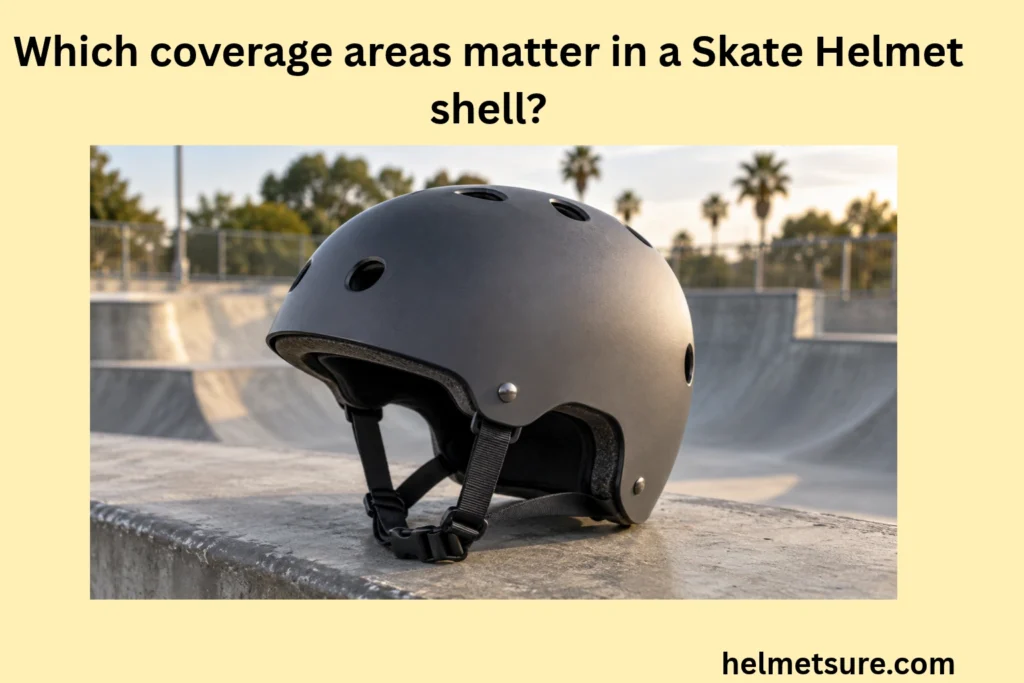
Which Coverage Areas Matter in a Skate Helmet Shell?
Skate helmet shell coverage should be evaluated across the forehead, sides, crown, and rear, then checked again while worn because shell geometry, helmet size, certification, and protective performance are not interchangeable.
These four regions form a practical inspection map. First examine the coverage designed into the shell; then put the helmet on and confirm that the same envelope remains balanced and stable on the wearer. A deep-looking shell can still leave a persistent local gap, and a suitable shell can lose effective coverage if it shifts.
Skate Helmet Shell Coverage Is About Which Head Areas the Shell Extends Over—and Which It Leaves Exposed
Skate helmet shell coverage describes the head areas the shell physically extends over and the areas left outside that envelope.
This is a question of geometry: where the front, side, upper, and rear shell edges sit relative to the wearer’s head. It is not a visual shortcut for impact attenuation, certification, or overall helmet quality. A useful evaluation therefore begins with what the shell encloses and then checks whether that designed coverage survives real worn positioning.
Shell coverage as the physical extent of the helmet around the head
Shell coverage is the physical extent of the skate helmet shell around the wearer’s head.
Its edges, depth, and curvature create a coverage footprint: the structural envelope the product is designed to place over the head. Coverage is only one aspect of the shell, however. The outer shell also concerns the shell’s role within the complete helmet system, which should not be reduced to visible extent alone.
Covered zones versus exposed zones as the basic evaluation model
The simplest shell-coverage model compares head zones enclosed by the shell with zones that remain visibly exposed.
Put the helmet in its intended position and trace its boundary visually from front to rear on both sides. The result is an observation map, not a compliance test: “covered” means beneath the apparent shell envelope, while “exposed” means outside it. An exposed area may justify closer inspection, but it does not automatically prove that a helmet fails a standard or predicts an injury.
Why helmet circumference alone does not describe shell coverage depth
Helmet circumference alone does not describe shell coverage depth because size around the head and shell extension over the head are different dimensions.
Circumference helps match a wearer to a stated size range; shell depth describes how far a particular geometry extends at the front, sides, crown, and rear. Two models may accommodate similar head circumferences yet place their edges differently. Cross-model conclusions therefore require current manufacturer drawings, measurements, or on-head inspection—not equivalent size labels.
Why visible shell coverage should not be treated as proof of impact performance
Visible shell coverage should not be treated as proof of impact performance because geometric extent and tested impact response are separate evidence categories.
ASTM F1492-25 covers design and performance requirements and associated testing for skateboarding and trick-roller-skating helmets, including defined impact and retention-system requirements. Those results concern a tested helmet system under a specified protocol. A shopper’s visual observation of shell depth is useful for coverage evaluation, but cannot reproduce a laboratory test, establish compliance, or forecast an individual outcome.
The practical task is therefore to map the forehead/front, temple/lateral, crown, and occipital/rear regions without converting that map into a protection score.
Which Head Zones Should Be Included in a Skate Helmet Shell Coverage Map?
A practical skate helmet shell-coverage map should inspect the forehead/front, temple/lateral, crown, and occipital/rear regions as separate but connected zones.
These are anatomical reference areas for consistent observation, not universal regulatory boundaries. They let a buyer ask the same four questions of every candidate shell: Where does it begin at the front? How consistently does it extend down both sides? Does the crown connect the surrounding areas? How far does the rear envelope continue around the back of the head?
Forehead and frontal coverage at the front edge of the shell
Forehead and frontal coverage are evaluated at the front shell edge and the head area that remains beneath it.
The front edge provides a visible reference for the shell’s frontal extent when the helmet is level and positioned as its maker instructs. Use it to compare candidates on the same wearer, but do not invent a fixed eyebrow distance or present a familiar fit rule as a universal shell-coverage standard. A precise placement instruction must come from the applicable manufacturer or authoritative source.
Temple and lateral coverage along the sides of the head
Temple and lateral coverage describe how far the shell extends along the sides of the head.
Inspect the side edges and their curvature on both the left and right. The goal is to identify the lateral coverage profile and any conspicuously shallow transition, not to infer side-impact performance. A deeper side wall is a geometric observation; whether a helmet manages a defined impact depends on evidence for the complete tested design, not on shell appearance alone.
Crown coverage across the upper surface of the head
Crown coverage describes the shell extent across the upper surface of the head.
The crown connects the front, side, and rear portions of the envelope. It matters because a coherent upper shell helps those zones read as one continuous geometry, but extensive top coverage is not sufficient by itself. A helmet can look substantial across the crown while still presenting a shallow front edge, uneven side transition, or high rear edge on a particular wearer.
Occipital and lower-rear coverage at the back of the head
Occipital and lower-rear coverage describe how far the shell extends around the back of the head.
Use the occipital area as a practical reference for rear extent and inspect the lower-rear edge in the intended worn position. Do not turn one anatomical landmark into a mandatory endpoint for every helmet. Exact test lines, placement references, and model geometry have to come from the applicable standard or manufacturer documentation rather than from a generic visual rule.
| Coverage zone | Shell area to inspect | Core evaluation question | Main misread to avoid |
|---|---|---|---|
| Forehead / front | Front shell edge | Does the front edge provide meaningful frontal extent in the intended worn position? | Treating one universal eyebrow distance as mandatory |
| Temple / lateral | Left and right shell edges | Does the shell extend consistently along both sides? | Equating depth with proven side-impact performance |
| Crown | Upper shell envelope | Does upper coverage connect coherently with surrounding regions? | Treating crown extent as sufficient by itself |
| Occipital / rear | Rear and lower-rear shell edge | Does the shell extend meaningfully around the back of the head? | Treating one anatomical endpoint as universally required |
With the map established, each region can be evaluated more precisely without assigning unsupported numerical cutoffs.
What Makes Forehead Coverage Meaningful When Evaluating Shell Depth?
Forehead coverage is meaningful when the front shell edge provides appropriate frontal extent in the intended worn position without relying on an unsupported universal placement measurement.
The correct question is not “Does every helmet end at the same distance above the eyebrows?” It is “Does this shell maintain a sensible frontal envelope on this wearer when positioned as intended?” CPSC guidance says a helmet should be level rather than tilted back or pulled too low, and should remain stable after adjustment. Model-specific instructions remain controlling.
Front shell extent as an evaluation reference for forehead coverage
Front shell extent provides the primary visible reference for evaluating forehead coverage.
Observe the front edge only after the helmet has been placed in its intended position. That combines a fixed product attribute—shell depth—with a wearer-dependent condition—position. The edge can reveal a useful frontal profile, but it is not a universal measuring line. Compare the extent with the rest of the shell and with the manufacturer’s wearing illustration instead of applying an unsupported distance.
Excessive exposed forehead as a sign that effective front coverage should be reassessed
Excessive exposed forehead is a reason to reassess effective front coverage rather than assume the shell is positioned correctly.
The observation is a warning, not a diagnosis. A large-looking exposed area may result from a shallow shell, a helmet tilted backward, unsuitable size or head-shape compatibility, or a combination of these. Restore the intended position using only the maker’s adjustment system, then inspect again. Do not label the helmet noncompliant or attach an injury estimate to appearance alone.
How backward helmet displacement reduces effective frontal coverage
Backward helmet displacement reduces effective frontal coverage by moving the front shell edge away from its intended position over the forehead.
Nothing about the molded shell changes; the relationship between shell and head changes. That distinction prevents a positioning problem from being misread as a design defect. CDC’s skateboard-helmet guidance emphasizes choosing the correct activity helmet and checking that it fits, while CPSC guidance stresses a level, snug, stable position. Repeated rearward movement is therefore a coverage-relevant stability warning.
Why front coverage should be judged together with the shell’s overall depth
Front coverage should be judged with overall shell depth because one edge cannot describe the balance of the complete coverage envelope.
A low front edge does not compensate for shallow lateral or rear regions, just as generous rear depth does not erase persistent forehead exposure. Follow the shell from the front around both sides, across the crown, and toward the rear. Frontal extent is meaningful when it participates in a coherent multi-zone profile and remains present in the worn state.
What Makes Temple and Side Coverage Meaningful in a Skate Helmet Shell?
Temple and side coverage are meaningful when the shell extends consistently along the lateral head region without relying on circumference or appearance as substitutes for depth.
Side evaluation requires three observations: how far each side edge extends, whether the two sides form a coherent profile on the wearer, and whether that profile stays in place during ordinary movement. These checks describe effective lateral coverage only. They do not demonstrate a side-impact result, certify the product, or establish that a visibly deeper side is safer.
Lateral shell depth as the main observable side-coverage characteristic
Lateral shell depth is the main observable characteristic for judging how far a skate helmet shell extends along the sides of the head.
Look at each side from a neutral angle and trace the shell edge from the frontal curve toward the rear. A continuous, reasonably balanced side profile is the target. Because manufacturers can shape shells differently, any claim about a named model’s exact depth needs direct product documentation or measurement. Visual depth by itself remains a coverage cue, not a laboratory metric.
Temple-area exposure as a lateral coverage warning signal
Noticeable temple-area exposure can be a lateral coverage warning signal that warrants reassessment of shell geometry and worn position.
First determine whether the shell is level and centered. Then check whether the same exposure persists after approved adjustments and gentle normal head movement. Persistent exposure may indicate a wearer-shell mismatch or shallow geometry; changing exposure may indicate displacement. Either finding deserves investigation, but neither visible state alone establishes noncompliance, injury probability, or performance failure.
How left-right shell symmetry affects interpretation of side coverage
Left-right shell symmetry helps interpret side coverage because similar intended geometry should normally produce a coherent lateral profile when the helmet is positioned correctly.
Compare matching reference areas rather than judging one side in isolation. Uneven exposure can arise because the helmet is rotated, because the wearer’s head shape interacts differently with the interior, or because the product geometry itself differs. Symmetry is therefore a diagnostic clue. It is not proof of good fit, protection, or a shell defect without further evidence.
Why similar helmet circumferences can still produce different lateral coverage profiles
Similar helmet circumferences can still produce different lateral coverage profiles because shell geometry is not determined by circumference alone.
A size range states which head measurements a manufacturer intends the helmet to accommodate; it does not fully encode side-wall depth, curvature, or edge placement. Two same-size candidates can consequently look and sit different on the same wearer. Use manufacturer specifications for model-specific claims and compare the actual worn coverage profile instead of predicting it from S, M, L, or a circumference band.
What Role Does Crown Coverage Play Within the Overall Shell Envelope?
Crown coverage completes the upper portion of the shell envelope but should be interpreted together with the front, sides, and rear.
The crown matters chiefly as a connector. It joins the shell’s surrounding regions into one geometry and helps reveal whether transitions are coherent or abruptly shallow. It should not become the dominant criterion simply because it occupies a large visible area. Surface bulk, ventilation layout, or an uninterrupted top panel is not evidence of impact performance.
Crown coverage as shell extent across the upper head
Crown coverage is the shell extent spanning the upper surface of the head.
Inspect whether the upper shell forms a coherent bridge between the front, lateral, and rear regions. This is usually straightforward because the crown is visually prominent, but prominence should not inflate its decision weight. The crown is one coverage component among four; passing the crown check only means the upper zone appears represented within the designed and worn shell envelope.
How shell curvature influences the continuity of upper coverage
Shell curvature influences how smoothly crown coverage transitions into the front, sides, and rear of the helmet.
Curvature can make those transitions gradual or abrupt, changing the appearance and distribution of shell extent. There is no universal “best” curve established by this framework. Use curvature to identify continuity and local shallowness, not to rank safety. Any specific statement about a model’s shell architecture should be verified against the manufacturer’s current technical material or direct measurement.
Why extensive crown coverage does not compensate for shallow front or rear shell depth
Extensive crown coverage does not compensate for shallow front or rear shell depth because coverage must remain coherent across multiple anatomical zones.
Each region contributes its own boundary to the shell envelope. If the top appears extensive but the forehead or back remains persistently exposed, the local condition still exists. Do not average it away with an informal score. Reassess the shallow zone, determine whether geometry or position causes it, and judge that finding directly.
Why crown coverage is most useful when interpreted as part of the complete shell envelope
Crown coverage is most useful when interpreted as part of the complete shell envelope rather than as an isolated score.
Follow the crown’s front, side, and rear transitions and ask whether they support a balanced profile on the wearer. This integrated view captures the article’s central distinction: nominally covering every named zone is not enough if the connections are uneven or if movement breaks the envelope. Crown extent informs coverage, but it does not stand in for total helmet quality.
What Makes Rear and Occipital Coverage Meaningful in a Skate Helmet Shell?
Rear and occipital coverage are meaningful when the shell extends coherently around the back of the head and remains there in the intended worn position.
Rear evaluation must separate the helmet’s fixed geometry from its behavior on the wearer. A high-looking rear edge may be the model’s design, the result of a helmet sitting too high, or a temporary state caused by movement. Identify the cause before deciding whether the coverage match is acceptable, and avoid converting the observation into a performance claim.
Rear shell depth as the main observable characteristic of back-of-head coverage
Rear shell depth is the main observable characteristic for judging how far the skate helmet extends around the back of the head.
Inspect the rear edge from the side and back while the helmet is level and stable. The edge defines the visible rear profile, but only for that worn position. Deeper appearance is not proof of superior rear-impact performance. Model-specific depth claims require direct specifications or measurements, while formal impact claims require results from the applicable complete-helmet test protocol.
The occipital region as an evaluation reference rather than an unsupported universal placement standard
The occipital region is a useful rear-coverage reference, not an automatic universal placement standard for every skate helmet.
It gives reviewers consistent language for the back-of-head area and makes comparisons easier. It does not create a universal point every shell must cross. ASTM F1492-25 establishes formal requirements for skateboarding and trick-roller-skating helmets; its current edition should be consulted directly for compliance questions rather than reverse-engineering a test boundary from on-head appearance.
A high rear shell edge as a warning condition for incomplete effective coverage
A high rear shell edge can be a warning condition when it leaves the intended back-of-head region unusually exposed in the worn position.
Treat it as a prompt to check position, size and shape compatibility, and shell geometry. If the edge lowers into a balanced profile when the helmet is correctly repositioned and then remains there, the original observation was positional. If substantial exposure persists, the coverage match may be unsuitable for that wearer. Appearance alone still does not establish a certification failure.
How upward shell movement changes rear coverage even when the helmet geometry stays the same
Upward shell movement can reduce effective rear coverage even though the helmet’s designed shell geometry has not changed.
As the shell lifts relative to the head, areas initially under the rear and side edges can become exposed. CPSC guidance says an adjusted helmet should not move back-to-front or side-to-side, which supports checking sustained position rather than a single posed moment. Repeated upward movement is evidence of unstable effective coverage, not automatic proof that the molded shell is shallow.
How Do Front, Side, Crown, and Rear Coverage Work Together as One Shell Envelope?
Front, side, crown, and rear coverage work together as one shell envelope because each zone contributes to the continuity of the helmet’s structural extent around the head.
The four-zone map should never become four disconnected scores. Shell edges curve into one another, and local depth changes affect the surrounding profile. A strong evaluation looks for completeness, connected transitions, and the absence of a persistent weak region. It does not compute an unsupported average that lets three extensive zones conceal one meaningful gap.
How frontal coverage transitions into lateral shell extent
Frontal coverage transitions into lateral shell extent where the front edge curves around the sides of the head.
Inspect this transition on both sides. A coherent curve indicates that frontal depth continues into a lateral envelope; an abrupt rise or shallow segment flags an area for closer inspection. Because the shell is continuous, front and side observations should inform one another. Neither should be treated as an isolated performance score or as proof that the helmet passed a particular impact site.
How lateral coverage connects the crown with the rear shell
Lateral coverage connects the crown with the rear shell by forming the side portion of the continuous coverage envelope.
The sides are therefore more than two standalone depth checks: they are the geometric bridges between upper and back coverage. Trace whether each side maintains a coherent relationship with the crown above and the rear edge behind. Generous crown and rear extent cannot conceal a persistent shallow lateral transition, because that local gap remains part of the wearer’s actual coverage profile.
Why one unusually shallow zone creates an uneven coverage profile
One unusually shallow zone can create an uneven coverage profile even when the other shell regions appear extensive.
Local shallowness interrupts either the amount of coverage or the continuity between adjacent areas. That is why “mostly deep” is not a sufficient conclusion. Identify whether the weak region comes from designed geometry, off-center placement, upward or backward movement, or wearer incompatibility. The cause determines whether repositioning can correct the profile or whether the candidate should be rejected for that wearer.
Why balanced coverage matters more than maximizing a single anatomical region
Balanced coverage matters more than maximizing a single region because the shell envelope must remain coherent across front, sides, crown, and rear.
Maximizing one zone can create a misleading sense of completeness while another remains exposed. Balance does not mean all edges must sit at identical heights; the regions have different anatomy and geometry. It means all four are meaningfully represented, their transitions make sense, and none remains persistently or disproportionately shallow in the intended worn state.
| Zone relationship | What to inspect | Warning pattern |
|---|---|---|
| Front → lateral | Whether frontal extent transitions coherently around both sides | Abruptly shallow side transition |
| Lateral → crown | Whether side coverage joins the upper shell without an isolated shallow region | Side depth appears disproportionate to crown extent |
| Lateral → rear | Whether side-shell depth continues coherently toward the back | Localized lateral/rear gap |
| Complete envelope | Whether all four regions remain represented without one persistent weak zone | One region remains materially exposed despite strong coverage elsewhere |
How Does Designed Shell Coverage Differ From Effective Coverage When the Helmet Is Worn?
Designed shell coverage describes the geometry built into the helmet, while effective coverage describes which intended zones remain covered when the helmet is actually worn and stays in position.
This is the decisive comparison. Designed coverage can be assessed from the product’s shape, shell edges, and technical documentation. Effective coverage exists only in the helmet-wearer relationship. A product photograph can show the first state, but it cannot prove the second for a different head shape, size, position, or movement pattern.
Designed coverage as the zones the helmet shell is shaped to extend over
Designed coverage is the set of head zones the helmet shell geometry is shaped to extend over.
It is fixed by the shell’s front, side, crown, and rear architecture. Product views and technical drawings can help describe that intended profile, although model-specific claims still require current manufacturer evidence. Designed coverage is a product attribute, not a guarantee that every wearer will realize the same envelope. The helmet must still sit correctly and remain stable on an individual head.
Effective coverage as the zones still enclosed when the helmet is actually positioned on the head
Effective coverage is the set of intended zones that remain enclosed when the skate helmet is actually positioned and retained on the wearer’s head.
Position, head-shape compatibility, and stability determine whether designed coverage becomes real coverage. CPSC advises a comfortable, snug, level helmet that does not move after adjustment. For the full fitting procedure, follow the manufacturer and the dedicated guide to helmet fit; here, fit matters only where it changes the shell envelope.
How backward displacement can reduce effective forehead coverage
Backward displacement can reduce effective forehead coverage by moving the front shell edge away from its intended frontal position.
This illustrates why a shell should be assessed twice: once for its geometry and again on the wearer. A shell may have a reasonable designed front edge yet expose more forehead after shifting backward. Restore its intended position using approved adjustments and repeat gentle normal movement. If the pattern returns, the effective coverage is unstable even though the shell shape is unchanged.
How upward displacement can reduce effective rear and lateral coverage
Upward displacement can reduce effective rear and lateral coverage by lifting shell edges away from the regions they initially enclosed.
Observe the rear and both sides before and after ordinary head movement. The molded dimensions remain constant, but the coverage map can change as the helmet rises. This is why a static mirror check is only the starting point. A suitable worn profile should remain substantially consistent rather than depend on repeated manual repositioning between movements.
Why adequate designed coverage can still produce inadequate effective coverage on a particular wearer
Adequate designed coverage can still produce inadequate effective coverage when the helmet cannot maintain the intended shell position on a particular wearer.
Head shape, size compatibility, internal fit architecture, and retention adjustment can all influence where the shell settles. If approved adjustments cannot produce and retain balanced coverage, the helmet may be a poor match for that individual. That conclusion is wearer-specific: it does not establish that the model is defective or universally unsuitable.
| Evaluation state | What it describes | Primary question | Common failure |
|---|---|---|---|
| Designed coverage | Built-in shell geometry | Which zones is the shell shaped to extend over? | Assuming geometry guarantees wearer suitability |
| Effective coverage | Coverage realized when worn | Which intended zones remain covered in the intended position? | Assuming product photos predict wearer-specific coverage |
| Stable effective coverage | Coverage maintained during normal movement | Does the intended envelope remain in place? | Ignoring repeated displacement |
| Coverage mismatch | Difference between designed and realized coverage | Is the issue geometry, position, or wearer-shell compatibility? | Treating all mismatches as a product defect |
Which Coverage Gaps Should Trigger Reassessment of a Skate Helmet Shell?
Coverage gaps should trigger reassessment when one region is disproportionately shallow, repeatedly becomes exposed, or cannot be corrected by restoring the helmet to its intended stable position.
Because this framework does not establish universal dimensions, use qualitative decision states: pass, warning, failure, and rejection. Each state belongs only to the coverage evaluation. It does not issue a certification verdict or total-safety judgment. Apply model-specific measurements only when the current manufacturer or applicable standard actually provides them.
Pass condition: coverage remains balanced across front, sides, crown, and rear
A coverage profile passes the structural check when front, sides, crown, and rear are all represented without an obvious persistent weak zone.
The shell should form a coherent envelope in its intended position and retain that profile through gentle normal movement. “Pass” means the coverage observation is acceptable enough to proceed to other checks. It does not certify the helmet, validate impact performance, prove overall fit quality, or guarantee protection against an injury. Those decisions require their own evidence.
Warning condition: one shell region appears noticeably shallower than the surrounding coverage profile
A noticeably shallower shell region is a warning condition because it can create an uneven coverage profile.
Do not reject the helmet from the first visual impression. Center and level it, use only approved adjustments, and identify whether the pattern comes from positioning, size and head-shape interaction, or fixed shell geometry. If the region becomes balanced and remains stable, the warning may be resolved. If it persists, move the decision toward a coverage failure.
Warning condition: normal movement repeatedly exposes an area that was initially enclosed
Repeated exposure during normal movement is a warning that effective coverage is not remaining stable even if the helmet began in an acceptable position.
The important pattern is repeated or persistent displacement, not a single ambiguous moment. Recheck the helmet in the maker’s intended position and observe whether the front, sides, or rear repeatedly move away from the covered zones. A profile that disappears during ordinary movement is less decision-useful than one that remains consistently realized on the wearer.
Failure condition: positioning adjustments cannot correct a persistent coverage gap
A persistent coverage gap becomes a failure condition when ordinary intended-position adjustments cannot restore balanced effective coverage.
At this point the problem has moved beyond simple repositioning. The remaining cause may be shell geometry or wearer-shell incompatibility, but the practical result is the same: the intended envelope is not being achieved. Use only the manufacturer’s adjustment features. Do not add makeshift padding, drill, cut, reshape, heat, or otherwise alter the helmet to chase coverage.
Rejection condition: the shell geometry consistently leaves important intended zones exposed on the wearer
Reject the coverage profile for that wearer when the shell geometry consistently leaves intended front, lateral, crown, or rear zones inadequately enclosed despite correct positioning.
This is a decision about the match between one helmet and one wearer. Choose another size, shape, or model whose approved configuration produces a more coherent worn envelope. Do not generalize the mismatch into a model-wide defect, and do not assume a visually larger shell will automatically solve it. Reapply the same four-zone method to the next candidate.
| Decision state | Observable pattern | Interpretation | Required action |
|---|---|---|---|
| Pass | All four zones represented; no obvious persistent weak region | Coverage profile appears balanced and stable | Continue evaluating other helmet attributes separately |
| Warning | One zone appears noticeably shallower | Cause is not yet established | Reassess geometry and position |
| Warning | Normal movement repeatedly exposes a previously enclosed area | Effective coverage may be unstable | Reassess the fit/position relationship |
| Failure | Correct positioning does not resolve the gap | Coverage problem persists | Treat the coverage match as failed |
| Rejection | Intended zones remain persistently exposed on that wearer | Wearer-shell coverage profile is unsuitable | Reject that helmet for this coverage decision |
How Can Fit and Positioning Be Used Without Turning This Into a General Helmet-Fit Guide?
Fit and positioning belong on this page only when they change where the shell sits or which intended coverage zones remain enclosed.
The coverage question needs limited fit information because effective coverage is position-dependent. It does not need a complete treatment of measurement, strap routing, buckle adjustment, pad selection, pressure, comfort, or retention-system setup. For those tasks, use the manufacturer’s current instructions and a dedicated fit resource; retain here only the effect on the shell envelope.
Fit matters here only when it changes where the shell sits over the head
Fit matters to shell coverage only when it changes where the helmet sits over the wearer’s head.
If wearer compatibility causes the shell to perch high, rotate, or settle rearward, the effective coverage map changes. That is the relevant connection: fit interaction influences shell position, which influences enclosure of the four zones. Other fit considerations may still be important, but they should be assessed separately so they do not replace the page’s structural coverage task.
Positioning matters here only when it changes which zones remain covered
Positioning matters to this coverage evaluation only when it changes which front, lateral, crown, or rear zones remain beneath the shell.
A backward shift can reduce frontal enclosure; upward movement can change rear or lateral enclosure; rotation can create left-right asymmetry. Describe these consequences without turning them into a full adjustment tutorial. The manufacturer’s intended wearing position remains the reference, and comfort preference alone should not redefine the coverage evaluation.
Movement matters here only when it causes effective coverage to shift
Helmet movement matters to this page only when it changes the effective coverage pattern during normal wearer movement.
Watch for repeated changes in the front edge, side symmetry, or rear edge after the helmet was correctly placed. Movement that does not materially change those zones is outside this page’s main question; movement that repeatedly exposes them is a warning. This keeps the analysis centered on sustained effective coverage rather than on every aspect of retention-system performance.
Sizing details that do not change coverage interpretation belong outside this page
Sizing details belong outside this page when they do not change the interpretation of shell coverage.
Head measurement, full size-chart selection, pad combinations, strap adjustment, and comfort tuning deserve dedicated instructions. Include them here only when they explain why the shell sits in a way that alters zone coverage. A nominally correct size can still produce an unsuitable coverage profile, while a coverage pass does not prove that every broader sizing or fit criterion has passed.
Which Adjacent Helmet Features Should Not Be Confused With Shell Coverage?
Shell coverage should be kept separate from helmet size, liner construction, certification, overall fit quality, and proven protective performance.
Each attribute answers a different question. Coverage asks where the shell extends. Size asks whom a product is intended to accommodate. Liner construction describes part of the impact-management system. Certification documents claimed compliance with an applicable standard. Fit evaluates a broader wearer-product relationship. Protective performance requires defined testing or outcome evidence.
Shell coverage versus helmet size
Shell coverage describes where the shell extends, while helmet size describes the wearer range or dimensional fit the helmet is designed to accommodate.
Size can influence whether a wearer realizes the intended coverage, but it does not fully determine shell depth. Verify any model-specific range against current manufacturer documentation, then examine the worn geometry directly. Use the dedicated guide to right size for the sizing workflow rather than treating its result as proof of adequate shell coverage.
Shell coverage versus impact-liner construction
Shell coverage describes geometric extent, while impact-liner construction describes a different part of the helmet’s impact-management system.
The visible outer boundary cannot tell a buyer the liner’s material, architecture, thickness distribution, condition, or tested response. Those require manufacturer and performance evidence. Conversely, a particular liner description does not prove that the shell provides balanced front, lateral, crown, and rear coverage on a wearer. Keep the two observations separate even though both belong to the complete helmet system.
Shell coverage versus certification status
Shell coverage and certification status are separate because visible geometry does not reveal which standards a helmet has been tested and documented to meet.
CPSC advises consumers to look for the label or marking for the standard appropriate to the activity and not rely solely on a helmet’s name or appearance. For skateboarding and trick roller skating, ASTM’s current F1492 edition covers defined design and performance requirements. Check the actual product label and current documentation; do not infer compliance from a deep, rounded, or “skate-style” shell.
Shell coverage versus overall fit quality
Shell coverage and overall fit quality overlap only where fit changes the shell’s worn position; they are not the same evaluation attribute.
Overall fit also includes size compatibility, pressure distribution, retention adjustment, comfort, and stability. A shell can provide balanced visible coverage while another fit variable remains unsuitable. The reverse can also occur: a helmet may feel comfortable yet sit in a position that leaves a persistent coverage gap. Pass each evaluation on its own terms.
Shell coverage versus proven protective performance
Shell coverage describes structural extent, while proven protective performance requires separate test or outcome evidence.
ASTM F1492-25’s published scope and abstract identify defined performance and test requirements, including impact and retention-system elements; the CDC also warns that there is no concussion-proof helmet. These sources reinforce the boundary: a visible coverage profile can be acceptable as geometry without proving a test result, comparative superiority, or prevention of a specific injury.
| Shell coverage is | Shell coverage is not |
|---|---|
| A structural attribute describing shell extent | A certification status |
| A multi-zone front/side/crown/rear profile | A helmet-size label |
| A designed geometry that must also be checked when worn | A complete fit assessment |
| An observable shell-envelope characteristic | An impact-liner construction type |
| One input into helmet evaluation | Proof of overall safety or injury prevention |
Which Coverage Areas Should Carry the Most Weight in the Final Evaluation?
No single coverage area should dominate the final evaluation; front, lateral, crown, and rear zones should first be complete, then continuous and stable when worn.
The decision sequence is more useful than asking which anatomical area matters most. Begin with zone completeness, move to balance and continuity, verify effective coverage on the wearer, and give persistent gaps more weight than cosmetic shell bulk. Only after the coverage profile passes should the buyer separately evaluate activity suitability, labels, fit, construction, and performance evidence.
First confirm that front, lateral, crown, and rear zones are all represented
First confirm that the front, lateral, crown, and rear zones are all meaningfully represented in the shell-coverage profile.
This is the completeness gate. Trace the visible envelope around the wearer and note whether any primary zone is absent or materially underrepresented. Do not allow one deep region to compensate for another that is effectively missing. If all four appear present, continue to the harder question: whether their depths and transitions create a balanced, connected profile.
Next check whether any one region is disproportionately shallow or exposed
Next check whether any one coverage region is disproportionately shallow or exposed relative to the rest of the shell profile.
Compare each zone with its neighbors and repeat the left-right check. A local weakness remains relevant even if the rest of the shell looks extensive, so do not average it away. Reposition the helmet correctly to identify whether the pattern is fixed geometry or a temporary positional artifact. Persistent local exposure carries the decision forward to reassessment.
Then verify that intended coverage remains present when the helmet is actually worn
Then verify that the intended coverage remains present when the helmet is actually worn and remains in its intended position.
Observe the four zones after correct placement and again through gentle normal head movement. Designed geometry becomes an acceptable wearer-specific profile only when it remains realized. If the front shifts backward, the sides become asymmetric, or the rear edge rises repeatedly, return to the manufacturer’s adjustment instructions and reassess before accepting the coverage match.
Treat persistent effective-coverage gaps as more important than cosmetic shell size
Persistent effective-coverage gaps matter more than cosmetic shell size because visible bulk does not correct an area that remains uncovered on the wearer.
A large or deep-looking helmet can still sit poorly, rotate, or distribute its depth unevenly. Conversely, visual compactness does not automatically mean inadequate coverage. Judge the actual worn envelope. If an intended zone remains persistently exposed after correct positioning, select another suitable candidate rather than choosing by external volume or attempting an unapproved modification.
Judge coverage as one structural criterion rather than as proof of total helmet safety
Judge shell coverage as one structural helmet criterion rather than as proof of total safety, certification, fit quality, or injury prevention.
An acceptable coverage profile is complete across the four zones, continuous between them, stable when worn, and free of persistent effective gaps. That result answers the coverage question only. The HelmetSure evaluation behavior is therefore: inspect actual candidates for zone completeness → continuity → stability when worn → absence of persistent gaps, then verify activity suitability, certification markings, complete fit, and performance evidence separately.
Final Shell-Coverage Check
Frequently Asked Questions About Skate Helmet Shell Coverage
Short answers about coverage zones, worn position, persistent gaps, and evidence boundaries.
Which four shell-coverage areas should I inspect?
Inspect the forehead/front, both lateral sides, crown, and rear or occipital region as one connected envelope.
Does a deeper shell automatically provide better protection?
No. Depth is observable geometry; protective performance requires separate testing and evidence.
Is there one universal eyebrow distance for every skate helmet?
No. Use current manufacturer instructions and judge the intended worn position for that model and wearer.
Does more side coverage prove better side-impact performance?
No. Lateral extent and tested side-impact response are different evidence categories.
Why should crown coverage be checked with the other zones?
Because extensive crown coverage cannot compensate for a shallow front, side, or rear zone.
What is effective shell coverage?
It is the designed coverage that remains realized when the helmet is correctly positioned and stable on the wearer.
When should a coverage gap cause rejection?
Reject the wearer-shell match when correct intended positioning cannot resolve a persistent gap in an important intended zone.
Does balanced shell coverage prove total helmet safety?
No. Certification, impact performance, complete fit, condition, and activity suitability must be evaluated separately.