
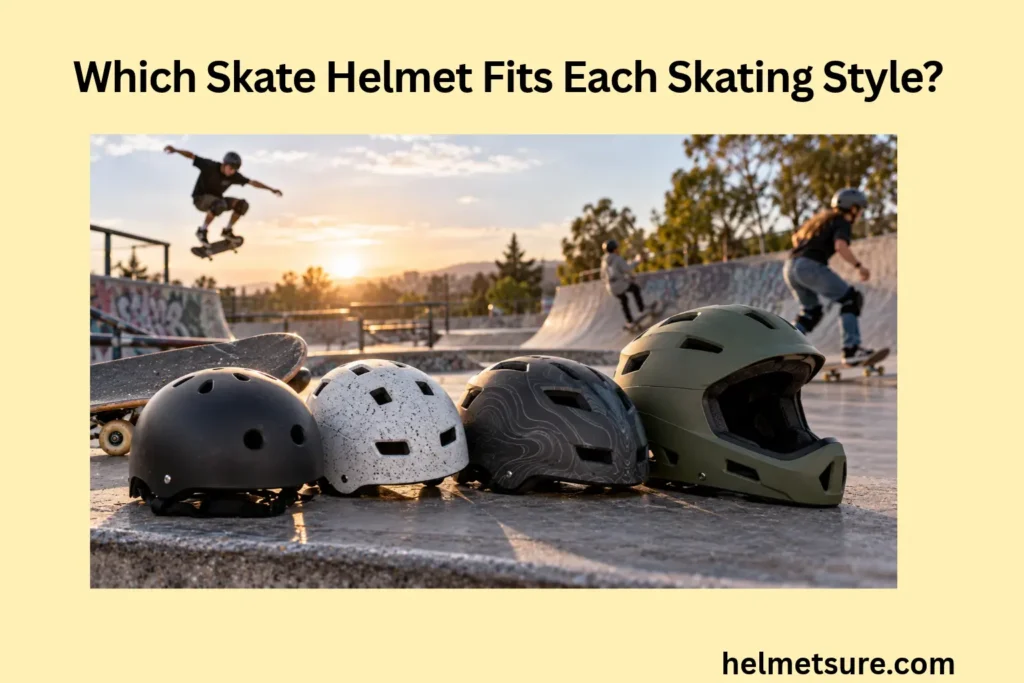
Which Skate Helmet Fits Each Skating Style?
The right skate helmet matches the skating style’s impact environment, applicable certification or rule set, required coverage, and secure fit; recreational, trick, downhill, derby, and hockey use do not share one interchangeable helmet requirement.
A helmet should be selected for the skating that will actually be performed—not for its shell shape, color, price, or a generic “multi-sport” description. Start by identifying the skating style, verify the applicable certification or governing rule, check the required coverage, and then confirm that the helmet fits securely.
This order matters. A helmet can fit the wearer comfortably yet still be outside the intended-use scope of the relevant standard or ineligible under an event rule. Conversely, a helmet can carry an appropriate certification but fail the individual fit check.
Certification and rule compliance describe tested or permitted use under defined conditions. They do not guarantee that a helmet will prevent concussion, traumatic brain injury, facial injury, or another outcome in every crash. Check the actual label and manufacturer documentation on the candidate helmet, confirm the current rules for any organized event, and follow the manufacturer’s fitting instructions.
Impact Pattern, Speed, and Rule Set Matter More Than a Helmet’s Shape
Impact pattern, typical speed, skating environment, trick intensity, and formal rule requirements determine helmet selection more reliably than shell shape alone.
The rounded shell commonly associated with skate helmets is only an appearance cue. It does not reveal which standard the model meets, whether it was intended for recreational or trick use, or whether an event permits it. Formal eligibility comes from the certification label, current product documentation, and any rulebook that governs the activity.
Four variables establish the selection path:
- Identify the discipline-level speed and use environment.
- Classify the activity as recreational, trick/aggressive, downhill, or organized sport.
- Verify the relevant certification or governing rule.
- Check whether the resulting helmet category provides the required coverage and fits securely.
How typical speed changes the level of helmet coverage a skating style demands
Typical skating speed changes the coverage question because higher-speed disciplines can introduce different impact environments and, in some rule sets, additional helmet requirements.
Recreational path skating and downhill racing do not present the same selection problem. At ordinary recreational use, the first question is usually whether a recreational roller-skating or qualifying bicycle-helmet pathway applies. In a sanctioned downhill event, the governing rule can elevate full-face construction from a preference to an eligibility condition.
The useful relationship is:
Greater discipline-specific speed exposure → greater importance of checking coverage and formal rules → possible escalation beyond ordinary open-face selection.
Speed alone does not identify a certification and does not create one universal point at which every skater must change to a full-face helmet. The activity, event, and applicable rules define the requirement. Skill level does not waive a formal equipment rule.
How ramps, rails, bowls, roads, and recreational paths create different impact conditions
Ramps, rails, bowls, roads, and recreational paths create different activity environments, so helmet selection must reflect the skating being performed rather than surface or shell appearance alone.
Ramps, bowls, rails, jumps, and technical lines commonly indicate skateboard-style or trick/aggressive use. Recreational paths more often indicate ordinary quad or inline skating. Roads are less decisive because they can be used for cruising, transportation, freeride, or downhill racing.
Environment therefore works as a classification signal:
Environment → activity pattern → relevant helmet category → certification or rule verification.
No single surface automatically proves which helmet is required. A smooth road does not make downhill racing recreational, and a hard-shell helmet at a park is not necessarily certified for skateboarding. The activity performed on the surface remains decisive.
How tricks and aggressive skating change the certification category worth checking
Tricks and aggressive skating change the certification category worth checking because current safety guidance can classify these uses separately from ordinary recreational roller and inline skating.
The U.S. Consumer Product Safety Commission groups longboarding, skateboarding, and aggressive or trick roller and inline skating with the skateboard-helmet category. ASTM F1492-25 formally covers helmets used for skateboarding and trick roller skating. Recreational roller skating follows a different ASTM pathway, and CPSC guidance allows a qualifying bicycle helmet to cross over only to specified recreational roller and inline use.
Ramps, jumps, grinds, park features, and aggressive-inline sessions are therefore signals to stop relying on a recreational-only assumption and verify the skateboard/trick-use certification path. “Aggressive” here names a skating discipline; it is not a judgment about the rider.
When competition rules determine helmet eligibility before comfort or appearance matter
Competition rules determine helmet eligibility first when the governing discipline specifies an accepted helmet category, construction, certification, or face-protection requirement.
For an organized event, the decision order is:
Governing rule → eligible helmet setup → secure fit → comfort and preference comparison.
World Skate downhill rules, WFTDA risk-management requirements, and IISHF inline-skater-hockey rules illustrate three different forms of control: a full-face construction requirement, a skating-specific hard-shell gear requirement, and a hockey-specific helmet-and-face-protection setup. Each applies only within its governing scope. A competition rule is not automatically a statute, and one federation’s rules do not govern every event in the sport.
| Selection variable | What it changes | Decision effect | Evidence boundary |
|---|---|---|---|
| Typical speed | Priority given to coverage and event-rule checks | May escalate the configuration beyond ordinary open-face logic | No universal speed cutoff |
| Environment | Classification of the activity being performed | Helps separate recreational, trick, road, and downhill use | Terrain alone does not establish certification |
| Tricks or aggressive use | Relevant intended-use category | Shifts the verification path toward skateboard/trick-use certification | Verify current official guidance and labels |
| Formal rules | Competition eligibility | Can override generic labels and personal preferences | Use the current applicable rulebook |
Once the use conditions are known, certification becomes the first formal filter.
Which Helmet Certifications Apply to Recreational, Trick, and Skateboard-Style Use?
Helmet certification must be matched to the skating activity because recreational roller use, trick skating, and skateboard-style use do not share one interchangeable standard.
ASTM F1492-25 and ASTM F1447-24 are active standards with different formal scopes. CPSC’s consumer guidance then adds an activity-based crossover explanation for CPSC-compliant bicycle helmets. These sources should be read as complementary—not collapsed into a single generic “skate certification.”
ASTM F1492-25 for skateboarding and trick roller-skating use
ASTM F1492-25 is the standard to verify for the skateboarding and trick roller-skating uses specified in its official scope.
Its title is Standard Specification for Helmets Used in Skateboarding and Trick Roller Skating. ASTM states that it covers performance requirements for helmets used in those activities and that a claim of compliance means the helmet meets the specification as a whole.
For street skateboarding, park skating, bowl and vert skating, trick roller skating, and related use categories supported by current guidance, an F1492 marking establishes compliance with that standard’s defined requirements. It does not prove that the helmet fits the individual, satisfies a separate competition rule, or prevents a particular injury.
Do not infer F1492 compliance from a rounded shell, low-profile styling, or a hard outer shell. Check the label inside the helmet and the manufacturer’s current model documentation.
ASTM F1447-24 for recreational bicycling and roller-skating use
ASTM F1447-24 is the recreational bicycling and roller-skating standard whose current scope must be verified before it is used in a helmet recommendation.
Its official title is Standard Specification for Helmets Used in Recreational Bicycling or Roller Skating. ASTM states that it covers performance requirements for helmets manufactured for those recreational uses.
This makes F1447 a relevant verification path for ordinary recreational quad and inline skating. It should not be treated as interchangeable with F1492 because the activity scopes are the reason recreational and trick use are separated.
Certification combinations vary by model. A helmet meeting another standard cannot be assumed to meet F1447 unless the actual label or official documentation says so.
Where CPSC bicycle certification fits recreational inline and roller skating
CPSC bicycle certification fits recreational inline and roller skating only where current CPSC guidance explicitly supports that recreational crossover.
CPSC states that a CPSC-compliant bicycle helmet may be used for bicycling, recreational inline skating, recreational roller skating, or kick-scooter riding. Its activity table separately places longboarding, skateboarding, and aggressive/trick roller and inline skating in the skateboard-helmet category.
The crossover is therefore an option for the named recreational uses, not a universal substitution rule:
Recreational roller or inline activity → verify the CPSC bicycle label → keep the helmet as a candidate → confirm fit and intended-use documentation.
When the activity changes to longboarding or aggressive/trick skating, use the separate skateboard/trick category identified by current guidance. The wider relationship among these pathways is covered in safety certifications, but the ASTM and CPSC sources—not the internal page—establish the formal scope.
When discipline-specific competition rules override a generic skate-helmet label
Discipline-specific competition rules override a generic skate-helmet label whenever the governing event specifies a particular helmet category, certification, construction, or face-protection setup.
A package may describe a product as “skate,” “action sports,” or “multi-sport,” but those descriptions do not establish event eligibility. For competition, check the event affiliation, current rulebook, required configuration, accepted certifications, and any component restrictions before comparing comfort.
This rule will later control three exceptions:
- World Skate downhill events require the helmet construction specified in the current downhill rulebook.
- WFTDA-sanctioned derby uses the current WFTDA risk-management requirements.
- IISHF-governed inline skater hockey uses a hockey-specific helmet and face-protection rule set.
| Certification or rule source | Intended use to verify | Relevant styles | Main limitation |
|---|---|---|---|
| ASTM F1492-25 | Skateboarding and trick roller-skating scope | Street, park, bowl/vert, trick and aggressive rows where supported | Does not replace fit or event-rule checks |
| ASTM F1447-24 | Recreational bicycling and roller-skating scope | Recreational quad and inline skating | Recreational scope should not be extended to trick use |
| CPSC bicycle certification and guidance | Named recreational crossover and consumer activity distinctions | Recreational roller and inline skating; other styles only where explicitly listed | Activity-specific, not universal |
| Governing-body rules | Current competition requirements | Downhill, roller derby, and inline skater hockey | Applies only within the governing event or organization |
These verified categories feed directly into the style matrix.
Style-to-Helmet Match Matrix: Which Helmet Category Fits Each Type of Skating?
Each skating style should be matched first to its typical helmet category and then checked against the certification or governing rule that makes that category relevant.
| Skating style | Typical helmet category | Certification or rule set to verify | Coverage priority | Primary selection caveat |
|---|---|---|---|---|
| Street skateboarding | Skateboard/skate helmet category | ASTM F1492-25 and current applicable guidance | Secure cranial coverage within the certified design | Shell shape does not prove certification |
| Park skateboarding | Skateboard/skate helmet category | ASTM F1492-25 and any applicable park or event rule | Coverage that remains correctly positioned during park use | A venue or competition may add requirements |
| Bowl and vert skateboarding | Skateboard/skate helmet category | ASTM F1492-25 and applicable event rules | Secure coverage for ramp, bowl, and vert use | Perceived difficulty does not create a separate standard |
| Recreational quad skating | Recreational roller-skating helmet or qualifying CPSC bicycle-helmet pathway | ASTM F1447-24 or CPSC guidance, as applicable to the actual helmet | Secure recreational-use coverage | Trick use changes the certification path |
| Recreational inline skating | Recreational roller-skating helmet or qualifying CPSC bicycle-helmet pathway | ASTM F1447-24 or CPSC guidance, as applicable to the actual helmet | Secure recreational-use coverage | Do not extend recreational crossover to aggressive inline use |
| Aggressive inline skating | Skateboard/trick-use helmet category | ASTM F1492-25 and current applicable guidance | Coverage appropriate to the verified category | A recreational bicycle-helmet pathway is not the default assumption |
| Trick roller skating | Skateboard/trick-use helmet category | ASTM F1492-25 and current guidance | Secure trick-use coverage | Appearance does not verify the standard |
| Recreational longboarding / cruising | Skateboard-helmet category under current CPSC activity guidance | ASTM F1492-25 or another current standard explicitly accepted for the activity | Secure open-face coverage unless a separate rule applies | Do not merge cruising with downhill competition |
| Downhill / freeride longboarding | Downhill-appropriate helmet; full-face where the applicable rule requires it | Current World Skate or actual event regulations | Chin and facial coverage where mandated | A competition rule does not automatically govern every recreational session |
| Roller derby | Rule-compliant skating helmet setup | Current WFTDA or actual league/event rules | Hard-protective helmet shell or inserts and any permitted face protection | Generic skate labeling does not prove league compliance |
| Roller hockey | Hockey-specific, rule-compliant helmet setup | Current IISHF or actual league/event rules | Hockey helmet plus the face protection required for the player and division | Do not substitute a generic skate helmet without rule support |
This matrix is the complete style-to-category recommendation set. The following sections explain why the answer changes at the main certification, coverage, governing-rule, and fit boundaries.
Recreational Roller and Inline Skating Split From Trick Use at the Certification Boundary
Recreational roller and inline skating separate from trick and aggressive use when the applicable certification guidance assigns those activities to different helmet categories.
The dividing factor is the activity pattern, not the wearer’s skill label. A beginner performing tricks still needs to check the trick-use category, while an experienced skater on an ordinary recreational path remains within the recreational comparison unless another rule applies.
When a CPSC-compliant bicycle helmet remains an option for recreational roller or inline skating
A CPSC-compliant bicycle helmet remains an option for recreational roller or inline skating only where current CPSC guidance explicitly supports that recreational crossover.
For the specified recreational activities, a candidate bicycle helmet remains in consideration when its CPSC compliance is verifiable on the actual product. It must still be comfortable, snug, level, securely retained, and used consistently with its manufacturer’s instructions.
The decision is conditional:
Recreational activity → qualifying CPSC bicycle certification → candidate remains eligible for evaluation → secure fit still required.
The same conclusion cannot be carried into aggressive inline, trick roller skating, longboarding, or a governed competition without checking their separate category or rule requirements.
When ramps, tricks, and aggressive skating shift selection toward the skateboard-helmet category
Ramps, tricks, and aggressive skating shift helmet selection toward the skateboard/trick-use category when current standards or regulator guidance classify those activities separately from recreation.
CPSC’s table groups longboarding, skateboarding, and aggressive/trick roller and inline skating under the skateboard helmet category. ASTM F1492-25 covers skateboarding and trick roller-skating helmets. Together, those primary sources establish the category boundary without relying on a subjective claim that one style is simply “more dangerous.”
Ramps, jumps, grinds, and technical trick sessions therefore trigger a different certification check. Beginner status, infrequent participation, or a helmet’s skate-style appearance does not remove that check.
Why helmet appearance cannot confirm whether the required certification is present
Helmet appearance cannot confirm certification because visual shell shape does not establish which standard a specific helmet model has actually been tested and labeled to meet.
Two helmets can look nearly identical yet carry different certifications, intended-use statements, or no relevant certification at all. Visual cues can suggest a product category, but verification requires the physical label and current official model documentation.
Use this distinction:
Appearance → category clue only. Label and documentation → certification evidence.
A hard shell does not automatically mean ASTM F1492 compliance. Likewise, the words “multi-sport” do not prove that the helmet supports every listed skating style.
| Decision attribute | Recreational roller or inline use | Trick or aggressive use |
|---|---|---|
| Environment | Recreational paths and ordinary skating contexts | Ramps, tricks, technical and aggressive contexts |
| Activity pattern | Recreational | Trick/aggressive |
| Certification path | Verify F1447 or the supported CPSC crossover | Verify F1492 and current applicable guidance |
| Selection consequence | A CPSC bicycle-certified option can remain a candidate | Do not rely on recreational bicycle crossover by default |
Downhill creates a different exception: it changes the coverage and rule question, not merely the recreational-versus-trick classification.
Downhill and Freeride Skating Can Move Helmet Selection From Open-Face to Full-Face Coverage
Downhill and freeride skating can move helmet selection from open-face to full-face coverage when the applicable competition or discipline rules require additional facial and chin coverage.
This is not a universal rule that every longboard session requires the same helmet. The correct question is whether the rider is entering a governed downhill event, following another discipline-specific rule, or skating recreationally outside that rule’s authority.
Why downhill competition rules can make full-face construction mandatory
Downhill competition rules can make full-face construction mandatory when the current governing rule explicitly requires that helmet configuration for event eligibility.
The World Skate Downhill Skateboarding & Street Luge Rule Book, updated June 2026, applies its required equipment provisions to practice, qualifying, and race runs at World Skate-sanctioned events. It requires helmets to use a single-piece outer hard shell and full-face design, be structurally sound, be worn according to the manufacturer’s instructions, and use the strap securely as designed. It also prohibits a detachable chin guard.
The rulebook strongly recommends a certified full-face helmet and separately limits the categories of helmets permitted at those events. A full-face silhouette alone is therefore not enough; the actual helmet must satisfy the current rule.
This is a competition requirement, not a claim that every downhill or freeride skater is subject to the same law. Riders outside a World Skate event must verify the rules, guidance, and laws that actually apply to their session or organizer.
How full-face coverage changes chin and facial protection compared with an open-face helmet
Full-face coverage adds a chin bar and surrounding facial structure that an open-face helmet does not provide, changing the areas physically covered by the helmet.
An open-face design leaves the face and chin more exposed by geometry. A full-face design extends the coverage footprint around those areas. Additional physical coverage can be required by a discipline, but it does not guarantee that a facial or head injury will be prevented.
Coverage and compliance remain separate questions:
Full-face structure → additional chin and facial coverage. Certification and event rule → verified eligibility.
The deeper decision about full-face choice begins with this coverage difference, but any mandatory-event claim must still come from the current governing rule.
Why ventilation and visibility remain secondary to the applicable downhill rule set
Ventilation and visibility affect usability, but they remain secondary when the applicable downhill rule set already defines the helmet configuration required for participation.
Airflow, field of view, eyewear integration, and comfort matter during actual use. They should be compared only among helmets that have already passed the event’s certification, construction, and coverage filters.
The priority is:
Rule eligibility first → secure fit second → ventilation and visibility comparison afterward.
A more ventilated open-face helmet cannot become eligible for an event that requires a single-piece full-face design. “Secondary” does not mean unimportant; it means those factors enter after mandatory conditions are satisfied.
Why a full-face shell shape still requires certification and event-rule verification
A full-face shell shape still requires certification and event-rule verification because appearance does not establish which standard or competition requirement the helmet satisfies.
Motorcycle, downhill-mountain-bike, BMX, and skating helmets may all use full-face geometry, but similar coverage does not prove equivalent certification or permission. Treat any full-face product as a candidate until three checks are complete:
- Check the intended-use statement and certification label.
- Compare the helmet with the current event rule.
- Reject it if the certification, construction, or component configuration does not satisfy that rule.
Retail categories and photographs are not substitutes for these checks.
| Configuration | Use environment | Rule requirement | Facial coverage | Principal limitation |
|---|---|---|---|---|
| Open-face | Recreational or discipline-specific use where permitted | Verify the actual event or discipline rule | Leaves the face and chin more exposed by design | Ineligible where full-face construction is mandated |
| Full-face | Downhill/freeride candidate and competition where required | Verify the current rule and accepted helmet category | Adds chin and facial coverage structure | Shape alone does not prove eligibility |
Organized derby and hockey create a separate exception through their own sport-specific equipment rules.
Roller Derby and Roller Hockey Require Sport-Specific Helmet Rule Checks
Roller derby and roller hockey require sport-specific helmet rule checks because organized disciplines can define equipment requirements beyond a generic skate-helmet category.
Do not transfer the rule of one organization to the entire sport. WFTDA governs WFTDA-sanctioned play and specified insured activities. IISHF governs its inline skater hockey competitions. Another league or event may use a different authority.
Why roller derby helmet selection starts with the applicable league or event rules
Roller derby helmet selection starts with the applicable league or event rules because equipment eligibility depends on the rule set governing that competition.
For WFTDA-sanctioned games, the October 2024 WFTDA Risk Management Guidelines require skaters and skating officials on skates to wear a helmet. The helmet must have a hard-protective shell or inserts; protective gear must be designed for skating, fit well, be worn correctly, remain in good condition, and follow the manufacturer’s guidance.
Under those WFTDA guidelines, full- and half-face shields are permitted subject to stated conditions, while cage-style face shields are not permitted. A non-form-fitting shield must be designed for the brand and helmet type with which it is paired. Those details apply to the WFTDA scope and should not be presented as universal roller-derby law.
For another derby league, begin again with its current rules. A generic skate helmet label cannot establish event compliance without that comparison.
Why inline hockey requires a hockey-specific helmet rather than a generic skate helmet
Inline hockey requires the hockey-specific helmet setup defined by its applicable rules rather than relying on a generic skate-helmet label.
The IISHF Official Rule Book 2026/2027 requires all players during games and pre-game warmups to wear a hockey helmet with its manufactured chin strap securely fastened. This is a sport-specific category requirement; an ordinary skateboard or roller-skating helmet is not an automatic substitute.
The exact rule applies within IISHF’s authority. Another roller-hockey or inline-hockey competition may use a different rulebook, so the player must verify the organization, age group, division, and event requirements.
When face-protection requirements change the complete helmet setup
Face-protection requirements change the complete helmet setup when the governing sport rule specifies a cage, shield, visor, or other approved facial-protection component.
IISHF’s 2026/2027 rules require full-face protection for specified players and age groups, define attachment and construction conditions for masks or visors, and require goalkeepers to use a full-face mask with a hockey helmet or a goalkeeper’s full-face head protector. WFTDA, by contrast, permits qualifying full- and half-face shields but prohibits cage-style face shields under its current guidelines.
This difference shows why “helmet” can mean a complete rule-defined system:
Rule-required face protection → compatible and permitted helmet-component combination → complete eligible setup.
An attachment that seems to fit physically is not necessarily manufacturer-approved or rule-compliant. Do not modify the shell, drill attachment points, improvise brackets, or assume cross-brand compatibility.
| Discipline | Governing source to check | Helmet category under the cited rule | Face-protection status under the cited rule |
|---|---|---|---|
| Roller derby | WFTDA or actual league/event rules | WFTDA requires a skating-designed helmet with hard-protective shell or inserts | WFTDA permits qualifying shields and prohibits cage-style shields |
| Inline skater hockey | IISHF or actual league/event rules | IISHF requires a hockey helmet with manufactured chin strap fastened | IISHF requirements vary by player category; full-face protection applies where specified |
Once rule eligibility is established, every candidate still has to pass the same individual fit test.
How Should the Correct Helmet Fit Before It Is Considered Suitable?
The correct helmet is suitable only after it sits level, fits snugly without uncontrolled shell movement, and remains securely positioned through the retention system.
Fit comes after category and rule validation. A securely fitting recreational helmet does not become eligible for trick use or organized hockey if it lacks the required certification or setup.
How a level helmet position prevents excessive forehead or rear-head exposure
A level helmet position keeps the helmet in its intended fore-aft placement instead of leaving excessive forehead or rear-head area exposed through incorrect positioning.
CPSC guidance says a helmet should be comfortable and snug and worn level rather than tilted backward or pulled too low over the forehead. That starting position allows the helmet’s intended coverage area to sit where the design expects it.
Tilting the helmet back can expose more of the forehead. Pulling it too far forward can alter rear placement and visibility. The specific model’s instructions should settle its intended position and adjustment sequence.
The detailed process for helmet fit begins with this level position and then checks snugness, movement, and retention.
How shell movement reveals a helmet that is too loose for secure use
Excessive shell movement after intended adjustment indicates that the helmet is not maintaining stable contact with the rider’s head.
Excess internal space, an incorrect size, or a head-shape mismatch can allow the shell to shift independently. During a normal fit check, the helmet should remain stable rather than sliding freely from front to back or side to side. CPSC’s guidance calls for a snug fit and says the helmet should not move in those directions once positioned.
Do not invent a universal distance tolerance. Fit systems differ, and normal skin or scalp movement beneath a snug helmet is not the same as the shell sliding independently over the head.
If adjustment cannot control the shell without painful pressure, reassess the size or shape. Tightening a dial does not necessarily correct a wrong shell size, and pain is not proof of secure fit.
How the chin strap keeps the helmet positioned during normal head movement
The chin strap supports helmet retention by helping the correctly fitted shell remain positioned during normal head movement.
The strap works with the shell fit; it does not replace it. Once correctly routed and fastened, it limits the helmet’s ability to lift or come off as the wearer looks up, down, or sideways. The buckle and webbing should follow the manufacturer’s intended configuration.
Use this relationship:
Correct shell fit + correctly adjusted retention system → improved positional stability.
Do not tighten the strap in an attempt to force an oversized or incompatible shell to stop moving. Do not substitute or modify buckles, straps, or attachment hardware.
Why sizing systems and adjustment pads should follow the helmet manufacturer’s instructions
Sizing systems and adjustment pads should follow the helmet manufacturer’s instructions because fit components are designed for the specific helmet model and size range.
Sizing charts, pad thicknesses, rear dials, suspension systems, and strap routing vary. Use the current chart and approved components supplied for the exact model, then reassess position, snugness, movement, and retention.
Comfort pads and structural impact liners are not interchangeable. Do not add household foam, alter the protective liner, drill the shell, or create another improvised fit configuration. CPSC advises using only manufacturer-specified adjustments and not adding unapproved padding or parts.
Use this four-point fit check:
- Position: Confirm that the helmet sits in the level position specified by the authority or manufacturer.
- Snugness: Confirm secure contact without obvious excess space or painful concentrated pressure.
- Movement: Confirm that normal head motion does not produce uncontrolled shell displacement after adjustment.
- Strap security: Confirm that the retention system and buckle are correctly routed, adjusted, and secured.
A helmet that passes this fit check can cross styles only when the certification, coverage, and rule requirements also remain compatible.
When Can One Helmet Safely Cover More Than One Skating Style?
One helmet can cover more than one skating style only when the styles share compatible certification, coverage, governing-rule, and secure-fit requirements.
No single attribute is enough. A dual-certified label may resolve a standards question but not a full-face event requirement. Full-face coverage may resolve geometry but not a hockey rule. A rule-compliant category may still fail on the wearer’s head.
Shared certification requirements as the first condition for cross-style helmet use
Shared certification requirements are the first condition for cross-style helmet use because one helmet cannot legitimately cover two activities when their required standards or rule sets conflict.
List the skating styles and compare the applicable certification or rule path for each. Then check the actual label on the candidate helmet.
Same qualifying pathway → continue to coverage. Conflicting requirement → separate-helmet path.
Shared appearance, brand, or “multi-sport” marketing does not count as shared certification. Even multiple certifications cannot override a separate governing-body requirement.
Why the most demanding regular skating style should control the shared helmet choice
The most demanding regular skating style should control the shared helmet choice when its verified coverage or rule requirements are stricter than those of the rider’s other compatible styles.
“Most demanding” means the style with the stricter verified certification, coverage, or governing-rule condition—not the one that merely looks faster or more dangerous. If both activities are otherwise compatible, use the stricter regular-use requirement as the selection ceiling.
This rule remains multi-dimensional. A full-face helmet may provide greater physical coverage yet still lack a certification needed for another style. Likewise, a helmet with several labels may remain ineligible under a rule that specifies another construction or face-protection system.
When competition rules or full-face requirements make a separate helmet necessary
A separate helmet becomes necessary when one skating style has a competition, full-face, or sport-specific equipment requirement that the shared helmet does not satisfy.
A World Skate downhill event and IISHF inline skater hockey are bounded examples. If the candidate does not meet the applicable full-face downhill construction rule or hockey-specific helmet-and-face-protection rule, the crossover ends.
Conflicting mandatory requirement → shared helmet rejected → separate rule-compliant helmet required for that activity.
Preference differences alone do not force separate helmets, but formal incompatibility does. Similar full-face geometry cannot establish cross-sport equivalence.
Why crossover still fails if the shared helmet does not fit securely for the rider
Cross-style helmet use still fails when the shared helmet does not fit the rider securely, even if its certification and coverage requirements otherwise match both skating styles.
Standards and rules establish category-level test or eligibility conditions; they do not establish secure fit for every head shape and size. Reuse the same four fit gates: level position, snug contact, controlled movement, and secure retention.
Requirements match + insecure individual fit → reject the shared helmet.
Do not repair crossover fit with unapproved pads or structural modifications. Follow the manufacturer’s size chart and approved adjustment process or choose another model.
The complete crossover decision is:
- Verify the same relevant standard or compatible certification path.
- If no, use separate helmet solutions.
- If yes, continue.
- Confirm compatible coverage requirements.
- If no, use the stricter required configuration or separate helmets.
- If yes, continue.
- Check for conflicting competition or sport-specific rules.
- If a conflict exists, use a separate rule-compliant helmet.
- If no conflict exists, continue.
- Confirm secure individual fit.
- If fit fails, reject the shared helmet.
- If fit passes, one helmet can remain a candidate for both uses.
Choose the Helmet That Meets the Most Demanding Requirements of the Way You Skate
Choose the helmet that satisfies the verified requirements of the most demanding skating style you regularly perform, then confirm that it remains suitable for any additional styles you want it to cover.
Use this final sequence:
Final Skate-Helmet Selection Checklist
Frequently Asked Questions About Skate Helmet Selection
Short answers covering style matching, certification, full-face coverage, organized sports, fit, and cross-style use.
Can one skate helmet fit every skating style?
Not automatically. Certification scope, coverage, event rules, and secure fit must remain compatible across every intended style.
Which standard applies to skateboarding and trick roller skating?
Verify ASTM F1492-25 or another current standard explicitly accepted for the actual activity and governing context.
Can a bicycle helmet be used for recreational roller skating?
A CPSC-compliant bicycle helmet can remain a candidate for named recreational crossover uses, but not as a default substitute for trick, aggressive, downhill, or organized-sport requirements.
Do ramps or aggressive tricks change helmet selection?
Yes. They shift the verification path away from ordinary recreational crossover and toward a skateboard or trick-use category supported by current guidance.
Does a full-face shape prove downhill eligibility?
No. Verify the actual certification, construction requirement, helmet label, and current event rule.
Can a generic skate helmet be used for roller hockey?
Do not assume so. Inline skater hockey can require a hockey-specific helmet and category-dependent face protection under the applicable rules.
What fit checks matter before skating?
Confirm level position, secure contact, controlled movement, correct strap routing, buckle engagement, and manufacturer-approved adjustment.
What should control a cross-style helmet choice?
The most demanding regular style’s verified certification, coverage, and rule requirements should control, provided the helmet also fits the rider securely.