
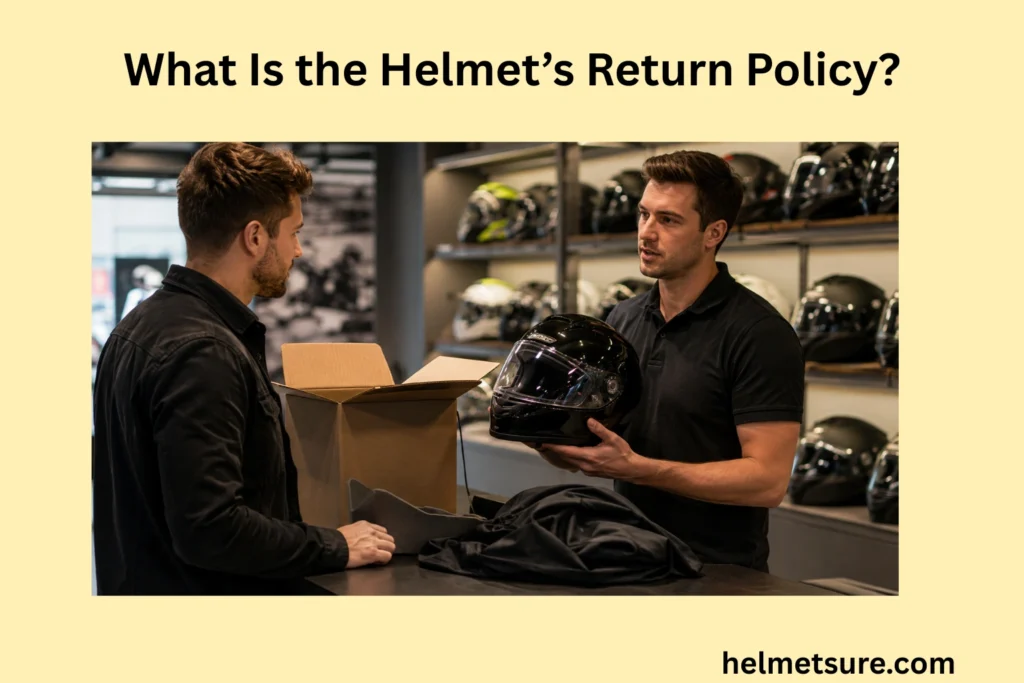
What Is the Helmet’s Return Policy?
A helmet return policy defines whether a purchase can be sent back, how long eligibility lasts, what condition the helmet must remain in, what process applies, and whether approval leads to a refund, exchange, or credit.
To evaluate the policy, identify the seller or manufacturer responsible for the transaction and read the current written terms for the exact purchase channel and region. Verify who may return the helmet, which date starts the window, what product condition is required, which exclusions apply, how authorization and shipping work, and what the buyer receives after approval.
A Return Policy Defines When a Helmet Can Be Sent Back Rather Than Guaranteeing Every Purchase Can Be Reversed
A helmet return policy defines the documented circumstances under which a purchase can be sent back rather than guaranteeing that every buyer can reverse every transaction.
The phrase “returns accepted” is incomplete without its conditions. The buyer may need to satisfy a deadline, preserve a specified product state, provide transaction evidence, use a designated channel, and accept an outcome other than a cash refund. Written seller or manufacturer terms—not general expectations about customer service—define the ordinary return being evaluated.
Why having a return policy does not mean every helmet purchase qualifies for return
A valid purchase may lose eligibility if the window closes, activity use leaves prohibited wear, required parts are missing, or the transaction belongs to an excluded category. Conversely, a helmet remains returnable when the purchase and product satisfy every applicable term and the buyer completes the process correctly.
Use a fixed sequence: identify the applicable policy, verify initial eligibility, confirm the deadline and item condition, check exclusions, then follow the return procedure. Approval still does not automatically mean a full cash refund; the outcome must be read separately.
How return eligibility differs from warranty coverage for defects
Helmet return eligibility differs from warranty coverage because returns govern reversing or resolving a purchase under seller terms, while warranties govern eligible defects under separate protection terms.
A return policy may allow a change-of-mind return even when the product has no defect, provided the buyer satisfies its conditions. A helmet outside the ordinary return window may still have a valid defect claim under separate helmet warranty coverage. The two mechanisms can have different decision-makers, periods, evidence requirements, product-condition rules, and remedies.
Do not send every damaged or defective helmet through the ordinary return route. Check whether the seller uses a damaged-on-arrival procedure, whether the manufacturer controls a warranty claim, and whether a separate crash-replacement program exists. Keep those processes distinct unless the documents explicitly connect them.
Why written return terms matter more than general promises of easy returns
Written helmet return terms matter more than general promises of easy returns because the documented policy defines the actual eligibility, timing, condition, cost, and refund rules.
Marketing phrases such as “easy returns” or “shop with confidence” do not reveal the start date, deadline event, packaging rules, excluded purchases, shipping responsibility, or permitted deductions. The operational policy does. Save the version visible at purchase, because seller terms can change and regional pages may differ.
For online shopping in the United States, the Federal Trade Commission (FTC) advises consumers to check how many days they have, who pays return shipping, whether restocking fees apply, and whether sale merchandise follows different rules. That is useful evaluation guidance, not a universal return entitlement. Other jurisdictions may provide additional rights.[1]
Which Helmet Purchases Are Eligible for Return?
Helmet return eligibility depends on purchase source, proof of purchase, purchaser status, sale classification, and any region- or retailer-specific restrictions stated in the applicable policy.
Establish eligibility before calculating a deadline or preparing the helmet. The same model can be returnable through one seller, conditionally returnable through another, and outside a manufacturer-direct process when it was bought from a third party.
How purchase source can determine whether the seller or manufacturer controls the return
Purchase source determines which helmet return policy applies when retailers, marketplaces, and manufacturers maintain separate post-purchase rules.
Identify the merchant of record on the receipt or order confirmation. A brand website may handle direct purchases but direct a retailer purchase back to that retailer. A marketplace may distinguish between items sold by the platform, fulfilled by it, or sold and shipped by an independent merchant.
Do not assume the manufacturer accepts a standard return merely because its name appears on the helmet. Contact the entity named in the applicable policy and preserve communications if responsibility is unclear.
How proof of purchase establishes eligibility under the stated policy
Proof of purchase establishes helmet return eligibility when the seller requires documentation confirming the transaction, date, product, and purchasing account or customer.
Accepted evidence might include a receipt, invoice, order number, account record, gift receipt, or another document—but only the policy can establish which form qualifies. Match the record to the exact model, purchase channel, transaction date, and buyer where required.
Keep the original electronic or printed record and the policy captured at purchase. A bank entry may show payment without identifying the product, so do not promise that it replaces the seller’s required proof unless the terms allow it.
How original-purchaser requirements can limit who may initiate the return
Original-purchaser requirements can limit helmet returns when the policy restricts eligibility to the customer or account that completed the original transaction.
This rule can affect gifts, second-hand purchases, marketplace transfers, and returns attempted by another household member. Determine whether the policy follows the customer, the transaction, the product, or an eligible gift receipt. Do not infer transferability from possession of the helmet alone.
When purchaser status is ambiguous, seek written clarification before relying on return protection. A policy restriction and any statutory rights are separate questions and may vary by jurisdiction.
How sale, clearance, or final-sale status can change return eligibility
Sale, clearance, or final-sale status changes helmet return eligibility only when the applicable policy assigns different return rights to those purchase categories.
A discounted price does not automatically mean the helmet is non-returnable. Confirm whether the product page, cart, receipt, or policy marked the item “final sale,” applied a shorter window, limited the outcome to exchange or credit, or used the ordinary rules.
Record the designation shown at purchase. Do not add a final-sale exclusion after the fact or generalize a rule from another retailer’s policy.
How region or retailer-specific terms can alter the applicable return rules
Use the policy for the country or region where the transaction occurred and the seller that completed it. Currency, shipping destination, website domain, store location, and consumer-law disclosures can help identify the applicable market, but the terms should confirm it.
Do not quote one region’s window or fee as an international rule. When comparing retailers, hold the country, product, purchase channel, and transaction type constant.
Return Eligibility by Purchase Condition
| Purchase condition | Eligibility status | What to verify |
|---|---|---|
| Manufacturer-direct purchase | Eligible, conditional, or not eligible | Applicable manufacturer terms |
| Third-party retailer purchase | Eligible, conditional, or not eligible | Whether the retailer controls the return |
| Proof of purchase available | Eligible or conditional | Required evidence |
| Second-hand purchase | Verify | Purchaser restrictions |
| Discounted purchase | Verify | Sale status alone may not exclude it |
| Final-sale purchase | Verify | Explicit exclusion required |
| Region-specific purchase | Verify | Local policy terms |
How Long Does the Buyer Have to Return the Helmet?
The helmet return window lasts only for the period defined by the applicable policy and begins from the purchase, delivery, or other event specified in the terms.
The number of days is meaningful only after the start event, counting method, and deadline event are known. Online, in-store, collection, gift, and promotional purchases may share one rule or follow different rules, depending entirely on the seller’s documentation.
How the purchase or delivery date can establish the start of the return window
The helmet return window begins from the purchase or delivery date only when the applicable policy defines that event as the timing trigger.
An in-store policy may use the transaction date, while a shipped order may use purchase, dispatch, delivery, or another recorded event. Click-and-collect orders may use collection or the original transaction. Do not choose the latest date simply because it favors the buyer.
Locate the start clause, retain evidence of the trigger, and calculate only after resolving channel-specific rules. If delivery is disputed, preserve carrier and seller records.
How the stated number of return days determines the final eligible date
The stated return-window length determines the final eligible date once the policy’s start event and counting method are established.
Verify the exact number and whether the terms use calendar days, business days, a named date, or another formulation. Check how the seller treats the starting day, weekends, public holidays, and extended seasonal periods if the policy addresses them.
Do not invent a grace period or deadline extension. When timing is close, contact the responsible seller promptly and retain evidence of every required action.
How online and in-store purchases may follow different return timing rules
Online and in-store helmet purchases can follow different return timing rules when delivery, collection, or transaction dates trigger separate return windows.
Compare the channel sections of the same seller’s policy. A store purchase may begin immediately, while an online order can involve delivery and shipping events. Alternatively, the seller may use one common period. Mention a difference only when the written terms document it.
The buyer should not assume an online order can be returned to a physical branch or that store staff can extend an online deadline. Verify channel, location, and processing route together.
How initiating a return before the deadline can differ from the seller receiving it before the deadline
Determine which event preserves eligibility: submitting a portal request, obtaining authorization, generating a label, handing the parcel to a carrier, receiving a postmark, or delivery to the seller. Contacting support may not be enough if the terms require shipment or receipt within the window.
Follow the strictest documented step that applies and keep timestamped confirmation, carrier acceptance, tracking, and delivery records. Do not impose an arrival deadline when the policy uses authorization or dispatch instead.
Return-Window Timing Map
| Purchase type | Start event | Return window | Deadline event |
|---|---|---|---|
| Online order | Verify purchase, shipment, or delivery | Verify | Authorization, shipment, or receipt |
| In-store purchase | Verify transaction date | Verify | Verify |
| Click-and-collect | Verify | Verify | Verify |
| Gift purchase | Verify if different | Verify | Verify |
| Promotional purchase | Verify if different | Verify | Verify |
What Condition Must the Helmet Be In to Qualify for Return?
A helmet must remain in the condition required by the return policy, which can include limits on wear, damage, tags, packaging, accessories, and actual activity use.
Item-Condition Checklist
Condition is separate from timing: a helmet can be within the window yet fail the product-state rules. Read what the seller means by new, unused, unworn, resaleable, complete, or original condition before opening, trying on, assembling, removing tags, or discarding materials.
How unused or unworn condition can affect return eligibility
An unused or unworn helmet condition affects return eligibility when the seller requires the product to remain new, unused, or resaleable.
The policy may distinguish inspection and permitted try-on from real-world activity use. Do not define that boundary yourself. Sweat, odor, dirt, scuffs, strap marks, adhesive residue, or other evidence may influence the seller’s assessment when the terms require pristine condition.
If the policy is unclear, ask before trying the helmet. Never use a strict return rule as a reason to accept uncertain fit or suitability.
How removed tags or altered packaging can affect acceptance
Removed tags or altered packaging can affect helmet return acceptance when the seller requires original presentation materials to remain intact.
Check whether tags must remain attached, seals unopened, protective films in place, and the product box undamaged. Shipping cartons and retail packaging are different items; identify which the policy actually requires.
Do not claim that every opened box or detached tag voids eligibility. Preserve materials until the helmet is accepted, and follow the written rule rather than another retailer’s practice.
How visible wear, marks, or damage can change the return outcome
Visible wear, marks, or damage can change a helmet return outcome when the policy requires the product to remain unused, undamaged, or suitable for resale.
Document the helmet immediately after delivery, especially if it arrives with scratches, dents, cracked parts, missing items, or packaging damage. Seller-caused or transit-related issues may follow a different route from buyer-caused wear.
If the helmet has been impacted or may be structurally compromised, do not keep using it while negotiating a return. Evaluate helmet condition separately from financial eligibility and follow manufacturer safety instructions.
How retaining original accessories and included materials can preserve eligibility
Retaining original helmet accessories and included materials preserves return eligibility when the policy requires a complete product package.
Keep removable pads, visors, covers, hardware, manuals, storage bags, charging items, documentation, and promotional inclusions when they were part of the purchase and the terms require their return. Create an inventory before repacking.
Do not assume every insert is mandatory or that missing parts automatically produce rejection. The seller may accept the return with conditions, deduct value, or reject it only where the policy allows; verify the exact consequence.
How trying the helmet for fit can differ from using it in actual activity
Before riding, skating, climbing, working, or beginning another activity, confirm whether the seller permits only a clean indoor try-on and what must remain attached. Use the manufacturer’s size chart and helmet sizing guidance to select a candidate, then evaluate how a helmet should fit without exceeding the seller’s allowed trial.
Some policies may prohibit returns after any wear; others may permit reasonable fitting. Do not assume a universal try-on right or a universal fitting-time threshold.
Which Situations Can Make the Helmet Non-Returnable?
A helmet can become non-returnable when explicit policy exclusions apply to sale status, use, damage, missing components, packaging, or hygiene-related conditions.
Every exclusion must come from the applicable policy. Do not convert common retail practices into universal rules, and keep ordinary return exclusions separate from damaged-goods procedures, warranty claims, statutory remedies, and safety retirement decisions.
How final-sale or clearance terms can remove standard return rights
Final-sale or clearance terms remove standard helmet return rights only when the seller explicitly assigns reduced or no return eligibility to that purchase category.
“Sale,” “discounted,” “outlet,” “clearance,” and “final sale” are not automatic synonyms. Check the product page, receipt, promotional conditions, and return policy for the exact designation and any exception for defective or incorrectly supplied goods.
If the seller offers only exchange or store credit for the category, record that outcome separately from eligibility. Never infer non-returnability from a low price alone.
How signs of use can move the helmet outside normal return eligibility
Signs of use can move a helmet outside normal return eligibility when the policy requires new, unused, unworn, or resaleable condition.
Tie the evidence to the seller’s stated standard. Activity-related dirt, odor, sweat, scuffs, strap marks, accessory installation, or removed protective material may matter when the policy defines them as use. Permitted inspection or fit testing should remain separate.
Do not invent what counts as unacceptable use. If evaluation itself risks eligibility, clarify the rule before proceeding.
How damage caused after purchase can disqualify a standard return
Damage caused after purchase can disqualify a standard helmet return when the policy requires the product to remain undamaged.
Separate buyer-caused damage from transit damage, manufacturing concerns, and products supplied in the wrong condition. Report damage on arrival promptly through the prescribed channel, with photographs and packaging evidence where requested.
Do not route every damaged product through the ordinary change-of-mind process. Warranty, damaged-goods, insurance, or safety procedures may control, and financial resolution never determines whether continued use is safe.
How missing packaging or components can trigger rejection when the policy requires them
Missing packaging or helmet components can trigger return rejection when the policy explicitly requires a complete original package.
Compare the return contents with the original packing list, product description, and policy. Include required pads, accessories, manuals, cables, fasteners, cases, and retail packaging. Photograph the packed contents when useful.
Only documented requirements should control. Do not tell buyers that every tissue sheet or shipping filler is mandatory unless the seller says so, and do not promise acceptance when a required product component is missing.
How hygiene-related restrictions can limit returns when explicitly stated in the terms
A helmet contacts the head, but that fact alone does not prove a non-return rule. Verify whether the policy names helmets, protective equipment, wearable products, opened goods, removed hygiene seals, or another defined category and what event triggers the limitation.
Do not create an exclusion from assumption. If a restriction exists, preserve the exact wording and check whether defective or misdescribed goods follow a separate procedure under the seller’s terms or applicable law.
Non-Returnable Conditions
| Exclusion condition | Eligibility consequence | What to verify |
|---|---|---|
| Final-sale designation | Return can be unavailable | Explicit final-sale rule |
| Prohibited signs of use | Return can be rejected | Condition definition |
| Buyer-caused damage | Standard return can be unavailable | Damage rule |
| Missing required packaging | Return can become conditional or be rejected | Packaging requirement |
| Missing accessories or components | Return can become conditional or be rejected | Completeness rule |
| Hygiene restriction | Return can be limited | Explicit policy language |
What Steps Must the Buyer Follow to Return the Helmet?
Returning an eligible helmet requires following the seller or manufacturer’s documented authorization, evidence, packaging, and shipping procedure.
Return Process Checklist
Treat the process as a chain. Contact the responsible party, obtain authorization if required, submit proof, preserve eligible condition, pack the complete product, use the approved route, and retain tracking and delivery records until the outcome is complete.
How contacting the seller or manufacturer starts the return process
Contacting the correct seller or manufacturer starts the helmet return process when the policy requires the buyer to initiate the request through a designated channel.
Use the portal, store counter, email address, phone number, or account workflow specified in the policy. Provide the order number and reason category requested without making an unsupported technical diagnosis.
Contact does not necessarily preserve eligibility by itself. Confirm what subsequent action must occur before the deadline and keep a dated copy of the request and response.
How return authorization can be required before sending the helmet back
Return authorization can be required before a helmet is shipped back when the policy requires an approval number, label, portal confirmation, or similar pre-return step.
Do not send the helmet to a general business address unless the instructions permit it. An unauthorized parcel may be delayed, rejected, or disconnected from the order. Record the authorization number, approved destination, expiration, and associated label.
Authorization starts the process; it may not mean the seller has approved the final refund. Condition inspection can still occur after receipt.
How proof of purchase and product details support the return request
Proof of purchase and helmet product details support the return request by confirming the transaction, product identity, date, and applicable policy.
Submit only what the seller requests: order number, receipt, model, variant, size, product code, account details, photographs, or reason for return. Accuracy prevents the return from being matched to the wrong product or policy.
The evidence supports processing but does not override a closed window, excluded category, or condition failure. Keep approval and eligibility distinct.
How packaging requirements affect whether the returned helmet is accepted
Packaging requirements affect helmet return acceptance when the policy specifies how the product must be packed or which original materials must accompany it.
Protect the helmet during shipment, include required retail materials and components, remove or cover obsolete labels as directed, and place authorization information where requested. Do not attach carrier labels directly to retail packaging unless permitted.
Adequate transit protection matters even when original packaging is optional. New damage during return shipment can complicate inspection and responsibility.
How return-shipping instructions determine where and how the helmet must be sent
Verify whether the seller provides a prepaid label, deducts its cost, requires buyer-paid shipping, specifies a carrier, or accepts an in-store handoff. Do not invent a fee or processing time; distance, service level, region, and policy affect them.
Use tracking when required or prudent and retain carrier acceptance and delivery evidence. Follow hazardous-material or electronic-device instructions if the exact product includes a component to which they apply.
What Does the Buyer Receive After an Approved Return?
An approved helmet return leads to the refund, exchange, store-credit, or other outcome defined by the applicable policy after any permitted shipping or restocking deductions.
Calculate the practical outcome rather than assuming the purchase price comes back in cash. Separate the product refund, original delivery charge, return-shipping cost, restocking fee, payment method, exchange rules, and store-credit restrictions.
How a full refund differs from a partial refund
A full helmet refund returns the policy-defined refundable purchase amount, while a partial refund reflects permitted deductions, reduced eligibility, or other documented adjustments.
Define the base amount before calling a refund “full.” It might refer only to the product price, while original shipping, expedited delivery, gift wrapping, duties, or other charges receive separate treatment. A partial refund must follow a documented deduction or adjustment.
Compare the expected net amount with the confirmation issued after inspection. If the figures differ, ask the seller to identify the clause and calculation used.
How original shipping charges may be handled separately from the product refund
Original shipping charges can be handled separately from the helmet product refund when the policy excludes, conditionally reimburses, or fully refunds delivery costs.
Check whether treatment changes with the return reason. A change-of-mind return, wrong item, damaged delivery, or seller error may follow different rules. Free outbound delivery also does not establish that return shipping is free.
Do not promise reimbursement of the original charge without policy evidence. Record the product and delivery amounts separately in any comparison.
How return-shipping costs can reduce the practical value of the refund
Return-shipping costs reduce the practical value of a helmet refund when the buyer must pay to send the product back.
Determine whether the buyer purchases postage, uses a seller label whose cost is deducted, or receives prepaid return service. The actual expense can depend on parcel size, destination, carrier, tracking, and insurance, so no generic estimate is reliable.
Compare net refund value, not just eligibility. Seller-paid shipping preserves more value, but it should receive credit only when documented for the buyer’s reason and region.
How restocking fees can change the amount ultimately returned
Restocking fees reduce the final helmet refund only when the applicable return policy explicitly permits such a deduction.
Verify the rate or formula, the base amount, the purchase categories affected, and the conditions that trigger or waive the fee. Never import a “standard” percentage from general retail practice.
A clearly stated fee lowers practical flexibility but does not automatically make a return useless. Calculate its effect together with shipping and other allowed deductions.
How exchange or store credit can replace a cash refund when the policy specifies those outcomes
Distinguish a replacement size or model, merchant credit, refund to the original payment method, and cash reimbursement. Check availability, price-difference treatment, credit expiration, geographic limits, and product restrictions only when the policy states them.
Do not assume the buyer chooses freely among outcomes. Exchange or credit can help correct an unsuitable choice, but neither provides the same flexibility as money returned to the buyer.
Approved Return Outcomes
| Approved return outcome | Buyer receives | What to verify |
|---|---|---|
| Full refund | Policy-defined refundable amount | Whether shipping is included |
| Partial refund | Refund minus permitted deductions | Deduction basis |
| Exchange | Replacement product | Eligibility and price-difference rules |
| Store credit | Seller-specific credit | Expiration or restrictions if stated |
| Refund minus return shipping | Net reimbursement | Shipping responsibility |
| Refund minus restocking fee | Reduced reimbursement | Fee amount and conditions |
When Should the Return Policy Influence the Helmet Purchase Decision?
A helmet return policy deserves more purchase weight when fit or product suitability cannot be fully confirmed before purchase and the documented terms provide realistic flexibility to correct a poor match.
Return protection is most useful when uncertainty cannot be eliminated before payment, especially online. Give it weight in proportion to actual usability: eligible purchase, adequate window, realistic condition rules, manageable process, limited deductions, and a useful outcome.
Give the return policy more weight when helmet fit cannot be confidently confirmed before purchase
Give the helmet return policy more purchase weight when correct fit cannot be confidently confirmed before buying because return flexibility reduces the cost of resolving an unsuitable fit.
Size charts and measurements can narrow the choice, but individual shape and product geometry can still create pressure, movement, or poor positioning. A policy that permits a sufficient indoor evaluation while preserving eligible condition can reduce that uncertainty.
Do not let return flexibility replace careful selection. A buyer should still choose the likely correct size and understand the permitted try-on before opening or wearing the helmet.
Give the return policy more weight when online purchasing limits hands-on evaluation
Give the helmet return policy more weight for online purchases when the buyer cannot inspect, handle, or try the exact product before completing the transaction.
Online images and specifications cannot fully reveal personal fit, control accessibility, finish condition, or compatibility with the buyer’s equipment. A usable return process creates a recovery path when the delivered product differs from reasonable expectations or does not suit the buyer.
The FTC advises U.S. online shoppers to read return and refund terms and retain purchase records.[2] Apply the seller’s actual regional policy rather than assuming online purchases everywhere receive the same rights.
Reduce return-policy value when strict condition rules make realistic returns difficult
Reduce return-policy value when strict helmet condition requirements make it difficult to evaluate fit or suitability without risking loss of return eligibility.
A policy may appear flexible by duration but offer little practical value if any opened packaging, detached tag, or permitted-looking try-on creates uncertainty. Compare what the buyer needs to evaluate with what the policy allows.
Do not violate the terms to test the product. If a confident evaluation cannot be completed within them, prefer an in-person seller, a clearer policy, or another otherwise suitable option.
Reduce return-policy value when fees or shipping costs substantially reduce the refund
Reduce return-policy value when return shipping, restocking fees, or other permitted deductions materially reduce the buyer’s net refund.
Calculate the product refund, original delivery treatment, label or postage cost, restocking fee, and any nonrefundable charges. Avoid unsupported estimates; use the policy and actual shipping information for the destination.
A return can remain worthwhile despite costs, but the policy should not receive the same purchase credit as an otherwise equivalent option that returns more value through a similarly accessible process.
Keep fit, intended use, applicable safety requirements, and model suitability above return convenience
Confirm choosing a helmet for its intended use and the applicable helmet safety certification requirements before treating the policy as a differentiator. CPSC guidance illustrates that activity-appropriate selection and the relevant standard matter.[3] NHTSA separately emphasizes fit and required labeling for U.S. motorcycle helmets.[4] Those examples are category- and jurisdiction-specific, not a universal standard list.
Return terms help compare helmets that already appear to qualify. They cannot repair a wrong activity category, poor fit, missing requirement, unsuitable configuration, or safety concern.
Treat a Flexible Return Policy as Purchase Protection Rather Than Proof the Helmet Is the Right Choice
Treat a flexible helmet return policy as purchase protection rather than proof of product suitability because the policy reduces post-purchase friction without establishing fit, safety, quality, or intended-use compatibility.
The final evaluation sequence is: identify the responsible seller, verify eligibility, calculate the window, preserve the required condition, check exclusions, follow the process, calculate the net outcome, and only then decide how much value the policy adds.
Judge return flexibility by eligibility, timing, condition requirements, costs, and refund outcome
Judge helmet return flexibility by its eligibility rules, return window, item-condition requirements, costs, process, and final refund or exchange outcome.
No single attribute settles the question. A long window may be weakened by strict condition rules; broad eligibility may be reduced by buyer-paid shipping; a simple process may end only in store credit. Compare each dimension against the buyer’s realistic situation.
A strong policy is one the buyer can actually use without guessing about timing, product state, responsibility, or financial outcome.
Give vague return promises less weight than clear written terms
Policy clarity improves confidence but does not automatically make the terms favorable. Save the applicable page and receipt before purchase, and obtain written clarification for any point that could materially affect the return.
Do not fill gaps with reviews, chat assumptions, or another retailer’s practice. A concise precise policy can be stronger evidence than a long document that leaves the decisive conditions unresolved.
Let a favorable return policy reduce purchase friction only after the helmet meets the buyer’s requirements
Let a favorable helmet return policy reduce purchase friction only after the helmet already appears to meet the buyer’s fit, intended-use, safety, and model-suitability requirements.
Between otherwise suitable helmets, a clearer and more usable return policy can legitimately reduce financial risk and break a tie. Give credit for realistic eligibility, enough evaluation time, workable condition rules, limited costs, and a useful refund or exchange outcome.