
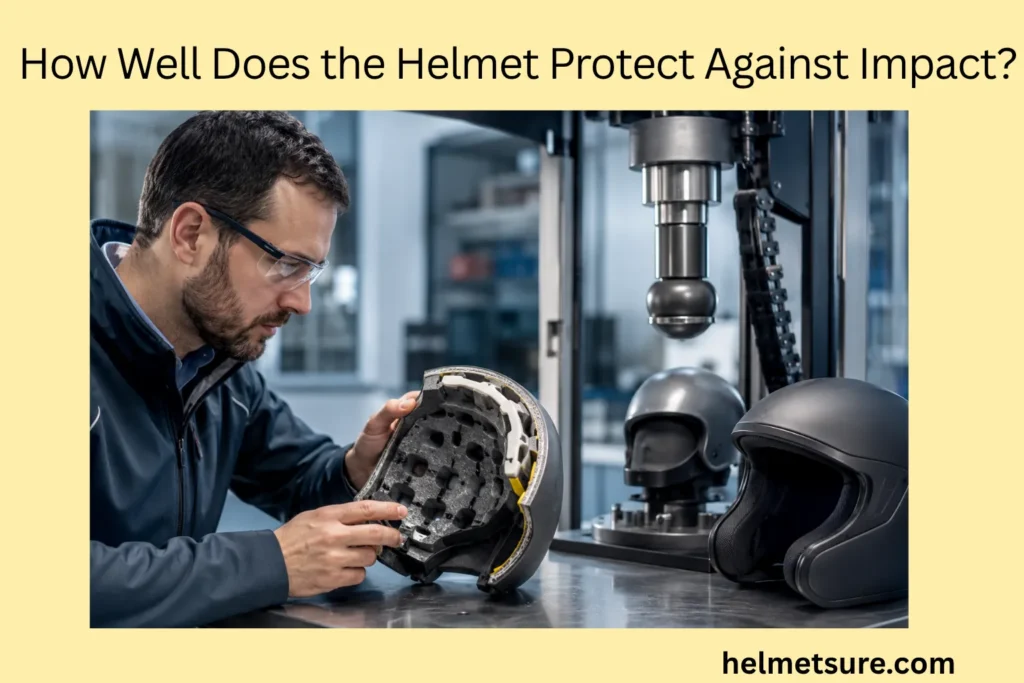
How Well Does the Helmet Protect Against Impact?
Helmet impact protection depends on how its shell, liner, coverage, fit, and retention manage impact energy under verified test conditions; judge performance from activity-relevant evidence and current helmet condition, not one material, feature, or marketing claim.
Evaluate helmet impact protection as the response of the complete helmet system. The shell, energy-management liner, geometry, interfaces, fit, and retention work together, while certification or other test evidence shows how that system performed under defined conditions.
Helmet Impact Protection Reduces Impact Energy but Does Not Eliminate Injury Risk
Helmet impact protection reduces the mechanical loading transmitted toward the head under defined conditions, but it cannot eliminate injury risk across every crash.
How helmet impact protection is intended to reduce forces reaching the head
Helmet impact protection reduces forces reaching the head by managing impact energy through the helmet’s shell, liner, geometry, and other protective components.
When the helmet contacts a surface, the outer structure can change the load path and spread localized loading. The impact liner can deform over time and distance, helping reduce the acceleration transmitted to a test headform under the conditions for which the system was designed. Interfaces, internal geometry, coverage, and retention also influence how the protective structure is engaged.
Force, energy, acceleration, and injury risk are related but not interchangeable. The helmet does not make impact energy disappear, and some motion and loading still reach the head and body. The defensible claim is that the complete system is designed to attenuate defined impacts—not that one component absorbs every force.
Why impact protection cannot eliminate injury risk in every crash
Impact protection cannot eliminate injury risk because real crashes can exceed or differ from the impact conditions for which a helmet is designed and tested.
Crash severity, direction, contact point, surface, body motion, and multiple contacts can differ from a laboratory protocol. A helmet may meet every requirement of an applicable standard while still facing an impact outside that standard’s test envelope. Certification establishes defined compliance, not unlimited protection.
How crash speed, impact direction, and surface conditions affect the protection challenge
Crash speed, impact direction, contact surface, and impact location change the mechanical challenge the helmet must manage.
Higher speed can increase available energy, but travel speed is not necessarily the same as head-impact speed. Body motion, braking, sliding, secondary contacts, and the angle of impact affect what reaches the helmet. A flat surface, edge, curb-like shape, or deformable surface can also create different contact conditions.
Direction matters because normal contact primarily drives translational motion, while angled contact can add tangential loading and rotational motion. These variables explain why one result from one impact location cannot represent every crash or be transferred automatically to another helmet category.
Why marketing claims alone do not establish real-world impact performance
Marketing claims alone do not establish real-world impact performance because protection statements require relevant testing, certification, or independently verifiable technical evidence.
For a measurable claim, look for the test method, helmet model and configuration, sample information, impact conditions, measured outcome, and comparator. Interpret any improvement only within that evidence. A percentage without its protocol and baseline cannot support a reliable comparison.
Impact claim interpretation boundaries
| Claim | What it means | What it does not mean |
|---|---|---|
| Impact attenuation | Reduced headform loading under defined test conditions | No injury is possible |
| Certification pass | The helmet meets defined requirements | It is best in every crash |
| Rotational-management feature | The design intends to address rotational loading | Concussion prevention is guaranteed |
| More coverage | More head area is enclosed by protective structure | Attenuation is better at every impact |
| Thick or hard structure | A visible or measurable construction attribute | Superior protection is proven |
How Does a Helmet Manage Energy During an Impact?
A helmet manages impact energy through the coordinated response of the outer shell, energy-management liner, geometry, interfaces, and retention system.
The sequence is a system response: contact enters through the outer structure, the load path changes through shell and geometry, the liner deforms, and the wearer-facing system must remain positioned. Different helmet categories can assign additional roles to these components, so the exact construction and applicable evidence matter.
How the outer shell spreads impact load across a larger area
The outer shell can help distribute a localized impact across a broader area of the underlying helmet structure while also serving other category-specific protective functions.
The shell receives the first contact and can deform, flex, or redirect the localized load into a wider region of the liner. Depending on the helmet category, it may also address abrasion, penetration, object deflection, or structural containment. Those additional functions should be claimed only when supported by the applicable standard and product documentation.
How the liner deforms or compresses to manage impact energy
The energy-management liner reduces transmitted loading by deforming, compressing, crushing, or otherwise dissipating impact energy according to its material and structural design.
Controlled deformation extends the time and distance over which the headform slows. Depending on the design, that response can involve foam-cell crushing, elastic deformation, engineered structures, or several layers and interfaces. Comfort padding should not be confused with the impact liner; it mainly supports fit and wearer contact.
How shell and liner interaction affects the force transmitted toward the head
Shell and liner interaction affects transmitted loading because the shell changes how impact enters the helmet while the liner manages the resulting energy and deceleration.
Shell geometry, liner thickness and structure, bonding, gaps, slip interfaces, and local coverage all affect the load path. A shell that spreads contact differently can engage a different liner area; a liner that responds well in one region may behave differently where thickness or geometry changes.
This interaction is why component data cannot rank complete helmets on its own. A shell material’s stiffness or a liner foam’s laboratory curve may explain a mechanism, but only helmet-level evidence captures the architecture assembled in the tested configuration.
Why different impact mechanisms should not be reduced to helmet hardness alone
Helmet hardness alone cannot represent impact protection because shells and liners require different mechanical behaviors across different impact severities and loading conditions.
Do not compare helmets by tapping the shell, squeezing exposed foam, or judging external bulk. These subjective checks do not reproduce a prescribed impact, measure headform acceleration, or account for the complete system. Relevant test evidence must settle the performance question.
Energy-management stages in a complete helmet system
| Stage | Component or process | Primary role |
|---|---|---|
| Contact | Outer shell or outer structure | Receives and redistributes localized loading |
| Structural response | Shell and geometry | Changes the load path and local deformation |
| Energy management | Impact liner | Deforms or compresses to manage energy |
| System response | Shell, liner, and interfaces | Controls loading transmitted to the headform |
| Position preservation | Fit and retention | Keeps intended protective zones aligned |
What Test Evidence Shows How the Helmet Handles Impact?
Impact test evidence shows how a helmet performs under defined laboratory conditions and should be interpreted only within the standard, helmet category, test setup, and intended-use scope involved.
A useful test result identifies the exact helmet, protocol, impact conditions, metric, and outcome. Certification provides a pass/fail compliance pathway; an independent rating or manufacturer comparison may use a different method and should not be treated as equivalent without examining the protocol.
How certification testing provides defined impact-performance evidence
Certification testing provides defined impact-performance evidence by measuring helmet response under prescribed impact, conditioning, positioning, and pass/fail conditions.
This is the proper role of helmet safety certification: it connects a helmet category to documented minimum requirements. For U.S. bicycle helmets, the CPSC framework includes impact attenuation, positional stability, retention strength, peripheral vision, conditioning, and labeling. The CPSC bicycle-helmet guidance describes a 300 g peak-acceleration limit within that regulation’s defined impact procedure.[2]
Motorcycle testing is different. FMVSS No. 218 specifies motorcycle-specific conditioning, impact sites, anvils, velocities, acceleration criteria, penetration, retention, and labeling. The two frameworks illustrate why a threshold must always remain attached to its category and protocol.[3]
Why the relevant test standard should match the helmet’s intended use
The relevant impact standard should match the helmet’s intended use because different helmet categories are tested against different defined hazards and performance requirements.
Start with the activity and jurisdiction, then identify the governing or recognized helmet standard. Bicycle, motorcycle, skate, equestrian, football, climbing, snow, industrial, and other helmets can use different test lines, impact locations, anvils, conditioning, retention methods, metrics, and pass criteria.
A demanding result from the wrong category is not automatically useful evidence for the planned activity. The test must address the helmet type and use being evaluated. If a product claims multiple uses, verify each relevant pathway and the exact manufacturer-stated scope.
How to verify test or certification information for the exact helmet model
Verify test or certification information by matching the exact helmet model, variant, certification marking, and manufacturer documentation to the claimed performance evidence.
Record the manufacturer, precise model name, generation, size or shell configuration where relevant, market, and production identifiers. Compare the physical label with the official manual, certification declaration, technical report, or database entry. A model-family page or photo of a neighboring product cannot confirm the exact unit.
Pay attention to removable chin bars, visors, add-on covers, electronics, or other configurations if the test claim depends on them. Do not transfer evidence between generations or markets, because construction and certification can change while the marketing name remains similar.
Why passing a standard does not prove identical protection in every crash scenario
Passing a helmet standard does not prove identical protection in every crash because real impacts vary beyond the prescribed laboratory conditions used for certification.
Standards create repeatable conditions so products can be evaluated consistently. A real crash can involve a different speed, impact angle, contact surface, location, sequence, body motion, or environmental state. Those differences can alter both helmet response and head kinematics.
When manufacturer performance claims require supporting test information before comparison
Manufacturer impact-performance claims require supporting test information when they imply measurable superiority, reduced acceleration, rotational mitigation, or other comparative protection benefits.
Ask what was tested, who performed the test, which models and sizes were used, what impact conditions applied, which metric was measured, and what the stated percentage used as its baseline. A result comparing one prototype with one control configuration cannot automatically describe every production model.
Separate linear and rotational metrics. A lower value in one metric at one location does not prove superiority across every impact or guarantee a medical outcome. Independent studies can help interpret a method, but results remain tied to the products and conditions actually tested.
Impact-protection evidence checklist
How Does Impact Direction Change the Protection a Helmet Needs?
Impact direction changes helmet-protection relevance because frontal, lateral, rear, and oblique loading engage different helmet areas and produce different head-motion responses.
How frontal impacts place different demands on helmet coverage and energy management
Frontal impacts make front-of-head coverage and the helmet system’s response at frontal contact locations relevant to protection evaluation.
First check whether the intended front region is within the helmet’s protective structure when the helmet is worn in the prescribed position. Then identify whether the applicable standard or independent protocol includes relevant frontal locations and how the exact helmet performed.
Why side impacts make lateral coverage relevant to protection evaluation
Side impacts make lateral coverage relevant because the helmet must physically cover and manage loading at the side regions exposed in the intended activity.
Lateral depth and side-liner extent can affect whether the helmet structure is available at a particular contact point. Activity and category determine which side regions are relevant and which locations the applicable standard evaluates.
Do not rank side-impact protection from shell depth alone. Two helmets with similar profiles can have different liner geometry, test coverage, and certified scope. Treat lateral area and measured response as separate comparison fields.
How rear impacts increase the importance of back-of-head coverage
Rear impacts increase the relevance of back-of-head coverage because impact protection cannot operate over regions that the helmet does not cover.
Check whether the rear area relevant to the activity lies within the shell-and-liner system when the helmet is correctly positioned. Extended geometry can cover more area, but the presence of material does not reveal how the complete system performs at rear test locations.
Avoid universal rear-coverage dimensions. Coverage conventions and test lines differ across categories and products. Use the applicable standard and exact model documentation to understand what is enclosed and what was tested.
Why oblique impacts differ from straight-line impacts in how forces reach the head
Oblique impacts differ from straight-line impacts because tangential contact can create substantial rotational motion in addition to translational acceleration.
During angled contact, friction and the tangential component of the load can rotate the helmeted head while the normal component also accelerates it. Linear and rotational kinematics are different measurements, and improvement in one does not guarantee improvement in the other.
A peer-reviewed motorcycle-helmet study found that helmet model, impact location, and technology influenced translational and rotational responses differently in the tested oblique conditions. That supports condition-specific interpretation; it does not transfer the reported rankings or values to untested models or other helmet categories.[4]
Why coverage location must be evaluated separately from the helmet’s tested impact performance
Coverage location and tested impact performance must be evaluated separately because one identifies where protective structure exists while the other measures how the helmet responds under prescribed impacts.
Use helmet head coverage to map the enclosed regions, including liner extent and the prescribed wearing position. Then examine the applicable test line, impact sites, metric, and result. Both checks matter, but neither can substitute for the other.
More coverage can also affect sight lines, mass, airflow, and movement depending on the design. Those trade-offs belong in the broader suitability decision and do not turn covered area into an attenuation score.
Impact direction, coverage, and performance questions
| Impact direction | Head area exposed | Coverage relevance | Performance question |
|---|---|---|---|
| Frontal | Forehead and front | Is the relevant front region covered? | How does the helmet respond at tested front locations? |
| Lateral | Side and temple region | Is side coverage appropriate to the activity? | What evidence supports lateral impact response? |
| Rear | Back of the head | Does coverage extend over relevant rear areas? | How does construction perform at tested rear locations? |
| Oblique | Variable contact region | Coverage determines where structure can engage | How are translational and rotational responses managed? |
How Do the Helmet Shell and Liner Affect Impact Protection?
Helmet shell and liner design affect impact protection through material stiffness, deformation, thickness, geometry, layering, and their interaction as a complete system.
How shell stiffness and deformation affect load distribution during impact
Shell stiffness and deformation affect impact load distribution by controlling how localized contact is spread and transferred into the helmet’s underlying energy-management structure.
A shell must interact with the liner and suit the category’s hazards. Its thickness, curvature, reinforcement, material, and local features can alter how it flexes or carries load. The effective balance can differ across helmet locations and impact conditions.
Research characterizing athletic helmet shells found mechanical differences by shell material and location within the study scope. Such component measurements can explain behavior, but they do not rank complete helmets or establish how a specific commercial model attenuates every impact.
How liner density and thickness influence impact-energy management
Liner density and thickness influence impact-energy management by affecting deformation distance, stiffness, compression behavior, and the impact range the liner can manage before densification.
Thickness supplies potential deformation distance, while density, cell structure, geometry, material rate sensitivity, and layering influence the force required to use that distance. The ideal response depends on the impact range and the rest of the helmet architecture.
No universal density or thickness is best. A thicker liner made from one material can respond differently from a thinner engineered structure, and regional thickness can vary inside one helmet. Use exact specifications to describe construction and helmet-level tests to judge performance.
Why a thicker or harder helmet does not automatically provide better protection
A thicker or harder helmet does not automatically provide better impact protection because helmet response depends on the combined design and the range of impacts it is engineered to manage.
External bulk may come from the shell, impact liner, comfort padding, ventilation channels, styling, or category-specific structures. Hardness perceived by touch is not a calibrated impact measurement. It also says nothing about how quickly the liner stiffens or whether it reaches densification under a particular load.
Compare complete-system results, not visual thickness or mass. Added material may change coverage, comfort, or weight without proving lower headform loading in a relevant test.
How multi-layer or engineered liner systems may target different impact conditions
Multi-layer and engineered liner systems use different materials, geometries, or interfaces to target specific impact-energy or head-motion conditions.
Examples include layers with different stiffness, deformable columns or lattices, segmented structures, and slip interfaces intended to permit relative motion. These approaches may target different severities, directions, or kinematic components, depending on implementation.
Design intent is not performance proof. Require exact-model evidence before concluding that a proprietary structure improves a measured outcome. Prototype or simulation results should not be transferred to a production helmet that was not evaluated in the same configuration.
Why construction claims should be interpreted alongside test evidence rather than in isolation
Construction claims should be interpreted alongside helmet-level test evidence because material and structural descriptions alone do not reveal the complete impact response.
Use construction information to explain why a result may occur, then use certification or transparent testing to establish what the assembled helmet did. The evidence should correspond to the exact model, size or configuration where relevant, and intended activity.
Phrases such as “carbon,” “multi-density,” “aerospace-grade,” or “advanced polymer” are not impact ratings. A material can support weight, durability, stiffness, manufacturing, or styling goals as well as protection. Do not declare one construction safer without comparable complete-helmet evidence.
Helmet component roles and evidence limits
| Component | Primary function | Impact role | Limitation |
|---|---|---|---|
| Outer shell | Load path and surface protection | Spreads or redirects localized loading | Shell property alone does not define attenuation |
| Impact liner | Controlled deformation | Manages energy and deceleration | Material name alone does not define performance |
| Multi-layer or interface | Condition-specific response | Targets selected load or motion modes | Benefit must be demonstrated in testing |
| Comfort padding | Wearer interface | Supports fit and comfort | It is not equivalent to the impact liner |
How Do Fit and Retention Affect the Helmet’s Ability to Protect During Impact?
Fit and retention affect impact protection by keeping the helmet’s tested protective zones positioned over the intended areas of the wearer’s head.
Fit is a wearer-specific positioning dependency. It helps make the helmet’s existing protective capability available in use, but it does not change the certification or laboratory result earned by the model.
Why a helmet that shifts before impact may leave intended coverage areas exposed
A helmet that shifts before impact can leave intended coverage areas misaligned with the parts of the head the helmet is designed to protect.
A helmet worn too high, tilted, or able to roll substantially may not keep its shell and liner over the intended regions. The practical problem is misalignment, not a change in the certification status printed on the product.
The CPSC bicycle framework evaluates positional stability separately from impact attenuation, illustrating that these are distinct system requirements. For the wearer, follow the exact manufacturer instructions and reject a candidate that cannot remain correctly positioned.
How proper sizing helps keep protective zones aligned with the head
Proper sizing helps keep helmet protective zones aligned by placing the wearer within the model’s intended fit range before final fit and retention adjustment.
Use the exact manufacturer’s chart as the starting point, then assess actual fit. Size labels are not standardized across brands or categories, and two helmets with the same nominal size can have different internal length, width, depth, and contour.
Head-shape compatibility matters alongside circumference. A correct candidate size should permit stable, distributed contact and the prescribed position without painful pressure. Sizing narrows the options; it does not complete the fit decision.
Why strap and retention adjustment matter when impact forces try to move the helmet
Strap and retention adjustment matter because the retention system helps resist helmet displacement during movement and impact-related loading.
The system may include straps, buckles, anchors, cradles, dials, or other category-specific components. It must be routed, fastened, and adjusted according to the exact helmet instructions. Buckle closure alone does not prove stability.
Check hardware condition and whether the helmet retains its prescribed position during manufacturer-approved fit checks. Secure adjustment is not the same as excessive tightening, and a retention system cannot correct a fundamentally wrong shell size or head-shape mismatch.
How excessive looseness or pressure can indicate an unsuitable fit
Excessive looseness or concentrated pressure can indicate unsuitable helmet fit because stable protection requires secure, distributed contact rather than movement or painful pressure points.
Looseness can allow rocking, rolling, or shifting. Concentrated pain can indicate that the internal profile conflicts with the wearer’s head shape or that the size is too small. Both conditions call for reassessment rather than progressively tighter adjustment.
Do not add improvised padding, cut liners, alter straps, or make unauthorized modifications to solve the mismatch. Compare another size or model using the manufacturer’s fitting process.
Why correct fit supports impact protection without increasing the helmet’s tested protection rating
Correct fit supports impact protection by preserving helmet position, but it does not increase the impact rating established by the helmet’s test evidence.
Do not award extra impact-performance points because one helmet feels tighter. Excessive pressure may indicate failure, while secure distributed contact supports positioning. The documented test result remains the same regardless of who wears the helmet.
Fit and retention checklist
How Does a Previous Impact Affect the Helmet’s Remaining Protection?
A previous impact can change a helmet’s remaining protection when the shell, liner, interfaces, or other protective components deform, crack, compress, or otherwise lose part of their original energy-management capability.
Certification describes a model tested in prescribed condition; it does not continuously certify the remaining capacity of one used or impacted unit. Post-impact decisions must therefore combine impact history, visible condition, inspection limits, and exact manufacturer instructions.
How impact-induced liner compression can reduce remaining energy-management capacity
Impact-induced liner compression can reduce remaining energy-management capacity when the liner does not fully recover to its original structure after loading.
Permanent crushing can reduce the deformation distance available at the affected location during a later impact. Recoverable materials and engineered structures behave differently, and the extent of change depends on product, severity, location, and loading history.
Repeated-impact research on equestrian helmets found diminished performance in the tested helmets and conditions. The finding explains why prior impact can matter; it does not establish one replacement rule for every helmet material or category.
Why hidden damage may matter even when the shell looks normal
Hidden damage may matter even when the shell looks normal because impact can affect internal liner, interfaces, adhesives, or structural components without obvious external evidence.
A resilient outer shell can return toward its original shape while an underlying liner remains compressed. Internal cracks, separated interfaces, damaged anchors, or other changes may also be difficult to see without disassembly, which consumers generally should not perform unless the manufacturer expressly directs it.
How single-impact and multi-impact design claims change what needs verification after a crash
Single-impact and multi-impact design claims change the post-crash verification process only when the exact manufacturer documentation defines how the helmet should be inspected, reused, or replaced after impact.
Material names cannot settle this decision. EPS should not be treated as a universal one-impact rule for every product, and EPP or another recoverable material should not be treated as permission for unlimited reuse. Architecture, impact severity, damage, category rules, and manufacturer limits remain relevant.
Locate the manual for the exact model and production version. Follow its instructions for inspection, factory assessment, reconditioning where formally supported, or replacement. “Multi-impact” never means damage-proof.
When visible cracks, crushed material, or deformation create a clear replacement threshold
Visible cracks, crushed protective material, permanent deformation, broken retention hardware, or other manufacturer-defined damage indicators create a strong reason to remove the helmet from service and follow replacement guidance.
Stop relying on the original protection claim when structural integrity or positioning is compromised. Do not keep wearing the helmet while trying to determine whether a crack is short enough, a dent is shallow enough, or a strap anchor is “mostly” functional; no universal consumer thresholds support those judgments.
A superficial scuff can be different from structural damage, but appearance alone may not resolve the distinction. Use model-specific manufacturer guidance or an authorized inspection pathway rather than attempting a home structural repair.
When manufacturer replacement guidance should override assumptions based on appearance
Manufacturer replacement guidance should control post-impact decisions when it is stricter than visual inspection because the manufacturer defines the intended service limits of the exact helmet.
The manufacturer knows the materials, assembly, intended impact behavior, and inspection limits of that product. If its manual directs replacement after a defined impact, follow that instruction even when the helmet looks unchanged.
This is also reflected in category-specific rules. CPSC bicycle labeling guidance warns that an impacted helmet can be seriously damaged without visible evidence, while FMVSS No. 218 requires a motorcycle-helmet instruction addressing a severe blow. These examples support conservative, exact-product decisions rather than a universal rule.
Post-impact condition and required action
| Condition | Protection concern | Visible evidence | Required action |
|---|---|---|---|
| Known significant impact | Possible liner or structural change | May or may not be visible | Check exact manufacturer replacement guidance |
| Cracked shell | Structural-integrity concern | Visible | Remove from service and follow manufacturer guidance |
| Crushed liner | Reduced deformation capacity | Visible or inspectable as directed | Replace according to product guidance |
| Broken retention hardware | Positioning failure | Visible | Do not rely on the helmet until resolved through an approved pathway |
| Unknown used-helmet history | Unresolved protection status | Often none | Treat the uncertainty as a separate condition decision |
| “Multi-impact” claim | Reuse limit remains product-specific | Not determinable visually | Verify exact manufacturer instructions |
How Should You Compare the Impact Protection of Two Helmets?
Compare the impact protection of two helmets only after confirming that both are intended for the same activity and that their test evidence, coverage, fit, and condition can be interpreted on a comparable basis.
Why both helmets should first be suitable for the same intended activity
Both helmets should first be suitable for the same intended activity because impact-performance evidence from different helmet categories is not automatically comparable.
Identify the activity, market, applicable standards, and manufacturer-stated scope for each candidate. If one is a bicycle helmet and the other is a motorcycle, skate, or industrial helmet, their test objectives and protocols may answer different questions even when both report acceleration.
Only keep candidates that meet the actual use requirement. Same brand, similar shape, or overlapping marketing language does not create category equivalence.
How comparable certification or test evidence creates a more meaningful baseline
Comparable certification or test evidence creates a stronger baseline when both helmets were evaluated under the same or meaningfully equivalent protocol and conditions.
Check headforms, anvils, impact velocities, locations, conditioning, sample configuration, metrics, pass limits, and rating methods. Two values sharing the same unit are not comparable if the protocols differ materially.
Within one transparent protocol, model results may support a bounded comparison. Across different tests, describe each result in its own framework unless a qualified methodology explains how equivalence or normalization was established.
Why coverage differences should be evaluated separately from impact-test performance
Coverage differences should be evaluated separately because broader protected area and better measured attenuation are different forms of helmet performance.
Create distinct comparison fields. In one, document which activity-relevant head areas the helmet encloses. In the other, record exact-model attenuation or rating evidence under a shared protocol. Do not combine them into an invented protection score.
A helmet may cover more area yet show no comparative attenuation evidence. Another may perform strongly in tested zones while offering a different coverage profile. The use case determines how both dimensions influence suitability.
How fit and retention can change the practical value of otherwise similar protection claims
Fit and retention can change the practical value of similar protection claims because a helmet that does not remain correctly positioned may not keep its intended protective zones aligned.
After establishing comparable technical evidence, assess both helmets on the actual wearer. A model that creates stable, distributed contact and correct coverage can remain eligible; one that rocks, rolls, creates persistent painful pressure, or cannot be retained correctly should be rejected for that wearer.
This wearer-specific decision does not rewrite the laboratory result. The better-fitting helmet is more suitable for the person, not automatically higher-rated in testing.
Why price, appearance, and material names are weak substitutes for documented evidence
Price, appearance, and material names are weak substitutes for impact evidence because none independently measures how the complete helmet responds under relevant test conditions.
Price can reflect branding, distribution, comfort, finish, accessories, production volume, or other commercial factors. Styling can suggest category without proving it. Material names can explain construction but not complete-system attenuation.
Use these factors only after protection evidence, activity match, coverage, fit, retention, and condition have been resolved. Never assume the more expensive, heavier, lighter, harder, thicker, or more technical-looking helmet provides greater impact protection.
Two-helmet impact-evidence comparison matrix
| Comparison dimension | Helmet A | Helmet B | Validity check |
|---|---|---|---|
| Intended use | Same relevant activity? | ||
| Applicable standard | Same or meaningfully comparable framework? | ||
| Impact evidence | Exact-model evidence? | ||
| Coverage | Compared separately from attenuation? | ||
| Fit | Correct for the actual wearer? | ||
| Retention | Stable when adjusted correctly? | ||
| Prior-impact status | Both units uncompromised? | ||
| Evidence strength | Primary or technical evidence available? |
What Should You Do When Impact-Protection Claims Are Missing or Unclear?
Missing, vague, conflicting, or unsupported impact-protection claims should trigger verification rather than being converted into assumed performance.
When missing certification or test information prevents meaningful impact evaluation
Missing certification or test information prevents meaningful impact evaluation when the helmet’s intended activity, applicable standard, or performance evidence cannot be verified.
Separate three states: verified compliance, documented failure or mismatch, and unresolved evidence. A missing label or unavailable report does not establish measured failure, but it also does not support a protection claim.
Do not fill the gap with shell appearance, material prestige, a seller description, or user reviews. If the activity, model identity, and applicable certification cannot be confirmed, the helmet should not receive positive impact-performance credit.
How to verify manufacturer documentation for the exact helmet model
Verify impact-protection claims through the exact helmet model’s manufacturer documentation, certification records, technical specifications, and referenced test evidence.
Search the official model page, current manual, certification declaration, technical report, and regulator or rating database where relevant. Match the exact generation, variant, market, size or shell configuration, and permitted accessories.
Brand reputation cannot replace this evidence. Nor can documentation for a visually similar predecessor or successor. If the manufacturer cannot connect the claim to the exact product, keep the claim unresolved.
Why retailer claims should not replace primary test or certification evidence
Retailer claims should not replace primary impact-test or certification evidence because seller copy does not define the test protocol, certification scope, or complete helmet performance.
A retailer page can help locate a model name or claim that needs checking, but it is not the governing source for impact performance. Product listings can omit qualifiers, combine variants, preserve outdated text, or repeat manufacturer marketing without technical context.
Customer reviews are also unsuitable for validating attenuation, certification, hidden integrity, or injury outcomes. They can describe comfort or usability experiences, but they cannot reproduce controlled testing or determine the current structure of another helmet.
How vague phrases such as “high-impact protection” create a verification problem without supporting evidence
Vague phrases such as “high-impact protection” create a verification problem because they do not specify the test method, impact severity, metric, comparator, or helmet category supporting the claim.
Decompose the phrase into questions: Which standard or protocol? Which exact helmet? What impact locations and conditions? What metric? Compared with what? Who ran the test? Without answers, the adjective has no standardized performance meaning.
The same applies to “maximum,” “pro,” “race-level,” “military-grade,” or similar language when used without a governing technical scope. Do not translate marketing vocabulary into a protection level.
When unresolved protection claims should be excluded from the buying decision rather than assumed true
Unresolved impact-protection claims should be excluded from the buying decision when the evidence cannot establish what was tested, which model was tested, or whether the result applies to the intended activity.
Exclusion means awarding no positive protection credit to the claim; it does not mean inventing a failed test result. The candidate may remain unresolved or may be rejected if an applicable certification or activity match is a required eligibility condition.
Warranty, return terms, price, and brand familiarity do not validate the missing evidence. Choose a candidate with a clear primary-source chain rather than converting uncertainty into assumed performance.
Impact-evidence uncertainty checklist
How Do You Decide Whether the Helmet Provides Enough Impact Protection for Your Use?
Decide whether a helmet provides enough impact protection by confirming intended-use suitability, relevant test evidence, appropriate coverage, secure fit and retention, acceptable current condition, and resolved protection claims.
Confirm that the helmet is intended and tested for the activity you plan to do
Confirm that the helmet is intended and tested for the activity you plan to do before using its impact-performance evidence in the purchase decision.
Name the activity and jurisdiction, identify the applicable helmet category, and match the exact product to the relevant standard and manufacturer-stated use. Strong evidence for a different activity does not resolve this eligibility step.
If a helmet is promoted for more than one use, validate every planned activity separately. Keep the product only when its documentation clearly covers the use being assessed.
Use documented impact evidence rather than appearance or marketing claims
Use documented impact evidence rather than helmet appearance, technology names, material prestige, or marketing claims when judging protection performance.
Prioritize a current applicable standard, exact-model certification, transparent independent protocol, or manufacturer report with sufficient test context. Confirm the configuration, metric, impact conditions, and comparator before relying on a numerical claim.
Appearance and branded technology can guide questions, not answer them. If the evidence chain cannot be reconstructed, treat the claimed benefit as unresolved.
Check that helmet coverage aligns with likely impact locations for the activity
Check that helmet coverage aligns with the head regions relevant to the intended activity while keeping coverage separate from the helmet’s measured impact attenuation.
Verify the wearing position, shell-and-liner extent, applicable test line, and category-specific coverage expectations. Then assess attenuation evidence as its own dimension. Maximum visible area is not automatically the winning configuration.
Also confirm that the coverage design permits the sight lines, movement, and equipment interaction required for the activity. These suitability checks do not change the measured impact result.
Confirm that fit and retention keep the helmet positioned as intended
Confirm that fit and retention keep the helmet positioned as intended so its protective structure remains aligned with the wearer’s head during use.
Use exact size guidance, assess head-shape compatibility, and complete the manufacturer’s fit and retention checks. Seek stable, distributed contact and correct coverage without excessive movement or concentrated painful pressure.
Reject a helmet that cannot be stabilized correctly. Do not compensate with unauthorized padding, strap alterations, or excessive tightening, and do not mistake a tighter feel for a higher impact rating.
Treat previous impact or damage as a separate protection-status check
Treat previous impact or damage as a separate protection-status check because certification and new-product test evidence do not establish the remaining capacity of an individual damaged helmet.
Review impact history, visible damage, liner condition where inspection is permitted, retention hardware, interfaces, and manufacturer replacement instructions. A valid certification label cannot record what happened after manufacture.
If damage is visible, history is materially uncertain, or the manufacturer directs replacement after the event, stop relying on the original protection claim. Durability and post-impact integrity are separate questions.
Resolve missing or conflicting impact evidence before treating the helmet as suitable
Resolve missing or conflicting impact evidence before treating the helmet’s protection claims as established or using them to justify the final purchase.
The final impact-protection decision requires activity-relevant evidence, suitable coverage, stable fit and retention, and acceptable current condition. Remove unsupported claims from the comparison and do not declare a universal “best” helmet when protocols or use cases differ.
Once impact protection is supported by activity-relevant evidence and the helmet’s fit, coverage, retention, and condition are acceptable, use the complete helmet buying factors framework to evaluate the remaining product and purchase criteria.
Final impact-protection evaluation checklist
Frequently Asked Questions About Helmet Impact Protection
These answers summarize the article’s injury, testing, construction, direction, fit, damage, comparison, and evidence boundaries.
Can a helmet prevent every concussion or head injury?
No. A helmet can manage defined mechanical loading and reduce specified risks, but it cannot guarantee a medical outcome or protect against every crash condition.
Does a harder or thicker helmet always protect better?
No. Material properties, thickness, geometry, deformation range, interfaces, and complete helmet-level performance must be interpreted together.
What does passing a helmet standard prove?
It shows that the tested helmet met the named requirements under the protocol’s defined conditions. It is not a universal safety score or injury guarantee.
Why do impact direction and location matter?
Frontal, lateral, rear, and oblique contacts engage different coverage regions and can create different combinations of translational and rotational motion.
Does greater head coverage prove better attenuation?
No. Coverage identifies where protective structure exists; impact testing measures how the system responds. Evaluate those as separate dimensions.
Can correct fit increase a helmet’s laboratory rating?
No. Correct fit does not change the test rating, but it helps keep intended protective zones aligned and determines wearer-specific suitability.
Can a helmet remain protective after a significant impact?
Remaining capacity is product- and event-specific. Follow the exact manufacturer’s inspection or replacement guidance, even when damage is not visible.
How should two helmets’ impact protection be compared?
First confirm the same intended use, then compare meaningfully equivalent protocols, exact-model evidence, coverage, fit, retention, and current condition.